Summary
Table of Content

Leather Packaging Materials Market
Get a free sample of this report
Form submitted successfully!
Error submitting form. Please try again.
Thank you!
Your inquiry has been received. Our team will reach out to you with the required details via email. To ensure that you don't miss their response, kindly remember to check your spam folder as well!
Request Sectional Data
Thank you!
Your inquiry has been received. Our team will reach out to you with the required details via email. To ensure that you don't miss their response, kindly remember to check your spam folder as well!
Form submitted successfully!
Error submitting form. Please try again.
Leather Packaging Materials Market Size
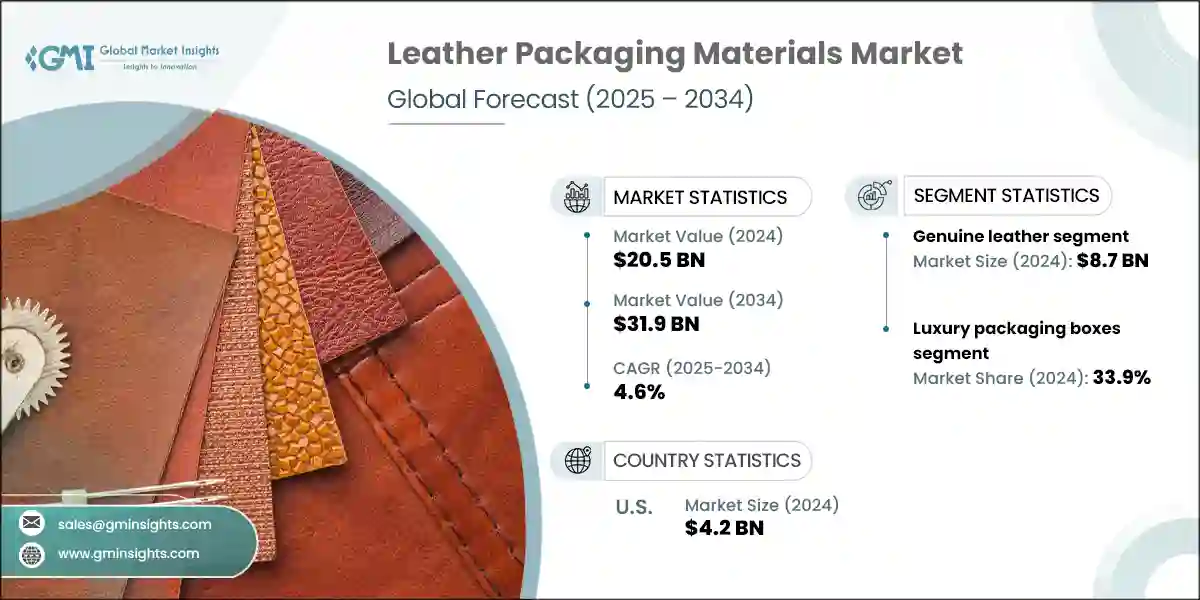
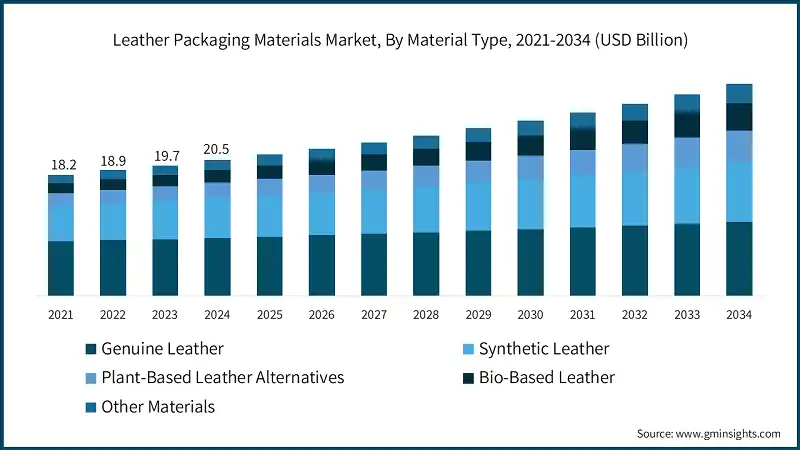
The global leather packaging materials market was valued at USD 20.5 billion in 2024. The market is expected to grow from 21.3 billion in 2025 to 31.9 billion in 2034, at a CAGR of 4.6%.
Leather Packaging Materials Market Key Takeaways
Market Size & Growth
- 2024 Market Size: USD 20.5 Billion
- 2034 Forecast Market Size: USD 31.9 Billion
- CAGR (2025–2034): 4.6%
Regional Dominance
- Largest Market: Asia‑Pacific
- Fastest Growing Region: Latin America
Key Market Drivers
- Growing demand for premium packaging.
- Focus on sustainable packaging solutions.
- Innovation in alternative leather materials.
Challenges
- Higher production and processing costs.
- Regulatory uncertainty on animal-based products.
Opportunity
- Development of lightweight leather composites.
- Integration of sustainable tanning and recycling methods.
Key Players
- Market Leader: LVMH (Louis Vuitton Moët Hennessy) led with over 28.1% market share in 2024.
- Leading Players: Top 5 players in this market include LVMH (Louis Vuitton Moët Hennessy), Kering SA, Hermès International, Prada Group, Burberry Group, which collectively held a market share of 58% in 2024.
Get Market Insights & Growth Opportunities
- Leather packaging materials are leather finished using packs that include various kinds of natural and synthetic leather types, such as PU (polyurethane) and PVC (polyvinyl chloride), and genuine leather. Such materials are used for packaging premium products, such as those found in luxury goods, cosmetics, electronics, and fashion industries. This is because they are durable, attractive, and eco-friendly for top-end branding.
- Current trends in the packaging market towards environmental care are reflected within the elite packaging sector. In addition, the luxury packaging segment is on the rise, while leather-based materials decrease the use of plastics and increase reuse and added value. Leather texture and design alternatives enhance customer experience by individualizing and offering custom features that plastic or cardboard would not deliver.
- Leather texture and design alternatives enhance customer experience by individualizing and offering custom features that plastic or cardboard would not deliver. Due to which the growth and preference for leather packaging material is increasing rapidly.
- The 2022 circular economy outlook states that leather packaging, particularly upcycled or plant-based materials, can support circular design and help reduce reliance on fossil-based materials and environmental impact.
- European makers have been developing bio-leather and vegan leather substitutes adhering to ESG standards but do not compromise on luxury quality.
- Asia-Pacific is the fastest-growing market due to the expansion by e-commerce, gift-giving culture, and luxury retail. The booming markets are China, South Korea, and India. Additionally, Governments within the region and manufacturers are united in the efforts to develop new forms of packaging, including leather, meeting the demands of today, which are more toward sustainable luxury products.
- In conclusion to this, leather packaging is increasingly popular for its eco-friendly, durable, and customizable features, with growing demand in luxury markets globally.
To get key market trends
Leather Packaging Materials Market Trends
- The leather packaging materials industry is on its way toward eco-friendliness, with an evident increase in the popularity of recycled leather and plant-based materials. The trend indicates a shift toward the overall sustenance of being green and waste-less in manufacturing and packaging processes.
- In line with this, industries are trying to produce leather materials that are more durable and resistant to sunlight, moisture, and wear pertaining to the shifting needs of the consumers and the industry alike. Governments and institutions throughout the world, of which Germany is an example, are funding the research to deliver efforts for the development of new and sustainable materials that can serve the packaging industry and beyond.
- Such innovations can be incorporated into a brand's personalization of its package, with very accurate results. Besides, there is also a growing use of AI and machine learning for predictive design and additional customization options based on what customers prefer.
- Another innovative trend that is arising is using a multilayering process of different materials at the same time: leather or leather-like materials with various characteristics. In this way, the balance is struck between strength and flexibility while maintaining aesthetics, without any need to couple separate assembly parts. As a result, it paves the way for sophisticated designs that meet both practical and luxurious packaging needs.
- Conclusion to this, the leather packaging materials is supported by advanced cutting and assembly automated machines that speed up and improve accuracy in production. This kind of system can directly walk on the production floor with complex shapes or customized designs, thus reducing manual work and increasing productivity. Improvements now allow manufacturers to quickly create made-to-order packaging solutions in support of such trends as limited editions and personalized branding.
Leather Packaging Materials Market Analysis
Learn more about the key segments shaping this market
The leather packaging materials industry by material type is segmented into genuine leather, synthetic leather, plant-based leather alternatives, bio-based leather, other materials. Genuine leather generated USD 8.7 billion in 2024.
- Genuine leather stands out as the premium choice for packaging, preferred for its durability, tactile appeal, and timeless feel. Its robust yet moldable nature makes it the handy material for luxury packaging, where both quality and tradition hold significant importance.
- Being cost-effective in the packaging market, synthetic leather provides a perfect mix of durability and style for brands, without the hard expenses incurred with original leather. Tough enough to withstand demanding conditions, it allows for very attractive yet functional packaging that would otherwise not have been cheap, had it been made with genuine leather.
- Bio-Based Leather are also fastest growing material and expected to growth at a CAGR of 8.3%. These innovations not only enhance its strength and performance but also solidify its status as a sustainable and dependable option for contemporary packaging requirements.
- Brands are increasingly turning to renewable sources such as pineapple leaves (Piñatex), mushrooms (Mylo), and cactus to create bio-based leathers that are not only sustainable but also cruelty-free. These materials are made from agricultural by-products, helping to reduce waste while providing a renewable resource for fashion production.
Learn more about the key segments shaping this market
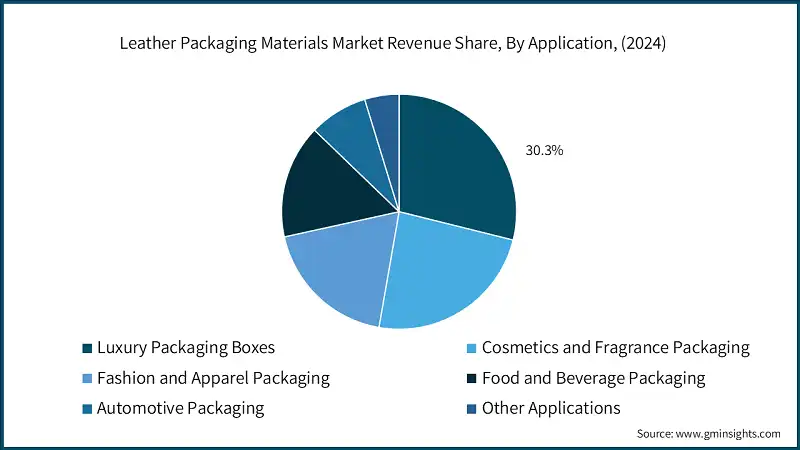
Based on application, the leather packaging materials market is segmented into luxury packaging boxes, cosmetics and fragrance packaging, fashion and apparel packaging, food and beverage packaging, automotive packaging, other applications. Luxury packaging boxes made up 33.9% of the market in 2024.
- Luxury brands prefer leather packaging boxes to pack their products for that ultra-luxury touch. These boxes are great in looks and built to last, making them perfect for gift-giving and display purposes. They can also be customized for a brand, which in turn boosts perceived value for customers.
- The leather packaging marketplaces cosmetics and fragrance packaging in a second position since demand for premium presentation and a unique brand identity has increased. To add look and feel to the products, luxury beauty brands are utilizing leather elements while providing protection through innovative and highly sumptuous packaging solutions.
- Driven by a demand for unique, durable, and visually striking packaging, specialty and niche applications in the leather packaging market are steadily expanding. High-performance materials, such as premium or textured leather, enhance both the functionality and luxury appeal of offerings, including limited-edition products, custom gift sets, and collectible items.
Based on end use, the leather packaging materials market is segmented into luxury goods industry, cosmetics and personal care, electronics and technology, food and beverage, automotive industry, others. Luxury goods industry leads the market in 2024 due to demand for personal luxury goods such as fashion, leather goods, watches, and jewelry.
- Leather packaging options are primarily made for use by luxury brands and manufacturers of high-end products. These leather packaging’s are employed to enhance the brand image, create elegant customer experience, and add value through exquisite designs. End-users pay extra attention to quality, uniqueness, and customer appeal in every detail while using leather packaging.
- Leather packaging finds its use in end-user industries like electronics, food, and beverages, as well as automobiles. These industries turn to leather packaging for the protection of high-value items, impressive presentation of products, and more effective communication of brand identity. Leather packaging is revered for its high value regarding resistance, appearance, and sustainable practice, an area which goes in line with the above growing demand for eco-friendly solutions.
- Thus, as companies increasingly consider bespoke and high-quality packaging to distinguish their products in a competitive marketplace, demand for leather packaging rises. This points further to the fact that leather packaging meets both functional and aesthetic requirements across different industries.
Based on distribution channel, the leather packaging materials market is segmented into direct sales, distributors and wholesalers, online channels, retail channels. Direct sales lead the market in 2024 due to effective feedback and engagement with their target market.
- Direct sales dominate the leather packaging material market, especially in that luxury category where specific solutions are expected by brands and thus require proximity of manufacturers. Such a sales channel is perfect for high-end applications, like gift boxes, cosmetics, fragrances, and fashion accessories as it assures high-quality standardization, maximum personalization, and consistent branding. These kinds of companies will engage directly with the leather artisan or suitable outlet for external packaging that is reflective of the brand's identity while meeting customer-end expectations.
- Distributors and wholesalers, however, take a lion's share of the market necessary for efficiency and scalability, that is, to be available locally. They sell standard leather packages in bulk to industries like electronics, food and beverages and automotive. This channel also opens the market for manufacturers because it increases logistic optimization and reduces lead times. Among these were direct sales focusing on customizing and branding, while the cost-effective option for companies stressing dependability and operational efficiency at higher volumes were offered through distributors and wholesalers.
- Online channels and retail outlets have become the main channels for the distribution of leather packaging materials, each holding its respective advantage to meet the dynamic demands of buyers. The online channel offers immediate access to a variety of products with instant comparison of styles, prices, and customization options for businesses and individual buyers alike.
- Retail outlets provide an entirely different experience that helps customers feel and touch the material when shopping. They are important for providing immediate support while customers assess the texture and quality of any product. This is particularly important since luxury and specialty buyers appreciate detailed artisanal craftsmanship and finishes. Retail outlets can process walk-ins and clients who cherish the traditional way. In conclusion, online and retail together help build a balanced clientele.
Looking for region specific data?
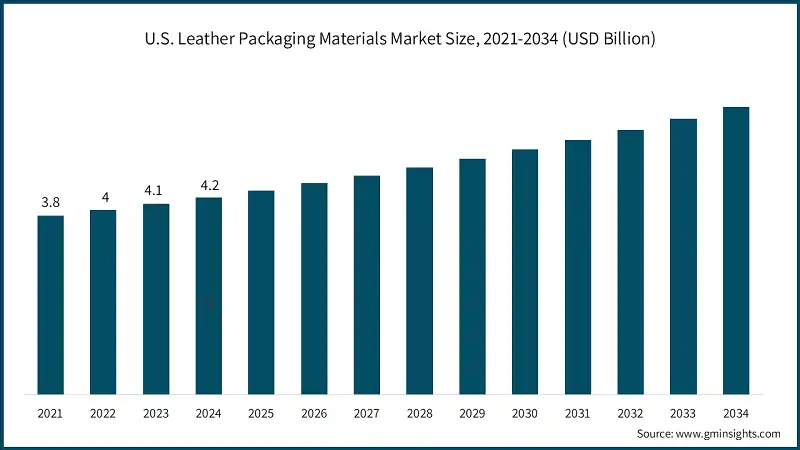
U.S. leather packaging materials market was accounted for USD 4.2 billion in 2024.
- As a region, North America contribute significant revenue share for leather packaging materials in the packaging industry by the U.S., which highly dominates the region, having a very advanced infrastructure in technology usage and a subsequent high adoption rate of these technologies plus huge investments in innovation construction.
- The U.S. also boasts of a strong presence of key players in the industry, budding innovators, and extensive R&D activities-fuelling the development and adoption of high-performance filament materials appropriate for large construction projects. These efforts are complemented by the country's demand for environment-friendly and cost-effective solutions for buildings, which even increase the demand for specialized polymer filaments to hold up further complex constructions.
- Canada, although a relatively smaller market in size, is receiving rapid growth due to the increasing government initiatives encouraging sustainable construction practices along with technological advancements. The adoption of the packaging method by Canadian market is done mainly to reduce project time and costs, especially for construction at remote and environmentally sensitive sites.
- The positive aspect of adopting eco-friendly and durable filament materials starts to gain importance with government incentives as well as partnerships with industry.
The leather packaging materials market in the Germany is expected to experience significant and promising growth from 2025 to 2034.
- Manufactures increasingly conscious of sustainable packaging, brands in the UK are becoming more focused on smarter and efficient leather packaging solutions. Europe remains aloof in developing new materials, with considerable emphasis on environmentally acceptable stuff and high-performance alternatives to leather, with strong commitment to quality standard and environmental regulations.
- In Europe, Germany has also been regarded as one of the fastest-growing countries in the leather packaging market due to heavy investment in research, technology, and advanced manufacturing. This merger of old, new, and sustainable allows Europe to sustain its pole position in the global leather packaging sector.
The leather packaging materials market in China is expected to experience significant and promising growth from 2025 to 2034.
- Both India and China are substantial catalysts for thick expansion in the fraction of the market in the Asia-Pacific region. China, however, flies ahead as it is backed with above-average government funding into sustainable manufacturing as well as smart packaging. The cutting-edge technologies in production, apart from eco-friendly materials, are the factors which set the country apart. India has started to gain momentum; however, with the developing government initiatives as well as a blossoming consumer base demand for lower-priced yet value-added packaging.
UAE leather packaging materials market is expected to experience significant and promising growth from 2025 to 2034.
- Leather packaging has set out on a fast track, especially in the Middle East-the UAE and Saudi Arabia where it is expected to rise soon. The synergy between markets in luxury goods and conservation missions has pushed forth the new trend of recycling in the Middle East. The UAE's many elaborate projects have meant billions for servicing high-end packages for industry.
- In addition to this, retail and tourism are another point of attack for efforts to help industries move through. This effort is laced with recyclable ideas that mirror the effort's unique set of ideals and for which only the industry is foremost in the UAE. While Saudi Arabia is following suit with a different marketing intention, the country itself is pulling aside its objective-specific government policies that keep the vaccination from running directly toward diversification through green-industry-related avenues.
- The UAE and Saudi Arabia are leading the charge in eco-friendly leather packaging, combining luxury, sustainability, and innovation. With significant development projects, they are positioning the region as a key industry hub.
In Brazil is expected to experience significant and promising growth from 2025 to 2034.
- The Brazilian leather packaging market significantly focusing on the increased demand for sustainable and affordable solutions. The country has had the government initiate eco-friendly measures, which include recycling and using bio-based materials, with the aim of fulfilling its environmental goals. Along with these, the growing luxury and fashion sectors in Brazil will further beef up demand for leather packaging of the highest end. Nonetheless, Argentina still must move from pilot and research projects into applications, but it will take time. Despite economic and infrastructure difficulties, the modest growth of the region certainly underlines Brazil's position as the fastest and most promising market for leather packaging in Latin America.
Leather Packaging Materials Market Share
- Leather packaging materials markets is moderately consolidated with players like LVMH (Louis Vuitton Moët Hennessy), Kering SA, Hermès International, Prada Group, Burberry Group, Gucci (Kering), Chanel, Bottega Veneta (Kering), Bulgari (LVMH), Cartier (Richemont) holding approximately 58% market share.
- Leading companies in the leather packaging materials industry secure their dominance through long-term dedicated R&D activities. They continue the consistent development of innovative sustainable leather packaging materials formulations that match stringent regulatory norms and industry standards.
- Apart from joining forces in mergers with luxurious brands, retailers, and product manufacturers, numerous companies have established partnership arrangements. The objective of these collaborations is to make entry into the market much easier and to provide customized solutions. Programs for rapid regional expansion into Asia-Pacific, North American, and European markets allow these companies to innovate, create new industry standards, and shape the future of leather packaging materials.
- Therefore, the popularity of premium packaging alternatives is on the rise. It assists companies looking to diversify into the fashion, cosmetics, or electronics market, among others. Such strategic expansions will not only widen the market reach of a company but also strengthen its global competitive edge.
Leather Packaging Materials Market Companies
Major players operating in the leather packaging materials industry are:
- LVMH (Louis Vuitton Moët Hennessy)
- Kering SA
- Hermès International
- Prada Group
- Burberry Group
- Gucci (Kering)
- Chanel
- Bottega Veneta (Kering)
- Bulgari (LVMH)
- Cartier (Richemont)
LVMH was formed by the merger of Moët Hennessy and Louis Vuitton in 1987. The brand uses very fine leather and eco-friendly materials to attractively wrap its products; the traditional craftsmanship was combined with contemporary innovation to ethically source the packaging materials for LVMH.
Kering SA is a global, family-led luxury group which focuses in ready-to-wear and couture, leather goods, jewellery, eyewear and beauty segments. The company focuses on having eco-friendly alternatives, aspiring to bring luxury closer to this value of sustainability. Kering tailors its packaging in accordance with the distinct identity of each brand, all while ensuring that its product line stands durable, well-made, and less harmful to the environment.
Hermès International family-run, independent brand which have 60 production and training sites, while developing its international distribution network of 293 stores in 45 countries. The defining aspect of the brand has remained the perpetual emphasis on design and precision in top-shelf material. The choice of top-notch natural leather guarantees durability and elegance in every piece, according to the hallmark of Hermès. Each packaging accessory reflects not only the commitment of Hermès to artisanal detail and sustainability but also extends the notion of luxury beyond the other aspects of form, function, and beauty up to the highest standards.
Prada Group distributes its products in more than 70 countries, through 609 Directly Operated Stores (DOS), e-commerce channels and selected e-tailers and department stores. Committed to a high standard of leather: high-quality leather that meets ethical sourcing. With elegance and durability, Prada is making the kind of packaging that would be at home in any of today's prevailing environmental and design standards.
Collectively, these companies illustrate a collaborative approach in innovating and refining leather packaging such that the widespread adoption of packaging materials can be made possible to address the issues related to material performance, compatibility, and scalability.
Leather Packaging Materials Market Report Attributes
| Key Takeaway | Details |
|---|---|
| Market Size & Growth | |
| Base Year | 2024 |
| Market Size in 2024 | USD 20.5 Billion |
| Forecast Period 2025 - 2034 CAGR | 4.6% |
| Market Size in 2034 | USD 31.9 Billion |
| Key Market Trends | |
| Drivers | Impact |
| Growing demand for premium packaging | Leather packaging improves the overall customer experience by offering a premium touch and feel. |
| Focus on sustainable packaging solutions | More recyclable and reusable materials help company achieve sustainable goals. |
| Innovation in alternative leather materials | Synthetic and semi-synthetic laboratory-developed leather materials offer better environmental benefits. |
| Pitfalls & Challenges | Impact |
| Higher production and processing costs | Increased costs for tanning, finishing, and ethical sourcing of leather significantly raise the final product price. |
| Regulatory uncertainty on animal-based products | Global regulations on animal welfare, sustainability certifications, and import/export restrictions create uncertainty. |
| Opportunities: | Impact |
| Development of lightweight leather composites | Expands application scope and improves functionality for modern packaging needs. |
| Integration of sustainable tanning and recycling methods | Enhances eco-appeal while meeting regulatory demands, supporting long-term market growth. |
| Market Leaders (2024) | |
| Market Leaders |
28.1% Market Share |
| Top Players |
Collective market share in 2024 is 58% |
| Competitive Edge |
|
| Regional Insights | |
| Largest Market | Asia‑Pacific |
| Fastest growing market | Latin America |
| Emerging country | China, India, and Vietnam |
| Future outlook |
|
What are the growth opportunities in this market?
Leather Packaging Materials Industry News
- April 2025 – Brought up from Melbourne, Australia, Alt. Leather has developed an eco-based leather alternative out of natural fibers as well as agricultural waste, thus providing an animal-free option with zero plastics.
- October 2024 - Kahei Co., Ltd. has accepted the BioPTMG plant-derived polyol from the Mitsubishi Chemical Group, which contains more than 92% biomass content, as the main material for bio-synthetic leather products, such as bags.
- March 2024 - To fulfill the automotive industry's requirement to transition towards more animal-free leather substitutes, Dow has developed an innovative alternative in the form of artificial leather based on polyolefin elastomers (POE).
- February 2020 – LANXESS showcased its comprehensive product range in the field of leather chemicals at the India which is Leather Fair (IILF) in Chennai, India. The company showcased it’s leather for shoes, clothing, furniture, and the automotive industry comprises mineral and synthetic tanning agents, preservatives, retanning agents, and fatliquoring agents.
The Leather packaging materials market research report includes an in-depth coverage of the industry with estimates and forecast in terms of revenue in USD Billion from 2021–2034 for the following segments:
Market, By Material Type
- Genuine Leather
- Bovine Leather
- Sheep Leather
- Pig Leather
- Other Animal Leather
- Synthetic Leather
- Polyurethane (PU) Leather
- Polyvinyl Chloride (PVC) Leather
- Other Synthetic Materials
- Plant-Based Leather Alternatives
- Pineapple Leather (Piñatex)
- Apple Leather
- Cactus Leather
- Cork Leather
- Mushroom Leather
- Other Plant-Based Materials
- Bio-Based Leather
- Lab-Grown Leather
- Microbial Leather
- Recycled Leather
- Other materials
Market, By Application
- Luxury Packaging Boxes
- Jewelry Packaging
- Watch Packaging
- Premium Electronics Packaging
- Luxury Accessories Packaging
- Cosmetics and Fragrance Packaging
- Perfume Packaging
- Skincare Packaging
- Makeup Packaging
- Premium Beauty Sets
- Fashion and Apparel Packaging
- Handbag Packaging
- Shoe Packaging
- Clothing Packaging
- Leather Goods Packaging
- Food and Beverage Packaging
- Wine Packaging
- Premium Spirits Packaging
- Gourmet Food Packaging
- Gift Set Packaging
- Automotive Packaging
- Parts Packaging
- Accessories Packaging
- Premium Component Packaging
- Other Applications
- Corporate Gifts
- Promotional Items
- Collectibles Packaging
Market, By End Use Industry
- Luxury Goods Industry
- High-End Fashion
- Luxury Accessories
- Premium Jewelry
- Luxury Watches
- Cosmetics and Personal Care
- Premium Beauty Brands
- Niche Fragrance Houses
- Luxury Skincare
- Professional Cosmetics
- Electronics and Technology
- Premium Consumer Electronics
- Luxury Audio Equipment
- High-End Gadgets
- Professional Equipment
- Food and Beverage
- Premium Alcoholic Beverages
- Gourmet Food Products
- Specialty Coffee and Tea
- Artisanal Products
- Automotive Industry
- Luxury Car Manufacturers
- Premium Auto Parts
- Aftermarket Accessories
- Other Industries
- Hospitality
- Corporate Sector
- Retail and E-commerce
Market, By Distribution Channel
- Direct Sales
- Manufacturer to Brand Direct
- Custom Packaging Solutions
- OEM Partnerships
- Distributors and Wholesalers
- Regional Distributors
- Specialized Packaging Distributors
- Multi-Category Wholesalers
- Online Channels
- E-commerce Platforms
- Company Websites
- B2B Marketplaces
- Retail Channels
- Specialty Packaging Stores
- Trade Shows and Exhibitions
- Showrooms
The above information is provided for the following regions and countries:
- North America
- U.S.
- Canada
- Europe
- Germany
- UK
- France
- Spain
- Italy
- Rest of Europe
- Asia Pacific
- China
- India
- Japan
- Australia
- South Korea
- Rest of Asia Pacific
- Latin America
- Brazil
- Mexico
- Argentina
- Rest of Latin America
- Middle East and Africa
- Saudi Arabia
- South Africa
- UAE
- Rest of Middle East & Africa
Frequently Asked Question(FAQ) :
What is the market size of the leather packaging materials in 2024?
The market size was USD 20.5 billion in 2024, with a CAGR of 4.6% expected through 2034 driven by demand for premium, eco-friendly packaging across luxury sectors.
What is the projected value of the leather packaging materials market by 2034?
The market is expected to reach USD 31.9 billion by 2034, fueled by innovation in sustainable materials, premium branding demand, and luxury retail expansion.
How much revenue did the genuine leather segment generate in 2024?
Genuine leather segment generated USD 8.7 billion in 2024.
What was the market share of luxury packaging boxes in 2024?
Luxury packaging boxes accounted for 33.9% of the market in 2024.
What is the growth outlook for bio-based leather from 2025 to 2034?
Bio-based leather is expected to grow at a CAGR of 8.3% till 2034.
How much revenue did the U.S. leather packaging materials market generate in 2024?
The U.S. market generated USD 4.2 billion in 2024. Growth was driven by luxury demand and advanced infrastructure.
What are the key trends in the leather packaging materials industry?
Key trends include rising use of bio-leather, growth in personalized luxury packaging, and development of lightweight composites for eco-luxury applications.
Who are the key players in the leather packaging materials market?
Key players include LVMH, Kering SA, Hermès International, Prada Group, Burberry Group, Gucci, Chanel, Bottega Veneta, Bulgari, and Cartier.
Leather Packaging Materials Market Scope
Related Reports