Summary
Table of Content

Lawn and Garden Equipment Market
Get a free sample of this report
Form submitted successfully!
Error submitting form. Please try again.
Thank you!
Your inquiry has been received. Our team will reach out to you with the required details via email. To ensure that you don't miss their response, kindly remember to check your spam folder as well!
Request Sectional Data
Thank you!
Your inquiry has been received. Our team will reach out to you with the required details via email. To ensure that you don't miss their response, kindly remember to check your spam folder as well!
Form submitted successfully!
Error submitting form. Please try again.
Lawn and Garden Equipment Market Size
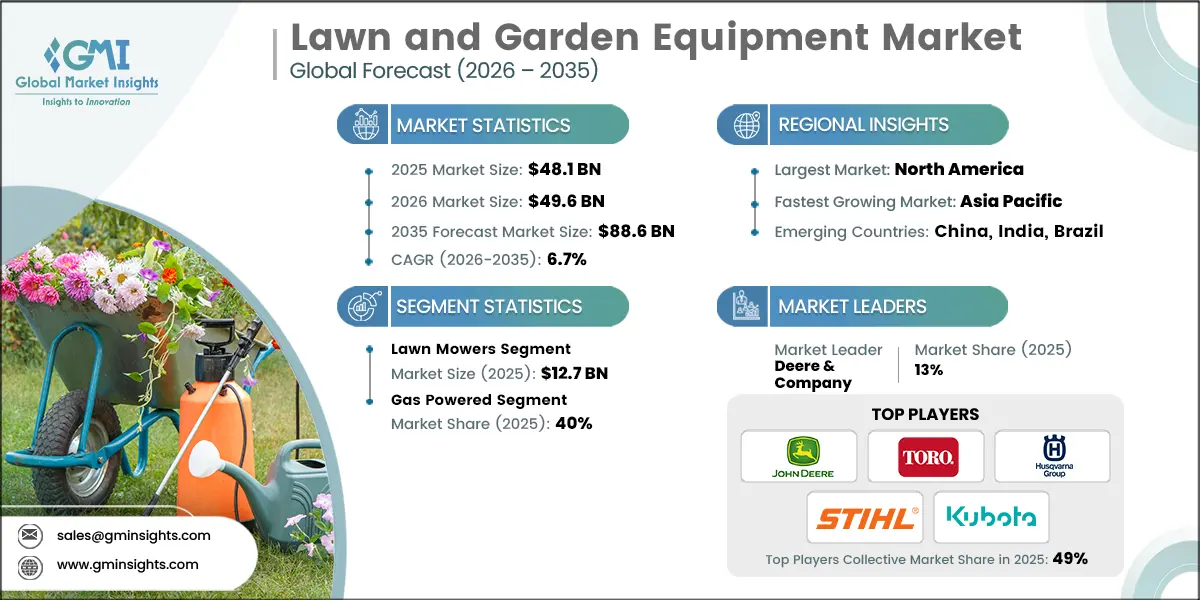
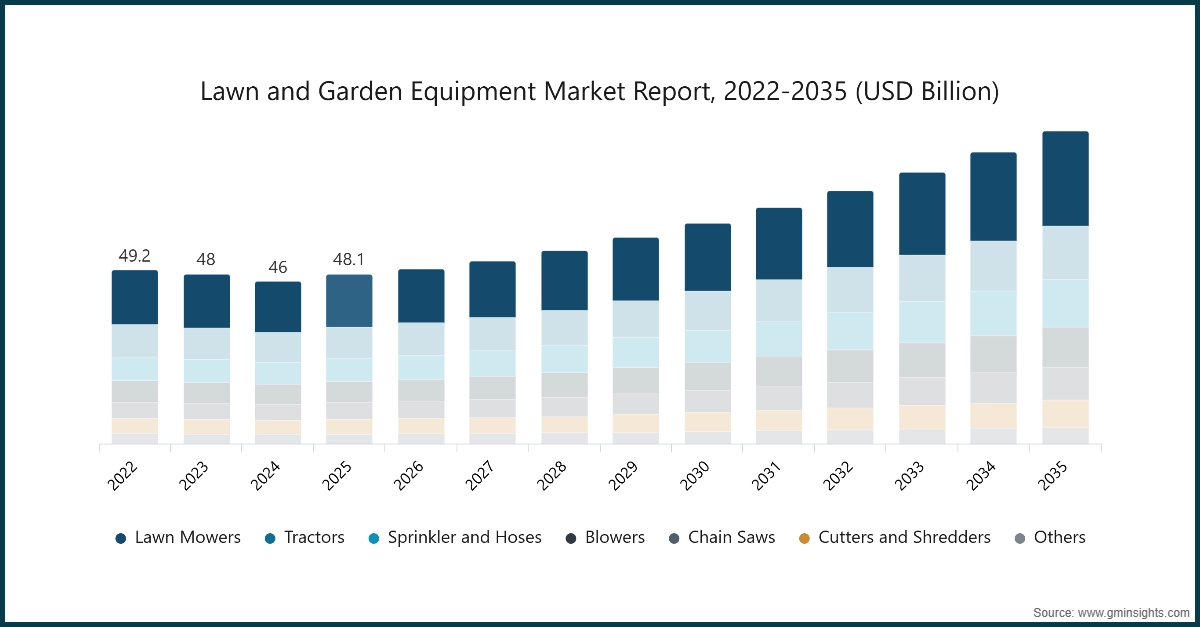
The lawn and garden equipment market was estimated at USD 48.1 billion in 2025. The market is expected to grow from USD 49.6 billion in 2026 to USD 88.6 billion in 2035, at a CAGR of 6.7% according to latest report published by Global Market Insights Inc.
Lawn and Garden Equipment Market Key Takeaways
Market Size & Growth
- 2025 Market Size: USD 48.1 Billion
- 2026 Market Size: USD 49.6 Billion
- 2035 Forecast Market Size: USD 88.6 Billion
- CAGR (2026–2035): 6.7%
Regional Dominance
- Largest Market: North America
- Fastest Growing Region: Asia Pacific
Key Market Drivers
- Technological advancements.
- Increasing interest in eco-friendly and sustainable products.
- Growth in home improvement and outdoor leisure activities.
Challenges
- Environmental concerns regarding the use of fuel-powered tools.
- High maintenance cost of advanced equipment.
Opportunity
- Rising demand for smart gardening tools.
- Expansion in emerging markets.
Key Players
- Market Leader: Deere & Company led with over 13% market share in 2025.
- Leading Players: Top 5 players in this market include Stihl Holding AG, Deere & Company, Toro Company, Kubota Corporation, Husqvarna Group, which collectively held a market share of 49% in 2025.
Get Market Insights & Growth Opportunities
The lawn and garden equipment industry is experiencing stable demand from residential consumers along with fast-growing commercial and institutional landscaping businesses. The rapid increase of urbanized areas and new home construction has changed the way homeowners identify their yards as places to live outside, particularly for people who live in suburban and peri-urban areas. Increasingly, homeowners see caring for their lawn and garden as part of their way of life and not simply as maintenance activities.
This change in attitude has increased demand for equipment that is simple to use, ergonomic, multifunctional, and convenient. In contrast, commercial end-use customers such as lawn care contractors, municipalities, golf courses, and sports facilities, continue to be significant contributors to the overall lawn and garden industry. Commercial end-users seek equipment with high durability, maximum uptime, and exceptional productivity to meet their heavy-duty usage needs. Although seasonality still affects purchasing patterns, the influence of dealer networks, rental programs, and complete after-sales service have increased importance in supporting revenue streams and developing long-term loyalty with customers. Technology is substantially changing the competitive landscape of the lawn and garden industry, and battery-powered and electric equipment has been one of the main catalysts for this change.
To get key market trends
Lawn and Garden Equipment Market Trends
The global market is undergoing significant transformation, shaped by evolving consumer preferences, technological advancements, and a heightened focus on environmental sustainability.
Here are 6 key business trends shaping the global lawn and garden equipment market:
- Transforming Toward Battery Operated Equipment: Many people are deciding to buy cordless electric lawn and garden tools over gas powered since they are quieter, emit fewer pollutants, and have lower maintenance costs. Environmental concerns and demand for easier-to-use tools has caused manufacturers to expand their lines of cordless products.
- Integration of Smart and IoT Technologies: The lawn and garden market have seen significant growth in smart equipment such as automated lawnmowers and intelligent irrigation systems that connect to the Internet of Things (IoT). More technological options allow for the automation of processes, the ability to remotely control devices from anywhere, and data analysis which is appealing to a growing number of consumers with a desire for convenience and effective management of their garden space.
- Increase in Demand for Eco-friendly Products: The increase in eco-friendly awareness is affecting consumers' purchasing decisions as evidenced by increasing demand for products made from recycled materials, energy-efficient designs, and alternative energy sources. As a result, manufacturers are raising their profile on the basis of sustainability through eco-friendly marketing and communicating their green initiatives to customers.
- Growth of E-commerce and Direct To Consumer Sales Channels: The online channel is an increasingly important sales platform for the lawn and garden equipment category, providing greater access to more products, competitive pricing, and convenience. Companies are building their e-commerce and direct-to-consumer sales channels to deliver a wider product offering to their customer base and increase direct contact with customers.
Lawn and Garden Equipment Market Analysis
Learn more about the key segments shaping this market
Based on equipment type, the lawn and garden equipment market is divided into lawn mowers, tractors, sprinkler and hoses, blowers, and chain saws. In 2025, lawn mowers held the major market share, generating a revenue of USD 12.7 billion.
In both the consumer and contractor segment, lawn mowers are an integral part of how property owners define finished outdoor spaces. No matter the size of the dwelling, climate, or design approach used; homeowners expect their lawns to have been cut cleanly with an even edge. This shared expectation forms the basis for all mowers being considered as the primary tool or at the very least one of the primary mowers of outdoor tools; this also facilitates a larger installed base and shorter replacement cycles compared to other types of lawn care tools. The continued demand for mowers is bolstered by additional factors. As lifestyle and housing patterns develop, homeowners are now considering lawns to be part of their living space, therefore requiring regular maintenance.
- The introduction of electric mowers makes it easier for consumers to purchase new products as well as upgrade current ones; there is little doubt that battery-powered mowers are better suited for urban living with their lower noise levels, cleaner emissions and ease of use for most consumers in dense residential/urban areas along with being a good fit for HOA's and periods when noise-sensitive activity occurs. The rapid acceptance of new battery-powered products has further solidified the demand for additional lawn care equipment within the manufacturer's platform; when a consumer purchases a new electrical battery-powered mower it encourages them to purchase additional trimmer, blower, and even chainsaw lawn care products from that manufacturer because they have already made an investment in the batteries and chargers.
- Lawn mower retail dynamics are also highly favorable to mowers; retail displays at big box retailers, seasonal promotional events, and the ability for consumers to evaluate products side-by-side in an aisle setting contribute to a productive retailing environment for mowers, while at the same time dealers are working hard to develop demonstration loan options and specialized financing options in order to promote higher-end mowers and more frequent model updates to consumers.
- The professional and institutional user segment continues to set higher performance standards for the upper end of the segment of the lawn mower category. The performance of zero-turn mower riders has greatly improved the performance of these products.
Learn more about the key segments shaping this market
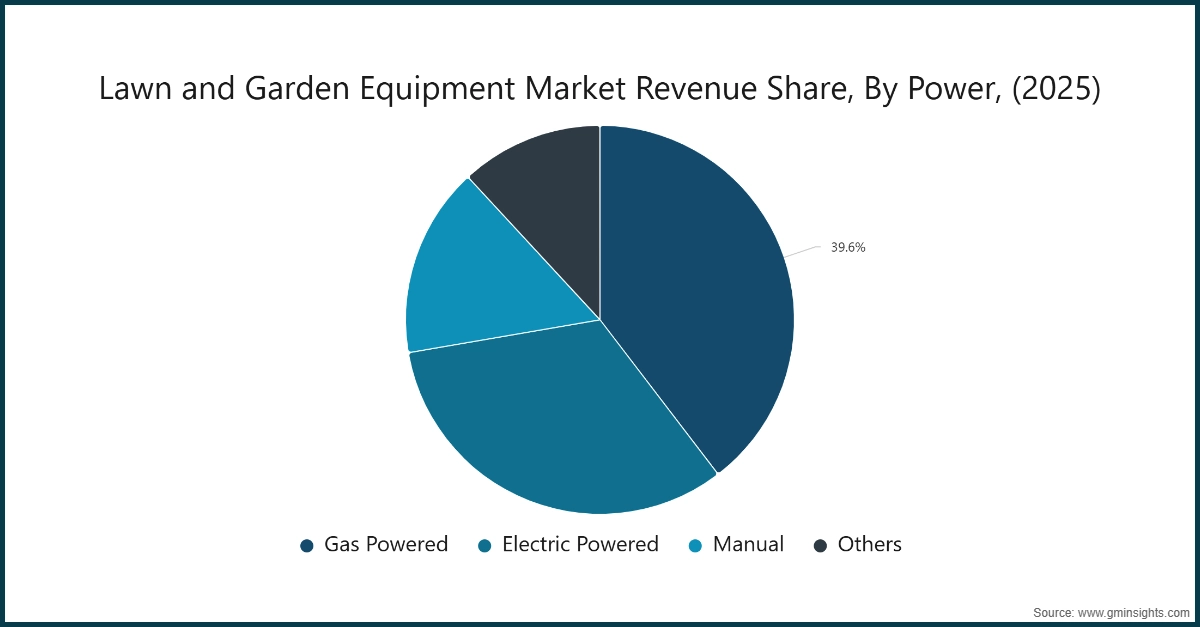
Based on power, the lawn and garden equipment market is segmented into gas powered, electric powered, manual, and others. Gas powered segment held the largest share, accounting for 40% of the global market in 2025.
- Gas-powered equipment remains the most popular type of equipment in the world today because it is known for its durability and versatility in performing high-intensity and long-duration lawn and landscape work. Professional landscapers, contractors, and property owners on larger properties rely on gas engines for their long-term power delivery capabilities, quick refueling, and reliability across a variety of difficult operational environments such as cutting through thick, overgrown grass, travelling on an uneven surface or slope, having to perform for long periods each day without the loss of efficiency or productivity.
- For end users who must operate large grass areas like commercial sites or multiple locations, a larger amount of time between charging of battery-powered equipment compared to gas-powered equipment is a huge advantage. Reliability during peak seasons (when users cannot afford to interrupt their work due to the need for charging) is always a consideration when using equipment, because end users often operate under tight time schedules and with heavy workloads.
- The years of experience and familiarity that end users have from using gas-powered tools is a very important factor in determining the continued use of this equipment. End users have either considerable experience with gas-powered equipment, established maintenance routines, and direct access to fuel and repair facilities, making end users less likely to switch to either battery-powered, or other types of power sources. As such, gas-powered mowers, trimmers, and blowers continue to be the most popular equipment options for projects requiring high power density, durability, and continual operation.
Based on price, the lawn and garden equipment market is segmented into low, medium, and high. In 2025, VR fertilizer/nutrient dominate the market with highest market share.
- The medium-priced segment of the market is the most significant contributor to the overall size of the industry. The medium-priced segment produces a perfect balance of performance, durability, and affordability; therefore, it appeals to a wide range of consumers. More and more residential homeowners are purchasing medium-priced lawn and garden tools due to their superior quality, improved reliability, and easier to use. Medium-priced tools outperform entry-level products by providing better functionality and longer product life while being more affordable than professional-grade equipment.
- Consumers in this tier of pricing put a high value on tools with strong motors, long life spans, ergonomic designs, and features that provide basic functions such as self-propelling drives, adjustable cutting heights, and compatibility with cutting-edge battery platforms. In addition, many medium-priced lawn and garden tools provide features, such as weather-resistance, noise-reducing technology, and enhanced safety features, that make them a preferred choice for consumers who wish to maintain their lawns with consistency and efficiency over time.
- As lawn and garden products are now viewed as part of a regular maintenance routine rather than an occasional one, more and more consumers consider medium-priced tools as investments, providing reliable performance throughout the year and reducing the frequency with which they must replace lower-priced tools.
- From an equipment manufacturer's point of view, the medium-priced segment is a significant area of convergence among the three areas of product innovation, production volume, and profit margins.
Looking for region specific data?
North America Lawn and Garden Equipment Market
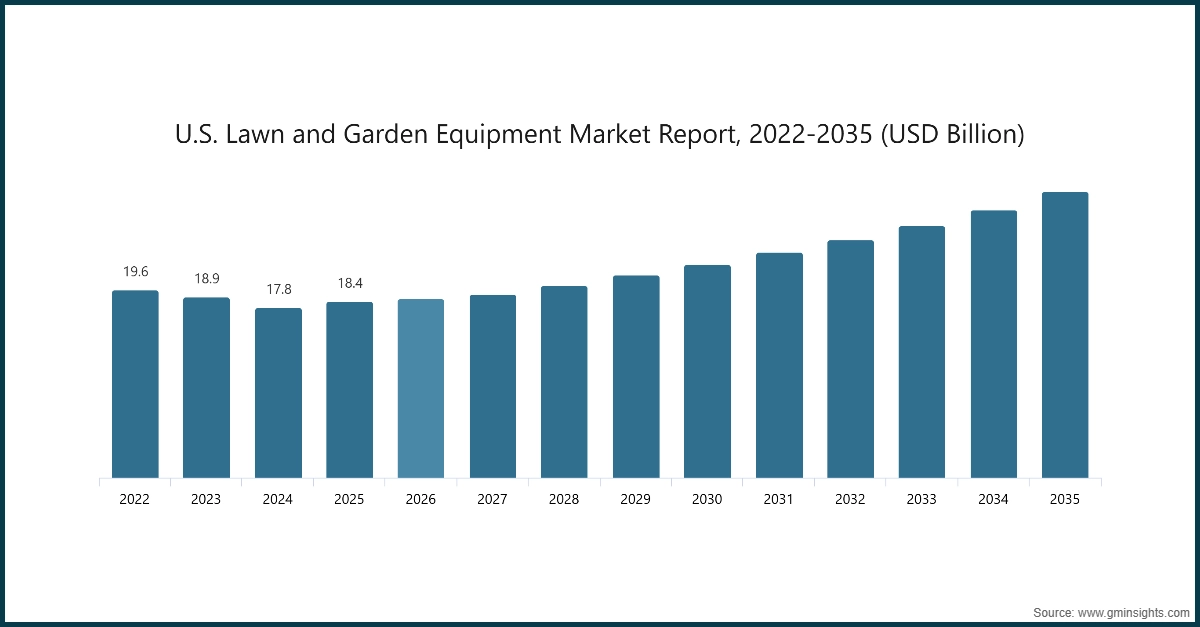
In 2025, the U.S. dominated the North America market, accounting for around 80% and generating around USD 91% billion revenue in the same year.
North America is still the top region for lawn and garden equipment sales, due to the long-standing culture of lawn care, high levels of home ownership, and a high number of homes located in suburbia. Many homes in North America have a private lawn, garden or yard that require continual maintenance, therefore lawn maintenance is not just something that homeowners do occasionally; it is a daily chore for most.
- This daily chore is motivated by the desire to improve curb appeal, maintain property values, and create functional outdoor living areas.
Because of this, there is continued demand for a variety of lawn care equipment such as lawn mowers, lawn trimmers, leaf blowers, and irrigation systems. The climate of North America also creates a demand for lawn care equipment, as North America has seasonal, cyclical planting and mowing periods resulting in lawn care equipment being needed to be used on a consistent basis for many months out of the year and being replaced on a regular basis. - The high rates of "Do It Yourself" (DIY) projects in home improvement encourage homeowners to purchase and use their own lawn care and improvement equipment instead of hiring someone else to install and maintain their outdoor areas; this promotes an overall high level of residential lawn equipment sales.
Europe Lawn and Garden Equipment Market
In Europe market, Germany leads the market 23.5% share in 2025 and is expected to grow at 6.8% during the forecast period.
- The European lawn and garden equipment market is shaped by a combination of lifestyle trends, urban green initiatives, and robust governmental support for sustainability. Gardening is deeply ingrained in European culture, with consumers in Western Europe particularly favoring high-quality, durable equipment. The region has emerged as a leader in adopting electric and robotic lawn mowers, reflecting a strong inclination toward innovation and environmental responsibility.
- Stringent regulations aimed at reducing carbon emissions are accelerating the shift from gas-powered to battery-powered equipment. This regulatory environment, coupled with consumer demand for sustainable solutions, is driving manufacturers to invest in research and development to produce energy-efficient and eco-friendly products. The commercial segment also plays a significant role, with demand fueled by the maintenance of parks, public gardens, and other professionally landscaped spaces.
Asia Pacific Lawn and Garden Equipment Market
The Asia Pacific holds significant share in the market. China holds a market share of around 41% in 2025 and is anticipated to grow with a CAGR of around 7.8% from 2026 to 2035.
- The Asia Pacific region is experiencing rapid growth in the market, driven by urbanization, rising disposable incomes, and an increasing interest in home gardening. Countries such as China, Japan, Australia, and India are at the forefront of this growth, with consumers showing a heightened awareness of outdoor aesthetics and environmental sustainability. The region's expanding middle class is investing in gardening as a leisure activity, further boosting demand for lawn and garden equipment.
- Commercial landscaping is also on the rise, supported by the development of hospitality sectors, corporate campuses, and urban infrastructure projects. While manual tools continue to dominate in developing markets, there is a noticeable shift toward electric and automated equipment. This transition is facilitated by advancements in technology, the availability of affordable models, and the growing penetration of online retail channels.
- Manufacturers are increasingly focusing on product innovation to cater to the diverse needs of the Asia Pacific market. Compact, lightweight, and energy-efficient equipment is gaining popularity, particularly in urban areas where space is limited. Additionally, the integration of smart technologies, such as app-controlled lawn mowers and automated irrigation systems, is expected to drive future growth in the region.
Lawn and Garden Equipment Market Share
Deere & Company is leading with 13% market share. Stihl Holding AG, Deere & Company, Toro Company, Kubota Corporation, and Husqvarna Group collectively hold around 49%, indicating moderately fragmented market concentration. These prominent players are proactively involved in strategic endeavors, such as mergers & acquisitions, facility expansions & collaborations, to expand their product portfolios, extend their reach to a broad customer base, and strengthen their market position.
- Stihl is a privately held German manufacturer renowned for its chainsaws and other handheld outdoor power equipment. They hold a significant position due to their unwavering focus on quality, durability, and professional-grade performance. Their extensive dealer network provides strong customer support, fostering deep brand loyalty among both professional landscapers and discerning homeowners.
- Deere & Company is a global leader, particularly known for its agricultural and construction machinery, but holds a substantial position in the lawn and garden market with its iconic John Deere brand. They dominate in ride-on mowers, garden tractors, and utility vehicles, leveraging their strong brand recognition, advanced engineering, and robust dealer infrastructure to serve both residential and commercial landscaping needs.
- Toro Company specializes in turf maintenance equipment, irrigation systems, and outdoor lighting solutions for residential, commercial, and golf course markets. Their significant position stems from a comprehensive product portfolio, continuous innovation in battery-powered and robotic solutions, and a strong focus on professional-grade quality. They cater effectively to diverse landscaping demands.
Lawn and Garden Equipment Market Companies
Major players operating in the lawn and garden equipment industry are:
- Ariens Company
- Briggs & Stratton Corporation
- Deere & Company
- Falcon Garden Tools
- Fiskars Group
- Honda Motor Co., Ltd
- Husqvarna Group
- Koki Holdings Co., Ltd
- Kubota Corporation
- Makita Corporation
- Robert Bosch GmbH
- Stanley Black & Decker
- STIGA S.p.A
- Stihl Holding AG & Co. KG
- Techtronic Industries Co. Ltd (TTI)
- The Toro Company
Kubota Corporation is a Japanese multinational known for its tractors, heavy equipment, and engines, with a strong presence in the lawn and garden sector. They hold a significant position through reliable, high-performance compact tractors, zero-turn mowers, and utility vehicles. Their reputation for durability, fuel efficiency, and robust engineering appeals to both homeowners with larger properties and commercial operators.
Husqvarna Group is a Swedish manufacturer of outdoor power products, including chainsaws, trimmers, and robotic lawnmowers. They hold a significant position due to their strong legacy in forestry and gardening, coupled with pioneering innovation in battery-powered and autonomous solutions. Their commitment to user experience and environmental considerations resonates with a broad global customer base.
Lawn and Garden Equipment Market Report Attributes
| Key Takeaway | Details |
|---|---|
| Market Size & Growth | |
| Base Year | 2025 |
| Market Size in 2025 | USD 48.1 Billion |
| Market Size in 2026 | USD 49.6 Billion |
| Forecast Period 2026-2035 CAGR | 6.7% |
| Market Size in 2035 | USD 88.6 Billion |
| Key Market Trends | |
| Drivers | Impact |
| Technological advancements | Smart features like battery-powered tools, robotic lawn mowers, and IoT-enabled equipment improve efficiency, ease of use, and precision. These innovations reduce labor, noise, and maintenance, attracting both residential and commercial users. |
| Increasing interest in eco-friendly and sustainable products | Rising environmental awareness is driving demand for electric and battery-operated equipment with lower emissions and noise levels. Manufacturers are responding by replacing gas-powered tools with sustainable alternatives. |
| Growth in home improvement and outdoor leisure activities | More homeowners are investing in landscaping and garden maintenance to enhance outdoor living spaces. This trend boosts demand for lawn mowers, trimmers, blowers, and other garden equipment for personal use. |
| Pitfalls & Challenges | Impact |
| Environmental concerns regarding the use of fuel-powered tools | Growing concerns over emissions, noise pollution, and regulatory restrictions are reducing the appeal of gasoline-powered equipment. This pressures manufacturers to phase out legacy products, increasing transition costs and compliance challenges. |
| High maintenance cost of advanced equipment | Advanced equipment such as robotic mowers and smart tools involves high repair, battery replacement, and servicing costs. These expenses limit adoption, especially among price-sensitive residential users and small landscaping businesses. |
| Opportunities: | Impact |
| Rising demand for smart gardening tools | Growing adoption of smart, connected tools such as robotic mowers and app‑controlled equipment is opening new revenue streams for manufacturers. |
| Expansion in emerging markets | Rapid urbanization, rising disposable incomes, and increasing interest in landscaping are driving demand in emerging economies. |
| Market Leaders (2025) | |
| Market Leader |
13% market share |
| Top Players |
Consolidate share of 49% |
| Competitive Edge |
|
| Regional Insights | |
| Largest market | North America |
| Fastest growing market | Asia Pacific |
| Emerging countries | China, India, Brazil |
| Future Outlook |
|
What are the growth opportunities in this market?
Lawn and Garden Equipment Industry News
- In November 2025, Honda introduced a new generation of battery powered walks behind lawn mowers, with the HRN BV, HRX BV, HRX BE, and HRC BE models scheduled for sale as direct replacements for the company’s previous gasoline powered offerings. This lineup spans residential to commercial use cases, enabling Honda to transition its core walk behind portfolio to battery power while preserving its hallmark cut quality, durability, and user familiarity.
- In October 2025, Billy Goat, a subsidiary of Briggs & Stratton, introduced the Z3002 and X3002 Hurricane stand on blowers, marking the next generation of high capacity debris management equipment for landscape professionals. These new models are designed to deliver increased airflow performance, along with improved ergonomics and enhanced durability, making them well suited for demanding commercial lawn, grounds, and property maintenance applications.
- In October 2025, Ariens announced Model Year 2025 enhancements to its Sno Thro two stage snow blower range, introducing engine upgrades, increased fuel capacity, and improved torque consistency to enhance reliability and performance in demanding winter conditions. Although snow blowers are seasonal products, these updates reinforce Ariens’ broader lawn and garden and outdoor power equipment portfolio, highlighting the company’s continued focus on incremental innovation across its core equipment lines.
- In October 2025, Billy Goat, a subsidiary of Briggs & Stratton, introduced the Z3002 and X3002 Hurricane stand on blowers, marking the next generation of high capacity debris management equipment for landscape professionals. These new models are designed to deliver increased airflow performance, along with improved ergonomics and enhanced durability, making them well suited for demanding commercial lawn, grounds, and property maintenance applications.
The lawn and garden equipment market research report includes in-depth coverage of the industry with estimates & forecasts in terms of revenue (USD Billion) and volume (Thousand Units) from 2022 to 2035, for the following segments:
Market, By Product Type
- Lawn mowers
- Tractors
- Sprinkler and hoses
- Blowers
- Chain saws
- Cutters and shredders
- Others
Market, By Power
- Gas Powered
- Electric Powered
- Manual
- Others
Market, By Price
- Low
- Medium
- High
Market, By End User
- Residential
- Commercial
- Others
Market, By Distribution Channel
- Online
- E-commerce
- Company Websites
- Offline
- Specialty Stores
- Home Improvement Stores
- Others
The above information is provided for the following regions and countries:
- North America
- U.S.
- Canada
- Europe
- Germany
- UK
- France
- Italy
- Spain
- Asia Pacific
- China
- Japan
- India
- South Korea
- Australia
- Latin America
- Brazil
- Mexico
- Middle East and Africa
- South Africa
- Saudi Arabia
- UAE
Frequently Asked Question(FAQ) :
What is the market size of the lawn and garden equipment market in 2024?
The market size was USD 41 billion in 2024, with a CAGR of 6.7% expected through 2034, driven by urbanization, and growing interest in home improvement.
What is the projected value of the lawn and garden equipment industry by 2034?
The market is expected to reach USD 77.7 billion by 2034, fueled by smart technology adoption, sustainable tools, and the DIY gardening trend.
What is the forecasted market size in 2025?
The lawn and garden equipment market is projected to reach USD 43.3 billion in 2025, maintaining steady growth fueled by innovation and increasing demand for outdoor tools.
How much revenue did the lawn mowers segment generate in 2024?
Lawn mowers generated USD 12.3 billion in 2024, dominating the product type segment due to their essential role in residential and commercial landscaping.
What was the market share of the offline distribution channel in 2024?
The offline segment held a 64.4% market share in 2024, supported by customer preference for hands-on product inspection and immediate availability.
What is the growth outlook for the residential end-user segment from 2025 to 2034?
The residential segment, which held 54.8% market share in 2024, is expected to grow at a CAGR of 6.6% from 2025 to 2034 due to rising homeownership and green space investments.
Which region leads the lawn and garden equipment market?
North America led the market in 2024 with USD 8.5 billion in revenue, driven by widespread homeownership, a strong DIY culture, and seasonal lawn care demand.
Who are the key players in the lawn and garden equipment market?
Key players include Deere & Company, Husqvarna Group, The Toro Company, Briggs & Stratton, Stanley Black & Decker, Stihl Holding, Honda, Bosch, Makita, and Techtronic Industries.
Lawn and Garden Equipment Market Scope
Related Reports