Summary
Table of Content

Laser Welding Machine Market
Get a free sample of this report
Form submitted successfully!
Error submitting form. Please try again.
Thank you!
Your inquiry has been received. Our team will reach out to you with the required details via email. To ensure that you don't miss their response, kindly remember to check your spam folder as well!
Request Sectional Data
Thank you!
Your inquiry has been received. Our team will reach out to you with the required details via email. To ensure that you don't miss their response, kindly remember to check your spam folder as well!
Form submitted successfully!
Error submitting form. Please try again.
Laser Welding Machine Market Size
- The movement for industry type automation through laser welding machines is strongly influencing the growth in demand for these types of machines across many different industries. Manufacturers of automotive, electronics, aerospace, and precision engineering have been implementing more automated welding cells, robotic integration, and Industry 4.0 systems into their production processes to increase productivity and results of manual variability. Laser welding systems are designed in such a way that they cover many of the requirements needed for automated welds, such as programmable precision, high repeatability and the ability to integrate with advanced control systems, making them a top choice for modern factories looking to achieve repeatable quality products and maximize their overall production throughput.
- Additionally, automation-driven environments rely on technologies that can operate continuously with minimal downtime, and laser welding machines deliver exactly that. Their non-contact nature reduces tool wear, maintenance requirements, and production interruptions, while advanced sensing and real-time monitoring features support autonomous quality control. As capital investments in smart manufacturing rise, the adoption of laser welding solutions is expected to expand further, reinforcing their role as a core technology within fully automated production lines.
- The laser welding machine market is experiencing robust growth, driven by the increasing demand for ultra-precise welding across industries such as electric vehicles (EVs), medical devices, microelectronics, and aerospace. This growth is fueled by the rising adoption of advanced manufacturing technologies and the need for high-precision joining solutions.
- Modern components are becoming increasingly miniaturized, complex, and sensitive to heat, necessitating welding methods that minimize distortion while ensuring pinpoint accuracy. Laser welding addresses these challenges by delivering narrow, clean weld seams with exceptional depth control. For instance, in the EV sector, where battery packs and lightweight structures are critical, laser welding ensures precise and reliable connections, enhancing both performance and safety. According to the International Energy Agency (IEA), global EV sales surpassed 10 million units in 2023, underscoring the growing demand for advanced manufacturing solutions like laser welding.
- Additionally, the adoption of new materials, such as lightweight aluminum alloys, advanced composites, and high-conductivity metals, has further highlighted the importance of laser welding. Its ability to produce strong, consistent welds with minimal heat input helps preserve the mechanical and thermal properties of these materials while reducing the need for extensive post-processing.
- Furthermore, industries are placing greater emphasis on tighter tolerances, superior aesthetic quality, and enhanced structural reliability. Laser welding machines meet these requirements by offering unmatched precision and repeatability. In the medical device sector, for instance, laser welding is used to manufacture intricate components such as pacemakers, surgical instruments, and implants, where precision and biocompatibility are critical.
The laser welding machine market was estimated at USD 2.9 billion in 2025. The market is expected to grow from USD 3.1 billion in 2026 to USD 4.7 billion in 2035, at a CAGR of 5% according to latest report published by Global Market Insights Inc.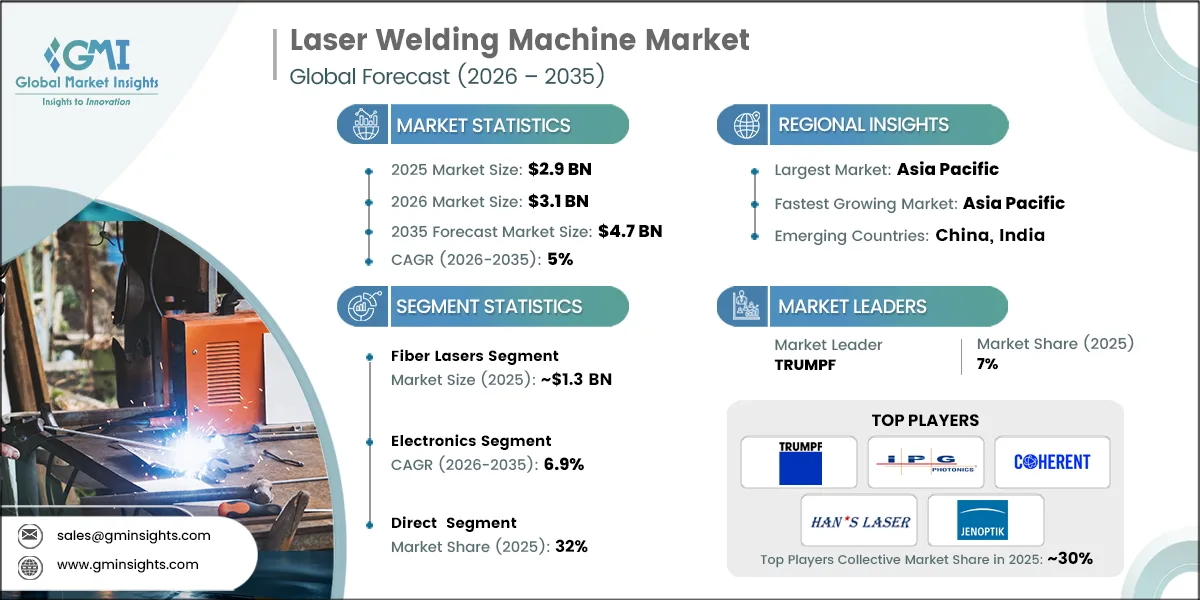
Laser Welding Machine Market Key Takeaways
Market Size & Growth
- 2025 Market Size: USD 2.9 Billion
- 2026 Market Size: USD 3.1 Billion
- 2035 Forecast Market Size: USD 4.7 Billion
- CAGR (2026–2035): 5%
Regional Dominance
- Largest Market: Asia Pacific
- Fastest Growing Region: Asia Pacific
Key Market Drivers
- Growing adoption of automation in manufacturing.
- Rising demand for high-precision welding.
- Technological advancements in laser sources.
Challenges
- High initial investment costs.
- Skilled workforce shortage.
Opportunity
- Increasing use in electric vehicle (EV) manufacturing.
- Expansion in medical device fabrication.
Key Players
- Market Leader: TRUMPF led with over 7% market share in 2025.
- Leading Players: Top 5 players in this market include TRUMPF, IPG Photonics, Coherent, Han’s Laser Technology Industry Group, Jenoptik, which collectively held a market share of 30% in 2025.
Get Market Insights & Growth Opportunities
To get key market trends
Laser Welding Machine Market Trends
- The integration of laser welding machines with advanced technologies such as robotics, IoT systems, and automated production lines is revolutionizing manufacturing processes across various industries. This integration significantly enhances accuracy, consistency, and throughput, enabling manufacturers to meet the growing demand for high-quality products. Industries such as automotive, electronics, and medical devices are increasingly adopting automated welding cells equipped with real-time monitoring systems, AI-driven quality control mechanisms, and continuous operation capabilities with minimal human intervention. These advancements align with the global transition toward smart factories and Industry 4.0 workflows, which emphasize efficiency, connectivity, and data-driven decision-making.
- For instance, the adoption of Industry 4.0 principles has been projected to increase manufacturing productivity by up to 30% over the next decade, according to industry reports. The deployment of such systems not only reduces operational costs but also ensures compliance with stringent quality standards, making them indispensable in modern manufacturing environments.
- The rapid growth of the electric vehicle (EV) market is driving unprecedented demand for advanced welding technologies capable of delivering clean, precise, and low-distortion welds. Laser welding has emerged as a critical technology for assembling EV battery packs, lightweight vehicle structures, and complex assemblies. Its ability to join dissimilar materials, such as aluminum and copper, and handle intricate geometries makes it an ideal solution for EV manufacturing. According to the International Energy Agency (IEA), global EV sales surpassed 10 million units in 2023, reflecting a 35% increase from the previous year. This surge in EV adoption has compelled manufacturers to expand their laser welding capacities to support high-volume, high-precision component fabrication.
- Handheld laser welding machines are witnessing rapid adoption due to their flexibility, portability, and ease of use, particularly among small and medium-sized manufacturers. These systems are increasingly preferred over traditional welding tools, offering faster processing speeds, cleaner weld seams, and greater versatility for delicate or complex parts. Recent advancements in compact fiber laser sources and ergonomic designs have significantly lowered entry barriers, making these systems accessible to a broader range of users. Their ability to deliver high-quality welds with minimal operator training further enhances their appeal in competitive manufacturing environments.
- Fiber laser welding technologies are rapidly gaining traction as industries shift away from traditional CO₂ and solid-state systems. Fiber lasers offer superior beam quality, energy efficiency, and lower maintenance requirements, making them a cost-effective and high-precision solution for modern manufacturing needs. Their adaptability to both automated and handheld applications has solidified their position as the preferred choice for high-speed, high-accuracy production environments. The technology's ability to handle complex geometries and advanced materials, coupled with its scalability, makes it indispensable in sectors such as automotive, aerospace, and electronics.
- The demand for laser welding in high-precision manufacturing is growing rapidly, driven by its ability to deliver exceptional accuracy and minimal heat-affected zones. Industries such as aerospace, medical device fabrication, electronics miniaturization, and jewelry manufacturing are leveraging laser welding to produce micro-components, intricate assemblies, and advanced materials with tight tolerances and strong structural integrity.
Laser Welding Machine Market Analysis
Learn more about the key segments shaping this market
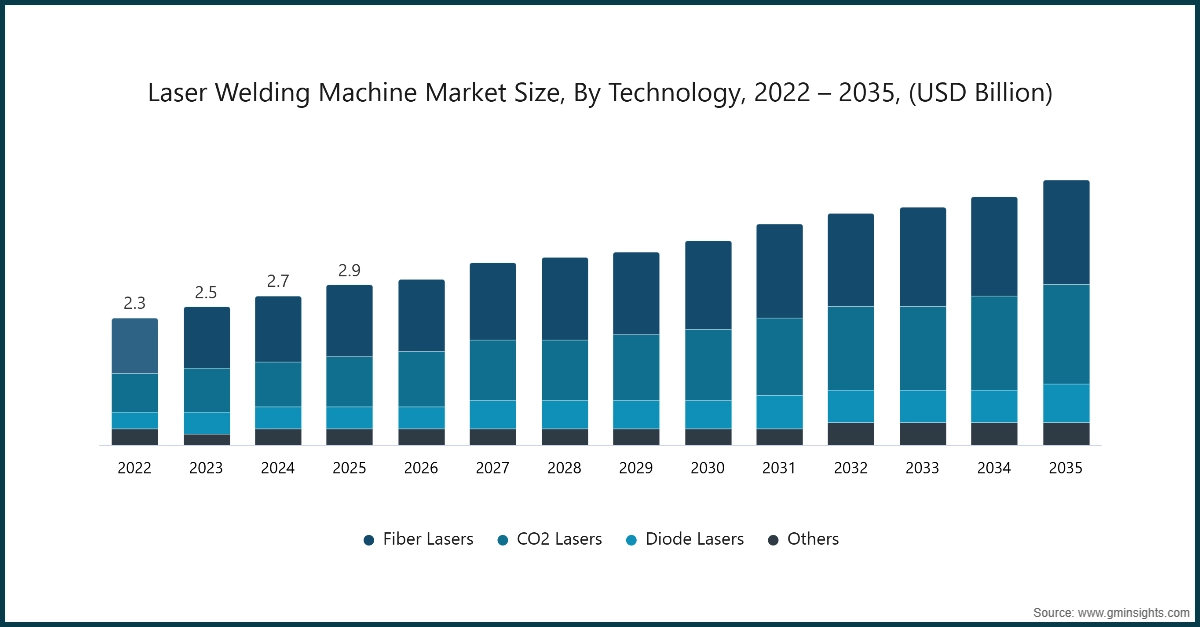
Based on technology, the market is categorized into fiber lasers, CO2 lasers, diode lasers and others. The fiber lasers segment accounted for revenue of around USD 1.3 billion in 2025 and is anticipated to grow at a CAGR of 4.2% from 2026 to 2035.
- Fiber lasers have established clear dominance in the laser welding machine market due to their superior efficiency, higher beam quality, and lower maintenance requirements compared to CO₂ and solid‑state systems.
- Their ability to deliver high‑precision welding with minimal heat distortion makes them the preferred technology across automotive, aerospace, electronics, and medical manufacturing. This technological edge has allowed fiber lasers to lead market share and continually replace older laser types in both automated and handheld welding applications.
Learn more about the key segments shaping this market
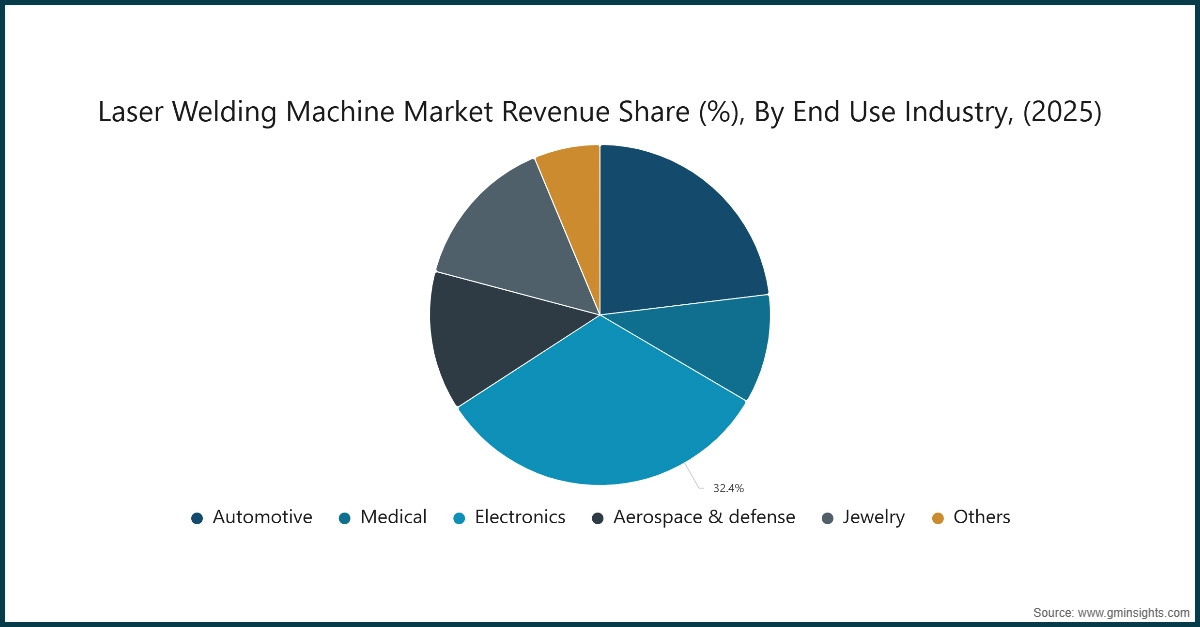
Based on end use industry of market consists of automotive, medical, electronics, aerospace & defense, jewellery and others. The electronics segment emerged as leader and held 32.4% of the total market share in 2025 and is anticipated to grow at a CAGR of 6.9% from 2026 to 2035.
- The electronics industry has emerged as one of the most influential end‑use segments for laser welding machines, driven by ongoing miniaturization, increasing device complexity, and rising demand for high‑precision micro‑joining techniques.
- Laser welding provides the fine beam control and low thermal impact required for delicate electronic components, sensors, circuitry, and semiconductor packaging. As manufacturers push for greater product compactness and reliability, the segment’s reliance on laser welding continues to strengthen.
Based on distribution channel, the market consists of direct and indirect. The direct segment emerged as leader and held 32% of the total market share in 2025.
- Direct distribution channels play a key role in the laser welding machine market, particularly as manufacturers prioritize close customer relationships, technical support integration, and tailored system configurations.
- Through direct sales, suppliers can provide customized solutions, installation services, training, and after‑sales support critical aspects when deploying sophisticated welding technologies that require technical expertise. This model is especially dominant among high‑value industrial buyers who seek long‑term partnerships with equipment providers.
Looking for region specific data?
North America Laser Welding Machine Market
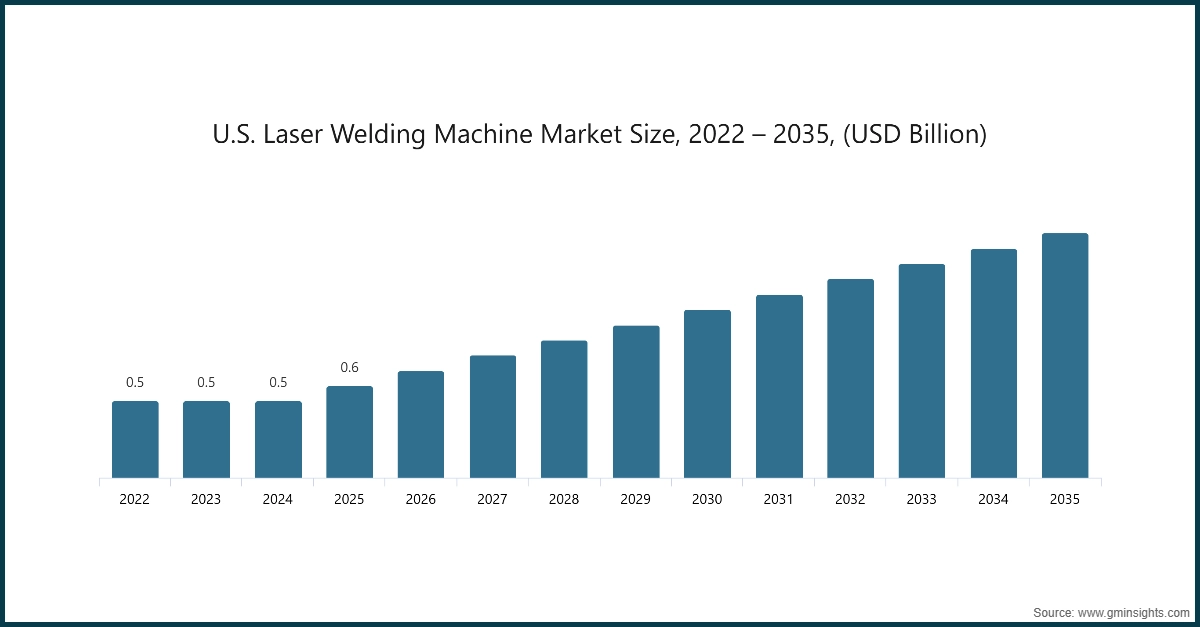
The U.S. dominates an overall North America market and valued at USD 600 million in 2025 and is estimated to grow at a CAGR of 5.1% from 2026 to 2035.
The U.S. laser welding machines market share is high due to the significant advancement in the manufacturing industry, higher levels of automation, and the active presence of the automotive, aerospace, electronics, and medical devices sectors.
- Furthermore, with the shift to electric vehicles (EVs), the need for precision welding in semiconductor and battery production is on the rise, which is why U.S. manufacturers are focusing on investing significantly in fiber laser technology to improve efficiency and product quality.
- Moreover, the growing investments in the aerospace and defense sector, where precise welding of aircraft parts and turbine engines is critical, have also improved the country’s market position.
Europe Laser Welding Machine Market
In the European market, Germany is expected to experience significant and promising growth from 2026 to 2035.
European industries particularly in Germany, France, and the UK focus on high‑end, automation‑intensive applications such as aerospace components, EV systems, and medical devices. Strict regulatory standards and a push toward efficient, clean manufacturing further promote the adoption of laser welding over traditional processes. As a result, Europe continues to lead in innovation, quality standards, and deployment of sophisticated welding technologies, reinforcing its market dominance.
Asia Pacific Laser Welding Machine Market
In the Asia Pacific market, the China held 31% share in 2025 and is anticipated to grow at a CAGR of 4.6% from 2026 to 2035.
- Low manufacturing costs, strong government support for industrial automation, and dense electronics supply‑chain networks further enhance APAC’s dominance. Rapid uptake of fiber lasers, handheld welding systems, and high‑speed automated welding lines positions the region as the global center for both production and consumption of laser welding equipment. APAC’s ability to scale technological innovations quickly continues to widen its competitive edge over Western markets.
Middle East and Africa Laser Welding Machine Market
In the Middle East and Africa market, Saudi Arabia is expected to experience significant and promising growth from 2026 to 2035.
- MEA represents a smaller but steadily evolving market segment, with growth largely driven by increasing industrialization, infrastructure expansion, and rising adoption of precision welding technologies in sectors such as energy, automotive assembly, and metal fabrication.
- While not yet a dominant contributor, the region benefits from growing investment in advanced manufacturing technologies, especially in Gulf nations focused on industrial diversification.
Laser Welding Machine Market Share
- In 2025, the prominent manufacturers are collectively held the market share of ~30%.
- TRUMPF’s competitive edge in the laser welding market stems from its continuous innovation in advanced welding technologies, exemplified by the launch of BrightLine Scan for the TruLaser Weld 5000. This technology enables simultaneous robot‑scanner beam guidance, tighter tolerances, higher weld robustness, and reduced scrap—features that strongly appeal to automotive, fabrication, and precision‑manufacturing sectors.
- IPG Photonics maintains a dominant competitive position through its leadership in high‑power fiber laser technology and its rapid rollout of advanced welding solutions tailored for EV battery production, aerospace, and high‑precision manufacturing. In 2025, the company introduced innovations such as the LDD‑1000‑DS deep weld‑sensing system and high‑speed On‑the‑Fly welding platforms, enabling real‑time weld quality monitoring, improved throughput, and superior processing accuracy
- Coherent’s competitive strength lies in its aggressive expansion of next‑generation laser welding tools, highlighted by the 2025 launches of the WELD1D+ processing head and WELD2D MP welding scanner. These technologies offer real‑time beam control, API‑driven adaptability, and high‑precision foil‑to‑tab and busbar welding for EV batteries and power electronics key growth markets.
Laser Welding Machine Market Companies
Major players operating in the market include:
Amada Weld Tech
CHIRON Group
Coherent
Emerson Electric
Han's Laser Technology Industry Group
Huagong Laser Engineering
IPG Photonics
Jenoptik
KEYENCE
Laser Technologies
Laser line
Laser Star Technologies
Penta Laser
Precitec
TRUMPF
Han’s Laser stands out through its vertical integration of core laser‑welding components, ranging from semiconductor pump sources to specialty fibers and complete high‑power welding systems. In 2025, the company showcased major breakthroughs in localized industrial laser technology at the China Laser Industry Summit, positioning itself as a high‑tech leader aligned with China’s broader manufacturing self‑reliance strategy.
Jenoptik’s competitive edge lies in its established expertise in high‑precision laser systems and its recognized presence among leading global manufacturers of advanced laser platforms, including technologies applicable to laser welding.
Laser Welding Machine Market Report Attributes
| Key Takeaway | Details |
|---|---|
| Market Size & Growth | |
| Base Year | 2025 |
| Market Size in 2025 | USD 2.9 Billion |
| Market Size in 2026 | USD 3.1 Billion |
| Forecast Period 2026-2035 CAGR | 5% |
| Market Size in 2035 | USD 4.7 Billion |
| Key Market Trends | |
| Drivers | Impact |
| Growing adoption of automation in manufacturing | Industries such as automotive, electronics, and aerospace are rapidly adopting automation, increasing the demand for precise and high speed laser welding systems. Laser welding supports lean manufacturing by reducing cycle times and improving production efficiency. |
| Rising demand for high-precision welding | As product designs become more compact and complex—especially in EV batteries, medical devices, and micro electronics—the need for precise, low distortion welding methods grows. Laser welding machines offer superior accuracy and minimal heat affected zones, making them the preferred choice |
| Technological advancements in laser sources | Improvements in fiber lasers, CO₂ lasers, and ultrafast laser technologies have enhanced performance, energy efficiency, and versatility. These advancements reduce operating costs and expand application areas, further driving market adoption |
| Pitfalls & Challenges | Impact |
| High initial investment costs | Laser welding machines require substantial upfront capital for installation, integration, and operator training. This limits adoption among small and medium sized manufacturers, slowing overall market penetration |
| Skilled workforce shortage | Operating advanced laser welding systems requires trained technicians and engineers, and many industries face talent shortages. Lack of skilled labor can lead to operational inefficiencies and increased downtime |
| Opportunities: | Impact |
| Increasing use in electric vehicle (EV) manufacturing | The rise of EVs creates significant opportunities for laser welding in battery modules, motor components, and lightweight vehicle structures. Demand for precision and high speed welding positions laser technology as a core enabler of EV production |
| Expansion in medical device fabrication | Growth in minimally invasive devices, implants, and micro components boosts the need for clean, precise welding. Laser welding’s ability to work with delicate materials without contamination creates strong opportunities in the medical sector |
| Market Leaders (2025) | |
| Market Leader |
7% market share |
| Top Players |
The collective market share in 2025 is ~30% |
| Competitive Edge |
|
| Regional Insights | |
| Largest Market | Asia Pacific |
| Fastest growing market | Asia Pacific |
| Emerging countries | China, India |
| Future outlook |
|
What are the growth opportunities in this market?
Laser Welding Machine Industry News
- In September 2025, Coherent launched WELD1D+ next‑generation laser welding processing head. Features integrated API control and real‑time beam adjustment for EV, electronics, and industrial welding applications.
- In January 2024, Coherent introduced Exact Weld 410 laser welding systems for medical device manufacturing, contributing to the rapidly growing demand for high-quality welding in medical devices.
- In May 2024, IPG Photonics launched Light Weld 2000XR under the handheld laser welding and cleaning product line. This has a high production speed and will increase productivity.
The laser welding machine market research report includes in-depth coverage of the industry, with estimates & forecast in terms of revenue (USD Billion) and volume (Thousand Units) from 2022 to 2035, for the following segments:
Market, By Technology
- Fiber Lasers
- CO2 Lasers
- Diode Lasers
- Others
Market, By Output
- Below 3 kW
- 3 kW – 6 kW
- Above 6 kW
Market, By End Use Industry
- Automotive
- Medical
- Electronics
- Aerospace & defense
- Jewellery
- Others
Market, By Distribution channel
- Direct
- Indirect
The above information is provided for the following regions and countries:
- North America
- U.S.
- Canada
- Europe
- Germany
- UK
- France
- Italy
- Spain
- Asia Pacific
- China
- Japan
- India
- South Korea
- Australia
- Latin America
- Brazil
- Mexico
- Argentina
- MEA
- Saudi Arabia
- UAE
- South Africa
Frequently Asked Question(FAQ) :
What is the market size of the global laser welding machine in 2025?
The market size was USD 2.9 billion in 2025, with a CAGR of 5% expected through 2035, driven by rising industrial automation, growing EV production, and increasing demand for ultra-precise welding across electronics, aerospace, and medical devices.
What is the projected value of the global laser welding machine industry by 2035?
The global laser welding machine market is expected to reach USD 4.7 billion by 2035, propelled by rapid adoption of fiber laser technology, expansion of EV battery manufacturing, and growing integration of laser welding with robotics and Industry 4.0 systems.
What is the current laser welding machine industry size in 2026?
The market size is projected to reach USD 3.1 billion in 2026.
How much revenue did the fiber lasers segment generate in 2025?
The fiber lasers segment generated approximately USD 1.3 billion in 2025, due to superior beam quality, energy efficiency, lower maintenance requirements, and dominance in automated and handheld welding applications across automotive, aerospace, and electronics sectors.
Which end-use industry segment holds the largest share in the laser welding machine market in 2025?
The electronics segment held the largest share of 32.4% in 2025, expected to grow at a CAGR of 6.9% from 2026 to 2035, driven by ongoing device miniaturization, increasing complexity of electronic components.
Which region leads the laser welding machine market?
The U.S. laser welding machine market is estimated to grow at a CAGR of 5.1% from 2026 to 2035, supported by advancements in automotive, aerospace, electronics, and medical device manufacturing, along with rising EV battery production investments.
What are the key trends shaping the laser welding machine market?
Key trends include rising adoption of handheld fiber laser welding systems among SMEs, and growing demand for high-precision micro-welding in medical devices, aerospace components, and semiconductor packaging.
Who are the key players in the laser welding machine market?
Key players include Amada Weld Tech, CHIRON Group, Coherent, Emerson Electric, Han's Laser Technology Industry Group, Huagong Laser Engineering, IPG Photonics, Jenoptik, KEYENCE, Laser Technologies, Laser Line, Laser Star Technologies, Penta Laser, Precitec, and TRUMPF.
Laser Welding Machine Market Scope
Related Reports