Summary
Table of Content

Land-Based Remote Weapon Station Market
Get a free sample of this report
Form submitted successfully!
Error submitting form. Please try again.
Thank you!
Your inquiry has been received. Our team will reach out to you with the required details via email. To ensure that you don't miss their response, kindly remember to check your spam folder as well!
Request Sectional Data
Thank you!
Your inquiry has been received. Our team will reach out to you with the required details via email. To ensure that you don't miss their response, kindly remember to check your spam folder as well!
Form submitted successfully!
Error submitting form. Please try again.
Land-Based Remote Weapon Station Market Size
The growth in the market is based on the growing number of modernization projects for armored vehicles in the NATO and Indo-Pacific regions, the growing need for crew survivability in asymmetric warfare, the development of counter-UAS solutions at the tactical vehicle level, the incorporation of remote lethality solutions into network-centric battlefield structures, and the continuous acquisition of lightweight weapon stations for rapid mobility and border security forces.
Land-Based Remote Weapon Station Market Key Takeaways
Market Size & Growth
- 2025 Market Size: USD 7.1 Billion
- 2026 Market Size: USD 7.4 Billion
- 2035 Forecast Market Size: USD 11.6 Billion
- CAGR (2026–2035): 5.1%
Regional Dominance
- Largest Market: North America
- Fastest Growing Region: Asia Pacific
Key Market Drivers
- NATO Eastern flank vehicle survivability upgrades.
- U.S. Army CROWS modernization programs.
- Rising demand for unmanned turret integration.
- Infantry fighting vehicle fleet digitization.
- Lightweight RWS adoption on tactical vehicles.
Challenges
- Export restrictions under ITAR regulations.
- Integration complexity with legacy armored fleets.
Opportunity
- AI-enabled autonomous target recognition upgrades.
- Hybrid electric combat vehicle integration.
Key Players
- Market Leader: Kongsberg Defence & Aerospace led with over 22.2% market share in 2025.
- Leading Players: Top 5 players in this market include Kongsberg Defence & Aerospace, Elbit Systems Ltd., Rheinmetall AG, Raytheon Technologies Corporation, Saab AB, which collectively held a market share of 67.2% in 2025.
Get Market Insights & Growth Opportunities
The market is mainly driven by NATO Eastern flank vehicle survivability modernization projects as NATO member states continue to enhance defense preparedness in response to increased regional threats. NATO launched Operation "Eastern Sentry" in September 2025 to improve eastern flank defenses after Russian drones entered Polish airspace which showed that alliance members had developed stronger collective deterrence capabilities. The higher operational capacity requires military forces to acquire advanced RWS mounts which will enable them to conduct remote operations while protecting their personnel.
Another major driver of the market for unmanned turret integration is the increasing demand for the integration of unmanned turret systems in armored vehicles, as governments are increasingly adopting advanced remote fire solutions for front-line vehicles. In July 2024, The Polish Armament Agency signed a contract worth USD 722 million through which they will acquire 58 Rosomak IFVs that feature the domestic ZSSW-30 unmanned turret system which improves their combat effectiveness and ability to track targets and protect their soldiers in battle.
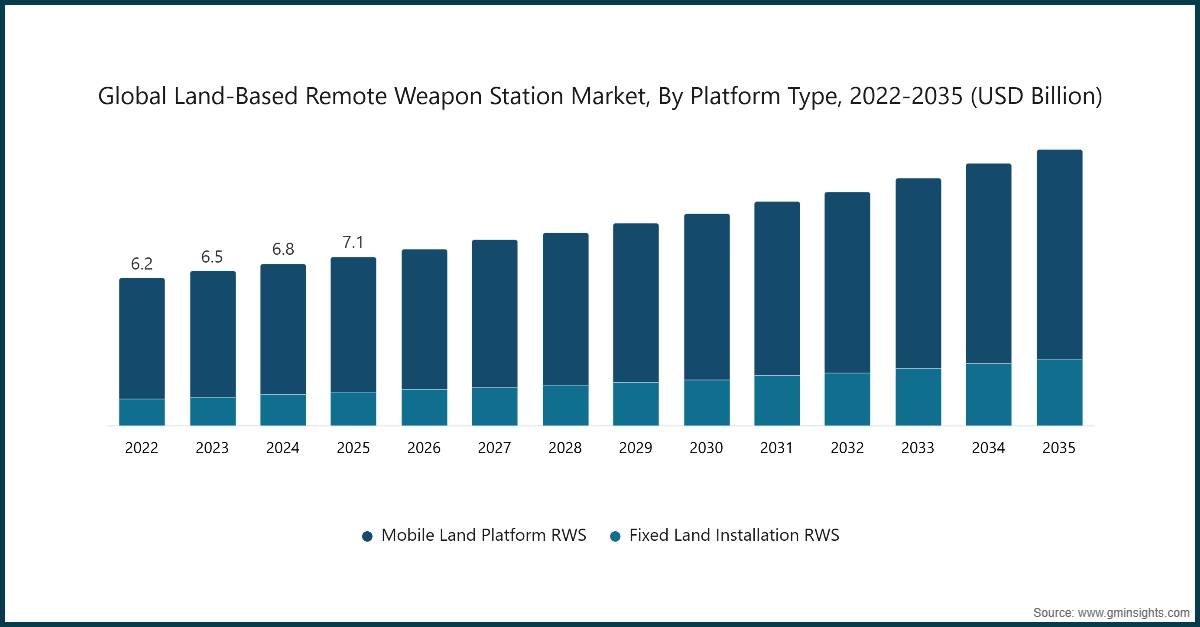
Between 2022 and 2024, the market witnessed considerable growth, increasing from USD 6.2 billion in 2022 to USD 6.8 billion in 2024 because defense budgets increased after the Russia-Ukraine war and military officials started focusing on upgrading armored vehicle protection systems. The rising demand for remote weapon stations for infantry fighting vehicles, 4x4 tactical vehicles, and main battle tanks has also contributed to the growth of the market during this period. Further driving the market are the validations of remote lethality solutions on the battlefield, the integration of advanced electro-optical targeting modules, and the expansion of modernization contracts in Eastern Europe and certain Asia-Pacific defense programs.
The global land-based remote weapon station market was valued at USD 7.1 billion in 2025. The market is expected to grow from USD 7.4 billion in 2026 to USD 9.4 billion in 2031 & USD 11.6 billion in 2035, at a CAGR of 5.1% during the forecast period according to the latest report published by Global Market Insights Inc.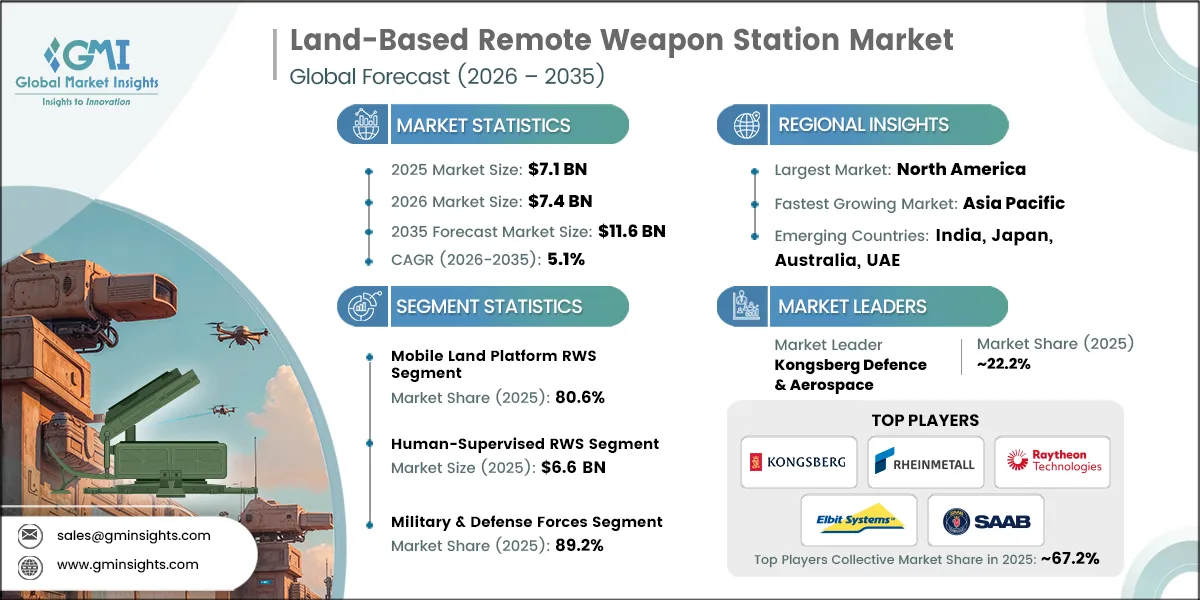
To get key market trends
Land-Based Remote Weapon Station Market Trends
- The incorporation of counter-UAS solutions into land mobile remote weapon stations is a growing and prominent trend on the battlefield. The use of drones in high-intensity conflicts and asymmetric warfare saw rapid growth after 2022. The military organizations will sustain their development of vehicle-level air defense systems until 2032. The new development improves tactical protection for military personnel while enabling remote weapon systems to perform more functions beyond their standard direct-fire operations.
- The open-architecture and modular electronic systems development process creates new design requirements for remote weapon systems. The defense organizations started demanding rapid system upgrades while reducing dependency on specific vendors for fire-control and sensor subsystem components in 2021. The trend will continue until 2030 because it enables organizations to integrate new technologies at a fast pace. The system provides multiple advantages which include scalable modernization, budget-friendly upgrades and system compatibility with various armored vehicle systems.
- The increasing need for remote lethality in urban and hybrid warfare is redefining operational strategies. The military operations showed a post-2020 increase because soldiers needed to conduct their mission work within populated areas which needed them to use precise methods for handling sensitive situations. The adoption rate is expected to increase until 2035 because urban warfare risks will continue to be high. This trend improves force protection while aligning with stricter rules of engagement and mission adaptability.
- The convergence of remote weapon systems with digital battlefield management networks is advancing command-and-control integration. Uptake expanded significantly after 2022 as armed forces accelerated network-centric warfare transformation programs. Expansion is expected through 2033 as militaries pursue real-time data fusion across ISR and combat platforms. The outcome is faster decision-making cycles, coordinated engagements, and enhanced multi-domain operational effectiveness.
Land-Based Remote Weapon Station Market Analysis
Learn more about the key segments shaping this market
Based on the platform type, the global market is divided into mobile land platform RWS and fixed land installation RWS.
- The mobile land platform RWS segment accounted for 80.6% of the market in 2025. Mobile platforms lead the land-based RWS market due to large-scale integration across armored personnel carriers, infantry fighting vehicles, MRAPs, and tactical 4x4 fleets. Growing armored vehicle recapitalization programs in NATO and Asia-Pacific countries sustain demand. These systems enhance crew protection, enable stabilized fire-on-the-move capability, and support multi-weapon configurations, making them central to modern maneuver warfare doctrines.
- The fixed land installation RWS segment is anticipated to grow at a CAGR of 7.3% over the forecast period. Growth is driven by increasing deployment along fortified borders, critical infrastructure, and forward operating bases. Rising cross-border tensions and drone infiltration risks are accelerating adoption of remotely operated defensive weapon stations for perimeter security. Their ability to provide persistent surveillance, automated target tracking, and reduced manpower exposure supports expanding investment in static defense networks.
Learn more about the key segments shaping this market
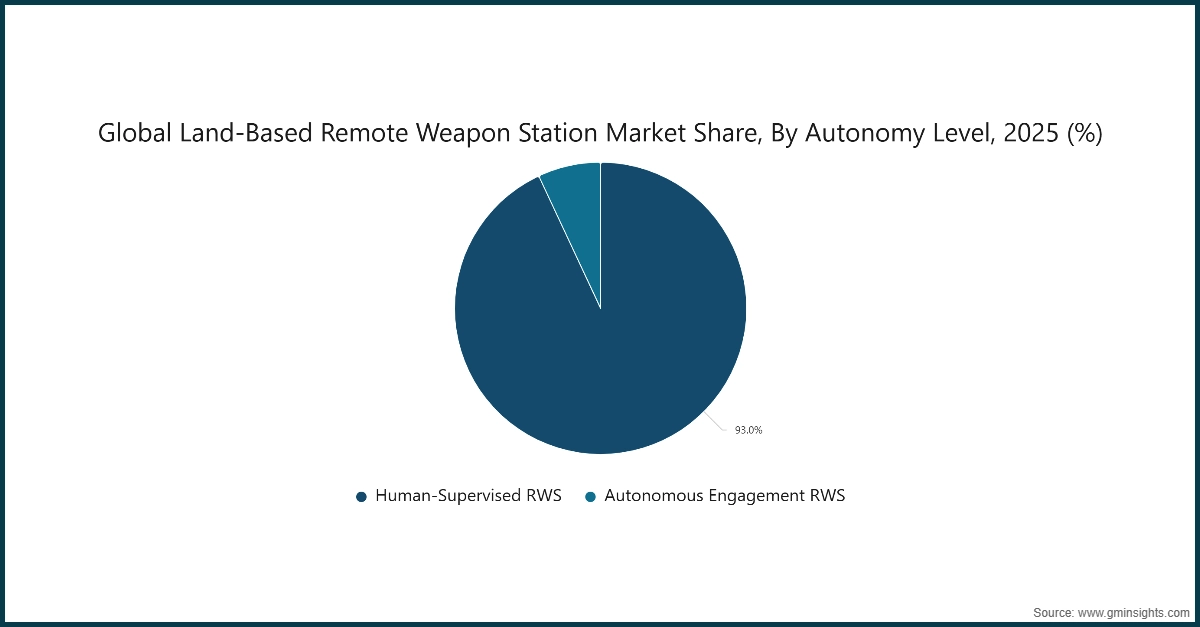
Based on the autonomy level, the land-based remote weapon station market is divided into human-supervised RWS and autonomous engagement RWS.
- The human-supervised RWS segment dominated the market in 2025 and was valued at USD 6.6 billion, driven by regulatory frameworks and rules of engagement requiring operator-in-the-loop control. Military forces currently prefer supervised engagement systems because they provide both accountability and risk reduction for civilian casualties while meeting international humanitarian standards. The established deployment of their products across multiple armored vehicle fleets together with their system compatibility with older command networks enables them to maintain their dominant market position.
- The autonomous engagement RWS segment is expected to witness growth at a CAGR of 13.7% during the forecast period, because of developments in AI-based target detection and sensor fusion technology and automatic threat identification. The need for faster military responses combined with increasing drone presence on battlefields drives military organizations to develop systems with greater operational independence. The combination of advanced electro-optical systems and machine learning algorithms allows this segment to achieve the fastest growth rate.
Based on the end-user, the land-based remote weapon station market is divided into military & defense forces and law enforcement & border security forces.
- The military & defense forces segment led the market in 2025 with a market share of 89.2%, as remote weapon stations are primarily procured for armored combat vehicles, border deployments, and expeditionary operations. Large-scale modernization programs, heavy vehicle upgrades, and counter-UAS requirements sustain dominant demand from national armed forces. Continuous recapitalization cycles and multi-year procurement contracts ensure this segment remains the primary revenue contributor.
- The law enforcement & border security forces segment is expected to witness growth at a CAGR of 7.5% during the forecast period. Growth is driven by increasing militarization of border protection, critical infrastructure defense, and anti-smuggling operations. Remote weapon systems deployed on surveillance towers and rapid-response vehicles enhance personnel safety while improving deterrence capability, making this segment the fastest-growing end-user category.
Looking for region specific data?
North America Land-Based Remote Weapon Station Market
The North America held a market share of 33.8% of market in 2025.
- In North America, the market for land-based remote weapon stations is growing because of the ongoing defense modernization and high defense spending for the procurement of advanced RWS technology. The United States represented the majority share in 2025, which is a result of its leadership position in the adoption of remote weapon stations for MRAPs, Stryker, and Bradley platforms with AI targeting and sensor fusion.
- The North American market is fueled by the ongoing modernization efforts of the U.S. Army and DoD, homeland security needs along the borders, and a developed industry base that promotes the integration of RWS technology in military and security forces. This strong regional focus on networked weapons, autonomous engagement capabilities, and border protection initiatives is set to sustain steady growth through 2035.
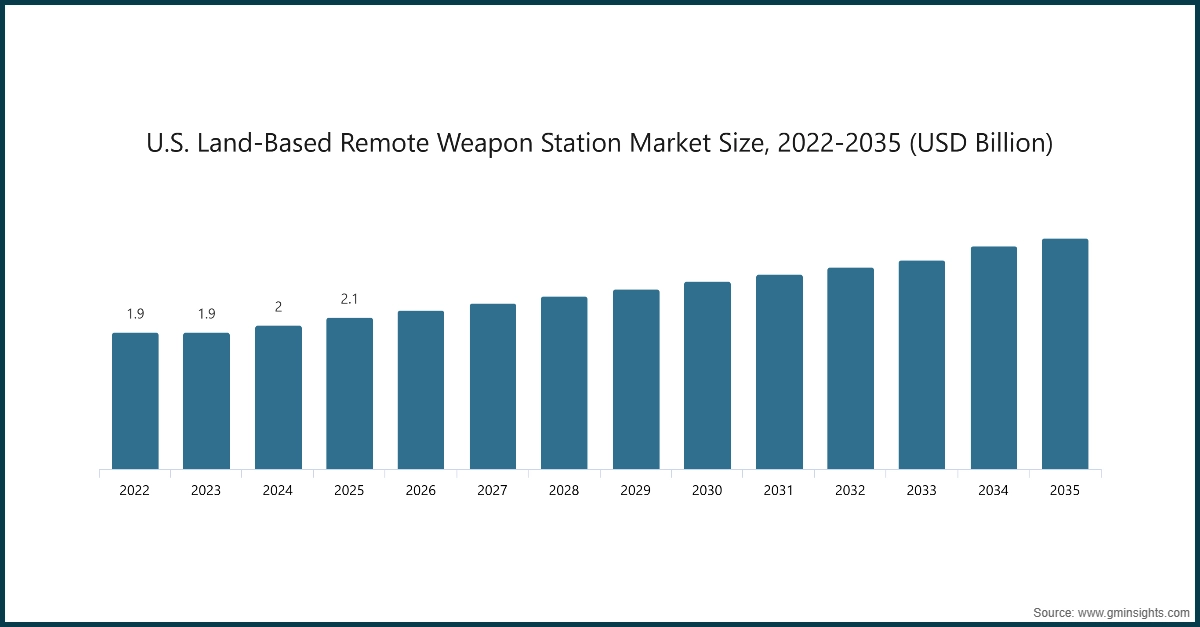
The U.S. land-based remote weapon station market was valued at USD 1.9 billion and USD 1.9 billion in 2022 and 2023, respectively. The market size reached USD 2.1 billion in 2025, growing from USD 2 billion in 2024.
- The growth of the land‑based remote weapon system market in the United States is particularly strong due to strategic military procurement and defense budget allocation. In 2025, RWS accounted for the majority of U.S. remote weapon station revenue within North America, as the Department of Defense prioritizes modernization of armored vehicle fleets and counter‑UAS capabilities across army platforms.
- The U.S. Army’s ongoing CROWS recompete program valued up to USD 1.5 billion highlights continued investment in next‑generation remote weapon stations with enhanced fire‑control and sustainment frameworks. Additionally, robust border security mandates under U.S. Customs and Border Protection to enhance situational awareness and response mechanisms further support RWS adoption, making the U.S. a clear leader in the regional market.
Europe Land-Based Remote Weapon Station Market
Europe market accounted for USD 1.8 billion in 2025 and is anticipated to show lucrative growth over the forecast period.
- Europe’s land‑based remote weapon system market is expanding due to elevated defense spending and collective security initiatives following heightened geopolitical instability in Eastern Europe. The European Defence Agency reported accelerated procurement cycles for RWS installations on upgraded infantry fighting vehicles (IFVs), reconnaissance units, and border security fleets in response to cross‑border drone threats and hybrid warfare.
- Nations such as Poland, Finland, and Romania are prioritizing remote weapon stations integrated with advanced electro‑optical sensors, thermal imaging, and counter‑UAS modules to enhance deterrence along NATO’s eastern flank. EU collaborative defense programs under PESCO and bilateral co‑development deals with industry players (e.g., Rheinmetall and Kongsberg) strengthen interoperability standards and sustain high demand for state‑of‑the‑art land RWS across European armed forces. This region’s focus on digital fire‑control upgrades, autonomous engagement safeguards, and modular integration ensures continued adoption through the next decade.
Germany dominates the Europe market, showcasing strong growth potential.
- Germany represents the leading position in Europe in the adoption of remote weapon stations because of the ongoing modernization of Puma IFVs and Boxer APCs, which are now equipped with advanced RWS and electro-optical fire control systems. These upgrades enhance precision engagement, counter-drone capability, and crew survivability, making Germany a key adopter of cutting-edge land-based RWS technologies in Europe.
- The country’s defense industrial strategy emphasizes domestic manufacturing through partnerships with Rheinmetall AG and KMW, ensuring tailored solutions and reduced reliance on foreign suppliers. Investments in networked battlefield management and interoperable fire-control systems across NATO brigades further strengthen Germany’s leadership. These factors position Germany as a benchmark for integrating next-generation RWS platforms across European armed forces.
Asia Pacific Land-Based Remote Weapon Station Market
The Asia Pacific market is anticipated to grow at the highest CAGR of 6.8% during the forecast period.
- The Asia Pacific system market is expanding due to increased defense modernization programs, regional security challenges, and cross-border tensions. Nations such as Australia, Japan, and South Korea are upgrading armored vehicles and border surveillance platforms with integrated RWS, counter-UAS sensors, and stabilized weapon mounts.
- Growing investments in networked battlefield systems, tactical mobility platforms, and modular RWS solutions support operational readiness and interoperability. Collaborative procurement and technology transfer programs with global defense manufacturers further accelerate adoption, making APAC a high-growth region for advanced land-based RWS solutions.
India market is estimated to grow with a significant CAGR, in the Asia Pacific market.
- India is witnessing strong adoption of land-based remote weapon systems due to modernization of its mechanized infantry and armored vehicle fleets. The Indian Army and Border Security Force are procuring lightweight and medium-caliber RWS for BMP, T-90, and indigenous Arjun MBT platforms, enhancing cross-border defensive capability and rapid response along the northern and northeastern frontiers.
- Strategic initiatives under the Make in India defense program encourage domestic manufacturing and co-development of modular RWS platforms with international defense companies. Integration of electro-optical sensors, fire-control software, and stabilized remote turrets enhances operational readiness, precision targeting, and soldier protection. These factors, coupled with growing investment in counter-drone and networked battlefield technologies, position India as a fast-growing market for land-based RWS in the Asia Pacific region.
Middle East and Africa Land-Based Remote Weapon Station Market
UAE market to experience substantial growth in the Middle East and Africa market.
- The United Arab Emirates (UAE) is witnessing targeted growth in the land‑based remote weapon system market driven by its strategic defense modernization and border defense requirements. With heightened focus on rapid threat detection and counter‑UAS capability across critical urban and energy infrastructure, the UAE Armed Forces have integrated stabilized RWS onto light tactical vehicles, patrol boats, and fixed defensive positions along border and coastal sectors.
- Significant investments under the UAE Armed Forces’ Force Modernisation Programme emphasize interoperable battlefield networks, precision fire‑control solutions, and remote engagement systems tailored for desert and city terrains, enhancing survivability and response times. Additionally, bilateral defense cooperation agreements with leading OEMs particularly for localized assembly and technology transfer of RWS and sensor systems reinforce the UAE’s role as a key adopter of advanced land‑based remote weapon technologies in the Middle East & Africa (MEA) region.
Land-Based Remote Weapon Station Market Share
The market is led by players such as Kongsberg Defence & Aerospace, Elbit Systems Ltd., Rheinmetall AG, RTX Corporation, and Saab AB. These five companies collectively accounted for 67.2% market share in 2025. They have very strong competitive advantages because of their diversified RWS solutions in light, medium, and heavy platforms, electro-optical sensors, and their integration with armored vehicles and tactical fleets.
Innovations in AI-enabled targeting, networked command systems, and autonomous engagement solutions further improve their technological superiority. Geographical reach in NATO, Europe, Middle East, and Asia-Pacific regions further helps in dominating the market, and ongoing R&D in modular and multi-platform weapon stations further helps in their adoption in military as well as security forces across the globe. Their collective knowledge, global contracts, and ongoing innovation make them the standard for performance and reliability in the land-based RWS market.
Land-Based Remote Weapon Station Market Companies
Prominent players operating in the land-based remote weapon station industry are as mentioned below:
- ASELSAN A.S
- BAE Systems plc
- Electro Optic Systems
- Elbit Systems Ltd.
- FN Herstal
- General Dynamics Corporation
- Kongsberg Defence & Aerospace
- Leonardo S.p.A
- Rafael Advanced Defense Systems
- Rheinmetall AG
- Saab AB
- ST Engineering
- Thales Group
- RTX Corporation
Kongsberg Defence & Aerospace provides combat-tested Protector and MCT-30 RWS solutions, with a strong focus on advanced stabilization, multi-caliber solutions, and NATO compatibility. Their emphasis on modularity, sensor integration, and network compatibility helps in their use with armored vehicles, patrol vehicles, and expeditionary forces, with a strong focus on high survivability and operational flexibility.
Elbit Systems Ltd. develops lightweight modular RWS solutions which include EO/IR sensor systems, AI-powered fire control technology and digital target tracking capabilities. The systems enable swift tactical deployment on 4x4 vehicles and IFVs which deliver accurate combat results while decreasing danger to their operators.
Rheinmetall AG produces heavy-caliber RWS systems which include unmanned turrets designed for use in IFVs and MBTs that feature advanced stabilization technology, fire-control systems and ammunition management capabilities. The company improves operational efficiency through its European armored modernization projects while providing military systems that work across multiple platforms.
The company integrates precision targeting sensors, counter-UAS modules and electronic warfare systems into RWS platforms. Their systems enable U.S. and allied forces to conduct networked operations which improve their reaction speed and battlefield situational awareness during multi-domain engagements.
Saab AB provides compact RWS systems which use adaptable technology to deliver multiple mission capabilities and accurate fire control results. Saab systems enable both armored vehicles and stationary platforms to use NATO and Scandinavian defense programs through modular weapon and sensor integration which allows rapid deployment in urban combat situations.
Land-Based Remote Weapon Station Market Report Attributes
| Key Takeaway | Details |
|---|---|
| Market Size & Growth | |
| Base Year | 2025 |
| Market Size in 2025 | USD 7.1 Billion |
| Market Size in 2026 | USD 7.4 Billion |
| Forecast Period 2026-2035 CAGR | 5.1% |
| Market Size in 2035 | USD 11.6 Billion |
| Key Market Trends | |
| Drivers | Impact |
| NATO Eastern flank vehicle survivability upgrades | Drives 24% growth as NATO Eastern flank vehicle survivability upgrades accelerate procurement of advanced RWS to counter drone swarms, ATGMs, and loitering munitions. |
| U.S. Army CROWS modernization programs | Supports 21% growth through U.S. Army CROWS modernization programs, where upgrades focus on improved fire-control systems, thermal imaging, counter-UAS capability, and open-architecture electronics. |
| Rising demand for unmanned turret integration | Contributes 19% growth as rising demand for unmanned turret integration increases across infantry fighting vehicles and medium armored platforms. |
| Infantry fighting vehicle fleet digitization | Adds 18% growth due to infantry fighting vehicle fleet digitization programs integrating RWS with battlefield management systems, ISR sensors, and stabilized fire-control units. |
| Lightweight RWS adoption on tactical vehicles | Accounts for 18% growth as lightweight RWS adoption expands on tactical vehicles, MRAPs, and 4x4 patrol platforms. Reduced weight systems allow deployment on rapid mobility forces, border security fleets, and expeditionary units without compromising vehicle speed or payload efficiency. |
| Pitfalls & Challenges | Impact |
| Export restrictions under ITAR regulations | Restrains market growth as export restrictions under ITAR regulations limit cross-border transfer of weapon stations, fire-control systems, and targeting components. Lengthy approval timelines, end-user certification requirements, and geopolitical sensitivities delay international contracts and restrict supplier flexibility in multi-country defense programs. |
| Integration complexity with legacy armored fleets | Limits growth due to integration complexity with legacy armored fleets, where older vehicle architectures lack compatible power supply, digital interfaces, and stabilization systems. Retrofitting requires structural modification, software harmonization, and additional testing, increasing program costs and extending deployment timelines. |
| Opportunities: | Impact |
| AI-enabled autonomous target recognition upgrades | Presents significant growth potential by enabling AI-enabled autonomous target recognition upgrades that improve threat detection accuracy, reduce operator workload, and enhance engagement speed against fast-moving drones and asymmetric threats. Integration of machine vision and advanced algorithms strengthens next-generation RWS competitiveness in high-intensity combat scenarios. |
| Hybrid electric combat vehicle integration | Offers opportunity through hybrid electric combat vehicle integration, where electric powertrains provide higher onboard power availability for advanced sensors, stabilization systems, and directed-energy subsystems. Electrified platforms enhance silent watch capability, energy efficiency, and compatibility with future high-power weapon station technologies. |
| Market Leaders (2025) | |
| Market Leader |
~22.2% market share. |
| Top Players |
Collective Market Share of ~67.2% |
| Competitive Edge |
|
| Regional Insights | |
| Largest Market | North America |
| Fastest growing market | Asia Pacific |
| Emerging countries | India, Japan, Australia, UAE |
| Future outlook |
|
What are the growth opportunities in this market?
Land-Based Remote Weapon Station Industry News
- In February 2026, Elbit Systems Ltd. was awarded contracts worth approximately USD 277 million by an international customer for the supply of UT30MK2 30 mm turrets and munitions, delivering modular manned/unmanned weapon stations that enhance APC firepower while retaining troop safety. This contract highlights growth in tactical vehicle weapon integration demand.
- In December 2025, Kongsberg Defence & Aerospace secured a significant contract with the German and Swedish militaries for delivery of PROTECTOR RS4 remote weapon stations to support the Common Armoured Vehicle System (CAVS) 6×6 programme, expanding multinational RWS deployment and interoperability across European land forces. This contract underscores rising integration of stabilized remote weapon systems for modern armoured fleets.
- In October 2025, Electro Optic Systems (EOS) secured a USD 22 million contract to supply advanced RWS hardware for integration onto a major U.S. Army ground combat vehicle, marking the company’s entry into large‑scale US defence platforms and expanding its footprint in North American remote weapon station deployment.
The land-based remote weapon station market research report includes in-depth coverage of the industry with estimates and forecast in terms of revenue (USD Million) from 2022 – 2035 for the following segments:
Market, By Platform Type
- Mobile land platform RWS
- Combat vehicles (armored fighting vehicles)
- Infantry fighting vehicles (IFVs)
- Armored personnel carriers (APCs)
- Main battle tanks (MBTs)-secondary armament
- Tactical Vehicles
- Joint light tactical vehicles (JLTV)
- Mine-resistant ambush protected (MRAP) vehicles
- Tactical trucks & logistics vehicles
- Unmanned ground vehicles (UGVs)
- Combat vehicles (armored fighting vehicles)
- Fixed land installation RWS
- Permanent installations
- Deployable / containerized systems
Market, By Weapon Type
- Light (5.56mm – 7.62mm)
- Medium (12.7mm – 14.5mm)
- Heavy (20mm – 40mm+)
Market, By Autonomy Level
- Human-supervised RWS
- Autonomous engagement RWS
Market, By End-User
- Military & defense forces
- Law enforcement & border security forces
The above information is provided for the following regions and countries:
- North America
- U.S.
- Canada
- Europe
- Germany
- UK
- France
- Spain
- Italy
- Russia
- Asia Pacific
- China
- India
- Japan
- Australia
- South Korea
- Latin America
- Brazil
- Mexico
- Argentina
- Middle East and Africa
- South Africa
- Saudi Arabia
- UAE
Frequently Asked Question(FAQ) :
What is the market size of the land-based remote weapon station market in 2025?
The global land-based remote weapon station (RWS) market was valued at USD 7.1 billion in 2025, driven by rising armored vehicle modernization programs and increasing demand for advanced defense systems.
What is the expected market size of the land-based remote weapon station market in 2026?
The market is projected to reach USD 7.4 billion in 2026, supported by expanding defense budgets and growing investments in military technology.
What is the projected value of the land-based remote weapon station market by 2035?
The market is expected to reach USD 11.6 billion by 2035, growing at a CAGR of 5.1%, driven by continued armored vehicle upgrades and modernization initiatives.
Which platform type dominated the land-based remote weapon station industry in 2025?
The mobile land platform RWS segment dominated the market with an 80.6% share in 2025, owing to its extensive integration across armored personnel carriers and combat vehicles.
What was the valuation of the human-supervised RWS segment in 2025?
The human-supervised RWS segment was valued at USD 6.6 billion in 2025, as most military forces prefer operator-in-the-loop engagement systems to comply with operational regulations and international humanitarian standards.
What is the growth outlook for autonomous engagement RWS?
The autonomous engagement RWS segment is expected to grow at a CAGR of 13.7% during the forecast period, driven by advancements in AI-based target recognition and autonomous defense technologies.
Which region leads the land-based remote weapon station industry?
North America led the market with a 33.8% share in 2025, driven by strong defense spending, armored fleet modernization programs, and advanced RWS deployment across U.S. military platforms.
Who are the key players in the land-based remote weapon station market?
Key companies include Kongsberg Defence & Aerospace, Elbit Systems Ltd., Rheinmetall AG, RTX Corporation, Saab AB, ASELSAN A.S., BAE Systems plc, Leonardo S.p.A., Rafael Advanced Defense Systems, and Thales Group.
Land-Based Remote Weapon Station Market Scope
Related Reports