Summary
Table of Content

Laboratory and Medical Scale Ozone Generator Market
Get a free sample of this report
Form submitted successfully!
Error submitting form. Please try again.
Thank you!
Your inquiry has been received. Our team will reach out to you with the required details via email. To ensure that you don't miss their response, kindly remember to check your spam folder as well!
Request Sectional Data
Thank you!
Your inquiry has been received. Our team will reach out to you with the required details via email. To ensure that you don't miss their response, kindly remember to check your spam folder as well!
Form submitted successfully!
Error submitting form. Please try again.
Laboratory and Medical Scale Ozone Generator Market Size
- Increasing demand for cost-effective and energy-efficient products, leaving no harmful by-products, will foster the industry growth in medical and laboratory facilities. Rising pressure on the medical industry to reduce its environmental impact by using chemical-free, zero-waste solutions for disinfection will complement the product penetration. For instance, as per the 2025 medical‑waste emissions study, ozone treatment generates only 654.77 kg CO₂e per ton and costs just USD 78.61 per ton, offering hospitals a significantly cleaner and more economical disinfection alternative compared to conventional methods, leading to strengthening the business growth.
- The growing requirement for low-temperature sterilization methods is fueling the demand for ozone generators in laboratories and medical institutions as entities look for safer and residue-free methods. Additionally, in controlled settings, ozone is an ideal substitute for chemical-based disinfectants due to its capability to sterilize heat-sensitive equipment while maintaining a high level of microbial kill.
The global laboratory and medical scale ozone generator market was estimated at USD 57 million in 2025. The market is expected to grow from USD 61.7 million in 2026 to USD 136.7 million in 2035, at a CAGR of 9.3%, according to a recent study by Global Market Insights Inc.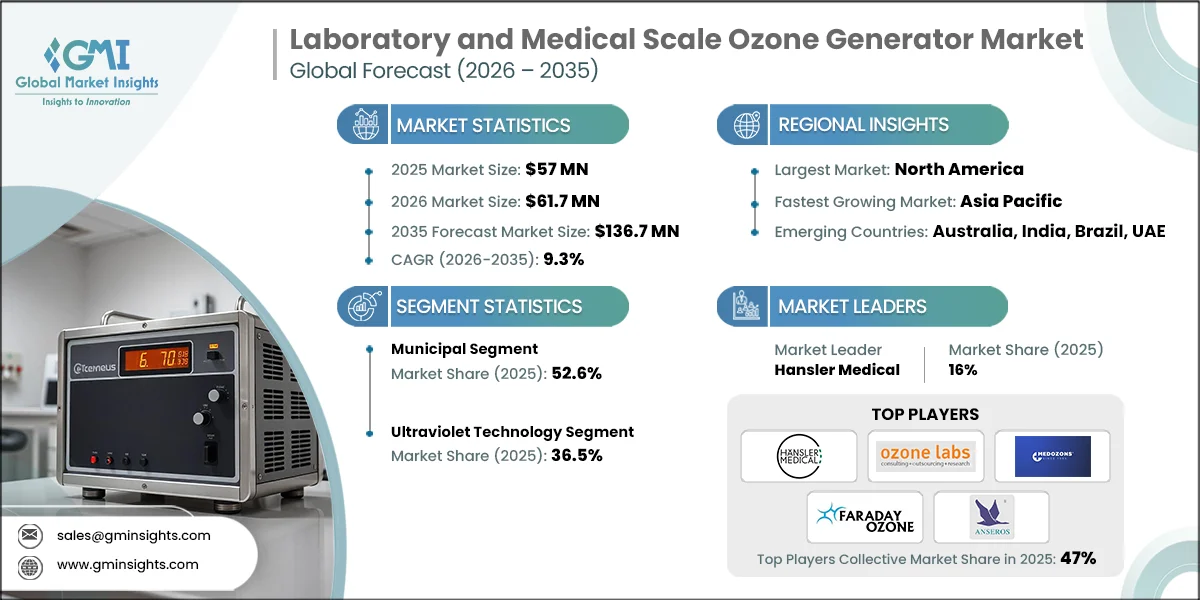
Laboratory and Medical Scale Ozone Generator Market Key Takeaways
Market Size & Growth
- 2025 Market Size: USD 57 Million
- 2026 Market Size: USD 61.7 Million
- 2035 Forecast Market Size: USD 136.7 Million
- CAGR (2026–2035): 9.3%
Regional Dominance
- Largest Market: North America
- Fastest Growing Region: Asia Pacific
Key Market Drivers
- Rising demand for precision sterilization.
- Increasing shift toward green disinfection.
Challenges
- Strict safety and compliance requirements.
- Limitations in material compatibility.
Opportunity
- Expanding use in advanced research applications.
- Growing demand for infection‑control technologies.
Key Players
- Market Leader: Hansler Medical led with over 16% market share in 2025.
- Leading Players: Top 5 players in this market include Hansler Medical, OzoneLab, Medozons, Faraday Ozone, Anseros Klaus Nonnenmacher GmbH, which collectively held a market share of 47% in 2025.
Get Market Insights & Growth Opportunities
To get key market trends
Laboratory & Medical Scale Ozone Generator Market Trends
- Increasing emphasis on infection control is strengthening demand for solutions that can remove harmful microorganisms from the air, which is especially vital in high‑risk areas such as operating rooms, patient wards, and laboratory environments. This demand is further supported by stringent healthcare regulations and global standard‑setting bodies, including the WHO and the U.S. EPA, which continue to promote higher hygiene and infection‑control standards.
- The increasing demand for chemical-free disinfection is pushing medical facilities to use more sustainable sterilization techniques. Ozone generators, which produce no waste and leave no residue, have recently come to the forefront as a viable alternative for medical and laboratory facilities searching for non-toxic, sustainable, and safe alternatives to traditional chemical disinfectants.
- Increasing awareness of healthcare-associated infections is encouraging hospitals and laboratories to adopt ozone-based sterilization to reduce contamination risks. With greater focus on preventing pathogen transmission in operating rooms, patient wards, and research areas, ozone systems are becoming an important tool for maintaining strict hygiene standards.
Laboratory and Medical Scale Ozone Generator Market Analysis
Learn more about the key segments shaping this market
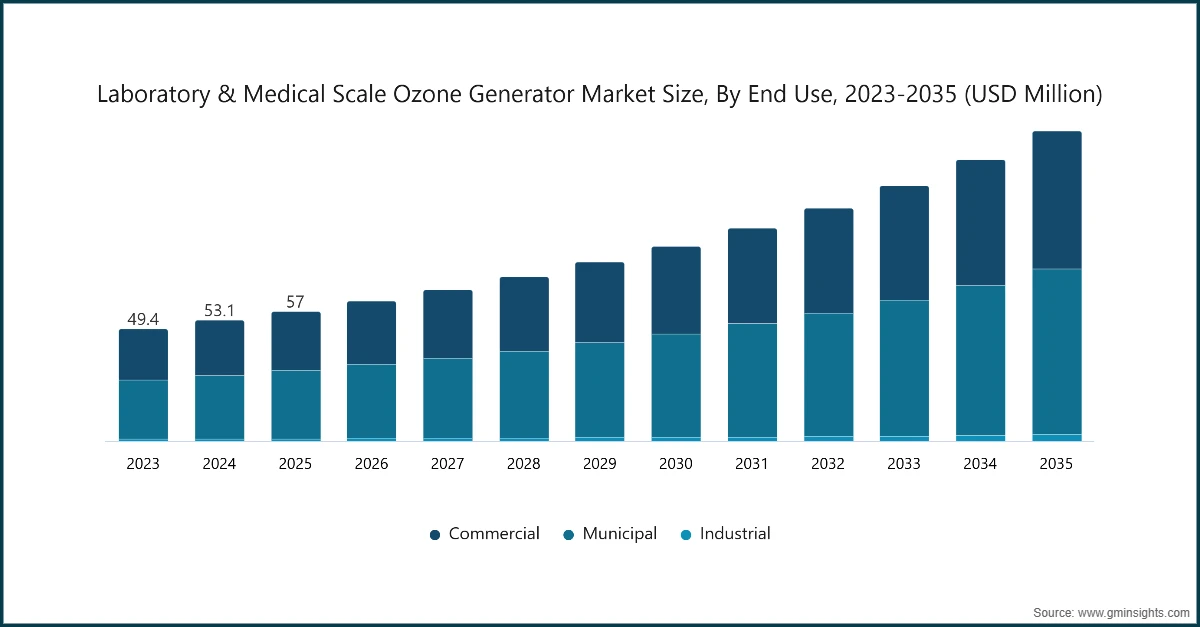
Based on end use, the industry is segmented into commercial, municipal and industrial. Municipal dominated the market, accounting for 52.6% in 2025 and is expected to grow at a CAGR of 9.4% through 2035.
- Growing regulatory pressure on municipal utilities to meet strict sanitation standards is accelerating ozone generator adoption in laboratory and medical applications, as residue‑free pathogen elimination becomes essential. For instance, the EPA is regulating close to 90 contaminants under the NPDWR, which all public water systems must comply with.
- The commercial segment is expected to grow at a CAGR of 7.9% by 2035. Increasing emphasis on stringent infection‑control standards in commercial laboratory and medical environments is driving the product adoption, as facilities seek fast, chemical‑free sterilization that eliminates bacteria, viruses, and other pathogens without residue. This aligns with rising demand for effective disinfection technologies that enhance workplace hygiene and operational safety.
Learn more about the key segments shaping this market
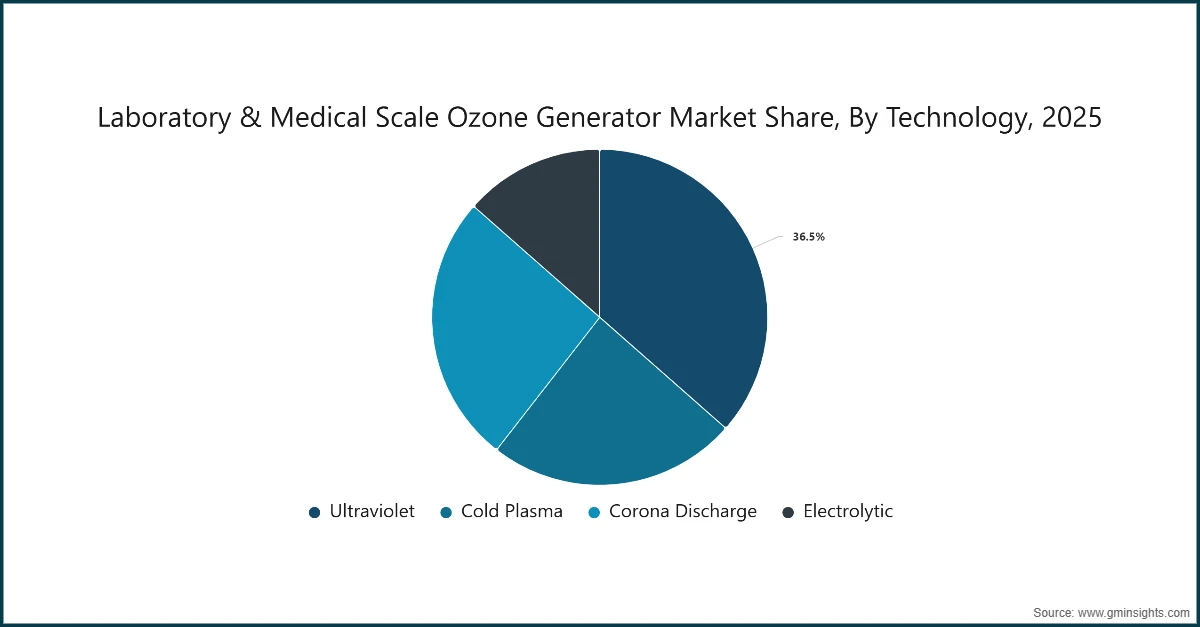
Based on technology, the laboratory and medical scale ozone generator market is segmented into ultraviolet, cold plasma, corona discharge, and electrolytic technology. Ultraviolet technology dominates the market with a 36.5% share in 2025, and the segment is expected to grow at a CAGR of 9% from 2026 to 2035.
- The growing requirement for precise and low-residue sterilization in laboratories and medical settings is driving the adoption of ultraviolet ozone generators, since the technology enables the controlled production of ozone without any chemical by-products. The compatibility of the technology with sensitive equipment and a closed clinical environment also makes it attractive in applications where hygiene and safety are of utmost importance.
- The corona discharge technology is expected to expand at a CAGR of 8.4% by 2035. The increasing demand for technology that provides high efficiency in ozone generation, along with compactness and scalability, in addition to being affordable compared to other technologies, is fueling the technology adoption. In addition, the lower consumable requirement in corona discharge ozone generators makes it more cost-effective, which is suitable for continuous use in medical applications.
Looking for region specific data?
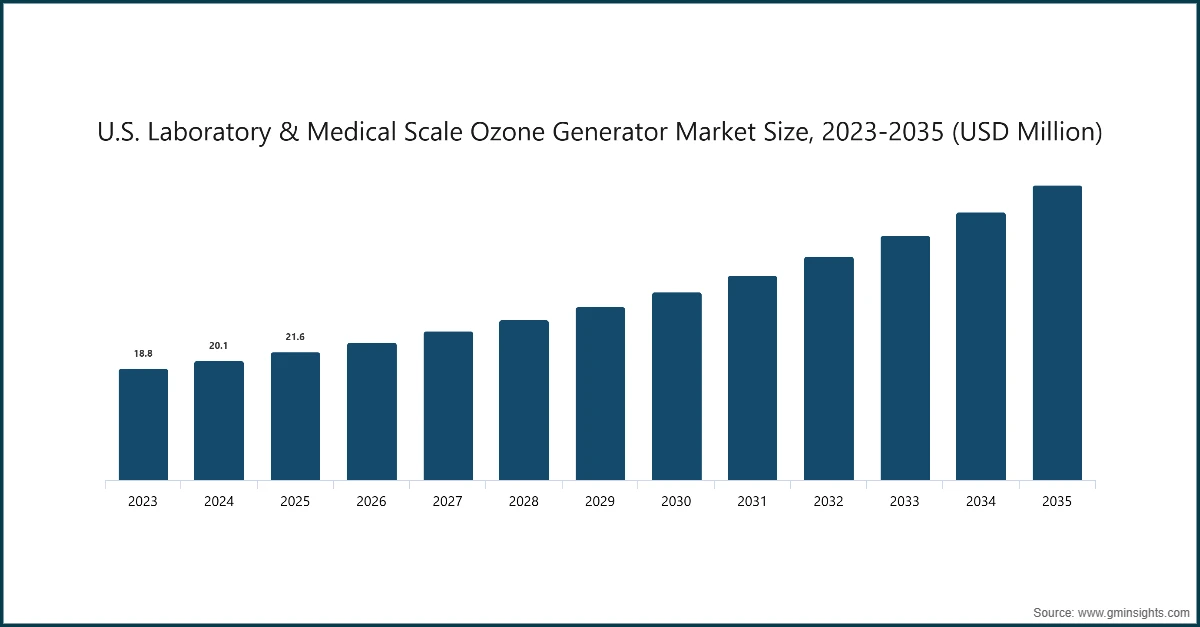
- The U.S. laboratory & medical scale ozone generator market is anticipated to grow over USD 49 Million by 2035. The increasing standards of healthcare, including those of the FDA and CDC, require effective and chemical-free sterilization, thus driving the adoption of the product. Increasing medical and research labs' focus on the reduction of environmental impact and adoption of sustainable practices in healthcare and research settings, where the elimination of hazardous chemicals is important, will further enhance the industry outlook.
- In the Asia Pacific market, the fast development of the healthcare infrastructure, along with the increasing modernization of the medical sector in countries such as China, India, and Japan, will provide lucrative opportunities for the growth of the product. The growing demand for air and water purification systems in highly polluted areas is also boosting the adoption of ozone generators. The industrial and healthcare sectors are looking for effective contamination control solutions. For instance, the PM2.5 level in India was 50.6 µg/m³, which is ten times higher than the WHO standards, and the pollution index in China was 76.46, which highlights the need for effective disinfection technologies.
Laboratory and Medical Scale Ozone Generator Market Share
The major market players are collaborating with the key players of various industries, such as the pharmaceutical and healthcare industry, to develop ozone generators that can be used in a medical environment, focusing on bacterial and viral disinfection. In an attempt to understand the specific needs of such industries and ensure that their products are applicable for specific uses in the medical field, such as air purification and sterilization, some manufacturers collaborate with hospitals and research institutions. In addition, the top players in the ozone generator market are also investing in research and development activities to improve the capabilities of ozone generators in laboratory and medical equipment applications.
Laboratory & Medical Scale Ozone Generator Market Companies
Eminent players operating in the laboratory & medical scale ozone generator industry are:
- A2Z Ozone
- Anseros Klaus Nonnenmacher GmbH
- Aurozone
- Bieffe Italia
- Dinies Technologies
- Eltech Ozone
- Faraday Ozone
- Hansler Medical
- Jelight Company
- LNI Swissgas
- Longfian Scitech Co., Ltd
- Medozons
- MKS Instruments
- OzoneLab
- Oxidation Technologies
- Ozone Engineering
- Relyon plasma GmbH
- Sedecal
- Veolia Water Technologies & Solutions
- Xylem Water Solutions
Laboratory and Medical Scale Ozone Generator Market Report Attributes
| Key Takeaway | Details |
|---|---|
| Market Size & Growth | |
| Base Year | 2025 |
| Market Size in 2025 | USD 57 Million |
| Market Size in 2026 | USD 61.7 Million |
| Forecast Period 2026-2035 CAGR | 9.3% |
| Market Size in 2035 | USD 136.7 Million |
| Key Market Trends | |
| Drivers | Impact |
| Rising demand for precision sterilization | Growing need for accurate, chemical‑free sterilization in laboratories and medical facilities is increasing ozone generator adoption, as ozone enables efficient microbial control without residues, enhancing safety and operational hygiene standards. |
| Increasing shift toward green disinfection | Increasing preference for sustainable disinfection methods drives uptake of ozone systems, as institutions replace chemical consumables with ozone‑based processes to reduce waste, exposure risks, and environmental impact. |
| Pitfalls & Challenges | Impact |
| Strict safety and compliance requirements | Increasing regulatory scrutiny on ozone exposure levels poses challenges, as medical and laboratory operators must invest in monitoring, ventilation, and training to ensure safe use, raising operational barriers |
| Limitations in material compatibility | Growing concerns around ozone’s corrosive impact on sensitive laboratory instruments and medical materials limit adoption, requiring users to implement protective measures or restrict ozone use in certain workflows. |
| Opportunities: | Impact |
| Expanding use in advanced research applications | Rising integration of ozone in molecular biology, surface treatment, and sterilization studies creates opportunities for specialized laboratory‑grade ozone systems tailored to controlled, high‑precision scientific environments. |
| Growing demand for infection‑control technologies | Increasing focus on infection‑prevention strategies in healthcare facilities drives demand for compact medical ozone generators, enabling rapid disinfection of instruments, rooms, and consumables with minimal operational overhead. |
| Market Leaders (2025) | |
| Market Leader |
16% market share |
| Top Players |
Collective market share is 47% |
| Competitive Edge |
|
| Regional Insights | |
| Largest Market | North America |
| Fastest growing market | Asia Pacific |
| Emerging countries | Australia, India, Brazil, UAE |
| Future outlook |
|
What are the growth opportunities in this market?
Laboratory & Medical Scale Ozone Generator Industry News:
- In January 2023, Konica Minolta launched the BACTECTOR 2.0SC ozone generator, which features precise ozone control for safe disinfection. The device enhances the removal of bacteria and viruses through advanced sensing and healthcare-grade design technology.
- In March 2022, Konica Minolta, Inc. and Tamura TECO Co., Ltd. joined hands to create an ozone generator that is specifically designed for the medical field. The ozone generator is meant to fight bacteria and viruses, which will result in a cleaner and safer environment. This is the first time that both companies have collaborated on a project. The production of the ozone generator has begun at the smart factory of Konica Minolta, DMC1-MIKAWA.
The laboratory & medical scale ozone generator market research report includes an in-depth coverage of the industry with estimates & forecast in terms of revenue and volume in “USD Million & Units'' from 2022 to 2035, for the following segments:
Market, By Technology
- Ultraviolet
- Cold plasma
- Corona discharge
- Electrolytic
Market, By End Use
- Commercial
- Municipal
- Industrial
The above information has been provided for the following regions and countries:
- North America
- U.S.
- Canada
- Europe
- Germany
- UK
- France
- Russia
- Italy
- Spain
- Asia Pacific
- China
- Australia
- India
- Japan
- Middle East & Africa
- Saudi Arabia
- UAE
- South Africa
- Latin America
- Brazil
- Argentina
Frequently Asked Question(FAQ) :
What is the market size of the laboratory and medical scale ozone generator market in 2025?
The global market size for laboratory & medical scale ozone generator was valued at USD 57 million in 2025, driven by increasing demand for chemical-free.
What is the projected value of the laboratory & medical scale ozone generator market by 2035?
The market is expected to reach USD 136.7 million by 2035, growing at a CAGR of 9.3% from 2026 to 2035, supported by rising infection control standards.
What will be the laboratory and medical scale ozone generator market size in 2026?
The market is projected to grow to USD 61.7 million in 2026, reflecting stronger adoption in hospitals, research labs, and municipal sanitation facilities.
Which end-use segment dominates the market?
The municipal segment accounted for 52.6% of the market share in 2025 and is expected to grow at a CAGR of 9.4% through 2035, driven by increasing regulatory pressure on public sanitation systems.
Which technology leads the laboratory & medical scale ozone generator market?
The ultraviolet technology segment held the largest share at 36.5% in 2025 and is projected to grow at a CAGR of 9%, owing to its precise ozone generation capability.
What is the growth outlook for corona discharge technology?
The corona discharge segment is expected to expand at a CAGR of 8.4% through 2035, supported by high ozone generation efficiency.
How large is the U.S. laboratory and medical scale ozone generator industry?
The U.S. market is anticipated to exceed USD 49 million by 2035, driven by strict sterilization standards set by regulatory authorities such as the U.S. Food and Drug Administration and the Centers for Disease Control and Prevention.
Who are the key players in the laboratory & medical scale ozone generator market?
Leading companies include Konica Minolta, Xylem Water Solutions, Veolia Water Technologies & Solutions, MKS Instruments, and Anseros Klaus Nonnenmacher GmbH, among others.
Laboratory and Medical Scale Ozone Generator Market Scope
Related Reports