Summary
Table of Content

KVM Switch Market
Get a free sample of this report
Form submitted successfully!
Error submitting form. Please try again.
Thank you!
Your inquiry has been received. Our team will reach out to you with the required details via email. To ensure that you don't miss their response, kindly remember to check your spam folder as well!
Request Sectional Data
Thank you!
Your inquiry has been received. Our team will reach out to you with the required details via email. To ensure that you don't miss their response, kindly remember to check your spam folder as well!
Form submitted successfully!
Error submitting form. Please try again.
KVM Switch Market Size
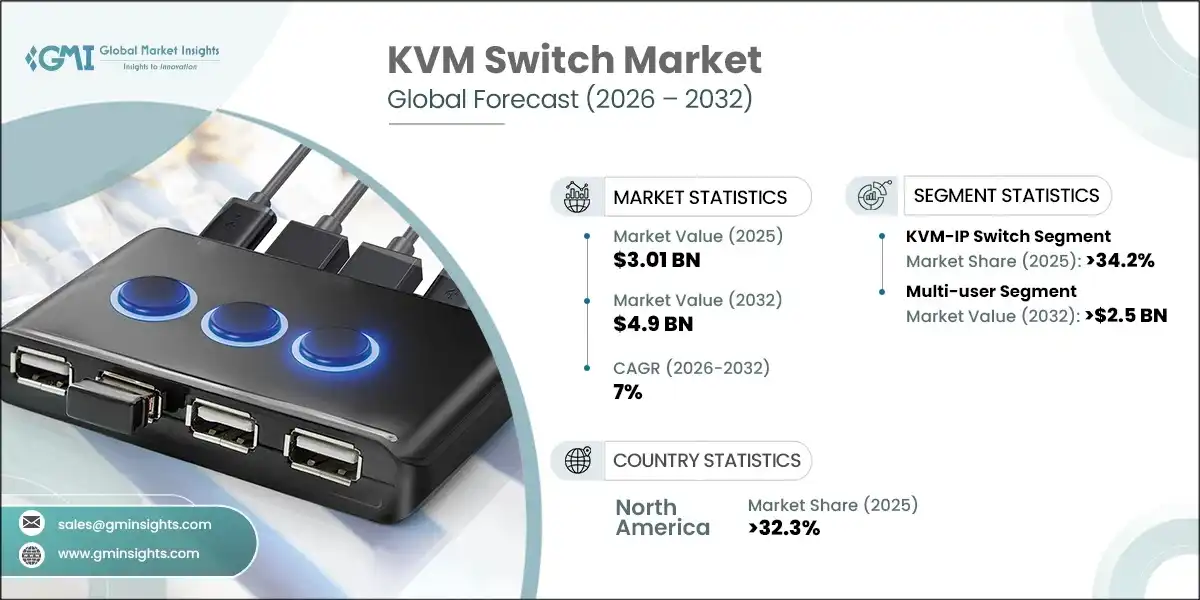
The global KVM switch market size was valued at USD 3.01 billion in 2025 and is anticipated to register a CAGR of 7% between 2026 and 2032. The KVM switch market is witnessing steady growth, driven by the rapid expansion of digital data, cloud computing adoption, and large-scale data center deployments worldwide. As enterprises consolidate and scale data center infrastructure, the need for centralized and efficient server management has increased significantly. KVM switches enable IT administrators to control multiple servers from a single console, helping optimize rack space, reduce hardware costs, and improve operational efficiency—key factors contributing to the rising market size.
KVM Switch Market Key Takeaways
Market Size & Growth
- 2025 Market Size: USD 3.01 Billion
- 2032 Forecast Market Size: USD 4.9 Billion
- CAGR (2026–2032): 7.4%
Key Market Drivers
- Data center expansion and consolidation.
- Remote workforce and IT management.
- Cybersecurity concerns and compliance requirements.
- Efficiency and operational cost savings.
- Technological advancements and innovation.
Challenges
- Compatibility and integration issues.
- Emergence of software-based alternatives.
Get Market Insights & Growth Opportunities
Growing investments in hyperscale and regional data centers further support KVM market expansion. In 2024, major technology companies announced multi-billion-dollar investments in data center infrastructure across Southeast Asia, highlighting sustained demand for secure and scalable IT management solutions. In parallel, the widespread adoption of hybrid and remote work models has accelerated the need for remote server access and troubleshooting, reinforcing the role of KVM switches in maintaining business continuity and minimizing system downtime.
However, the KVM switch market faces competitive pressure from software-based alternatives such as virtualization platforms and remote desktop solutions. While these technologies offer flexibility and lower upfront costs, hardware-based KVM switches continue to be preferred in high-security, latency-sensitive, and compliance-driven environments, supporting their continued adoption across enterprise and data center applications.
To get key market trends
KVM Switch Market Trends
There's a growing trend towards KVM-over-IP solutions, which enable remote access and management of IT infrastructure over IP networks. These solutions provide flexibility and scalability, allowing administrators to control servers and devices from anywhere with an internet connection. With the rise of distributed work environments and the need for remote IT management, KVM-over-IP solutions offer significant advantages in terms of accessibility, security, and ease of deployment.
For example, in June 2024, UVS reports a 75% increase in demand for KVM (Keyboard, Video, and Mouse) solutions, indicating a significant surge in the adoption of these virtualization technologies. The primary reason for this robust growth is the rising adoption of cloud computing and data center consolidation, which require advanced KVM solutions for remote access and management.
KVM switch vendors are increasingly integrating their solutions with cloud management platforms, such as AWS, Azure, and Google Cloud. This trend enables seamless management of both on-premises and cloud-based infrastructure from a single interface. Administrators can provision, monitor, and control servers and virtual machines across hybrid cloud environments, streamlining operations and improving efficiency.
For instance, in April 2024, Veeam Software expanded its Data Platform to include support for host-based backups of VMs running on Oracle Linux KVM hypervisor. This move further enhances the freedom of choice for customers in virtualization, allowing them to select and migrate to the platforms that best suit their needs while maintaining seamless data management, security, and protection.
KVM Switch Market Analysis

Learn more about the key segments shaping this market
Based on switch type, the market is segmented into KVM-Desktop switch, KVM-IP switch, KVM-Secure switch, KVM High-Performance switch, and others. The KVM-IP switch segment accounted for the largest market share with over 34.2% in 2025.
- The KVM (Keyboard, Video, Mouse) switch market witnessed a significant shift in 2025, with the KVM-IP switch segment emerging as the dominant player, capturing over 34.2% of the market share. This surge in demand for KVM-IP switches reflects the growing need for remote management capabilities in modern IT environments. For example, manufacturers such as ATEN International Co., Ltd. and Vertiv Group Corp. reported substantial sales and adoption of KVM-IP switches, attributing their success to the switches' ability to provide remote access and control of servers and devices via IP networks.
- The integration of KVM-IP switches with cloud management platforms and virtualization technologies has further fueled their adoption. As organizations increasingly embrace remote work and distributed IT setups, the remote management capabilities offered by KVM-IP switches have become indispensable for ensuring operational continuity and efficiency.

Learn more about the key segments shaping this market
The KVM switch market, by user type, is segmented into single-user and multi-user systems. The multi-user segment is the fastest growing, expected to expand at a CAGR of over 7% through 2032 and reach a market value of more than USD 2.5 billion by 2032, driven by rising demand for collaborative and centralized server management. This growth trajectory reflects the growing recognition among businesses of the benefits offered by multi-user KVM switch solutions in terms of cost savings, improved productivity, and streamlined IT management processes. For example, Vertiv Group Corp., a prominent player in the KVM switch market, attributes the sustained expansion of the multi-user segment to the increasing deployment of collaborative work environments and the need for centralized control and access management across multiple users.
- As organizations continue to prioritize efficiency and collaboration in their IT operations, the demand for multi-user KVM switch solutions is poised to remain robust, driving significant market growth in the coming years.

Looking for region specific data?
The North America KVM switch market holds the largest market share over 32.3% in 2025. North America's mature IT infrastructure, characterized by data centers, server rooms, and IT-intensive industries, drives demand for KVM switch solutions. The region's robust IT ecosystem, widespread cloud computing, IoT technologies, and digital transformation initiatives also drive demand. Stringent regulatory compliance requirements and cybersecurity concerns in sectors like finance, healthcare, and government further fuel the adoption of KVM switches to enhance data security, streamline IT operations, and ensure regulatory compliance.
The United States is a key player in the KVM switch market due to its strong economic foundation and global technology hub status. The country's thriving IT and telecommunications sectors, along with the adoption of advanced technologies like virtualization and cloud computing, make it an ideal location for KVM switch deployment. The demand for remote work arrangements and efficient IT management solutions, particularly during global events like the COVID-19 pandemic, further drives the market's growth.
China's KVM switch market is experiencing rapid growth due to its growing IT infrastructure, expanding data center market, and widespread adoption of cloud computing and digital technologies. The demand for KVM switch solutions is expected to rise, supported by government initiatives for IT modernization and cybersecurity measures.
Germany's robust industrial sector, renowned for automation and Industry 4.0 initiatives, has driven the adoption of KVM switches. These technological tools are crucial for optimizing IT management and control in production facilities, research laboratories, and engineering environments. Germany's focus on innovation and technological leadership further fuels the KVM switch market's growth.
Japan's IT infrastructure, technological innovation, and widespread adoption of advanced technologies in sectors like automotive, electronics, and healthcare drive the market for KVM switches. Japanese enterprises value reliability, performance, and scalability in IT solutions, making KVM switches essential for data center management, remote access, and server control. Japan's commitment to digital transformation and smart technology initiatives predicts sustained growth in KVM switch solutions.
KVM switches are gaining popularity in South Korea due to its thriving technology sector, dynamic IT ecosystem, and rapid digitalization efforts. South Korean enterprises prioritize efficiency, security, and connectivity in their IT infrastructure, driving demand for KVM switch solutions. As South Korea invests in emerging technologies like 5G, IoT, and AI, the demand for KVM switches is expected to rise, demonstrating its commitment to innovation and technological leadership.
KVM Switch Market Share
Aten International Co., Ltd. and Vertiv Holdings Co together hold a combined market share of over 10%, supported by their well-established KVM switch portfolios. Aten International is widely known for delivering dependable and scalable solutions that fit a broad range of enterprise needs, while Vertiv focuses on innovation and a strong customer-first approach. Both companies help organizations improve IT infrastructure management, enhance operational efficiency, and maintain reliable connectivity across critical environments such as data centers, telecommunications networks, and healthcare facilities.
The KVM switch market is highly competitive, with several global and regional players including Dell Technologies, Belkin International, Tripp Lite, Black Box KVM Limited, and Adder Technology Limited. These companies continue to compete on product performance, pricing, and geographic reach. As competition increases, market participants are expected to invest more in feature upgrades, expand their regional footprint, and pursue strategic partnerships to stay competitive and address evolving customer requirements.
KVM Switch Market Companies
Major players operating in the KVM switch industry are:
- Aten International Co., Ltd.
- Vertiv Holdings Co
- Dell Technologies Inc.
- Belkin International, Inc.
- Tripp Lite
- Black Box KVM Limited
- Adder Technology Limited
KVM Switch Market Report Attributes
| Key Takeaway | Details |
|---|---|
| Market Size & Growth | |
| Base Year | 2025 |
| Market Size in 2025 | USD 3.01 Billion |
| Forecast Period 2026 - 2032 CAGR | 7.4% |
| Market Size in 2032 | USD 4.9 Billion |
| Key Market Trends | |
| Growth Drivers |
|
| Pitfalls & Challenges |
|
What are the growth opportunities in this market?
KVM Switch Industry News
- In March 2024, Vertiv joined the NVIDIA Partner Network, leveraging its expertise in high-density power and cooling infrastructure to support the adoption of NVIDIA technologies. This partnership is expected to drive innovation in data centers and edge computing.
- In February 2023, Dell Technologies launched The Dell UltraSharp 43 4K USB-C Hub Monitor (U4323QE). The monitor includes a built-in USB hub, allowing users to connect multiple devices and charge their laptops. It also supports KVM (keyboard, video, and mouse) switching, enabling the use of a single mouse and keyboard with multiple computers.
The KVM switch market research report includes in-depth coverage of the industry with estimates & forecast in terms of revenue (USD Million) from 2021 to 2032, for the following segments:
Market, By Switch type
- KVM-desktop switch
- KVM-IP switch
- KVM-secure switch
- KVM high-performance switch
- Others
Market, By Use-type
- Single-user
- Multi-user
Market, By Organization size
- Small & medium enterprises (SME)
- Large enterprises
Market, By End-Use industry
- Aviation
- Datacenters
- Government
- Healthcare & pharmaceutical
- IT & telecom
- Media & entertainment
- Marine
- Military & defense
- Others
The above information is provided for the following regions and countries:
- North America
- U.S.
- Canada
- Europe
- Germany
- UK
- France
- Italy
- Spain
- Rest of Europe
- Asia Pacific
- China
- Japan
- India
- South Korea
- ANZ
- Rest of Asia Pacific
- Latin America
- Brazil
- Mexico
- Rest of Latin America
- MEA
- UAE
- Saudi Arabia
- South Africa
- Rest of MEA
Frequently Asked Question(FAQ) :
What is the KVM switch market size in 2025?
The market KVM switch was valued at USD 3.01 billion in 2025. The market's growth is driven by the increasing adoption of centralized server management, cloud computing, and large-scale data center deployments.
What is the projected value of the KVM switch market by 2032?
The market size for KVM switch is expected to reach USD 4.9 billion by 2032, growing at a CAGR of over 7%. This growth is fueled by the increasing need for cost-effective, scalable, and collaborative server management solutions.
What was the market share of the KVM-IP switch segment in 2025?
The KVM-IP switch segment accounted for over 34.2% of the market share in 2025, making it the largest segment. Its dominance is attributed to the growing demand for remote server management and secure access solutions.
What is the growth outlook for the multi-user segment from 2025 to 2032?
The multi-user segment is projected to grow at a CAGR of over 7% through 2032, reaching a market value exceeding USD 2.5 billion. This growth is driven by the rising adoption of collaborative and centralized server management systems.
KVM Switch Market Scope
Related Reports