Summary
Table of Content

Knee Braces Market
Get a free sample of this report
Form submitted successfully!
Error submitting form. Please try again.
Thank you!
Your inquiry has been received. Our team will reach out to you with the required details via email. To ensure that you don't miss their response, kindly remember to check your spam folder as well!
Request Sectional Data
Thank you!
Your inquiry has been received. Our team will reach out to you with the required details via email. To ensure that you don't miss their response, kindly remember to check your spam folder as well!
Form submitted successfully!
Error submitting form. Please try again.
Knee Braces Market Size
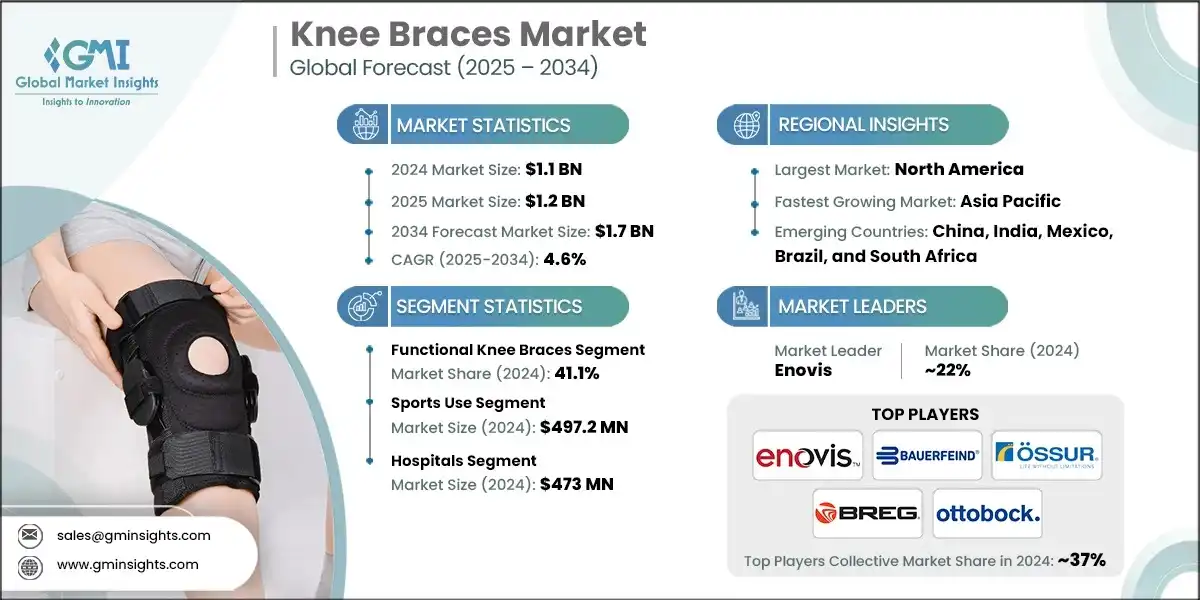
The global knee braces market was valued at USD 1.1 billion in 2024. The market is expected to grow from USD 1.2 billion in 2025 to USD 1.7 billion in 2034, at a CAGR of 4.6% during the forecast period, according to the latest report published by Global Market Insights Inc. The high market growth is attributed to the surging prevalence of osteoarthritis and orthopedic conditions, the rising number of road accidents and sports-related injuries, and the increasing geriatric population prone to knee ailments.
To get key market trends
Knee braces are transforming orthopedic care with their potential to enhance joint stability, prevent injury, and rehabilitate post-surgery. These devices ensure the provision of focused support for ligament injuries, osteoarthritis, and other sports-related conditions, thus guaranteeing better mobility and recovery in a speedier manner. Advanced knee braces reduce treatment delay, optimize rehabilitation protocols, and provide patients with precision-driven solutions.
Top companies like enovis, BAUERFEIND, OSSUR, BREG, and ottobock design state-of-the-art knee braces integrating lightweight composite materials, adjustable compression systems, and smart sensor integrations. Their patient-centric platforms include functional, prophylactic, and rehabilitative braces, addressing diverse needs from sports injury prevention to chronic disease management. With innovations like custom-fit solutions, modified hinge technologies, and IoT-enabled monitoring, these companies support personalized care, enhanced comfort, and long-term joint health stability.
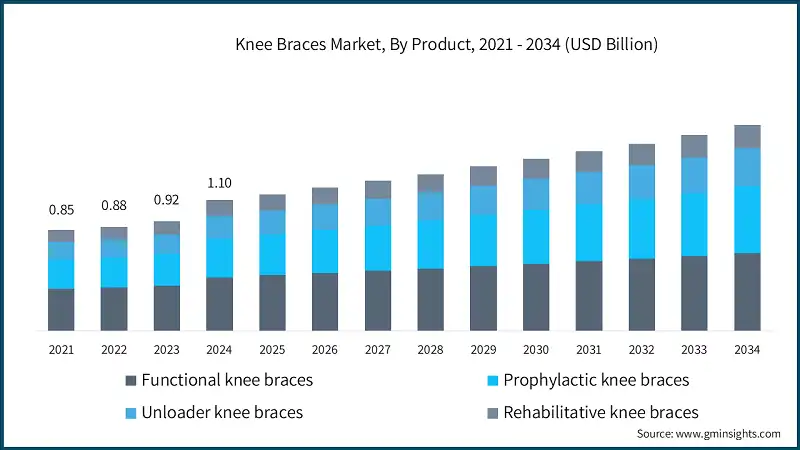
The market has increased from USD 851.6 million in 2021 and reached USD 922.8 million in 2023, with a historic growth rate of 4.1%. This expansion has been driven by the rising prevalence of knee injuries and osteoarthritis, growing participation in sports and fitness activities, advancements in brace design and materials, and increasing demand for non-invasive treatment options for joint stability and pain management.
Knee injuries and degenerative joint conditions like osteoarthritis are becoming increasingly common due to aging populations, sedentary lifestyles, and growing participation in high-impact sports. For instance, according to an article published by the medRxiv Journal, Osteoarthritis affected 607 million people globally in 2021, leading to chronic pain and reduced mobility.
Similarly, sports-related knee injuries, such as ligament tears and meniscus damage, are on the rise among both professional athletes and recreational fitness enthusiasts. These conditions create a sustained demand for knee braces as a non-invasive, cost-effective solution for pain relief, joint stabilization, and rehabilitation, reducing the need for surgical interventions and supporting long-term mobility.
A knee brace is a type of medical device that has been designed to offer support, protection, and stabilization to the knee joint. Knee braces are meant to be preventive of injury, assist during the recovery phase after an injury or surgical procedure, and help manage chronic conditions such as osteoarthritis.
Knee Braces Market Report Attributes
| Key Takeaway | Details |
|---|---|
| Market Size & Growth | |
| Base Year | 2024 |
| Market Size in 2024 | USD 1.1 Billion |
| Market Size in 2025 | USD 1.2 Billion |
| Forecast Period 2025 - 2034 CAGR | 4.6% |
| Market Size in 2034 | USD 1.7 Billion |
| Key Market Trends | |
| Drivers | Impact |
| Surging prevalence of osteoarthritis and orthopedic conditions | Boosts demand for braces as non-invasive pain and mobility solutions. |
| Rising number of road accidents and sports-related injuries | Drives adoption for recovery and rehabilitation. |
| Technological advancements | Improves comfort and performance, attracting premium buyers. |
| Increasing geriatric population prone to knee ailments | Expands user base for mobility and joint support. |
| Pitfalls & Challenges | Impact |
| Lack of education about preventive care and rehabilitation options | Limits penetration in emerging markets. |
| High cost of knee braces | Restricts uptake in price-sensitive regions. |
| Opportunities: | Impact |
| Integration of IoT and sensor technology for real-time monitoring and rehabilitation support | Enables smart monitoring and personalized rehab. |
| Customization and comfort-oriented designs | Improves compliance and supports premium pricing. |
| Market Leaders (2024) | |
| Market Leaders |
~22% |
| Top Players |
Collective market share in 2024 is ~37% |
| Competitive Edge |
|
| Regional Insights | |
| Largest Market | North America |
| Fastest Growing Market | Asia Pacific |
| Emerging Country | China, India, Mexico, Brazil, and South Africa |
| Future Outlook |
|
What are the growth opportunities in this market?
Knee Braces Market Trends
Technological innovation has significantly transformed the market, making products more effective, comfortable, and patient-friendly.
- Modern orthopedic braces now incorporate lightweight composite materials such as carbon fiber and advanced polymers, which reduce bulk while maintaining strength and durability. These improvements enhance patient compliance by offering better mobility and comfort compared to traditional heavy designs.
- Moreover, the integration of smart sensors and IoT-enabled features allows real-time monitoring of knee movement, pressure distribution, and rehabilitation progress. Connected braces can transmit data to healthcare providers, enabling personalized treatment plans and remote physiotherapy support. This digital integration aligns with the growing trend of telehealth and home-based care, making knee braces an essential component of modern orthopedic management.
- Additionally, customization through 3D printing and AI-driven design is gaining traction. Patients can now receive braces tailored to their anatomy, ensuring optimal fit and functionality. This not only improves therapeutic outcomes but also enhances user comfort and satisfaction. Combined with adjustable hinge systems and modular components, these innovations cater to diverse needs, from sports injury prevention to chronic disease management.
Knee Braces Market Analysis
Learn more about the key segments shaping this market
Based on product, the knee braces market is segmented into functional knee braces, prophylactic knee braces, unloader knee braces, and rehabilitative knee braces. The functional knee braces segment accounted for 41.1% of the market in 2024 due to their widespread use in managing ligament injuries, providing joint stability during rehabilitation, and preventing re-injury in athletes. The segment is expected to exceed USD 656.3 million by 2034, growing at a CAGR of 3.8% during the forecast period.
On the other hand, the prophylactic knee braces segment held a significant market share of 29.4% in 2024, and its growth can be attributed to the increasing emphasis on injury prevention among athletes and physically active individuals. These braces are widely adopted in sports medicine to reduce the risk of ligament tears and knee instability during high-impact activities.
- This dominance of the functional knee braces segment is further reinforced by their versatility in both clinical and sports settings, combined with growing awareness of preventive care and advancements in lightweight, ergonomic designs, which have driven strong adoption across hospitals, orthopedic clinics, and retail channels. Functional knee braces are widely used for ligament stabilization, post-surgical recovery, and injury prevention among athletes, making them a preferred choice for both acute and chronic conditions.
- The unloader knee braces segment held a revenue of USD 193.7 million in 2024, with projections indicating a steady expansion at 5.1% CAGR from 2025 to 2034. This growth is fueled by the rising prevalence of osteoarthritis, increasing preference for non-invasive pain management solutions, and growing awareness of joint unloading technology for reducing pressure on affected compartments. Advancements in lightweight materials, ergonomic designs, and adjustable tension systems have further enhanced patient comfort and compliance, driving adoption among aging populations and individuals seeking alternatives to surgical interventions.
- The rehabilitative knee braces segment held a revenue of USD 131.3 million in 2024, with projections indicating a steady expansion at 4.1% CAGR from 2025 to 2034. This growth is fueled by the increasing number of post-surgical recovery cases, rising adoption of structured rehabilitation programs, and growing preference for non-invasive solutions to restore mobility. These braces play a critical role in stabilizing the knee during healing, reducing complications, and accelerating recovery timelines.
Based on application, the knee braces market is segmented into sports use, ligament, and other applications. The sports use segment continues to dominate, accounting for a majority market share valued at USD 497.2 million in 2024.
- This dominance is primarily driven by the rising incidence of sports-related knee injuries, increasing participation in professional and recreational sports, and growing awareness of preventive care among athletes. Functional and prophylactic knee braces are widely adopted to provide joint stability, reduce injury risk, and support rehabilitation, making them essential in sports medicine.
- The ligament segment held a revenue of USD 351 million in 2024, with projections indicating a steady expansion at 5.4% CAGR from 2025 to 2034. This growth is fueled by the rising incidence of ligament injuries such as ACL and MCL tears, increasing participation in high-impact sports, and growing adoption of functional braces for post-surgical recovery and injury prevention. Enhanced brace designs featuring adjustable hinges, lightweight materials, and improved stabilization technology have further boosted demand.
- The other applications segment held a revenue of USD 252.9 million in 2024, with projections indicating a steady expansion at 4.8% CAGR from 2025 to 2034. This growth is fueled by the increasing use of knee braces for conditions beyond ligament injuries and osteoarthritis, such as patellar tracking disorders, tendonitis, and post-fracture stabilization. Rising awareness of preventive care and rehabilitation in non-sports contexts, coupled with advancements in brace designs for specialized needs, has supported adoption.
Learn more about the key segments shaping this market
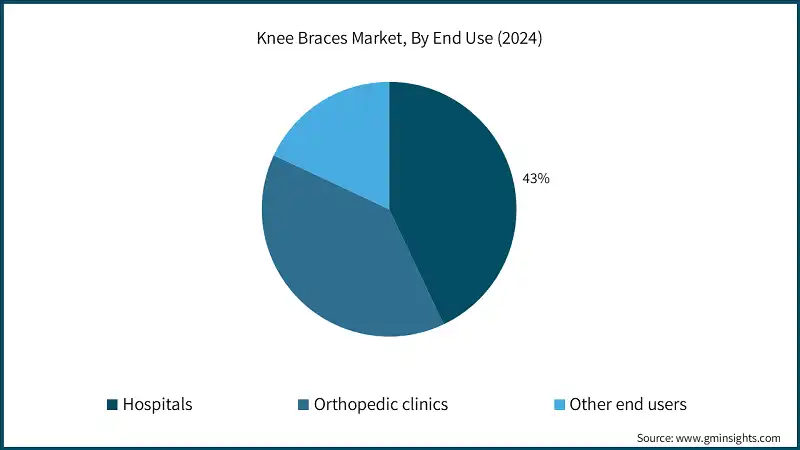
Based on end use, the knee braces market is segmented into hospitals, orthopedic clinics, and other end users. The hospitals segment accounted for USD 473 million in 2024 and is expected to grow at a 4.4% CAGR from 2025 to 2034.
- This growth is driven by the increasing number of orthopedic surgeries and post-operative rehabilitation cases, rising adoption of advanced knee braces for inpatient care, and the availability of skilled professionals for brace fitting and monitoring. Hospitals remain a primary point of care for severe injuries and complex conditions, ensuring consistent demand for functional and rehabilitative braces. Additionally, partnerships with manufacturers for bulk procurement and integration of smart bracing solutions into recovery protocols further strengthen this segment’s growth trajectory.
- The orthopedic clinics segment accounted for USD 429.6 million in 2024 and is expected to grow at a 5.1% CAGR from 2025 to 2034, driven by the increasing preference for specialized care, the rising number of outpatient procedures, and growing adoption of knee braces for sports injuries and post-surgical rehabilitation. Clinics offer personalized treatment plans and expert fitting services, which enhance patient outcomes and compliance.
- The other end users segment accounted for USD 198.6 million in 2024 and is expected to grow at a 4.2% CAGR from 2025 to 2034. This growth is driven by the increasing convenience of e-commerce platforms, rising consumer preference for home delivery, and expanding availability of branded and generic knee braces online. Competitive pricing, easy product comparisons, and integration of telehealth consultations further enhance adoption.
Looking for region specific data?
North America Knee Braces Market
North America dominated the market with the highest market share of 38.9% in 2024.
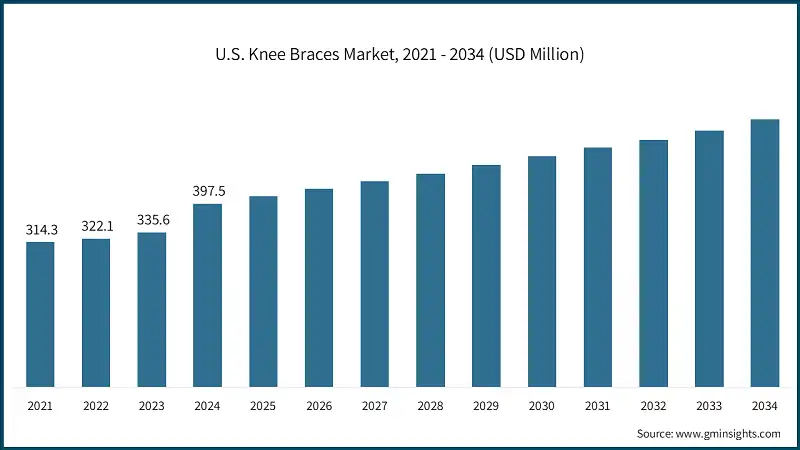
- The U.S. market was valued at USD 314.3 million and USD 322.1 million in 2021 and 2022, respectively. The market size reached USD 397.5 million in 2024, growing from USD 335.6 million in 2023, and is anticipated to grow at a CAGR of 3.8% between 2025 and 2034.
- According to the Centers for Disease Control and Prevention, the U.S. accounts for 58.5 million cases of arthritis, creating strong demand for functional and rehabilitative braces. The region benefits from favorable reimbursement policies under Medicare and Medicaid, further boosting adoption. Additionally, the presence of leading players ensures continuous innovation and product availability.
- The growing popularity of preventive care in sports and the rise in outpatient orthopedic procedures have strengthened demand across hospitals, clinics, and retail channels. With increasing awareness and strong distribution networks, the region is expected to maintain its dominance in the market over the forecast period.
Europe Knee Braces Market
Europe market accounted for USD 291.4 million in 2024 and is anticipated to show lucrative growth over the forecast period.
- Europe’s market is expanding steadily, supported by a growing aging population and rising incidence of musculoskeletal disorders such as osteoarthritis and ligament injuries.
- Countries like Germany, France, and the UK lead the regional market due to high healthcare spending and strong adoption of orthopedic solutions. The region also benefits from well-established distribution channels, including retail and e-commerce platforms, which make knee braces easily accessible to consumers.
- The demand for prophylactic and rehabilitative braces is increasing in Europe, driven by sports injury prevention and post-operative recovery needs. Technological innovations, such as ergonomic designs and breathable materials, are improving patient comfort and compliance.
Asia Pacific Knee Braces Market
The Asia Pacific market is anticipated to grow at a CAGR of 5.7% during the analysis timeframe.
- Asia Pacific is the fastest-growing knee braces market, fueled by demographic shifts, rising healthcare expenditure, and increasing awareness of orthopedic care.
- Countries like China and India dominate the regional market due to large populations, growing incidence of osteoarthritis, and expanding hospital infrastructure.
- The adoption of knee braces for post-surgical rehabilitation and sports injury prevention is accelerating, supported by government initiatives to improve healthcare access.
- Technological advancements, including 3D-printed custom-fit braces and IoT-enabled monitoring systems, are gaining popularity in developed markets like Japan and South Korea.
Latin America Knee Braces Market
The Latin America market is experiencing robust growth over the analysis timeframe.
- Latin America’s market is growing rapidly, driven by increasing sports participation, rising road accidents, and a growing burden of bone disorders such as osteoarthritis and osteoporosis.
- Brazil and Mexico are key contributors, supported by improving healthcare infrastructure and growing awareness of preventive care.
- Moreover, functional braces dominate the regional market due to their widespread use in recovery injury and sports medicine.
Middle East & Africa Knee Braces Market
The Middle East & Africa (MEA) market is experiencing notable growth over the analysis timeframe.
- The MEA market is expanding steadily, supported by the rising prevalence of orthopedic conditions, obesity-related joint issues, and growing awareness of non-invasive treatment options.
- Countries like Saudi Arabia and South Africa are leading the regional market, driven by improving healthcare infrastructure and increasing sports-related injuries.
Knee Braces Market Share
Leading industry players such as enovis, BAUERFEIND, OSSUR, BREG, and ottobock collectively hold a 37% share of the market, accounting for a significant portion of total revenue. These companies maintain leadership through robust portfolios of functional, prophylactic, rehabilitative, and unloader braces, supported by advanced engineering, clinical validation, and strong brand reputation. Their competitive edge is reinforced by innovations in lightweight composite materials, adjustable hinge systems, and smart sensor integration, along with strategic investments in digital health and tele-rehabilitation platforms.
Emerging players are gaining traction by focusing on custom-fit solutions, 3D-printed designs, and IoT-enabled braces for real-time monitoring. These companies leverage digital platforms, AI-driven motion analysis, and collaborations with physiotherapy providers to deliver personalized rehabilitation experiences. Their emphasis on affordability, ergonomic comfort, and preventive care positions them as agile contenders in a market increasingly shaped by smart healthcare technologies and patient-centric orthopedic solutions.
Knee Braces Market Companies
A few of the prominent players operating in the knee braces industry include:
- 3M
- ALEX ORTHOPEDIC
- BAUERFEIND
- BREG
- Dicarre
- enovis
- essity
- HELY & WEBER
- MCDAVID
- MEDI-DYNE
- MEDLINE
- MUELLER SPORTS MEDICINE
- OSSUR
- ottobock
- push braces
- tynor
- enovis
enovis is a global leader in orthopedic solutions with a USP centered on innovation in bracing and rehabilitation technologies. Its strength lies in a comprehensive portfolio of functional, prophylactic, and rehabilitative knee braces designed for sports medicine and post-surgical recovery. enovis differentiates itself through advanced hinge systems, lightweight composite materials, and customizable fit technologies that enhance patient comfort and compliance.
BAUERFEIND stands out for its USP of premium-quality orthopedic braces and support products, backed by decades of German engineering excellence. Its knee braces are recognized for ergonomic designs, superior comfort, and medical-grade materials, making them a preferred choice for both clinical and sports applications. BAUERFEIND’s competitive edge lies in its commitment to precision fit, durability, and patient-centric solutions, supported by continuous R&D and collaborations with healthcare professionals.
OSSUR’s USP is built on innovation in mobility and functional bracing solutions, with a strong focus on osteoarthritis management and sports injury prevention. The company excels in proprietary hinge systems, lightweight designs, and smart bracing technologies that integrate sensor-based monitoring for real-time rehabilitation feedback. OSSUR’s emphasis on digital health, customization, and evidence-based product development ensures superior clinical outcomes and patient satisfaction.
Knee Braces Industry News:
- In January 2024, Enovis Corporation announced the launch of the DonJoy ROAM OA knee brace, designed for patients with osteoarthritis and other knee pain or instability. This product aims to relieve pain, improve stability, and enhance mobility by shifting weight away from the affected knee compartment. This product launch helped the company gain a competitive edge over its peers.
- In September 2021, OSSUR announced the launch of the REBOUND ACL brace, an advanced knee brace intended for patients recovering from anterior cruciate ligament (ACL) injury. This product reduces strain on a patient's ACL and provides a comfortable load on their posterior thigh and anterior tibia and is incorporated with a dynamic tension system (DTS). This innovative launch helped the company to enhance its product portfolio and increase its business revenue.
The knee braces market research report includes an in-depth coverage of the industry with estimates and forecasts in terms of revenue in USD Million from 2021 - 2034 for the following segments:
Market, By Product
- Functional knee braces
- Prophylactic knee braces
- Unloader knee braces
- Rehabilitative knee braces
Market, By Application
- Sports use
- Ligament
- Other applications
Market, By End Use
- Hospitals
- Orthopedic clinics
- Other end use
The above information is provided for the following regions and countries:
- North America
- U.S.
- Canada
- Europe
- Germany
- UK
- France
- Spain
- Italy
- Netherlands
- Asia Pacific
- China
- Japan
- India
- Australia
- South Korea
- Latin America
- Brazil
- Mexico
- Argentina
- Middle East and Africa
- South Africa
- Saudi Arabia
- UAE
Frequently Asked Question(FAQ) :
Who are the key players in the knee braces market?
Key players include 3M, ALEX ORTHOPEDIC, BAUERFEIND, BREG, Dicarre, enovis, essity, HELY & WEBER, MCDAVID, and MEDI-DYNE.
How much revenue did the functional knee braces segment generate?
The functional knee braces segment accounting for 41.1% of the market share.
What was the valuation of the hospitals segment?
The hospitals segment generated USD 473 million in 2024 and is projected to grow at a CAGR of 4.4% from 2025 to 2034.
Which region leads the knee braces market?
North America led the market with a 38.9% share in 2024, driven by advanced healthcare infrastructure and a high prevalence of knee-related conditions.
What are the upcoming trends in the knee braces industry?
Key trends include the use of lightweight composite materials, integration of IoT-enabled features for real-time monitoring, and the growing adoption of telehealth and home-based care solutions.
What is the projected size of the knee braces market in 2025?
The market is expected to reach USD 1.2 billion in 2025.
What is the projected value of the knee braces market by 2034?
The market is expected to reach USD 1.7 billion by 2034, fueled by advancements in product technology, increasing sports injuries, and the adoption of telehealth solutions.
What is the market size of the knee braces market in 2024?
The market size was USD 1.1 billion in 2024, with a CAGR of 4.6% expected through 2034, driven by the rising prevalence of osteoarthritis, orthopedic conditions, and an aging population prone to knee ailments.
Knee Braces Market Scope
Related Reports