Summary
Table of Content

Kitchen Sinks Market
Get a free sample of this report
Form submitted successfully!
Error submitting form. Please try again.
Thank you!
Your inquiry has been received. Our team will reach out to you with the required details via email. To ensure that you don't miss their response, kindly remember to check your spam folder as well!
Request Sectional Data
Thank you!
Your inquiry has been received. Our team will reach out to you with the required details via email. To ensure that you don't miss their response, kindly remember to check your spam folder as well!
Form submitted successfully!
Error submitting form. Please try again.
Kitchen Sinks Market Size
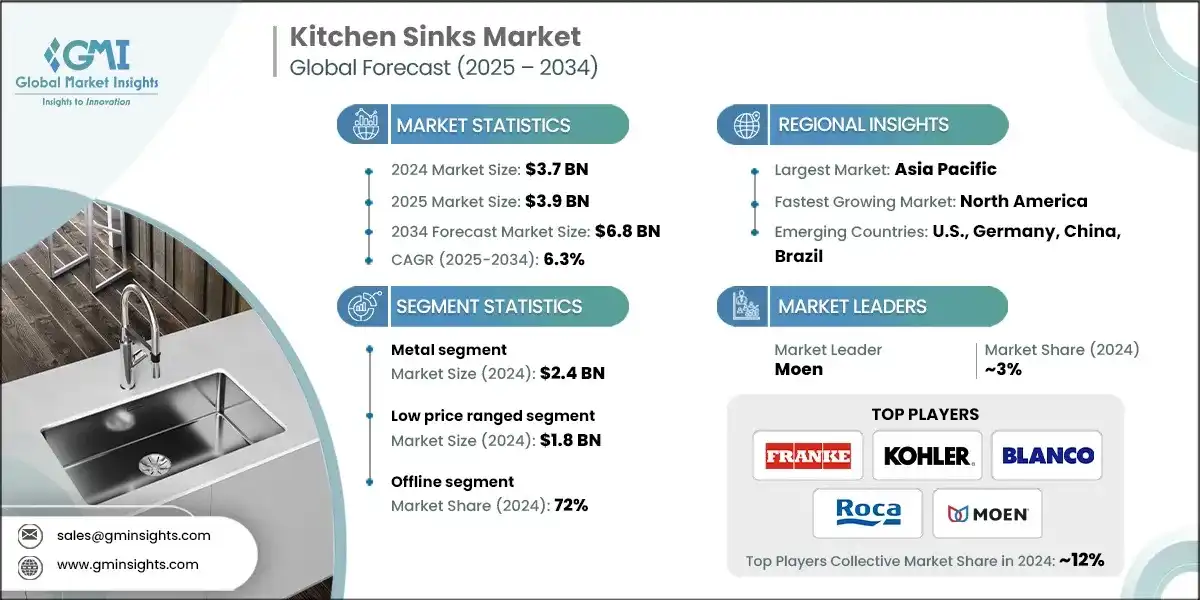
The global kitchen sinks market size was estimated at USD 3.7 billion in 2024. The market is expected to grow from USD 3.9 billion in 2025 to USD 6.8 billion in 2034, at a CAGR of 6.3%, according to Global Market Insights Inc.
To get key market trends
- The rising residential construction and remodeling has increased the demand for modern kitchen designs, leading to a need for stylish and functional kitchen sinks. The new residential construction and renovation have elevated the demand for contemporary kitchen designs, so stylish and functional kitchen sinks are needed. The homeowners want to make their kitchen not only look better but also be more functional, hence the variety of sink designs, materials, and functionality is crucial. The trend towards modular kitchens has a significant impact on the kitchen sink market.
- Modular kitchens are favored as they are space-efficient and look good. The trend promotes the application of creative sink designs that complement the overall design of the kitchen and enhance functionality. Additionally, consumers are becoming more aware of the environmental impact of kitchen products. As a result, more people are looking for kitchen sinks made from sustainable and durable materials, like stainless steel and composite materials. These materials not only last long but also fit with eco-friendly home design trends.
- New sinks are now also featured with advanced functions like built-in sprays, soap dispensers, and waste management systems, making them more popular. Moen, for example, has launched a touchless faucet with motion sensor, allowing activation by a single hand motion or utensil movement. This is water-saving technology that simplifies work by removing the task of personally operating the faucet.
- Furthermore, the increasing homeownership rate has also boosted investments in stylish and luxurious kitchen upgrades. Consumers are choosing products that combine good looks with modern technology. Renovation activity stayed strong in 2023, with over half of homeowners (55%) taking on projects. They plan to spend a median of $15,000, and high-budget renovations can reach up to $85,000, according to the 2023 U.S. Houzz & Home Study. This ongoing focus on home improvement drives demand for kitchen sinks, which are essential in modern kitchen upgrades. Homeowners looking for functionality, design, and technology in their kitchen renovations are more likely to seek premium sink solutions that help enhance both utility and aesthetics. This trend highlights the importance of kitchen sinks as key items in the growing market for home improvement products.
Kitchen Sinks Market Report Attributes
| Key Takeaway | Details |
|---|---|
| Market Size & Growth | |
| Base Year | 2024 |
| Market Size in 2024 | USD 3.7 Billion |
| Forecast Period 2025 - 2034 CAGR | 6.3% |
| Market Size in 2034 | USD 6.8 Billion |
| Key Market Trends | |
| Drivers | Impact |
| Increasing numbers of quick service restaurants & food joints across the globe | Boosts demand for commercial-grade kitchen sinks that are durable and easy to maintain. It also drives innovation in sink designs tailored for high-volume food prep environments. |
| Rising residential construction and renovation activities | More housing projects and renovations increase the need for kitchen fixtures, making sinks a key purchase. This fuel demands across all price segments, especially in urban and suburban areas. |
| Consumer preference for sustainable and durable materials | Consumers are increasingly choosing sinks made from stainless steel, granite composite, and recycled materials. This shift encourages manufacturers to invest in eco-friendly production and long-lasting designs. |
| Pitfalls & Challenges | Impact |
| High installation and maintenance costs | These costs can deter budget-conscious consumers and slow adoption in price-sensitive markets. It also limits demand for premium or complex sink models requiring professional setup. |
| Market saturation | With numerous players offering related products, competition intensifies, leading to price wars and reduced profit margins. It also makes differentiation and brand loyalty harder to achieve. |
| Opportunities: | Impact |
| Expansion in smart and IoT-enabled kitchen fixtures | This encourages innovation in sink design, integrating features like touchless operation and water usage monitoring. It attracts tech-savvy consumers and adds value to premium kitchen setups. |
| Growing demand for modular and space-saving kitchen designs | Compact and multifunctional sink units are gaining popularity in urban homes with limited space. This drives demand for customizable and efficient sink solutions that fit modern kitchen layouts. |
| Market Leaders (2024) | |
| Market Leaders |
Market share of ~3% |
| Top Players |
Collective market share in 2024 is ~12%. |
| Competitive Edge |
|
| Regional Insights | |
| Largest Market | Asia Pacific |
| Fastest Growing Market | North America |
| Emerging Country | U.S., Germany, China, Brazil |
| Future Outlook |
|
What are the growth opportunities in this market?
Kitchen Sinks Market Trends
- The kitchen sink market has experienced advancements in recent years due to growing consumer demand for functional solutions. New sinks are equipped with built-in sprays, soap dispensers, and trash management systems, which enhance their attractiveness. For instance, Moen has introduced a motion-sensor touchless faucet that responds to a simple wave of the hand or movement of a utensil. These innovation safes water and provide convenience by eliminating contact with the faucet.
- The market also encompasses Internet of Things (IoT) technology that enables kitchen fixtures to talk to and interact with each other seamlessly. Some of the prominent advancements are motion sinks and innovative designs such as convertible sink configurations that transform kitchen islands into visually appealing spaces, complete with sink channels that resemble running rivers. GROHE Limited, for example, provides top-notch kitchen sinks with best-quality stainless steel material, including innovations such as the GROHE QuickFix system for simple installation and GROHE Whisper technology to reduce noise during usage.
- The increasing environmental awareness is another major trend in the market. Manufacturers are looking for environmentally friendly materials such as recycled stainless steel, composite granite, and bamboo to meet eco-aware consumers' demands. For example, Elkay's "Recycled Stainless Steel Sinks" and Blanco's "Silgranit" sinks are popular due to their eco-friendly make and durability.
- Additionally, the growing adoption of online shopping has improved the buying experience of customers, providing greater choices in terms of designs and brands. Websites like Wayfair and Home Depot are critical in improving product visibility and access, allowing consumers to make better choices.
Kitchen Sinks Market Analysis
Learn more about the key segments shaping this market
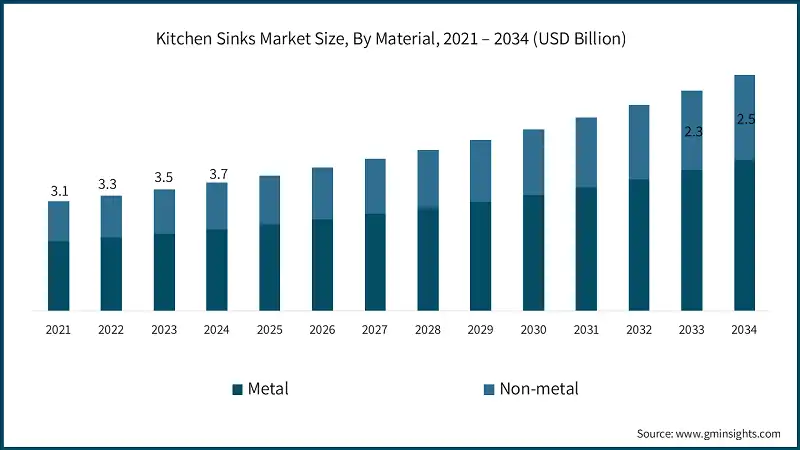
Based on the material the market is segmented into metal and non-metal. The metal segment accounted for revenue of USD 2.4 billion in 2024 and is anticipated to grow with a CAGR of 6.4% during the forecast period from 2025-2034.
- This growth is due to their long-lasting feature, attractive look, and resistance to corrosion. Metal sinks, particularly those of stainless steel, have become popular choices due to ease of maintenance. They complement contemporary kitchen styles and withstand hot temperature and usage. Moreover, they are cost-effective and recyclable, and this suits the trend towards sustainability. This accounts for their increasing popularity among households, companies, and hotels.
- Moreover, metal sinks also come in brushed, polished, or matte finishes, which make them a more attractive option. The fact that they are hygienic and can manage hot temperatures also makes them a popular choice. As people's preferences shift towards long-lasting and practical solutions, the metal segment remains the market leader.
Based on the price the kitchen sinks market is segmented into low, medium and high. The low price ranged kitchen sinks accounted for revenue of USD 1.8 billion in 2024 and is anticipated to grow with a CAGR of 6.4% during the forecast period from 2025-2034.
- Increasing urbanization and the surge in low-cost housing projects have fueled demand for affordable kitchen solutions, particularly in emerging markets. Also, budget-conscious shoppers and first-time homebuyers value functionality and affordability, thus low-cost sinks are a preferred pick.
- Furthermore, growth in online platforms has also increased availability, while companies are enhancing quality and aesthetics even at reduced price levels, additionally promoting demand.
Learn more about the key segments shaping this market
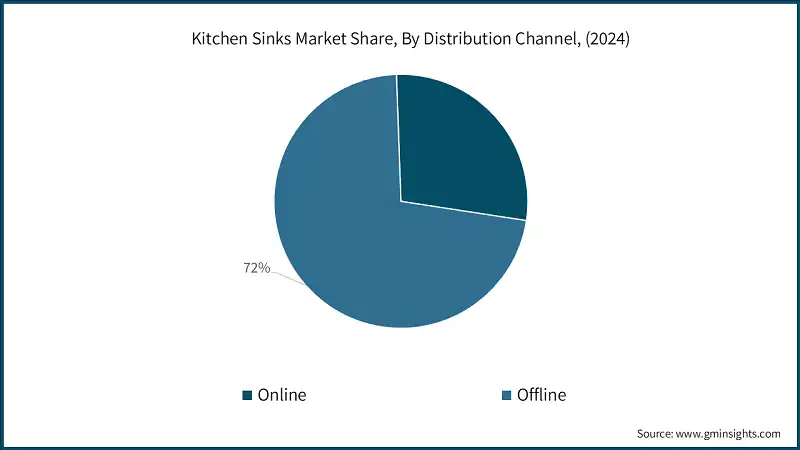
Based on the distribution channel, the kitchen sinks market is divided into online and offline. The offline segment accounts for the market share of around 72% in 2024 and is expected to grow at a CAGR of 6.3% over the forecast period.
- The offline segment leads the market due to the benefits provided by retail channels. Offline retail channels such as home improvement stores, showrooms, and specialty kitchen retailers allow consumers to physically explore products. This enables consumers to make informed purchases. Tactile exploration of various materials and styles allows consumers to evaluate quality and understand how suitably products will fit their kitchens.
- In addition, offline stores also provided professional advice and installation services, which enhance customers' trust in their purchases. The presence of well-known brands and promotion in physical outlets increases sales in this segment as well, making it a market with a significant share.
Looking for region specific data?
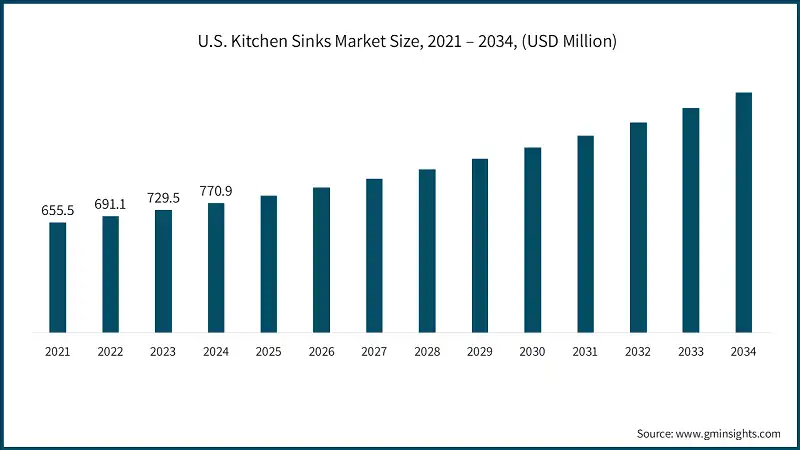
In terms of country, the U.S. dominated the North America kitchen sinks market with a share of around 75.8% in 2024 and is expected to grow at a CAGR of 6.4% in the forecast period from 2025-2034.
- The strong construction and renovation industries in the country drives the demand as homeowners invest more in updating their kitchens. The U.S. market favors high-quality materials, especially stainless steel and composite options, which are known for their durability and appealing look. The rising trend of customized kitchen designs and the increasing popularity of eco-friendly materials also boost market growth. The many established manufacturers and competitive retail environment give consumers more choices, solidifying the United States' status as the leader in the North American market.
The Europe kitchen sinks market is expected to grow at a CAGR of 6.2% over the forecast period.
- Germany maintains a significant share in the Europe market. The country benefits from a strong economy and high demand for premium home improvement products. Known for its quality manufacturing, Germany offers a wide range of kitchen sinks that focus on durability, functionality, and innovative design. German consumers value high-quality materials, like stainless steel and composites, for their long-lasting nature and attractive look. The trend towards modern and modular kitchen designs has also driven the demand for stylish sinks that match contemporary spaces. The presence of leading manufacturers and a solid distribution network further establishes Germany's strong position in the European market.
China dominated the kitchen sinks market in the Asia Pacific with a market share of around 30.5% in 2024 and is anticipated to grow at a CAGR of 6.9% during the forecast period.
- China has become the main player in the Asia Pacific market, driven by rapid urbanization, rising disposable incomes, and greater demand for modern home amenities. The increase in residential construction and renovation projects in urban areas has significantly raised the need for quality kitchen solutions, as consumers prefer sinks that are both stylish and functional.
- Chinese manufacturers have played a key role in this growth, providing a wide range of kitchen sinks that meet different consumer tastes in design, material, and price. Additionally, the growth of e-commerce platforms in China has made it easier for consumers to access a variety of kitchen sink options, further strengthening the country's position in the Asia Pacific market.
Saudi Arabia dominated the kitchen sinks market in the Middle East and Africa with a market share of 35.7% in 2024 and is anticipated to grow at a CAGR of 5.8% during the forecast period.
- The country is experiencing rapid urbanization, supported by government programs like Vision 2030, aimed at diversifying the economy and improving infrastructure. The increase in residential construction, along with rising investments in real estate, has driven up the demand for kitchen sinks. The trend toward modern and modular kitchens among urban residents has also contributed to market expansion.
- High disposable incomes in Saudi Arabia and changing consumer preferences for premium, visually appealing kitchen fixtures have significantly influenced demand. The hospitality sector, which is growing due to government support for tourism, is also boosting the market, as hotels and resorts invest more in quality kitchen infrastructure.
Kitchen Sinks Market Share
- In 2024, the prominent manufacturers in the market are Franke, Kohler, Blanco, Roca and Moen. Together these companies hold a market share of ~12% of the total market. The fragmented kitchen sinks industry comprises numerous regional companies competing on a global scale. To achieve success, these companies are focusing on product design innovation, expanding distribution channels, and prioritizing sustainability. They are also enhancing customer engagement through personalized solutions and leveraging e-commerce to broaden their reach, all while maintaining competitive pricing and quality standards.
- The market features a wide array of sink configurations, including single-bowl, double-bowl, and multi-bowl designs, crafted from materials such as stainless steel, composite granite, ceramic, and fireclay. Companies are heavily investing in design innovation, emphasizing improved ergonomics, enhanced water efficiency, and advanced noise reduction technologies. Furthermore, leading players are increasingly focusing on sustainable product offerings to meet the rising consumer demand for eco-friendly solutions.
- The competitive landscape is evolving with the growing importance of digital marketing strategies. Approaches such as social media campaigns, influencer collaborations, and precision-targeted online advertising are now critical for boosting brand recognition and fostering consumer engagement. Consequently, businesses must stay ahead of shifting trends in design, sustainability, and consumer behavior while ensuring profitability and competing effectively in an increasingly saturated market.
Kitchen Sinks Market Companies
Major players operating in the kitchen sinks industry are:
- American Standard
- Blanco
- BONKE
- Duravit
- Elkay
- Foster
- Franke
- Hafele
- Kohler
- Moen
- Nirali
- Reginox
- Roca
- Schock
- Teka
Kohler secures its leadership in the market by prioritizing premium design, continuous innovation, and a strong brand legacy. The company provides an extensive range of sink styles, materials, and finishes, appealing to both classic and modern kitchen designs. By incorporating smart technology and sustainable practices into its product development, Kohler effectively attracts environmentally conscious and tech-oriented consumers.
Blanco distinguishes itself in the market with its expertise in high-performance materials such as Silgranit and stainless steel, valued for their durability and hygienic properties. The company emphasizes ergonomic and functional designs, ensuring its products are practical and easy to maintain. With a dominant presence in Europe and a growing global footprint, Blanco customizes its offerings to meet regional preferences while maintaining high-quality standards.
Roca leverages its experience in ceramics and bathroom solutions to deliver stylish and functional kitchen sinks. The company focuses on providing value through modern designs, affordability, and accessibility, particularly in emerging markets. Roca’s global manufacturing capabilities and strategic design partnerships enable it to create region-specific products while maintaining a cohesive brand identity.
Kitchen Sinks Industry News
- In April 2025, Thompson introduced the Kintsugi Collection, a premium line of fireclay kitchen sinks inspired by Japanese artistry. Each handcrafted sink features intricate inlays of 23-carat gold, fine silver, or copper, offering a luxurious and customizable focal point for kitchen designs.
- In March 2025, Carysil announced a significant investment of INR 500 crore to expand its kitchen solutions manufacturing capabilities. This includes INR 100 crore to double its sink production capacity from 1 million to 2 million units annually and INR 50 crore to increase stainless steel sink output to 2.5 lakh units per year, reinforcing its market presence.
- In 2025, FOTILE launched its FreshBake™ Range, emphasizing multifunctionality and innovation. A standout product is the 3-in-1 In-Sink Dishwasher, which integrates a kitchen sink, produce washer, and dishwasher into a single, space-saving unit.
- In February 2025, BLANCO introduced the INTEOS workstation sink, designed to serve as a sleek and functional centerpiece for contemporary kitchens. Featuring curated accessories, oven-safe trays, and organized storage solutions, these sinks are engineered to streamline workflow and elevate kitchen aesthetics.
- In 2024, Kohler launched the Cairn Kitchen Sinks in India, marking its entry into the country's dynamic market. This strategic move emphasizes Kohler's commitment to innovation and excellence in kitchen solutions. The sinks, crafted from the proprietary Neoroc™ material, combine stunning design with exceptional durability, featuring a matte finish that enhances any kitchen aesthetic.
- In March 2024, Zurn Elkay Water Solutions introduced updates to its Elkay Quartz sink line, enhancing the Quartz Classic and Quartz Luxe collections. The Elkay Quartz sinks combine style and durability, offering a wide range of vibrant colors. Made from a mix of natural quartz and high-performance acrylic resin, these sinks are designed to resist stains, smudges, and color fading, ensuring long-term functionality and visual appeal. With heat resistance up to 535°F, they provide exceptional durability. Additionally, the material's sound-dampening properties help reduce noise and vibration, creating a quieter kitchen environment.
The kitchen sinks market research report includes in-depth coverage of the industry, with estimates & forecasts in terms of revenue (USD Billion) and Volume (Million Units) from 2021 to 2034, for the following segments:
Market, By Material
- Metal
- Non-metal
Market, By Bowl
- Single
- Double
- Multiple
Market, By Installation
- Drop-in or top mount
- Undermount
- Farmhouse or apron-front
- Others
Market, By Price
- Low
- Medium
- High
Market, By End Use
- Residential
- Commercial
Market, By Distribution Channel
- Online
- Offline
The above information is provided for the following regions and countries:
- North America
- U.S.
- Canada
- Europe
- UK
- Germany
- France
- Italy
- Spain
- Asia Pacific
- China
- Japan
- India
- South Korea
- Australia
- Malaysia
- Indonesia
- Latin America
- Brazil
- Mexico
- Argentina
- MEA
- Saudi Arabia
- UAE
- South Africa
Frequently Asked Question(FAQ) :
Who are the key players in the kitchen sinks market?
Key players include Kohler, Blanco, Franke, Moen, Roca, Elkay, Duravit, Hafele, Schock, Teka, American Standard, BONKE, Foster, Nirali, and Reginox.
Which region leads the kitchen sinks market?
Asia Pacific leads the global market, with China holding ~30.5% share in 2024. Strong residential construction, rising disposable incomes, and e-commerce growth drive the region’s dominance.
What is the growth outlook for offline distribution channels from 2025 to 2034?
The offline distribution segment, which held ~72% share in 2024, is expected to grow at a CAGR of 6.3% till 2034, fueled by the advantages of in-store product experience, professional advice, and installation services.
What was the valuation of the low-price segment in 2024?
Low-priced kitchen sinks generated USD 1.8 billion in 2024, supported by urbanization, affordable housing, and rising demand among first-time homebuyers.
What is the market size of the kitchen sinks in 2024?
The market size was USD 3.7 billion in 2024, driven by rising residential construction, remodeling activities, and demand for stylish, functional kitchen solutions.
What is the projected value of the kitchen sinks market by 2034?
The global market value for kitchen sinks is expected to reach USD 6.8 billion by 2034, growing at a CAGR of 6.3%, supported by modular kitchen adoption and eco-friendly material preferences.
What is the market outlook for 2025?
The kitchen sinks market is projected to be valued at USD 3.9 billion in 2025, reflecting steady growth from new housing projects, renovations, and rising demand for durable, sustainable sinks.
How much revenue did the metal sinks segment generate in 2024?
The metal sinks segment accounted for USD 2.4 billion in 2024, maintaining its dominance due to durability, corrosion resistance, and alignment with modern kitchen styles.
Kitchen Sinks Market Scope
Related Reports