Summary
Table of Content

Kitchen Faucets Market
Get a free sample of this report
Form submitted successfully!
Error submitting form. Please try again.
Thank you!
Your inquiry has been received. Our team will reach out to you with the required details via email. To ensure that you don't miss their response, kindly remember to check your spam folder as well!
Request Sectional Data
Thank you!
Your inquiry has been received. Our team will reach out to you with the required details via email. To ensure that you don't miss their response, kindly remember to check your spam folder as well!
Form submitted successfully!
Error submitting form. Please try again.
Kitchen Faucets Market Size
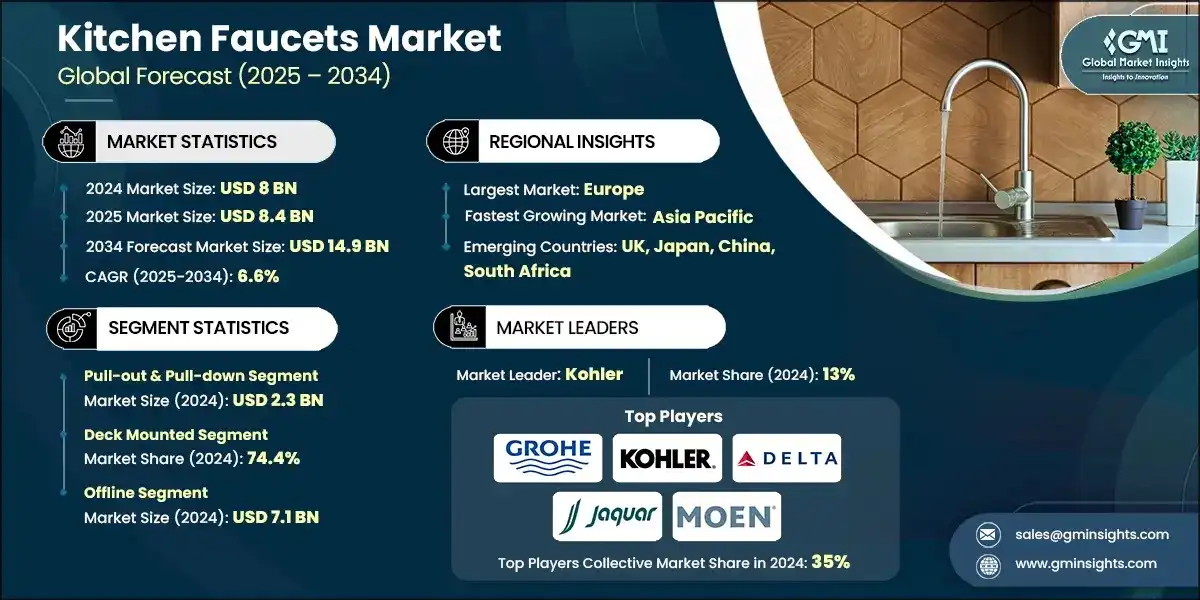
The global kitchen faucets market size was estimated at USD 8 billion in 2024. The market is expected to grow from USD 8.4 billion into 2025 to USD 14.9 billion in 2034, at a CAGR of 6.6%, according to latest report published by Global Market Insights Inc.
Kitchen Faucets Market Key Takeaways
Market Size & Growth
- 2024 Market Size: USD 8 Billion
- 2025 Market Size: USD 8.4 Billion
- 2034 Forecast Market Size: USD 14.9 Billion
- CAGR (2025–2034): 6.6%
Key Market Drivers
- Increasing spending on residential renovations and repairs.
- Technological advancements.
- Rising disposable income.
Challenges
- Proliferation of low-quality products.
- Technological complexity.
Opportunity
- Smart sensor technology integration.
- Sustainability and water conservation.
Key Players
- Market Leader: Kohler led with over 13% market share in 2024.
- Leading Players: Top 5 players in this market include Grohe, Kohler, Delta, Jaquar, Moen, which collectively held a market share of 35% in 2024.
Get Market Insights & Growth Opportunities
Factor contributing to the kitchen faucets market is the rising trend of home improvements and renovations. As householders become more willing to invest in kitchen upgrades to improve the appearance and functionality of their homes, we have seen increasing demand in kitchens that meet those expectations. This is particularly true in urban markets, where they exercise this investment on older housing stock relative to recent builds, and the consumer's willingness to modify the house should factor into the demand.
Additionally, as kitchen renovations take place, the preference is to replace old fittings with upgraded, higher-end options that improve water efficiency, durability and customizable designs.
In addition, governmental rebates and increased disposable income have positively impacted this category of renovation and improvement. In multiple municipal programs aimed at water conservation and energy efficiency, eco-friendly (low flow) plumbing and fixture upgrades are often included. The DIY trend and interest in home improvement programs have also provided a boost to consumers engaged in kitchen upgrades. Consequently, faucet brands/products are experiencing growth in sales to both consumers and professional installation services, contributing to development in the category.
The kitchen faucet market is experiencing a technological renaissance, with new features supporting convenience, hygiene, and water efficiency. Touchless faucets continue to grow in popularity for their ability to limit the transfer of germs and improve the experience of using a faucet; and use motion sensors to automatically activate water flow, making them ideal for busy kitchens and families with children.
Smart faucets allow connection to voice control and/or control the temperature and flow of water using an app, allowing for a customization that a faucet traditionally has not included while also supporting water efficiency and personalization in the kitchen. In addition to the user-friendly benefits, the persistence of use of materials and improved manufacturing processes has led to faucet designs that are more durable and environmentally friendly.
Improvements such as ceramic disc valves, anti-scald technology, and water filtration systems that are built into a faucet, have now become standard features of premium models. All these features enhance a faucet's performance as well as answer to the increasing consumer knowledge regarding health and environmental health. It is anticipated that manufacturers will continue to develop smarter and environmentally friendly technology as technology improves and the growth of the market continues.
To get key market trends
Kitchen Faucets Market Trends
Smart device integration within kitchen faucets is quickly changing consumer expectations. Touchless faucets featuring motion sensors, voice activation, and even app customization are in growing demand, especially among urban residents.
- These new design elements offer much-needed convenience. They are also more sanitary, because they reduce the need to touch the faucet itself. As smart homes gain traction, kitchen faucets would become connected devices that provide real-time usage and water savings information.
- Changing attitudes towards the environment are also affecting faucet design and purchase decisions. Consumers increasingly examine options for faucets that minimize water usage without sacrificing performance.
- Advances from manufacturers recycle water, reduce flow rates, and have built-in filtration systems. Many governance bodies, especially in the US, are also much more Active in regulating water efficiency policies, and some brands are actively attempting to develop eco-conscious products that meet compliance without compromising green-minded consumers.
- Kitchen faucets do much more than simply function, if a homeowner dismisses the fact that kitchen faucets are essentially a design choice, they tend to make that choice too. Homeowners looking to remodel their kitchens lean towards high-end faucets with finishes such as matte black, brushed nickel, and antique bronze.
- Many of the same faucets that the A&D industry is promoting feature minimalism, ergonomic handles, and integration with the modern kitchen. Furthermore, the collision of several trends in interior design, and the proliferation of social media essentially places designers as mere influencers in guiding consumer behavior toward tasteful, visually stimulating purchases.
- Digital channels are changing how consumers shop for kitchen faucets. Online marketplaces and websites operated by brands, allow consumers a wealth of product catalogs, reviews from other users, and virtual try-on software to aid in making product decisions. This is especially advantageous for niche and premium brands that don't depend on traditional retail for targeted audiences. When consumers can have products brought to their house and they can return them without hassle, e-commerce will continue to have traction.
Kitchen Faucets Market Analysis
Learn more about the key segments shaping this market
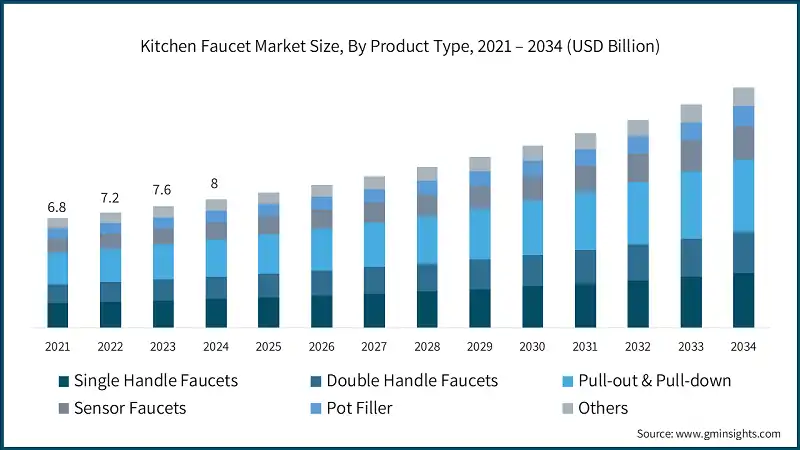
Based on product type, the kitchen faucets market is divided into single handle faucets, double handle faucets, pull-out & pull down, sensor faucets, pot filler and others. In 2024, pull-out & pull-down faucets held the major market share, generating a revenue of USD 2.3 billion.
- Modern kitchens are increasingly adopting pull-out and pull-down faucets for their efficiency and ease of use. Both faucets feature a removable nozzle attached to a hose, allowing users to direct water flow more accurately than a traditional faucet that is fixed in place. This is especially useful for rinsing dishes, cleaning the sink, and filling large pots.
- The only difference is in the direction they go. Pull-out faucets come out horizontally toward the user. Pull-out faucets are a great option for smaller kitchens with shallow sinks, and they are less height above their sinks. Pull-down faucets have a high-arc spout, and the spray head pulls downward into the sink, creating better reach within the sink when deep cleaning the entire sink area or simply a better-looking faucet in an open space.
- Pull-down and pull-out kitchen faucets have become the top types of products in the faucet category because of their combination of usability, convenience, and aesthetic design. The elevated spray heads enable customers to direct water flow in an efficient manner, addressing the daily or routine household tasks of rinsing vegetables and washing dishes or sink cleaning better. This flexibility makes pull-out and pull-down kitchen faucets especially desirable for busy families and contemporary kitchen environments.
Learn more about the key segments shaping this market
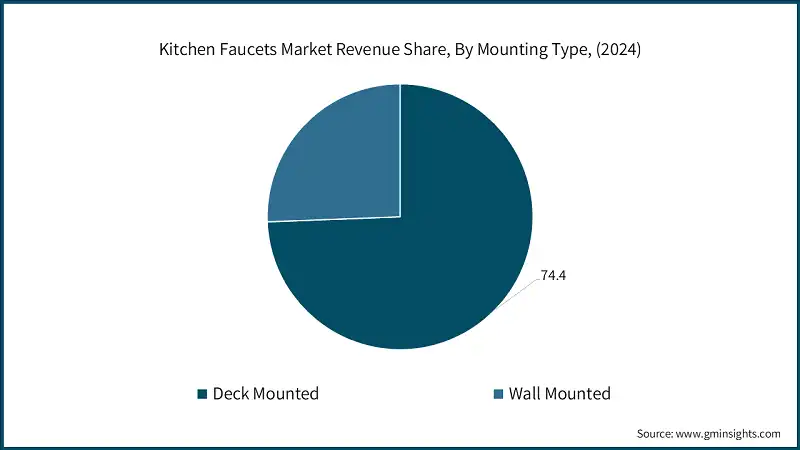
Based on mounting type, the kitchen faucets market is segmented into deck mounted and wall mounted. The deck mounted segment held the largest share, accounting for 74.4% of the global kitchen faucets market in 2024.
- Deck-mounted kitchen faucets mount directly to the countertop or sink deck as opposed to the wall. This style of installation is typical of modern kitchens because it is straightforward to install and fits just about every sink style. The faucet base inputs pre-drilled holes in the sink or counter, providing simple plumbing connections and access for maintenance.
- Deck-mounted faucets are available in various configurations single-handle, double-handle, and touchless. Their versatility allows them to work well with traditional or modern kitchen styles. Many deck-mounted faucets have a pull out or pull-down spray head configuration that also adds to the versatility of your faucet without complexity in installation.
- One of the main benefits of deck-mounted faucets is their accessibility and versatility. They are easier to swap or upgrade as opposed to wall-mounted and can be used on almost any kitchen surface. They require some counterspace for the holes to be drilled within the existing surface.
Based on the distribution channel, the kitchen faucets market is segmented into offline and online. In 2024, offline held a major market share, generating a revenue of USD 7.1 billion.
- Offline channels remain the most common distribution channel for kitchen faucets because they provide an experiential purchase method for consumers. Customers, and especially for high-involvement products like kitchen faucets, prefer to go to the retail location to see, touch, and model the faucet before making a purchase. This in-person assessment helps consumers judge the construction, finish, and functionality of products that can't be adequately reviewed online.
- Retail stores, hardware stores, and showrooms also offer a personal service and professional knowledge that enhances the buying experience. Sales agents typically explain technical specifications, installation needs, and compatibility with customers’ current kitchen to facilitate informed decision-making. The aspect of building trust with customers is a key category-driver of sales in many locations where the digital experience is still being developed.
- Offline channels capitalize on relationships with contractors, plumbers, and interior designers, who are often able to influence purchases. Typically, these professionals access items from local distributors or retail partners, reinforcing the role of physical availability and after-sales service. Therefore, offline distribution remains a strong, and preferred, method of distribution for both the individual buyer and trade professional buyer of kitchen faucets.
Looking for region specific data?
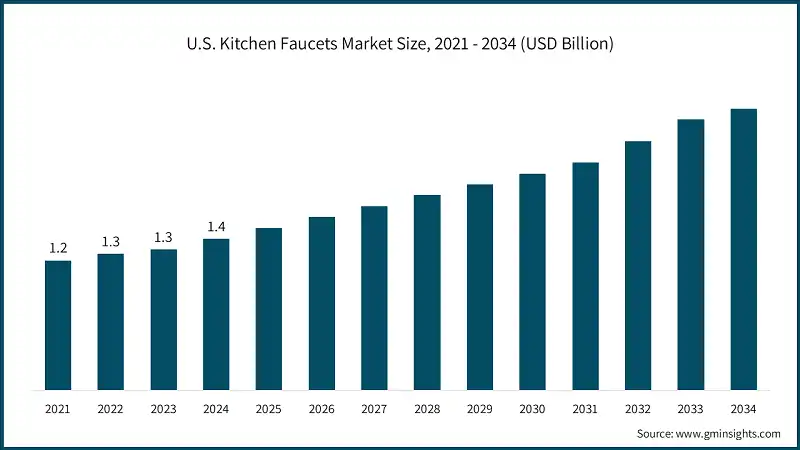
In 2024, the U.S dominated the kitchen faucets market, accounting for around 68.6% and generating around USD 1.4 billion revenue in the same year.
- The US leads the kitchen faucets market in North America due to high levels of consumer awareness, mature home improvement culture, strong residential and commercial demand, and a large presence of major faucet manufacturers with a mature plumbing and hardware retailer ecosystem. This has created an environment conducive to innovation and efficient distribution. Moreover, consumers in the US are increasingly willing to make a premium investment in smart and multifunctional kitchen fixtures, thus contributing to increased growth in popular premium fixtures, such as pull-out and pull-down faucets.
- North America is growing in the kitchen faucet market primarily because of the diverse and well-developed enterprise and retail backdrop. Offline retail networks are still preferred by consumers, with home improvement chains and specialty store options creating similar levels of product accessibility. Online shopping is also growing in popularity, allowing continuation of exploration and purchase of faucets online from local and regional point of sale or online stores.
Europe kitchen faucets market, Germany leads the market with 31% share in 2024 and is expected to grow at 7.2% during the forecast period.
- Europe dominates the kitchen faucet market due to its focus on design innovation, sustainability, and high production standards. In Europe, consumers are focused on durable, environmentally friendly products with a modern aesthetic and efficient energy use. European brands create cutting-edge features like water-saving aerators and touchless products to cater to the environmentally conscious consumers and increase overall market demand.
- The region also benefits from a strong consumer-focused home improvement culture and a developed landscape of brick-and-mortar specialty retailers and showrooms. While e-commerce is continuing to grow at a solid pace, bricks and mortar will remain a mainstay for retailing, as customers wish to feel, touch, and experience products first-hand. The benefit of the well-established brick-and-mortar channels increased consumer and builder access and supported stable sales across urban and suburban markets.
The Asia Pacific kitchen faucets market, China holds a market share of around 34.1% in 2024 and is anticipated to grow with a CAGR of around 7.6% from 2025 to 2034.
- The Asia Pacific is developing into one of the key regions in the kitchen faucet market with rapid urbanization, rising disposable incomes, and an increasing demand for modern home infrastructure. There are rapid increases in residential construction and kitchen renovations in areas such as China, India, and Southeast Asian countries and consumers are increasingly looking for faucets that provide both style and functionality.
- The region also benefits from a growing manufacturing base and expanding retail channels, both online and offline. Local and international brands are investing in both product innovation and product distribution to address consumer preferences that emerge in urban/suburban environments. Given increased health awareness and smart home solutions, Asia Pacific is rapidly becoming an important growth region within the market.
Middle East & Africa kitchen faucets market is growing at a CAGR of 5.7% during the forecast period.
- The Middle East & Africa region is witnessing gradual growth in the kitchen faucet market, fueled by urbanization, infrastructure development, and growing investment in residential and commercial construction. The UAE, Saudi Arabia, and South Africa are moving to modern kitchen designs, and consumers interest in fixtures that are stylish, durable, and conserve water has increased. Initiatives from governments to facilitate sustainable water use, and in terms of smart cities, have started to drive the demand for sophisticated faucet solutions.
- The market continues to develop at a slower pace relative to other areas, middle east & Africa capitalizes on expanding retail networks, and brand presence both local and international. Off-line channels dominate while these channels compose the mainstream when dealing with urban cities and are helped primarily by showroom and hardware stores that sell a variety of faucets. It will continue to become more significant in the global kitchen faucet industry as consumer awareness for hygiene, design, and conservation increases.
Kohler is leading with a 13% market share. Grohe, Kohler, Delta, Jaquar, and Moen collectively hold around ~35%, indicating moderately fragmented market concentration. These prominent players are proactively involved in strategic endeavors, such as mergers & acquisitions, facility expansions & collaborations, to expand their product portfolios, extend their reach to a broad customer base, and strengthen their market position.
- Jaquar is at the forefront of designing sustainable kitchen faucets with a clear emphasis on water savings and smart technology. Their latest innovations consist of touchless faucets with motion sensors, low-flow aerators, and smart leak detection sensors to facilitate reduced water consumption without compromising performance. Combined with attractive designs, features include temperature control and programmable timers. It offers a combination of eco-efficiency and modern-day convenience, making them an attractive option for environmentally aware consumers.
- TOTO continues to set benchmarks for faucet innovation globally, presenting Japanese design philosophy alongside technology and aesthetics. The latest kitchen faucet collections incorporate touchless operation, ultra-slim spouts, with the newest water-saving mechanisms. TOTO continues to develop smart, hygienic, and attractive faucet solutions for modern and contemporary households and commercial spaces.
Kitchen Faucets Market Companies
Major players operating in the kitchen faucets industry are:
- American Standard
- Blanco
- Delta
- Dornbracht
- Grohe
- Hansgrohe
- Hindware
- Jaquar
- Johnson Bathrooms
- Jorger
- Kohler
- Moen
- Pfister
- Roca Sanitario
- TOTO
Grohe's kitchen faucet lines reflect a graceful European design and a performance-oriented focus for today's modern lives. With advancements such as SmartControl touch activation, multiple water stream options, and water-saving capabilities, there is a balance of luxury and functionality in their products. The Essence and Zedra collections highlight this message clearly, particularly when it comes to effortless intuitive control of water and its use. Like many manufacturers, Grohe is concerned about craftsmanship and user-centric design when it comes to faucets and kitchens in general.
Hindware expanded its kitchen fixture offerings to include an innovative array of prepared sinks that are extra stylish, specially equipped for modular and modern kitchens. They have also launched a set of sensor-based faucets with both touchless operation and integrated water treatment systems.
Kitchen Faucets Market Report Attributes
| Key Takeaway | Details |
|---|---|
| Market Size & Growth | |
| Base Year | 2024 |
| Market Size in 2024 | USD 8 Billion |
| Market Size in 2025 | USD 8.4 Billion |
| Forecast Period 2025 - 2034 CAGR | 6.6% |
| Market Size in 2034 | USD 14.9 Billion |
| Key Market Trends | |
| Drivers | Impact |
| Increasing spending on residential renovations and repairs | This trend is accelerating demand for paperless workflows, forcing organizations to adopt high speed scanners for efficient digitizing documents and compliant data management. |
| Technological advancements | Consumer expectations are shifting through technology, with advances like touchless action, water-saving features, and smart controls making their way into the mainstream market, driving the innovation of features and increasing adoption. |
| Rising disposable income | Disposable income is rising, and consumers are increasingly willing to spend now on high-quality kitchen fixtures. More people are spending in both urban and semi-urban centers, with growth potential for this category especially in the mid-to-premium market. |
| Pitfalls & Challenges | Impact |
| Proliferation of low-quality products | The exponential increase in low-quality products that are penetrating the faucet market will erode brand value and diminish consumer trust. There are a wide range of inexpensive, poorly manufactured faucets making their way through retail and online channels, resulting in consumer health, safety, durability, leaking and performance concerns. |
| Technological complexity | Technological complexities are also anticipated challenges, especially as smart faucets or touchless faucets become more commonplace. These luxuries can afford extremely convenient actions; however, they also require installation, maintenance and user understanding. |
| Opportunities: | Impact |
| Smart sensor technology integration | The utilization of smart sensor technology is creating new opportunities for innovation, providing the advantage of touchless operation and added sanitation. This is attractive to potential tech-savvy consumers and is in line with the growing trend of convenience and automation in modern kitchens. |
| Sustainability and water conservation | The increasing emphasis on sustainability and water efficiency is driving the interest in sustainable and water-wise faucets with features, including low-flow aerators and monitoring of smart, efficient water use. |
| Market Leaders (2024) | |
| Market Leaders |
13% market share |
| Top Players |
The collective market share in 2024 is 35% |
| Competitive Edge |
|
| Regional Insights | |
| Largest Market | Europe |
| Fastest Growing Market | Asia Pacific |
| Emerging Country | UK, Japan, China, South Africa |
| Future Outlook |
|
What are the growth opportunities in this market?
Kitchen Faucets Industry News
- In August 2025, Blanco introduced the Catris-S Flexo, their newest kitchen faucet with a sleek and lightweight design inspired by professional/lounge-level variations like those used for food service now adapted for glamour and home usability. Available in three finishes: chrome, PVD Steel, and black matt, this faucet offers a high, flexible spout featuring black rubber-coated exterior and two spray modes: aerated stream and jet spray. A magnetic holder provides a convenient way to quickly detach and re-attach the sprayer end.
- In February 2025, Moen launched two new warm-toned finishes lifeshine bronzed gold and polished nickel to four of its established kitchen faucet collections: Cia, Kurv, Genta, and Belfield. The addition of these new finishes responds to a larger trend toward personal expression in home design that gives consumers even more options for customizing their kitchen style. All four collections flaunt these rich new finishes, adding sophistication to a diverse mix of modern and traditional styles.
- In June 2024, Jaquar highlighted the introduction and growth of smart faucets in Indian kitchens with cutting-edge digital features such as touchless operation, voice activation, and precise temperature control. In addition to convenience and enhanced hygiene, these devices are also a part of the larger trend towards “smart homes” in India. Smart faucets can easily connect to your smartphone or smart home products and track water usage history, leaks, as well as, and even custom presets for specific users while offering an unparalleled unique and efficient water experience.
- In May 2024, Delta Faucet Company launched its innovative Touch2O kitchen faucets with its ‘touchless technology’ to assist in multitasking and to reduce mess in any busy household. The original faucets were previewed at the 2024 Kitchen & Bath Industry Show and provided three simple ways to control the water flow with initial motion sensing, surface tapping, or the intended manual handle. Delta’s advanced Touchless Technology, with capacitive sensing, detects a human presence within four inches instead of relying on infrared, allowing for a quick activation and keeping the faucet clean.
- In February 2024, Kohler launched the Components Kitchen Faucet Collection which features an understated design; a kitchen faucet collection with elegant details and geometric purity accomplished through precise details. The collection offers seven configuration options available in multiple finishes allowing for a modern aesthetic look while also offering exceptional function. All attributes of the components collection elevate kitchen faucet design in the modern age.
The kitchen faucets market research report includes in-depth coverage of the industry with estimates & forecasts in terms of revenue (USD Billion) and volume (Thousand Units) from 2021 to 2034, for the following segments:
Market, By Product Type
- Single-handle faucets
- Double-handle faucets
- Pull-out & pull-down
- Sensor faucets
- Pot filler
- Others
Market, By Mounting Type
- Deck mounted
- Wall mounted
Market, By Material
- Stainless steel
- Copper
- Brass
- Plastic
- Others
Market, By Technology
- Manual
- Touch activated
- Motion sensor
- Smart faucets
Market, By Price
- Low
- Medium
- High
Market, By End Use
- Residential
- Commercial
Market, By Distribution Channel
- Offline
- Online
The above information is provided for the following regions and countries:
- North America
- U.S.
- Canada
- Europe
- Germany
- UK
- France
- Italy
- Spain
- Asia Pacific
- China
- India
- Japan
- Australia
- South Korea
- Latin America
- Brazil
- Mexico
- Argentina
- Middle East and Africa
- South Africa
- Saudi Arabia
- UAE
Frequently Asked Question(FAQ) :
What is the market size of the kitchen faucets in 2024?
The market size was estimated at USD 8 billion in 2024, with a CAGR of 6.6% expected through 2034. The growth is driven by increasing home renovations, demand for high-end fittings, and smart device integration.
What is the projected value of the kitchen faucets market by 2034?
The market is poised to reach USD 14.9 billion by 2034, fueled by trends such as eco-friendly designs, smart technology adoption, and premium product preferences.
What is the expected size of the kitchen faucets market in 2025?
The market size is projected to grow to USD 8.4 billion in 2025.
How much revenue did the pull-out and pull-down faucets segment generate in 2024?
The pull-out and pull-down faucets segment generated approximately USD 2.3 billion in 2024, led by their efficiency and ease of use in modern kitchens.
What was the market share of the deck-mounted faucets segment in 2024?
The deck-mounted faucets segment accounted for 74.4% of the market in 2024, owing to their straightforward installation and compatibility with various sink styles.
How much revenue did offline distribution channels generate in 2024?
Offline distribution channels generated USD 7.1 billion in 2024, as consumers preferred in-person assessments for high-involvement products like kitchen faucets.
Which region dominated the kitchen faucets sector?
The U.S. accounting for 68.6% of the global share and generating approximately USD 1.4 billion in 2024.
What are the upcoming trends in the kitchen faucets market?
Trends include smart device integration, eco-friendly water-saving designs, premium finishes, and rising digital channel influence for purchases.
Who are the key players in the kitchen faucets industry?
Key players include American Standard, Blanco, Delta, Dornbracht, Grohe, Hansgrohe, Hindware, Jaquar, Johnson Bathrooms, Jorger, Kohler, Moen, Pfister, Roca Sanitario, and TOTO.
Kitchen Faucets Market Scope
Related Reports