Summary
Table of Content

K-12 Dual Language Immersion Market
Get a free sample of this report
Form submitted successfully!
Error submitting form. Please try again.
Thank you!
Your inquiry has been received. Our team will reach out to you with the required details via email. To ensure that you don't miss their response, kindly remember to check your spam folder as well!
Request Sectional Data
Thank you!
Your inquiry has been received. Our team will reach out to you with the required details via email. To ensure that you don't miss their response, kindly remember to check your spam folder as well!
Form submitted successfully!
Error submitting form. Please try again.
K-12 Dual Language Immersion Market Size
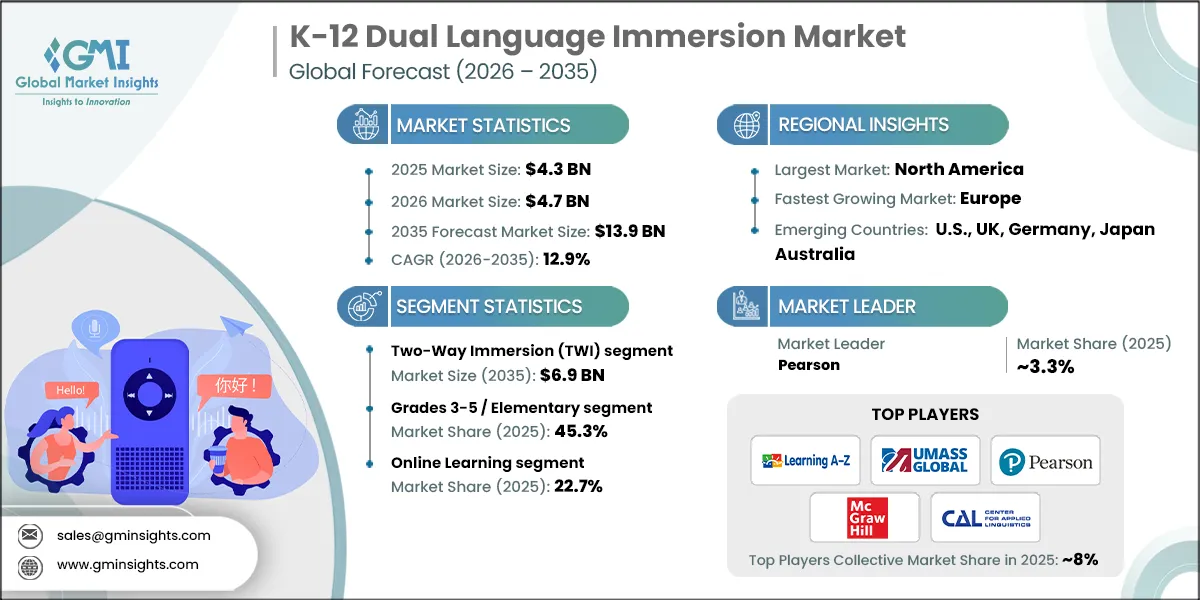
The global K-12 dual language immersion market was valued at USD 4.3 billion in 2025. The market is expected to grow from USD 4.7 billion in 2026 to USD 13.9 billion in 2035, at a CAGR of 12.9% during the forecast period according to the latest report published by Global Market Insights Inc. The market is expanding, owing to the growth driven by increasing recognition of bilingual proficiency as a key academic and career asset, prompting more school districts and private educators to integrate dual language programs into standard K‑12 offerings. Such programs not only enhance language skills but also support cultural competency and cognitive development, attracting broad stakeholder support.
To get key market trends
For instance, Atlanta is expanding its dual language immersion initiative to new schools and students while partnering with colleges and universities to further the development of teachers and adapt curricula accordingly. Furthermore, the new Mandarin Immersion School in Houston illustrates the very high demand from the community for other forms of bilingual education, especially since there are limited public seats.
As we look to the future, growth in developing markets and increasing investment in both bilingual teacher training and tech-based language learning resources will continue to drive growth across all sectors of bilingual education. Because both parents and governments place an emphasis on providing students with global readiness, it is expected that the dual language immersion market will experience continued growth over the long term.
K-12 Dual Language Immersion Market Report Attributes
| Key Takeaway | Details |
|---|---|
| Market Size & Growth | |
| Base Year | 2025 |
| Market Size in 2025 | USD 4.3 Billion |
| Market Size in 2026 | USD 4.7 Billion |
| Forecast Period 2026-2035 CAGR | 12.9% |
| Market Size in 2035 | USD 13.9 Billion |
| Key Market Trends | |
| Drivers | Impact |
| Rising demand for bilingual & biliterate graduates | Growing recognition of bilingualism as a critical academic and workforce skill is driving strong demand for dual language immersion programs. Parents, educators, and policymakers increasingly view biliteracy as a long-term advantage, accelerating enrollment growth and sustained investment in K-12 dual language immersion globally. |
| Globalization of education & workforce | As economies and education systems become more interconnected, proficiency in multiple languages is essential. Global mobility, international careers, and cross-cultural collaboration are pushing schools to adopt dual language immersion models that prepare students for global academic pathways and competitive international labor markets. |
| Rising availability of digital learning resources | The expansion of bilingual digital curricula, adaptive learning platforms, and virtual teacher collaboration tools is lowering implementation barriers for dual language immersion programs. These technologies improve instructional quality, scalability, and consistency, enabling schools to expand DLI offerings across regions with limited local resources. |
| Expansion of international & magnet schools | International and magnet schools increasingly use dual language immersion as a core differentiator to attract families. Their expansion across both developed and emerging markets is increasing program visibility, accelerating adoption, and creating stable demand for bilingual curricula, trained educators, and language-specific instructional materials. |
| Strong academic outcomes linked to DLI | Research demonstrating improved cognitive development, academic achievement, and long-term educational outcomes among DLI students strengthens stakeholder confidence. Proven performance benefits support policy backing, funding approvals, and program expansion, reinforcing dual language immersion as a sustainable and high-impact instructional model in K-12 education. |
| Pitfalls & Challenges | Impact |
| Shortage of qualified bilingual teachers | Limited availability of certified bilingual educators constrains the expansion of dual language immersion programs worldwide. Recruitment challenges, certification gaps, and high attrition rates increase program costs and slow adoption, particularly in emerging markets and rural districts, restricting the scalability and consistent quality of DLI implementation. |
| Curriculum development complexity | Designing and maintaining dual language immersion curricula requires alignment across languages, academic standards, and cultural contexts. This complexity increases development time, costs, and implementation risk for schools, discouraging adoption and leading to inconsistent program quality across regions, which can hinder long-term market growth. |
| Opportunities: | Impact |
| Growth in teacher training and credentialing services | Rising demand for qualified bilingual educators is creating strong growth opportunities for teacher training, certification, and professional development providers. Expanded credentialing services improve workforce availability, reduce implementation barriers, and support scalable deployment of dual language immersion programs, accelerating market growth and improving program quality globally. |
| Rapidly developing education systems in underpenetrated markets | Emerging education systems in Asia-Pacific, Latin America, and the Middle East present significant expansion opportunities for dual language immersion programs. Increased government investment, rising middle-class enrollment, and education reforms focused on global competitiveness are driving adoption, expanding the addressable market for DLI solutions worldwide. |
| Market Leaders (2025) | |
| Market Leader |
~3.3% Market Share |
| Top Players |
Collective Market Share ~8% |
| Competitive Edge |
|
| Regional Insights | |
| Largest Market | North America |
| Fastest growing market | Europe |
| Emerging countries | U.S., UK, Germany, Japan, Australia |
| Future outlook |
|
What are the growth opportunities in this market?
K-12 Dual Language Immersion Market Trends
- A major trend in the K‑12 dual language immersion market is expansion into early childhood education, with schools adding immersive programs at younger ages. For example, Ben Milam International Academy in Texas launched a bilingual pre‑K 3 program with a 90/10 language model, supporting early biliteracy and engagement from age three onward.
- Another trend is the geographic spread of DLI programs within public systems, driven by policy goals and community advocacy. In Kern County, CA, multiple districts are scaling Spanish‑English immersion from preschool through eighth grade, with new schools opening to meet demand and support the state’s Global CA 2030 bilingual targets.
- Technology integration is reshaping delivery, as hybrid learning models and AI‑enabled tools enhance personalized instruction, accessibility, and engagement. AI and VR applications are emerging to support adaptive language practice and culturally rich experiences in classrooms. Moreover, the growing parental and community demand, particularly among Latino families, reinforcing investment in dual language offerings and influencing school planning decisions.
- Furthermore, the expansion of bilingual education in both the international and local education systems with governments support has significantly boosted market growth. The bilingual education system both in India and Europe is indicative of a increased recognition that dual language immersion has a critical role in developing 21st century skills and multicultural competency.
K-12 Dual Language Immersion Market Analysis
Learn more about the key segments shaping this market
On the basis of program model, the market is segmented into Two-Way Immersion (TWI), One-Way Immersion (OWI), and Heritage Language Immersion (HLI).
- The Two-Way Immersion (TWI) segment is anticipated to reach USD 6.9 billion by 2035. The segment is riven by the increasing emphasis on bilingual proficiency and cultural diversity. Schools are adopting TWI programs to integrate native and non-native speakers, enhancing cognitive development and academic performance. For instance, Miami-Dade County Public Schools expanded its TWI programs, serving thousands of Spanish and English learners.
- TWI programs benefit from policies that support their creation as well as advocacy from communities where these programs are established especially in multicultural areas. The Dual Language TWI Program in Austin, Texas integrates English-speaking students and Spanish speaking students into the same classroom, promoting biliteracy, social equity, and creating a sense of belonging. The use of digital tools, such as bilingual e-books, and adaptive learning applications contribute to the accessibility, scalability, and long-term effectiveness of TWI programs in K-12 educational institutions all over the world.
- The One-Way Immersion (OWI) segment was valued at USD 916.3 million in 2025 and is anticipated to grow at a CAGR of 12.7% over the forecast years. The growth is driven by schools focusing on single-language learners seeking proficiency in a target language. For example, Chicago Public Schools’ Spanish OWI programs help native English speakers achieve fluency while maintaining academic standards, supporting increasing parental demand for specialized language education.
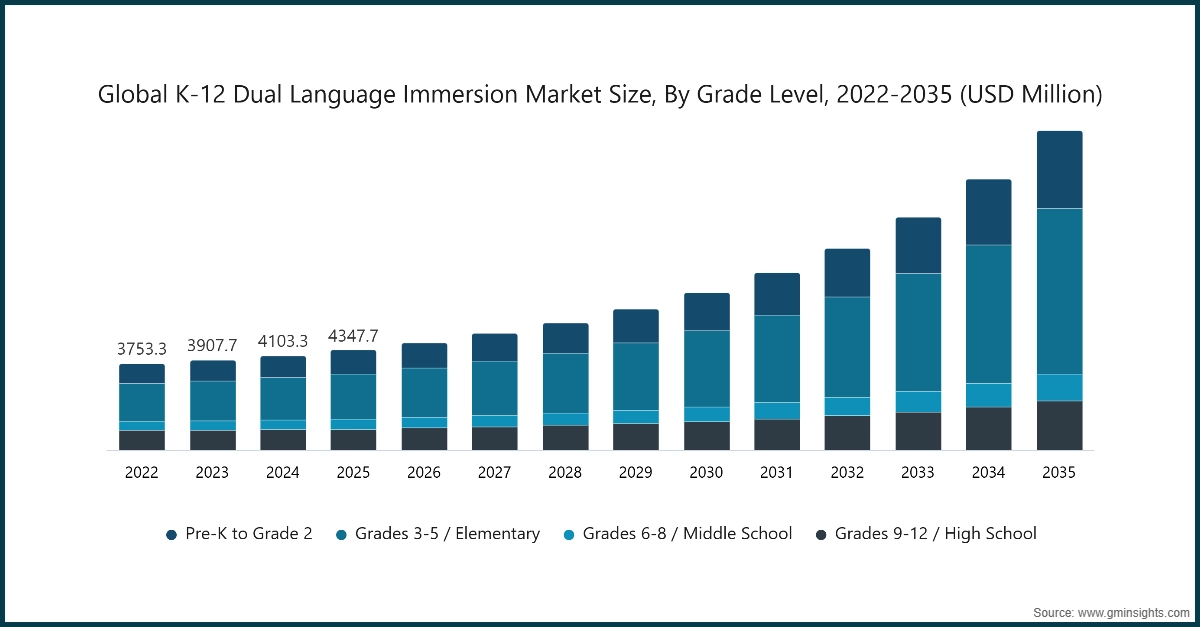
On the basis of grade level, the K-12 dual language immersion market is divided Pre-K to Grade 2, Grades 3-5 / Elementary, Grades 6-8 / Middle School, and Grades 9-12 / High School.
- The Grades 3-5 / Elementary segment held a market share of 45.3% in 2025 due to driven by strong demand for early-stage bilingual literacy and foundational cognitive development. Elementary immersion programs, such as the dual language Spanish-English curriculum at San Diego’s Kearny Elementary, engage students in immersive instruction, fostering biliteracy while supporting academic achievement across core subjects, fueling segment growth globally.
- The Pre-K to Grade 2 segment is anticipated to grow at a CAGR of 13.2% during the forecast period 2026 – 2035, driven by increasing recognition of early language acquisition benefits. Immersion programs at this stage enhance cognitive development, biliteracy, and social skills. For instance, Boston Public Schools’ Pre-K dual language initiative integrates Spanish-English instruction to build foundational language proficiency.
- Early adoption promotes investment by parents as well as government support through policies aimed at helping families with younger children. For example, in New York City, PS 124 implements a Mandarin/English immersion program to help improve literacy skills in culturally appropriate ways and track student performance based on quantifiable results. In addition, using digital resources and other types of bilingual curricula allows for increased student participation through scalability and diverging language proficiency levels. As a result, the number of students enrolled in dual-language immersion programs around the world has continued to grow significantly between Pre-K and Grade 2 levels.
Learn more about the key segments shaping this market
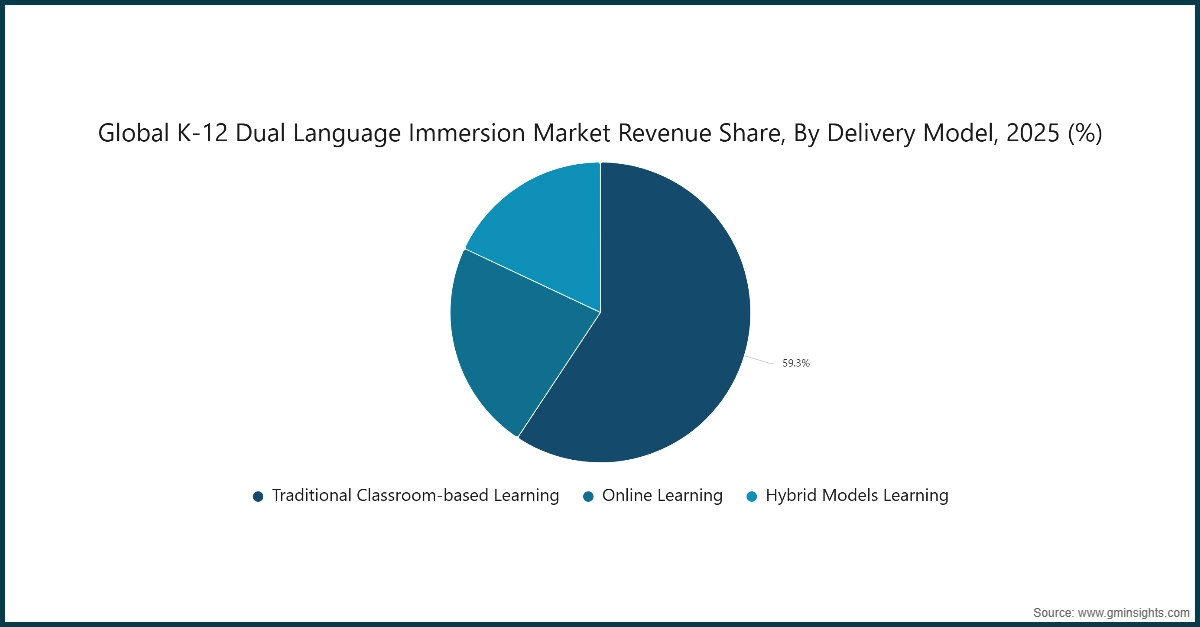
On the basis of By Delivery Model, the K-12 dual language immersion market is divided into Traditional Classroom-based Learning, Online Learning, Hybrid Models Learning.
- The Online Learning segment held a market share of 22.7% in 2025, driven by increasing adoption of digital platforms for bilingual instruction. Schools leverage virtual classrooms, interactive language apps, and online curriculum resources to reach wider student populations. For example, Rosetta Stone Classroom and Duolingo for Schools enable English-Spanish and Mandarin-English dual language lessons across K-12 grades.
- The segment’s growth is also supported by hybrid learning models and teacher training platforms, which enhance program scalability and accessibility. Districts like Austin Independent School District integrate online modules into classroom instruction, supplementing in-person immersion programs. These digital solutions improve student engagement, personalized learning, and assessment capabilities, solidifying the online learning segment’s role as a key driver of global dual language immersion adoption.
North America K-12 Dual Language Immersion Market
Looking for region specific data?
The North America K-12 dual language immersion market holds a significant share of the 34.7% in 2025.
- North America’s growth in the K-12 dual language immersion industry is driven by strong demand for bilingual and biliterate graduates, supportive government policies, and increasing multicultural student populations. For example, Miami-Dade County Public Schools expanded its Spanish-English TWI programs, serving thousands of students and setting a model for district-wide dual language adoption across the U.S.
- In addition, North America is known for its strong support of private/charter schools, which contribute positively to the success of the North American education system. For example, Concordia International School in Texas has added a large number of students each year in their French/English immersion program largely due to the academic/cognitive gains demonstrated by their students. These schools are also investing heavily in digital bilingual curricula as well as training teachers to deliver the program effectively. These initiatives will bolster North America's dominant position and will help drive future growth in the marketplace.
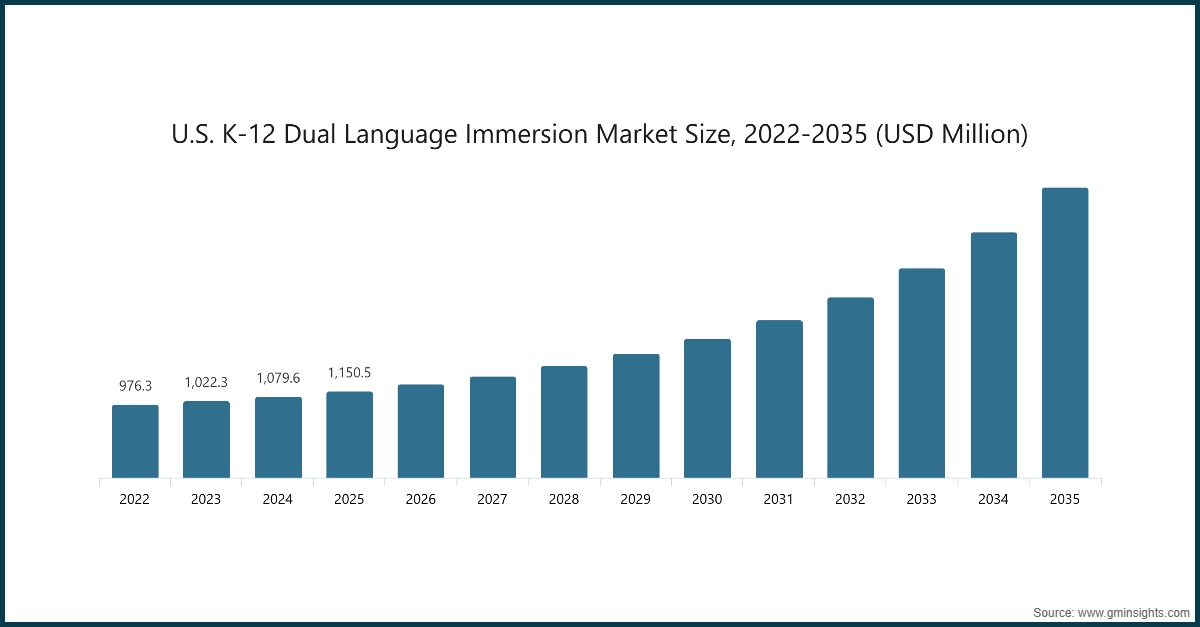
The U.S. K-12 dual language immersion market was valued at USD 976.3 million and USD 1,022.3 million in 2022 and 2023, respectively. The market size reached USD 1,150.5 million in 2025, growing from USD 1,079.6 million in 2024.
- The U.S. market is expanding due to is expanding due to increasing demand for bilingual graduates and parental preference for academic programs that promote cognitive development and cultural competence. For instance, New York City’s Dual Language Program enrolls thousands of students across Spanish, Mandarin, and French immersion classrooms, reflecting the growing emphasis on early biliteracy.
- Furthermore, the government supports expansion due to their involvement and funding available through various initiatives for multilingual education. For example, the Austin Independent School District has developed TWI and OWI programming from Pre-K through 12th grade, provided through teacher training, digital learning, and access to other resources. These efforts will enhance program quality and increase access to dual language immersion and OWI education at both charter and public schools throughout the United States.
Europe K-12 Dual Language Immersion Market
Europe market accounted for USD 1.9 billion in 2025 and is anticipated to show lucrative growth over the forecast period.
Europe’s is witnessing strong growth due to increasing demand for bilingual education and multilingual competency among students. Programs such as French-English immersion in Luxembourg schools and German-English bilingual programs in Berlin are fostering early biliteracy while supporting academic performance and cultural understanding.
- Furthermore, In addition to this, government policy, in general, encourages people to speak more languages and travel abroad, therefore contributing to the growth of language learning. In Spain, for example, the Generalitat de Catalunya has implemented a number of regional policies to promote the use of both Catalan and English in immersion programs at primary schools across the country. Private bilingual and digital language schools are also contributing to the rapid growth of the market for bilingual education, placing Europe in a strong position for the continued development of K-12 dual language immersion.
- Germany dominates the Europe K-12 dual language immersion market, due to strong government support for multilingual education, high parental demand, and established bilingual school networks. Programs like the Berlin Cosmopolitan School’s English-German immersion curriculum and Hamburg’s bilingual primary schools provide early biliteracy and cultural competence. Coupled with teacher training initiatives and digital language resources, Germany remains a leading market in Europe.
Asia Pacific K-12 Dual Language Immersion Market
The Asia Pacific market is anticipated to hold a share of 13.5% in 2025 and is expected to grow at a CAGR of 11.5 % during the forecast period.
The Asia-Pacific market is experiencing rapid growth due to rising demand for English proficiency, globalization of education, and expanding middle-class enrollment. For example, Shanghai International Schools and Delhi’s American Embassy School offer English-Chinese and English-Hindi dual language programs, enhancing academic performance while fostering bilingual and cross-cultural competencies among students.
- Furthermore, government initiatives promoting multilingual education further boost adoption. Programs in Singapore and South Korea integrate bilingual curricula from early childhood through elementary grades, supported by digital learning platforms and teacher training initiatives. These developments enable scalable program expansion, strengthen workforce readiness, and position Asia-Pacific as one of the fastest-growing regions in the global market.
- China K-12 dual language immersion market is estimated to grow with a CAGR of 36.1%, in the Asia Pacific market driven by rising demand for English proficiency, international university preparation, and bilingual skill development. Schools such as Yew Chung International School Shanghai and Dulwich College Beijing offer English-Chinese dual language programs, integrating digital learning tools and immersive curricula to enhance academic performance and cross-cultural competency.
Latin American K-12 Dual Language Immersion Market
The Latin America market was valued at USD 259.7 million in 2025. Latin America represents an emerging growth market for K-12 dual language immersion, due to increasing demand for English proficiency and global workforce readiness. Schools like Colegio Nueva Granada in Colombia and American School Foundation in Mexico City offer English-Spanish immersion programs, combining bilingual curricula with digital learning tools to enhance literacy, academic achievement, and cross-cultural skills.
Middle East and Africa K-12 Dual Language Immersion Market
The Middle East & Africa market is driven by growing demand for English-Arabic bilingual education, international school expansion, and rising expatriate populations. For example, Dubai’s GEMS Education network and The American International School of Johannesburg offer immersive bilingual programs, combining advanced curricula and digital learning platforms to enhance academic performance, language proficiency, and cross-cultural competence across the region.
K-12 Dual Language Immersion Market Share
The global K-12 dual language immersion industry is moderately consolidated, led by key educational solution providers including Learning A-Z, UMASS Global, Pearson, McGraw Hill, Inc., and the Center for Applied Linguistics (CAL). Together, these companies account for a significant portion of the market, driven by comprehensive bilingual curricula, teacher training programs, and digital learning platforms that support immersive language instruction.
These top players benefit from strong expertise in language pedagogy, long-standing relationships with public and private school districts, and broad product portfolios spanning Pre-K to Grade 12 programs. Continuous investments in adaptive digital tools, professional development, and culturally responsive content enhance program effectiveness and scalability, positioning them as market leaders.
Despite their dominance, the market remains partially fragmented, with regional and niche providers offering specialized dual language solutions, such as heritage language programs, one-way immersion models, or localized bilingual content. Smaller firms compete through cost-efficient platforms, hybrid delivery models, and customized teacher support, fostering innovation in digital curricula, online learning tools, and scalable bilingual education solutions, supporting sustained global market growth.
K-12 Dual Language Immersion Market Companies
Prominent players operating in the K-12 dual language immersion industry are as mentioned below:
- Learning A-Z
- UMASS GLOBAL
- Goethe-Institut
- Pearson
- McGraw Hill, Inc
- Houghton Mifflin Harcourt (HMH)
- Imagine Learning LLC.
- Cengage Learning, Inc.
- Avant Assessment
- ACTFL
- Center for Applied Linguistics (CAL)
- Dual Language Education of New Mexico
- East Carolina University College of Education
- Washington State University
- Scholastic Corporation
- Renaissance Learning, Inc.
- IXL Learning
- Pearson is a leading global educational publisher and assessment provider with a wide portfolio of world language and dual language resources that support K‑12 immersion instruction. The company’s curricula and instructional materials, including dual‑language instructional guides and language learning pathways, help educators deliver bilingual content and literacy outcomes. Pearson’s global reach, emphasis on digital learning, and integrated assessment solutions strengthen its competitive position in multilingual education worldwide.
- McGraw Hill, Inc. delivers comprehensive K‑12 educational content and digital platforms that support bilingual and dual language instruction. Its Spanish‑language programs, such as Maravillas alongside core language arts and world language resources, offer parallel instruction that fosters biliteracy and cultural understanding. McGraw Hill’s focus on research‑based language acquisition strategies and adaptable learning tools enhances dual language immersion effectiveness across diverse school settings.
- UMASS GLOBAL focuses on educator preparation and professional development tailored to bilingual instruction, including accredited online programs and bilingual teaching credentials such as the California Bilingual Authorization. By enhancing teacher readiness and supporting scalable professional development, UMASS GLOBAL plays a critical role in the supply of qualified educators, driving the quality and expansion of dual language immersion programs globally.
K-12 Dual Language Immersion Industry News
In July, 2025, Lone Star Online Academy (LSOA) is set to launch the nation’s first virtual dual language immersion (DLI) kindergarten program in Fall 2025, targeting K–8 students across Texas. The program offers one-way bilingual instruction, enabling early language acquisition and cognitive development through a fully online platform. The initiative will start with kindergarten in 2025–26 and expand one grade per year, reaching higher grades as cohorts progress. The inaugural year is expected to enroll over 100 bilingual students, highlighting growing adoption of virtual and flexible dual language immersion models in the K-12 market.
In July 2024, Wabash City Schools and Indiana University Kokomo have expanded their dual language immersion (DLI) program to the secondary level, extending bilingual education beyond middle school into high school. Previously offered through grade 7, the program now enables students to continue DLI Spanish instruction and cultural studies through eighth grade and into their freshman and sophomore years. High school students enrolled in the program will take four Spanish courses (one per semester), fulfilling requirements for a Spanish minor, while strengthening language proficiency and cultural knowledge.
The K-12 dual language immersion market research report includes in-depth coverage of the industry with estimates and forecast in terms of revenue in USD Billion from 2022 – 2035 for the following segments:
Market, By Language Offered
- Spanish
- French
- German
- Chinese
- Japanese
- Portuguese
- Hawaiian
- Korean
- Russian
- Italian
- Others
Market, By Program Model
- Two-Way Immersion (TWI)
- One-Way Immersion (OWI)
- Heritage Language Immersion (HLI)
Market, By Grade Level
- Pre-K to Grade 2
- Grades 3-5 / Elementary
- Grades 6-8 / Middle School
- Grades 9-12 / High School
Market, By Delivery Model
- Traditional Classroom-based Learning
- Online Learning
- Hybrid Models Learning
Market, By Institution Type
- Public Schools
- Private Schools
- Charter Schools
- Home Schooling & Individual Learners
The above information is provided for the following regions and countries:
- North America
- U.S.
- Canada
- Europe
- Germany
- UK
- France
- Spain
- Italy
- Netherlands
- Asia Pacific
- China
- India
- Japan
- Australia
- South Korea
- Latin America
- Brazil
- Mexico
- Argentina
- Middle East and Africa
- South Africa
- Saudi Arabia
- UAE
Frequently Asked Question(FAQ) :
What is the market size of the K-12 Dual Language Immersion in 2025?
The market size was USD 4.3 billion in 2025, with a CAGR of 12.9% expected through 2035 driven by increasing recognition of bilingual proficiency as a key academic and career asset.
What is the projected value of the K-12 Dual Language Immersion market by 2035?
The K-12 Dual Language Immersion market is expected to reach USD 13.9 billion by 2035, propelled by globalization of education, digital learning resources, and strong academic outcomes linked to DLI programs.
What is the current K-12 Dual Language Immersion market size in 2026?
The market size is projected to reach USD 4.7 billion in 2026.
How much revenue did the Two-Way Immersion (TWI) segment generate by 2035?
The Two-Way Immersion (TWI) segment is anticipated to reach USD 6.9 billion by 2035, driven by increasing emphasis on bilingual proficiency and cultural diversity.
What was the valuation of the One-Way Immersion (OWI) segment in 2025?
One-Way Immersion (OWI) held USD 916.3 million in 2025 and is anticipated to grow at a CAGR of 12.7% over the forecast years.
What is the growth outlook for the Pre-K to Grade 2 segment from 2026 to 2035?
The Pre-K to Grade 2 segment is projected to grow at a CAGR of 13.2% from 2026 to 2035, due to increasing recognition of early language acquisition benefits and foundational cognitive development.
Which region leads the K-12 Dual Language Immersion market?
North America held 34.7% market share in 2025, driven by strong demand for bilingual graduates, supportive government policies, and increasing multicultural student populations.
What are the upcoming trends in the K-12 Dual Language Immersion market?
Key trends include expansion into early childhood education, geographic spread of DLI programs within public systems, technology integration with AI and VR applications, and growing parental demand particularly among Latino families.
Who are the key players in the K-12 Dual Language Immersion market?
Key players include Learning A-Z, UMASS GLOBAL, Goethe-Institut, Pearson, McGraw Hill Inc., Houghton Mifflin Harcourt (HMH), Imagine Learning LLC., Cengage Learning Inc., Avant Assessment, ACTFL, Center for Applied Linguistics (CAL), Dual Language Education of New Mexico, East Carolina University College of Education, Washington State University, Scholastic Corporation, Renaissance Learning Inc., and IXL Learning.
K-12 Dual Language Immersion Market Scope
Related Reports