Summary
Table of Content

Juice Concentrates Market
Get a free sample of this report
Form submitted successfully!
Error submitting form. Please try again.
Thank you!
Your inquiry has been received. Our team will reach out to you with the required details via email. To ensure that you don't miss their response, kindly remember to check your spam folder as well!
Request Sectional Data
Thank you!
Your inquiry has been received. Our team will reach out to you with the required details via email. To ensure that you don't miss their response, kindly remember to check your spam folder as well!
Form submitted successfully!
Error submitting form. Please try again.
Juice Concentrates Market Size
- The juice concentrate market is experiencing steady growth which results from rising consumer demand for beverage products that offer both health benefits and easy-to-use and multiple-use drinking options. The juice concentrate segment functions as the vital component which beverage producers need to create their various fruit drinks and smoothies and flavored beverages. Urbanization growth and lifestyle changes and consumer preference for natural and healthy products serve as the primary drivers which fuel market expansion.
- Juice concentrates serve an essential function in the entire beverage supply chain system. The products serve as concentrated fruit juice which provides users with benefits of longer shelf life and lower shipping expenses and simpler storage requirements. The beverages taste fresh because water-based reconstitution of the concentrates enables cost savings for both manufacturers and retailers.
- Juice concentrates provide value because they maintain most vitamins and minerals found in fresh fruit. Juice concentrates serve as essential components which manufacturers need to establish product consistency and maintain product quality while keeping flavors intact. Juice concentrates help manufacturers solve waste problems while they improve their production efficiency. The environmental advantages of concentrates stem from their ability to decrease packaging and transportation requirements thus supporting sustainable operations.
The global juice concentrates market was valued at USD 84.9 billion in 2025. The market is expected to grow from USD 89.1 billion in 2026 to USD 138.3 billion in 2035, at a CAGR of 5% according to latest report published by Global Market Insights Inc.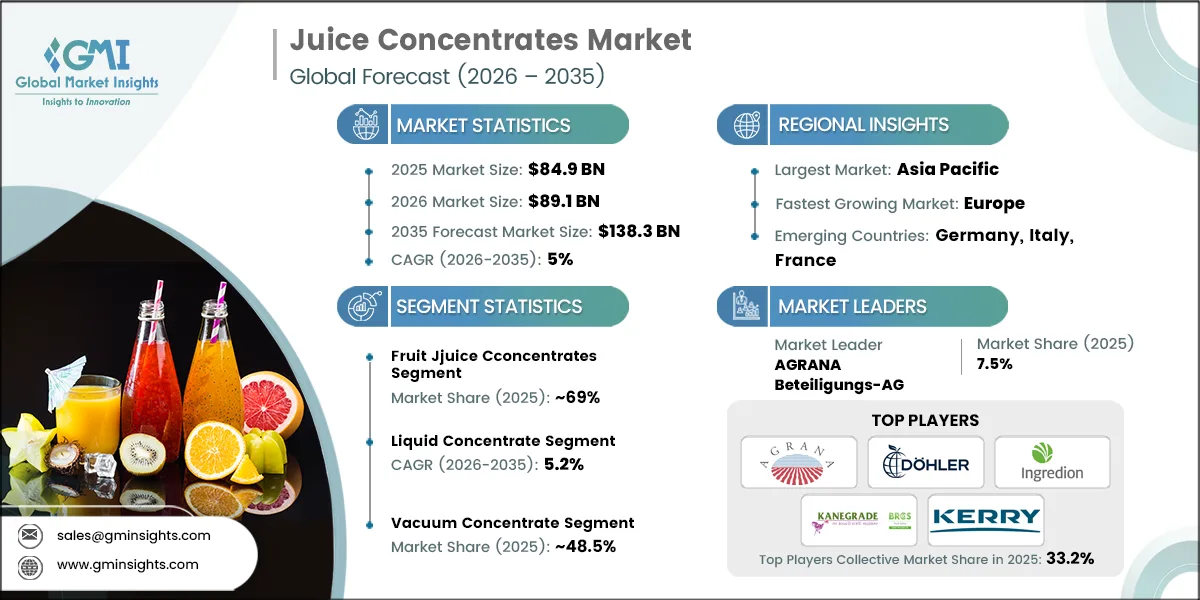
Juice Concentrates Market Key Takeaways
Market Size & Growth
- 2025 Market Size: USD 84.9 Billion
- 2026 Market Size: USD 89.1 Billion
- 2035 Forecast Market Size: USD 138.3 Billion
- CAGR (2026–2035): 5%
Regional Dominance
- Largest Market: Asia Pacific
- Fastest Growing Region: Europe
Key Market Drivers
- Rising demand for natural and healthy products.
- Convenience and ease of storage.
- Expansion of the food & beverage industry.
Challenges
- Stringent regulations.
Opportunity
- Emerging markets.
- Innovation in flavored and functional products.
Key Players
- Market Leader: AGRANA Beteiligungs-AG led with over 7.5% market share in 2025.
- Leading Players: Top 5 players in this market include AGRANA Beteiligungs-AG, DÖHLER, Ingredion Inc., Kanegrade, Kerry Group, which collectively held a market share of 33.2% in 2025.
Get Market Insights & Growth Opportunities
To get key market trends
Juice Concentrates Market Trends
- The worldwide juice concentrate industry has expanded because more consumers want easy-to-use drinks that provide health benefits and contain natural ingredients. Current market developments demonstrate that the industry adopt new products and modern technologies and create new rules which will define its future development.
- The juice concentrate production methods have improved because of technological progress which brought better manufacturing techniques. The introduction of high-pressure processing (HPP) and membrane filtration and advanced pasteurization techniques has enabled manufacturing companies to produce products with better quality and longer shelf life and maintained their original nutritional content. Technology enables manufacturers to create concentrates that have better clarity and stability while using fewer preservatives and artificial additives which meet consumer demand for clean-label products.
- The market currently emphasizes product innovation as companies work to create new flavor combinations and organic products and functional concentrates that contain vitamins and minerals and herbal extracts. The demand for natural and organic concentrates is rising because health-conscious consumers prefer these products. The market now offers innovations which include both low-sugar and sugar-free concentrates to serve the needs of diabetic customers and people who want to lose weight.
- Safety regulations and quality standards and transparency requirements receive priority in international regulatory systems. The FDA & EFSA establish strict rules which manufacturers must follow to maintain food safety, and show ingredient information and execute quality control procedures. The regulations require companies to implement cleaner production methods and transparent labeling systems to achieve their legal obligations and gain consumer trust.
Juice Concentrates Market Analysis
Learn more about the key segments shaping this market
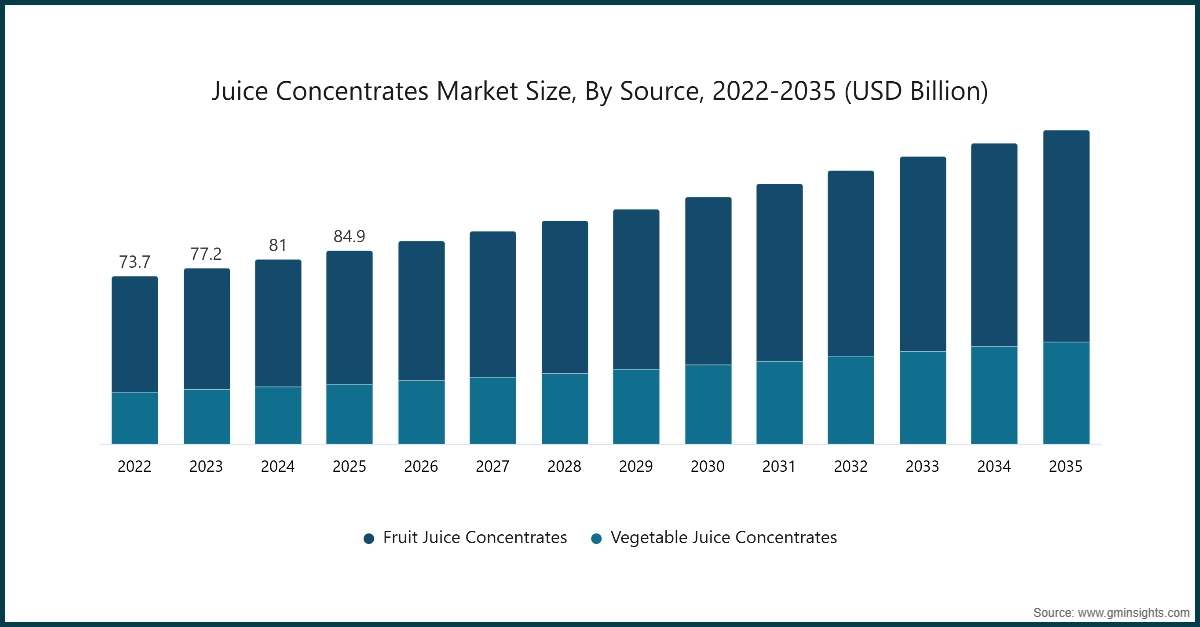
Based on source, the market is segmented into fruit juice concentrate and vegetable juice concentrates. Fruit juice concentrates dominated the market with an approximate market share of 69% in 2025 and is expected to grow with CAGR of 4.8% by 2035.
- The fruit juice concentrate segment has maintained its leading position because consumers choose natural flavors which provide health advantages. Orange and apple and pineapple concentrates are the top three fruit options because people can use them to create both drinks and food items. Grape and berry concentrates have become more popular because people recognize their antioxidant benefits while those products target premium markets. Lemon concentrates have seen rising usage across drink and cooking sectors because people prefer experiencing new taste options.
- Carrot and tomato concentrates have established themselves as essential elements in functional food and beverage products because consumers showed enthusiasm for healthy dietary options. The market for beetroot and cucumber concentrates has expanded because of their health benefits which include better blood circulation and increased body hydration. Natural organic and minimally processed concentrate products have become the primary factor which determines sourcing decisions because manufacturers now prioritize environmentally friendly farming methods and pure product components.
Learn more about the key segments shaping this market
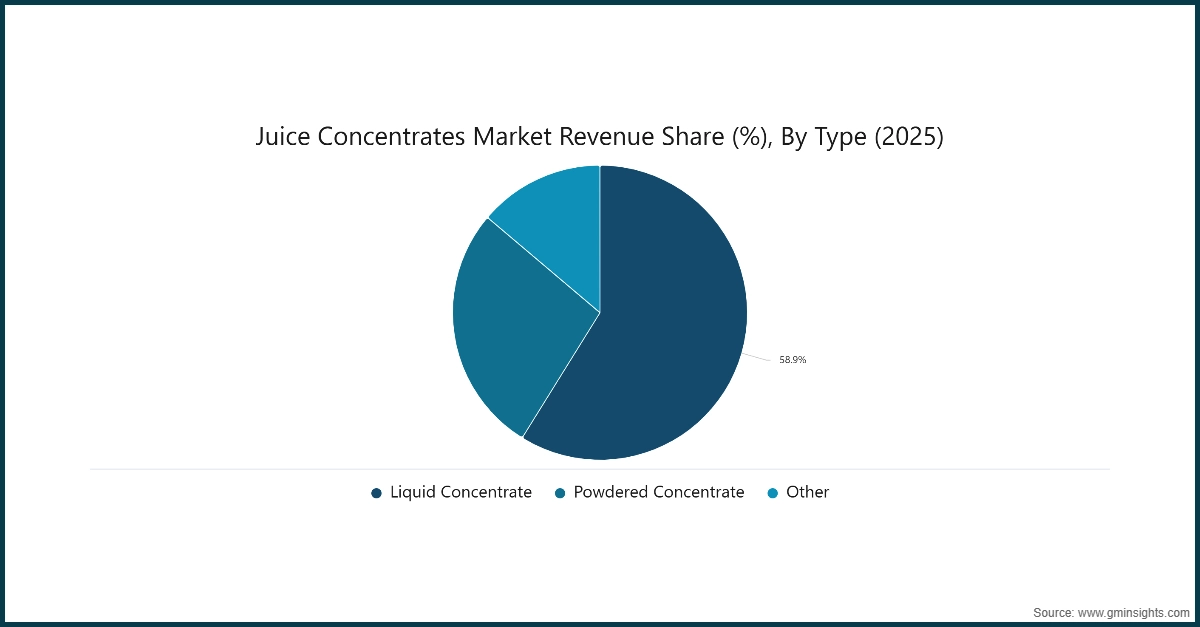
Based on type, the juice concentrates market is segmented into liquid concentrate, powdered concentrate, other. Liquid concentrate held the largest market share of 58.9% in 2025 and is expected to grow at a CAGR of 5.2% during 2026-2035.
- The fruit concentrate market is experiencing steady growth driven by increasing demand in the food and beverage industry for natural ingredients, convenience, and health-focused products. Liquid concentrates continue to dominate due to their ease of use, longer shelf life, and quick blending in beverages, smoothies, and processed foods.
- Powdered concentrates are gaining popularity because of their portability, extended shelf life, and suitability for powdered drink mixes and instant products. The "Other" segment, including freeze-dried and specialty concentrates, is expanding as consumers seek innovative and unique flavor options. Market trends indicate a rising preference for organic and non-GMO fruit concentrates, aligning with health and sustainability concerns. Additionally, technological advancements in extraction and preservation methods are improving product quality and reducing costs.
Based on processing method, the juice concentrates market is segmented into vacuum concentrate, freeze concentration, membrane concentration, aroma recovery, other. Vacuum concentrate dominated the market with an approximate market share of 48.5% in 2025 and is expected to grow with a CAGR of 4.6% by 2035.
- Vacuum concentration provides the best method because it preserves flavor and nutritional value while using less energy for the process. Freeze concentration proves most effective for producing premium products which require high standards in their organic and natural product lines. Membrane concentration technology has gained popularity because it offers effective results which preserve fresh flavors through a non-heat process and health-oriented markets find it advantageous. Aroma recovery processes have become common in the beverage industry because they help create better flavor profiles for high-end products and craft beverages. The market now features new techniques which energy savings while processing time decreases thus helping businesses achieve their environmentally friendly objectives.
Based on application, the juice concentrates market is segmented into beverages, bakery & confectionery, dairy, other. Beverages dominated the market with an approximate market share of 48.5% in 2025 and is expected to grow with a CAGR of 4.8% by 2035.
- The beverage industry uses juice concentrates as a main component for creating smoothies and soft drinks and functional drinks because customers want products that provide health benefits through natural ingredients. The bakery and confectionery industries use concentrates to create flavors which become both fillings and flavors that extend product freshness while maintaining taste quality.
- The dairy sector uses fruit and vegetable concentrates to produce yogurts and milkshakes and flavored milk products which meet the demand for both healthy and delicious dairy items. Manufacturers develop novel uses for concentrates which result in exceptional sensory experiences while they create processed snacks and culinary ingredients for various food products.
Looking for region specific data?
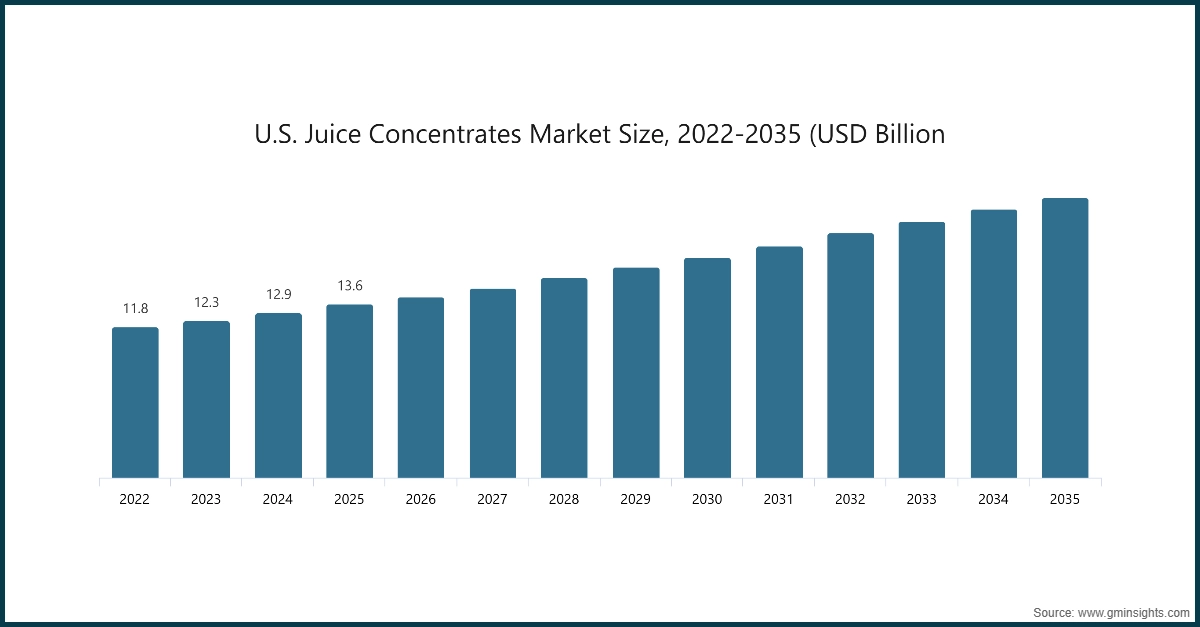
The North America juice concentrates market is growing rapidly on the global level with a market share of 20% in 2025.
- The North American market experiences continuous growth because consumers increasingly seek healthy natural organic products. The region develops new product formulations and packaging solutions because its consumers demand clean-label food products. Membrane filtration technology and high-pressure processing technology help produce better products which have longer shelf lives. The regulatory frameworks create safer product environments which require brands to implement high-quality control procedures. The market shows growing demand for functional fruit concentrates which contain vitamins and minerals to meet needs of health-conscious customers.
Europe juice concentrates market leads the industry with revenue of USD 25.3 billion in 2025 and is anticipated to show lucrative growth over the forecast period.
- The fruit concentrate market in Europe relies heavily on consumers who prefer organic and sustainable products which guide manufacturers in developing and sourcing their product lines. The region develops consumer trust through its strict regulatory framework, which ensures that products meet high-quality standards and maintain complete transparency. The company focuses its development efforts on two main objectives, which include creating natural flavor profiles while reducing sugar content. The industry uses freeze concentration technology combined with aroma recovery technology to maintain its products’ nutritional value and their authentic taste. The market grows because bakery and dairy and beverage makers need fruit concentrates while customers increasingly prefer plant-based products and clean-label options.
The Asia Pacific juice concentrates market is anticipated to grow at a CAGR of 5.1% during the analysis timeframe.
- The Asia Pacific region shows strong growth in its fruit concentrate market because disposable incomes and urbanization and dietary habits are increasing. The market for fruit-based beverages and snacks is expanding so manufacturers need to create new products with different flavors and formulations. The industry uses membrane concentration technology and aroma recovery technology to enhance its product quality. The local market for exotic fruit products and the growing demand for organic products create two major drivers of this trend. The region's food processing industry expansion leads to greater usage of fruit concentrates which benefit multiple business sectors.
Latin America juice concentrates accounted for 9.8% market share in 2025 and is anticipated to show steady growth over the forecast period.
- The fruit concentrate market in Latin America is growing because the region has abundant fruit supply and new export markets emerge. The rising demand for natural products which have minimal processing drives local product producers to implement modern processing methods. Innovations focus on improving flavor retention and reducing sugar content to meet global health trends. The market growth occurs when governments support local product sourcing and environmental sustainable business methods. The regional market grows because beverages and confectionery use more tropical fruit products which are becoming more popular.
Middle East & Africa juice concentrates accounted for USD 4.1 billion market size in 2025 and is anticipated to show lucrative growth over the forecast period.
- The MEA region experiences steady growth in its fruit concentrate market because the food and beverage sector expands and consumers prefer natural products. The market needs products that contain local fruits and flavors which match the preferences of the regional customers. The region adopts technological advancements to enhance product stability and shelf life because its cold chain systems are not fully developed. The growing middle class and increasing urban population will drive up demand for processed foods and fruit-based beverages, which will expand the market.
Juice Concentrates Market Share
The top 5 companies in juice concentrates industry include AGRANA Beteiligungs-AG, DÖHLER, Ingredion Inc., Kanegrade, Kerry Group. These are prominent companies operating in their respective regions covering approximately 33.2% of the market share in 2025. These companies hold strong positions due to their extensive experience in market. Their diverse product portfolios, backed by robust production capabilities and distribution networks, enable them to meet the rising demand across various regions.
- AGRANA operates as a strong player in fruit concentrate production because of its extensive knowledge and wide range of product offerings. The company achieves its competitive edge through its complete supply chain operations, which start from raw material acquisition and continue through processing to deliver products of superior quality while keeping production costs down. The company maintains operations across Europe, North America, and Asia to develop its business base while responding to specific needs of local markets.
- DÖHLER specializes in producing natural ingredients for flavor and juice production while developing fruit concentrates through its innovative product development process. The company achieves its competitive advantage through its strong research and development capabilities which enable it to develop natural fruit concentrates that serve customers in the beverage and bakery sectors and the dairy industry worldwide. The company operates global production facilities which enable it to deliver flexible solutions that meet customer demands in different regions while establishing itself as a trustworthy partner in the fruit concentrate business.
- Ingredion operates as a key player in the specialty ingredients market which includes fruit concentrates and develops cutting-edge products that prioritize customer needs. The company achieves its competitive edge through three main elements which include its diverse product range, advanced processing technology and its extensive distribution network. The company develops functional ingredients which meet current consumer preferences and provide health benefits through its clean-label product offerings.
- Kanegrade produces organic fruit concentrates which maintain high-quality standards through its commitment to sustainable natural sourcing methods. The company maintains its competitive advantage through its specialized focus on organic products which attract customers who prefer natural products with minimal processing. Kanegrade builds its product distinction through sustainable farming methods and complete product traceability which creates transparency for its customers and establishes scope for less sustainable companies.
- Kerry operates as a leading global provider of food ingredients and flavor solutions which include fruit concentrates while developing new products that support consumer health trends. The company achieves its competitive advantage through an integrated supply chain system which includes its extensive research and development capabilities and its diverse product range that meets local market needs. The company develops functional ingredients together with clean-label products and sustainability initiatives to meet the market demand for healthier products that have lower environmental impact.
Juice Concentrates Market Companies
Major players operating in the juice concentrates industry include:
- AGRANA Beteiligungs-AG
- DÖHLER
- Ingredion Inc.
- Kanegrade
- Kerry Group
- Lemonconcentrates
- Northwest Naturals
- Rachels Orchard
- Südzucker Group
- SunnySyrup
- Symrise
- Tree Top Ingredients
Juice Concentrates Market Report Attributes
| Key Takeaway | Details |
|---|---|
| Market Size & Growth | |
| Base Year | 2025 |
| Market Size in 2025 | USD 84.9 Billion |
| Market Size in 2026 | USD 89.1 Billion |
| Forecast Period 2026-2035 CAGR | 5% |
| Market Size in 2035 | USD 138.3 Billion |
| Key Market Trends | |
| Drivers | Impact |
| Rising demand for natural and healthy products | Consumers are increasingly seeking natural, preservative-free, and nutritious beverages, boosting the demand for fruit concentrates as a healthy ingredient. |
| Convenience and ease of storage | Fruit concentrates offer long shelf life, easy transportation, and quick reconstitution, making them popular among manufacturers and retailers. |
| Expansion of the food & beverage industry | Growing consumption of processed foods, fruit-based drinks, and dairy products worldwide fuels the need for fruit concentrates as flavoring and ingredient sources. |
| Pitfalls & Challenges | Impact |
| Stringent regulations | Food safety and quality standards across regions can restrict production processes and increase compliance costs for manufacturers. |
| Opportunities: | Impact |
| Emerging markets | Rapid urbanization and increasing disposable incomes in developing countries present growth opportunities for fruit concentrate manufacturers. |
| Innovation in flavored and functional products | Developing new flavors, organic, and functional concentrates (e.g., with added vitamins or probiotics) can attract health-conscious consumers. |
| Market Leaders (2025) | |
| Market Leader |
7.5% |
| Top Players |
Collective Market Share of 33.2% in 2025 |
| Competitive Edge |
|
| Regional Insights | |
| Largest Market | Asia Pacific |
| Fastest growing market | Europe |
| Emerging countries | Germany, Italy, France |
| Future outlook |
|
What are the growth opportunities in this market?
Juice Concentrates Industry News
- In May 2024, Döhler expanded its South African facility in Paarl by adding new production lines for powdered and liquid compounds, emulsions, and flavors. This upgrade boosts the plant’s capacity for processing bulk juice concentrates and positions it as a key manufacturing hub. It allows regional customers to access Döhler’s full range of compounds, supporting the food, beverage, and health sciences sectors across Southern Africa.
- In April 2024, Symrise launched a prune juice concentrate from its diana food range, featuring a guaranteed minimum sorbitol content, showcased at Vitafoods. A clinical trial conducted by Guangdong Provincial Hospital of Traditional Chinese Medicine and Guangdong University of Technology with 38 volunteers demonstrated potential health benefits of this concentrate for managing functional constipation.
- In November 2022, Citrosuco launched Evera, a new business unit that produces natural ingredients for different industries by reusing orange waste including husks, peels, leaves, and seeds.
This juice concentrates market research report includes in-depth coverage of the industry, with estimates & forecasts in terms of revenue (USD Billion) and volume (Kilo Tons) from 2022 to 2035, for the following segments:
Market, by Source
- Fruit juice concentrate
- Orange
- Apple
- Pineapple
- Grapes
- Berries
- Pear
- Lemon
- Other
- Vegetable juice concentrate
- Carrot
- Cucumber
- Tomato
- Onion & garlic
- Beetroot
- Other
Market, by Type
- Liquid concentrate
- Powdered concentrate
- Others
Market, by Processing Method
- Vacuum concentrate
- Freeze concentration
- Membrane concentration
- Aroma recovery
- Other
Market, by Application
- Beverages
- Bakery & confectionery
- Dairy
- Other
The above information is provided for the following regions and countries:
- North America
- U.S.
- Canada
- Europe
- Germany
- UK
- France
- Spain
- Italy
- Rest of Europe
- Asia Pacific
- China
- India
- Japan
- Australia
- South Korea
- Rest of Asia Pacific
- Latin America
- Brazil
- Mexico
- Argentina
- Rest of Latin America
- Middle East and Africa
- Saudi Arabia
- South Africa
- UAE
- Rest of Middle East and Africa
Frequently Asked Question(FAQ) :
What was the market size of the juice concentrates in 2025?
The market size was USD 84.9 billion in 2025, growing at a CAGR of 5% through 2035, driven by rising demand for health-focused and convenient beverages.
What is the projected value of the juice concentrates market by 2035?
The market is poised to reach USD 138.3 billion by 2035, supported by advancements in production technologies and increasing demand for natural and organic products.
What is the expected size of the juice concentrates industry in 2026?
The market size is projected to reach USD 89.1 billion in 2026.
What was the market share of fruit juice concentrates in 2025?
Fruit juice concentrates held around 69% of the market share in 2025 and are expected to grow at a CAGR of 4.8% through 2035.
What was the market share of liquid concentrates in 2025?
Liquid concentrates accounted for 58.9% of the market in 2025 and are projected to grow at a CAGR of 5.2% through 2035.
What is the growth outlook for vacuum concentrates from 2026 to 2035?
Vacuum concentrates are expected to grow at a CAGR of 4.6% through 2035, following a 48.5% share in 2025.
Which region leads the juice concentrates sector?
North America leads the market with a 20% share in 2025, driven by demand for organic and clean-label products and advancements in processing technologies.
What are the upcoming trends in the juice concentrates market?
Key trends include advancements in processing technologies, rising clean-label demand, low-sugar innovations, and stricter food safety regulations.
Who are the key players in the juice concentrates industry?
Key players include AGRANA Beteiligungs-AG, Döhler, Ingredion Incorporated, Kanegrade, Kerry Group, Lemonconcentrates, Northwest Naturals, Rachels Orchard, and Südzucker Group.
Juice Concentrates Market Scope
Related Reports