Summary
Table of Content

Japan Single-use Duodenoscope Market
Get a free sample of this report
Form submitted successfully!
Error submitting form. Please try again.
Thank you!
Your inquiry has been received. Our team will reach out to you with the required details via email. To ensure that you don't miss their response, kindly remember to check your spam folder as well!
Request Sectional Data
Thank you!
Your inquiry has been received. Our team will reach out to you with the required details via email. To ensure that you don't miss their response, kindly remember to check your spam folder as well!
Form submitted successfully!
Error submitting form. Please try again.
Japan Single-use Duodenoscope Market Size
The high market growth is attributed to the increasing prevalence of gastrointestinal disorders and the growing shift toward single-use medical devices in the country.
Single-use duodenoscopes are fully disposable endoscopic devices intended for single-use in Endoscopic Retrograde Cholangiopancreatography (ERCP) procedures. These devices eliminate contamination risks associated with reprocessing and associated operational burden.
Japan Single-use Duodenoscope Market Key Takeaways
Market Size & Growth
- 2026 Market Size: USD 4.1 Million
- 2035 Forecast Market Size: USD 204.6 Million
- CAGR (2026–2035): 54.4%
Key Market Drivers
- Increasing prevalence of gastrointestinal disorders.
- Technological advancements.
- Growing shift toward single-use medical devices in the country.
Challenges
- High cost associated with the device.
Opportunity
- Favorable regulatory approvals and hospital pilot programs.
Get Market Insights & Growth Opportunities
No leading medical device companies are presently commercializing single-use duodenoscopes within the Japan single-use duodenoscope market. However, international manufacturers, including Boston Scientific, Ambu, and Olympus, are anticipated to enter the Japanese market in the coming years, supported by progressing regulatory approvals and increasing emphasis on infection control in clinical settings.
Growth in the Japan single-use duodenoscope market will be gradual but structurally supported by demographic shifts, infection control priorities, and evolving hospital risk management practices.
Market expansion is primarily driven by Japan’s strong institutional focus on patient safety and hospital-acquired infection (HAI) prevention. Reusable duodenoscopes, due to their intricate elevator mechanisms and complex reprocessing requirements, carry inherent contamination risks. While Japan has not experienced large-scale duodenoscope-related outbreaks, global infection incidents have increased awareness among clinicians, hospital administrators, and regulators. This growing risk consciousness is creating early-stage interest in single-use alternatives as a preventive strategy rather than a reactive solution.
Japan’s demographic profile further reinforces long-term demand. With approximately 29% of the population aged 65 and above and continuing to rise the country has the highest proportion of elderly individuals globally. The aging population is contributing to a steady increase in biliary and pancreatic disorders, thereby driving ERCP procedure volumes across tertiary and specialty centers. As ERCP volumes rise, hospitals are increasingly evaluating technologies that enhance procedural safety while maintaining clinical performance.
The Japan single-use duodenoscope market is expected to reach from USD 4.1 million in 2026 to USD 204.6 million in 2035, growing at a CAGR of 54.4% during the forecast period, according to the latest report published by Global Market Insights Inc.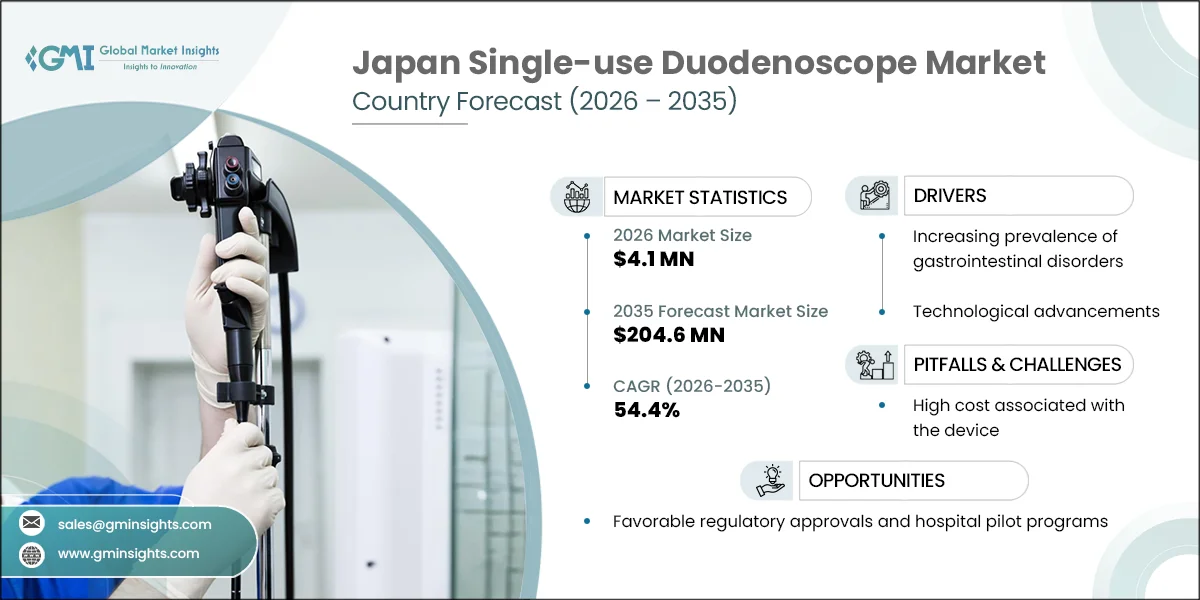
To get key market trends
Japan Single-use Duodenoscope Market Trends
The technological advancements in the design of endoscopic instruments have reduced the traditional hurdles of adopting single-use duodenoscopes, which is a highly important factor in a technically demanding market like Japan.
- The Japanese endoscopy culture requires strict standards of high-resolution imaging, visualization accuracy, torque stability, and elevator mechanism control, which have traditionally favored reusable platforms. Advances in imaging sensor technology, light transmission technology, distal tip articulation, and ergonomic design have greatly diminished the performance differences between reusable and disposable platforms. This convergence in performance reduces physician skepticism related to image clarity and maneuverability, thereby lowering one of the key adoption risks for Boston Scientific’s potential launch in Japan.
- Globally, innovation in duodenoscope technology has accelerated in response to well-documented contamination risks associated with reusable devices. Despite incremental improvements, such as disposable end caps and enhanced reprocessing protocols, structural challenges, including complex internal channels, biofilm formation, and human error during sterilization, remain unresolved. Fully sterile, single-use duodenoscopes were developed to eliminate these risks at the source. Clinical experience from markets where such devices are already commercialized demonstrates procedural feasibility, stable performance across ERCP indications, and increasing physician familiarity over time. This accumulated global evidence strengthens confidence in technological maturity and reduces uncertainty surrounding clinical reliability.
- Therefore, these technological advancements substantially reduce product-performance risk in Japan. For Boston Scientific, technological maturity is no longer the primary gating factor for market entry. Instead, competitive advantage will depend on successful regulatory navigation, the generation of Japan-specific clinical validation data, and alignment with national reimbursement structures. The technological foundation is sufficiently robust to support strategic launch planning.
Japan Single-use Duodenoscope Market Report Attributes
| Key Takeaway | Details |
|---|---|
| Market Size & Growth | |
| Base Year | 2026 |
| Market Size in 2026 | USD 4.1 Million |
| Forecast Period 2026-2035 CAGR | 54.4% |
| Market Size in 2035 | USD 204.6 Million |
| Key Market Trends | |
| Drivers | Impact |
| Increasing prevalence of gastrointestinal disorders | Rising incidence of biliary and pancreatic conditions is expected to increase ERCP procedure volumes, supporting future demand for single-use duodenoscopes. |
| Technological advancements | Improvements in imaging quality, maneuverability, and device ergonomics are likely to enhance clinical confidence and accelerate adoption once products are introduced. |
| Growing shift toward single-use medical devices in the country | Stronger focus on infection prevention and reprocessing challenges is expected to drive hospital interest in disposable endoscopy solutions. |
| Pitfalls & Challenges | Impact |
| High cost associated with the device | Higher per-procedure costs compared to reusable duodenoscopes may slow adoption, particularly in cost-sensitive hospitals and reimbursement-limited settings. |
| Opportunities: | Impact |
| Favorable regulatory approvals and hospital pilot programs | Future approvals and initial pilot deployments in major hospitals could create early adoption pathways and establish clinical and economic value for single-use systems in Japan. |
| Regional Insights | |
| Future outlook |
|
What are the growth opportunities in this market?
Japan Single-use Duodenoscope Market Share
The Japan single-use duodenoscope market currently has no active commercial participants, as major global manufacturers have not yet launched single-use duodenoscope products in the country. Although companies such as Boston Scientific, Ambu, and Olympus are key players in the global single-use endoscopy segment, their duodenoscope offerings are either in earlier launch phases in other regions or awaiting broader commercialization strategies for Japan.
As a result, the competitive landscape in Japan can be described as a pre-launch environment, with no company holding a measurable market share at present. However, the market is expected to transition toward an emerging competitive structure once regulatory approvals are secured and product launches begin.
Japan Single-use Duodenoscope Market Companies
A few of the prominent players that are expected to operate in the Japan single-use duodenoscope industry include:
- Ambu
- Boston Scientific
- Olympus
- Boston Scientific
Boston Scientific leverages its strong global leadership in endoscopy and single-use device innovation, offering advanced disposable duodenoscope platforms designed to reduce infection risk and eliminate reprocessing complexities. Its extensive clinical network and established relationships with hospitals support rapid adoption once commercialized in Japan.
Ambu is a pioneer in single-use endoscopy, with a broad portfolio of disposable visualization devices and a strong track record in infection-prevention solutions. The company focuses on ergonomic design, high-quality imaging, and scalable production capabilities, positioning it as a key early mover in Japan’s single-use duodenoscope segment.
Frequently Asked Question(FAQ) :
What is the market size of Japan single-use duodenoscope in 2026?
The Japan single-use duodenoscope market is expected to reach USD 4.1 million in 2026, growing at a remarkable CAGR of 54.4% through 2035.
What is the projected value of the Japan single-use duodenoscope market by 2035?
The market is expected to reach USD 204.6 million by 2035, driven by infection control priorities and rising ERCP procedure volumes.
What role does Japan's aging population play in market growth?
With approximately 29% of the population aged 65 and above, rising biliary and pancreatic disorders are steadily increasing ERCP procedure volumes across hospitals.
What are the upcoming trends in the Japan single-use duodenoscope market?
Key trends include increasing physician adoption of disposable platforms, growing emphasis on infection control, and evolving hospital risk management practices favoring single-use devices.
What challenges do manufacturers face in entering the Japan market?
Manufacturers must navigate complex regulatory approvals, generate Japan-specific clinical validation data, and align with national reimbursement structures to succeed commercially.
Who are the key players in Japan single-use duodenoscope market?
Boston Scientific, Ambu, and Olympus are anticipated to enter the Japanese market, pending regulatory approvals and commercialization strategies.
Japan Single-use Duodenoscope Market Scope
Related Reports