Summary
Table of Content

Ionic Liquids for Battery Applications Market
Get a free sample of this report
Form submitted successfully!
Error submitting form. Please try again.
Thank you!
Your inquiry has been received. Our team will reach out to you with the required details via email. To ensure that you don't miss their response, kindly remember to check your spam folder as well!
Request Sectional Data
Thank you!
Your inquiry has been received. Our team will reach out to you with the required details via email. To ensure that you don't miss their response, kindly remember to check your spam folder as well!
Form submitted successfully!
Error submitting form. Please try again.
Ionic Liquids for Battery Applications Market Size
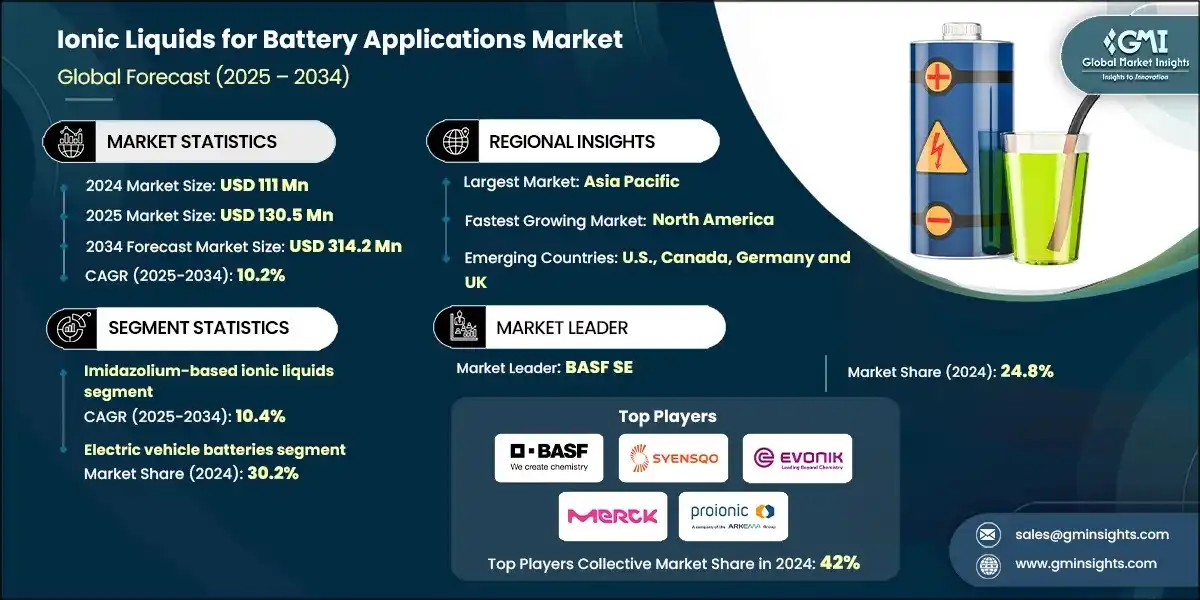
The global ionic liquids for battery applications market was estimated at USD 111 million in 2024. The market is expected to grow from USD 130.5 million in 2025 to USD 314.2 million in 2034, at a CAGR of 10.2%, according to latest report published by Global Market Insights Inc.
To get key market trends
- Ionic liquid markets for battery applications are being propelled into significant growth by the increased demand for advanced energy storage solutions. Ionic liquids are organic salts that are liquid at relatively low temperatures and present unique features-high thermal stability, non-volatility, excellent ionic conductivity, and wide electrochemical windows. These characteristics make them perfect for application as electrolytes in all types of batteries: lithium-ion, sodium-ion, and the new solid-state batteries.
- Ionic liquids act as critical electrolytes in batteries to promote the migration of ions across the electrodes and give better performance, safety, and lifetime to batteries. In addition, ionic liquids allow for batteries to be run at higher voltages and broader temperature ranges which extend their functionality range to electric vehicles (EVs), grid storage, and portable electronic devices.
- Various factors work in unison to shape the landscape of such markets. The shift towards electric vehicles and integration of renewable energy sources into the grids have necessitated safer high-capacity batteries which have stimulated demand for ionic liquid electrolytes. The ongoing technological advancement is further focusing on enhancing the conductivity and reducing the cost of ionic liquids; these factors encourage the very expansion of the market. However, the environment is faced with production at high cost and scalability in question. In fact, research continues with the aim of developing ionic liquids that can be produced economically and in an environmentally responsible manner, thus increasing commercial viability.
- Asia Pacific is the largest market for ionic liquids for battery applications due to growing industrialization in the developing countries like China, India, Japan and others.
- North America is the fastest growing region for ionic liquids for battery applications market, as the nation is full of opportunities and large-scale commercial facilities the region can enhance its performance in this market in the coming years.Ionic Liquids for Battery Applications Market Report Attributes
Key Takeaway Details Market Size & Growth Base Year 2024 Market Size in 2024 USD 111 Million Market Size in 2025 USD 130.5 Million Forecast Period 2025 – 2034 CAGR 10.2% Market Size in 2034 USD 314.2 Million Key Market Trends Drivers Impact Enhanced safety performance Ionic liquids are non-volatile and non-flammable, significantly reducing the risk of battery fires and explosions, which promotes their adoption in safety-critical applications like electric vehicles and portable electronics. Superior electrochemical stability They offer wide electrochemical windows and high thermal stability, enabling batteries to operate efficiently at high voltages and temperatures, thus improving overall performance and lifespan. Increasing demand for electric vehicles The global push towards sustainable transportation boosts the need for high-performance, durable, and safe battery electrolytes, driving the adoption of ionic liquids in next-generation lithium-ion and beyond batteries. Pitfalls & Challenges Impact High manufacturing costs The complex synthesis processes and high purity requirements lead to elevated production costs, which can hinder large-scale commercial adoption. Limited commercial availability Compared to traditional electrolytes, ionic liquids are less widely available, and their integration into existing manufacturing processes can be challenging. Opportunities: Impact Development of safer, fire-resistant batteries Ionic liquids' non-flammable nature offers significant opportunities to produce safer batteries for electric vehicles, portable electronics, and grid storage, reducing safety concerns and expanding their adoption. Enabling high-performance and high-temperature batteries Their thermal stability and wide electrochemical windows can facilitate the creation of batteries that operate efficiently at higher temperatures and voltages, opening new markets for high-performance energy storage. Innovation in solid-state and next-generation batteries The potential integration of ionic liquids with solid electrolytes paves the way for next-generation batteries with higher energy densities, improved safety, and longer lifespans, fueling research and commercialization efforts. Market Leaders (2024) Market Leaders - BASF SE
Market Share 24.8%Top Players - BASF SE
- Syensqo
- Evonik Industries AG
- Merck KGaA
- Proionic GmbH- Arkema Group
Collective Market Share 42% in 2024Competitive Edge - BASF SE leads with extensive R&D, strong manufacturing capacity, and broad chemical expertise, positioning it as a key player in ionic liquids for batteries.
- Evonik Industries AG and Merck KGaA also hold significant market shares due to their advanced specialty chemicals and innovative formulations.
- Syensqo and Proionic GmbH—Arkema Group focus on niche, high-performance ionic liquids and tailored solutions, emphasizing innovation and customization.
Regional Insights Largest Market Asia Pacific Fastest growing market North America Emerging countries U.S., Canada, Germany and UK Future outlook - The future outlook for the ionic liquid market in battery applications is highly optimistic. The escalating demand for safer, high-performance, and environmentally friendly energy storage solutions is fueling innovation and adoption across various sectors. Advancements in ionic liquid formulations are improving battery efficiency, stability, and lifespan, making them more attractive for electric vehicles, renewable energy storage, and portable electronics. Growing investments in research and development are driving cost reductions and scalability. Increasing regulatory focus on safety and sustainability will further accelerate market growth.
What are the growth opportunities in this market?
Ionic Liquids for Battery Applications Market Trends
- Ionic liquid battery applications market trend is presently characterized with rapid technology, changing regulations, and continuous product innovations. With the increasing demand for safer energy management, research is focusing on the design of new ionic liquid formulations that would increase battery performance, thermal stability, and life span. Innovations in the composition of electrolytes are leading to batteries with high voltage that can offer increased ionic conductivity which plays a major role in the advancement of electric vehicle (EV) technologies and renewable energy storage.
- Increased stress on the safety, environmental sustainability, and recyclability of battery components is found globally in regulatory frameworks. Manufacturers are being pressed to use ionic liquids as safer medium than the traditional organic solvents with a better burden of flammability and toxicity because of the well-defined safety standards and environmental regulations; thus, all the innovation on green and biodegradable ionic liquids would thus further continue to increase their market prospects.
- Cost and scalability are also drivers of product innovation. Companies are performing research on low-cost ionic liquids that will be manufactured on a large scale but maintain high performance. Meanwhile, ionic liquids are beginning to find synergies with developing battery technologies such as solid-state batteries and lithium-silicon systems, which would open more market growth opportunities.
Ionic Liquids for Battery Applications Market Analysis
Learn more about the key segments shaping this market
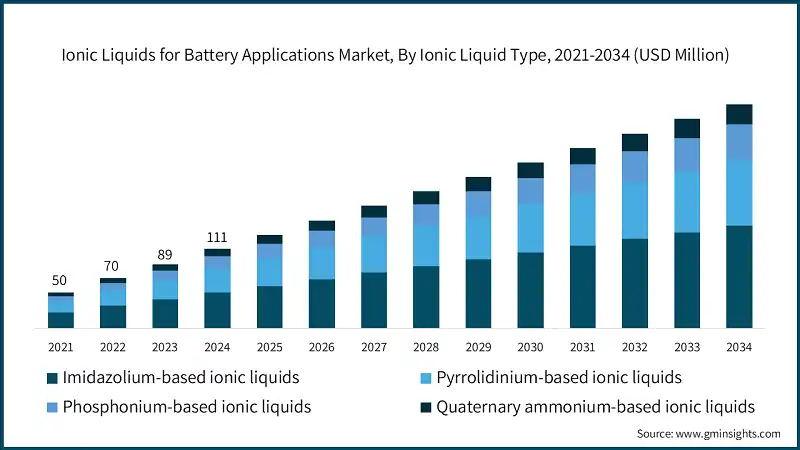
- Imidazolium-based ionic liquids constitute a very significant 45.2% of the market in the year 2024. This imidazolium share demonstrates a close relationship with their almost unparalleled electrochemical stability, ionic conductivity properties, and commercial availability. The imidazolium segment is poised to get massive investments in R&D, helping in all the commercial formulations, which have been advantageous to all the battery chemistries. The fact that they have better economies of scale in manufacturing and reliable supply chain enables them to be substantially cost-effective for posturing on continuous market leadership.
- Pyrrolidinium-based ionic liquids amounting to almost 29.8% due to their highest ionic conductivity and excellent low-temperature performance. The remarkable growth in this subcategory has gained traction accordingly with the implementation of these materials in consumer electronics and automotives where ultra-fast charging and low-temperature ways of operation necessitate lower-temperature operability.
- The ionic liquids for battery applications market from phosphonium segment grabbed 15.2% of the market. Phosphonium-based ionic liquids are capable of operation up to 150 degrees C with almost electrochemical stability; they are well suited for high-temperature processes and systems that require maximum stability. The growth in the segment can be attributed to the increasingly accepted use in energy storage of potential large scale and industrial battery systems, which most often require thermal management.
- Quaternary Ammonium represent 9.8% of the total alkaline electrolyte market, because of their lower viscosities and the cost-effective synthesis routes. They possess good electrochemical properties and are cheaper than other ionic liquid when they are used in practice.
Learn more about the key segments shaping this market
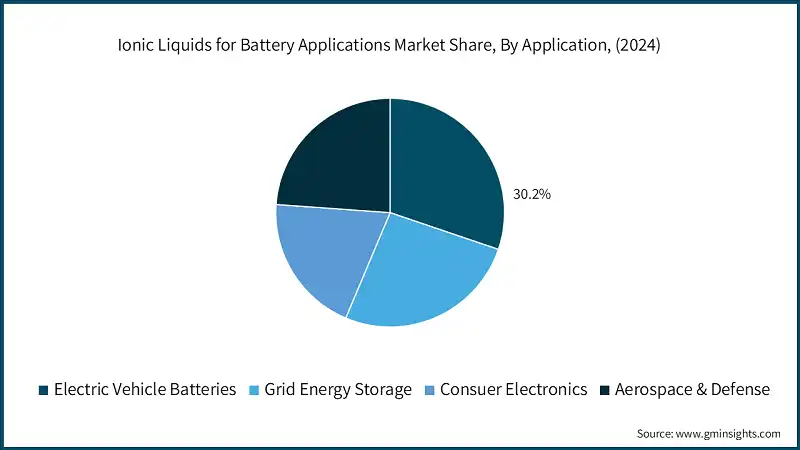
Based on applications, the ionic liquids for battery applications market is segmented into electric vehicle batteries, grid energy storage, consumer electronics, aerospace & defense. The market dynamics are very diverse across major end-use sectors that the application segments create regarding requirements for specific performances, regulation concerns, and technology adoption trends.
- Electric vehicle batteries constitute the biggest application segment, capturing 30.2% of the market share due to the transition of the automotive industry towards electrification and the paramount importance of battery safety performance. The growth of this segment rides on growing production of electric vehicles, stringent safety regulations, and consumer demand for enhanced battery performance.
With potential future development of next-generation battery programs, major automotive OEMs are identified to be well investing in ionic liquid electrolyte technologies. - Grid energy storage carries a share of 26.1% market share, influenced by increased deployments from renewable sources and grid modernization efforts. Ionic liquids cover such features as extended operational temperature ranges, limited fire risk, and improved lifecycle characteristics laying down total cost of ownership in favor of stationary storage applications. Strong utility-scale storage deployments will bolster this segment in addition to requirements for integrated distributed energy resources.
- Consumer electronics accounts for 19.8% of the ionic liquids for battery applications market, with a 9.8% CAGR reflecting the constant demand for portable electronic devices and increasing emphasis on battery safety in consumer applications. From the point of view of safety, ionic liquids offer better safety than conventional electrolytes but allow the design of compact batteries for more energy density. These applications include smartphones, tablets, wearable devices, and Internet of Things sensors.
- With strong growth of 10.1% CAGR within the aerospace and defense segment, this particular market currently holds 23.9% share. Demand for aerospace and defense applications for such stringent safety requirements and difficult operational conditions drives this market segment growth.
Looking for region specific data?
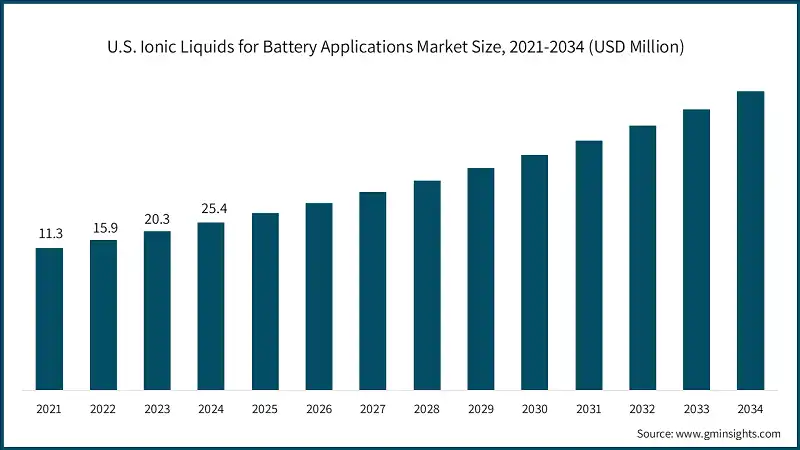
North America Ionic Liquids for Battery Applications Market The North America market account market share of 28.2% in 2024. U.S. dominates the North America ionic liquids for battery applications market, showcasing strong growth potential. Europe ionic liquids for battery applications accounted for USD 22.1 million in 2024 and is anticipated to show lucrative growth over the forecast period. Germany dominates the European ionic liquids for battery applications market, showcasing strong growth potential. The Asia Pacific ionic liquids for battery applications is anticipated to grow at the CAGR of 10.2% during the analysis timeframe. China ionic liquids for battery applications is estimated to grow with a significant CAGR, in the Asia Pacific ionic liquids for battery applications. Latin America ionic liquids for battery applications accounted for USD 3.2 million in 2024 and is anticipated to show lucrative growth over the forecast period. Brazil leads the Latin American ionic liquids for battery applications market, exhibiting remarkable growth during the analysis period. Middle East & Africa ionic liquids for battery applications accounted for USD 1.1 million in 2024 and is anticipated to show lucrative growth over the forecast period. Saudi Arabia ionic liquids for battery applications market to experience substantial growth in the Middle East and Africa market in 2024. The top 5 companies in the ionic liquids for battery applications industry include BASF SE, Syensqo, Evonik Industries AG, Merck KGaA, Proionic GmbH - Arkema Group. These are prominent companies operating in their respective regions covering 42%-43% of the market share. These companies hold strong positions globally due to their extensive experience in ionic liquids for battery applications market. Their diverse product portfolios, backed by robust production capabilities and distribution networks, enable them to meet the rising demand across various regions. Major players operating in the ionic liquids for battery applications industry include:Europe Ionic Liquids for Battery Applications Market
Asia Pacific Ionic Liquids for Battery Applications Market
Latin American Ionic Liquids for Battery Applications Market
Middle East and Africa Ionic Liquids for Battery Applications Market
Ionic Liquids for Battery Applications Market Share
Ionic Liquids for Battery Applications Market Companies
Ionic Liquids for Battery Applications Industry NewsThis ionic liquids for battery applications market research report includes in-depth coverage of the industry, with estimates & forecasts in terms of revenue (USD Million) and volume (Tons) from 2025 to 2034, for the following segments:
Market, By Ionic Liquids Type
- Imidazolium-based ionic liquids
- Pyrrolidinium-based ionic liquids
- Phosphonium-based ionic liquids
- Quaternary ammonium-based ionic liquids
Market, By Application
- Electric vehicle batteries
- Automotive traction batteries
- Hybrid vehicle systems
- Fast charging applications
- Grid energy storage
- Utility-scale storage systems
- Frequency regulation applications
- Long-duration storage solutions
- Consumer electronics
- Smartphone applications
- Laptop & portable devices
- Wearable technology
- Aerospace & defense
- Satellite battery systems
- Military applications
The above information is provided for the following regions and countries:
- North America
- U.S.
- Canada
- Europe
- Germany
- UK
- France
- Spain
- Italy
- Rest of Europe
- Asia Pacific
- China
- India
- Japan
- Australia
- South Korea
- Rest of Asia Pacific
- Latin America
- Brazil
- Mexico
- Argentina
- Rest of Latin America
- Middle East and Africa
- Saudi Arabia
- South Africa
- UAE
- Rest of Middle East and Africa
Frequently Asked Question(FAQ) :
What are the upcoming trends in the ionic liquids for battery applications market?
Key trends include the development of safer, fire-resistant electrolytes, integration with solid-state and next-generation batteries, and innovation toward cost-effective and sustainable ionic liquid production to meet the growing energy storage demand.
Who are the key players in the ionic liquids for battery applications industry?
Key players include BASF SE, Syensqo, Evonik Industries AG, Merck KGaA, Proionic GmbH – Arkema Group, Solvionic SA, IoLiTec GmbH, Tokyo Chemical Industry Co., Ltd., NOHMs Technologies Inc., and Richman Chemical Inc.
Which region leads the ionic liquids for battery applications market?
North America accounted for 28.2% of the market share in 2024. Growth is driven by rising EV adoption, renewable energy integration, and government support for advanced energy storage technologies.
What was the valuation of the electric vehicle batteries application segment in 2024?
Electric vehicle batteries accounted for 30.2% of the market in 2024, driven by the global transition toward electrification and the growing focus on battery safety and performance.
How much revenue did the imidazolium-based ionic liquids segment generate in 2024?
Imidazolium-based ionic liquids held 45.2% market share in 2024, leading the industry due to their superior electrochemical stability, ionic conductivity, and broad commercial availability.
What is the projected value of the ionic liquids for battery applications market by 2034?
The market is expected to reach USD 314.2 million by 2034, supported by innovation in solid-state batteries and focus on safer, high-performance electrolytes.
What is the market size of the ionic liquids for battery applications industry in 2024?
The market size was USD 111 million in 2024, growing at a CAGR of 10.2% through 2034, driven by the rising demand for electric vehicles and advanced energy storage systems.
What is the current ionic liquids for battery applications market size in 2025?
The market size is projected to reach USD 130.5 million in 2025.
Ionic Liquids for Battery Applications Market Scope
Related Reports