Summary
Table of Content

Intimate Wet Wipes Market
Get a free sample of this report
Form submitted successfully!
Error submitting form. Please try again.
Thank you!
Your inquiry has been received. Our team will reach out to you with the required details via email. To ensure that you don't miss their response, kindly remember to check your spam folder as well!
Request Sectional Data
Thank you!
Your inquiry has been received. Our team will reach out to you with the required details via email. To ensure that you don't miss their response, kindly remember to check your spam folder as well!
Form submitted successfully!
Error submitting form. Please try again.
Intimate Wet Wipes Market Size
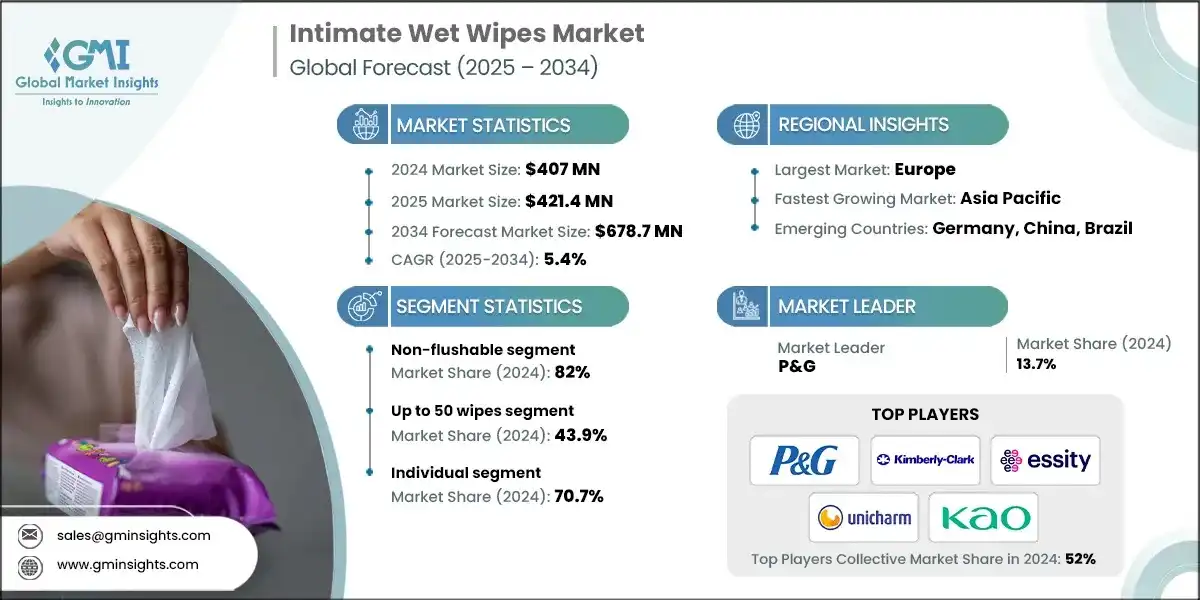
The global intimate wet wipes market size was estimated at USD 407 million in 2024. The market is expected to grow from USD 424.1 million in 2025 to USD 678.7 million in 2034, at a CAGR of 5.4% according to latest report published by Global Market Insights Inc.
Intimate Wet Wipes Market Key Takeaways
Market Size & Growth
- 2024 Market Size: USD 407 Million
- 2025 Market Size: USD 424.1 Million
- 2034 Forecast Market Size: USD 678.7 million
- CAGR (2025–2034): 5.4%
Key Market Drivers
- Growing Hygiene Awareness.
- Convenience and on-the-go use.
- Product innovation and natural formulations.
Challenges
- Environmental concerns (non-biodegradable).
- Skin sensitivity and irritation risk.
- Cultural stigma / acceptance barriers.
Opportunity
- Rising demand for eco-friendly and biodegradable wipes.
- Expansion into emerging markets with growing hygiene awareness.
- Growth of premium, specialized, and dermatologically advanced formulations.
Key Players
- Market Leader: P&G led with over 13.7% market share in 2024.
- Leading Players: Top 5 players in this market include P&G, Kimberly-Clark Corporation, Essity AB, Unicharm Corporation, Kao Corporation, which collectively held a market share of 52% in 2024.
Get Market Insights & Growth Opportunities
- The market in the world is a well-established subsector of the personal care and hygiene products market, constantly gaining momentum due to changing lifestyles, growing hygiene awareness, and innovation in products. Such commercial intensity with a wide array of consumer acceptance is envisaged to result in the market valuation of approximately USD 407 million by the year 2024.
- Market sizing analysis comprises the detailed estimation of production volumes, retail sales values, distribution channel performance, and regional consumption patterns. The market segmentation includes different product varieties: general cleansing wipes, menstrual hygiene wipes, postpartum care products, and specialized formulations for particular intimate health issues. Product prices range widely from economy-tier offers targeted for developing markets to premium organic and dermatologically tested products that secure higher price positioning in the developed world.
- The global intimate wet wipes market has emerged as one of the major sectors within the personal care and hygiene products category. It shows consistent growth, while the trend of changing consumer lifestyles, increasing awareness of hygiene, and innovations in products have occurred continuously. The market value reached USD 407 million in 2024, reflecting high commercial activity with wide consumer acceptance across different geographic markets and demographic segments.
- Quantitative market assessment draws from a range of data sources, including manufacturer production statistics, retail sales tracking, import-export trade data, and consumer expenditure surveys. The World Bank's Living Standards Measurement Study provides methodological guidelines for the measurement of hygiene behaviors and out-of-pocket health expenditure at the household level in low- and middle-income countries.
- In accordance with World Bank findings, this enables hygiene product demand estimates and expenditure patterns. Entailing such data infrastructure allows more precise market sizing and demand forecasting, especially in emerging markets where coverage from commercial market research may be patchy.
- The broader feminine hygiene products market includes intimate wet wipes alongside menstrual care products and is projected to grow from USD 27 billion in 2023 to USD 47.98 billion by 2032 at a CAGR of 6.60%, based on data from the World Bank.
- Within this broad market, the cleaning and deodorizing segment-which involves intimate wipes-is smaller but fast-growing, impelled by increasing awareness of personal hygiene, concerns about odor control, demand for multipurpose products, and the need for convenience on-the-go.
- Geographic distribution of market value reflects disparities in economic development, hygiene infrastructure, cultural attitudes, and product accessibility. The developed markets of North America and Europe continue to capture disproportionately large shares of global value on account of their higher pricing per unit, premium product penetration, and established distribution infrastructure.
- However, emerging markets in Asia Pacific, Latin America, and select Middle Eastern and African countries are increasingly contributing to volume growth as urbanization progresses, incomes rise, and hygiene awareness expands.
To get key market trends
Intimate Wet Wipes Market Trends
The market is dynamic evolution, configured around interconnected trends that are fundamentally transforming product development, consumer behavior, regulatory landscapes, and competitive strategies. These emerging trends reflect broader societal shifts toward sustainability, health consciousness, digital commerce, and personalized wellness solutions.
Digital Commerce and Direct-to-Consumer Models
- E-commerce and direct-to-consumer distribution channels structurally change how intimate hygiene products reach consumers. These changes significantly influence access to markets, consumer behavior, and competitor activity. E-retailing lowers many of the major challenges that have traditionally plagued the adoption of intimate hygiene products, such as concerns over privacy, and a general lack of in-store shelf space within some markets.
- Privacy and discretion represent the most important advantages of online purchasing of intimate hygiene products. Most users feel embarrassed or uneasy buying such merchandise in physical retail locations where one undertakes transactions in full view of other shoppers and cashiers.
- E-commerce platforms afford private browsing, discreet packaging, and home delivery that eliminate these social barriers. This advantage of privacy is most critical in conservative markets where the purchase of intimate hygiene merchandise will bring social stigma.
- This digital commerce trend is particularly pronounced in emerging markets, where traditional retail infrastructure may be limited but mobile internet penetration is expanding fast. In India, for example, e-commerce platforms are facilitating access to intimate hygiene products in smaller cities and rural areas that have typically been relatively underpenetrated by physical retail distribution.
- This channel evolution is democratizing access and accelerating market development in previously under-served geographies.
Health and Wellness Integration
- Intimate hygiene has become part of larger, mainstream health and wellness frameworks. This is reflective of changing consumer attitudes toward intimate care: no longer something best ignored but rather an integral part of a health regimen. And this normalization-now supported at every level by public health organizations, healthcare providers, and wellness influencers-is a call to proactive intimate health management.
- World Health Organization recognition of menstrual health as a human right and the emphasis on comprehensive sexual and reproductive health services give institutional validation for intimate hygiene as a legitimate health priority according to World Bank data.
- WHO guidance stipulates that decent menstrual hygiene management requires access to clean menstrual materials, soap and water for cleaning, private changing facilities, safe disposal options, and information on healthy practices
Regulatory Evolution and Compliance
- The regulatory frameworks around intimate wet wipes are constantly changing, given environmental concerns, considering safety, and consumer protection policies. This evolution of regulations opens challenges and opportunities for industry; while compliance investments are obligatory, they may advantage established firms possessing requisite regulatory expertise and resources.
- Material restrictions increasingly include prohibition of plastics and microplastics regulations. The EU has legislated restrictions on microplastics and General Product Safety Regulation 2023/988, both of which demand greater product traceability and safety.
- These mandate the reformulation to biodegradable substrates and ingredient transparency. In the US market, the FDA's Modernization of Cosmetics Regulation Act, known as MoCRA, demands that all cosmetic manufacturers register their facilities and list all products. That has raised the cost of compliance and created a barrier to entry that would favor established firms.
- Safety standards for intimate hygiene products are under increased regulatory scrutiny, specifically on the safety of ingredients, prevention of contamination, and disclosure of allergens.
- The U.S. Environmental Protection Agency's Safer Choice program provides product specifications for dermal exposure, including heightened criteria for leave-on products and products intended for infants and children according to the EPA.
- To meet the Safer Choice standard, products must avoid sensitizers, use ingredients that meet rigorous toxicological criteria, and be transparent about ingredients. This certification program provides a roadmap for manufacturers to differentiate their products on safety while delivering third-party validation to consumers.
Intimate Wet Wipes Market Analysis
Learn more about the key segments shaping this market
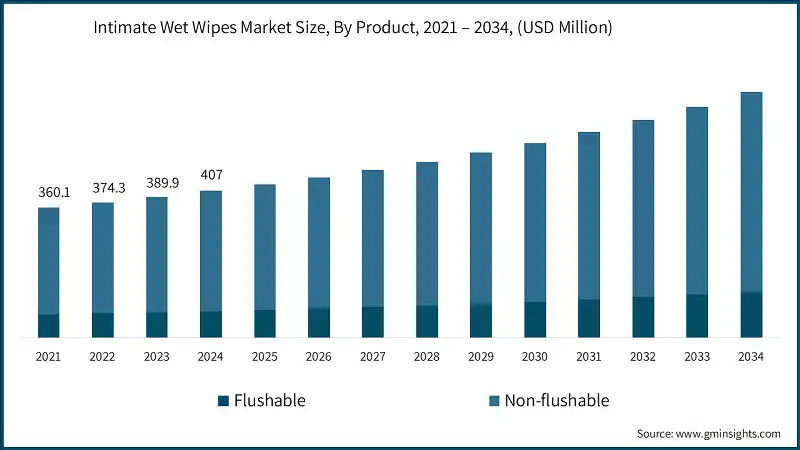
Based on type, the segmentation of market includes flushable and non-flushable. The segment of non-flushable held around 82% market share in 2024 and is projected to see a CAGR of about 5.3% during 2025-2034.
- Non-flushable wipes accounted for 82% of the market share in 2024 and were expected to grow at a CAGR of 5.3% through 2034. This segment includes most of the intimate hygiene wipes marketed today, which are made from several substrate materials such as polyester, polypropylene, cotton, wood pulp, rayon, and blended fibers. Non-flushable products tend to have greater wet strength and durability, and also better shelf stability than their flushable counterparts.
- These properties contribute to effective cleansing and to consumer satisfaction. Manufacturing can be more flexible because the product can be optimized for particular performance attributes including thickness, texture, absorbency, and ingredient compatibility without the constraint of having to ensure rapid disintegration in water.
- According to the UK government, wet wipes account for the vast majority of sewer blockages, despite most of them being labeled as non-flushable demonstrating that real consumer disposal behavior is sometimes not aligned with product labeling.
- This non-flushable segment has well-established manufacturing infrastructure and material supply chains, combined with production economics that enable competing price points in a range from economy to premium. Innovation in products will entail sustainability in materials, natural formulation, special ingredients targeting specific intimate health needs, and packaging convenience.
- The segment has felt significant headwinds, however, from growing environmental concerns and increased regulatory pressure.
Learn more about the key segments shaping this market
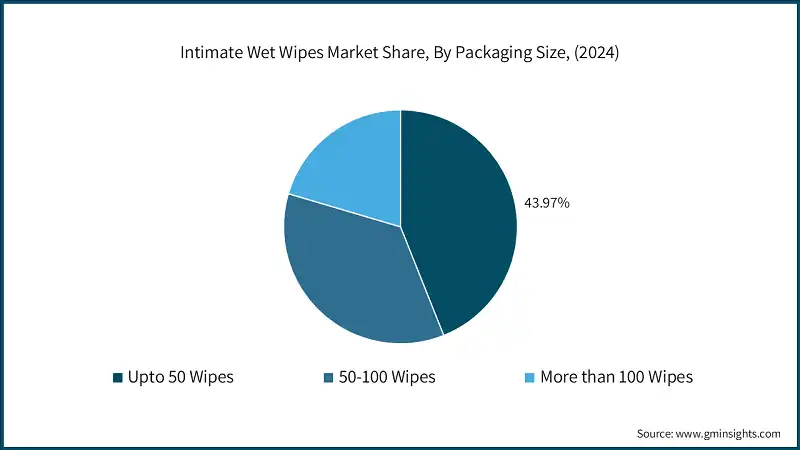
Based on packaging size, the global intimate wet wipes market is categorized into up to 50 wipes, 50-100 wipes, and more than 100 wipes. The up to 50 wipes segment held around 43.9% of the total market share in 2024 and is anticipated to grow at a CAGR of 5.3% from 2025 to 2034.
- The packaging of up to 50 wipes was responsible for around 43.97% of the market share in the year 2024 and is anticipated to grow during the forecast period from 2024 to 2034 at a CAGR of around 5.3%. It includes small-format packaging of individual sachets, travel packs, and compact pouches for portability and convenience.
- While commanding premium per-unit pricing on account of higher relative packaging costs to product volume, small formats create value through convenience and portability, with reduced waste risk from product drying. This is a very important format for brand trial and sampling strategies as it allows consumers to experience the products without having to buy large quantities.
- Distribution advantages are that it allows for impulse purchase locations such as checkout counters, retail travel, vending machines, and convenience stores where there is limited space available or decisions for quick purchases.
- Packaging of 50-100 wipes had the largest market share of 35.60% in 2024 and is expected to witness the fastest growth at a CAGR of 5.7% through 2034. This midsize format offers the best balance between convenience, value, and storage practicality, making it the ideal choice for regular home use by households with moderate consumption.
- Packaging generally uses flip-top or resealable closures that have been designed to maintain product moisture over an extended use period with easy one-handed dispensing.
- Over 100 wipes packaging represented a 20% market share in 2024 and is expected to increase at a CAGR of approximately 5% through 2034, reflecting the value segment. Large format packaging provides the best per-unit economics while catering to high-consumption households, multi-person families, and value-driven consumers who consider value over convenience.
- These formats typically use larger tubs or multi-pack configurations designed for home storage with extended periods.
- Bulk comes with its own set of challenges: storage requirements, maintaining product freshness over longer periods of use, and higher upfront purchase costs inhibit trial and accessibility among price-sensitive consumers
Based on the end-user, global intimate wet wipes market is categorized as individual and commercial. The individual segment held around 70.7% of the total market share in 2024.
- Individual consumers dominated the market, with a share of 70.72% in 2024 and a projected growth at a CAGR of 5.7% through 2034. This segment embodies personal purchase for home use, impelled by individual hygiene, health consciousness, convenience consideration, and brand loyalty.
- Product attributes emphasized in consumer decision-making processes incorporate formulation safety, ingredient naturalness, fragrance preference, packaging convenience, brand reputation, and price-value relationships.
- The individual segment benefits from various distribution channels, such as supermarkets, drugstores, specialty personal care retailers, and the highly growing e-commerce platform. Variations in products go from economy to premium, from conventional to organic formulations, and from general-purpose to specialized products to deal with intimate health concerns.
- Marketing strategies focus on emotional benefits like confidence, freshness, self-care, and empowerment, besides functional attributes of cleansing efficacy and convenience.
- Commercial and institutional end-use accounted for 29% market share in 2024 with projected 4.5% CAGR through 2034. The segment covers purchases made by business entities, medical facilities, hotel industries, educational institutions, and public centers that supply the product to employees, patients, guests, students, and public consumers.
- Purchase decisions for commercial purposes are based on different factors: bulk price, product performance, compliance with regulations, relations with suppliers, and operational concerns.
- Healthcare facilities represent a significant commercial subsegment, as hospitals, clinics, and long-term care facilities purchase intimate hygiene products for patient care. Global estimates suggest that almost half of all healthcare facilities in the world lack basic hygiene services, and hundreds of millions of people receive care in health care settings that lack reliable water.
- The slower growth compared to individual consumers in the commercial segment is indicative of market maturation in developed regions, budget constraints in public institutions, and the fact that commercial provision remains limited in many markets.
- However, the outstanding opportunities lie in the emerging markets, where improving infrastructure coupled with rising service standards drives amenity expansion, and in the developed markets, where corporate social responsibility and gender equity initiatives are increasingly elevating intimate hygiene provision as a workplace and public facility standard.
Looking for region specific data?
North America Intimate Wet Wipes Market
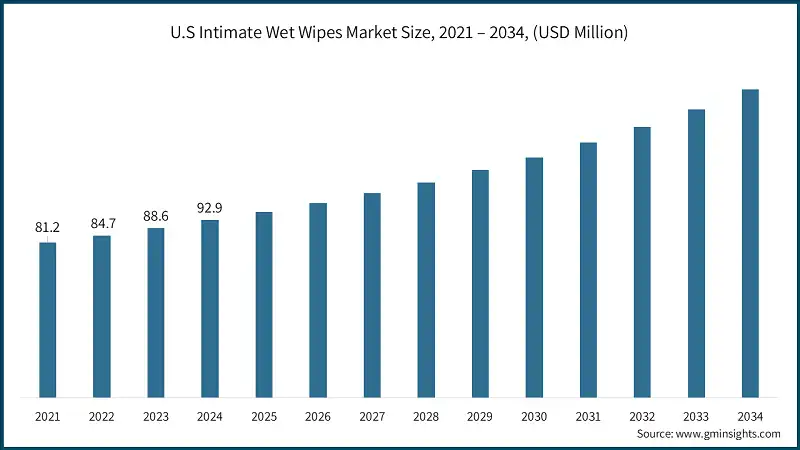
- North America held 29.67% of the market share in 2024 and is expected to grow at a CAGR of 5.6% through 2034. The region is a significant, mature market that features high product awareness, a wide-reaching distribution infrastructure, premium product penetration, along with changing regulatory frameworks.
- The United States captures the majority of regional market value, while Canada is a smaller yet still considerable market that mirrors many of those same characteristics.
- North America maintains high consumer awareness and product normalization, where intimate hygiene products are easily available through diverse retail channels and where cultural attitudes are generally supportive of the use of personal hygiene products.
- The premium segment has performed well, as consumers show a willingness to pay more for organic, natural, dermatologically tested, and specialized formulations. Brand loyalty is pronounced but not inflexible, as consumers stay open to innovation and ingredient transparency and especially sustainability credentials.
- Regulatory evolution is taking hold of the North American market, with federal efforts to establish national "Do Not Flush" labeling standards via the bipartisan WIPPES Act. Various states in the U.S., such as California, Washington, Oregon, Illinois, Colorado, Michigan, and New Jersey, have already enacted their own requirements for labeling products. Thus, in practice, a patchwork regulatory environment has already been implemented across the federal landscape.
Asia Pacific Intimate Wet Wipes Market
- Asia Pacific accounted for 23.94% market share in 2024 with the fastest projected regional growth at 6.1% CAGR through 2034, representing the most dynamic market opportunity. Growth drivers are rapid urbanization, increasing disposable incomes, growing middle-class populations, increased health awareness, improvement in retail infrastructure, and other demographic factors like high youth population and more women entering the workforce.
- India, Japan, and South Korea are highlighted as key emerging markets within the region. Each possesses its own unique characteristics, whether cultural, demographic, or financial in nature.
- India provides an opportunity for high growth on account of an estimated population of 1.4 billion; a fast-growing, urban middle class; government-led hygiene initiatives, including the Swachh Bharat (Clean India) campaign that was launched in 2014. Yet, some powerful counterpoints exist, such as affordability constraints, limited retail infrastructure in rural areas, cultural sensitivities associated with intimate hygiene, and the fact that hundreds of millions of Indians are not connected to basic sanitation facilities
- Japan continues to have a high demand for prestige and sophisticated hygiene products, with sophisticated consumers who will pay higher prices for quality, innovation, and specialty formulations. The Japanese market provides high-quality product standards, widespread retail distribution, and cultural emphasis on cleanliness and personal presentation.
- The aging demographics present an opportunity for specialized product offerings with older consumers but also present a challenge with slower population growth.
Europe Intimate Wet Wipes Market
- Europe accounted for a share of 32.71% in 2024 and is expected to advance at a CAGR of 5.3% through 2034. A high level of hygiene standards, strong environmental consciousness, advanced retail infrastructure, supporting regulatory frameworks, and the general cultural attitude have normalized intimate hygiene product use in the region.
- European consumers show a strong preference for sustainable and organic formulations, with a willingness to pay premium prices for products that meet environmental and safety standards.
- Regulatory leadership sets the European market apart, with the European Union instituting wide-ranging frameworks on microplastics restrictions, mandating greater traceability and safety standards via the General Product Safety Regulation 2023/988, and national-level initiatives such as the UK ban on plastic-containing wipes.
- These are driving faster-than-ever industry transitions toward biodegradable materials and ingredient transparency at an unprecedented rate. Compliance challenges and opportunities for innovation abound.
- The UK's legislation, which saw overwhelming public support during consultations, underlines a strong social consensus regarding priorities for the environment.
- Distribution infrastructure in Europe is very well developed, with extensive retail networks, sophisticated supply chains, and advanced e-commerce platforms giving comprehensive market coverage.
- Major retailers like Boots, Aldi, and Tesco have proactively removed plastic from wipes ahead of regulatory requirements, exemplifying strong retail-sector engagement with sustainability priorities.
- Cultural factors that will help drive the European market include relatively progressive attitudes toward menstrual health and intimate hygiene, comprehensive sexual health education across much of the continent, and gender-equity policies that address period poverty and hygiene access.
- There is considerable variance around the region, though, and Northern and Western European countries are generally more progressive in their attitudes and product penetration, while Southern and Eastern European markets may be more culturally conservative.
Intimate Wet Wipes Market Share
The market is at a stage of moderate concentration, where established multinational corporations have greater market shares due to large distribution networks, strong brand recognition, high investments in marketing activities, and diversified product portfolios across different personal care categories.
The top five players held 52% in 2024 alone; thus, the degree of competition in the market sufficiently balances the scaling advantages of major corporations with the scope of specialized manufacturers and regional players.
- Procter & Gamble Company, with a wide portfolio of personal care brands, Always being a leading feminine hygiene brand with global recognition and distribution, managed to retain market leadership with 13.7% share in the year 2024. Major competitive advantages of P&G include substantial research and development capabilities, thereby continuous product innovation; sophisticated consumer insight due to decades of its presence in the market; vast global distribution networks with reach into a variety of retail channels and geographies; and marketing expertise with substantial investments in advertising. Its scale enables it to have manufacturing efficiencies, procurement advantages, and provides the ability to invest in sustainability initiatives such as biodegradable material development and packaging innovation.
- Nice-Pak Products, Inc. is a major player in private label and contract manufacturing for intimate wipes for retail brands and institutional customers. This business model allows retail chains and smaller brands to provide competitive products without having to invest in manufacturing infrastructure. Further competitive intensity is brought by Edgewell Personal Care Company, with the brand Playtex, and Kao Corporation. Kao is extremely strong in Asian markets, while Edgewell uses its expertise in feminine care. Ontex Group maintains its focus on personal hygiene, while it has particular strength in European markets and in emerging economies.
- Merger and acquisition activity has been moderating in the intimate wipes segment, with larger personal care corporations occasionally acquiring specialized brands or technologies to enhance portfolios and accelerate innovation. Strategic partnerships between manufacturers and retailers are common, very specifically in private label development, as this enables retailers to offer competitive products while the manufacturers receive volume and market access.
- Competitive strategies differ by player type. Multinational corporations focus on brand building, innovation, breadth of distribution, and diversification across price tiers and product types. Regional specialists concentrate on local market knowledge, cultural adaptation, and selective distribution. Digital native direct-to-consumer brands are more focused on digital marketing, community building, sustainability credentials, and personalized customer experiences. Private label manufacturers compete based on cost efficiency, flexibility, and relationships with retailers.
Intimate Wet Wipes Market Companies
Major players operating in the intimate wet wipes industry are:
- Bodyform/Libresse (Essity)
- Edgewell Personal Care Company
- Essity AB
- Hengan International Group
- Johnson & Johnson
- Kao Corporation
- Kimberly-Clark Corporation
- Natracare LLC
- Nice-Pak Products, Inc.
- Ontex Group
- Procter & Gamble Company
- Rael Inc.
- The Honey Pot Company
- Unicharm Corporation
- Unilever PLC
The market features a diverse competitive landscape encompassing multinational personal care corporations, specialized hygiene product manufacturers, private label producers, and emerging direct-to-consumer brands. Major players operating in the market include:
- Procter & Gamble Company has a share of 13.7% in the global market, mainly based on the Always brand and other feminine hygiene products. The company is involved in business in more than 180 countries due to its far-reaching distribution network across the globe. Innovation at P&G is advanced through substantial financial investments in research and development, while profound knowledge of consumers secures its leading positions in significant market trends. Its product portfolio spans from low-priced brands to premium ones, so it can satisfy virtually all consumers.
Furthermore, the company strives to minimize waste, focusing on biodegradable materials for packaging. P&G recently engaged in expanding special product lines connected with intimate health, developing e-commerce and direct-to-consumer channels, and supporting education about intimate health in cooperation with healthcare professional associations. - Kimberly-Clark Corporation, under the Kotex brand, offers a variety of feminine hygiene products, including intimate cleansing wipes. The company focuses on innovation in material science by creating advanced nonwoven substrates that offer superior performance combined with environmental responsibility. Backed by powerful brand equity developed over many decades, Kimberly-Clark ensures wide distribution through its extensive retail partnerships, while manufacturing processes remain efficient. The company is committed to sustainability by striving to increase the use of renewable materials and recyclable packaging. Key areas of strategic focus include premium product creation with specialty formulation, geographic expansion into emerging markets like Asia Pacific and Latin America, and deepening digital engagement across educational content and e-commerce.
- Essity AB addresses intimate hygiene with the brands Bodyform and Libresse, both strong in Europe. The products appeal to a more youthful demographic by addressing period stigma, supporting gender equity, and offering intimate health education. Sustainability at Essity refers to using biodegradable materials, responsible sourcing, and applying circular economy principles. Designs are based on dermatologically tested formulations, pH balancing, and transparency of ingredients. The company is seeking to expand into emerging markets, offering products with particular local needs and pricing strategies while developing its digital commerce capability, partnering where appropriate with NGOs focused on menstrual health education and access.
- Unicharm Corporation has a strong foothold in Asia, most specifically in Japan, China, and other countries in East Asia. The success of the company pertains to local consumer tastes, maintaining extensive distribution networks, and creating products for regional tastes, including specific textures and packaging. Unicharm invests in advanced materials and manufacturing technologies. To remain innovative, the company has also expanded its operations into other emerging markets, adapting its products to meet the needs of such markets. It focuses on offering premium products to take care of various environmental concerns of the developed Asian markets and enhance its e-commerce platforms, particularly in China's highly developed digital commerce ecosystem.
Intimate Wet Wipes Market Report Attributes
| Key Takeaway | Details |
|---|---|
| Market Size & Growth | |
| Base Year | 2024 |
| Market Size in 2024 | USD 407 Million |
| Market Size in 2025 | USD 424.1 Million |
| Forecast Period 2025 - 2034 CAGR | 5.4% |
| Market Size in 2034 | USD 678.7 million |
| Key Market Trends | |
| Drivers | Impact |
| Growing Hygiene Awareness | Increasing public focus on personal cleanliness is driving higher adoption of intimate wipes. |
| Convenience and on-the-go use | Consumers value wipes for their portability and quick use in busy or travel situations. |
| Product innovation and natural formulations | Brands are boosting demand by introducing safer, gentler, and more natural ingredient combinations. |
| Pitfalls & Challenges | Impact |
| Environmental concerns (non-biodegradable) | Many wipes contribute to plastic waste and pollution due to slow decomposition. |
| Skin sensitivity and irritation risk | Harsh chemicals or fragrances can cause irritation, limiting suitability for sensitive users. |
| Cultural stigma / acceptance barriers | In some regions, intimate hygiene products face hesitation due to cultural taboos. |
| Opportunities: | Impact |
| Rising demand for eco-friendly and biodegradable wipes | Consumers increasingly seek sustainable options with minimal environmental impact. |
| Expansion into emerging markets with growing hygiene awareness | Growing incomes and hygiene education in developing regions create new market potential. |
| Growth of premium, specialized, and dermatologically advanced formulations | Demand is rising for high-performance wipes tailored to specific skin and health needs. |
| Market Leaders (2024) | |
| Market Leaders |
Market share 13.7% |
| Top Players |
Collective market share in 2024 is 52% |
| Competitive Edge |
|
| Regional Insights | |
| Largest Market | Europe |
| Fastest Growing Market | Asia Pacific |
| Emerging Country | Germany, China, Brazil |
| Future Outlook |
|
What are the growth opportunities in this market?
Intimate Wet Wipes Industry News
Recent industry developments reflect the dynamic evolution of the market, with regulatory actions, product launches, sustainability initiatives, and strategic partnerships shaping competitive dynamics and market trajectories.
- November 2025: The United Kingdom made a landmark decision to ban the sale and supply of wet wipes containing plastic in England. Legislation of this nature, expected to take effect in spring 2027 after an 18-month transition period, is a step toward addressing environmental challenges. Government figures revealed that in 2023 alone, out of 32 billion wet wipes sold in the UK market, 12 billion contained plastic. The ban will be for all consumer retail sales, not on medical professionals, pharmacies, and commercial entities. The public was supportive of the measure, with 95% supporting the proposal. The new ban brings England into line with Scotland, Wales, and Northern Ireland, all of which have either implemented or are working on such bans, thus creating a uniform regulatory regime across the UK. Indeed, many retailers, such as Boots, Aldi, and Tesco, have already removed plastic from their wet wipes, showcasing industry readiness. The legislation should facilitate a more rapid shift toward biodegradable alternatives and could inspire similar moves in other regions.
- March 2025: Senators Susan Collins and Jeff Merkley of the United States have proposed the bipartisan Wastewater Infrastructure Pollution Prevention and Environmental Safety (WIPPES) Act. The legislation would require explicit "Do Not Flush" labels on non-flushable wet wipes, including personal care and intimate wipes, due to a rise in sewer blockages and infrastructure damage across the United States. These issues reportedly cost U.S. clean water utilities an estimated $441 million annually. The bill has gained significant support from various organizations such as public works associations, environmental groups, and industry players. The bill instructs the Federal Trade Commission to ensure the "Do Not Flush" label and a recognizable symbol are both on the front of packaging. It also creates an EPA grant program that would finance consumer education programs led by states, local governments, and non-profits. The WIPPES Act introduces a federal standard that will simplify the patchwork of state-level labeling laws already enacted across several states, such as California, Washington, and New Jersey.
- June 2024: The WIPPES Act, H.R. 2964, passed the U.S. House of Representatives with overwhelming bipartisan support, as more than 82% of members voted to approve the bill, demonstrating their commitment to helping wastewater infrastructure cope with the crisis caused by improperly flushed wipes. This followed the House Energy and Commerce Committee's unanimous approval of the bill on a 31-0 vote. The bill cited a 2019 estimate from the National Association of Clean Water Agencies that puts the annual operating cost increase for U.S. clean water utilities because of wipes at about $441 million. Despite these awareness messages, many consumers are still confused about non-flushable items, believing that they will be safe to flush. The bill will now head to the Senate, where Senators Collins and Merkley are expected to introduce it in March 2025 in an attempt to move the bill forward in the legislative process.
- March 2024: Water UK, the trade body for UK water companies, announced that it would abolish its "Fine to Flush" certification following concerns about consumer confusion. Instead, it launched a new "Bin the Wipe" campaign urging people to throw all wipes, including those marketed as flushable, in the bin rather than down the toilet. The shift reflects fears that even wiping products meeting strict standards of flushability pose significant infrastructure issues in the real world. Water UK wants a complete ban on manufacturing plastic wipes and compulsory "do not flush" labelling on all wet wipes, regardless of their material. It pointed out that problems persist, such as £200 million annual costs to clear sewer blockages and extreme cases-like the removal of a 100-tonne fatberg from a west London sewer, which took more than a month of specialist work.
The intimate wet wipes market research report includes in-depth coverage of the industry with estimates & forecasts in terms of revenue ($ Mn) and volume (Thousand Units) from 2021 to 2034, for the following segments:
Market, By Type
- Flushable
- Non-Flushable
Market, By Packaging Size
- Upto 50 wipes
- 50-100 wipes
- More than 100 wipes
Market, By Pricing
- Low
- Medium
- High
Market, By End-use
- Individual
- Commercial
Market, By Distribution Channel
- Online
- E-commerce
- Company websites
- Offline
- Mega retail store
- Specialty stores
- Others
The above information is provided for the following regions:
- North America
- U.S.
- Canada
- Europe
- UK
- Germany
- France
- Italy
- Spain
- Russia
- Asia Pacific
- China
- India
- Japan
- Australia
- South Korea
- Latin America
- Brazil
- Mexico
- Argentina
- MEA
- UAE
- South Africa
- Saudi Arabia
Frequently Asked Question(FAQ) :
What is the market size of the intimate wet wipes market in 2024?
The market size was USD 407 million in 2024, with a CAGR of 5.4% expected through 2034 driven by rising hygiene awareness, changing lifestyles, and continuous product innovation.
What is the projected value of the intimate wet wipes market by 2034?
The market is expected to reach USD 678.7 million by 2034, driven by growing demand for convenient hygiene solutions, sustainability-focused products, and expanding penetration in emerging markets.
How much revenue did the non-flushable wipes segment generate in 2024?
Non-flushable wipes dominated the market with 82% share in 2024, supported by strong consumer adoption and broader availability across global retail and e-commerce channels.
What was the valuation of the up to 50 wipes packaging segment in 2024?
The up to 50 wipes packaging segment held approximately 43.9% market share in 2024, driven by high demand for travel packs, single-use sachets, and compact formats offering portability and convenience.
What is the growth outlook for individual end-use from 2025 to 2034?
The individual end-use segment is projected to grow at a CAGR of 5.7% through 2034, driven by rising personal hygiene awareness, increasing preference for premium formulations, and expanding online distribution platforms.
Which region leads the intimate wet wipes industry?
Europe led the market with 32.71% share in 2024, supported by strong hygiene standards, advanced retail infrastructure, and high consumer preference for sustainable and organic products.
Which region leads the intimate wet wipes market?
North America held 29.67% of the market share in 2024, driven by high product awareness, a robust distribution network, premium product penetration, and evolving regulatory frameworks. The region is expected to grow at a CAGR of 5.6% through 2034.
Who are the key players in the intimate wet wipes market?
Key players include Procter & Gamble Company, Kimberly-Clark Corporation, Essity AB, Unicharm Corporation, Johnson & Johnson, Kao Corporation, Unilever PLC, Ontex Group, Nice-Pak Products Inc., and Edgewell Personal Care Company.
What is the estimated market size of the intimate wet wipes market in 2025?
The market is expected to reach approximately USD 424.1 million in 2025, driven by expanding consumer acceptance of intimate hygiene products and increased availability across digital and retail channels.
Intimate Wet Wipes Market Scope
Related Reports