Summary
Table of Content

Interferometric Synthetic Aperture Radar (InSAR) Market
Get a free sample of this report
Form submitted successfully!
Error submitting form. Please try again.
Thank you!
Your inquiry has been received. Our team will reach out to you with the required details via email. To ensure that you don't miss their response, kindly remember to check your spam folder as well!
Request Sectional Data
Thank you!
Your inquiry has been received. Our team will reach out to you with the required details via email. To ensure that you don't miss their response, kindly remember to check your spam folder as well!
Form submitted successfully!
Error submitting form. Please try again.
Interferometric Synthetic Aperture Radar Market Size
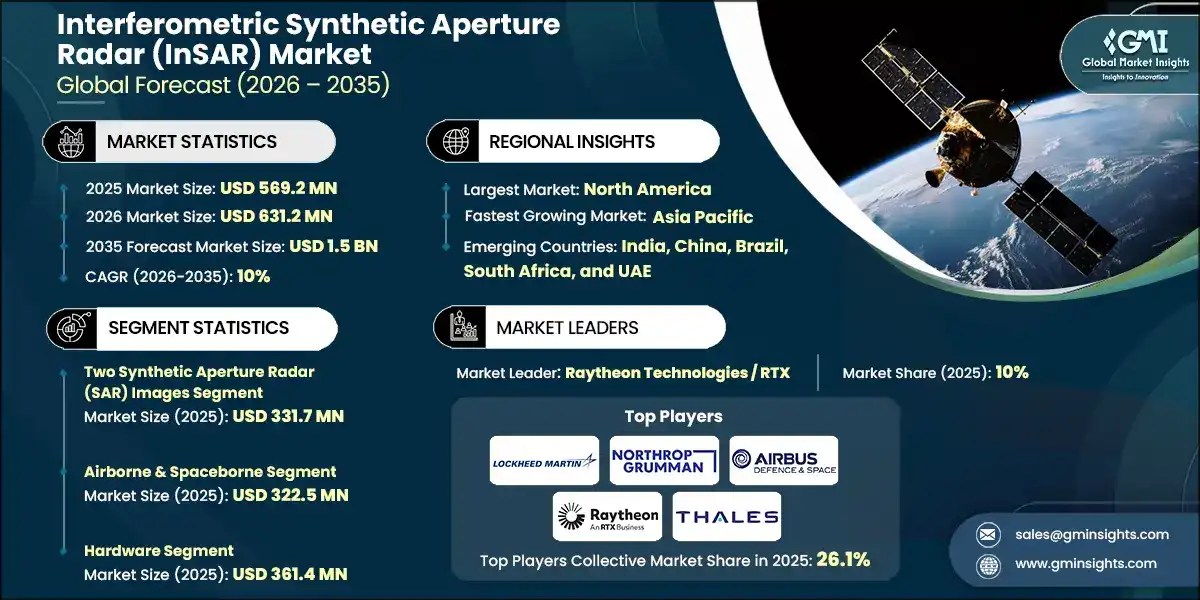
The global interferometric synthetic aperture radar market was valued at USD 569.2 million in 2025. The market is expected to grow from USD 631.2 million in 2026 to USD 1 billion in 2031 and USD 1.5 billion in 2035, at a CAGR of 10% during the forecast period, according to the latest report published by Global Market Insights Inc.
Interferometric Synthetic Aperture Radar (InSAR) Market Key Takeaways
Market Size & Growth
- 2025 Market Size: USD 569.2 Million
- 2026 Market Size: USD 631.2 Million
- 2035 Forecast Market Size: USD 1.5 Billion
- CAGR (2026–2035): 10%
Regional Dominance
- Largest Market: North America
- Fastest Growing Region: Asia Pacific
Key Market Drivers
- Infrastructure Monitoring & Maintenance.
- Integration with AI, ML, and Cloud Analytics.
- Oil, Gas & Mining Applications.
- Defense & Government Space Programs.
- Satellite Constellations & High-Frequency Revisit.
Challenges
- High Deployment & System Costs.
- Technical Complexity & Skill Requirements.
Opportunity
- Infrastructure Resilience & Smart City Projects.
- Environmental Monitoring & Disaster Management.
Key Players
- Market Leader: Raytheon Technologies / RTX led with over 10% market share in 2025.
- Leading Players: Top 5 players in this market include Lockheed Martin Corporation, Northrop Grumman Corporation, Airbus Defence and Space, Raytheon Technologies / RTX, Thales, which collectively held a market share of 26.1% in 2025.
Get Market Insights & Growth Opportunities
The market for interferometric synthetic aperture radar is expanding, owing to infrastructure monitoring & maintenance, integration with AI, ML, and cloud analytics, oil, gas & mining applications, defense & government space programs, and satellite constellations & high-frequency revisit.
Monitoring and maintenance of critical infrastructures such as bridges, roads, railways, and dams is rapidly advancing in the InSAR market due to the capacity to uncover small ground deformations. InSAR continuous monitoring provides improved maintenance, mitigates the risk of failures of the structures, and reduces the expenses of long-term repairs. InSAR also mitigates potential risks and aids in urban disaster preparedness. For instance, in December 2025, NASA and ISRO's joint NISAR mission to monitor infrastructure using spaceborne InSAR. The mission aims to detect millimeter-level shifts in structures and monitor their changes over time. This is the first spaceborne InSAR instrument capable of monitoring small shifts in structures in real time.
Oil, gas, and mining applications are a significant growth driver for the InSAR market because the technology allows monitoring of surface deformation and subsidence near extraction sites, pipelines, and storage facilities. InSAR supports operational safety, reduces environmental risks, and helps companies comply with regulatory requirements. By enabling large-area, continuous monitoring, it reduces the need for extensive field inspections and improves predictive maintenance and risk management for energy and mining infrastructure. In November 2025, B3 Insight and SatSense established collaboration to integrate SatSense's InSAR (Interferometric Synthetic Aperture Radar) satellite data into B3's OilfieldH2O platform to provide operators in the oil and gas real time monitoring of ground changes associated with drilling, injection wells, and earthquakes in order to manage risks related to well integrity and disposal capacity.
The interferometric synthetic aperture radar industry encompasses technologies and services that utilize radar satellites and/or airborne data that determine the deformation of the ground, subsidence, and changes in structure at the level of millimeters of precision. It plays a role in monitoring infrastructures, assessing geohazards, managing the environment, overseeing the oil and gas sectors, mining, and serving in defense. It provides accurate, continuous, and large-area monitoring services to governments, businesses, and academic organizations.
To get key market trends
Interferometric Synthetic Aperture Radar Market Trends
- InSAR has been widely used in sectors like infrastructure monitoring and environmental management, its applications are rapidly expanding into new areas. The agriculture sector, for example, is leveraging InSAR for precision farming by monitoring soil moisture levels and crop health. Additionally, the insurance industry is adopting InSAR technology for risk assessment and damage evaluation, especially in regions prone to natural disasters. The growing interest in climate change research is also driving the use of InSAR for monitoring glacier movements and sea-level rise.
- For instance, in June 2024, Synspective, a Japanese SAR satellite data and analytics company, announced the successful test observation of daily InSAR images using their StriX-3 and StriX-1 satellite. This breakthrough will significantly expand InSAR applications by providing more frequent data, enabling improved monitoring of construction sites, infrastructure, and natural hazards.
- The expansion of multi?satellite InSAR constellations is enabling far higher temporal resolution than older missions, supporting near?continuous surface monitoring for deformation and risk assessment. This helps sectors like infrastructure management and disaster response track changes much more rapidly than before, increasing the value of InSAR for timely decision?making. Governments and commercial players alike are launching more small radar satellites to improve revisit frequencies.
- Remote sensing technology is improving operational safety and environmental stewardship. With tools like high-resolution satellites and other advanced remote sensing technologies, organizations can now monitor and manage their operations with unparalleled accuracy. These technologies provide real-time environmental, infrastructure, and resource utilization data, which helps organizations make timely and proactive decisions.
Interferometric Synthetic Aperture Radar Market Analysis
Learn more about the key segments shaping this market
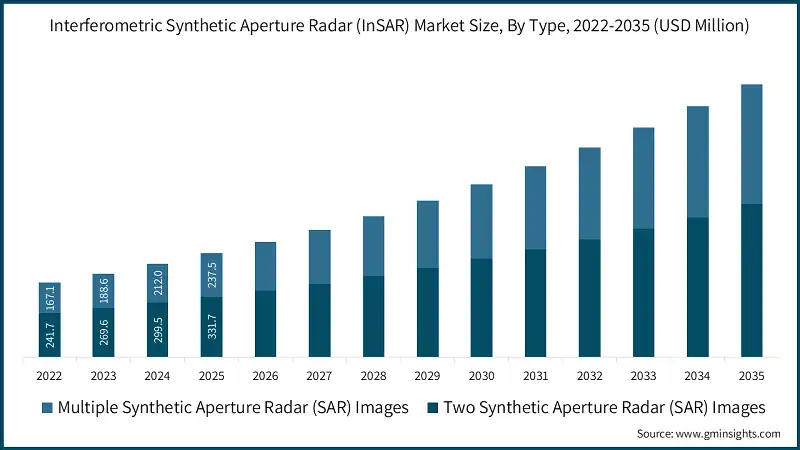
Based on type, the market is segmented into two synthetic aperture radar (SAR) images and multiple synthetic aperture radar (SAR) images.
- The two synthetic aperture radar (SAR) images accounted for the largest market, and was valued at USD 331.7 million in 2025, due to its cost-effectiveness and ease of implementation. This initiative uses only two images to capture movement and deformation of the ground at different times. This method is more cost effective and less complicated than others that require more images.
- Moreover, two Sar images techniques provide a good level of accuracy for numerous of subsidence, infrastructure stability, and land use change evaluation. For many users, the balance between high resolution data and ease of processing although low system and data complexity is great enough to not require more interactive different approach of multiple SAR images.
- The multi temporal SAR images was the fastest growing segment during the forecast period, growing at a CAGR of 10.5%. Multi-temporal SAR images allow precise measurements of total surface movement over time, facilitating long-term surveillance of structures, mining activities, and environmental variations, improving predictive maintenance and risk mitigation for extensive undertakings.
- The ability to work with multiple SAR images enables sophisticated analysis like time-series analysis and interferometric analysis, making it possible for governments and corporations to identify even minute displacements in the earth’s surface and make informed decisions in the fields of natural disaster management, urban development, and natural resource extraction.
Learn more about the key segments shaping this market
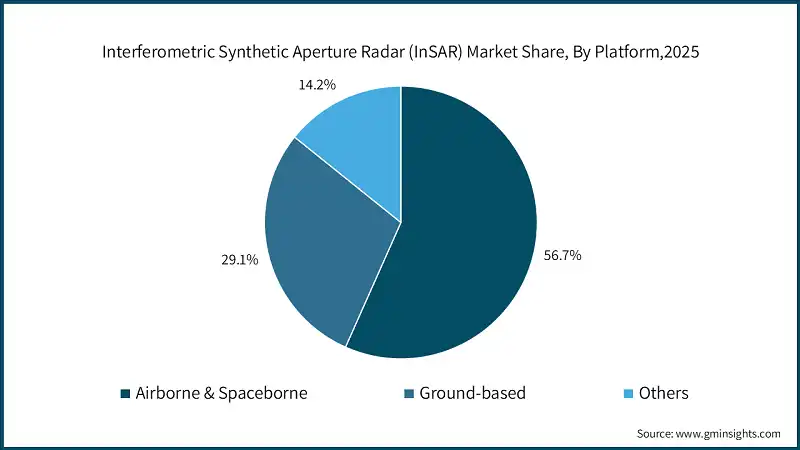
On the basis of platform, the interferometric synthetic aperture radar market is divided into airborne & spaceborne, ground-based, and others.
- The airborne & spaceborne was largest segment and was valued at USD 322.5 million in 2025. Airborne and spaceborne platforms greatly extend the breadth of the InSAR market due to the ability to continuously monitor large areas of the Earth’s surface, which is essential for infrastructure, disaster response, and environmental monitoring.
- High altitude and satellite InSAR data advocate for national earth observation programs which require frequent revisit and ubiquitous coverage propelling government and agency adoption. For example, in August 2025, NASA assisted in the development of a small-scale airborne InSAR radar which sits on high altitude platforms, improving the capabilities of observing the dynamic systems of the Earth.
- The ground-based was the fastest growing segment during the forecast period, growing at a CAGR of 10.6%. Spaceborne InSAR missions are increasingly used by governments for enhanced monitoring of surface deformation and climate impacts.
- Frequent global radar satellite passes enhance the monitoring of geohazard and land change, thus encouraging investment in space observation infrastructure. In November 2025, two high-resolution radar satellites were launched by Greece with support from the ESA and the EU, with a focus on improving the management of disasters and the environment.
Based on components, the interferometric synthetic aperture radar market is categorized into hardware, software, and services.
- The hardware segment accounted for the largest market and was valued at USD 361.4 million in 2025. Advanced InSAR hardware development, including compact radar units, improved antennas, and robust ground receivers, enhances reliability and enables deployment in remote or hazardous locations, expanding monitoring applications across infrastructure and geohazards.
- For instance, in August 2025, NASA and Aloft Sensing developed a compact HALE InSAR radar for Earth deformation observation, funded by a NASA technology program.
- Government?led space missions such as NASA?ISRO’s NISAR satellite elevate demand for dual?frequency InSAR hardware by providing unprecedented global radar coverage and high?resolution surface deformation data, empowering infrastructure resilience, disaster response, and climate monitoring efforts.
- The software segment was the fastest growing market during the forecast period, growing at a CAGR of 10.8%. Sophisticated InSAR software and services enhance data processing, anomaly detection, visualization, and interpretation, powered by AI and cloud capabilities, enabling faster insights for infrastructure, environmental, and risk management use cases.
- Government initiatives to standardize and host InSAR data in cloud archives accelerate adoption of software and analytical services for earth deformation time?series, supporting disaster preparedness, infrastructure monitoring, and research communities with scalable, interoperable processing workflows.
Looking for region specific data?
North America Interferometric Synthetic Aperture Radar Market
The North America market dominated the global interferometric synthetic aperture radar industry with a market share of 33.5% in 2025.
- The North American InSAR market experiences strong growth in the adoption of infrastructure sensing, environmental monitoring, and disaster management due to high investments in space technology, defense, and advanced analytics.
- The use of InSAR technology by federal organizations, such as NASA and USGS, to assess land deformation, geological threats, and environmental shifts, has increased the need for high-resolution radar data and analytical products in civil and commercial sectors.
- Sustained collaborations in research and development and government programs continue to drive innovation and market dominance.
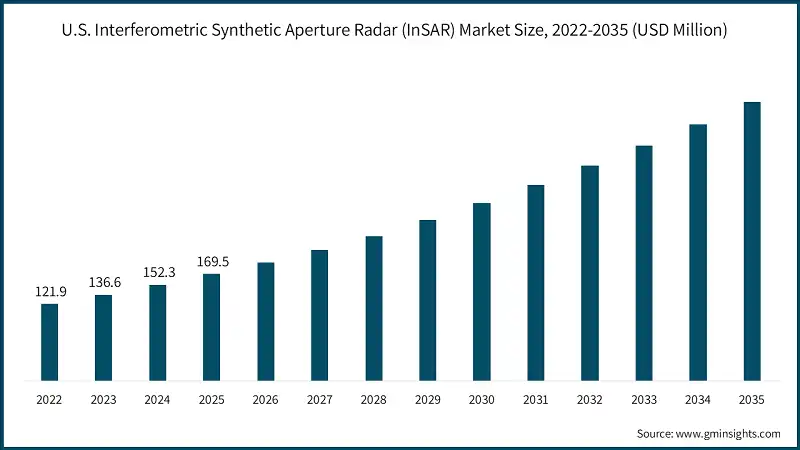
The U.S. market was valued at USD 121.9 million and USD 136.6 million in 2022 and 2023, respectively. The market size reached USD 169.5 million in 2025, growing from USD 152.3 million in 2024.
- In the United States, InSAR is being incorporated into a national hazard monitoring and terrestrial observation systems in an increasingly sophisticated manner. Federal agencies are broadening the application of InSAR from tracking land subsidence to examining volcanic deformation.
- The adoption of NASA and USGS InSAR techniques enhanced Federal resilience planning for both natural and human-induced hazards.
- For instance, in May 2025, the NASA OPERA project initiated open-access InSAR displacement products, increasing the usability of government land deformation data for research and other operational uses.
Europe Interferometric Synthetic Aperture Radar Market
Europe market accounted for USD 163.7 million in 2025 and is anticipated to show lucrative growth over the forecast period.
- Europe’s InSAR market trend is driven by sustained government and intergovernmental support for Earth observation, environmental monitoring, and disaster resilience through satellite radar missions.
- The Copernicus Programme’s Sentinel?1 constellation offers continuous, free, all?weather radar data that fuels national and EU?level applications, from ground motion analysis to coastal and flood monitoring.
- Adoption spans infrastructure planning, climate impact assessment, and regulatory compliance across member states. Strong emphasis on integrating InSAR with GIS and environmental policies enhances its strategic value for sustainable development.
Germany dominated the Europe market, showcasing strong growth potential.
- The InSAR market in Germany is primarily influenced by Germany and Europe’s Earth observation programs focused on environmental and spatial infrastructure monitoring.
- The German government support through the DLR and joined participation in the EU Copernicus programme is propelling the use of radar interferometry for analyzing subsidence and flooding, and land deformation.
- For instance, in November 2025, the Copernicus Sentinel?1D satellite was successfully launched, enhancing Europe’s radar imaging capacity with continuous, high?resolution data relevant for ground motion services, environmental monitoring, and disaster response, benefiting German agencies and research institutions.
Asia Pacific Interferometric Synthetic Aperture Radar Market
The Asia Pacific market is anticipated to grow at the CAGR of 10.6% during the analysis timeframe.
- The InSAR market within the Asia Pacific region is growing primarily as a result of rapid urbanization, infrastructure, and development of disaster risk reduction activities.
- China, India, and Japan are funding radar satellite programs and integrating InSAR into their national Earth observation systems. These systems are aimed at effective monitoring of seismic risks, land subsidence and infrastructure monitoring.
- Real-time processing and analytic capabilities are also being developed by regional research institutions and regional space agencies. National policies promoting the development of smart cities and environmental monitoring are also expediting the civil and industrial use of InSAR technology.
China market is estimated to grow with a CAGR of 11.6% during the forecast period, in the Asia Pacific interferometric synthetic aperture radar industry.
- China’s InSAR trend emphasizes ambitious space programs and integration of radar interferometry into national geospatial intelligence frameworks.
- The country’s space agencies are actively deploying InSAR?enabled satellites that deliver high revisit frequencies and rich datasets supporting infrastructure monitoring, urban planning, environmental protection, and disaster management.
- China’s focus on large?scale infrastructure projects, climate resilience, and precision mapping creates increased demand from public agencies and enterprises for InSAR insights.
Latin American Interferometric Synthetic Aperture Radar Market
Brazil leads the Latin American market, exhibiting remarkable growth during the analysis period.
- In Brazil, InSAR adoption is rising as government and research institutions increasingly leverage radar interferometry for natural resource management, infrastructure monitoring, and environmental compliance.
- The InSAR data is used by the dominant players in the energy, agriculture and mining sectors for the analysis of terrain deformation, risk management, and compliance documents preparation.
- The national geospatial programs and the partnerships with foreign Earth observation programs facilitate the increased use of surface deformation data for the purposes of flood mapping, land use, and urban development.
Middle East and Africa Interferometric Synthetic Aperture Radar Market
South Africa market to experience substantial growth in the Middle East and Africa interferometric synthetic aperture radar industry in 2025.
- The South Africa InSAR market trend demonstrates the use of radar interferometry in mining safety, geological risk assessment, and environmental monitoring. This trend is influenced by government and research efforts to promote the sustainable use of resources and reduce hazards.
- The extraction and mining sectors, which are foundational to the economy, utilize InSAR data to assess slope stability, subsidence, and the safety of infrastructures in accordance with the safety standards set by the regulations.
- The South African National Space Agency (SANSA) and other public institutions augment the provision of satellite data and improve the analytics for urban planning and land use planning.
Interferometric Synthetic Aperture Radar Market Share
The InSAR market features advanced technology and unique partnerships between providers of geospatial and radar technologies and satellite operators. The largest players in the market, such as Lockheed Martin Corporation, Northrop Grumman Corporation, Airbus Defence and Space, Raytheon Technologies / RTX, and Thales, held a market share of about 26.1% across the globe in 2025. These firms continue to direct valuable resources in the form of R&D to improve accuracy, refine temporal resolution, increase analytical capability, and extend radar imaging fusion across the sectors of infrastructure, environment, and defense.
These companies are leveraging partnerships, joint ventures, and technology-sharing initiatives to expedite satellite deployment, enhance analytics platforms, and expand global service offerings. Meanwhile, smaller specialized and innovative companies are providing customized software for real-time analysis of the ground's surface deformation and cloud-based InSAR services, which are enhancing the innovative and operational efficiency and sustainable development of critical domains, such as software for real-time ground data analysis.
Interferometric Synthetic Aperture Radar Market Companies
Prominent players operating in the interferometric synthetic aperture radar industry are as mentioned below:
- 3vGeomatics
- Airbus Defence and Space
- Capella Space
- GAMMA Remote Sensing AG
- GroundProbe
- ICEYE
- L3Harris Technologies
- Leonardo S.p.A.
- Lockheed Martin Corporation
- MDA Ltd.
- Northrop Grumman Corporation
- Raytheon Technologies
- Synspective
- Thales Group
- Tre Altamira
- Orbital Insight
- BAE Systems
- CGG
- PCI Geomatics
- sarmap SA
- SkyGeo
- Tele-Rilevamento Europa
Raytheon Technologies (RTX) held 10% of the InSAR market in 2025, driven by its strong portfolio of spaceborne radar systems, advanced SAR payloads, and defense-oriented Earth observation capabilities. The company’s strength lies in integrating InSAR technologies with defense, intelligence, and government space programs. Its deep relationships with military agencies, continuous investment in radar innovation, and large-scale systems integration capabilities enable broad adoption across national security, surveillance, and strategic infrastructure monitoring applications.
Airbus Defense and Space accounted for 4.8% of the market in 2025, supported by its leadership in satellite-based SAR missions and European Earth observation programs. Airbus benefits from strong participation in Copernicus and other government-backed initiatives, enabling wide-area deformation monitoring and environmental surveillance. Its end-to-end capabilities, from satellite manufacturing to data services—position the company as a key supplier for civil, environmental, and defense-driven InSAR deployments.
Thales captured 4.6% market share in 2025, leveraging its expertise in advanced radar systems, secure satellite payloads, and signal processing technologies. The company’s focus on high-reliability InSAR solutions supports applications in defense intelligence, border monitoring, and critical infrastructure surveillance. Strong alignment with government and space agency requirements enhances Thales’ competitiveness in regulated and security-sensitive InSAR programs.
Lockheed Martin Corporation held 3.7% of the InSAR market in 2025, driven by its involvement in space-based radar missions, defense satellite programs, and Earth observation payload development. The company’s strength lies in integrating InSAR capabilities into broader defense and intelligence architectures, supporting applications such as geospatial intelligence, disaster response, and strategic terrain monitoring for government clients.
Northrop Grumman Corporation accounted for 3.1% market share in 2025, supported by its radar technology expertise, space systems engineering, and participation in government-led surveillance and Earth observation programs. Its capabilities in advanced sensing, satellite platforms, and secure data systems enable targeted InSAR applications for defense, environmental monitoring, and national infrastructure assessment.
Interferometric Synthetic Aperture Radar (InSAR) Market Report Attributes
| Key Takeaway | Details |
|---|---|
| Market Size & Growth | |
| Base Year | 2025 |
| Market Size in 2025 | USD 569.2 Million |
| Market Size in 2026 | USD 631.2 Million |
| Forecast Period 2026 - 2035 CAGR | 10% |
| Market Size in 2035 | USD 1.5 Billion |
| Key Market Trends | |
| Drivers | Impact |
| Infrastructure Monitoring & Maintenance | Significantly reduces 30% infrastructure failures and maintenance costs by providing continuous, precise monitoring of bridges, dams, and urban areas. |
| Integration with AI, ML, and Cloud Analytics | Enhances 25% predictive modeling, anomaly detection, and decision-making efficiency across government and enterprise InSAR applications globally. |
| Oil, Gas & Mining Applications | Improves 20% operational safety, regulatory compliance, and risk mitigation for pipelines, mines, and extraction site monitoring activities. |
| Defense & Government Space Programs | Strengthens 10% national security, surveillance, disaster response, and strategic earth observation through government-supported InSAR program adoption. |
| Satellite Constellations & High-Frequency Revisit | Enables 15% near-real-time monitoring with continuous coverage, enhancing detection of rapid ground or infrastructure deformations. |
| Pitfalls & Challenges | Impact |
| High Deployment & System Costs | Significantly limits adoption among smaller enterprises and agencies; expensive satellite, airborne, and ground systems constrain market penetration. |
| Technical Complexity & Skill Requirements | Requires specialized expertise for data processing, interpretation, and integration; scarcity of skilled personnel impedes adoption across industries. |
| Opportunities: | Impact |
| Infrastructure Resilience & Smart City Projects | Will increase demand for precise monitoring, predictive maintenance, and risk mitigation solutions. |
| Environmental Monitoring & Disaster Management | Governments and agencies will adopt InSAR for flood, landslide, and earthquake tracking, enhancing safety and regulatory compliance. |
| Market Leaders (2025) | |
| Market Leaders |
10% market share |
| Top Players |
|
| Competitive Edge |
|
| Regional Insights | |
| Largest Market | North America |
| Fastest Growing Market | Asia Pacific |
| Emerging Countries | India, China, Brazil, South Africa, and UAE |
| Future outlook |
|
What are the growth opportunities in this market?
Interferometric Synthetic Aperture Radar Industry News
- In January 2025, ICEYE launched two SAR satellites on a mission named Transporter-12 with SpaceX, enhancing its efficiency in delivering High-Resolution Surface Change information.
- In July 2025, The NASA-ISRO SAR, or NISAR, was successfully launched from the Satish Dhawan Space Centre in India. This mission embodies a never-before-attempted partnership in using the dual-band InSAR technology to measure the deformation of land and ice with centimeter-level precision.
- In July 2025, the Itility Group bought a majority stake in Sensar, a Dutch Earth Observation company with specialization in analyzing InSAR radar signal data to measure the millimeter-level settling of the ground and infrastructure.
- In December 2025, a strategic partnership was announced between ICEYE and the Portuguese Air Force that aims to develop dedicated satellite imagery solutions for security and environmental observation, thereby commercializing specialized SAR data.
The interferometric synthetic aperture radar market research report includes in-depth coverage of the industry with estimates & forecasts in terms of revenue (USD Million) from 2022 to 2035, for the following segments:
Market, By Type
- Two synthetic aperture radar (SAR) images
- Multiple synthetic aperture radar (SAR) images
Market, By Platform
- Airborne & spaceborne
- Ground-based
- Others
Market, By Component
- Hardware
- Software
- Services
Market, By Application
- Navigation
- Impact assessment
- Flood and drought
- Seismic hazard
- Open-pit mine
- Others
- Monitoring
- Subsidence & field
- Infrastructure stability
- Glacier and ice sheet
- Volcanic activity
- Others
- Mapping & planning
- Others
Market, By End Use
- Aerospace & defense
- Agriculture
- Civil engineering & construction
- Environmental monitoring
- Mining
- Oil & gas
- Others
The above information is provided for the following regions and countries:
- North America
- U.S.
- Canada
- Europe
- Germany
- UK
- France
- Spain
- Italy
- Netherlands
- Asia Pacific
- China
- India
- Japan
- Australia
- South Korea
- Latin America
- Brazil
- Mexico
- Argentina
- Middle East and Africa
- Saudi Arabia
- South Africa
- UAE
Frequently Asked Question(FAQ) :
What is the market size of the interferometric synthetic aperture radar market in 2025?
The market size was USD 569.2 million in 2025 and is expected to grow at a CAGR of 10% from 2026 to 2035, driven by rising demand for infrastructure monitoring, geohazard assessment, and satellite-based earth observation.
What is the current interferometric synthetic aperture radar market size in 2026?
The interferometric synthetic aperture radar industry is projected to reach USD 631.2 million in 2026, supported by increased adoption across civil engineering, environmental monitoring, and defense applications.
What is the projected value of the interferometric synthetic aperture radar market by 2035?
The interferometric synthetic aperture radar industry is expected to reach USD 1.5 billion by 2035, growing at a CAGR of 10% during the forecast period due to integration of AI, cloud analytics, and expansion of satellite constellations.
How much revenue did the hardware component segment generate in 2025?
The hardware segment generated USD 361.4 million in 2025, accounting for the largest share of the InSAR market due to demand for advanced radar payloads, antennas, and ground receiving systems.
What was the valuation of the airborne & spaceborne platform segment in 2025?
The airborne & spaceborne platform segment was valued at USD 322.5 million in 2025, driven by the need for large-area, continuous monitoring through satellite and high-altitude radar systems.
What is the growth outlook for the software segment from 2026 to 2035?
The software segment is expected to grow at a CAGR of 10.8% through 2035, supported by increasing use of AI-driven analytics, cloud-based processing, and real-time deformation monitoring solutions.
Which region leads the interferometric synthetic aperture radar market?
The U.S. industry reached USD 169.5 million in 2025. Growth is driven by strong federal investments from agencies such as NASA and USGS and increasing adoption of InSAR for national hazard monitoring and infrastructure resilience.
What are the upcoming trends in the interferometric synthetic aperture radar industry?
Key InSAR industry trends include integration of AI and machine learning, expansion of multi-satellite constellations for high-frequency revisit, and increased use of cloud-based analytics for real-time infrastructure and environmental monitoring.
Who are the key players in the interferometric synthetic aperture radar market?
Major players in the interferometric synthetic aperture radar industry include Airbus Defence and Space, Lockheed Martin Corporation, Northrop Grumman Corporation, Raytheon Technologies (RTX), Thales Group, ICEYE, Synspective, Capella Space, Leonardo S.p.A., and L3Harris Technologies.
Interferometric Synthetic Aperture Radar (InSAR) Market Scope
Related Reports