Summary
Table of Content

Intelligent Traffic Signal System Market
Get a free sample of this report
Form submitted successfully!
Error submitting form. Please try again.
Thank you!
Your inquiry has been received. Our team will reach out to you with the required details via email. To ensure that you don't miss their response, kindly remember to check your spam folder as well!
Request Sectional Data
Thank you!
Your inquiry has been received. Our team will reach out to you with the required details via email. To ensure that you don't miss their response, kindly remember to check your spam folder as well!
Form submitted successfully!
Error submitting form. Please try again.
Intelligent Traffic Signal System Market Size
The market is undergoing a structural transformation as urban mobility ecosystems evolve from isolated, timer-based signal controls to fully connected, data-driven traffic orchestration platforms. Traditional fixed-cycle traffic lights, once dependent on pre-programmed timing plans and manual adjustments, are rapidly being replaced by adaptive, sensor-enabled, and AI-integrated systems capable of responding dynamically to real-time traffic conditions. Intelligent traffic signal systems (ITSS) are now mission-critical infrastructure components responsible for optimizing traffic flow, reducing congestion, lowering emissions, enhancing pedestrian safety, and supporting multimodal transport integration within smart city frameworks.
Intelligent Traffic Signal System Market Key Takeaways
Market Size & Growth
- 2025 Market Size: USD 8.2 Billion
- 2026 Market Size: USD 9.7 Billion
- 2035 Forecast Market Size: USD 26.8 Billion
- CAGR (2026–2035): 11.9%
Regional Dominance
- Largest Market: North America
- Fastest Growing Region: Asia Pacific
Key Market Drivers
- Increasing urbanization and traffic congestion.
- Government initiatives and smart city projects.
- Technological advancements in traffic management.
- Integration with other transportation systems.
Challenges
- Integration challenges and complexity.
- Data privacy and security concerns.
Opportunity
- Expansion in Emerging Markets.
- Integration with Smart Mobility Solutions.
- Adoption of AI and IoT Technologies.
- Public-Private Partnerships and Infrastructure Funding.
Key Players
- Market Leader: SWARCO led with over 10.9% market share in 2025.
- Leading Players: Top 5 players in this market include SWARCO, Siemens, Hisense TransTech, Econolite, Cubic, which collectively held a market share of 29.4% in 2025.
Get Market Insights & Growth Opportunities
Modern intelligent traffic systems, unlike traditional electromechanical signal controllers, are designed to function within integrated digital ecosystems. These systems utilize advanced technologies such as vehicle detection sensors, cameras, radar units, inductive loops, GPS data, and cloud-based analytics to facilitate real-time signal timing adjustments. By leveraging adaptive algorithms and predictive modeling, they enhance traffic flow efficiency by reducing idle times, limiting stop-and-go traffic, and improving synchronization across corridors. These innovations align with municipal objectives, supporting goals related to urban efficiency, sustainability, and road safety.
For example, in August 2025, the government of Abu Dhabi deployed an AI-powered traffic signal control system that uses real-time data from cameras and sensors to dynamically adjust signal timings across major intersections, demonstrating the growing adoption of adaptive signal technologies to reduce congestion and improve traffic flow efficiency.
The acceleration of smart city initiatives globally is intensifying the technical requirements for next-generation signal control systems. Intelligent controllers must now support edge computing, low-latency communication protocols, and interoperability with centralized traffic management centers (TMCs). Unlike legacy systems that operated independently at each intersection, modern architectures enable corridor-wide and city-wide coordination. This connectivity enhances traffic throughput, reduces travel time variability, and supports emergency vehicle preemption and public transport prioritization.
Technological advancement within the market is centered on automation, connectivity, and artificial intelligence. Manufacturers and system integrators are deploying machine learning algorithms that analyze historical and real-time traffic data to predict congestion patterns and proactively adjust signal phasing. Video-based vehicle detection powered by AI enables accurate classification of cars, buses, cyclists, and pedestrians, improving intersection safety. Integration with vehicle-to-infrastructure (V2I) communication platforms further enhances system responsiveness by enabling signals to interact directly with connected vehicles.
The transition toward connected and autonomous vehicle ecosystems is creating additional growth opportunities. As advanced driver assistance systems (ADAS) and autonomous vehicles expand, reliable signal timing data and signal phase and timing (SPaT) information become essential. Intelligent traffic signals equipped with dedicated short-range communication (DSRC) or cellular V2X (C-V2X) capabilities support safer intersection navigation, reduce collision risks, and enhance cooperative driving scenarios. This interoperability positions ITSS as foundational infrastructure for future autonomous mobility frameworks.
Public safety and environmental compliance are also driving adoption. Urban congestion contributes significantly to greenhouse gas emissions and fuel wastage. Adaptive signal systems reduce idle times and improve traffic progression, supporting decarbonization targets across North America and Europe. Additionally, pedestrian-first intersection designs integrated with smart signals enhance compliance with Vision Zero road safety initiatives by prioritizing vulnerable road users.
Commercial vehicle logistics and public transport electrification further amplify system relevance. Bus rapid transit (BRT) corridors increasingly rely on transit signal priority (TSP) technologies to reduce delays and improve schedule adherence. Freight-heavy corridors benefit from coordinated signaling that minimize bottlenecks, directly influencing supply chain reliability and operating costs. As cities adopt low-emission zones and congestion pricing models, intelligent signal systems help manage traffic redistribution efficiently.
Digital integration is redefining system architecture within the Intelligent Traffic Signal System Market. Modern deployments operate through centralized traffic management platforms that integrate data from road sensors, surveillance systems, weather stations, and mobility apps. Cloud-enabled dashboards allow authorities to remotely monitor intersection performance, implement dynamic timing adjustments, and conduct predictive maintenance. Cybersecurity compliance and adherence to international safety standards such as those established by the International Organization for Standardization are becoming critical, as signal system failures can disrupt urban mobility and compromise public safety.
Regionally, North America and Europe remain high-value markets due to mature infrastructure funding mechanisms, strong regulatory emphasis on road safety, and aggressive smart mobility targets. In the United States and major European capitals, congestion mitigation and emission reduction policies are accelerating the shift from fixed time to adaptive signal systems.
Asia-Pacific represents the fastest growing long-term opportunity. Rapid urbanization, expanding metropolitan populations, and large-scale smart city programs in China, India, and Southeast Asia are driving demand for scalable and cost-efficient traffic management solutions. China’s smart transportation initiatives integrate AI-based traffic analytics across megacities, while Japan and South Korea emphasize advanced V2X-ready infrastructure aligned with autonomous mobility development. India’s growing urban centers are increasingly adopting adaptive signal systems to address congestion challenges and improve intersection-level safety performance.
The global intelligent traffic signal system market was estimated at USD 8.2 billion in 2025. The market is expected to grow from USD 9.7 billion in 2026 to USD 26.8 billion in 2035, at a CAGR of 11.9%, according to latest report published by Global Market Insights Inc.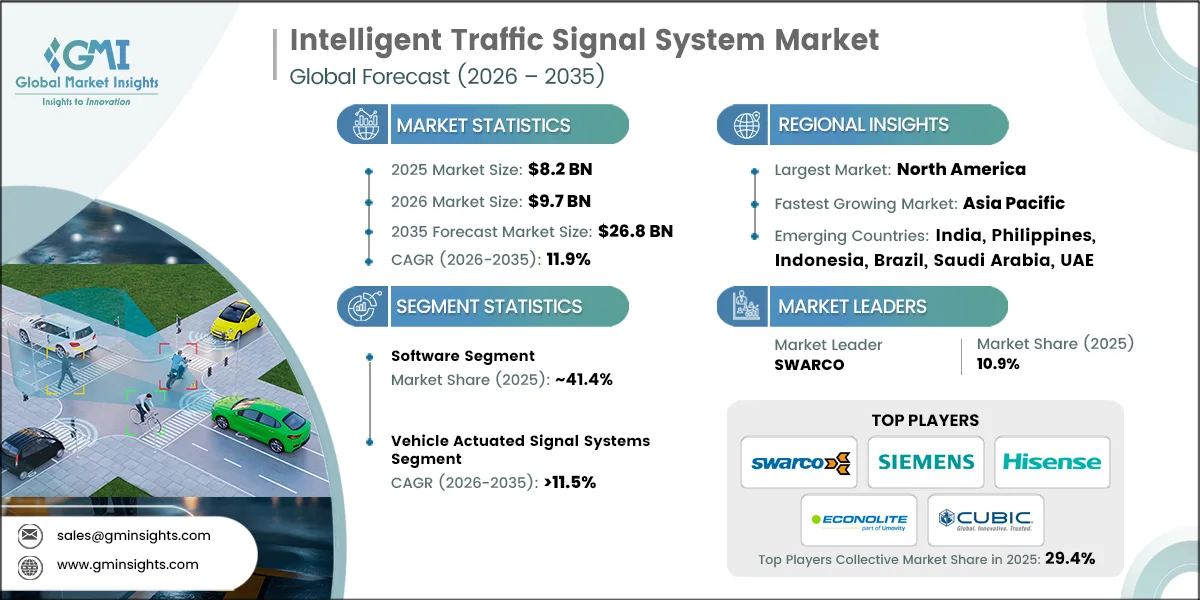
To get key market trends
Intelligent Traffic Signal System Market Trends
AI-driven adaptive traffic control systems use real-time traffic data, including vehicle counts, speed, and congestion levels, to automatically adjust signal timings. This reduces stop-and-go traffic, optimizes green-light durations, and improves overall road throughput. Cities adopting these systems can respond to sudden traffic surges, road incidents, and peak-hour congestion more efficiently, enhancing commuter experience, reducing travel times, and minimizing fuel consumption and emissions.
For example, in August 2025, Abu Dhabi introduced a smart traffic light system using sensors and AI at seven major city entry points, adjusting signal timing based on real‑time vehicle detection and improving flow in coordination with broader intelligent transport infrastructure.
Intelligent traffic signals are increasingly integrated with connected and autonomous vehicles, allowing two-way communication between vehicles and traffic infrastructure. This integration helps prioritize emergency vehicles, enable smooth lane merges, and provide predictive signal changes to autonomous systems. By synchronizing traffic signals with CAVs, cities can reduce congestion, improve road safety, and support the growing adoption of smart, autonomous transportation solutions.
The use of IoT sensors, cameras, and roadside units is expanding to collect granular traffic and environmental data. These devices enable predictive analytics, early congestion detection, and incident management. By continuously monitoring traffic flow, weather conditions, and pedestrian movements, cities can implement adaptive signal strategies, optimize traffic patterns in real time, and enhance safety for drivers, cyclists, and pedestrians alike, while improving urban mobility efficiency.
Modern intelligent traffic systems increasingly support multimodal transportation by giving priority to buses, trams, and emergency vehicles. Signal prioritization reduces delays for public transit, improves route adherence, and encourages commuters to choose sustainable transportation modes. Integrating signals with bike lanes, pedestrian crossings, and public transport routes ensures smoother traffic flow, reduces congestion in densely populated areas, and promotes greener, more efficient urban mobility solutions.
Cloud-based and software-defined traffic management solutions allow centralized monitoring, remote control, and real-time data analytics. These platforms enable rapid updates, predictive modeling, and scalable deployment without extensive hardware modifications. By leveraging cloud computing, cities can implement coordinated traffic policies, monitor multiple intersections simultaneously, and analyze historical and live data to make smarter decisions, improving overall traffic efficiency, safety, and system adaptability.
Intelligent Traffic Signal System Market Analysis
Learn more about the key segments shaping this market
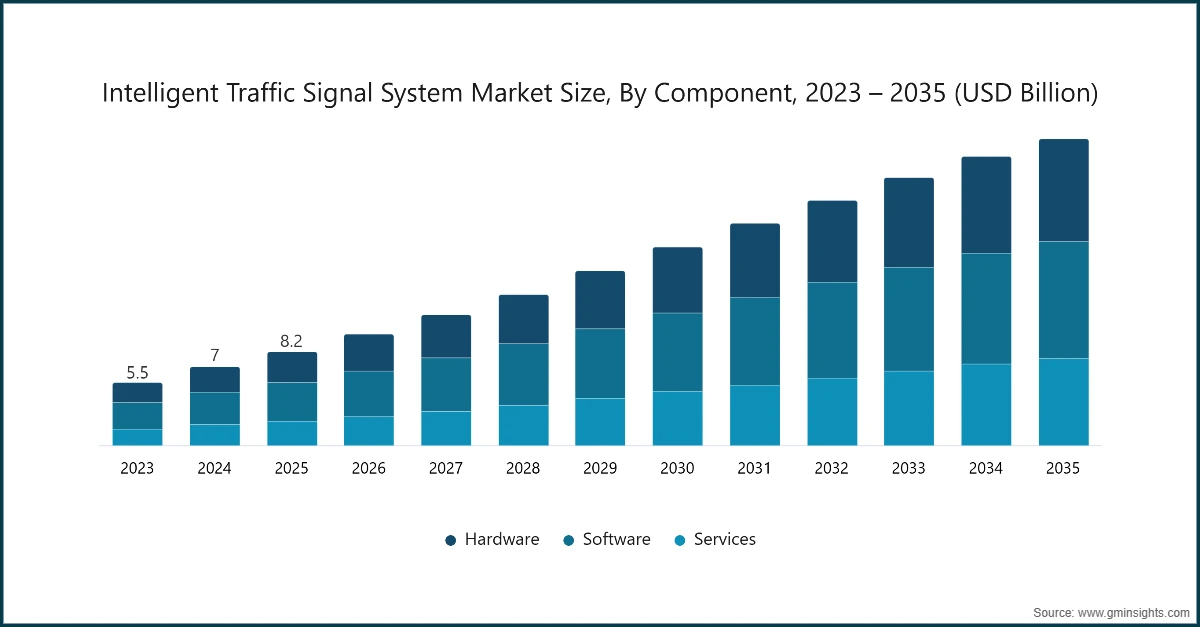
Based on component, the market is divided into hardware, software, and service. The software segment dominated the intelligent traffic signal system market, accounting for around 41.4% in 2025 and is expected to grow at a CAGR of more than 11% through 2035.
- The intelligent traffic signal system industry is largely dominated by software, driven by the increasing reliance on data-driven traffic management and real-time decision-making capabilities. Advanced software platforms enable adaptive signal control, predictive traffic analytics, and coordination of multiple intersections, allowing cities to respond dynamically to traffic congestion, accidents, and pedestrian flow. By leveraging AI, machine learning, and cloud computing, software solutions enhance traffic efficiency far beyond what traditional hardware-only systems can achieve.
- Integration with connected vehicle technologies, IoT devices, and smart city infrastructure further strengthens software dominance. Transportation authority’s increasingly adopt centralized traffic management platforms that analyze real-time data from sensors and cameras, optimize signal timings, and provide actionable insights for urban mobility planning. As cities aim for safer, more sustainable, and efficient transportation networks, software continues to be the primary driver of growth in the intelligent traffic signal system market.
- For example, in July 2025, Nagpur began installing AI‑powered speed radars, ANPR cameras, and smart signals as part of its Integrated Intelligent Traffic Management System (IITMS), equipping 50 intersections with advanced sensors and surveillance cameras for real‑time monitoring.
- The service segment is expected to experience a faster growth of more than 13% over the forecast period, driven by the increasing need for system installation, maintenance, and integration services across urban traffic networks. As cities adopt AI-enabled adaptive traffic signals, IoT-enabled sensors, and cloud-connected platforms, demand for professional services to deploy, configure, and optimize these systems is rising.
 Learn more about the key segments shaping this market
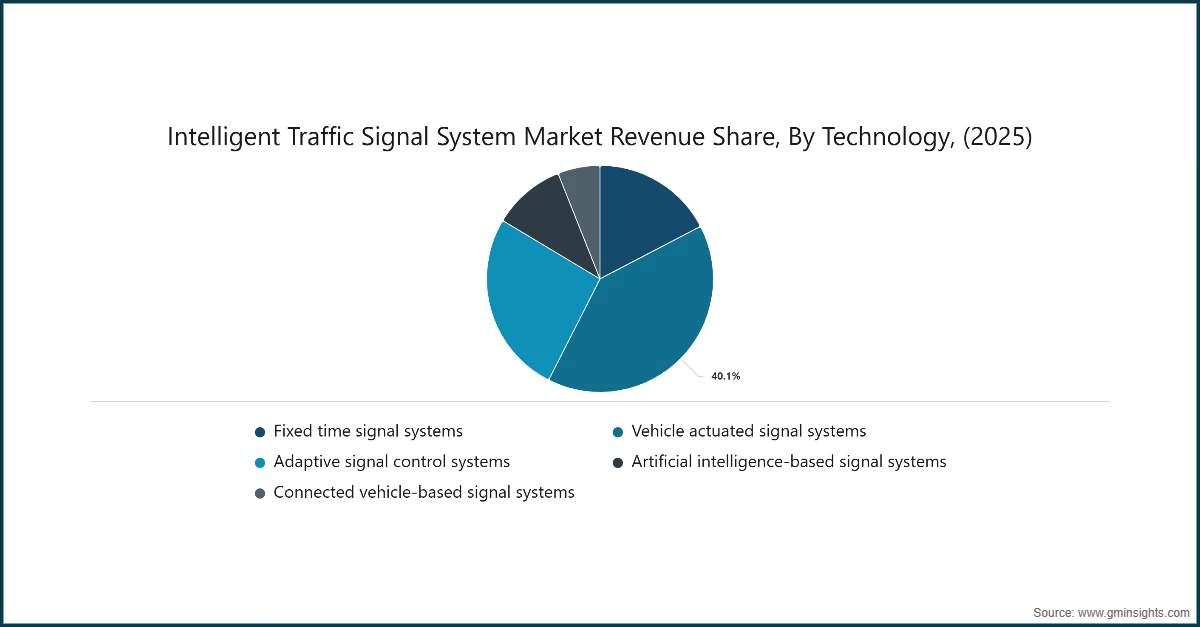
Based on technology, the market is categorized into fixed time signal systems, vehicle actuated signal systems, adaptive signal control systems, artificial intelligence-based signal systems, and connected vehicle-based signal systems. The Vehicle actuated signal systems segment dominates the market accounting for around 40.1% share in 2025, and the segment is expected to grow at a CAGR of over 11.5% from 2026-2035.
- The intelligent traffic signal system market is dominated by the vehicle actuated signal systems segment due to their ability to dynamically adjust signal timings based on real-time vehicle detection and traffic flow conditions. These systems use sensors, loop detectors, cameras, or radar technologies to detect approaching vehicles and automatically modify signal phases, improving traffic efficiency and reducing unnecessary waiting times at intersections.
- Their cost-effectiveness and widespread applicability across urban and suburban road networks further strengthen their dominance. Vehicle actuated systems are easier to deploy compared to fully adaptive traffic management systems and require relatively lower infrastructure upgrades. As cities increasingly seek efficient yet practical traffic control solutions to manage congestion, these systems are widely adopted to optimize intersection performance and enhance overall road safety.
- For example, in November 2025, the Mysuru Traffic Police began installing 35 smart traffic signals along the city’s Outer Ring Road, incorporating vehicle-actuated technology that automatically adjusts green-light durations based on real-time vehicle detection to improve traffic flow and reduce congestion at key junctions.
- The artificial intelligence-based signal systems segment is expected to grow with a CAGR of more than 14.9% due to the increasing adoption of advanced traffic management technologies that enable real-time analysis and dynamic signal optimization. AI-powered systems use data from cameras, sensors, and connected devices to predict traffic patterns, adjust signal timings automatically, and reduce congestion at busy intersections.
Based on application, the intelligent traffic signal system market is divided into urban traffic management, highway traffic management, smart city initiatives, public transportation management, and emergency vehicle management. The Urban traffic management segment held the major market share in 2025.
- The urban traffic management segment is the largest market segment in the market because major cities worldwide are experiencing rapid urbanization, rising vehicle ownership, and increasing traffic congestion. Metropolitan areas require advanced traffic signal systems to manage complex road networks, busy intersections, and high traffic volumes efficiently. Intelligent traffic signals help optimize signal timing, reduce delays, and improve overall traffic flow in densely populated urban environments.
- Government investments in smart city initiatives and intelligent transportation systems further strengthen this segment’s dominance. Urban authorities are deploying AI-enabled traffic signals, IoT sensors, and centralized traffic management platforms to monitor traffic conditions in real time and coordinate signals across multiple intersections. These technologies enhance commuter safety, support public transit prioritization, and improve urban mobility, making urban traffic management the primary application area for intelligent traffic signal systems.
- For example, in July 2025, the State of North Carolina deployed more than 2,500 AI-based traffic signals across its road network, marking one of the largest statewide intelligent traffic signal deployments in the United States to improve traffic flow and enable engineers to optimize signal operations using real-time data.
- The smart city initiatives segment is expected to grow with a CAGR of more than 14% due to the increasing adoption of digital infrastructure and intelligent transportation solutions aimed at improving urban mobility and sustainability. Governments across the world are integrating intelligent traffic signal systems within broader smart city frameworks to manage rising traffic congestion, optimize traffic flow, and enhance public safety in densely populated urban areas.
Based on end use, the intelligent traffic signal system market is divided into government transportation departments, municipal corporations, highway authorities, public transit agencies, smart city developers, and private infrastructure companies. The variable displacement pump segment dominated the market.
- The government transportation departments segment dominates the market due to their primary responsibility for planning, funding, and managing urban traffic infrastructure. Municipal and national transportation authorities oversee the installation and operation of traffic signals, road networks, and traffic management centers, making them the largest adopters of intelligent traffic signal technologies to reduce congestion and improve road safety.
- Strong public sector investments and policy initiatives further strengthen their dominance. Governments allocate significant budgets for smart city projects, intelligent transportation systems (ITS), and road modernization programs. These initiatives involve deploying AI-enabled traffic signals, IoT sensors, and centralized traffic control platforms, enabling real-time monitoring and efficient traffic management. As a result, government transportation departments remain the leading end users driving adoption of intelligent traffic signal systems worldwide.
- For example, in September 2024, Yunex Traffic launched the next generation “Yutraffic Actis” traffic signal range, designed to be 50% lighter and consume around 50% less energy than conventional signals, while incorporating advanced LED optics and recycled materials to improve sustainability and operational efficiency for urban traffic authorities.
- The smart city developers’ segment is expected to grow with a CAGR of more than 15% due to increasing investments in urban digital infrastructure and integrated mobility solutions. Smart city development projects require advanced traffic management systems to address congestion, improve road safety, and support efficient transportation networks in rapidly expanding urban environments.
Looking for region specific data?
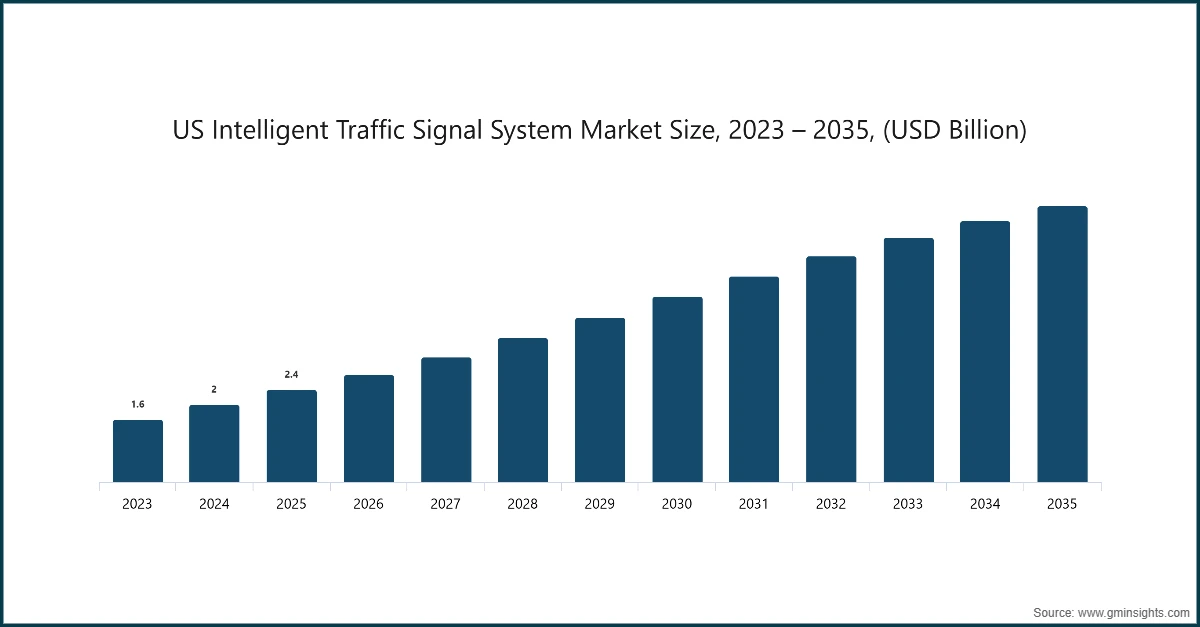
US dominated the intelligent traffic signal system market in North America with around 83.6% share and generated USD 2.4 billion in revenue in 2025.
- US market is experiencing robust growth due to increasing urban congestion, rising vehicle ownership, and government initiatives promoting smart city infrastructure. Major metropolitan areas, including New York, Los Angeles, and Chicago, are deploying AI-enabled adaptive traffic signals and IoT-based sensors to optimize traffic flow, reduce stop-and-go delays, and improve commuter safety. The adoption of connected vehicle technologies and integration with public transit networks is further accelerating demand for intelligent traffic systems that can manage multimodal transportation efficiently.
- Additionally, advancements in cloud-based traffic management platforms and predictive analytics are enabling real-time monitoring, centralized control, and data-driven decision-making. Federal and state funding programs for smart infrastructure, coupled with growing emphasis on sustainable urban mobility, are supporting widespread deployment, positioning the US as a key growth market for intelligent traffic signal solutions.
- For example, in July 2025, North Carolina installed approximately 2,500 AI‑based traffic signals across the state, marking the largest live statewide deployment of AI traffic signal software in the U.S. to improve signal operations and help engineers respond to real‑time traffic conditions more effectively.
- Canada is projected to grow at a significant CAGR in the intelligent traffic signal system market due to rising urbanization, increasing traffic congestion in major cities, and government-led smart city initiatives. Cities such as Toronto, Vancouver, and Montreal are experiencing rapid population growth, resulting in higher vehicle density and frequent traffic bottlenecks. To address these challenges, municipalities are investing in AI-driven adaptive traffic signal systems, IoT-based sensors, and cloud-enabled traffic management platforms that optimize signal timing, reduce delays, and improve road safety.
The intelligent traffic signal system market in Germany is expected to experience significant and promising growth from 2026 to 2035.
- Europe accounts for over 28% of the market in 2025 and is expected to grow at a CAGR of around 12.2% due to increasing urbanization, rising traffic congestion in major cities, and government initiatives toward smart mobility and sustainable transportation. Countries such as Germany, the UK, France, and the Netherlands are investing in AI-enabled adaptive traffic signals, IoT-based sensors, and cloud-connected traffic management systems to optimize traffic flow, reduce commute times, and enhance road safety. Integration with public transit, emergency vehicle prioritization, and connected vehicle infrastructure is supporting multimodal mobility and reducing urban carbon emissions.
- Germany is a strong intelligent traffic signal system market leader due to its advanced urban infrastructure, emphasis on smart mobility, and commitment to reducing traffic congestion in major cities like Berlin, Munich, and Hamburg. The country has been an early adopter of AI-powered adaptive traffic signals, IoT-enabled sensors, and cloud-based traffic management platforms, allowing real-time monitoring, predictive analytics, and dynamic signal optimization to improve traffic flow and commuter safety.
- Strong government support and regulatory initiatives further reinforce Germany’s leadership. Funding programs under the German Federal Ministry of Transport and Digital Infrastructure encourage deployment of intelligent traffic systems, including connected vehicle integration and public transit prioritization. Continuous technological innovation, integration with multimodal transportation networks, and focus on sustainability and emission reduction have positioned Germany at the forefront of the European intelligent traffic signal system market.
- For example, in August 2025, the city of Hamburg began modernizing up to 2,000 traffic lights with a next‑generation intelligent control system, replacing legacy infrastructure with an OCIT‑based central platform that dynamically optimizes signal timing, prioritizes public transport and emergency vehicles, and enhances real‑time traffic management across the city.
- The UK is emerging as a strong growth market for intelligent traffic signal systems due to increasing urban congestion, rising vehicle ownership, and government initiatives focused on smart city development and sustainable transport. Cities like London, Manchester, and Birmingham are investing in AI-powered adaptive traffic signals, IoT-enabled sensors, and cloud-based traffic management platforms to optimize traffic flow, reduce delays, and improve road safety.
The intelligent traffic signal system market in China is expected to experience significant and promising growth from 2026-2035.
- Asia Pacific accounts for over 25% of the market in 2025 and is expected to grow at a CAGR of around 13.2% between 2026 and 2035 owing to rapid urbanization, rising vehicle ownership, and increasing government investments in smart city infrastructure across the region. Countries such as China, India, Japan, South Korea, and Australia are facing growing traffic congestion in major metropolitan areas, creating strong demand for AI-driven adaptive traffic signals, IoT-based sensors, and cloud-enabled traffic management systems.
- China is the market leader in the intelligent traffic signal system segment due to rapid urbanization, increasing vehicle ownership, and large-scale government initiatives promoting smart city and intelligent transportation infrastructure. Major cities like Beijing, Shanghai, and Shenzhen are implementing AI-enabled adaptive traffic signals, IoT-based sensors, and cloud-connected traffic management platforms to optimize traffic flow, reduce congestion, and enhance road safety.
- Government support and strategic investments further strengthen China’s market leadership. Programs such as the “National Intelligent Transportation System Plan” and regional smart city projects fund the deployment of connected vehicle integration, real-time traffic monitoring, and public transit prioritization. Continuous technological advancements, predictive analytics, and software-defined traffic management allow Chinese cities to manage traffic efficiently, improve commuter experiences, and support sustainable urban mobility, positioning China at the forefront of the Asia Pacific intelligent traffic signal system market.
- For example, in May 2025, Nanchang Jinke Transportation Technology showcased AI‑enabled intelligent traffic signal and vehicle‑road collaboration solutions at the China International Road Traffic Safety Expo 2025, highlighting real‑time IoT signal control and automated traffic equipment monitoring capabilities.
- India is becoming one of the fastest-growing markets in the intelligent traffic signal system sector due to rapid urbanization, increasing vehicle ownership, and rising traffic congestion in major cities such as Mumbai, Delhi, Bengaluru, and Hyderabad. The growing need for efficient traffic management has led municipalities to invest in AI-enabled adaptive traffic signals, IoT-based sensors, and cloud-connected traffic management platforms that optimize signal timing, reduce delays, and enhance commuter safety.
The intelligent traffic signal system market in Brazil is expected to experience significant and promising growth from 2026 to 2035.
- Latin America holds around 6% of the market in 2025 and is growing steadily at a CAGR of around 10.3% between 2026 and 2035 due to increasing urbanization, rising vehicle density, and growing investments in smart city and intelligent transportation infrastructure across the region. Cities such as São Paulo, Mexico City, Buenos Aires, and Santiago are facing severe traffic congestion, prompting governments to adopt AI-enabled adaptive traffic signals, IoT-based sensors, and cloud-connected traffic management platforms to improve traffic flow, reduce commute times, and enhance road safety.
- Brazil dominates the intelligent traffic signal system market in Latin America due to rapid urbanization, high vehicle density, and government initiatives aimed at modernizing urban traffic management in major cities such as São Paulo, Rio de Janeiro, and Brasília. The country is investing heavily in AI-enabled adaptive traffic signals, IoT-based sensors, and cloud-connected traffic management platforms to reduce congestion, optimize signal timing, and improve road safety across busy urban corridors.
- Public funding and smart city programs further drive market adoption. Initiatives like the “National Urban Mobility Policy” and state-level intelligent transportation system (ITS) projects support deployment of connected traffic infrastructure, enabling real-time monitoring, emergency vehicle prioritization, and integration with public transit. These developments, combined with advancements in predictive traffic analytics and software-defined signal control, position Brazil as the leading market for intelligent traffic signal systems in Latin America.
- For example, in July 2024, Ribeirão Preto deployed an intelligent transportation system that upgraded 200 intersections with smart traffic lights and installed 150 cameras to dynamically optimize signal timing and improve traffic flow and public safety.
- The intelligent traffic signal system market in Mexico is experiencing high growth due to increasing urbanization, rising vehicle ownership, and severe traffic congestion in major cities such as Mexico City, Guadalajara, and Monterrey. To address these challenges, municipalities are investing in AI-driven adaptive traffic signals, IoT-based sensors, and cloud-connected traffic management platforms that optimize signal timing, improve traffic flow, and enhance road safety.
The intelligent traffic signal system market in UAE is expected to experience significant and promising growth from 2026-2035.
- MEA holds around 5% of the market in 2025 and is growing steadily at a CAGR of around 8.5% between 2026 and 2035 due to rapid urbanization, increasing traffic congestion, and large-scale investments in smart city infrastructure across the region. Countries such as the United Arab Emirates, Saudi Arabia, Qatar, and South Africa are experiencing rising vehicle density and urban mobility challenges, prompting governments to deploy AI-enabled adaptive traffic signals, IoT-based sensors, and cloud-connected traffic management platforms to optimize traffic flow, reduce travel times, and enhance road safety.
- The UAE dominates the MEA intelligent traffic signal system market due to rapid urbanization, increasing vehicle ownership, and government-led smart city initiatives aimed at improving traffic management and urban mobility. Cities such as Dubai and Abu Dhabi are deploying AI-powered adaptive traffic signals, IoT-enabled sensors, and cloud-connected traffic management platforms to optimize signal timing, reduce congestion, and enhance road safety.
- Strong government support and strategic infrastructure investments further strengthen the UAE’s leadership. Programs like the UAE Smart City Program and Dubai’s Roads and Transport Authority (RTA) initiatives integrate intelligent traffic systems with public transit, emergency vehicle prioritization, and real-time traffic analytics. Continuous advancements in predictive traffic modeling, software-defined traffic management, and connected vehicle integration are enabling the UAE to implement efficient, data-driven, and sustainable urban mobility solutions, positioning it as the leading market in the MEA region.
- For example, in August 2025, Abu Dhabi’s Integrated Transport Centre launched AI‑driven smart traffic lights at seven key entry points leading to Sheikh Zayed bin Sultan Street, using sensors and AI‑enabled cameras to monitor traffic flow in real time and dynamically adjust signal timings to ease congestion.
- Saudi Arabia is expected to grow at the fastest CAGR in the MEA intelligent traffic signal system market due to rapid urbanization, rising vehicle ownership, and government initiatives to modernize transportation infrastructure under the Saudi Vision 2030 program. Major cities such as Riyadh, Jeddah, and Dammam are facing increasing traffic congestion, prompting deployment of AI-driven adaptive traffic signals, IoT-enabled sensors, and cloud-connected traffic management platforms to optimize signal timing, reduce delays, and improve commuter safety.
Intelligent Traffic Signal System Market Share
- The top 7 companies in the intelligent traffic signal system industry are SWARCO, Siemens, Hisense TransTech, Econolite, Cubic, Sumitomo Electric Industries, and Iteris, contributed around 33.7% of the market in 2025.
- SWARCO focuses on expanding its adaptive signal control and smart traffic management portfolio through AI and machine learning integration. The company emphasizes modular, scalable solutions for municipalities, highway authorities, and smart cities. Strategic partnerships, targeted acquisitions, and international expansion are core to their growth, while investments in cloud-based platforms and IoT connectivity enhance real-time traffic analytics and urban mobility optimization.
- Siemens leverages its Sitraffic platform to deliver fully integrated traffic management solutions. Its strategies include AI-driven adaptive signal control, predictive traffic analytics, and connected vehicle integration. Siemens focuses on large-scale municipal deployments, smart city collaborations, and cloud-based traffic management platforms. Continuous R&D, partnerships with city authorities, and integration of industrial IoT capabilities strengthen its global leadership in intelligent traffic solutions.
- Hisense TransTech emphasizes AI-powered traffic signal systems, video analytics, and IoT-enabled monitoring for urban and highway traffic management. The company’s strategy includes large-scale smart city deployments in Asia, integrating predictive traffic flow models and adaptive signal control. It focuses on end-to-end solutions combining hardware, software, and cloud-based analytics, while forming partnerships with municipalities and technology providers to strengthen market penetration.
- Econolite’s strategy centers on adaptive traffic control, real-time signal optimization, and connected vehicle infrastructure. The company works closely with transportation agencies in North America to implement scalable, interoperable ITS solutions. Strategic initiatives include expanding software platforms, integrating AI-based analytics, and offering predictive traffic management services. Partnerships with municipalities and OEMs, along with hardware-software integration, reinforce Econolite’s competitive positioning in the intelligent traffic market.
- Cubic focuses on integrated urban mobility and traffic management platforms, combining AI-enabled signal control with public transport systems. Its strategy involves predictive analytics, cloud-based traffic optimization, and smart city collaborations. The company targets large-scale municipal deployments, leveraging data-driven insights to improve congestion management. Strategic partnerships with government agencies and long-term service contracts support Cubic’s emphasis on holistic urban mobility solutions.
- Sumitomo’s strategy revolves around reliable traffic signal controllers, communication modules, and ITS infrastructure. The company emphasizes hardware-software integration, connected vehicle compatibility, and modular deployments. Strategic goals include expanding into smart city initiatives, strengthening government partnerships, and leveraging advanced electronics capabilities to support large-scale adaptive traffic signal projects while ensuring long-term system reliability and infrastructure scalability.
- Iteris specializes in data-driven traffic intelligence, AI-powered detection systems, and cloud-based traffic management. Its strategy emphasizes real-time traffic monitoring, predictive analytics, and connected vehicle integration for municipal and highway traffic authorities. Iteris focuses on expanding software platforms, sensor-based solutions, and smart city projects globally. Strategic collaborations and technological innovation help the company deliver scalable, efficient, and intelligent traffic signal management solutions.
Intelligent Traffic Signal System Market Companies
Major players operating in the Intelligent traffic signal system industry are:
- Cubic
- Econolite
- Hisense TransTech
- Hisense TransTech
- Iteris
- NoTraffic
- Siemens
- Sumitomo Electric Industries
- SWARCO
- Yunex Traffic
- Due to the presence of major players such as Siemens, SWARCO Group, Econolite, Cubic, Hisense TransTech, Sumitomo Electric Industries, and Iteris, there is intense competition in the market for intelligent traffic signal systems. The top companies are focusing on enhancing AI-driven adaptive signal algorithms, integration with connected vehicle (V2X) infrastructure, and cloud-based traffic management platforms to strengthen their market position. As firms pursue strategies like product portfolio expansion, geographic penetration, partnerships, and acquisitions, the competitive landscape is expected to become even more dynamic and aggressive.
- Competition in pricing and performance features significantly impacts client selection among municipalities and smart city developers. Companies are optimizing manufacturing and deployment processes, enhancing software scalability, and forming alliances to reduce installation costs and accelerate project timelines. Additionally, regulatory compliance with ITS standards, urban traffic safety guidelines, and smart city mandates is driving innovation, including predictive traffic analytics, AI-based congestion mitigation, and IoT-enabled traffic signal monitoring, thereby improving system efficiency, reliability, and sustainability.
Intelligent Traffic Signal System Market Report Attributes
| Key Takeaway | Details |
|---|---|
| Market Size & Growth | |
| Base Year | 2025 |
| Market Size in 2025 | USD 8.2 Billion |
| Market Size in 2026 | USD 9.7 Billion |
| Forecast Period 2026-2035 CAGR | 11.9% |
| Market Size in 2035 | USD 26.8 Billion |
| Key Market Trends | |
| Drivers | Impact |
| Increasing urbanization and traffic congestion | Rapid urban population growth is significantly increasing vehicle density in major cities, resulting in frequent traffic congestion and longer commute times. Intelligent Traffic Signal Systems help optimize signal timing using real-time traffic data, improving road efficiency, reducing delays, and enhancing overall urban mobility. |
| Government initiatives and smart city projects | Governments worldwide are investing heavily in smart city infrastructure to improve urban mobility and sustainability. Intelligent traffic signal systems are being deployed as part of smart traffic management programs to reduce congestion, enhance road safety, and support data-driven urban transportation planning. |
| Technological advancements in traffic management | Advancements in technologies such as artificial intelligence, Internet of Things (IoT), and real-time data analytics are transforming traffic management systems. These innovations enable adaptive signal control, predictive traffic flow optimization, and improved incident response, making traffic signal systems more efficient and responsive. |
| Integration with other transportation systems | Intelligent traffic signal systems are increasingly integrated with broader transportation networks, including public transit, emergency vehicle management, and connected vehicle infrastructure. This integration improves traffic coordination, prioritizes public transport and emergency vehicles, and supports the development of smarter, interconnected urban mobility ecosystems. |
| Pitfalls & Challenges | Impact |
| Integration challenges and complexity | Integrating intelligent traffic signal systems with existing infrastructure, multiple traffic management platforms, and connected vehicles is complex. Compatibility issues, legacy system limitations, and varying standards across cities make deployment challenging, increasing installation costs, project timelines, and the need for specialized technical expertise. |
| Data privacy and security concerns | Intelligent traffic systems collect and transmit large volumes of real-time traffic and vehicle data. Ensuring data privacy, protecting against cyberattacks, and complying with regulatory standards is challenging, creating potential risks of unauthorized access, misuse, and public trust issues in smart city initiatives. |
| Opportunities: | Impact |
| Expansion in Emerging Markets | Rapid urbanization and growing vehicle ownership in emerging economies such as India, Brazil, and Southeast Asia present significant opportunities. Governments are investing in smart city initiatives, creating demand for intelligent traffic signal systems to manage increasing traffic volumes, reduce congestion, and improve urban mobility efficiently. |
| Integration with Smart Mobility Solutions | The rising adoption of connected vehicles, autonomous cars, and public transport systems creates opportunities to integrate intelligent traffic signals with broader smart mobility ecosystems. Such integration enables real-time traffic optimization, priority lane management, and coordinated multimodal transportation, enhancing overall efficiency and commuter experience. |
| Adoption of AI and IoT Technologies | Advancements in artificial intelligence, machine learning, and IoT sensors offer opportunities to enhance predictive traffic management. Intelligent traffic signal systems can leverage AI for dynamic signal timing, real-time congestion prediction, and adaptive routing, significantly improving traffic flow, safety, and urban transportation efficiency. |
| Public-Private Partnerships and Infrastructure Funding | Increasing availability of funding through public-private partnerships (PPPs) and smart city grants offers opportunities for rapid deployment of intelligent traffic signal systems. Collaborative investment models enable cities to modernize traffic infrastructure, implement large-scale projects, and accelerate adoption of advanced traffic management technologies. |
| Market Leaders (2025) | |
| Market Leader |
10.9% market share |
| Top Players |
Collective Market Share in 2025 is 29.4% |
| Competitive Edge |
|
| Regional Insights | |
| Largest Market | North America |
| Fastest growing market | Asia Pacific |
| Emerging countries | India, Philippines, Indonesia, Brazil, Saudi Arabia, UAE |
| Future outlook |
|
What are the growth opportunities in this market?
Intelligent Traffic Signal System Industry News
- In January 2026, Siemens Mobility and Yunex Traffic announced a strategic partnership expanding joint development of AI-powered traffic management platforms integrating real-time optimization, predictive analytics, and autonomous vehicle coordination, combining Siemens’ industrial IoT and cloud capabilities with Yunex’s traffic management expertise to address smart city requirements.
- In October 2025, NoTraffic secured USD 75 million in Series B funding to expand its AI-powered autonomous traffic management platform, eliminating traditional signal controller infrastructure. The cloud-based system, leveraging computer vision and machine learning, was deployed across 35 cities in North America and Europe, demonstrating 25–40% travel time improvements.
- In July 2025, SWARCO Group acquired an emerging AI traffic optimization company, enhancing its adaptive signal control portfolio with deep learning algorithms, computer vision expertise, and cloud platform architecture, planned for integration across SWARCO’s McCain product line in North America.
- In May 2025, Qualcomm Technologies announced its third-generation V2X chipset supporting simultaneous DSRC and 5G C-V2X communication with enhanced cybersecurity, extended range, and automotive-grade reliability, accelerating adoption by automotive manufacturers and infrastructure providers for traffic signal coordination applications.
The Intelligent traffic signal system market research report includes in-depth coverage of the industry with estimates & forecasts in terms of revenue ($Bn) from 2022 to 2035, for the following segments:
Market, By Technology
- Fixed time signal systems
- Vehicle actuated signal systems
- Adaptive signal control systems
- Artificial intelligence-based signal systems
- Connected vehicle-based signal systems
Market, By Component
- Hardware
- Traffic signal controllers
- Sensors
- Communication devices
- Power supply systems
- Software
- Traffic management software
- Analytics platforms
- Cloud-based solutions
- Services
- Installation
- Maintenance
- Consulting
- Integration services
Market, By Application
- Urban traffic management
- Highway traffic management
- Smart city initiatives
- Public transportation management
- Emergency vehicle management
Market, By End Use
- Government transportation departments
- Municipal corporations
- Highway authorities
- Public transit agencies
- Smart city developers
- Private infrastructure companies
The above information is provided for the following regions and countries:
- North America
- US
- Canada
- Europe
- Germany
- UK
- France
- Italy
- Spain
- Russia
- Belgium
- Netherlands
- Asia Pacific
- China
- India
- Japan
- Australia
- South Korea
- Philippines
- Indonesia
- Latin America
- Brazil
- Mexico
- Argentina
- MEA
- South Africa
- Saudi Arabia
- UAE
Frequently Asked Question(FAQ) :
What was the market size of the modular furniture in 2025?
The market size was USD 89 billion in 2025, with a CAGR of 5.1% expected through 2035. Urbanization and shrinking home sizes are key factors driving market growth.
What is the projected value of the modular furniture market by 2035?
The market is poised to reach USD 145.6 billion by 2035, driven by demand for space-saving, multifunctional furniture and sustainable materials.
What is the expected size of the modular furniture industry in 2026?
The market size is projected to reach USD 93.1 billion in 2026.
How much revenue did the living room furniture segment generate in 2025?
The living room furniture segment generated approximately USD 30.1 billion in 2025 and is anticipated to grow at a CAGR of 5.6% till 2035.
What was the market share of the wood segment in 2025?
The wood segment held 43.6% of the total market share in 2025 and is set to expand at a CAGR of 5% up to 2035.
What is the growth outlook for the residential segment from 2026 to 2035?
The residential segment, which held 64.9% of the total market share in 2025, is anticipated to observe around 5.4% CAGR up to 2035.
Which region leads the modular furniture sector?
The U.S. dominates the North American market, valued at USD 24.3 billion in 2025, with a projected CAGR of 5.1% from 2026 to 2035.
What are the upcoming trends in the modular furniture market?
Trends include the rising demand for multifunctional and space-saving furniture, sustainable materials, customizable designs via online platforms, and modular solutions for co-working spaces and businesses.
Who are the key players in the modular furniture industry?
Key players include Bene GmbH, Flexsteel Industries, Haworth Inc., Hay A/S, HNI Corporation, Kinnarps AB, Kokuyo Co., Ltd., La-Z-Boy Incorporated, MillerKnoll, Inc., Okamura Corporation, and Sedus Stoll AG.
Intelligent Traffic Signal System Market Scope
Related Reports