Summary
Table of Content

Intelligent All-Wheel Drive System Market
Get a free sample of this report
Form submitted successfully!
Error submitting form. Please try again.
Thank you!
Your inquiry has been received. Our team will reach out to you with the required details via email. To ensure that you don't miss their response, kindly remember to check your spam folder as well!
Request Sectional Data
Thank you!
Your inquiry has been received. Our team will reach out to you with the required details via email. To ensure that you don't miss their response, kindly remember to check your spam folder as well!
Form submitted successfully!
Error submitting form. Please try again.
Intelligent All-Wheel Drive System Market Size
The intelligent all-wheel drive (AWD) system market is projected to witness strong growth in the coming years, driven by rising vehicle premiumization, increasing consumer demand for enhanced vehicle performance, stability, traction, and safety, as well as the rapid expansion of SUVs, crossovers, and electric vehicles (EVs) worldwide. Growing pressure on automotive OEMs, Tier-1 suppliers, and fleet operators to differentiate vehicles, improve handling and off-road capabilities, enhance fuel efficiency, and comply with stringent safety and regulatory standards is accelerating the adoption of advanced AWD system technologies.
Intelligent All-Wheel Drive System Market Key Takeaways
Market Size & Growth
- 2025 Market Size: USD 5.5 Billion
- 2026 Market Size: USD 5.9 Billion
- 2035 Forecast Market Size: USD 13.7 Billion
- CAGR (2026–2035): 9.8%
Regional Dominance
- Largest Market: Asia Pacific
- Fastest Growing Region: North America
Key Market Drivers
- Rising EV & Hybrid Vehicle Adoption.
- Consumer Demand for Safety & Performance.
- Technological Advancements.
- Premiumization of Vehicles.
Challenges
- High System Cost.
- Complex Integration & Validation.
Opportunity
- Electrification & Multi-Motor AWD Expansion.
- Connected & Predictive AWD Solutions.
Key Players
- Market Leader: GKN Automotive led with over 19.3% market share in 2025.
- Leading Players: Top 5 players in this market include BMW, Ford, GKN Automotive, Honda, Nissan, which collectively held a market share of 51% in 2025.
Get Market Insights & Growth Opportunities
Technological advancements such as full-time automatic AWD, torque vectoring systems, multi-motor e-axle AWD, predictive torque distribution, and connected AWD control modules are transforming traditional drivetrain design and functionality. For instance, in March 2025, BorgWarner launched a next-generation intelligent AWD system optimized for electric and hybrid vehicles, while ZF Friedrichshafen AG, in April 2025, introduced a predictive torque vectoring solution for premium SUVs, enhancing vehicle stability and energy efficiency. These innovations improve traction, cornering performance, and overall drivability across various road and weather conditions.
In May 2025, leading AWD system solution providers including Magna International, GKN Automotive, Dana Incorporated, Continental AG, and JTEKT Corporation expanded their portfolios through investments in modular AWD platforms, multi-axle electric drive units, lightweight differentials, and AI-enabled torque management systems. For example, GKN Automotive developed an electric AWD module for next-generation BEVs and PHEVs, Dana Incorporated introduced a modular torque vectoring system compatible with hybrid and conventional drivetrains, and Continental AG showcased advanced AWD control units with integrated diagnostics and connected vehicle features for SUVs and crossovers.
The intelligent AWD system ecosystem continues to evolve as electrification, connected vehicle technologies, and performance efficiency reshape drivetrain design priorities. Industry participants are increasingly prioritizing scalable modular platforms, high-performance torque management systems, and cost-optimized electronic actuation units that enable broader adoption across economy, mid-range, and premium vehicles. These developments are redefining the market, enabling improved vehicle handling, energy-efficient designs, reduced emissions in hybrid/electric architectures, and long-term value creation across global passenger car, SUV, and EV segments.
The global intelligent all-wheel drive system market was valued at USD 5.5 billion in 2025. The market is expected to grow from USD 5.9 billion in 2026 to USD 13.7 billion in 2035, at a CAGR of 9.8%, according to latest report published by Global Market Insights Inc.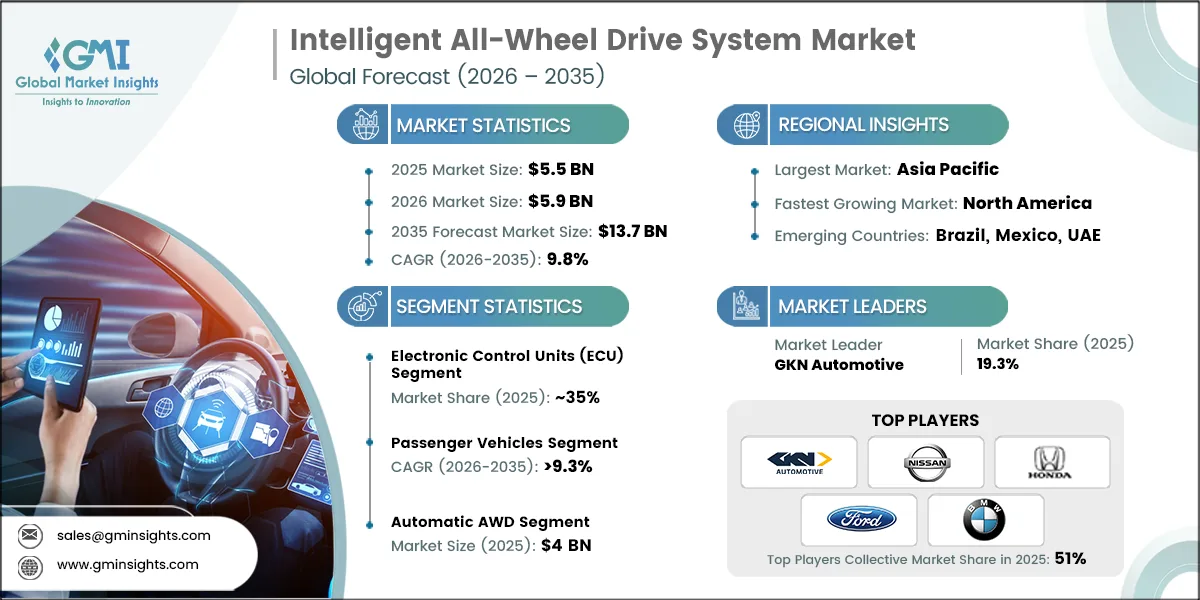
To get key market trends
Intelligent All-Wheel Drive System Market Trends
The demand for advanced intelligent all-wheel drive (AWD) system solutions is steadily increasing, driven by growing collaboration among automotive OEMs, Tier-1 suppliers, drivetrain developers, and regulatory authorities. These partnerships aim to enhance vehicle stability, traction control, fuel efficiency, energy optimization, and compliance with increasingly stringent safety and environmental standards. Stakeholders are working together to develop integrated, modular, and electronically controlled AWD platforms, incorporating torque vectoring modules, predictive AWD control units, multi-axle e-axles, and sensor-integrated electronic differentials with real-time vehicle dynamics monitoring.
For instance, in 2025, leading AWD system manufacturers strengthened strategic collaborations with global OEMs to deploy full-time automatic AWD, multi-motor torque vectoring, and hybrid/electric drivetrain-compatible AWD modules for next-generation passenger cars, SUVs, and crossover vehicles. These initiatives improved handling performance, off-road capability, energy efficiency, and vehicle safety, while reducing drivetrain losses and optimizing performance under varying road and weather conditions worldwide.
Regional customization of intelligent AWD system solutions has emerged as a key trend. Major suppliers are developing region-specific torque distribution calibrations, temperature-resistant driveline components, and predictive AWD control strategies tailored for Europe, North America, Asia Pacific, Latin America, and the Middle East & Africa. These solutions address local climatic conditions, regulatory safety requirements, road conditions, and vehicle performance expectations across premium, mid-range, and economy vehicle segments.
The rise of specialized AWD electronics providers and modular powertrain solution developers is reshaping the competitive landscape. Companies focusing on multi-motor AWD architectures, modular torque vectoring platforms, lightweight e-axles, and ECU-integrated control systems are enabling scalable and cost-effective adoption of advanced AWD technologies. These innovations empower both established OEMs and emerging automakers to enhance vehicle handling, traction, energy efficiency, and system durability across ICE, hybrid, and electric platforms.
The development of standardized, interoperable, and modular AWD architectures is transforming the market. Leading players are deploying platforms that integrate seamlessly with vehicle ECUs, connected telematics, ADAS, and predictive diagnostics frameworks. These platforms support real-time AWD monitoring, predictive maintenance, multi-vehicle compatibility, and global regulatory compliance, enabling OEMs to deliver efficient, high-performance, safe, and environmentally responsible vehicles for the global automotive market.
Intelligent All-Wheel Drive System Market Analysis
Learn more about the key segments shaping this market
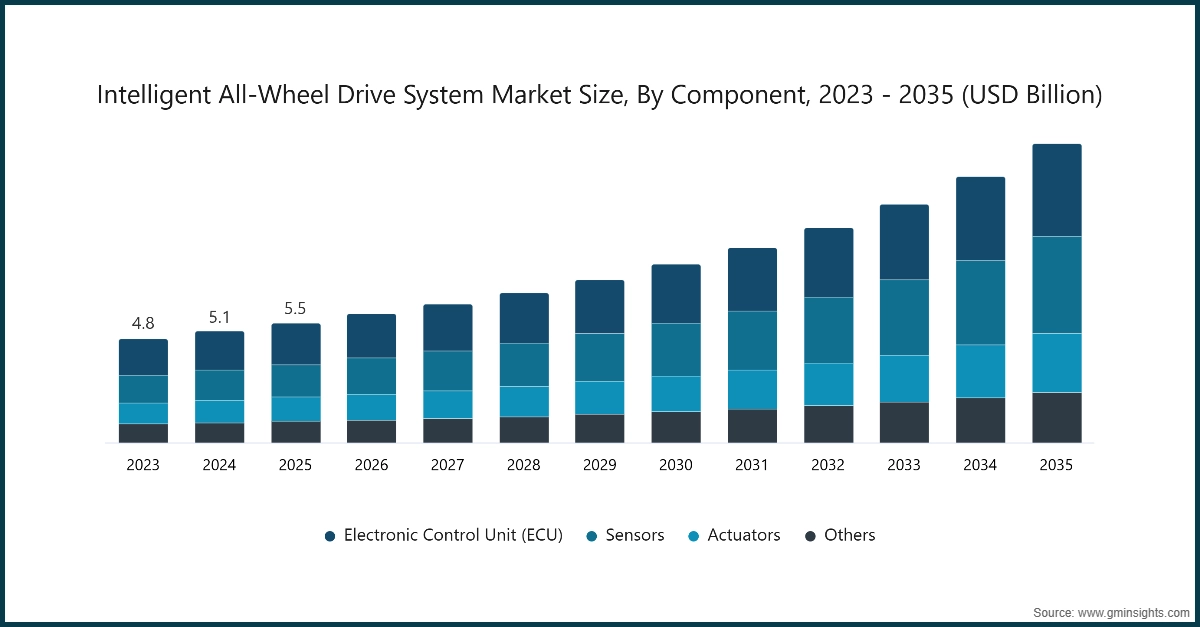
Based on component, the market is divided into electronic control units (ECU), sensors, actuators and others. The electronic control units (ECU) segment accounted for around 35% share in 2025 and is expected to grow at a CAGR of over 8.7% from 2026 to 2035.
- The electronic control units (ECU) segment dominates the intelligent All-Wheel Drive (AWD) system market, primarily due to its critical role in managing torque distribution, coordinating multi-axle differentials, and controlling predictive AWD functions. With the widespread adoption of AI-enabled torque vectoring and multi-motor AWD architectures in modern passenger vehicles, SUVs, and EVs, ECUs have become essential components for improving vehicle stability, handling performance, energy efficiency, and safety compliance. Their extensive integration across OEM platforms ensures consistent demand in both new vehicle production and aftermarket service channels globally.
- Other components, including sensors, actuators, and mechanical differentials, play complementary roles within the AWD system architecture. Sensors monitor wheel speed, yaw, and traction conditions, while actuators implement torque adjustments and differential locking. These components are critical for system functionality but hold a comparatively smaller revenue share within the broader AWD system market.
- Continuous advancements in modular ECU design, high-speed processing, sensor integration, predictive torque algorithms, and connectivity with ADAS/vehicle telematics further reinforce the dominance of the ECU segment. These innovations enable real-time torque distribution, improved handling in adverse conditions, reduced drivetrain losses, and compatibility with hybrid and electric powertrains. As vehicle electrification, premiumization, and regulatory safety standards continue to expand, demand for advanced AWD ECUs is expected to remain strong across global passenger cars, SUVs, and light commercial vehicle segments.
Learn more about the key segments shaping this market
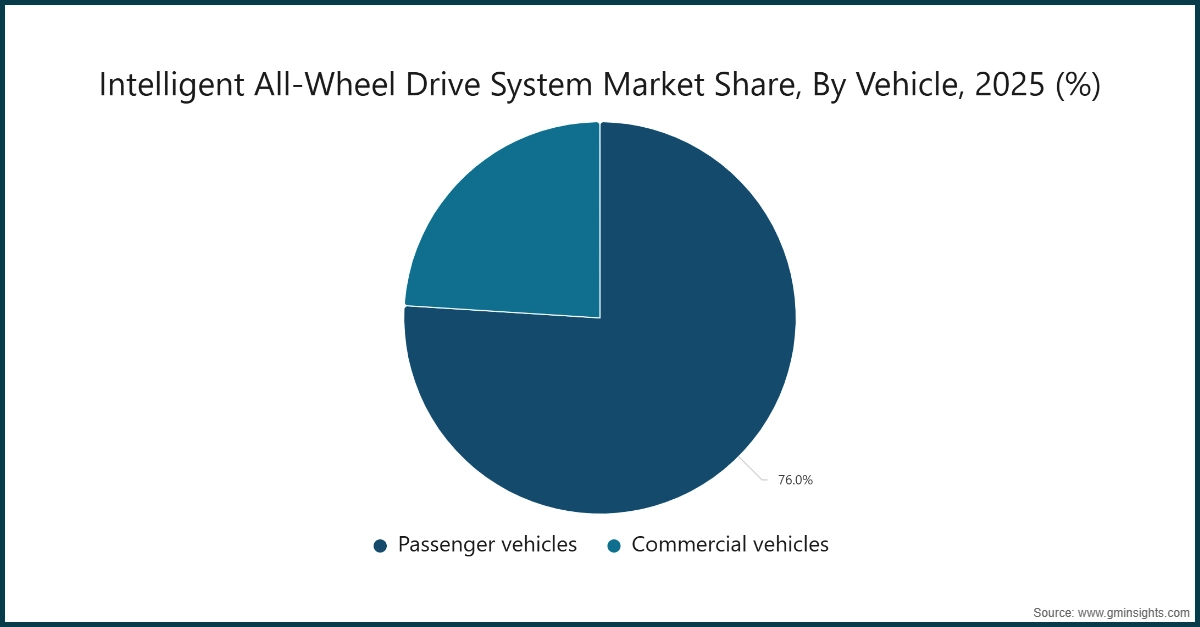
Based on vehicles, the intelligent all-wheel drive system market is divided into passenger vehicles and commercial vehicles. The passenger vehicles segment dominates the market, accounting for around 76% share in 2025 and is expected to grow at a CAGR of over 9.3% from 2026 to 2035.
- The passenger vehicles segment dominates the intelligent All-Wheel Drive (AWD) system market due to high global production volumes of cars, SUVs, crossovers, and hybrid-electric vehicles. Rising consumer demand for enhanced vehicle stability, traction control, all-weather performance, and energy-efficient drivetrains has accelerated the adoption of automatic AWD, full-time AWD, and predictive torque vectoring systems. OEM standardization of electronically controlled AWD modules, multi-axle e-axles, and connected torque distribution units across compact, mid-size, and premium passenger vehicles further reinforces this segment’s market leadership across Europe, North America, and Asia Pacific.
- The commercial vehicle segment is also witnessing steady adoption of AWD system solutions, particularly in light commercial vehicles (LCVs) and medium-duty trucks that benefit from improved traction, stability, and load-handling capabilities. Fleet operators increasingly prioritize reliable AWD performance, reduced drivetrain wear, and optimized energy efficiency to enhance operational performance. However, the comparatively lower production volume of AWD-equipped commercial vehicles, especially in heavy-duty diesel trucks, limits the overall share of this segment.
Based on system, the intelligent all-wheel drive system market is divided into Automatic AWD, and Manual/Driver-Selectable AWD. The automatic AWD segment dominated the market and was valued at USD 4 billion in 2025.
- The Automatic AWD segment dominates the intelligent All-Wheel Drive (AWD) system market due to its widespread adoption in modern passenger cars, SUVs, crossovers, and electrified vehicles, along with its superior performance, safety, and real-time torque optimization capabilities. Automatic AWD systems, including full-time automatic AWD, part-time automatic AWD, and predictive torque vectoring configurations, enhance vehicle stability, improve traction in varying road conditions, and optimize energy distribution without driver intervention. OEMs are increasingly standardizing electronically controlled automatic AWD platforms across vehicle portfolios to ensure enhanced drivability, regulatory safety compliance, and seamless integration with advanced vehicle dynamics control and ADAS systems.
- The Manual/Driver-Selectable AWD segment continues to exist primarily in off-road vehicles, utility vehicles, and select cost-sensitive models. These systems allow drivers to manually engage or disengage AWD based on driving conditions, offering operational flexibility at a comparatively lower technological complexity. However, limitations such as reduced real-time responsiveness, less optimal torque distribution, and limited compatibility with electrified and connected vehicle platforms restrict their adoption in modern mainstream vehicles.
Based on propulsion, the intelligent all-wheel drive system market is divided into ICE and Electric Vehicles. The ICE segment dominated the market and was valued at USD 5 billion in 2025.
- The ICE (Internal Combustion Engine) segment dominates the intelligent All-Wheel Drive (AWD) system market due to its widespread adoption across modern passenger cars, SUVs, crossovers, and light commercial vehicles worldwide. ICE-powered vehicles extensively utilize mechanical and electronically controlled AWD systems, including full-time automatic AWD and torque vectoring differentials, to enhance traction, stability, and all-weather performance. OEMs continue to standardize advanced AWD platforms across gasoline and diesel vehicle portfolios to meet consumer demand for performance differentiation, improved handling, and compliance with evolving safety standards.
- The Electric Vehicle (EV) segment, including battery electric vehicles (BEVs) and hybrid electric vehicles (HEVs/PHEVs), is witnessing rapid growth in AWD adoption, particularly through multi-motor architecture and e-axle-based AWD configurations. These systems enable precise torque distribution, improved energy efficiency, and enhanced vehicle control without traditional mechanical linkages.
Based on application, the intelligent all-wheel drive system market is divided into on-road and off-road. The on-road segment dominated the market and was valued at USD 4 billion in 2025.
- The On-Road segment dominates the intelligent All-Wheel Drive (AWD) system market, primarily due to its extensive adoption across modern passenger cars, SUVs, crossovers, and urban utility vehicles. With the widespread demand for enhanced vehicle stability, improved cornering control, all-weather traction, and driving comfort, on-road AWD systems have become essential for optimizing handling performance and safety compliance. OEMs increasingly integrate automatic and electronically controlled AWD platforms into mainstream vehicle lineups to ensure real-time torque distribution, improved fuel efficiency, and seamless compatibility with advanced driver assistance systems (ADAS).
- The Off-Road segment plays a complementary role within the AWD system market, primarily serving specialized vehicles such as off-road SUVs, pickup trucks, and utility vehicles. Off-road AWD systems focus on enhanced traction control, differential locking capability, and durability under rugged terrain conditions. While these systems are critical for performance in demanding environments, their comparatively lower production volumes limit their overall revenue share within the broader AWD market.
Based on end use, the intelligent all-wheel drive system market is divided into OEM and Aftermarket. The OEM segment dominated the market and was valued at USD 5 billion in 2025.
- The OEM segment dominates the intelligent All-Wheel Drive (AWD) system market, primarily due to the large-scale integration of advanced AWD technologies during vehicle manufacturing. Automotive manufacturers increasingly equip passenger cars, SUVs, crossovers, and electrified vehicles with factory-installed automatic AWD, torque vectoring modules, and electronically controlled differentials to enhance performance, safety, and brand differentiation. OEM-level integration ensures optimal system calibration, seamless compatibility with vehicle control units and ADAS platforms, and compliance with global safety and regulatory standards.
- The Aftermarket segment plays a supportive role in the market, focusing on replacement components, upgrades, and maintenance of AWD-related parts such as actuators, control modules, and differentials. While demand exists due to vehicle parc expansion and periodic servicing requirements, the aftermarket segment holds a comparatively smaller share as AWD systems are highly integrated and less frequently replaced compared to consumable automotive components.
Looking for region specific data?
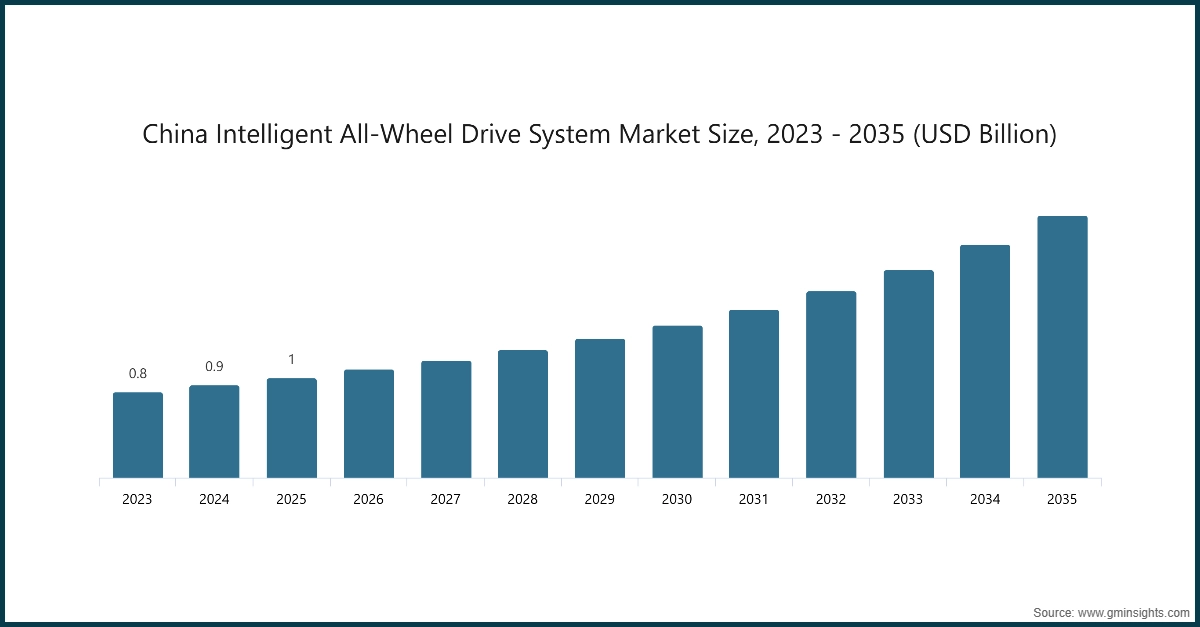
In 2025, China dominated the Asia Pacific intelligent all-wheel drive system market with around 51% share and generated approximately USD 1 billion in revenue.
- Asia-Pacific dominates the global intelligent All-Wheel Drive (AWD) system market, driven by high vehicle production volumes, expanding SUV and crossover segments, and rapid electrification trends. The region benefits from strong manufacturing infrastructure, increasing consumer demand for enhanced vehicle stability and all-weather traction, and the growing integration of automatic AWD, torque vectoring systems, and multi-motor e-axle architectures across conventional and electrified vehicle platforms.
- China dominates the Asia-Pacific intelligent AWD system market, supported by large-scale production of passenger vehicles and electric vehicles (EVs), along with a strong presence of OEMs and Tier-1 drivetrain suppliers. Strong domestic demand for premium driving performance and improved safety has accelerated the adoption of electronically controlled AWD modules across ICE, hybrid, and battery-electric vehicles. Major automotive hubs such as Shanghai, Beijing, Guangzhou, and Shenzhen are witnessing widespread deployment of predictive torque control systems, integrated ECU-based AWD modules, lightweight differentials, and connected drivetrain platforms. OEMs and suppliers collaborate closely to enhance handling performance, improve energy efficiency, and meet evolving regulatory standards.
- Other Asia-Pacific markets, including India, Japan, and South Korea, are emerging as high-growth regions. Growth is supported by increasing SUV penetration, hybrid vehicle adoption, and expansion of regional supplier networks. India focuses on cost-optimized AWD integration for mid-range and utility vehicles; Japan emphasizes precision-engineered torque vectoring and hybrid-compatible AWD systems; while South Korea prioritizes modular multi-motor AWD architectures and connected vehicle integration for premium and electrified vehicle segments.
U.S. holds share of 83% in North America intelligent all-wheel drive system market in 2025 and it will grow tremendously between 2026 and 2035.
- North America has a major share ofthe intelligent All-Wheel Drive (AWD) system market, primarily driven by strong demand for SUVs, crossovers, and pickup trucks, along with a well-established automotive manufacturing ecosystem and advanced drivetrain technology adoption. The region benefits from high consumer preference for enhanced traction, performance capability, and all-weather driving stability, as well as strict safety standards that encourage integration of electronically controlled AWD platforms.
- Within United States, widespread deployment of full-time automatic AWD, predictive torque vectoring systems, electronically controlled differentials, and e-axle-based AWD modules across passenger vehicles and light trucks fuels market growth. Major automotive hubs such as Detroit, Chicago, Los Angeles, and Austin play a significant role in AWD system innovation, large-scale production, and integration with advanced vehicle dynamics and ADAS technologies.
- Leading AWD system providers operating across North America, including BorgWarner, American Axle & Manufacturing, Dana Incorporated, Magna International, and ZF Friedrichshafen AG, continue expanding modular AWD architectures, multi-motor systems, and lightweight torque vectoring platforms. Continuous investments in electrified driveline technologies and connected AWD control systems further strengthen North America’s dominant position in the global market.
Germany holds share of 21% in Europe intelligent all-wheel drive system market in 2025 and it will grow tremendously between 2026 and 2035.
- Europe holds a major share of the intelligent All-Wheel Drive (AWD) system market, supported by a mature automotive ecosystem, globally recognized OEMs, and increasing integration of advanced drivetrain technologies such as electronically controlled AWD modules, torque vectoring systems, predictive traction control, and hybrid-compatible e-axle architectures. Manufacturers and Tier-1 suppliers across the region emphasize vehicle stability, performance optimization, emission reduction, and compliance with stringent EU safety and CO₂ regulations. Strong R&D capabilities, precision engineering standards, and widespread electrification initiatives reinforce Europe’s position as a key regional market for intelligent AWD systems.
- Germany dominates the European intelligent all-wheel drive system market, driven by its strong automotive manufacturing base, concentration of premium and performance vehicle OEMs, technological leadership, and strict regulatory enforcement. German manufacturers and drivetrain suppliers lead in the deployment of advanced torque vectoring AWD systems, integrated ECU-controlled drivetrain modules, lightweight differentials, and multi-motor e-axle platforms for hybrid and battery-electric vehicles. Significant investments in precision-engineered components, intelligent traction algorithms, and modular AWD architectures have enhanced vehicle dynamics, improved energy efficiency, and accelerated adoption across luxury, performance, and SUV segments positioning Germany as the regional leader.
- Other major European countries, including United Kingdom, France, and Netherlands, contribute to regional market expansion through increasing adoption of advanced AWD technologies. The UK emphasizes performance-oriented and premium vehicle integration, France focuses on emission-efficient AWD platforms and hybrid compatibility, while the Netherlands prioritizes high-durability drivetrain components and smart traction systems for electrified mobility. Despite growing adoption across these markets, Germany maintains its leadership in production scale, technological innovation, and comprehensive deployment of intelligent AWD systems across Europe.
Intelligent all-wheel drive system market in Brazil will experience significant growth between 2026 and 2035.
- Latin America holds a smaller share but is steadily expanding its presence in the Intelligent All-Wheel Drive (AWD) System Market, driven by growing production of passenger vehicles, SUVs, and hybrid-electric vehicles, increasing adoption of advanced AWD technologies, and rising investments in modular, electronically controlled drivetrain solutions. OEMs, fleet operators, and regional suppliers are gradually implementing standardized AWD integration, predictive torque management, and connected drivetrain platforms to ensure optimal vehicle stability, traction, and energy efficiency across diverse road conditions.
- Brazil dominates the Latin American intelligent AWD system market, supported by its large automotive industry, growing vehicle production volumes, and increasing adoption of automatic AWD, torque vectoring systems, multi-motor e-axle platforms, and ECU-integrated drivetrain modules. Major automotive hubs such as São Paulo, Rio de Janeiro, and Brasília host extensive OEM operations and supplier networks, where manufacturers deploy high-performance AWD platforms for ICE, hybrid, and electrified vehicles. Leading intelligent AWD system providers, including BorgWarner Inc., Delphi Technologies, Denso Corporation, Hitachi Automotive Systems, and Robert Bosch GmbH, actively offer integrated AWD solutions, reinforcing Brazil’s dominant position in the regional market.
- Mexico represents the second largest and rapidly growing market, driven by increasing adoption of automatic and multi-motor AWD systems in passenger cars, SUVs, and hybrid vehicles, alongside expansion of OEM and supplier networks. Key industrial centers such as Mexico City, Monterrey, and Guadalajara are witnessing higher deployment of ECU-integrated AWD modules, torque vectoring differentials, and connected drivetrain platforms, contributing to the modernization of Latin America’s intelligent AWD ecosystem, while Brazil continues to maintain its leading role.
Intelligent all-wheel drive system market in UAE will experience significant growth between 2026 and 2035.
- Middle East & Africa (MEA) holds a smaller share but is gradually expanding its presence in the intelligent All-Wheel Drive (AWD) system market, driven by growing production and adoption of passenger vehicles, SUVs, and hybrid/electric vehicles, increasing integration of advanced AWD technologies, and rising investment in modular, electronically controlled drivetrain platforms. OEMs, fleet operators, and service providers across the region are gradually implementing standardized installation processes, predictive torque management, and connected drivetrain monitoring to ensure optimal vehicle stability, traction, and energy efficiency.
- UAE dominates the MEA intelligent AWD system market, supported by its rapidly developing automotive sector, advanced OEM and supplier networks, and adoption of automatic AWD, multi-motor e-axle platforms, torque vectoring systems, and ECU-integrated drivetrain modules. Major automotive hubs such as Dubai, Abu Dhabi, and Sharjah host extensive OEM and supplier operations, where AWD programs include predictive torque control, lightweight differentials, hybrid-compatible e-axles, and connected AWD platforms. Leading intelligent AWD system providers, including BorgWarner, Delphi Technologies, Denso, Hitachi Automotive Systems, and Robert Bosch, actively offer high-performance, integrated AWD solutions, reinforcing the UAE’s dominant position in the MEA market.
- Other MEA countries, including Saudi Arabia, South Africa, and Egypt, are emerging as high-growth markets, driven by increasing adoption of advanced AWD systems in passenger vehicles, SUVs, and hybrid/electric platforms, alongside expansion of OEM and supplier networks. Saudi Arabia emphasizes fleet and commercial vehicle AWD applications, South Africa focuses on passenger and light commercial vehicles, and Egypt prioritizes modular multi-motor and connected AWD platforms. Despite growth in these countries, the UAE continues to maintain its leading role in MEA due to its service network scale, technological innovation, and strong government and enterprise support.
Intelligent All-Wheel Drive System Market Share
The top 7 companies in the market are Nissan, GKN Automotive, BMW, Acura, Infiniti, Honda and Ford. These companies hold around 58% of the market share in 2025.
- Nissan Motor delivers advanced intelligent All-Wheel Drive (AWD) system solutions across passenger cars, SUVs, and crossovers, including automatic AWD modules, torque vectoring differentials, multi-motor e-axles, and ECU-integrated drivetrain platforms. Nissan leverages global OEM collaborations, modular AWD architectures, and electrified powertrain integration to enhance vehicle stability, traction, and fuel efficiency. Its extensive production capabilities and strong regional footprint reinforce its competitive position in the global intelligent AWD system market.
- GKN Automotive provides high-performance AWD system components, including electronically controlled differentials, multi-axle torque management modules, and lightweight mechanical driveline architectures for passenger cars, SUVs, and hybrid vehicles. GKN leverages expertise in driveline electrification, modular design, and OEM integration to deliver scalable, reliable, and efficient AWD solutions. Its strong engineering capabilities and global OEM partnerships maintain its significant market presence.
- BMW offers premium intelligent AWD system technologies, including xDrive all-wheel drive modules, torque vectoring differentials, ECU-integrated AWD platforms, and hybrid-compatible multi-motor architectures. BMW leverages advanced vehicle dynamics engineering, precision manufacturing, and global OEM collaboration to deliver superior traction, handling, and fuel efficiency. Its continuous investment in electrified and connected AWD platforms strengthens its leadership in the market.
- Acura provides intelligent AWD solutions for luxury sedans and SUVs, including Super Handling All-Wheel Drive (SH-AWD) modules, predictive torque vectoring, and ECU-controlled drivetrain integration. Acura leverages precision engineering, advanced hybrid-compatible platforms, and OEM collaboration to optimize handling performance, energy efficiency, and safety compliance, maintaining a strong competitive position in the intelligent AWD market.
- Infiniti delivers intelligent AWD technologies for premium sedans and SUVs, including all-mode torque vectoring AWD systems, multi-motor e-axle platforms, and ECU-integrated drivetrain modules. Infiniti leverages advanced vehicle dynamics control, hybrid powertrain compatibility, and modular AWD architectures to enhance traction, stability, and fuel efficiency, reinforcing its market share in luxury and performance vehicle segments.
- Honda offers intelligent AWD system solutions for passenger vehicles, SUVs, and hybrid models, including Real Time AWD modules, predictive torque control, and ECU-integrated drivetrain platforms. Honda leverages global OEM partnerships, modular AWD architectures, and electrified powertrain integration to improve vehicle stability, handling, and fuel efficiency, maintaining its competitive presence across key markets.
Ford Motor provides intelligent AWD systems across SUVs, pickup trucks, and performance vehicles, including electronically controlled AWD modules, multi-axle torque vectoring platforms, and hybrid-compatible drivetrain architectures. Ford leverages advanced vehicle dynamics engineering, modular AWD designs, and global OEM collaboration to deliver reliable, efficient, and high-performance AWD solutions, strengthening its market share in North America and globally.
Intelligent All-Wheel Drive System Market Companies
Major players operating in the intelligent All-wheel drive system industry include:
- Acura
- BMW
- BorgWarner
- Delphi Technologies
- Ford
- GKN Automotive
- Hitachi Automotive
- Honda
- Infiniti
- Nissan
- The intelligent All-Wheel Drive (AWD) system market is highly competitive, with leading solution providers such as Robert Bosch, Denso, BorgWarner, Delphi Technologies (PHINIA), GKN Automotive, BMW, Nissan Motor, Honda, Ford Motor Company, and Acura occupying key segments across automatic AWD modules, torque vectoring systems, ECU-integrated drivetrain platforms, multi-motor e-axle architectures, and predictive AWD technologies, as well as OEM and aftermarket distribution channels.
- Robert Bosch, Denso, BorgWarner, Delphi Technologies (PHINIA), GKN Automotive, BMW, and Nissan Motor lead the market with comprehensive AWD system solutions, integrating automatic and multi-motor AWD modules, torque vectoring differentials, ECU-linked drivetrain platforms, and hybrid-compatible architectures. These companies focus on enhancing vehicle stability, handling performance, energy efficiency, traction control, and durability, while maintaining strong OEM collaborations, global manufacturing capabilities, and service networks.
- Honda, Ford Motor, and Acura specialize in advanced, technology-driven AWD solutions, emphasizing modular drivetrain designs, multi-axle torque management, predictive torque vectoring, and software-enabled ECU integration. Their products enable improved vehicle handling, energy efficiency, traction optimization, reliable performance, and seamless integration with connected, hybrid, and electrified vehicle platforms across passenger cars, SUVs, and light commercial vehicles worldwide.
- The intelligent all-wheel drive system industry is highly competitive, with leading solution providers such as Robert Bosch, Denso, BorgWarner, Delphi Technologies, NGK Spark Plug, Hitachi Automotive Systems, Mitsubishi Electric, Webasto, Inalfa Roof Systems, and Magna International occupying key segments across Coil-on-Plug systems, high-energy ignition coils, ECU-integrated
Intelligent All-Wheel Drive System Market Report Attributes
| Key Takeaway | Details |
|---|---|
| Market Size & Growth | |
| Base Year | 2025 |
| Market Size in 2025 | USD 5.5 Billion |
| Market Size in 2026 | USD 5.9 Billion |
| Forecast Period 2026-2035 CAGR | 9.8% |
| Market Size in 2035 | USD 13.7 Billion |
| Key Market Trends | |
| Drivers | Impact |
| Rising EV & Hybrid Vehicle Adoption | Multi-motor AWD architectures are increasingly integrated into BEVs and PHEVs, driving demand for intelligent AWD systems. |
| Consumer Demand for Safety & Performance | Growing preference for enhanced traction, cornering stability, and all-weather capability in SUVs, crossovers, and premium vehicles. |
| Technological Advancements | AI-enabled torque vectoring, predictive AWD control, and connected drivetrain systems improve performance and efficiency. |
| Premiumization of Vehicles | OEMs and fleet operators are equipping mid-range and premium vehicles with AWD to differentiate offerings and improve value perception. |
| Pitfalls & Challenges | Impact |
| High System Cost | Advanced AWD technologies and electronic actuation units increase vehicle costs, limiting adoption in lower-cost segments. |
| Complex Integration & Validation | Software-intensive AWD systems require extensive testing, increasing development time and complexity. |
| Opportunities: | Impact |
| Electrification & Multi-Motor AWD Expansion | Growing BEV and PHEV segments provide opportunities for modular AWD platforms and torque vectoring solutions. |
| Connected & Predictive AWD Solutions | Integration with telematics, AI, and connected vehicle systems enables new value-added services and aftermarket innovations. |
| Market Leaders (2025) | |
| Market Leader |
19.3% market share |
| Top Players |
Collective market share in 2025 is 51% |
| Competitive Edge |
|
| Regional Insights | |
| Largest Market | Asia Pacific |
| Fastest growing market | North America |
| Emerging countries | Brazil, Mexico, UAE |
| Future outlook |
|
What are the growth opportunities in this market?
Intelligent All-Wheel Drive System Industry News
- In November 2025, Nissan Motor showcased its advanced e‑4ORCE intelligent all‑wheel drive system on a new premium SUV at the Motor Expo 2025. The AWD platform, powered by dual electric motors, is designed to deliver confident handling, optimized traction across diverse road conditions, and enhanced performance for passenger vehicles leveraging Nissan’s e‑POWER electrified powertrain architecture.
- In July 2025, Ford Motor announced that Ford Pro will introduce an advanced all‑wheel drive (AWD) system on its E‑Transit Custom electric van. The new AWD platform employs dual electric drive units (front and rear) to deliver optimized torque distribution and enhanced traction in slippery or challenging terrains such as ice, mud, and steep surfaces.
- In January 2025, BorgWarner upgraded its intelligent AWD system offerings with high-output AWD modules, predictive torque vectoring systems, and ECU-linked multi-motor control platforms for passenger and commercial vehicles. The initiative targets large-scale OEM integration, optimized vehicle dynamics, and enhanced operational efficiency.
- In October 2024, NGK Spark Plug, Hitachi Automotive Systems (Hitachi Astemo), and Mitsubishi Electric launched integrated AWD system solutions for passenger cars, SUVs, and light commercial vehicles, combining multi-axle torque vectoring modules, ECU-integrated drivetrain platforms, sensor-enabled AWD units, and connected vehicle compatibility. The initiative emphasizes durability, energy efficiency, performance optimization, and seamless OEM integration across global markets.
- In March 2024, GKN Automotive introduced a next-generation AWD platform featuring predictive traction management, electronic torque distribution, and sensor-enabled control units. The deployment focuses on enhanced off-road capability, fuel efficiency, and adoption across passenger cars, SUVs, and light commercial vehicles.
The intelligent all-wheel drive system market research report includes in-depth coverage of the industry with estimates & forecasts in terms of revenue ($ Bn) and volume (units) from 2022 to 2035, for the following segments:
Market, By Component
- Electronic Control Unit (ECU)
- 32-bit ECU
- 64-bit ECU
- Sensors
- Wheel Speed Sensors
- Steering Angle Sensors
- Yaw Rate Sensors
- Accelerometers
- Actuators
- Electromagnetic Clutch Actuators
- Hydraulic Actuators
- Electromechanical Actuators
- Others
Market, By Vehicle
- Passenger vehicles
- Hatchbacks
- Sedan
- SUV
- Commercial vehicles
- Light commercial vehicles (LCV)
- Medium commercial vehicles (MCV)
- Heavy commercial vehicles (HCV)
Market, By Propulsion
- ICE
- Gasoline
- Diesel
- Electric Vehicles
- Battery Electric Vehicles (BEV)
- Plug-in Hybrid Electric Vehicles (PHEV)
- Hybrid Electric Vehicles (HEV)
Market, By System
- Automatic AWD
- Full-Time Automatic AWD
- Part-Time Automatic AWD
- Manual/Driver-Selectable AWD
- On-Demand Manual Engagement
- Lockable Differential Systems
Market, By Application
- On Road
- Urban Driving
- Highway/Long-Distance
- All-Weather Commuting
- Off-Road
- Construction Sites
- Agricultural Operations
- Recreational/Sports Utility
Market, By End Use
- OEM
- Aftermarket
The above information is provided for the following regions and countries:
- North America
- US
- Canada
- Europe
- UK
- Germany
- France
- Italy
- Spain
- Belgium
- Netherlands
- Sweden
- Asia Pacific
- China
- India
- Japan
- Australia
- Singapore
- South Korea
- Vietnam
- Indonesia
- Latin America
- Brazil
- Mexico
- Argentina
- MEA
- South Africa
- Saudi Arabia
- UAE
Frequently Asked Question(FAQ) :
What is the market size of the intelligent all-wheel drive system in 2025?
The market size was USD 5.5 billion in 2025, with a CAGR of 9.8% expected through 2035 driven by rising vehicle premiumization.
What is the projected value of the intelligent all-wheel drive system industry by 2035?
The intelligent all-wheel drive system market is expected to reach USD 13.7 billion by 2035, propelled by growing OEM standardization of electronically controlled AWD platforms across mainstream and premium vehicle segments.
What is the current intelligent all-wheel drive system industry size in 2026?
The market size is projected to reach USD 5.9 billion in 2026.
How much revenue did the electronic control units (ECU) component segment generate in 2025?
The ECU segment dominated the component market with approximately 35% share in 2025, expected to grow at a CAGR of over 8.7% through 2035, driven by its critical role in managing torque distribution, coordinating multi-axle differentials, and controlling predictive AWD functions.
What was the market share of the passenger vehicles segment in 2025?
The passenger vehicles segment dominated the market with approximately 76% share in 2025, growing at a CAGR of over 9.3% through 2035, driven by high global production volumes of cars, SUVs, and crossovers.
Which region leads the intelligent all-wheel drive system market?
China dominated the Asia Pacific intelligent all-wheel drive system market with around 51% share, generating approximately USD 1 billion in revenue in 2025, driven by high vehicle production, expanding SUV and crossover demand, and rapid electrification.
What are the key trends shaping the intelligent all-wheel drive system market?
Key trends include OEM–supplier collaboration for modular electronically controlled AWD platforms, regional customization of torque distribution systems, growth of specialized AWD electronics providers, and integration with ADAS, telematics, and predictive diagnostics.
Who are the key players in the intelligent all-wheel drive system market?
Key players include Acura, BMW, BorgWarner, Delphi Technologies, Ford, GKN Automotive, Hitachi Automotive, Honda, Infiniti, and Nissan.
Intelligent All-Wheel Drive System Market Scope
Related Reports