Summary
Table of Content

Insect Protein Processing Equipment Market
Get a free sample of this report
Form submitted successfully!
Error submitting form. Please try again.
Thank you!
Your inquiry has been received. Our team will reach out to you with the required details via email. To ensure that you don't miss their response, kindly remember to check your spam folder as well!
Request Sectional Data
Thank you!
Your inquiry has been received. Our team will reach out to you with the required details via email. To ensure that you don't miss their response, kindly remember to check your spam folder as well!
Form submitted successfully!
Error submitting form. Please try again.
Insect Protein Processing Equipment Market Size
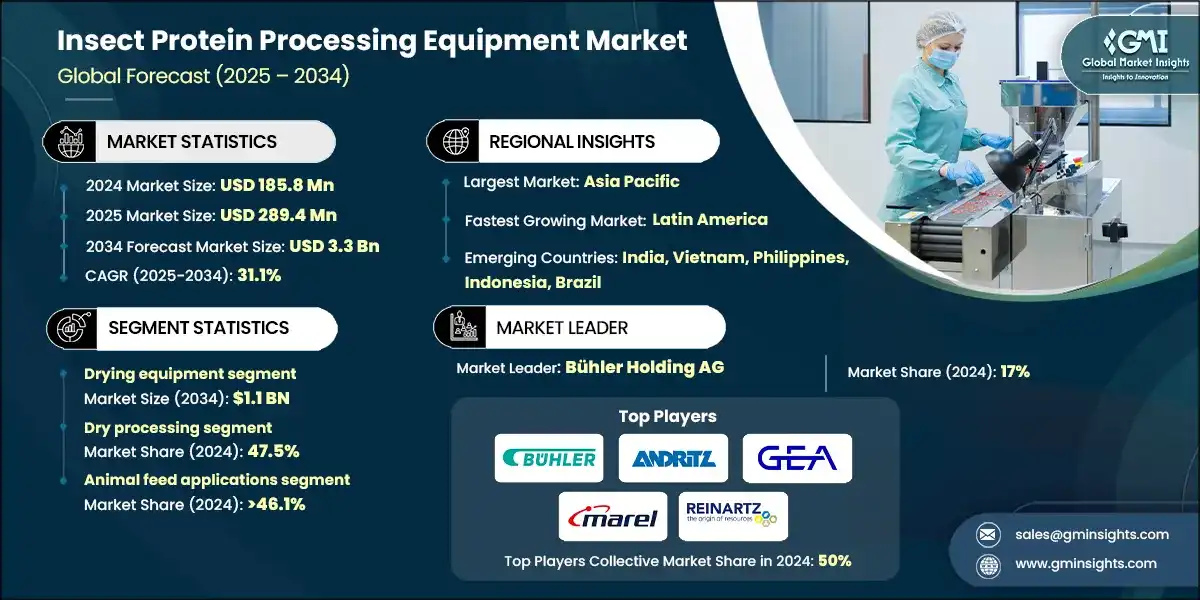
The global insect protein processing equipment market was valued at USD 185.8 million in 2024. The market is expected to grow from USD 289.4 million in 2025 to USD 3.3 billion in 2034, at a CAGR of 31.1%, according to the latest report published by Global Market Insights Inc. In the recent period the growing applicability of insect-based products in animal feed, aquaculture, pet food, and human nutrition, equipment manufacturers have witnessed growing orders from startup innovators and leading agro-industrial firms.
To get key market trends
One principal factor of this growth is the increasing levels of regulatory approvals and established regulation in Europe, North America, and Asia-Pacific. For instance, the EU approved Tenebrio molitor (yellow mealworm) for human consumption in 2021 which resulted in substantial equipment investments in the Netherlands, France and Germany. Furthermore, developing economies, such as India and Vietnam, are developing insect protein production infrastructure within their countries. Governments are associated with an upgraded research program which links processing insect biomass with automation.
From a processing perspective, drying technologies are anticipated to capture the largest share of the market due to the necessity of quickly drying black soldier fly larvae, crickets, and mealworms to maintain protein quality and prevent microbial contamination. Manufacturers of advanced belt drying systems, vacuum freeze drying, and rotary drum drying systems with IoT-based energy monitoring are beginning to be viewed as essential investments for mid- to large-scale insect protein processing facilities.
Some technology innovation trends have recently emerged in the market in the form of closed-loop protein extraction systems and solvent-free oil separation systems that maintain nutrients in insect oils and peptides. Additionally, equipment manufacturers are incorporating artificial intelligence driven process monitoring and systems into their equipment to increase yields, decrease energy costs, and facilitate adherence to stringent traceability requirements in the EU or Japan. New market leaders such as Buhler Group, EntoTech, Protix, and InnovaFeed continue to invest in modular and integrated platforms that are specifically designed around principles of circular bioeconomy.
Furthermore, the growing popularity of insect-based pet foods and functional human snacks can result in an uptick in demand for grinding, filtration, and spray-drying equipment that is certified GMP and food-grade. The North American market, representing the largest share from the U.S. and Canada, shows notable investment at an industrial scale, in protein meal fractionation plants along with packaging and pathogen control.
Outside of food and feed by-products, there is emerging processing infrastructure for bioactive compound extraction and nutraceutical ingredient processing, especially in the pharmaceuticals and cosmeceuticals. This equipment typically includes specialized decanter centrifuges, membranes for filtration, and vacuum evaporators for processing applications that are high value and low volume.
Insect Protein Processing Equipment Market Report Attributes
| Key Takeaway | Details |
|---|---|
| Market Size & Growth | |
| Base Year | 2024 |
| Market Size in 2024 | USD 185.8 Million |
| Market Size in 2025 | USD 289.4 Million |
| Forecast Period 2025 - 2034 CAGR | 31.1% |
| Market Size in 2034 | USD 3.3 Billion |
| Key Market Trends | |
| Drivers | Impact |
| Sustainability-Mandated Protein Transition | Drives demand for scalable insect protein processing solutions to replace soy and fishmeal. |
| Regulatory Approvals for Human & Animal Nutrition | Expands equipment investments as legal framework for insect-based feeds stabilizes. |
| Technological Advancements in Processing Systems | Fuels demand for high efficiency, integrated, and automated equipment solutions. |
| Pitfalls & Challenges | Impact |
| High Initial Capital Expenditure | Limits entry and scalability for small and medium insect farming enterprises. |
| Equipment Standardization & Compliance Complexity | Creates barriers due to varying food safety, hygiene, and certification standards. |
| Limited Skilled Workforce for Insect Processing | Slows adoption of advanced machinery due to lack of trained technicians and operators. |
| Opportunities: | Impact |
| Expansion of Pet Food & Functional Snack Segment | Opens new specialized equipment categories for human- and pet-grade processing lines. |
| Integration with Circular Bioeconomy Systems | Stimulates demand for frass processing, oil recovery, and waste-to-protein systems. |
| Penetration in Emerging Markets (APAC, Africa) | Unlocks growth for modular, small-footprint systems tailored for decentralized operations. |
| Market Leaders (2024) | |
| Market Leaders |
17% market share |
| Top Players |
Collectively 50% market share in 2024 |
| Competitive Edge |
|
| Regional Insights | |
| Largest Market | Asia Pacific |
| Fastest growing market | Latin America |
| Emerging countries | India, Vietnam, Philippines, Indonesia, Brazil |
| Future outlook |
|
What are the growth opportunities in this market?
Insect Protein Processing Equipment Market Trends
- A key trend in driving competitiveness in the market is the incorporation of automation, IoT (Internet of Things), and AI-based process optimization into insect protein production lines. Companies are more frequently using "smart" solutions to monitor moisture, protein concentration, energy, and batch performance in real-time to increase yield efficiency by 15-20% and reduce labor/ human errors. For example, companies like Protix and Entocycle have fully automated their vertical farms and processing using robotic handling and centralized control systems. The shift to Industrie 4.0-enabled machinery also meets regulatory requirements for global food traceability and improves compliance with HACCP and GMP guidelines.
- International regulatory bodies like the EU Novel Food Initiative and U.S. FDA’s GRAS certification framework, at relatively high speeds and on short timelines, are advancing policies that drive equipment recommendations. In 2021, yellow mealworm was approved by the EU for human consumption, which generated demand for food-grade equipment in countries such as France, Germany and the Netherlands.
- In a similar fashion, APAC countries including Thailand and South Korea, are developing extraction and hygiene standards. These changing standards put pressure on legacy systems and create demand for stainless-steel, food-contact-grade systems and other equipment with capabilities such as CIP (clean-in-place).
- In addition to food and feed, insect-based oils, frass fertilizers and bioactive compounds generate additional revenue opportunities. Equipment used for oil decantation, lipid separation, membrane filtration and enzymatic extraction are gaining traction specifically in the end market of functional cosmetics, nutraceuticals and organic fertilizers.
- According to FAO forecasts, the biofertilizer market will surpass USD 20 billion by 2028 and insect frass will play a foundational role in bioeconomy. Manufacturers that provide diversified equipment relative to these multiple-value chains will maintain higher levels of profitability and relevance.
Insect Protein Processing Equipment Market Analysis
Learn more about the key segments shaping this market
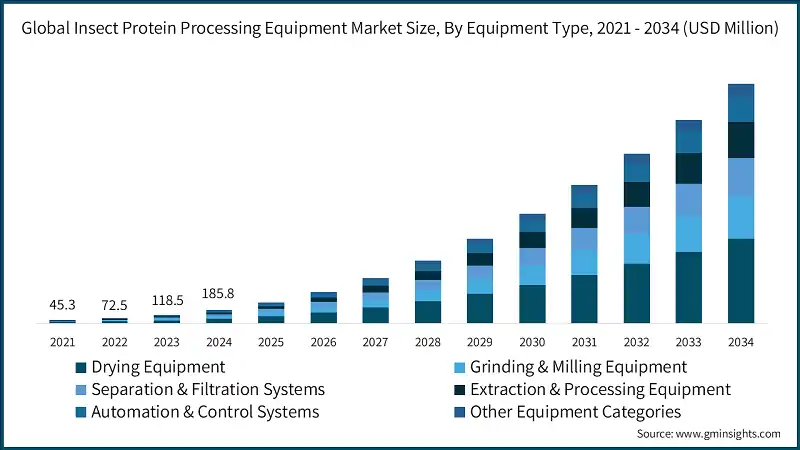
Based on equipment type, the market is divided into drying equipment, grinding & milling equipment, separation & filtration systems, extraction & processing equipment, automation & control systems, and other equipment categories. The drying equipment segment generated USD 65.1 million in revenue in 2024 and is projected to reach USD 1.1 billion by 2034, growing at a CAGR of 31.2%.
- This dominance is primarily due to the importance of drying insect protein products, which preserves nutritional value, shelf life, and microbial safety. For both animal- and human-edible insects, drying is crucial for high-protein meal production.
- Vacuum and freezer dryers represent one of the more pronounced product trends due to their capacity to retain bioactive compounds and improve protein quality. Despite the energy-intensive nature of these systems, they provide higher-value end products for human foods and nutraceuticals.
Based on processing method, the market is divided into dry processing, wet processing, and hybrid processing. In 2024, The dry processing segment held around 47.5% market share in 2024.
- Dry processing holds major market share owing to its cost-effectiveness, and ease of use, especially for large-scale production. In drying, grinding, and milling operations, less water is required, making them more suitable for water-scarcity and stricter environmental compliance areas.
- In this part of the market, a new trend is employing low-temperature drying technologies with dust control to optimize nutrient retention and workplace safety. As the demand for high-protein insect meal increases, dry processing systems are being fully automated to provide high-volume and continuous production.
Learn more about the key segments shaping this market
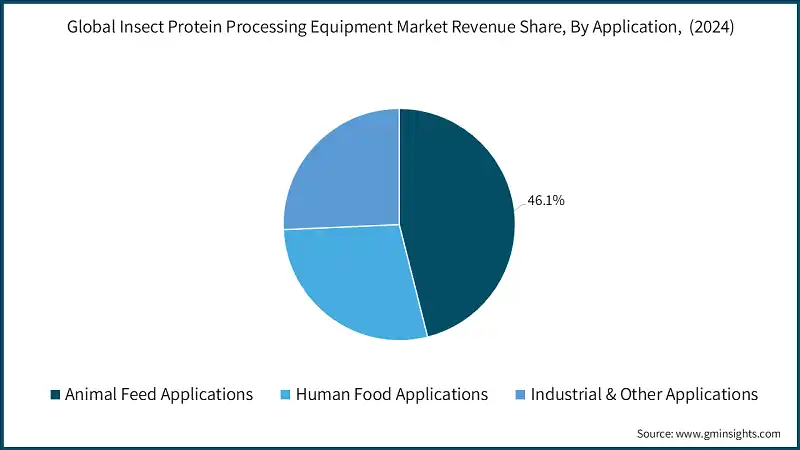
Based on application, the insect protein processing equipment market is divided into animal feed applications, human food applications, industrial & other applications. In 2024, The animal feed applications segment accounted for over 46.1% revenue share in 2024.
- Animal feed uses represent the largest market segment and will be the most commercially developed segment. According to the FAO, the insect protein based livestock market is anticipated to be upwards of 16% CAGR for 2025-2034 emptying in increased installations of drying, grinding, and oil recovery equipment before processing animal feeds commercial animal feed processing facilities.
- One pattern in the market that is emerging is aquaculture feed inclusion, as rising fishmeal prices and new regulations on sustainability, particularly in Europe and Southeast Asia, promote aquafeed companies to include insect-based formulations in their products. This trend has created a demand for processing equipment that is optimized to obtain fine-particle feed consistency, in addition to moisture control.
Looking for region specific data?
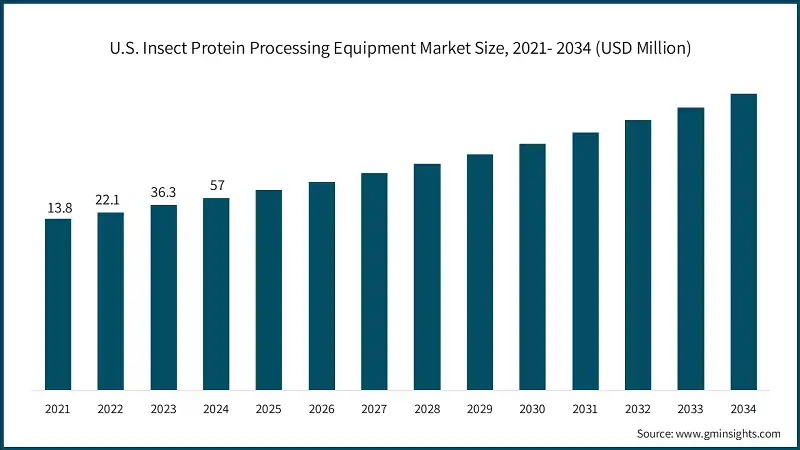
- The insect protein processing equipment market is thriving in North America particularly in the U.S. Significant investment through Silicon Valley-backed companies, such as Beta Hatch and Aspire Food Group, has combined to support large-scale tech facilities with significant automation in drying, oil separation, and traceability within processing.
- Meanwhile, Canada is encouraging insect protein processing because of its sustainability objectives and resource-efficient approaches to agriculture. The Canadian government has invested significantly in R&D through grants to stimulate the processing of insect proteins. Like the United States, there is a movement towards developing insect protein processing systems for human food. This is driven primarily by the high levels of consumer demand for clean-labels and alternative proteins.
- Europe is the most developed and regulated market for insect protein processing equipment due to its stringent environmental policies, established legal framework by EU Novel Food regulation, and subsidized innovative programs such as Horizon Europe.
- Much of the demand for processing equipment is due to compliance with EFSA (European Food Safety Authority) regulations incorporating stainless steel construction, as well as clean-in-place (CIP) and sanitary design. The aquaculture feed sector is also a large equipment purchaser, especially with the European Commission supporting feed sourcing from deforestation-free inputs.
- In addition, carbon credit and circular economy incentives at the EU level are stimulating innovation in frass processing and biorefinery models that require multi-purpose insect protein processing equipment.
- The Asia Pacific region is developing as a fast-growth area, especially from increasing demand for insect protein in countries such as China, Vietnam, Thailand, and South Korea, driven primarily by the need to find sustainable alternatives to fishmeal in aquaculture.
- Insect protein was highlighted as an important element of the 2021 National Green Agriculture Policy, created by the Chinese government to reduce emissions from the food system. Thus, both state-led and private industry is creating investment for mid-scale processing facilities for black soldier fly that will feature some mix of drying, grinding, and oil extraction.
- Labor-intensive insect rearing has competitive advantages in Southeast Asia, and as production continues to scale, costs of efficient modular systems will be required. South Korea offers a distinct advantage because of its emphasis on food-grade processing and its regulations, along with increased demand for functional snacks and nutraceuticals.
- The insect protein processing ecosystem is at an early stage in Latin America, but there are signs of it breaking through, primarily in Brazil, Mexico, and Colombia, where startups are piloting systems based on either BSFL or crickets for animal feed.
- Local governments are backing the insect protein business through sustainable agriculture and bioeconomy programs. Equipment trends are pointing toward inexpensive, semi-automated systems adapted to local climate and economic condition.
- Agricultural universities in Brazil are partnering with EU equipment manufacturers to localize the technology for processing, with emphasis on the extraction of oil and production of high-protein meal for targeted pig and poultry farms.
- Food security concerns, climate resilience strategies, and the need for sustainable animal feed in arid climatic zones drive demand for insect protein processing equipment in the Middle East & Africa.
- In countries such as South Africa, Kenya, and the UAE, governmental action with state-led incentives led the way, typically in the form of government subsidies and incubator programs focused on insect protein startups. In South Africa, private sector action developed, with universities working with feed companies using drying and sieving systems manufactured locally for BSFL.
- In East Africa, donor-funded pilot facilities test portable, containerized equipment for smallholder farming communities. In the UAE, vertical insect farming integrated in the desert is a focus, with the government utilizing the creation of closed-loop, automated processing systems as part of its efforts to create food independence expressed in its Vision 2030 plan.
Insect Protein Processing Equipment Market Share
Top 5 companies in the insect protein processing equipment industry are Bühler Holding AG, ANDRITZ Group, GEA Group AG, Marel, Maschinenfabrik Reinartz GmbH & Co. KG. The competitive situation in the global market is considered moderately concentrated, with the top five firms accounting for over 50% of total market share as of 2024.
Bühler Holding AG, which has the largest market share due to their global manufacturing presence, and their co-creation platform with Protix. The company provide automated drying units, grinding technology and hygienic design for both feed and food production.
ANDRITZ Group, GEA Group AG, Marel are other top competitive companies, differentiating themselves through modular equipment design innovations, closed loop drying services, and oil separation technology improvements, particularly for the black soldier fly and yellow mealworm.
Competition is based on technology sophistication, aftermarket service capabilities, compliance readiness (e.g., EFSA, FDA) and cost. Manufacturing equipment vendors with high levels of automation, data integration and traceability are preferred as the market processes more material and seeks "smart" processing systems.
Insect Protein Processing Equipment Market Companies
Bühler Group: Bühler Group, a leading global player in food and feed technology based in Switzerland, holds the largest market share for insect protein processing equipment. Bühler has partnered with Protix to co-develop a complete "turnkey" platform including automated BSF dryers and oil separators. Bühler emphasizes energy efficiency, and integrated data systems to keep pace with changing regulatory requirements worldwide.
Andritz Group: ANDRITZ Group operates highly in the industry due to the company’s expertise in dewatering, drying, and mechanical separation technologies. ANDRITZ Group decanter centrifuges and belt dryers are common on high-capacity black soldier fly (BSF) facilities in Europe and Asia. ANDRITZ Group builds on sustainability through the modular design of its equipment, which allows customers to efficiently scale their operations to meet eco-compliance.
GEA Group AG: Based in Germany, GEA Group provided the hygienic, food-grade processing systems when it and ANDRITZ Group collaborated on the Black Soldier Fly Equipment Facilities in Europe. GEA Group technology in spray dryers, membrane systems of filtration, and thermal treatment systems excels in precision and consistency in food and pet food applications. GEA automation strategies are focused on the automation of clean-in-place (CIP) systems, which prioritize traceability and food safety compliance, especially in mature markets.
Marel: Marel, an Icelandic company, has strong integrated technology systems in protein processing, and has recently included insect protein. Marel provides end-to-end solutions and includes packaging automation in highly digitized systems. The company prides itself on adaptability to assist established producers and those entering new markets for the first time.
Maschinenfabrik Reinartz GmbH & Co. KG: Maschinenfabrik Reinartz in Germany designs cold pressing, oil separation, dewatering systems, and systems for BSF larvae and mealworm prep. The company is recognized for high-quality, durable-efficiency, oil pressing, and oil-decanting mechanical presses and decanters oil and engineered presses that protect protein. Reinartz focuses on lowering energy usage, Maintenance Downtime, and taking the pressure off the insect protein startups and scale-ups.
Insect Protein Processing Equipment Industry News:
- In September 2025, Bühler Group expanded its range of products by launching its 4th Gen ModuDry continuous insect dryer, with AI-driven thermal control technology, for large scale BSF facilities in Europe and Asia, and with a 30% increased energy efficiency target.
- In July 2025, InnovaFeed completed the commissioning of its automated protein extraction line located in Decatur, Illinois, which integrates low energy closed loop dryers and membrane filtration systems, and co-located with ADM’s corn wet-milling plant.
- In March 2025, Andritz Group signed a strategic joint venture with a Vietnamese agritech cooperative on localising the manufacturing of BSF processing equipment, specifically for Southeast Asia’s feed industry, rotary disc dryers and mechanical presses, in Vietnam.
- In January 2025, LarvaeWorks launched AI-integrated microbial monitoring system which is part of insect grinding and milling machines to meet the growing traceability standards in the US pet food manufacturing.
- In November 2024, to meet the aquaculture industry demand for dried insect protein, Protix co-developed with Bühler and added a new high capacity flash drying and oil extraction system to its facility in the Netherlands. This increased production throughput by 40%.
The insect protein processing equipment market research report includes in-depth coverage of the industry, with estimates & forecast in terms of revenue (USD Million) & volume (Units) from 2021 to 2034, for the following segments:
Market, By Equipment Type
- Drying equipment
- Belt dryers & forced-air systems
- Vacuum dryers & freeze drying systems
- Spray dryers & specialized thermal systems
- Grinding & milling equipment
- Hammer mills & impact grinders
- Conical mills & particle size reduction
- Specialized communication systems
- Separation & filtration systems
- Centrifuges & decanter systems
- Membrane filtration & ultrafiltration
- Vibratory screens & mesh separation
- Extraction & processing equipment
- Protein extraction systems
- Oil separation & defatting equipment
- Solvent recovery & purification systems
- Automation & control systems
- Process control & monitoring equipment
- Quality assurance & testing systems
- Traceability & data management platforms
- Other equipment categories
- Packaging & storage systems
- Sterilization & sanitization equipment
- Material handling & conveying systems
Market, By Processing Method
- Dry processing
- Wet processing
- Hybrid processing
Market, By Application
- Animal feed applications
- Aquaculture feed processing
- Poultry feed applications
- Pet food & specialty feed
- Livestock feed integration
- Human food applications
- Protein powder & ingredient processing
- Snack food & bar manufacturing
- Meat analog & alternative protein processing
- Functional food & nutraceutical applications
- Industrial & other applications
- Pharmaceutical & bioactive compound extraction
- Cosmetic & personal care applications
- Fertilizer & frass processing
- Research & development applications
The above information is provided for the following regions and countries:
- North America
- U.S.
- Canada
- Europe
- Germany
- UK
- France
- Spain
- Italy
- Rest of Europe
- Asia Pacific
- China
- India
- Japan
- Australia
- South Korea
- Rest of Asia Pacific
- Latin America
- Brazil
- Mexico
- Argentina
- Rest of Latin America
- Middle East and Africa
- Saudi Arabia
- South Africa
- UAE
- Rest of Middle East and Africa
Frequently Asked Question(FAQ) :
Who are the key players in the insect protein processing equipment market?
Key players include Bühler Holding AG, ANDRITZ Group, GEA Group AG, Marel, Maschinenfabrik Reinartz GmbH & Co. KG, Alfa Laval AB, Aspire Food Group, Beta Hatch, Better Insect Solution, Cricket One, FarmInsect, Heat and Control Inc., Hosokawa Micron B.V., InnovaFeed, INSPRO SCIENCE, JBT Corporation, Key Technology, Krones AG, Protix, Russell Finex Ltd., Tebrio, Tetra Pak, The Dupps Company, Urschel Laboratories, and Ÿnsect.
What are the upcoming trends in the insect protein processing equipment market?
Key trends include integration of IoT and AI-based automation, regulatory approvals for human consumption, adoption of closed-loop protein extraction systems, and expansion into nutraceutical and cosmetic applications.
What is the current insect protein processing equipment market size in 2025?
The market size is projected to reach USD 289.4 million in 2025.
How much revenue did the drying equipment segment generate in 2024?
Drying equipment generated USD 65.1 million in 2024 and is projected to reach USD 1.1 billion by 2034.
What was the market share of the dry processing segment in 2024?
Dry processing segment held around 47.5% market share in 2024, due to its cost-effectiveness and ease of use for large-scale production.
What is the growth outlook for the animal feed applications segment?
Animal feed application is expected to grow at 16% CAGR from 2025-2034, driven by livestock and aquaculture feed demand.
Which region leads the insect protein processing equipment market?
Asia Pacific is the largest and fastest-growing market, driven by increasing demand for sustainable fishmeal alternatives in aquaculture across China, Vietnam, Thailand, and South Korea.
What is the market size of the insect protein processing equipment in 2024?
The market size exceeded USD 185.8 million in 2024, with a CAGR of 31.1% expected from 2025 to 2034 driven by expanding adoption of insect-based products in animal feed, aquaculture, pet food, and human nutrition.
What is the projected value of the insect protein processing equipment market by 2034?
The insect protein processing equipment market is expected to reach USD 3.3 billion by 2034, propelled by sustainability mandates, regulatory approvals, and technological advancements in processing systems.
Insect Protein Processing Equipment Market Scope
Related Reports