Summary
Table of Content

Industrial Water Sinks Market
Get a free sample of this report
Form submitted successfully!
Error submitting form. Please try again.
Thank you!
Your inquiry has been received. Our team will reach out to you with the required details via email. To ensure that you don't miss their response, kindly remember to check your spam folder as well!
Request Sectional Data
Thank you!
Your inquiry has been received. Our team will reach out to you with the required details via email. To ensure that you don't miss their response, kindly remember to check your spam folder as well!
Form submitted successfully!
Error submitting form. Please try again.
Industrial Water Sinks Market Size
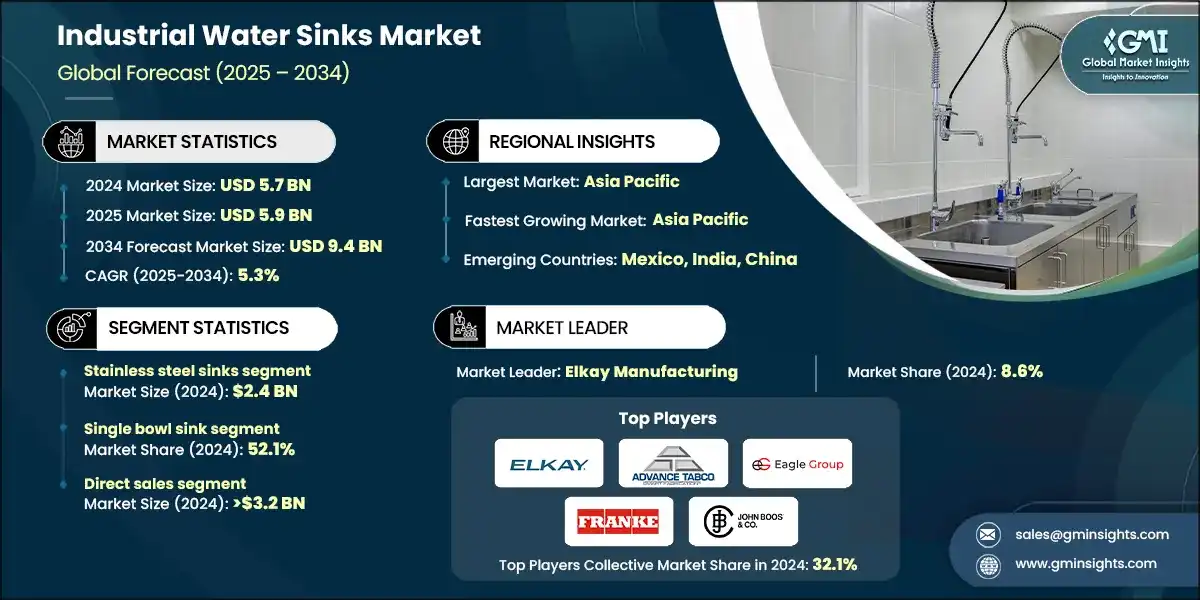
The industrial water sinks market was estimated at USD 5.7 billion in 2024. The market is expected to grow from USD 5.9 billion in 2025 to USD 9.4 billion in 2034, at a CAGR of 5.3% according to latest report published by Global Market Insights Inc.
To get key market trends
The enforcement of stringent hygiene and safety regulations across industries such as food and beverage, pharmaceuticals, healthcare, and cleanroom manufacturing continues to act as a significant growth driver for industrial-grade sinks. Regulatory frameworks, including HACCP (Hazard Analysis and Critical Control Points), GMP (Good Manufacturing Practices), NSF/ANSI standards, and EN norms, are compelling facilities to adopt advanced hygienic design features. These features include seamless welds, coved corners, sloped surfaces, splash containment, and hands-free actuation, which are critical for maintaining compliance and operational efficiency. According to the U.S. Food and Drug Administration (FDA), adherence to GMP standards is mandatory for ensuring product safety and quality, further emphasizing the need for specialized equipment. Additionally, post-pandemic operational strategies have prioritized frequent handwashing, traceability, and worker welfare, leading to sustained investments in durable and efficient wash stations. This trend is reflected in the capital expenditure (capex) and retrofit plans of many facilities, as they aim to align with evolving safety protocols.
Other major trends shaping the market for industrial sinks include sustainability and digitalization. In water-stressed regions, corporate ESG imperatives are driving the adoption of low-flow and touchless fixtures, thermostatic mixing valves, greywater recycling systems, and simplified CIP sanitation interfaces. About 2.3 billion people live in water-stressed countries, states the United Nations. IoT-enabled sinks with counters for temperature and usage logging, along with access controls, are similarly gaining traction. Such features do not only make it easier for facilities to document compliance with hygiene standards but reduce water and energy waste, along with optimizing maintenance schedules. One of the major reasons people are adopting industrial-grade sinks is because of the total-cost-of-ownership advantage. Benefits accrued from having long service life, easy cleanability, modular spare parts, and reduced bacterial harborage make them a much-preferred option over consumer-grade or ad-hoc alternatives. As such, facilities that invested in high-quality industrial equipment reportedly experienced a 15-20% reduction in their maintenance costs over a five-year period, according to a study by the National Association of Manufacturers.
The enforcement of strict sanitation and safety regulations in industries such as food and beverage, pharmaceuticals, healthcare, and cleanroom manufacturing will remain a significant driver of demand for industrial-grade sinks. Regulations such as HACCP (Hazard Analysis and Critical Control Points), GMP (Good Manufacturing Practices), NSF/ANSI, and EN are motivating these companies to go beyond rigid designs, while adding new hygienic design features such as no seams, coved corners, sloped surfaces, containment of splashes, and hands-free activation functionality to aid in compliance and improve efficiency. The Health U.S. Food and Drug Administration has reenacted the importance of compliance with GMP regulations to deliver safe and consistent products, and thus, specialized equipment. Finally, new strategies after the pandemic include a focus on frequent hand washing, traceability, and worker safety. Accordingly, continuous investment in durable and efficient wash stations have continue as companies are accustomed to their new safety protocols, as shown through their capital expenditures (capex) and retrofits.
Industrial Water Sinks Market Report Attributes
| Key Takeaway | Details |
|---|---|
| Market Size & Growth | |
| Base Year | 2024 |
| Market Size in 2024 | USD 5.7 Billion |
| Market Size in 2025 | USD 5.9 Billion |
| Forecast Period 2025 - 2034 CAGR | 5.3% |
| Market Size in 2034 | USD 9.4 Billion |
| Key Market Trends | |
| Drivers | Impact |
| Safety regulations across industries | Tightening hygiene and safety regulations across food and beverage, pharmaceuticals, healthcare, and cleanroom manufacturing are a primary tailwind. Standards such as HACCP, GMP, NSF/ANSI, and EN norms push facilities toward hygienic design features |
| Increasing refurbishments in industries | Industrial expansion and refurbishment cycles are accelerating demand. New capacity in bioprocessing, specialty chemicals, semiconductors, and high-care food plants requires specialized sink configurations such as, deep basins, multi-bay layouts, integrated drainboards, chemical-resistant materials |
| Increasing sustainability and digitalization | Water-stressed regions and corporate ESG mandates favor low-flow and touchless fixtures, thermostatic mixing, greywater or recirculating setups, and easier CIP sanitation interfaces. IoT-enabled counters, temperature and usage logging, and access controls help document compliance, reduce waste, and optimize maintenance. |
| Pitfalls & Challenges | Impact |
| Input cost volatility | Input cost volatility and supply constraints can squeeze margins and extend lead times. Stainless steel price swings, resin availability for polymer basins, and logistics bottlenecks complicate pricing and project delivery. In many bids, procurement still treats sinks as commodities, intensifying price competition and making it harder to monetize design and lifecycle advantages without clear spec ownership. |
| Fragmented codes and labor realities | Fragmented codes and labor realities add friction. Varying local plumbing codes, backflow requirements, and certification demands create engineering overhead and rework. Skilled installer shortages raise field costs and risk schedule slips. In some processes, alternatives like automated washdown, dry sanitation, or closed CIP systems reduce reliance on manual sink stations, narrowing certain use cases. |
| Opportunities: | Impact |
| Product and lifecycle innovation | Product and lifecycle innovation can unlock premium mix and recurring revenue. Water- and energy-stressed sites will pay for documented resource savings (low-flow, recirculation/greywater options, thermostatic control) and verifiable hygiene (antimicrobial finishes, seamless welds, self-draining geometries). IoT-enabled counters and temperature logs support audit trails and enable subscription analytics, predictive maintenance, and SLA-backed service contracts. |
| Increasing value added solutions with respect to industrial usage | Pairing sinks with adjacent EHS components—eyewash/showers, touchless faucets, backflow preventers, filtration, temperature mixing, and data logging—creates “compliance bundles” that win turnkey bids and services revenue |
| Market Leaders (2024) | |
| Market Leaders |
8.6% market share |
| Top Players |
Collective market share in 2024 is 32.1% |
| Competitive Edge |
|
| Regional Insights | |
| Largest market | Asia Pacific |
| Fastest growing market | Asia Pacific |
| Emerging countries | Mexico, India, China |
| Future outlook |
|
What are the growth opportunities in this market?
Industrial Water Sinks Market Trends
The integration of IoT sensors, artificial intelligence, is revolutionizing operations, transforming traditional reactive maintenance approaches into predictive, data-driven strategies.
- Industrial sinks are advancing from commodities to key hygiene control points driven by touchless technology and regulatory demand. Features such as touchless actuation mechanisms (infrared sensors, knee/foot pedals), thermostatic mixing valves to regulate water temperature, self-draining geometry, slope basins, and coved corners to negate bacterial harborage are now standards. These advancements are essential in food processing, pharmaceuticals, healthcare, and cleanroom environments, where auditing compliance to HACCP, GMP, NSF/ANSI, and EN requirements is necessary. The Centers for Disease Control and Prevention (CDC) has estimated as high as 50% in the reduction of foodborne illness with proper hand hygiene, and emphasizes the necessity for hygienic design of sinks. This transition changes sinks from a commodity into a specified piece of equipment with performance verification for compliance, safety, and efficiency.
- With the increase in water tariffs, ESG goals, and the general apprehension about water scarcity, industries are incorporating water-efficient technologies. Low-flow aerators, metered or timed dispensing systems, and smart valves maintain hygiene without wasting this vital resource. According to the EPA, for example, WaterSense-labeled products, including low-flow fixtures, save up to 20% more water than their standard counterparts.
- The integration of IoT-enabled technologies is transforming the compliance and operational efficiency of industrial sinks. Its characteristics include monitoring hand washing frequency, water temperature compliance, and sanitizer cycles using IoT-enabled counters and temperature sensors, coupled with usage logs. Badge-based access control systems, in addition to integration with MES, QMS, and EHS dashboards, further enhance audit trails and reduce downtime. Predictive maintenance of valves and sensors furthers limiting disruptions and supports analytics-driven decisions.
- The procurement process for industrial sinks is becoming increasingly specification-driven and reliant on digital platforms. Leading vendors are differentiating themselves by offering BIM/Revit objects, NSF/WRAS certifications, EPD/LCA documentation, and online configurators that provide instant quotes for pricing and lead times. E-commerce and MRO (Maintenance, Repair, and Operations) marketplaces are gaining traction, particularly among SMEs and during replacement cycles.
Industrial Water Sinks Market Analysis
Learn more about the key segments shaping this market
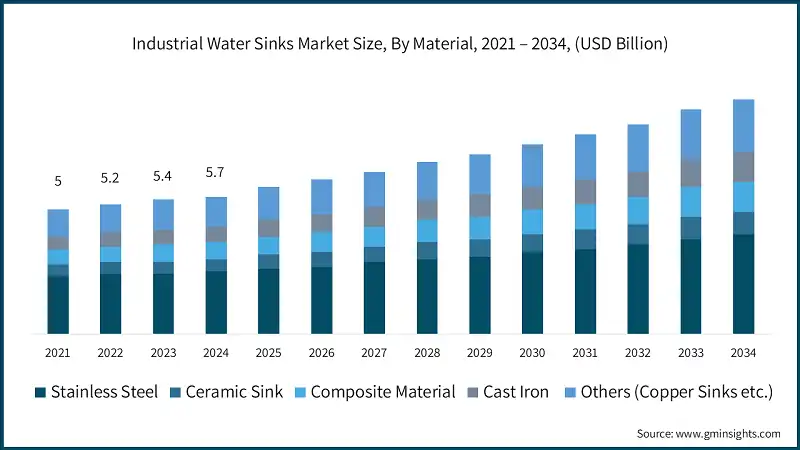
Based on material, the market is divided into stainless steel, ceramic, composite material, cast iron, others (copper sinks, etc.). The stainless steel sinks segment generating a revenue of USD 2.4 billion in 2024.
- Stainless steel continues to dominate as the preferred material for industrial sinks, consistently meeting the rigorous requirements of hygiene, durability, and regulatory compliance across various industries. Its smooth, non-porous, and weldable surfaces enable the creation of truly hygienic designs, incorporating features such as coved corners, seamless joints, and self-draining slopes.
- Stainless steel's thermal and mechanical robustness further enhances its appeal. It can endure high temperatures, resist impact, and withstand frequent sanitation processes, ensuring a long service life. This durability translates into a favorable total cost of ownership when compared to alternatives like coated steels or polymers, which are prone to degradation, cracking, or crazing over time. According to the International Stainless Steel Forum (ISSF), stainless steel has a recycling rate of approximately 85%, making it not only a durable choice but also an environmentally sustainable one.
Supply chain efficiency and environmental, social, and governance (ESG) considerations further reinforce stainless steel's dominance. Additionally, stainless steel's high recyclability and support for significant post-consumer content align with the ESG goals of many buyers. For instance, the ISSF reports that stainless steel products can contain up to 60% recycled material, contributing to reduced environmental impact without compromising performance or quality.
Learn more about the key segments shaping this market
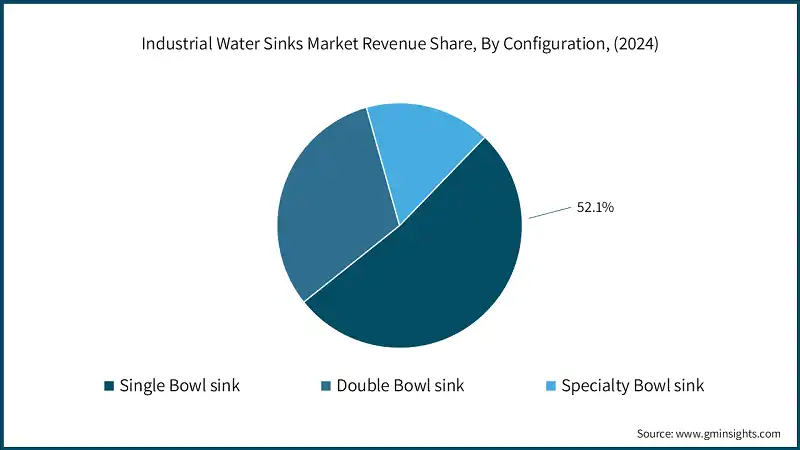
Based on configuration, the industrial water sinks market is segmented into single bowl sink, double bowl sink, specialty bowl sink. The single bowl sink segment held around 52.1% share of the global industrial water sink market in 2024.
- Single-bowl sinks have emerged as the dominant choice for point-of-use and hand-hygiene stations due to their ability to minimize cross-contamination risks and simplify cleaning processes. Their design, characterized by fewer seams and partitions, significantly reduces the potential for microbial harborage, accelerates sanitation cycles, and optimizes space utilization. These sinks are particularly well-suited for compact areas such as line entries, gowning zones, and production cells, where space efficiency is critical. According to the Centers for Disease Control and Prevention (CDC), proper hand hygiene can reduce the spread of infections by up to 50%, making the role of single-bowl sinks in maintaining hygiene standards even more critical.
- Their ease of installation and standardization across multi-site networks further enhances their appeal. Single-bowl sinks are compatible with advanced features such as touchless faucets, knee or foot actuators, splash guards, and drainboards, ensuring compliance with hygiene regulations without overcomplicating facility layouts. For instance, touchless faucets, as reported by manufacturers like Sloan Valve Company, can reduce water usage by up to 30%, contributing to sustainability goals while maintaining operational efficiency.
- In industrial settings, process segregation often necessitates the use of multiple simple single-bowl stations instead of a single multi-bowl fixture. This approach improves workflow efficiency and auditability, particularly in environments where hygiene and process control are paramount. For example, the Food and Drug Administration (FDA) mandates the use of multi-compartment sinks in foodservice settings.
Based on the distribution channel, the industrial water sinks market is segmented into direct sales and indirect sales. The direct sales segment exceeded USD 3.2 billion in 2024.
- Direct distribution remains the dominant channel in this market due to the critical importance of specification control and compliance. Enterprise buyers in industries such as food processing, pharmaceuticals, cleanrooms, and high-care manufacturing prioritize working with a single, accountable partner. These buyers require comprehensive solutions that include engineered-to-order designs, industry-standard certifications (such as NSF/WRAS and GMP/HACCP documentation), BIM submittals, and on-site commissioning. According to the U.S. Food and Drug Administration (FDA), compliance with Good Manufacturing Practices (GMP) is mandatory for pharmaceutical and food manufacturers, further emphasizing the need for precise specification control.
- By adopting a direct distribution model, manufacturers can maintain control over specifications, ensuring seamless integration of critical peripherals such as touchless valves, thermostatic mixing valves (TMVs), backflow prevention systems, eyewash stations, and advanced filtration systems. This approach allows manufacturers to validate hygienic designs, mitigate project risks in collaboration with Engineering, Procurement, and Construction (EPC) firms and General Contractors (GCs), and ensure adherence to strict timelines. A report by the National Association of Manufacturers (NAM) highlights that 94% of manufacturers consider lead-time certainty a key factor in maintaining operational efficiency, underscoring the value of direct distribution in this context.
Looking for region specific data?
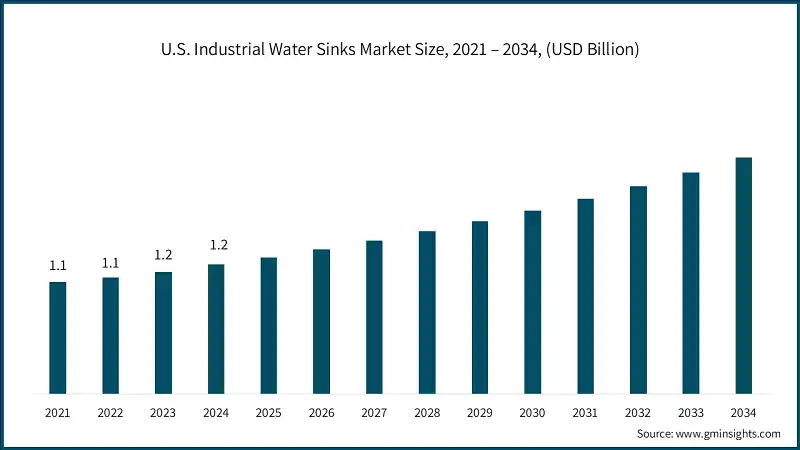
The U.S. industrial water sinks market dominated around 78.3% share and generating USD 1.2 billion revenue in 2024.
- The U.S. market for handwash stations is heavily influenced by specification- and compliance-driven purchasing, favoring stainless steel models, particularly 304 and 316L grades. Single-bowl, touchless handwash stations dominate the market, with sales primarily conducted through direct channels supported by certified installers. Compliance with stringent regulatory standards, including NSF/ANSI, IPC/UPC, and ADA, as well as USDA/FSIS requirements in food processing plants and GMP standards in pharmaceutical facilities, is mandatory.
- These regulations emphasize hygienic design, documented materials, and detailed submittals, steering buyers toward engineered solutions over commodity fixtures. According to the U.S. Census Bureau, the construction sector, which includes retrofitting and new installations, grew by 7.7% in 2023, further fueling demand for these solutions.
Europe industrial water sinks market; Germany leads the with 21% share in 2024 and is expected to grow at 4.6% during the forecast period.
- The European market is defined by its rigorous focus on hygienic design and sustainability, with 316L stainless steel being the preferred material for high-care applications in food and pharmaceutical sectors.
- Compliance with EHEDG/EU GMP and EN norms, along with national drinking-water certifications such as WRAS in the UK, DVGW in Germany, and ACS in France, underscores the region's commitment to quality and safety. According to the European Hygienic Engineering & Design Group (EHEDG), the adoption of hygienic equipment in food processing facilities has increased by 12% annually over the past five years, reflecting the growing emphasis on cleanability and contamination prevention.
The Asia Pacific with China leads with market share of around 27% in 2024 and is anticipated to grow with a CAGR of around 5.8% from 2025 to 2034.
- The Asia-Pacific (APAC) region leads in terms of volume and greenfield growth, driven by rapid industrialization and urbanization in countries like China, India, and Southeast Asia. Local stainless-steel fabricators and regional brands dominate the mid-tier and entry-level segments, primarily using 304-grade stainless steel.
- However, multinational corporations and top-tier domestic players in pharmaceuticals and semiconductors are increasingly specifying 316L-grade stainless steel and adopting hygienic designs aligned with EU and U.S. standards.
Middle East and Africa market are growing at a CAGR of 5.5% during the forecast period.
- The Middle East and Africa (MEA) market, though smaller in aggregate, is primarily driven by demand from Gulf Cooperation Council (GCC) countries, including Saudi Arabia, the UAE, and Qatar.
- These regions favor premium stainless steel, often 316L, due to its superior resistance to chloride-rich and humid environments.
Industrial Water Sinks Market Share
Elkay Manufacturing is leading with 8.6% market share. Elkay Manufacturing, Advance Tabco, Eagle Group, Franke Foods, John Boos & Co. collectively hold around 32.1%, indicating moderately fragmented market concentration. These prominent players are proactively involved in strategic endeavors, such as mergers & acquisitions, facility expansions & collaborations, to expand their product portfolios, extend their reach to a broad customer base, and strengthen their market position.
Elkay stands out as one of the most established names in the industrial water sink market, with over a century of experience and a reputation for quality and reliability. Its integration with Zurn Elkay Water Solutions gives it a unique advantage in combining traditional stainless steel craftsmanship with advanced water management technologies. Elkay’s sinks are widely recognized for durability, hygiene, and compliance with industry standards, making them a preferred choice for healthcare, hospitality, and large-scale industrial environments.
Advance Tabco has carved a niche as a customization powerhouse in the industrial sink segment. With an extensive catalog of over 6,000 stock products and strong fabrication capabilities, the company offers unmatched flexibility in sink configurations, including compartment sizes, gauges, and drainboard options. Its recognition as “Best in Class” for product quality and service in foodservice equipment underscores its commitment to excellence.
Industrial Water Sinks Market Companies
Major players operating in the industrial water sinks industry are:
- Advance Tabco
- Alfresco Grills
- BK Resources
- Blanco Professional
- Eagle Group
- Elkay Manufacturing
- Franke Foods
- John Boos & Co.
- Just Manufacturing
- Kohler Commercial
- Krowne Metal
- Regency Tables
- Tarrison Products
- Teka Foodservice
- Win-Holt Equipment
Eagle group differentiates itself through its expertise in sanitation-focused solutions and custom fabrication. Known for Uis-made sinks with deep-drawn bowls and robust stainless steel construction, Eagle caters to heavy-duty industrial environments where hygiene and durability are critical. Its SpecFAB division specializes in custom designs, allowing clients to create sinks that meet specific operational needs.
Franke brings a global perspective to the industrial sink market, operating in over 60 countries and leveraging its strength in foodservice and water technology. The company emphasizes innovation and sustainability, offering energy-efficient and water-saving designs that appeal to environmentally conscious businesses. Franke’s premium stainless steel sinks are widely used in hospitality, healthcare, and industrial sectors, supported by strong consulting and after-sales services for large-scale projects.
John Boos & Co. is synonymous with craftsmanship and durability, boasting over 130 years of experience in producing stainless steel commercial kitchen equipment and butcher block products. The company specializes in heavy-duty, custom stainless steel sinks and tables designed for demanding foodservice and industrial environments.
Industrial Water Sinks Industry News
- In February 2025, at KBIS 2025, Blanco unveiled INTEOS, a premium workstation sink with modular accessories for prep, bake, and serve workflows. Available in stainless steel and SILGRANIT
- In January 2025, Advance Tabco introduced new multi-compartment sinks and modular underbar systems for foodservice and industrial kitchens. Their FS series fabricated sinks gained attention for durability and NSF compliance.
- In September 2024, BK resources expanded offerings in compartment sinks, hand sinks, and utility sinks, emphasizing NSF compliance and ergonomic design.
The industrial water sinks market research report includes in-depth coverage of the industry with estimates & forecasts in terms of revenue (USD Billion) and volume (Thousand Units) from 2021 to 2034, for the following segments:
Market, By Material
- Stainless steel
- Ceramic sink
- Composite material
- Cast iron
- Others (copper sinks etc.)
Market, By Configuration
- Single bowl sink
- Double bowl sink
- Specialty bowl sinks
Market, By Installation Type
- Drop-in
- Under mount
- Farmhouse/Apron front sinks
- Others (bar sinks etc.)
Market, By Distribution Channel
- Direct sales
- Direct to End-Use
- Direct to Contractors/Builders
- Indirect sales
- Wholesalers
- Dealers
- Resellers
- Retailers
The above information is provided for the following regions and countries:
- North America
- U.S.
- Canada
- Europe
- Germany
- UK
- France
- Italy
- Spain
- Asia Pacific
- China
- India
- Japan
- Australia
- South Korea
- Latin America
- Brazil
- Mexico
- Argentina
- Middle East and Africa
- South Africa
- Saudi Arabia
- UAE
Frequently Asked Question(FAQ) :
What are the upcoming trends in the industrial water sinks market?
Key trends include adoption of IoT-enabled monitoring systems, touchless actuation technology, water-efficient fixtures, antimicrobial finishes, and integration with digital compliance platforms for audit trails and predictive maintenance.
Who are the key players in the industrial water sinks market?
Key players include Elkay Manufacturing, Advance Tabco, Eagle Group, Franke Foods, John Boos & Co., Blanco Professional, Kohler Commercial, Just Manufacturing, Krowne Metal, BK Resources, Regency Tables, Tarrison Products, Teka Foodservice, Win-Holt Equipment, and Alfresco Grills.
Which region leads the industrial water sinks market?
The U.S. industrial water sinks market held about 78.3% share with USD 1.2 billion revenue in 2024, fueled by strong specification- and compliance-based demand for stainless steel handwash stations, especially 304 and 316L grades.
What was the market share of single bowl sink segment in 2024?
Single bowl sinks held 52.1% market share in 2024, favored for minimizing cross-contamination risks and simplifying cleaning processes in point-of-use applications.
What is the growth outlook for the Asia Pacific industrial water sinks market from 2025 to 2034?
Asia Pacific industrial water sinks market is projected to grow at a 5.8% CAGR till 2034, supported by rapid industrialization, greenfield projects, and expanding pharmaceutical and semiconductor sectors in China, India, and Southeast Asia.
What is the market size of the industrial water sinks in 2024?
The market size was USD 5.7 billion in 2024, with a CAGR of 5.3% expected through 2034 driven by stringent hygiene and safety regulations across food & beverage, pharmaceutical, healthcare, and cleanroom manufacturing industries.
What is the projected value of the industrial water sinks market by 2034?
The industrial water sinks market is expected to reach USD 9.4 billion by 2034, propelled by regulatory compliance, sustainability initiatives, and increasing adoption of IoT-enabled technologies for hygiene monitoring.
What is the current industrial water sinks market size in 2025?
The market size is projected to reach USD 5.9 billion in 2025.
How much revenue did the stainless steel segment generate in 2024?
Stainless steel sinks generated USD 2.4 billion in 2024, dominating the market due to their durability, hygienic design, and regulatory compliance capabilities.
Industrial Water Sinks Market Scope
Related Reports