Summary
Table of Content

Industrial Valve Market
Get a free sample of this report
Form submitted successfully!
Error submitting form. Please try again.
Thank you!
Your inquiry has been received. Our team will reach out to you with the required details via email. To ensure that you don't miss their response, kindly remember to check your spam folder as well!
Request Sectional Data
Thank you!
Your inquiry has been received. Our team will reach out to you with the required details via email. To ensure that you don't miss their response, kindly remember to check your spam folder as well!
Form submitted successfully!
Error submitting form. Please try again.
Industrial Valve Market Size
- The increase in energy and infrastructure investment is a key factor driving the growth of the market. Governments and private businesses are increasing their capital expenditures on power generation and utility projects in the global economic climate. In addition, the need for reliable valves for flow control and pressure regulation in oil and gas exploration activities is increasing. As renewable energy has become more popular, valves used in renewable energy generation require proper operation of fluid transport through complex systems of piping. Infrastructure projects such as water treatment plants also require the use of valves.
- Industrial valves are critical to ensuring that pipelines operate safely and efficiently. Growing urbanization means that infrastructure for water distribution and wastewater management will need to be developed and maintained. Power generation facilities rely on high-performance valves to meet the safety and operational requirements of their processes. Increasing the capacity to refinish and produce petrochemical products will create additional demand for procuring valves for all facilities. Large construction projects require valve systems to be integrated into the engineering process during the early phases of the projects.
- The growth of the industrial valve market is fueled by the implementation of Industry 4.0 and automation in industry. Manufacturing facilities using automated control systems can improve their operational processes and precision. Automating processes require valves that can also support remote monitoring and control capabilities. Smart factories are fully dependent upon valves that are digitally connected so they can accurately regulate the flow of fluids and maintain the stability of each system. Industry 4.0 frameworks are focused on allowing for the real-time exchange of data between equipment and control platforms.
- Valve systems that are intelligent enable predictive maintenance, thereby reducing unplanned disruptions to operations. Increasing automation will create an increase in the demand for actuated valves that are compatible with centralized control architectures. When operating in industrial systems, operators will choose valves that have been designed to integrate seamlessly with digital sensors and controllers. When connected to an automated production environment, high-performance valves will help to achieve consistent processing performance by maintaining consistent process parameters. Because of the upgrading of industrial systems, conventional valve designs are being replaced with more advanced valve systems. As a result of the ongoing technology-driven modernization movement, the use of innovative valve systems will continue to increase across all industries.
- Due to the critical function of controlling the flow of fluids, check valves are an important segment of the industrial valve market. They allow for unidirectional movement of fluids, but prevent them from moving back through the valve, which would potentially cause damage to pipelines and equipment. Industries such as oil & gas, water treatment, and power generation rely heavily on check valves to protect their systems and ensure safe and reliable operations. Their durable design and minimal maintenance requirements enhance their long-term reliability, they can also be used with different types of media and under various pressure conditions, making them applicable to a wide range of industrial processes. The increasing demand for check valves due to the ongoing development of infrastructure and energy projects will continue to provide stable global demand for check valves.
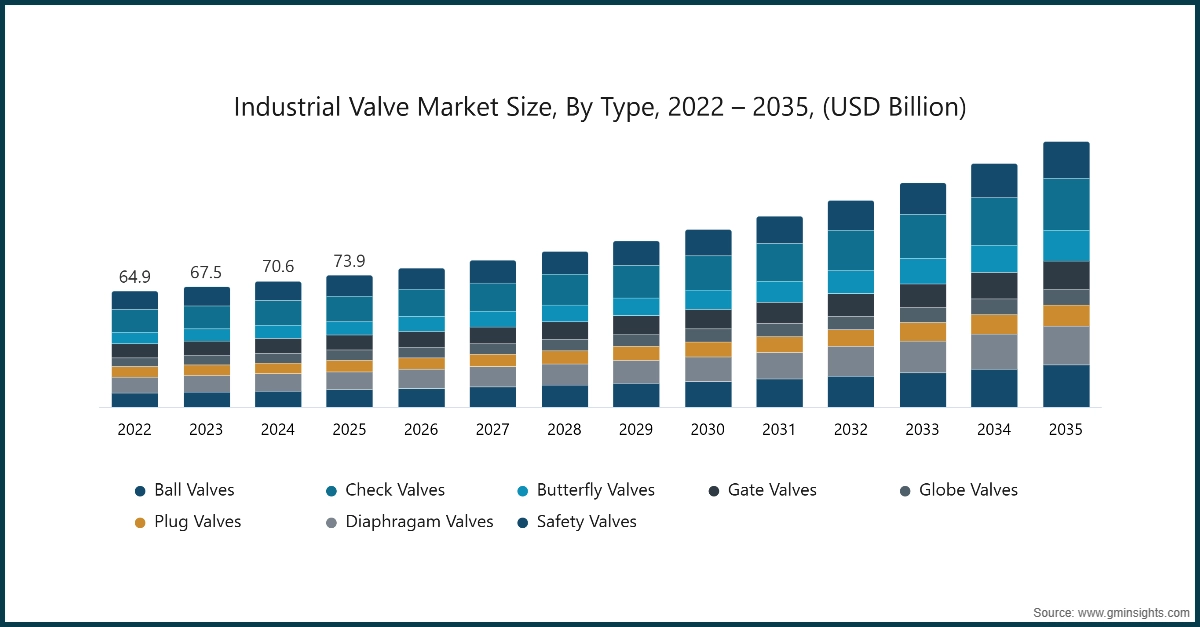
The industrial valve market was estimated at USD 73.9 billion in 2025. The market is expected to grow from USD 77.8 billion in 2026 to USD 149.1 billion in 2035, at a CAGR of 6.7%, according to latest report published by Global Market Insights Inc.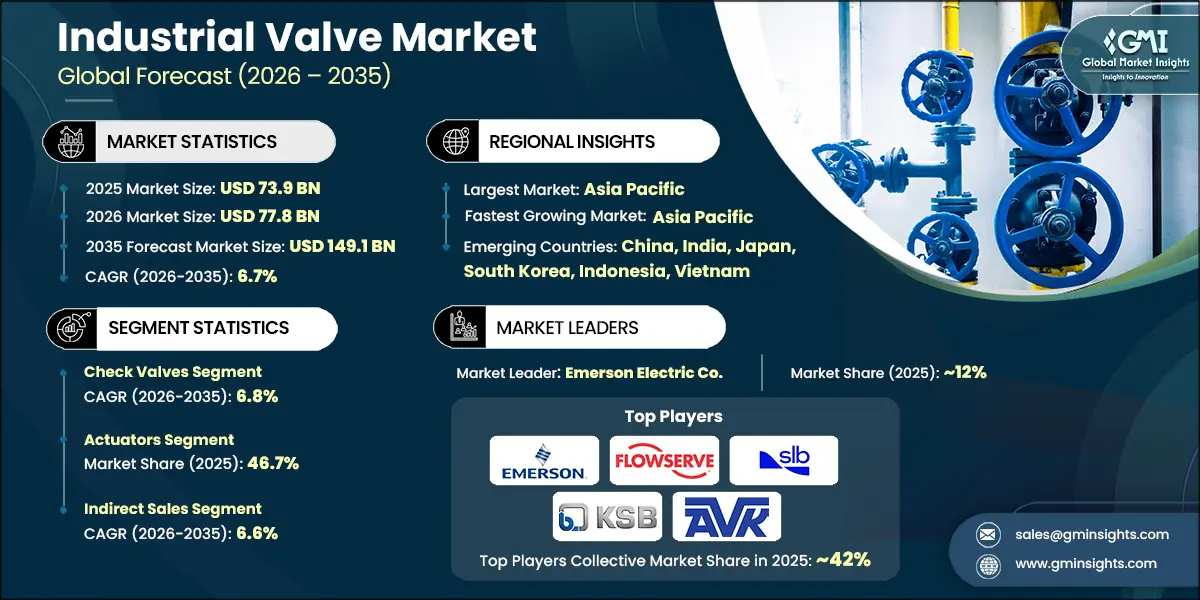
Industrial Valve Market Key Takeaways
Market Size & Growth
- 2025 Market Size: USD 73.9 Billion
- 2026 Market Size: USD 77.8 Billion
- 2035 Forecast Market Size: USD 149.1 Billion
- CAGR (2026–2035): 6.7%
Regional Dominance
- Largest Market: Asia Pacific
- Fastest Growing Region: Asia Pacific
Key Market Drivers
- Increasing consumer focus on skincare and personal grooming.
- Industrial automation and Industry 4.0 implementation.
- Growth in water treatment and utilities modernization.
Challenges
- Raw material price volatility and supply chain instability.
- Stringent regulatory compliance and certification demands.
Opportunity
- Expansion into renewable and clean energy infrastructure.
- Development of corrosion-resistant and performance-enhancing materials.
Key Players
- Market Leader: Emerson Electric Co. led with over 12% market share in 2025.
- Leading Players: Top 5 players in this market include Emerson Electric Co., Flowserve Corporation, SLB, KSB SE & Co. KGaA, AVK Holdings, which collectively held a market share of 42% in 2025.
Get Market Insights & Growth Opportunities
To get key market trends
Industrial Valve Market Trends
- Industrial operations require valves that reduce energy loss and provide tight sealing so that fluid does not leak when processing. Manufacturers are designing valves with tighter sealing mechanisms and more efficient flow paths so that unnecessary energy loss can be minimized and overall system efficiency improved. These enhancements aid in reducing the operating costs of industrial plants and allow manufacturers to meet new higher performance criteria. The increased interest in gaining efficiencies through enhanced valve technology has led to greater adoption across many industries.
- Modern industrial systems are continuing to increase the integration of smart controls into the valves. Smart valves include sensors and automation control that provide real-time data about position, pressure and flow so that they can be monitored and controlled remotely. Operators of plants use this information to make faster decisions and keep their processes stable. This increased connectivity has improved the reliability of operation and facilitated more accurate predictive maintenance planning.
- The oil and gas industry is still creating large volumes of industrial valve demand since they provide critical control of fluids. Valves used in oil and gas often operate under extreme pressure and temperature, therefore, require specialized materials and coatings that extend the life of the valve and keep it safe in these conditions. Industrial demand has sustained market growth despite the existence of commodities prices volatility.
- Valves that are manufactured from corrosion resistant alloys, as well as from highly resistant polymer materials, are required by chemical processing, power generation and water treatment industries. The continual exposure of these valves to harsh chemicals and abrasive materials, requires valves to be made from long-lasting materials that can withstand this exposure for an extended period. Therefore, many manufacturers are now producing valves that utilize engineered materials which prevent degradation of the valve to reduce the frequency of replacement.
- Valve manufacturers are beginning to provide their customers with a full range of aftermarket services, such as the repair, rebuilding and performance testing of valves. This is allowing industrial valve users access to greater asset life cycles as well as reducing unscheduled down time. In most cases technical support personnel will perform on-site assessments of valve performance and provide suggestions on how best to maintain and care for each valve based on its specific working conditions. By expanding the service capabilities of their customers’ valves companies can create customer loyalty and generate recurring revenue streams.
Industrial Valve Market Analysis
Learn more about the key segments shaping this market
Based on type, the market is categorized into ball valves, check valves, butterfly valves, gate valves, globe valves, plug valves, diaphragam valves, and safety valves. The check valves segment accounted for revenue of around USD 14.4 billion in 2025 and is anticipated to grow at a CAGR of 6.8% from 2026 to 2035.
- Check valves dominate the industrial valve market due to critical backflow prevention requirements. These valves ensure unidirectional flow, protecting pumps and pipelines from damage. Industries such as oil and gas, water treatment, and power generation depend heavily on reliable check valves. Simple design structure reduces maintenance needs and enhances operational efficiency.
- Compatibility with high pressure and corrosive environments increases industrial applicability. Rising infrastructure development and pipeline expansion projects strengthen demand globally. Consistent performance reliability reinforces the leading position of check valves across diverse industrial operations.
Based on component, of industrial valve market consists of actuators, valve body, and others. The actuators emerged as leader and held 46.7% of the total market share in 2025 and is anticipated to grow at a CAGR of 7.2% from 2026 to 2035.
- Actuators lead the market by component due to rising automation across industries. Automated valve control improves operational accuracy and process efficiency in complex systems. Industries such as oil and gas, power generation, and chemicals rely on actuators for remote operation. Electric and pneumatic actuators enhance responsiveness and reduce manual intervention requirements.
- Integration with control systems supports real-time monitoring and performance optimization. Growing focus on safety and productivity strengthens actuator adoption. Continuous modernization of industrial facilities reinforces their leading market share globally.
Learn more about the key segments shaping this market
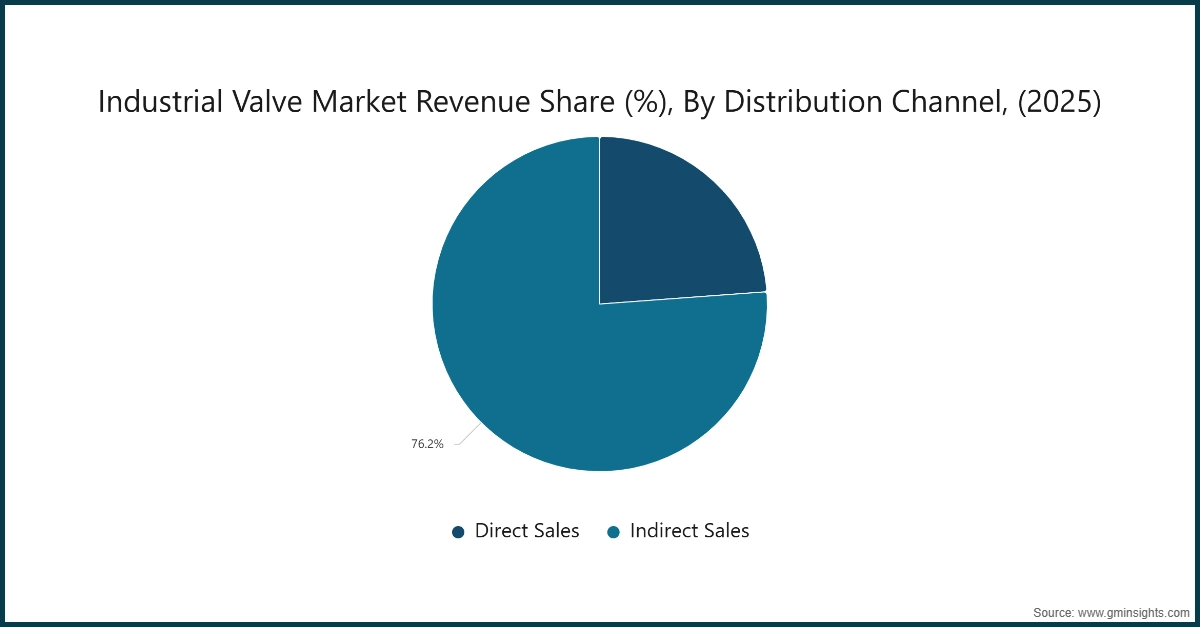
Based on distribution channel, industrial valve market consists of direct sales and indirect sales. The indirect sales emerged as leader and held 76.2% of the total market share in 2025 and is anticipated to grow at a CAGR of 6.6% from 2026 to 2035.
- Indirect sales emerged as the leading distribution channel in the market due to extensive regional reach. Distributors maintain strong relationships with end users across diverse industrial sectors. Local inventory availability reduces delivery timelines for maintenance and replacement requirements. Technical support offered by channel partners improves product selection accuracy.
- Bulk procurement through distributors simplifies supply chain management for manufacturers. After-sales services enhance customer confidence and long-term partnerships. Established dealer networks ensure consistent product accessibility across global industrial markets.
Asia Pacific Industrial Valve Market
Looking for region specific data?
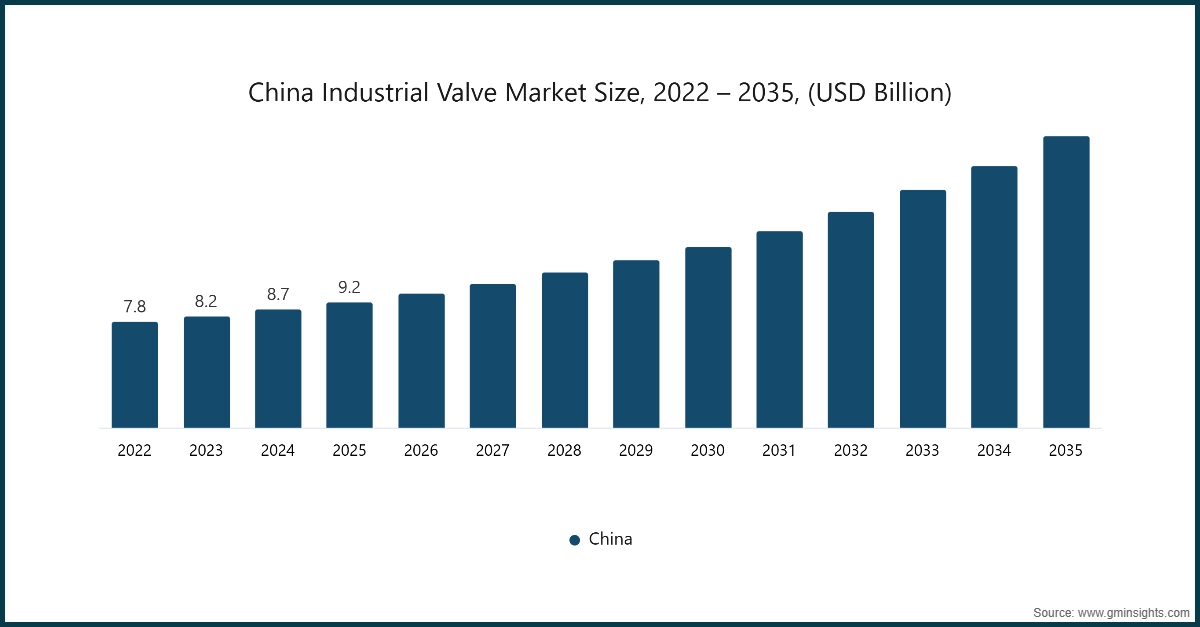
China dominates an overall Asia Pacific industrial valve market and valued at USD 9.20 billion in 2025 and is estimated to grow at a CAGR of 8.2% from 2026 to 2035.
- The China industrial valve market benefits from extensive manufacturing and energy infrastructure. Strong investment in thermal and renewable power projects drives valve installations. Expansion of petrochemical facilities increases demand for high-pressure industrial valves. Urban water treatment and distribution projects support consistent procurement volumes.
- Domestic manufacturers enhance production capacity to meet large-scale project requirements. Export-oriented equipment production sustains steady replacement demand. Industrial safety standards influence adoption of certified valve systems. Technological upgrades encourage integration of smart and automated valve solutions.
North America Industrial Valve Market
In the North America industrial valve industry, the U.S. held 78.8% market share in 2025 and is anticipated to grow at a CAGR of 5.8% from 2026 to 2035.
- The North America market is supported by strong shale oil and gas activity. Pipeline expansion projects increase demand for high-pressure and isolation valves. Aging water infrastructure drives replacement of outdated municipal valve systems. Strict environmental regulations encourage adoption of low-emission valve technologies.
- Chemical processing industries require precision control valves for safe operations. Advanced manufacturing facilities support demand for automated valve solutions. Presence of global valve manufacturers strengthens regional supply capabilities. Investment in industrial safety upgrades sustains consistent procurement cycles.
Europe Industrial Valve Market
In the Europe industrial valve industry, Germany is expected to experience significant and promising growth from 2026 to 2035.
- The Europe industrial valve industry benefits from energy transition initiatives across member states. Renewable power installations increase need for specialized flow control valves. Strong chemical and pharmaceutical industries drive demand for corrosion-resistant valve systems. District heating networks support consistent installation of control valves.
- Emphasis on carbon reduction influences selection of energy-efficient valve designs. High engineering standards encourage adoption of technologically advanced solutions. Replacement of aging industrial equipment supports steady aftermarket demand. Established OEM networks maintain stable supply across the region.
Middle East and Africa Industrial Valve Market
In the Middle East and Africa industrial valve industry, UAE held a significant market share in 2025 promising growth from 2026 to 2035.
- The Middle East and Africa market is driven by oil and gas infrastructure expansion. Large-scale upstream and downstream projects require durable pipeline valve systems. Desalination plants increase demand for corrosion-resistant water control valves. Mining activities across Africa support usage of heavy-duty industrial valves.
- Government-backed refinery upgrades sustain consistent equipment procurement. Harsh climatic conditions require valves designed for high temperature tolerance. Limited regional manufacturing increases reliance on imported valve technologies. Long project lifecycles support steady maintenance and replacement demand.
Industrial Valve Market Share
- In 2025, the prominent manufacturers in industrial valve industry are Emerson Electric Co., Alfa Laval, SLB, KSB SE & Co. KGaA, and AVK Holdings collectively held the market share of ~42%.
- Emerson Electric Co. is a leading player in the global industrial valve industry, particularly in control and automated valve solutions. The company serves oil & gas, power, chemical, and water industries with engineered valve systems integrated into digital automation platforms. Emerson emphasizes reliability, predictive maintenance, and smart valve technologies through IIoT integration. Its strong global service network and engineering expertise support its leadership in high-value industrial applications.
- Alfa Laval is a prominent supplier of industrial valves, particularly in hygienic, sanitary, and process-critical applications. The company serves industries such as food & beverage, pharmaceuticals, biotechnology, marine, and energy. Alfa Laval focuses on high-performance control, safety, and butterfly valves integrated into fluid handling systems. Its strength lies in engineering precision, stainless steel processing expertise, and compliance with strict hygiene and safety standards, supporting premium market positioning.
Industrial Valve Market Companies
Major players operating in the industrial valve industry include:
- ALFA LAVAL
- AVK Holding A/S
- Baker Hughes Company
- Crane Company
- Danfoss
- Emerson Electric Co.
- Georg Fischer Ltd.
- Hitachi, Ltd.
- ITT INC.
- KITZ Corporation
- KSB SE & Co. KGaA
- Mueller Co. LLC.
- SLB
- TechnipFMC plc
- The Weir Group PLC
SLB participates in the industrial valve market primarily through energy-sector applications, particularly upstream oil & gas systems. The company supplies high-performance valves and pressure control equipment for demanding environments. SLB leverages its expertise in energy infrastructure and digital monitoring technologies to enhance operational efficiency. Its strong footprint in global oil-producing regions supports stable demand within specialized valve segments.
KSB SE & Co. KGaA is a European manufacturer of pumps and industrial valves serving water, wastewater, power, and industrial sectors. The company focuses on durability, energy efficiency, and compliance with environmental standards. KSB benefits from a strong presence in municipal infrastructure projects and industrial facilities across Europe and Asia. Its engineering-driven approach and global manufacturing footprint strengthen its competitive position.
AVK Holding specializes in valves for water supply, wastewater treatment, gas distribution, and fire protection systems. The company emphasizes corrosion-resistant materials and long product life cycles suited for municipal infrastructure. AVK operates through a broad international distribution network and multiple production facilities. Its focus on standardization, reliability, and compliance with regional water regulations supports steady growth in infrastructure-driven markets.
Industrial Valve Market Report Attributes
| Key Takeaway | Details |
|---|---|
| Market Size & Growth | |
| Base Year | 2025 |
| Market Size in 2025 | USD 73.9 Billion |
| Market Size in 2026 | USD 77.8 Billion |
| Forecast Period 2026-2035 CAGR | 6.7% |
| Market Size in 2035 | USD 149.1 Billion |
| Key Market Trends | |
| Drivers | Impact |
| Increasing consumer focus on skincare and personal grooming | Ongoing capital projects in oil & gas pipelines, power generation, and water & wastewater systems increase the need for reliable industrial valves to control fluid flow and maintain system safety. |
| Industrial automation and Industry 4.0 implementation | Automation across manufacturing, chemical processing, and utilities elevates demand for advanced valve systems compatible with automated control platforms. |
| Growth in water treatment and utilities modernization | Urbanization and stringent environmental standards in water and wastewater sectors fuel investments in high-performance valves for flow regulation and leakage prevention. |
| Pitfalls & Challenges | Impact |
| Raw material price volatility and supply chain instability | Fluctuations in metals such as steel and specialty alloys raise production costs, complicating pricing strategies and profitability for manufacturers. |
| Stringent regulatory compliance and certification demands | Diverse international standards (API, ASME, ISO) increase production complexity, testing requirements, and time-to-market, especially for global suppliers |
| Opportunities: | Impact |
| Expansion into renewable and clean energy infrastructure | Growing investments in hydrogen, carbon capture, and other low-carbon energy projects create demand for specialized valve solutions compatible with new service conditions. |
| Development of corrosion-resistant and performance-enhancing materials | Innovation in advanced alloys and coatings opens opportunities for valves in harsh environments like chemical processing and subsea applications. |
| Market Leaders (2025) | |
| Market Leader |
Market share of ~12% |
| Top Players |
Collective market share of ~42% |
| Competitive Edge |
|
| Regional Insights | |
| Largest Market | Asia Pacific |
| Fastest growing market | Asia Pacific |
| Emerging countries | China, India, Japan, South Korea, Indonesia, Vietnam |
| Future outlook |
|
What are the growth opportunities in this market?
Industrial Valve Machine Industry News
- In November 2025, Emerson expanded its Fisher FIELDVUE digital valve controllers with advanced cybersecurity protections and enhanced remote diagnostics. The updated controllers integrate with industrial IoT systems to deliver secure data and performance analytics for critical valve systems.
- In October 2025, Baker Hughes launched a new fully electric ball valve actuator E-Act series for oil & gas and industrial automation applications. These actuators improve energy efficiency and reduce carbon emissions in industrial valve control systems worldwide.
- In September 2025, Crane Co. announced the release of its CSI 1000 Series severe service control valves, designed for high-pressure and high-temperature industrial environments such as power generation facilities.
- In August 2025, Danfoss released its EvoTec industrial valve automation platform featuring smart connectivity and predictive analytics for manufacturing and fluid control systems. This platform enhances uptime and operational visibility in process industries.
The industrial valve market research report includes in-depth coverage of the industry, with estimates & forecast in terms of revenue (USD Billion) and volume (Thousand Units) from 2022 to 2035, for the following segments:
Market, By Type
Ball Valves
- Check Valves
- Butterfly Valves
- Gate Valves
- Globe Valves
- Plug Valves
- Diaphragam Valves
- Safety Valves
Market, By Material
Steel
- Plastic
- Cast Iron
- Alloy Based
- Others
Market, By Component
Actuators
- Valve Body
- Others
Market, By Size
- <1"
- 1" to 6"
- 7" to 25"
- 26" to 50"
- >50"
Market, By End Use
Chemical
- Energy & Utilities
- Construction
- Metal & Mining
- Agriculture
- Pharmaceutical
- Food & Beverage
- Pulp & Paper
- Others
Market, By Distribution Channel
Direct Sales
- Indirect Sales
The above information is provided for the following regions and countries:
- North America
- U.S.
- Canada
- Europe
- Germany
- UK
- France
- Italy
- Spain
- Asia Pacific
- China
- Japan
- India
- South Korea
- Australia
- Latin America
- Brazil
- Mexico
- Argentina
- MEA
- Saudi Arabia
- UAE
- South Africa
Frequently Asked Question(FAQ) :
What was the market size of the industrial valve in 2025?
The market size was USD 73.9 billion in 2025, with a CAGR of 6.7% expected through 2035. Growth is driven by increased energy and infrastructure investments, along with rising demand in oil and gas exploration and renewable energy sectors.
What is the projected value of the industrial valve market by 2035?
The market is poised to reach USD 149.1 billion by 2035, fueled by advancements in valve technology, urbanization, and expanding petrochemical production capacities.
What is the expected size of the industrial valve industry in 2026?
The market size is projected to reach USD 77.8 billion in 2026.
How much revenue did the check valves segment generate in 2025?
The check valves segment generated approximately USD 14.4 billion in 2025 and is anticipated to grow at a CAGR of 6.8% till 2035.
What was the market share of the actuators segment in 2025?
The actuators segment held 46.7% of the total market share in 2025 and is expected to witness over 7.2% CAGR up to 2035.
What was the valuation of the indirect sales segment in 2025?
The indirect sales segment accounted for 76.2% of the total market share in 2025 and is set to expand at a CAGR of 6.6% through 2035.
Which region leads the industrial valve sector?
China dominates the Asia Pacific market, valued at USD 9.20 billion in 2025, and is estimated to grow at a CAGR of 8.2% from 2026 to 2035.
What are the upcoming trends in the industrial valve market?
Trends include energy-efficient valves with improved sealing, smart monitoring controls, corrosion-resistant materials, and growing aftermarket repair and testing services.
Who are the key players in the industrial valve industry?
Key players include ALFA LAVAL, AVK Holding A/S, Baker Hughes Company, Crane Company, Danfoss, Emerson Electric Co., Georg Fischer Ltd., Hitachi, Ltd., ITT INC., and KITZ Corporation.
Industrial Valve Market Scope
Related Reports