Summary
Table of Content

Industrial Traction Battery Market
Get a free sample of this report
Form submitted successfully!
Error submitting form. Please try again.
Thank you!
Your inquiry has been received. Our team will reach out to you with the required details via email. To ensure that you don't miss their response, kindly remember to check your spam folder as well!
Request Sectional Data
Thank you!
Your inquiry has been received. Our team will reach out to you with the required details via email. To ensure that you don't miss their response, kindly remember to check your spam folder as well!
Form submitted successfully!
Error submitting form. Please try again.
Industrial Traction Battery Market Size
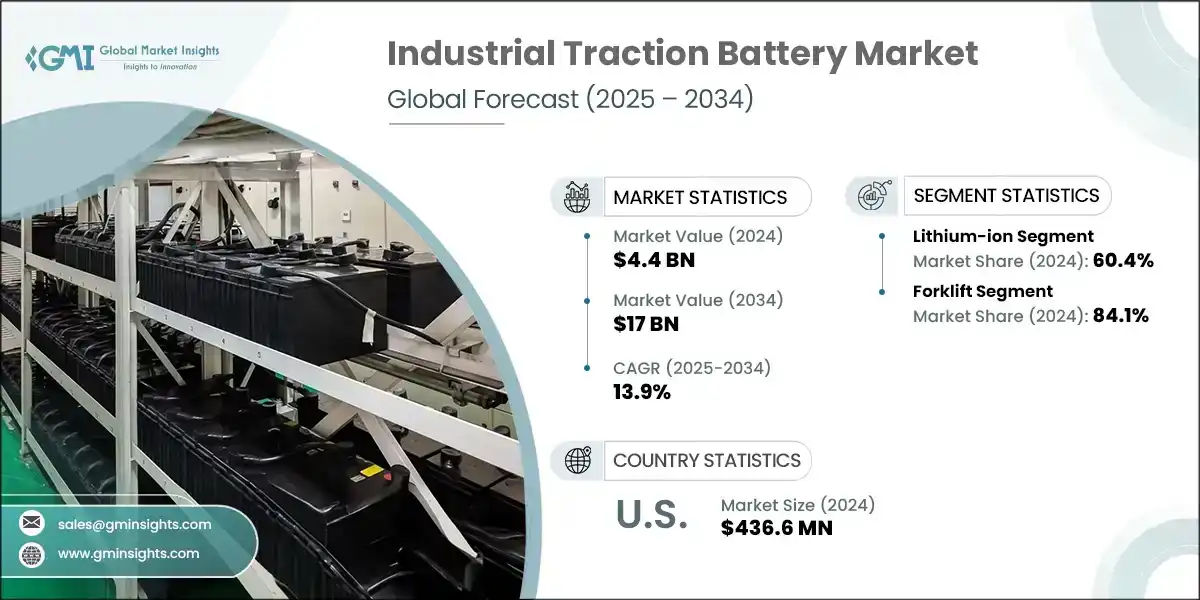
The global industrial traction battery market was valued at USD 4.4 billion in 2024. The market is expected to grow from USD 5.3 billion in 2025 to USD 17 billion in 2034, at a CAGR of 13.9%.
To get key market trends
- The rising adoption of electric forklifts, automated guided vehicles (AGVs), and utility vehicles in warehouses and manufacturing plants is driving demand for traction batteries. These electric alternatives offer lower operating costs, reduced emissions, and improved safety, making them attractive for modern industrial operations.
- Innovations in lithium-ion and ultracapacitor technologies have led to batteries with higher energy density, longer lifespans, and faster charging capabilities. These improvements enhance operational efficiency and reduce downtime, making traction batteries more viable for heavy-duty industrial applications.
- Supportive government policies promoting clean energy adoption, including subsidies and tax incentives for electric industrial vehicles, are accelerating market growth. These initiatives encourage industries to transition from fossil fuel-powered machinery to battery-powered alternatives.
- In 2024, the U.S. Department of Energy awarded over $3 billion in grants to 25 projects across 14 states under the Battery Manufacturing and Recycling Grants Program. These projects aim to expand domestic facilities for battery-grade minerals, components, and recycling. The initiative supports over 12,000 jobs and aligns with national goals for EV adoption and net-zero emissions by 2050.
- Investments in smart grids, industrial automation, and charging infrastructure are boosting the deployment of traction batteries. These developments support seamless integration of battery-powered equipment into industrial ecosystems, enhancing productivity and sustainability.
- Growing awareness of environmental impact and carbon emissions is pushing industries toward eco-friendly solutions. Traction batteries, especially lithium-ion variants, offer reduced ecological damage compared to traditional lead-acid batteries, aligning with corporate sustainability goals.
- In December 2023, the U.S. Treasury and IRS released guidance under the Inflation Reduction Act (IRA) to strengthen domestic battery supply chains. Starting in 2024, clean vehicles must exclude battery components from foreign entities of concern (FEOCs), with stricter mineral sourcing rules by 2025. This policy boosts U.S. manufacturing and energy security.
- Major players are forming alliances and entering strategic agreements to expand their market presence. These collaborations foster innovation, improve supply chains, and accelerate the deployment of advanced traction battery solutions across global industrial sectors.
- Battery swapping and subscription-based models are gaining traction, offering cost-effective and flexible energy solutions. These models reduce upfront investment and maintenance burdens, making traction batteries more accessible to small and medium-sized enterprises.
- In 2025, the Battery Council International urged Congress to maintain Section 45X of the IRA, which supports advanced battery manufacturing. They also advocated for the USA Batteries Act to eliminate excise taxes on raw materials and enhance DOE programs for R&D. These measures aim to protect domestic production and foster innovation in industrial batteries.
Industrial Traction Battery Market Report Attributes
| Key Takeaway | Details |
|---|---|
| Market Size & Growth | |
| Base Year | 2024 |
| Market Size in 2024 | USD 4.4 Billion |
| Forecast Period 2025 - 2034 CAGR | 13.9% |
| Market Size in 2034 | USD 17 Billion |
| Key Market Trends | |
| Drivers | Impact |
| Acceleration in EV adoption | Boosts the installation of industrial traction batteries in residential, commercial, and industrial heating systems |
| Growing demand for electric forklifts | Accelerates adoption by reducing upfront costs and encouraging green energy transition |
| Government incentives and policy support | Robust government subsidies, tax credits, and clean energy mandates are accelerating the adoption of industrial traction batteries |
| Pitfalls & Challenges | Impact |
| Supply chain vulnerabilities | Disruptions in mining or refining operations can delay production and inflate costs, challenging scalability and reliability for industrial battery manufacturers |
| Opportunities: | Impact |
| Circular economy integration | By reclaiming valuable materials and repurposing used batteries, companies can reduce waste, lower costs, and meet sustainability targets—creating a competitive edge in eco-conscious markets |
| Electrification of heavy industries | This shift boosts demand for high-capacity traction batteries, opening new revenue streams for manufacturers and driving innovation in rugged, long-lasting battery solutions |
| Smart Battery Management Systems (BMS) | These systems enhance battery performance and lifespan, offering value-added services and improving operational efficiency for industrial users |
| Market Leaders (2024) | |
| Market Leader |
|
| Top Players |
Collective market share in 2024 is 40% |
| Competitive Edge |
|
| Regional Insights | |
| Largest Market | Asia Pacific |
| Fastest Growing Market | Middle East & Africa |
| Emerging Country | U.S., UK, Saudi Arabia, UAE, Italy |
| Future outlook |
|
What are the growth opportunities in this market?
Industrial Traction Battery Market Trends
- There has been a surge in the adoption of industrial traction batteries driven by the increasing adoption of electric vehicles (EVs), automated guided vehicles (AGVs), and electric forklifts across industries. Traction batteries are essential for powering electric motors in industrial equipment, offering high energy density, durability, and long operational life. Their role in enabling emission-free operations is making them indispensable in logistics, manufacturing, and transportation sectors globally.
- For instance, in 2025, the European Commission launched a USD 3.15 billion funding initiative to support battery manufacturing across the EU, including traction batteries for industrial applications. The package includes grants and loans aimed at scaling up production of lithium-ion and nickel-based batteries, enhancing supply chain resilience, and accelerating industrial electrification. This move aligns with the EU’s Green Deal and REPowerEU strategy, aiming to reduce emissions and strengthen energy independence.
- Government initiatives and infrastructure investments are accelerating market growth. For example, the U.S. Department of Energy has allocated over USD 7.5 billion for EV charging infrastructure and USD 2.8 billion for battery manufacturing and recycling. These policies support the transition to battery-powered industrial tools and vehicles. Globally, similar efforts are underway, with countries investing in smart grids, clean energy, and battery supply chains. Regulatory incentives and carbon reduction mandates are encouraging industries to adopt traction batteries, aligning with broader climate and energy goals.
- Sustainability is a key driver of traction battery adoption. Businesses are shifting toward low-emission, energy-efficient solutions to meet ESG targets and reduce operational costs. Traction batteries enable electrification of industrial fleets, contributing to cleaner air and reduced noise pollution. The growing popularity of electric forklifts, AGVs, and rail systems reflects this transition. Battery technologies are evolving to support longer runtimes, faster charging, and better integration with smart energy systems. As industrial electrification becomes mainstream, traction batteries will play a central role in shaping the future of clean and efficient operations.
- For instance, in 2025, Mexico introduced a new industrial policy for electric vehicles and battery manufacturing, offering tariff exemptions, tax incentives, and infrastructure support to attract global battery producers. The initiative is part of Mexico’s strategy to align national and subnational EV goals, aiming to become a key player in North America’s battery supply chain. This move supports the development of traction batteries for industrial and commercial EVs, while boosting local employment and technological capacity.
Industrial Traction Battery Market Analysis
Learn more about the key segments shaping this market
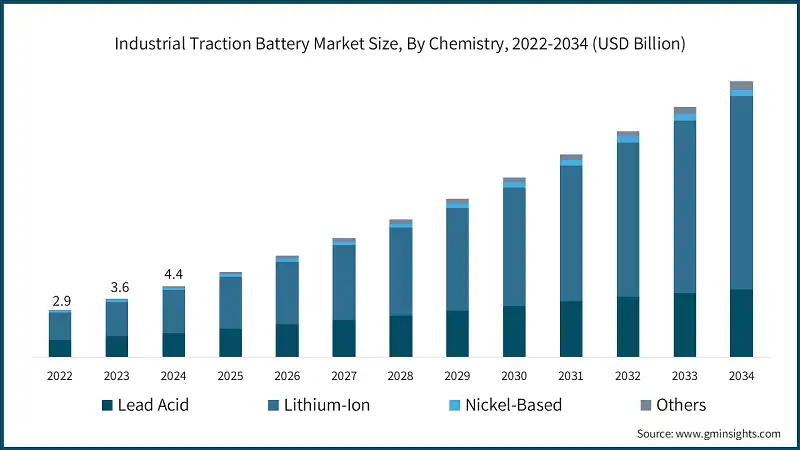
- Based on chemistry, the industry is segmented into lead acid, lithium-ion, nickel-based, and others. The lithium-ion segment dominated the industrial traction battery market accounting for 60.4% revenue share in 2024 and is expected to grow at a CAGR of over 15% through 2034.
- Industries are rapidly transitioning to electric and hybrid industrial vehicles to meet sustainability goals and comply with emissions regulations. Lithium-ion batteries are preferred for their high energy density, long cycle life, and low maintenance, making them ideal for continuous-use environments.
- The lead acid industrial traction battery market is projected to reach over USD 4 billion by 2034. Lead-acid batteries continue to be favored in price-sensitive markets and applications where initial cost and proven performance are critical. Their ability to handle high power demands efficiently makes them suitable for forklifts, railroads, and other heavy-duty industrial vehicles.
- For instance, in January 2024, the U.S. Department of Energy launched a three-year initiative under the Long Duration Energy Storage (LDES) National Consortium, promoting advanced lead-acid batteries for energy storage applications. The initiative, supported by six national laboratories and over 130 partners, aims to accelerate the commercialization of long-duration storage technologies.
- The nickel-based industrial traction battery market is expected to grow at a CAGR of over 11% till 2034. Nickel-based batteries are known for their durability and tolerance to overcharging, which enhances safety in industrial environments. Their low maintenance requirements and resistance to vibration and shock make them ideal for rugged applications where reliability is critical.
- For instance, in 2025, the Indonesian government continued its aggressive industrial policy by offering income tax holidays of up to 20 years, low nickel ore prices, and energy subsidies to attract investment in nickel-based battery production. These incentives supported companies like Tsingshan Holding Group and Jiangsu Delong Nickel Industry, which have collectively invested nearly USD 10 billion in nickel processing facilities.
Learn more about the key segments shaping this market
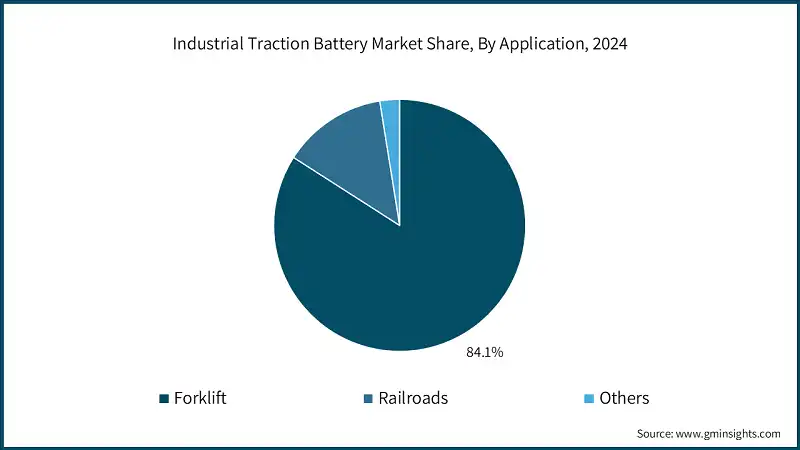
- Based on application, the industrial traction battery market is divided into forklift, railroads, and others. The forklift segment holds 84.1% market share in 2024 with over 13.2% CAGR till 2034. As companies seek more efficient and environmentally friendly material handling solutions, electric forklifts powered by traction batteries—especially lithium-ion—are becoming the preferred choice.
- Railroads application was estimated at USD 586.4 million in 2024. Governments are investing heavily in electrified rail systems, including hybrid and fully electric trains, which rely on traction batteries for propulsion and auxiliary power. Urbanization and the need for efficient public transportation are increasing the deployment of battery-powered metro and light rail systems.
- For instance, in May 2023, the Federal Economic Development Agency for Southern Ontario invested USD 3.6 million in Stromcore Energy Inc., a forklift battery manufacturer, to support advanced manufacturing and green product development. The funding enabled the launch of two energy-efficient innovations: the Electric Cart, a zero-emission forklift co-developed with Amazon, and the Turbo Bank, an AI-powered charger designed for enhanced efficiency.

Looking for region specific data?
- The U.S. dominated the industrial traction battery market in North America with around 70% share in 2024 and generated USD 436.6 million in revenue. The U.S. market is seeing rapid advancements in battery technology, including fast-charging capabilities, extended operational life, and smart telematics integration.
- In 2023, the U.S. government, under the Bipartisan Infrastructure Law and Inflation Reduction Act, catalyzed over USD 250 billion in cumulative investments across the battery and EV supply chain. These policies offer production tax credits, grants, and incentives for domestic battery manufacturing, including traction batteries for industrial use.
- North America industrial traction battery market is projected to grow at a CAGR of over 10% through 2034. Technological advancements in lithium-ion batteries—offering higher energy density and faster charging—are accelerating adoption. Sustainability goals and regulatory incentives are pushing industries toward cleaner energy solutions. The surge in e-commerce and automation is further boosting battery demand.
- The Europe industrial traction battery market was valued at USD 453.1 million in 2024. The region’s commitment to clean energy, supported by initiatives like REPowerEU and the EU Innovation Fund, is driving demand for lithium-ion batteries. Strategic partnerships, such as Volkswagen’s investment in Northvolt, are enhancing production capabilities.
- For illustration, in December 2024, the European Commission and European Investment Bank announced a USD 3.15 billion funding package to boost battery manufacturing. This includes USD 1 billion in grants for EV battery cell production and USD 1.8 billion in loans for the broader battery value chain.
- The Asia Pacific industrial traction battery market is set to reach over USD 13 billion by 2034. The region benefits from government incentives promoting clean energy and electrification. Demand for electric forklifts, AGVs, and warehouse automation is surging, especially in logistics and e-commerce. Technological innovation in lithium-ion chemistry and battery management systems is enhancing performance and safety.
- For citation, in 2024, India expanded its FAME-II scheme, offering subsidies and tax incentives to promote electric mobility and industrial electrification. The program supports the adoption of traction batteries in forklifts and AGVs. Meanwhile, China and South Korea continue to invest heavily in lithium-ion battery R&D and manufacturing infrastructure.
- The Middle East & Africa region is investing in electrification, renewable energy, and grid flexibility, which boosts demand for industrial batteries. Lithium-ion technology is gaining traction due to its efficiency and scalability. Strategic partnerships and manufacturing initiatives, such as Nigeria’s lithium-ion plant, are strengthening local capabilities.
- For citation, in 2025, Saudi Arabia and the UAE aligned their national strategies—Vision 2030 and Net Zero 2050—to promote battery energy storage and industrial electrification. The region is investing in lithium-ion and solid-state battery technologies for industrial applications.
- The Latin America industrial traction battery market will grow at a rate of over 10.5% by 2034. The region’s expanding logistics and industrial sectors are increasing demand for electric forklifts and material handling equipment. Lithium-ion batteries are preferred for their long life and energy efficiency.
- In 2025, Brazil attracted major investments, including USD 620 million from BYD for a battery plant and USD 10 billion from Tesla for a megafactory. These projects are supported by government incentives and strategic agreements to boost local battery production. Colombia and Chile also secured deals for lithium supply and EV battery manufacturing.
Industrial Traction Battery Market Share
- The top 5 players, consisting of BYD, EXIDE INDUSTRIES, Flux Power, Sunlight Group and ENERSYS holds 40% of the market share. Larger companies with significant market share can leverage economies of scale to reduce production costs and improve battery performance. As a result, they can offer more affordable and better-performing bolt-on battery solutions, which can accelerate adoption in industries such as material handling (forklifts) and rail transport.
- BYD is a global leader in battery technology, leveraging its expertise in lithium-ion solutions to serve the industrial traction battery market. Known for its innovation in electric mobility, BYD supplies batteries for forklifts, AGVs, and other industrial vehicles. The company emphasizes sustainability and high energy efficiency, aligning with the growing demand for clean energy solutions. BYD’s traction batteries offer long cycle life and fast charging capabilities, making them ideal for high-demand industrial operations.
- Exide Industries, India’s largest lead-acid battery manufacturer and a global player, dominates the industrial traction battery segment with a diverse portfolio. It offers batteries for forklifts, railways, telecom, and solar applications, ranging from 7Ah to 3200Ah. Exide is transitioning toward green technologies, including lithium-ion cell manufacturing, to meet evolving industrial needs. Its strategic manufacturing locations and robust distribution network ensure agility and efficiency.
- Flux Power specializes in advanced lithium-ion battery packs for material handling, airport ground support, and industrial automation. Its proprietary battery management systems (BMS) and smart telematics enhance operational efficiency and safety. Flux Power’s LiFT Pack series is widely adopted by Fortune 500 companies and major forklift manufacturers, reflecting its growing market traction. The company’s focus on clean energy and customer-centric innovation positions it as a key player in the transition from lead-acid to lithium-ion solutions.
- Sunlight Group is a global leader in motive power solutions, offering both lithium-ion and lead-acid batteries for industrial mobility. Operating one of the world’s largest motive battery manufacturing plants, Sunlight serves over 115 countries with a strong export focus. Its product range supports electric forklifts, AGVs, and logistics equipment, backed by smart IoT platforms like KnoWi and GLocal for battery monitoring. Sunlight’s technology-agnostic approach and investment in R&D enable it to adapt to market shifts and customer needs. The company emphasizes sustainability, automation, and innovation to drive growth in the industrial traction battery sector.
- ENERSYS is a prominent name in industrial energy storage, offering a wide array of traction batteries for electric forklifts, AGVs, and utility vehicles. Known for its high-performance lead-acid and lithium-ion solutions, ENERSYS supports industries with reliable, low-maintenance power systems. The company is investing in advanced chemistries and battery management technologies to enhance efficiency and reduce environmental impact. ENERSYS also explores battery swapping and subscription models to provide flexible energy solutions. Its global footprint and commitment to clean energy make it a key contributor to the evolving market
Industrial Traction Battery Market Companies
- Sunlight Group reported a revenue of USD 1.3 billion in 2024, with more than 28% of the revenue in Motive Power was generated by Lithium-Ion Solutions. The US Motive Power business accounts already for more than 20% of the Motive Power sales of the Group with a high growth trajectory.
- Exide Industries posted revenue exceeding USD 1.74 billion in 2024, reflecting strong financial momentum. The industrial products segment, which includes traction batteries for forklifts, railways, solar, and telecom applications, contributed significantly to this growth.
- EnerSys posted revenue exceeding USD 3.6 billion in fiscal year 2025, reflecting consistent financial growth and operational resilience. The Motive Power segment, which includes industrial traction batteries for forklifts, AGVs, and other electric vehicles, delivered record margins, highlighting its strategic importance.
Major players operating in the industrial traction battery market are:
- Amara Raja Batteries
- Aliant Battery
- BYD
- Camel Group
- East Penn
- EXIDE INDUSTRIES
- ecovolta
- ENERSYS
- Farasis Energy
- Flux Power
- Guoxuan High-tech Power Energy
- HOPPECKE Batteries
- Hitachi Energy
- Mutlu Corporation
- MIDAC
- Sunlight Group
- Sunwoda Electronic
- Toshiba Corporation
Industrial Traction Battery Industry News
- In February 2025, BYD has expanded its offerings of lithium-ion batteries for electric forklifts and other material handling equipment. The company is now focusing on providing cost-effective, high-energy density solutions for warehouses and logistics companies globally. BYD's LFP (lithium iron phosphate) battery technology is now the core of their expansion into Europe, where forklift fleets are undergoing rapid electrification. The company's growth in the industrial sector will significantly impact the market share of existing players, as the company is now poised to dominate in regions like North America and Europe.
- In January 2025, LG Energy Solution and Siemens Mobility have entered into a partnership to provide lithium-ion battery solutions for rail electrification projects in Europe and North America. The collaboration will focus on creating hybrid rail systems that combine traditional rail power sources with onboard battery storage, improving energy efficiency and reducing emissions. This battery system can be retrofitted to existing non-electrified rail lines, allowing for electric trains without costly infrastructure investments.
- In December 2024, Enersys, a leader in industrial batteries, has introduced a new series of bolt-on lithium-ion batteries designed specifically for material handling and automated guided vehicles (AGVs). The new range is optimized for high-demand environments such as warehouses, distribution centers, and e-commerce operations. The batteries feature improved battery management systems (BMS), faster charging times, and longer operational hours.
The industrial traction battery market research report includes in-depth coverage of the industry with estimates & forecast in terms of revenue (USD Million) from 2021 to 2034, for the following segments:
Market, By Chemistry
- Lead Acid
- Lithium-Ion
- Nickel-Based
- Others
Market, By Application
- Forklift
- Railroads
- Others
The above information has been provided for the following regions and countries:
- North America
- U.S.
- Canada
- Mexico
- Europe
- Germany
- UK
- France
- Italy
- Spain
- Netherlands
- Asia Pacific
- China
- Japan
- South Korea
- Australia
- India
- Middle East & Africa
- Saudi Arabia
- UAE
- South Africa
- Latin America
- Brazil
- Argentina
Frequently Asked Question(FAQ) :
Which region leads the industrial traction batteries market?
The U.S. led the North America industrial traction battery market with a 70% share, generating USD 436.6 million in 2024. Advancements in battery technology, such as fast charging and smart telematics, are driving regional growth.
What are the upcoming trends shaping the industrial traction battery market?
Key trends include the dominance of lithium-ion batteries, integration with IoT platforms for predictive maintenance, and the electrification of heavy industries driving demand for high-capacity batteries.
Who are the major players in the industrial traction battery market?
Key players include BYD, EXIDE INDUSTRIES, Flux Power, Sunlight Group, ENERSYS, Amara Raja Batteries, Aliant Battery, and Toshiba Corporation, among others.
How much revenue did the railroads segment generate in the industrial traction battery market in 2024?
The railroads segment generated USD 586.4 million in 2024, supported by government investments in electrified rail systems and growing demand for battery-powered metro and light rail solutions.
What is the growth outlook for the lead-acid battery segment through 2034?
The lead-acid battery segment is projected to reach over USD 4 billion by 2034, favored in price-sensitive markets and applications requiring proven performance and cost efficiency.
What was the market size of the industrial traction battery in 2024?
The market size was USD 4.4 billion in 2024, with a CAGR of 13.9% through 2034 driven by the rising adoption of electric forklifts, AGVs, and utility vehicles in industrial operations.
What is the projected value of the industrial traction battery market by 2034?
The industrial traction battery market is expected to reach USD 17 billion by 2034.
Which battery chemistry dominated the market in 2024?
The lithium-ion segment dominated the market in 2024, accounting for 60.4% of the revenue share, due to its superior energy density, long cycle life, and low maintenance requirements.
Industrial Traction Battery Market Scope
Related Reports