Summary
Table of Content

Industrial Surge Protection Devices Market
Get a free sample of this report
Form submitted successfully!
Error submitting form. Please try again.
Thank you!
Your inquiry has been received. Our team will reach out to you with the required details via email. To ensure that you don't miss their response, kindly remember to check your spam folder as well!
Request Sectional Data
Thank you!
Your inquiry has been received. Our team will reach out to you with the required details via email. To ensure that you don't miss their response, kindly remember to check your spam folder as well!
Form submitted successfully!
Error submitting form. Please try again.
Industrial Surge Protection Devices Market Size
The increasing reliance of electronic equipment and the rise in the rate of power outages due to grid instability and weather-related interruptions will fuel the growth of the industry. In addition, an increase in strict electrical safety laws and regulations across industries based on their mandatory adherence to IEC/UL standards of surge protection will have a positive influence on the industry environment.
Industrial Surge Protection Devices Market Key Takeaways
Market Size & Growth
- 2025 Market Size: USD 1.1 Billion
- 2026 Market Size: USD 1.2 Billion
- 2035 Forecast Market Size: USD 2.2 Billion
- CAGR (2026–2035): 7.2%
Regional Dominance
- Largest Market: Asia Pacific
- Fastest Growing Region: Middle East & Africa
Key Market Drivers
- Ongoing development & expansion of industries.
- Large‑scale integration of renewable energy sources.
- Escalating demand for reliable & continuous electricity.
Challenges
- High initial costs.
Opportunity
- Grid vulnerability mitigation.
- Protection for renewable-connected assets.
- Cost control through equipment protection.
- Expansion of mission‑critical digital systems.
Key Players
- Market Leader: ABB led with over 10% market share in 2025.
- Leading Players: Top 5 players in this market include ABB, Schneider Electric, Siemens, Eaton, GE Vernova, which collectively held a market share of 38% in 2025.
Get Market Insights & Growth Opportunities
Industrial surge protecting devices are essential elements which protect electrical equipment against lightning strikes, power surges and switching activities, which create transient spikes in electrical systems. They are operated by redirecting excessive voltage to non-sensitive equipment to avoid its destruction, loss of time and possible accidents. It is necessary in industrial applications where the safety of electrical systems is of paramount importance whereby there is need to secure the important assets such as motors, transformers and control systems.
For instance, the world energy investment was recorded at an all-time peak of USD 3.3 trillion in 2025. In the IEA analysis, the clean-energy technologies will lure about USD 2.2 trillion twice the amount of capital likely to go into the fossil fuels. The booming is indicative of increasingly robust industrial policy backing, energy-security concerns and escalating cost effectiveness of electrified solutions.
The industrial surge protection devices market was estimated at USD 1.1 billion in 2025. The market is expected to grow from USD 1.2 billion in 2026 to USD 2.2 billion by 2035, at a CAGR of 7.2%, according to a recent study by Global Market Insights Inc.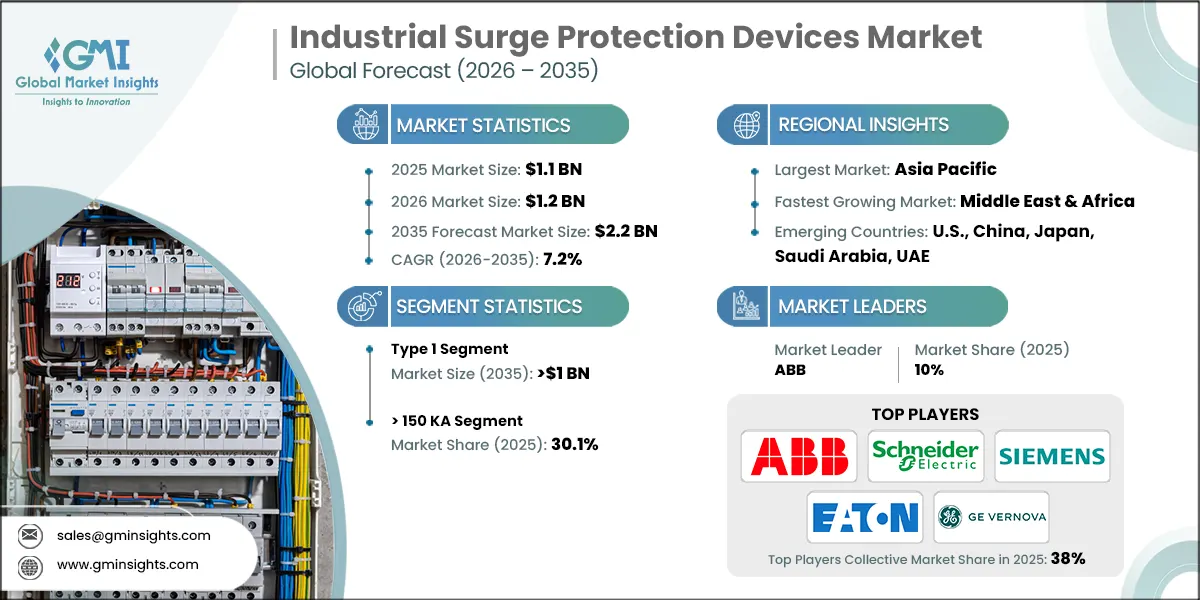
To get key market trends
Industrial Surge Protection Devices Market Trends
The use of smart grids and the growing focus on the safety against electrical inconveniences is bound to fuel the potential of the industry. There is a trend in the industry towards integrated products that combine surge protecting with other energy management capabilities that have full protection and monitoring capabilities. Furthermore, they are being incorporated into energy management systems to provide a comprehensive solution to energy conservation and power quality, and therefore, improving the surge protecting devices market.
Indicatively, during COP28 in 2023, almost 200 countries signed a historic pledge to substantially increase the rate of global energy-saving by 2030. Such a commitment by all should enhance the decarbonization process at the global level and aid in the long-term climate ambitions. The accord is also meant to spur economic growth, diversify energy-supply and minimize the operational risks that may be associated with inefficiency.
Industrial Surge Protection Devices Market Analysis
Learn more about the key segments shaping this market
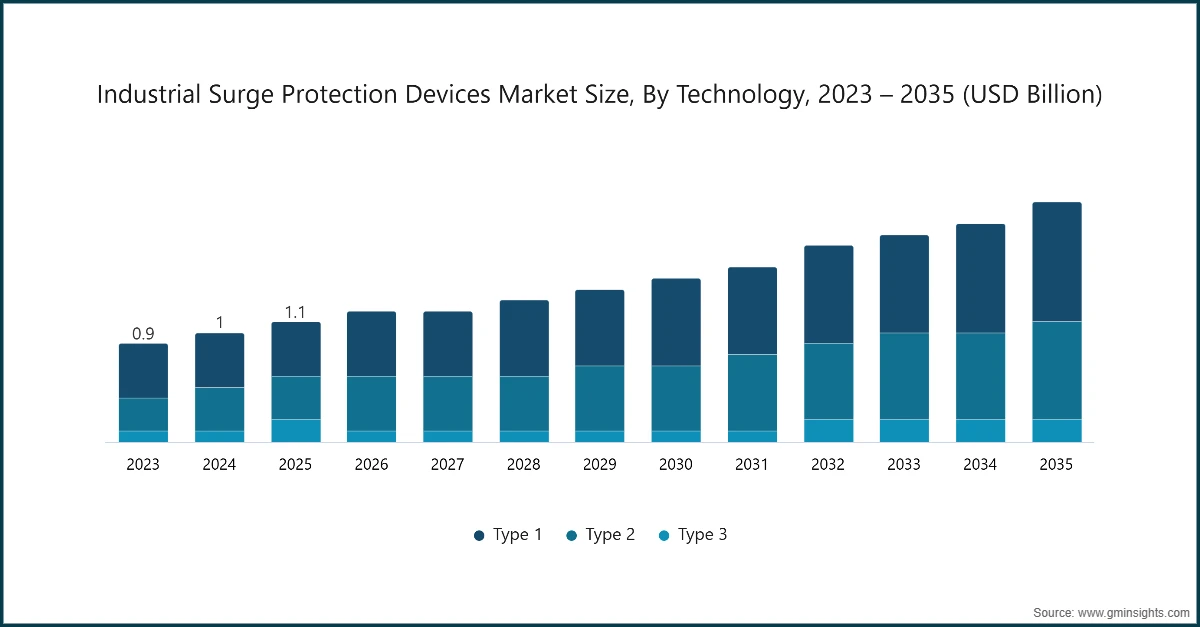
The type 1 industrial surge protection devices market will exceed USD 1 billion by 2035. The growing requirement to ensure that industrial equipment is not subjected to voltage spikes and electrical surges will impact the business landscape. These types of devices are necessary in protecting critical infrastructure in industrial environments, where power bursts can cause expensive downtime, equipment destruction, and safety risks. The product penetration will be supported by the increasing uptake of automation in accordance with the current growth of the industrial IoT systems.
Learn more about the key segments shaping this market
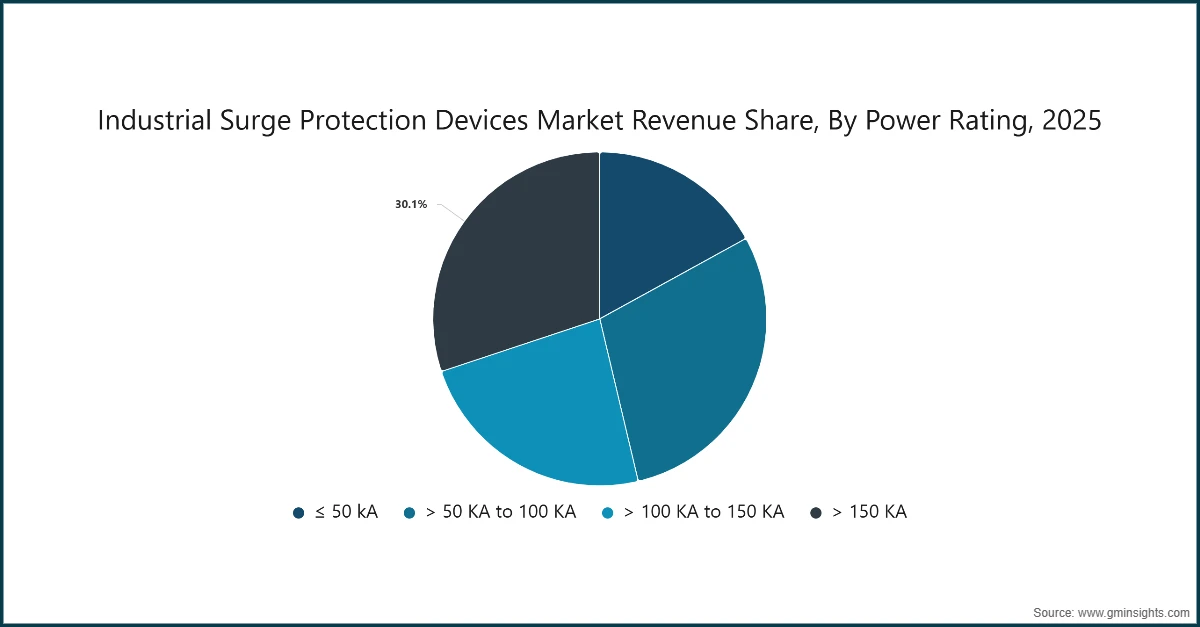
The > 150 kA industrial surge protection devices market holds a share of 30.1% in 2025. These SPDs play an important role in the protection of electrical systems, especially in industries like manufacturing, energy and telecommunications where electrical system failure can cost an organization a lot of money. Also, increased understanding of the long-term financial benefit of avoiding damage related to surges is making industries invest in higher rated SPD, which foster the industry potential.
For instance, the coalition government of Germany agreed on its 2025 budget, which will spend unprecedented amounts of money on climate and energy projects, but the constitutional debt brake constrained its ability. It includes a detailed growth program in order to boost the decarbonization of industry, electric mobility, and the modernization of national heating systems.
Looking for region specific data?
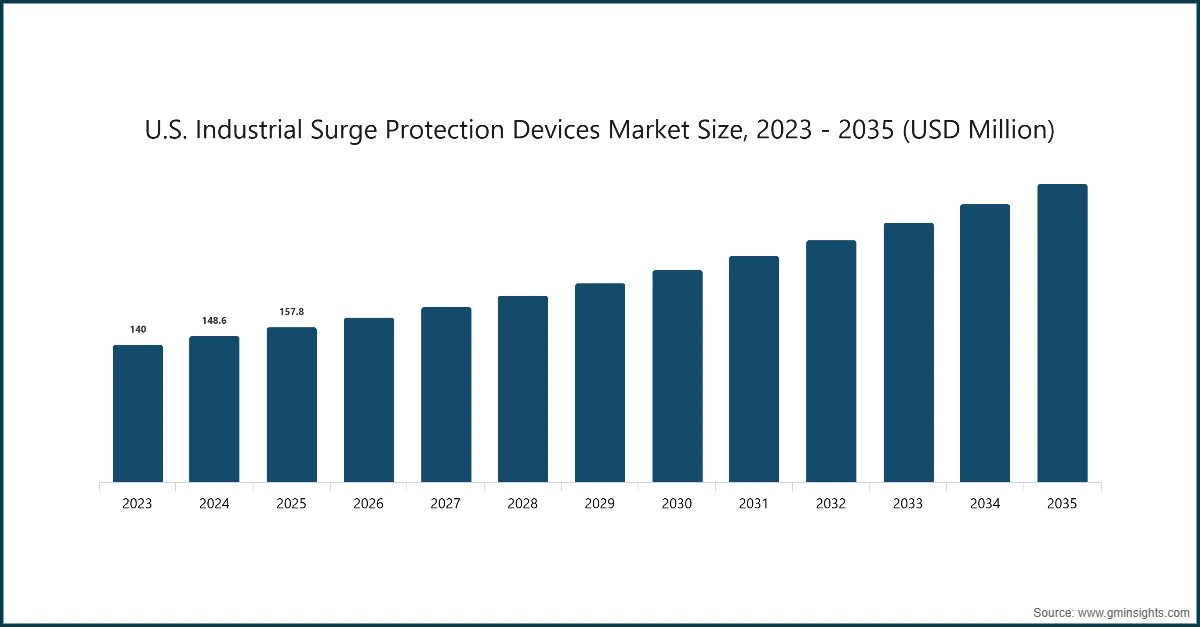
U.S. peak industrial surge protection devices market was valued at USD 157.8 million in 2025. Strict regulatory standard as per the increasing attention to the operational safety will intensify the business situation. The large scale development of infrastructural systems and increased use of innovative technologies and the use of sensitive electronic devices will serve as the key motivators behind the major growth of the industry. The fact that the current electricity infrastructure is aging coupled with the frequency of weather-related power outages also underscores the importance of these units.
For citation, in 2024, the U.S. Department of Energy awarded USD 2.2 billion to develop new transmission infrastructure and grid-modernization projects as part of the GRIP program. The program had recorded significant gains by Winter 2025, with billions being channeled towards resilience, smart-grid implementations, and system-wide modernization efforts. Such investments enable the adoption of best sensors, digital automation technology, and improved grid-reliability.
The business growth in the Asia Pacific region will be accelerated on account of rapid industrialization along with surging urbanization and increased uptake of the advanced technologies in a comprehensive tandem of industries. The increasing priority on energy efficiency and safety standards, as well as government actions that encourage the use of surge protecting devices in essential industries, will continue to add to the industry landscape.
Industrial Surge Protection Devices Market Share
Mersen is a company that deals with surge protection equipment that is used to protect electrical systems against voltage spikes and transients. Its products will be designed to provide stable security in a vast number of applications, such as residential, commercial and industrial settings. Its equipment has high performance and durability and employs advanced technologies to successfully absorb and dissipate the unnecessary energy of lightning strikes or other electrical unrest. They have a wide spectrum of solutions, which can be both AC and DC, which will provide a high level of protection against possible harm and increase the durability and stability of essential electrical equipment.
Industrial Surge Protection Devices Market Companies
The key industry players include:
ABB
Belkin
CAPE Electric
CG Power and Industrial Solutions
CITEL
DEHN
Eaton
Emerson Electric
GE Vernova
Havells
Hubbell
Legrand
Leviton Manufacturing
Maxivolt
Mersen
nVent
Phoenix Contact
Prosurge
Raycap
Rockwell Automation
Saltek
Schneider Electric
Siemens
Socomec
Weidmuller Electronics
Industrial Surge Protection Devices Market Report Attributes
| Key Takeaway | Details |
|---|---|
| Market Size & Growth | |
| Base Year | 2025 |
| Market Size in 2025 | USD 1.1 Billion |
| Market Size in 2026 | USD 1.2 Billion |
| Forecast Period 2026-2035 CAGR | 7.2% |
| Market Size in 2035 | USD 2.2 Billion |
| Key Market Trends | |
| Drivers | Impact |
| Ongoing development & expansion of industries | Rapid industrial expansion increases the installation of sensitive automation and power‑electronic systems, heightening the need for reliable surge protection. As facilities scale, the exposure to transient over voltages grows, making SPDs essential for safeguarding equipment and ensuring uninterrupted operations. |
| Large‑scale integration of renewable energy sources | The growing deployment of solar, wind, and hybrid energy systems introduces higher variability and switching transients into industrial power networks. This volatility increases the risk of surge events, prompting operators to adopt SPDs to protect inverters, transformers, and control equipment. |
| Escalating demand for reliable & continuous electricity | Rising reliance on continuous power for automation, digital control, and mission‑critical operations heightens sensitivity to voltage spikes and power disturbances. Businesses increasingly invest in SPDs to prevent costly downtime, equipment failures, and production losses caused by transient surges. |
| Pitfalls & Challenges | Impact |
| High initial costs | Industrial surge protection devices often require significant upfront investment, including installation, integration, and system upgrades. These high capital requirements may discourage smaller industries from adopting advanced SPDs, delaying modernization efforts. |
| Opportunities: | Impact |
| Grid vulnerability mitigation | Increasing grid fluctuations and voltage irregularities are pushing industries to adopt surge protection devices to safeguard sensitive electrical infrastructure. Frequent disturbances, especially in developing regions, amplify the risk of costly equipment failures. |
| Protection for renewable-connected assets | As industries integrate renewable energy systems, the need to protect inverters, converters, and controllers from transient surges becomes critical. The variability and back-feed risks associated with renewables heighten exposure to electrical spikes. |
| Cost control through equipment protection | Rising equipment repair and replacement costs encourage industries to invest in SPDs as a preventive strategy. By mitigating surge‑induced failures, businesses significantly reduce maintenance expenses and avoid production disruptions. |
| Expansion of mission‑critical digital systems | Growth of data-driven industrial operations increases reliance on sensitive digital electronics vulnerable to surges. Facilities are deploying SPDs to protect servers, control units, communication lines, and automation systems. Ensuring uninterrupted performance of these assets has become a top priority across sectors. |
| Market Leaders (2025) | |
| Market Leader |
Market Share of 10% |
| Top Players |
Collective Market Share of 38% |
| Competitive Edge |
|
| Regional Insights | |
| Largest Market | Middle East & Africa |
| Fastest growing market | Asia Pacific |
| Emerging countries | U.S., China, Japan, Saudi Arabia, UAE |
| Future outlook |
|
What are the growth opportunities in this market?
Industrial Surge Protection Devices Industry News
In October 2025, Schneider Electric has introduced an innovative plug-and-play surge protection device in the UK, specifically designed to be directly connected to its Acti9 and KQ Load center distribution boards. The completely integrated design with an inbuilt backup fuse eliminates the use of external disconnectors, supplementary enclosures or complicated wiring, which considerably simplifies the installation. The solution is compliant with the new BS 7671:2018 regulatory standards and the growing demands of small high-performance overvoltage protection in commercial and industrial applications.
In May 2025, GE Vernova stated the investment of about USD 16 million to increase their manufacturing and engineering presence in India due to increasing demand of advanced grid infrastructure. The project involves installation of a new production line in Chennai plant and introduction of another plant in Noida. These extensions will amplify the ability of the company to fabricate and experiment with next generation HVDC and FACTS technologies that will be required in grid stability and the same will be needed in the integration of renewable energies.
The industrial surge protection devices market research report includes in-depth coverage of the industry with estimates & forecast in terms of volume (‘000 Units) & revenue (USD Million) from 2022 to 2035, for the following segments:
Market, By Product
Hard-wired
Plug-in
Line cord
Power control devices
Market, By Technology
Type 1
Type 2
Type 3
Market, By Power Rating
≤ 50 kA
> 50 kA to 100 kA
> 100 KA to 150 kA
> 150 kA
The above information has been provided for the following regions and country:
North America
U.S.
Canada
Mexico
Europe
Germany
France
Russia
UK
Italy
Spain
Netherlands
Austria
Asia Pacific
China
Japan
South Korea
India
Australia
New Zealand
Malaysia
Indonesia
Middle East & Africa
Saudi Arabia
UAE
Qatar
Egypt
South Africa
Nigeria
Kuwait
Oman
Latin America
Brazil
Peru
Argentina
Frequently Asked Question(FAQ) :
What was the market size of the industrial surge protection devices in 2025?
The market size was USD 1.1 billion in 2025, with a CAGR of 7.2% expected through 2035. Increasing reliance on electronic equipment and rising power outages due to grid instability and weather-related disruptions are driving market growth.
What is the projected value of the industrial surge protection devices market by 2035?
The market is projected to reach USD 2.2 billion by 2035, driven by automation trends, industrial IoT adoption, and stricter electrical safety regulations.
What is the expected size of the industrial surge protection devices industry in 2026?
The market size is projected to reach USD 1.2 billion in 2026.
What is the growth outlook for type 1 industrial surge protection devices?
The type 1 segment is expected to exceed USD 1 billion by 2035, supported by the need to protect critical infrastructure from voltage spikes and electrical surges.
What was the market share of > 150 kA industrial surge protection devices in 2025?
The > 150 kA segment held a 30.1% market share in 2025, led by its importance in safeguarding electrical systems in industries like manufacturing, energy, and telecommunications.
What was the valuation of the U.S. industrial surge protection devices sector in 2025?
The U.S. market was valued at USD 157.8 million in 2025, fueled by regulatory standards, aging electricity infrastructure, and frequent weather-related power outages.
What are the upcoming trends in the industrial surge protection devices market?
Trends include the integration of surge protection with energy management systems, adoption of smart grids, and increased investment in higher-rated SPDs for long-term financial benefits.
Who are the key players in the industrial surge protection devices industry?
Key players include ABB, Belkin, CAPE Electric, CG Power and Industrial Solutions, CITEL, DEHN, Eaton, Emerson Electric, GE Vernova, Havells, and Hubbell.
Industrial Surge Protection Devices Market Scope
Related Reports