Summary
Table of Content

Industrial Sensor Market
Get a free sample of this report
Form submitted successfully!
Error submitting form. Please try again.
Thank you!
Your inquiry has been received. Our team will reach out to you with the required details via email. To ensure that you don't miss their response, kindly remember to check your spam folder as well!
Request Sectional Data
Thank you!
Your inquiry has been received. Our team will reach out to you with the required details via email. To ensure that you don't miss their response, kindly remember to check your spam folder as well!
Form submitted successfully!
Error submitting form. Please try again.
Industrial Sensor Market Size
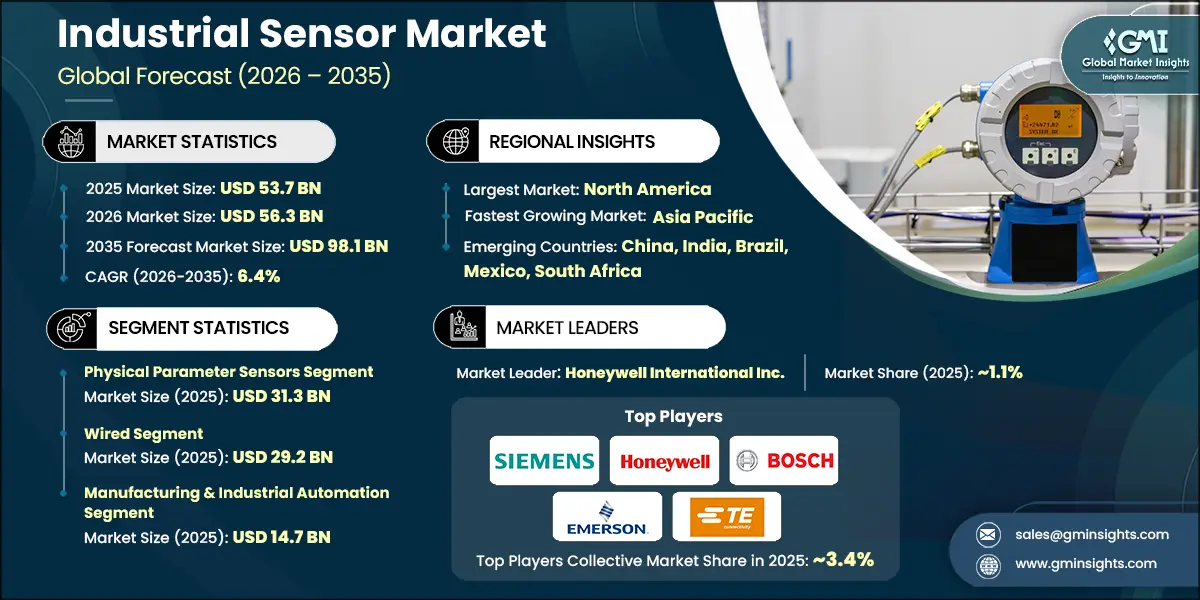
The global industrial sensor market was valued at USD 53.7 billion in 2025 with the volume of 312 thousand units in 2025. The market is expected to grow from USD 56.3 billion in 2026 to USD 98.1 billion in 2035, at a CAGR of 6.4% during the forecast period according to the latest report published by Global Market Insights Inc.
Industrial Sensor Market Key Takeaways
Market Size & Growth
- 2025 Market Size: USD 53.7 Billion
- 2026 Market Size: USD 56.3 Billion
- 2035 Forecast Market Size: USD 98.1 Billion
- CAGR (2026–2035): 6.4%
Regional Dominance
- Largest Market: North America
- Fastest Growing Region: Asia Pacific
Key Market Drivers
- Increasing Adoption of Industrial Automation and Smart Manufacturing.
- Integration of IoT and Industrial Internet of Things (IIoT) Technologies.
- Rising Demand for Predictive Maintenance and Real-Time Monitoring.
- Expansion in Renewable Energy and Advanced Power Generation Systems.
- Stringent Regulatory Compliance and Safety Standards.
Challenges
- High Initial Investment and Integration Complexity.
- Data Security and Reliability Concerns.
Opportunity
- Adoption of Smart Factories and Industry 4.0 Initiatives.
- Expansion in Renewable Energy and Advanced Power Systems.
Key Players
- Market Leader: Honeywell International Inc. led with over 1.1% market share in 2025.
- Leading Players: Top 5 players in this market include Siemens AG, Honeywell International Inc., Bosch Group, Emerson, TE Connectivity, which collectively held a market share of 3.4% in 2025.
Get Market Insights & Growth Opportunities
As advanced industrial operations such as manufacturing, energy, and aerospace expand, demand for industrial sensors will continue to increase. In complex industrial environments, industrial sensors are essential for monitoring and controlling a wide range of functions, from environmental monitoring and safety compliance to process control and equipment performance tracking. This ensures optimal operational efficiency. With continual increases in production volume and complexity of operation, more businesses are participating with sensor technology that enables reliable coordination with all stakeholders, as well as providing real-time situational awareness of both machinery & their associated processes.
Because industry is progressing toward greater amounts of automated and smart manufacturing operations, there is greater demand for precision Industrial Sensors. For successful operation of these sensors, they must meet both reliability and accuracy fully. They need to be able to work well while operating in high-throughput environments and under severe operating temperatures, and pressures. The emphasis on efficiency, safety, and operational performance has greatly increased the use of these technologies within many industries (e.g., manufacturing, energy, aerospace, and logistics) and at all levels of an organization.
Siemens has shown how smart sensors in its digital factories allow real-time data collection to be used for predictive maintenance, reducing downtime, and optimizing production capacity. GE has similarly deployed advanced sensors throughout its renewable energy and generation facilities to monitor the performance of their wind turbines, thereby improving their production efficiencies and being able to ensure compliance with all applicable regulations.
The trend toward stringent regulatory compliance and safety standards continues to evolve, driving the demand for sensors that ensure operational safety, quality control, and environmental monitoring.
The industrial sensor market will continue to grow at an accelerated pace due to the technological developments that are facilitating digital transformation & automation. Connected sensors, IIoT-enabled monitoring platforms, and cloud-based analytic applications are being deployed to support predictive maintenance, optimize production processes, and improve overall operational performance. In addition to supporting compliance with safety and environmental legislation, these systems also provide opportunities for reduced operational costs and increased revenue growth opportunities through the creation of intelligent and data-driven infrastructure.
To get key market trends
Industrial Sensor Market Trends
- Rapidly growing through the incorporation of advanced digital technology and automation within the manufacturing industry, energy sector and aerospace industry, industrial sensors have become an integral part of smart industrial environments by providing real-time monitoring capabilities, controlling processes, tracking equipment operation, and ensuring compliance with safety regulations as factories grow in both size and complexity while increasing production volume therefore requiring the use of industrial sensors that give you accurate, timely data regarding equipment and process management to create seamless integration across all operations.
- The move towards smart factories and Industry 4.0 initiatives is also increasing the number of connected sensors that work together to support digital twins, robotics and automated production lines. By using connected sensors companies can improve their predictive maintenance capabilities and reduce the amount of time spent having to fix unexpected issues and maximize their operational efficiency. Siemens has implemented smart sensors in its digital factories to provide insight through real-time data collection, improve its ability for predictive analytics and streamline production processes. GE has also deployed advanced sensors in its renewable energy and energy generation facilities to better monitor turbine performance, increase energy production and ensure they are meeting their regulatory requirements.
- The increasing focus on regulatory compliance, safety standards, and environmental monitoring continues to drive sensor adoption. Industrial sensors are crucial for ensuring operational safety, quality control, and sustainability. For instance, Vestas’ wind turbine monitoring systems use connected sensors to reduce operational risks, enhance energy efficiency, and support sustainable energy production.
Industrial Sensor Market Analysis
Learn more about the key segments shaping this market
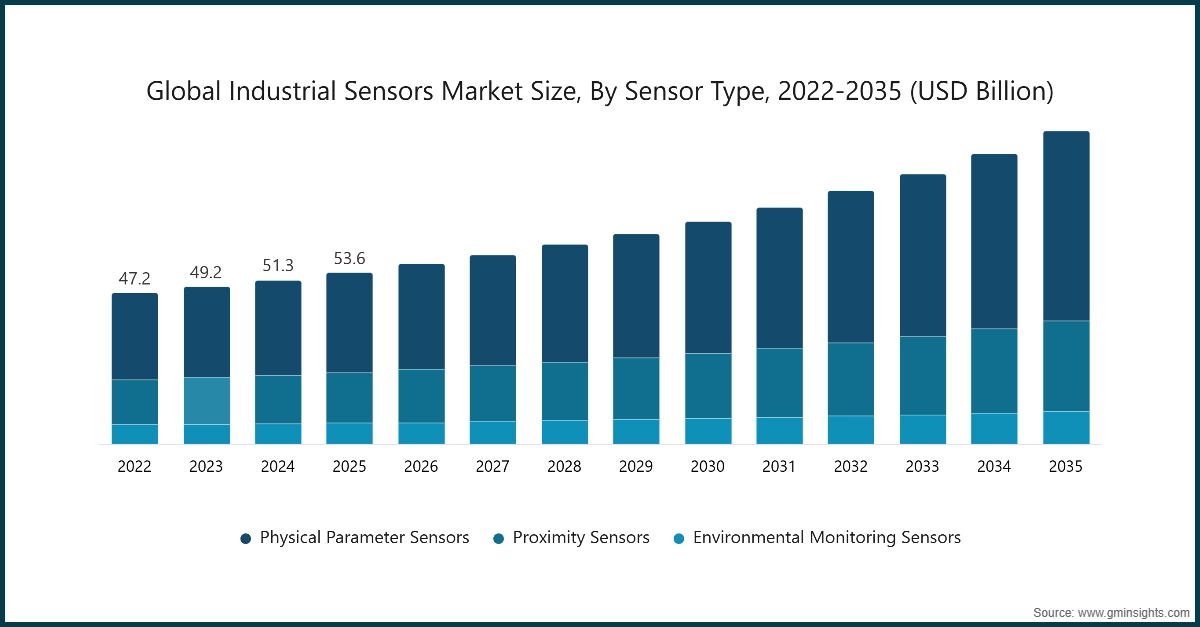
By Sensor Type, the industrial sensors market is segmented into physical parameter sensors, proximity sensors, environmental monitoring sensors, and others. The physical parameter sensors segment accounted for the largest market size of USD 31.3 billion in 2025.
- The Physical Parameter Sensors segment holds the largest market due to its critical role in real-time monitoring of industrial machinery, production processes, and equipment performance. These sensors enable early detection of mechanical, electrical, and operational anomalies, preventing downtime and ensuring efficiency across manufacturing and industrial applications.
- Physical parameter sensors provide high-precision measurements, durability under harsh operating conditions, and seamless integration with industrial automation and predictive maintenance systems. These advantages make them essential for monitoring parameters such as force, torque, pressure, vibration, and temperature, ensuring operational reliability in industrial environments.
- The Proximity Sensors segment is growing and is expected to register a 6.1% CAGR during the forecast period due to increasing demand for precise object detection, position sensing, and automation in industrial applications.
- Advancements in miniaturization, wireless connectivity, and integration with robotics and industrial IoT platforms are further improving the efficiency, accuracy, and deployment flexibility of proximity sensors, driving rapid adoption in manufacturing, logistics, and smart factory environments requiring automated monitoring and control.
Learn more about the key segments shaping this market
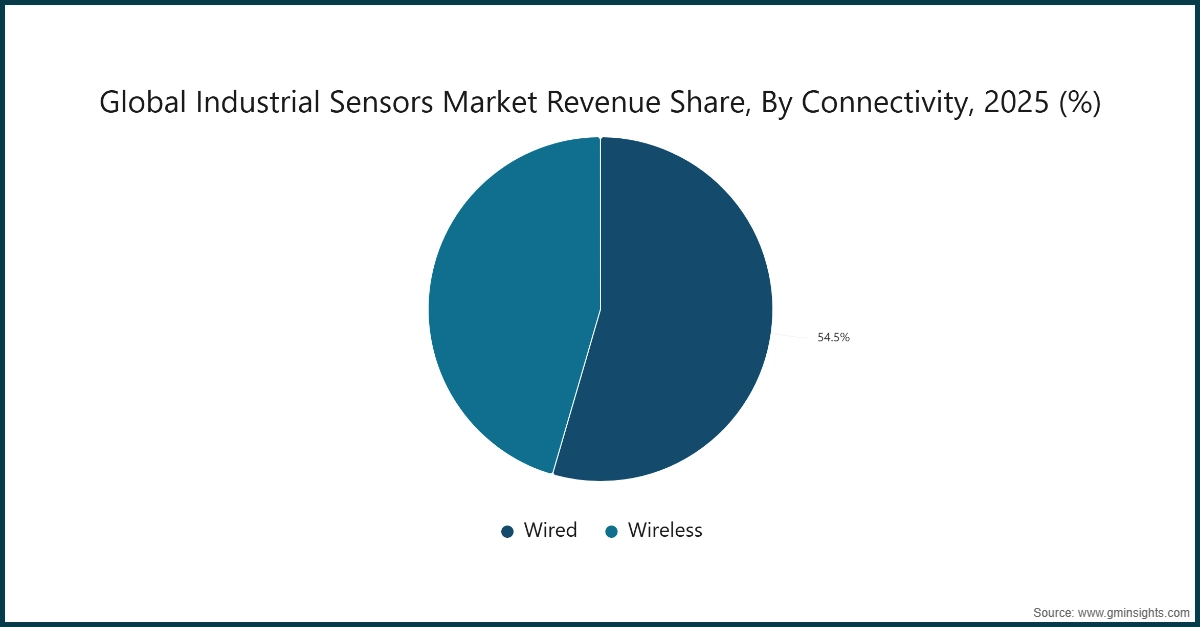
By Connectivity, the industrial sensor market is segmented into wired and wireless. The wired segment accounted for the largest market size of USD 29.2 billion in 2025.
- The wired segment holds the largest market due to its reliability, high data transmission accuracy, and robustness in industrial environments. Wired sensors are widely deployed in factories, processing plants, and energy facilities where consistent, uninterrupted data flow is critical for operational safety and efficiency.
- Wired sensors provide stable performance in harsh conditions, resistance to interference, and compatibility with existing industrial automation systems, making them essential for continuous monitoring of machinery, production lines, and critical infrastructure.
- The wireless segment is the fastest-growing and is expected to register a 6.7% CAGR during the forecast period due to increasing adoption of industrial IoT, smart factory automation, and remote monitoring solutions. Advancements in low-power wireless protocols, edge computing, and secure data transmission are driving the rapid adoption of wireless sensors, enabling flexible deployment, real-time monitoring, and predictive maintenance in modern industrial environments.
By End-use Industry, the industrial sensors market is segmented into multiple sectors, with Manufacturing & Industrial Automation accounting for the largest market size of USD 14.7 billion in 2025.
- The Manufacturing & Industrial Automation segment holds the largest market due to high adoption of sensors for process control, robotics, predictive maintenance, and operational efficiency. Industrial sensors are critical for monitoring equipment, optimizing production lines, and ensuring safety and quality standards across diverse manufacturing processes.
- This segment benefits from integration with industrial IoT platforms, automation systems, and smart factory solutions, enabling real-time monitoring and data-driven decision-making. North America and Europe lead in deployment of advanced sensors, while Asia Pacific is expanding rapidly due to increasing industrialization and adoption of Industry 4.0 technologies.
- The Pharmaceuticals segment is the fastest-growing and is expected to register a CAGR of 7.5% during the forecast period due to increasing demand for precision monitoring, quality assurance, and regulatory compliance in drug manufacturing and biotechnology processes.
- Advancements in high-precision sensors, wireless monitoring, and automation technologies are driving rapid adoption in pharmaceuticals, enabling real-time process monitoring, contamination prevention, and accurate environmental control, which are critical for patient safety and product efficacy.
North American Industrial Sensor Market
Looking for region specific data?
The North American industrial sensors market dominated over 35.2% of the revenue share in 2025.
- The North American market is growing steadily, fueled by the increasing adoption of smart manufacturing, industrial automation, and connected factory solutions. Companies are investing in real-time monitoring, predictive maintenance, and process optimization technologies to improve operational efficiency, reduce downtime, and enhance safety.
- Integration of IoT, IIoT, AI, and advanced analytics across manufacturing, energy, and aerospace sectors is further driving sensor deployment. Rising focus on sustainability, energy efficiency, and regulatory compliance is creating opportunities for high-precision and application-specific industrial sensors.
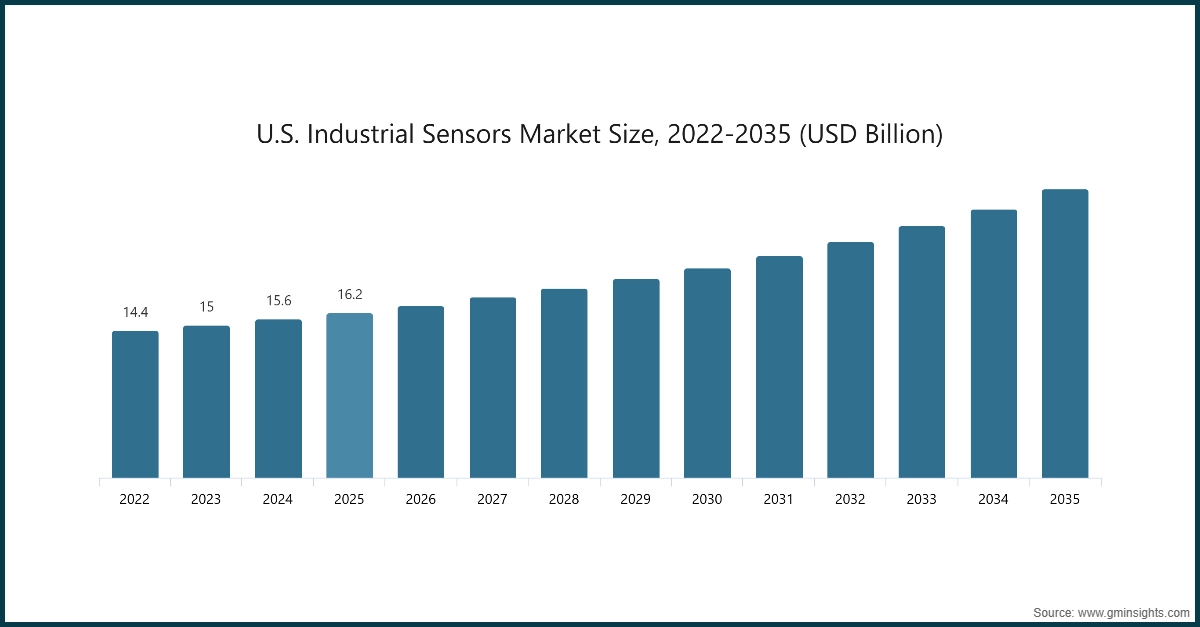
The U.S. industrial sensors market was valued at USD 14.4 billion and USD 15 billion in 2022 and 2023, respectively. The market size reached USD 16.2 billion in 2025, growing from USD 15.6 billion in 2024.
- The U.S. market is expanding due to strong investments in smart manufacturing, industrial automation, and renewable energy infrastructure. Increasing demand for real-time monitoring, predictive maintenance, and connected sensor solutions is driving adoption across manufacturing, energy, aerospace, and logistics sectors.
- Major modernization initiatives in U.S. industrial facilities, including IIoT integration and deployment of advanced analytics platforms, have enhanced operational efficiency, reduced downtime, and improved process reliability, highlighting significant growth opportunities for industrial sensor technologies.
Europe Industrial Sensor Market
- Europe’s industrial sensors industry is benefiting from stringent regulatory compliance, safety standards, and environmental monitoring requirements. Adoption of smart manufacturing, IIoT-enabled sensors, and predictive maintenance solutions is rising across manufacturing, energy, aerospace, and logistics sectors.
- Investment in advanced sensor technologies, AI-driven automation, and connected factory solutions is creating additional growth opportunities. The market is further supported by a focus on improving operational efficiency, reducing downtime, and enhancing safety and sustainability through precision sensor deployment.
The industrial sensors market in Germany is driven by the country’s robust manufacturing, energy, and aerospace sectors, which are investing heavily in cutting-edge sensor technologies.
- Germany is a leading market in Europe due to its advanced industrial infrastructure and strong focus on smart factories, predictive maintenance systems, and IIoT-enabled sensors. Advanced industrial sensors are increasingly deployed to ensure operational efficiency, process reliability, and compliance with stringent safety and environmental regulations.
- Government incentives supporting smart manufacturing, energy efficiency, and digital transformation, along with growing industrial automation initiatives, are driving sensor adoption. Focus on integrating AI, IoT, and connected analytics into industrial operations is expected to sustain market growth in the coming years.
Asia Pacific Industrial Sensor Market
- Asia Pacific is witnessing rapid industrial sensors industry growth driven by infrastructure expansion, rising industrial production, and increasing investments in manufacturing, energy, and aerospace sectors. Advanced sensor technologies and predictive analytics are becoming critical for operational efficiency, equipment reliability, and safety.
- The region is also focusing on integrating IoT, AI, and smart factory solutions to enable real-time monitoring, predictive maintenance, and process optimization. Investment in renewable energy, automated manufacturing systems, and connected industrial operations is further boosting industrial sensor adoption across the region.
The China industrial sensors market is estimated to grow at a CAGR of 8.2% within the Asia Pacific region.
- China is emerging as a major market due to modernization of manufacturing facilities, smart industrial initiatives, and government policies supporting advanced sensor technologies. IIoT-enabled sensors, AI-driven monitoring, and predictive maintenance solutions are being increasingly deployed across manufacturing, energy, and aerospace sectors.
- The focus on operational safety, efficiency, and predictive process management in industrial, energy, and aerospace applications is driving demand. Expansion of industrial infrastructure, integration of AI and IoT, and modernization of production systems are expected to accelerate market growth.
Latin American Industrial Sensor Market
- Brazil’s industrial sensors industry growth is supported by rising investments in manufacturing infrastructure, energy projects, and aerospace facilities. Industrial operations are increasingly relying on real-time monitoring, predictive maintenance, and smart sensor solutions to enhance operational efficiency and safety.
- Regulatory focus on industrial safety, environmental sustainability, and energy efficiency is creating opportunities for advanced sensor solutions. The integration of IIoT-enabled sensors, AI-driven monitoring systems, and connected industrial platforms is expected to further drive market expansion.
Middle East and Africa Industrial Sensor Market
- South Africa and other regional markets are experiencing gradual industrial sensors industry growth as manufacturing, energy, and aerospace sectors adopt advanced sensor technologies. Focus on predictive maintenance, process monitoring, and operational reliability is driving sensor adoption.
- Increasing investments in smart factories, renewable energy systems, and industrial automation projects are creating new opportunities. The market is expected to benefit from the growing emphasis on regulatory compliance, environmental standards, and digital transformation in industrial operations.
Industrial Sensor Market Share
The competitive landscape of the industrial sensors industry is characterized by moderate consolidation, high technological intensity, and a strong focus on precision, reliability, and real-time data acquisition. Key players such as Honeywell International Inc. (1.1%), Siemens AG (0.7%), Bosch Group (0.7%), Emerson (0.6%), and TE Connectivity (0.3%) collectively account for a significant portion of the market, reflecting a semi-consolidated structure where major industrial sensor providers coexist with specialized technology firms.
Market participants primarily compete on sensor accuracy, durability under harsh industrial conditions, connectivity options, and integration capabilities with automation and industrial IoT systems. Leading companies focus on continuous innovation in physical parameter sensors, proximity sensors, environmental monitoring solutions, and smart diagnostic modules to serve manufacturing, pharmaceuticals, energy, and process industries.
Major players invest heavily in R&D, advanced sensor manufacturing facilities, and automated testing systems to enhance product reliability and precision. Strategic collaborations with industrial automation providers, manufacturing OEMs, energy operators, and process industry stakeholders are widely adopted to expand technological capabilities, optimize sensor performance, and accelerate adoption of predictive maintenance, process efficiency, and safety solutions.
Industrial Sensor Market Companies
Prominent players operating in the industrial sensors industry are as mentioned below:
- ABB Ltd.
- Allegro MicroSystems, Inc.
- Balluff GmbH
- Banner Engineering
- Bosch Group
- Endress+Hauser Group Services AG
- Emerson Electric Co.
- Honeywell International Inc.
- ifm electronic gmbh
- Keyence Corporation
- LEM Holding
- Melexis
- OMRON Corporation
- Panasonic Industry
- Pepperl+Fuchs SE
- Rockwell Automation, Inc.
- SICK AG
- Sensatec GmbH
- Sensata Technologies
- Schneider Electric SE
- Siemens AG
- STMicroelectronics
- TE Connectivity
- Texas Instruments
- Turck Group
- Honeywell International Inc.
Honeywell International Inc. is a leading player in the global industrial sensors market with a market share of approximately 1.1%. The company specializes in high-precision sensors for manufacturing, processing automation, energy, and industrial applications, including vibration, temperature, pressure, and flow monitoring solutions. Honeywell focuses on reliability, accuracy, and real-time data integration, enabling predictive maintenance, process optimization, and operational efficiency. Continuous investments in R&D, advanced sensor technologies, and collaborations with industrial automation providers strengthen its position as a market leader in innovative and high-performance sensor solutions.
Siemens AG holds a market share of around 0.7% in the global industrial sensors market. The company provides physical parameter sensors, environmental monitoring sensors, and proximity sensing solutions for manufacturing, energy, and industrial automation sectors. Siemens emphasizes integration with industrial IoT platforms, automation systems, and smart factory solutions, enabling real-time monitoring, predictive maintenance, and enhanced operational performance. Strategic partnerships with industrial OEMs and energy operators allow Siemens to expand its global footprint and maintain a competitive edge in advanced industrial sensor technologies.
Bosch Group commands approximately 0.7% of the global industrial sensors market. The company delivers smart sensor solutions for manufacturing, automotive, and process industries, including proximity, pressure, and environmental sensors. Bosch focuses on precision, durability, and IoT-enabled monitoring capabilities to enhance operational efficiency and process reliability. Investments in R&D, connected sensor technologies, and Industry 4.0 integration strengthen Bosch’s ability to provide innovative, high-performance sensor solutions across global industrial applications.
Industrial Sensor Market Report Attributes
| Key Takeaway | Details |
|---|---|
| Market Size & Growth | |
| Base Year | 2025 |
| Market Size in 2025 | USD 53.7 Billion |
| Market Size in 2026 | USD 56.3 Billion |
| Forecast Period 2026-2035 CAGR | 6.4% |
| Market Size in 2035 | USD 98.1 Billion |
| Key Market Trends | |
| Drivers | Impact |
| Increasing Adoption of Industrial Automation and Smart Manufacturing | Drives demand advanced sensors that enable automated process control, real-time monitoring, and seamless integration across production lines, improving operational efficiency and reducing manual intervention. |
| Integration of IoT and Industrial Internet of Things (IIoT) Technologies | Fuels adoption of connected sensors that provide real-time data analytics, remote monitoring, and smart decision-making, supporting predictive insights and digital transformation initiatives across industries. |
| Rising Demand for Predictive Maintenance and Real-Time Monitoring | Encourages deployment of high-precision sensors that track equipment health, detect anomalies early, and prevent unplanned downtime, thereby enhancing productivity and reducing operational costs. |
| Expansion in Renewable Energy and Advanced Power Generation Systems | Increases the need for specialized sensors to monitor turbine performance, energy output, and environmental conditions, supporting efficient, sustainable, and reliable energy production. |
| Stringent Regulatory Compliance and Safety Standards | Drives demand for sensors that ensure adherence to safety, quality, and environmental regulations, enabling risk mitigation, enhanced operational safety, and compliance reporting across industrial operations. |
| Pitfalls & Challenges | Impact |
| High Initial Investment and Integration Complexity | The cost of deploying advanced sensors, along with integrating them into existing industrial systems, can be high, creating barriers for small and medium-sized enterprises (SMEs). |
| Data Security and Reliability Concerns | With increasing adoption of IoT- and IIoT-enabled sensors, sensitive operational data can be vulnerable to cyber threats. |
| Opportunities: | Impact |
| Adoption of Smart Factories and Industry 4.0 Initiatives | Growing implementation of smart manufacturing and automated production lines presents opportunities for industrial sensors to enable real-time monitoring, process optimization, and predictive maintenance, boosting efficiency and reducing downtime across industrial operations. |
| Expansion in Renewable Energy and Advanced Power Systems | The global shift toward renewable energy and hybrid power generation creates opportunities for sensors to monitor turbine performance, energy output, and environmental conditions, supporting sustainable operations, regulatory compliance, and improved reliability in power infrastructure. |
| Market Leaders (2025) | |
| Market Leader |
~1.1% Market Share |
| Top Players |
Collective Market Share is ~3.4% |
| Competitive Edge |
|
| Regional Insights | |
| Largest Market | North America |
| Fastest growing market | Asia Pacific |
| Emerging countries | China, India, Brazil, Mexico, South Africa |
| Future outlook |
|
What are the growth opportunities in this market?
Industrial Sensor Industry News
- In September 2025, Honeywell announced the launch of its 13MM Pressure Sensor, designed for high-purity manufacturing environments such as semiconductor fabrication. The sensor offered accurate performance under high-pressure and high-temperature conditions with minimal drift, complying with SEMI F20 standards to reduce defects and improve yield. It was also applicable to industries including solar, biopharmaceuticals, advanced optics, and food production, supporting precise, contamination-free operations and enhanced manufacturing reliability.
- In September 2024, TE Connectivity completed the acquisition of Sense Eletrônica Ltda, a leading Brazilian manufacturer of factory and process automation sensors. The acquisition expanded TE’s portfolio to include inductive and capacitive position sensors, photoelectric sensors, valve automation products, and connectivity solutions, strengthening its presence in Latin America. TE aimed to accelerate local business growth, bring Sense’s products to a global customer base, and maintain the company’s long-standing commitment to quality and service.
The industrial sensors market research report includes in-depth coverage of the industry with estimates and forecast in terms of revenue in (USD Billion) & Volume (Units) from 2022 – 2035 for the following segments:
Market, By Sensor Type
- Physical Parameter Sensors
- Temperature Sensors
- Pressure Sensors
- Flow Sensors
- Level Sensors
- Position & Motion Sensors
- Proximity Sensors
- Inductive & Capacitive Proximity
- Optical / Photoelectric Sensors
- Environmental Monitoring Sensors
- Humidity & Moisture Sensors
- Vibration & Condition Sensors
- Gas & Chemical Sensors
Market, By Technology
- MEMS (Micro-Electro-Mechanical Systems)
- Optical/Photonic
- Electrochemical
- Mechanical
- Electromagnetic
- Ultrasonic/Acoustic
- Others
Market, By Connectivity
- Wired
- Wireless
Market, By End-use Industry
- Chemicals & Petrochemicals
- Energy & Power
- Food & Beverage
- Manufacturing & Industrial Automation
- Metals & Mining
- Oil & Gas
- Pharmaceuticals
- Automotive & Transportation
- Water & Wastewater Treatment
- Others
The above information is provided for the following regions and countries:
- North America
- U.S.
- Canada
- Europe
- Germany
- UK
- France
- Spain
- Italy
- Netherlands
- Asia Pacific
- China
- India
- Japan
- Australia
- South Korea
- Latin America
- Brazil
- Mexico
- Argentina
- Middle East and Africa
- South Africa
- Saudi Arabia
- UAE
Frequently Asked Question(FAQ) :
What was the market size of the industrial sensor in 2025?
The market size was USD 53.7 billion in 2025, with a CAGR of 6.4% expected through 2035. The growth is driven by advancements in manufacturing, energy, and aerospace sectors, along with increasing adoption of smart technologies.
What is the projected value of the industrial sensor market by 2035?
The market is poised to reach USD 98.1 billion by 2035, fueled by the integration of Industry 4.0, smart factories, and connected sensor technologies.
What is the expected size of the industrial sensor industry in 2026?
The market size is projected to reach USD 56.3 billion in 2026.
How much revenue did the physical parameter sensors segment generate in 2025?
The physical parameter sensors segment generated approximately USD 31.3 billion in 2025, due to its critical role in real-time monitoring of industrial machinery and processes.
What was the valuation of the wired segment in 2025?
The wired segment accounted for USD 29.2 billion in 2025, led by its reliability, high data transmission accuracy, and robustness in industrial environments.
What is the growth outlook for the manufacturing & industrial automation segment?
The manufacturing & industrial automation segment accounted for USD 14.7 billion in 2025.
Which region leads the industrial sensor sector?
North America leads the market, holding a 35.2% share in 2025. Growth is propelled by the adoption of smart manufacturing, industrial automation, and connected factory solutions.
What are the upcoming trends in the industrial sensor market?
Trends include the adoption of Industry 4.0, connected sensors for digital twins and robotics, predictive maintenance, regulatory compliance, and sustainability-focused solutions such as environmental monitoring and energy efficiency.
Who are the key players in the industrial sensor industry?
Key players include ABB Ltd., Allegro MicroSystems, Inc., Balluff GmbH, Banner Engineering, Bosch Group, Endress+Hauser Group Services AG, Emerson Electric Co., Honeywell International Inc., ifm electronic gmbh, Keyence Corporation, LEM Holding, and Melexis.
Industrial Sensor Market Scope
Related Reports