Summary
Table of Content

Industrial Protective Fabrics Market
Get a free sample of this report
Form submitted successfully!
Error submitting form. Please try again.
Thank you!
Your inquiry has been received. Our team will reach out to you with the required details via email. To ensure that you don't miss their response, kindly remember to check your spam folder as well!
Request Sectional Data
Thank you!
Your inquiry has been received. Our team will reach out to you with the required details via email. To ensure that you don't miss their response, kindly remember to check your spam folder as well!
Form submitted successfully!
Error submitting form. Please try again.
Industrial Protective Fabrics Market Size
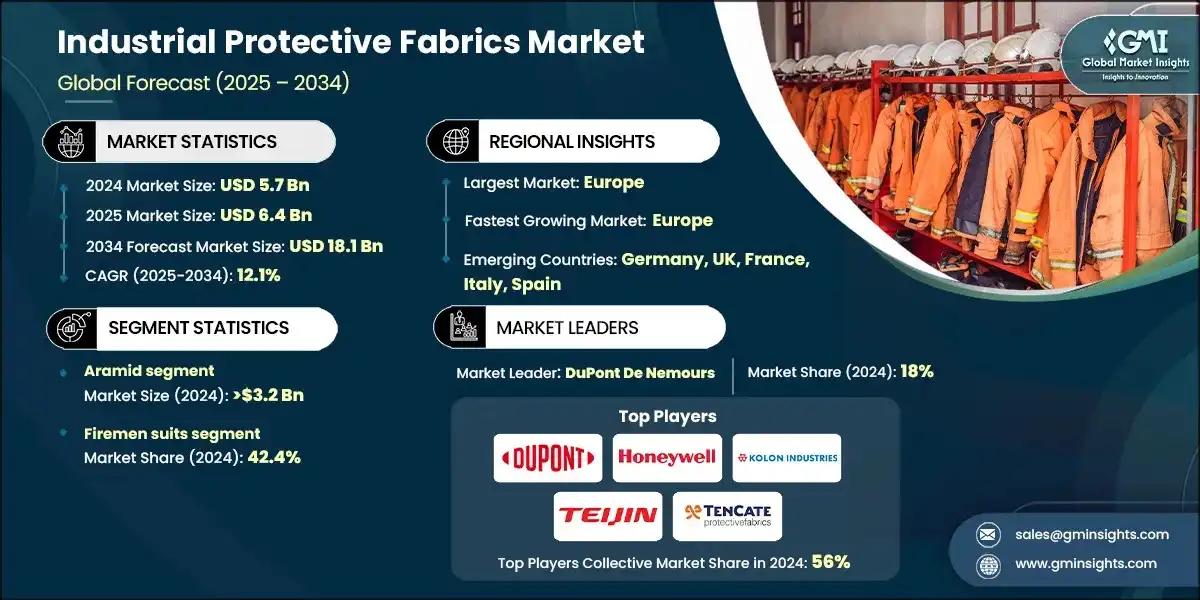
According to a recent study by Global Market Insights Inc., the global industrial protective fabrics market was estimated at USD 5.7 billion in 2024. The market is expected to grow from USD 6.4 billion in 2025 to USD 18.1 billion in 2034, at a CAGR of 12.1%.
Industrial Protective Fabrics Market Key Takeaways
Market Size & Growth
- 2024 Market Size: USD 5.7 Billion
- 2025 Market Size: USD 6.4 Billion
- 2034 Forecast Market Size: USD 18.1 Billion
- CAGR (2025–2034): 12.1%
Key Market Drivers
- Growing industrial activities driving demand.
- Advanced nanotechnology integration.
- Large workforce and stricter safety regulations.
- Sustainability drives fabric innovation.
Challenges
- Cost and production complexity.
- Material performance limitations.
Opportunity
- Integration of smart technologies.
- Sustainability-driven demand.
- Demand for enhanced comfort and protection.
Key Players
- Market Leader: DuPont De Nemours led with over 18% market share in 2024.
- Leading Players: Top 5 players in this market include DuPont De Nemours, Honeywell International Inc., KOLON Industries, Teijin Ltd., TenCate Fabrics EU, which collectively held a market share of 56% in 2024.
Get Market Insights & Growth Opportunities
- Industrial protective fabric is specialized textile used for offering safety and resistance in unsafe working environments. Protective fabric does not constitute everyday wear, but it is manufactured for protection from threats such as fire, chemicals, heat, electrical arcs, as well as mechanical abrasions. Such fabrics are essential in industries such as oil & gas, mining, construction, and utilities, where exposure to hazardous conditions is the norm and safety compliance is non-negotiable manufacturers chemical production.
- The market for these fabrics is steadily rising due to government regulations and increased consciousness on workplace safety. Stringent occupational safety norms imposed by governments and international organizations have made it mandatory for employers to invest in better personal protective equipment. Now, even industries have started turning their attention toward improving and strengthening the corporate safety of their employees in high-risk areas. Another factor contributing to demand is the growing number of other industries shifting toward sustainable practices and long-lasting materials, thereby making the demand for protective fabrics on top of performing under extreme conditions and, simultaneously, being environmentally durable.
- There is tremendous growth for aramid fibers like Kevlar and Nomex, considering good flame resistance, lightweight, and ability to withstand high temperatures. They are especially preferred for firefighting, military, and oilfield operations. At the same time, aggressively penetrating this market are chemically resistant polyolefins and mechanically stout polyamide resins in pharmaceutical labs and manufacturing plants. Applications having fire and chemical hazards are driving this market due to an increased number of fire accidents and stringent compliance demands of chemical handling.
- Technological transformations play a vital role in extending the application of industrial protective fabrics. The incorporation of smart textiles equipped with features to detect the condition of the environment, the person’s health, or the level of exposure-the systems leap forward in worker protection. Advances using nanotechnology also offer textiles with greater resistance to flames, moisture, and breathable comfort, thus pampering the users with safety as well as comfort. These developments could be instrumental in modifying the offerings of the manufacturers for the niche markets concerning global safety standards.
To get key market trends
Industrial Protective Fabrics Market Trends
- Increased awareness of workplace safety and regulatory policies augmenting with time is the major driver for market growth. The industries become more aware of the danger of evolving hazards and are therefore demanding more advanced protection textiles.
- In the chemical and oil & gas sectors, there is recognition for fabrics that offer enhanced resistance to multiple threats over the entitlement of resistance against a specific hazard, indicating a greater emphasis on total protection. Therefore, the heightened concern regarding safety standards has a direct relationship with apparently market expansion, where companies prioritize upgrades in protective solutions.
- Technological improvements have been the most vital force driving growth within this market, contributed specifically by the innovation of high-performance fibers and treatments. Such materials have aramid fibers where durability and stain resistance are usually incorporated for industry standards through nano-coatings.
- Innovation in fabric layering technologies improves both protection and comfort in wearables while addressing the already existing pain points regarding wearability. Thus, these improvements translate to gear that workers will be using them more often, hence improving their use and ultimately resulting in industrial protective fabrics market growth.
- Smart technologies are incorporated into protective textiles. Using sensors, companies can monitor environmental conditions such as those from toxic gas exposure, temperature, and physiological parameters such as heart rate. Some manufacturers add sensors to their gloves to alert workers of chemical contact or excessive heat through the embedded sensors. This combination of textiles with real-time measuring technology represents a paradigm shift from passive to active safety management, providing immediate feedback to users on the equipment and increasing general confidence regarding PPE, thus driving demand.
- Manufacturing processes are also changing constantly to adapt to these advancements and requirements from regulatory bodies. Automated and precise production lines hence lead to the efficient application of advanced coatings and fiber blends. It is increasingly stringent in terms of regulatory compliance with many countries necessitating various certifications that put numerous hazard resistances to the test.
Industrial Protective Fabrics Market Analysis
Learn more about the key segments shaping this market
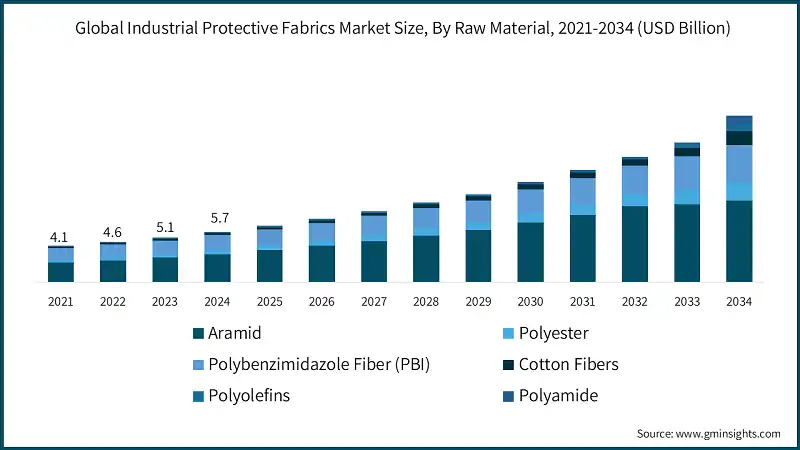
Based on raw material, the market is divided into aramid, polyester, polybenzimidazole fiber (PBI), cotton fibers, polyolefins and polyamide. The aramid segment crossed USD 3.2 billion in 2024 and is expected to grow at a CAGR of over 13.2% through 2034.
- Aramid fibers currently have the largest segment pertaining to industrial protective fabrics in terms of growth. Their significant heat resistance, flame retardancy, and strength make them suitable for high-risk industries such as oil & gas, firefighting, and electrical utilities. These segments have seen an increase in safety regulation enforcement, driving companies to implement their advanced protective gear and fueling demand for aramid-based fabrics.
- Cotton fibers and polyester have carved their niche in the market owing to their low cost and comfort. However, these materials are mainly used in low-risk protective clothing or layered protective systems. Cotton fibers and polyester, when believed to offer crosses of danger, do not possess the inherent protective properties required in harmful environments, thus limiting their growth potential. PBI and polyamide fibers have some niche advantages in chemical resistance and thermal stability, but high production costs leave little opportunity for widespread adoption.
Learn more about the key segments shaping this market
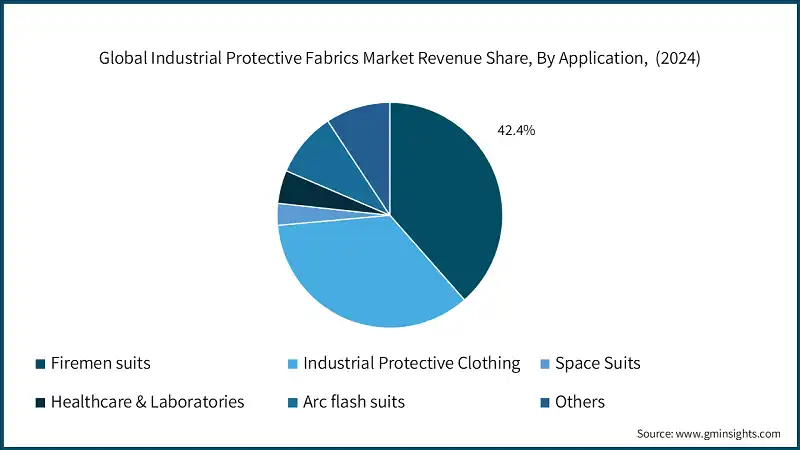
Based on application, industrial protective fabrics market is segmented into firemen suits, industrial protective fabrics, space suits, healthcare & laboratories, arc flash suits and others. The firemen suits segment dominates the market by 42.4% in 2024.
- Segment which holds the highest share now is the industrial protective apparel segment, which has been demonstrating growth steadily as it is widely used across highly risky industries such as construction, manufacturing, oil & gas, and chemicals. They require protective textiles which are durable and multi-functional against mechanical, thermal, and chemical hazards. Increasing awareness of workplace safety and stringent enforcement of industrial safety regulations have forced employers to invest in reliable high-quality protective garments for day-to-day use, making this segment a salient driver of market demand.
- Firemen suits and arc flash suits also growing as increasing urban infrastructure, electrical networks, and fire hazards globally. Firefighters and electrical utility workers need very specific fabrics that can resist heat and flame, as well as insulate. The healthcare & laboratories segment has been revived, especially in the post-pandemic period, because of the increased demand for barrier-protective clothing in medical, diagnostic, and pharmaceutical environments. Space suits are almost niches, but innovation in performance fabrics for really extreme conditions pushes forward developments that open new opportunities in the whole field. Each application refers to a specific need, but the broad utility and regulatory backing make industrial protective fabrics the leading segment.
Looking for region specific data?
North America Industrial Protective Fabrics Market
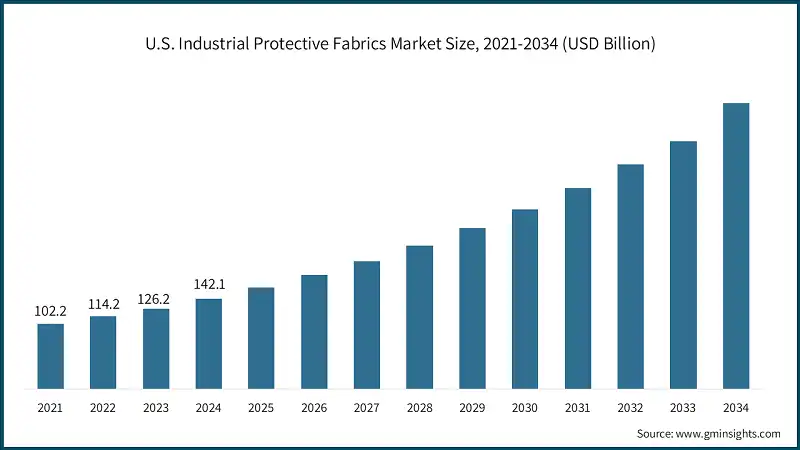
U.S. dominated industrial protective fabrics industry in North America with around 86.5% share and generated USD 142.1 billion in revenue in 2024.
- In North America industrial protective fabrics owes its ongoing demand from heavy industries such as oil & gas, utilities, construction, and defense. Across the entire region, worker safety regulations are vigorously enforced; government bodies such as OSHA (Occupational Safety and Health Administration) maintain high compliance standards. Also, the strong innovative capacity and tendency toward smart and sustainable materials in the region position North America as a key global hub for advanced protective textiles. U.S. plays a leading role, supported by its established manufacturing capabilities and strong institutional support for technological advancement.
- U.S. accounts for large industrial base with consistent safety regulatory enforcement and aggressive investments in smart textile innovation. Development of intelligent, sensor-integrated protective materials for workers and military personnel has been accelerated due to public-private partnerships such as Advanced Functional Fabrics of America (AFFOA), which is supported by the Department of Defense and research institutions such as MIT. Domestic manufacturers in U.S. have expanded their capacity to meet needs of civilian and federal, for high-performance flame-resistant and chemical protective gear. This whole ecosystem of regulation, innovation, and infrastructure will keep the U.S. at the forefront of demand and development for industrial protective fabrics until 2034.
Europe Industrial Protective Fabrics Market
The demand for industrial protective fabrics in Germany is expected to witness significant growth between 2025 and 2034.
- In the market of industrial protective fabrics in Europe, significant changes are occurring. Stringent regulation regarding safety for workers has become increasingly tighter across the European continent. The pressure exerted by the European Union fuels the Green Deal and the Strategy for Sustainable and Circular Textiles, compelling manufacturers to shift from traditional methods to recyclable and non-toxic long-lasting protective textiles. As legislation has become strict in various fields, including construction, energy, and manufacturing, there comes an increasing need for multifunctional fabrics that satisfy safety and environmental requirements.
- Industrial protective fabrics market in Germany is projected to be significant growth, supported largely by the fact that Germany possesses a highly industrialized economy with great emphasis placed on occupational safety. Since Germany serves as the backbone of manufacturing in Europe, the country has some of the most stringent safety standards in place through its German social accident insurance establishment (DGUV), which mandates the use of certified protective clothing in several high-risk industries. Other factors facilitating the development of advanced-generation fabrics, which provide multi-hazard protection and have less impact on the environment, are the country's well-developed textile engineering sector and the early adoption of eco-friendly manufacturing techniques. This combination of industrial demand, regulatory support, and technological leadership puts Germany in the forefront of the European protective fabrics market for the next decade.
Asia Pacific Industrial Protective Fabrics Market
The industrial protective fabrics industry in China is expected to experience significant and promising growth from 2025 to 2034.
- Industrial growth is rapid across the Asia Pacific region, with the safety of the worker and the modernization of factories and stricter labor regulations. Rising investments in technical textiles, including protective fabrics, are being poured from countries such as China and India and Japan. The demand for high-performance materials resistant to heat, chemicals, and mechanical force is now driven by increased construction, mining, and chemical activity.
- China is expected to experience growth in the industrial protective fabrics market, with industrialization along with rising workplace protection regulations. Striving for local innovation in high-end manufacturing including technical and functional textiles, the country "Made in China 2025" initiative is helping China to grow its market. Local governments have begun enforcing stricter inspections of labor safety, especially in high-risk industries such as construction, oil and gas, and heavy machinery. Investment by China in smart textile technology and automation further helps in the development of fabrics with better flame resistance, durability, and chemical protection. Due to domestic demand and increasing export potential, China strengthens its position as a producer and consumer in the global protective fabrics market.
Middle East & Africa Industrial Protective Fabrics Market
The UAE market for industrial protective fabrics is expected to experience significant and promising growth from 2025 to 2034, owing to the increased investment in these sectors: infrastructure, oil & gas, construction, and public utilities. One of the significant effects that such diversification in economies brings would be an increasing emphasis on safety for the workforce and modern protective gear, driven by the expansion of industrial capacity.
- Regulatory frameworks differ across countries; however, they all have a general trend toward pushing for international compliance in safety, this creates opportunities for suppliers of high-performance protective clothing. Those large multinational manufacturers are coming to the region with such niche offerings highly suited to extreme climates and hazardous workplace conditions common to the region.
- Rapid industrialization and increasing infrastructure projects contribute to the growth of the UAE industrial protective fabric market. The demand for better protective gear can be mostly attributed to the changing consciousness concerning the safety of workers and more stringent enforcement of safety regulations. Further, investments in technology development and modernization of industrial processes act as growing factors for this market.
Latin America Industrial Protective Fabrics Market
The industrial protective fabrics industry in Brazil is expected to experience significant and promising growth from 2025 to 2034.
- The Latin America market for industrial protective textiles is gradually gaining momentum, owing to increasing industrial activity in various sectors such as mining, construction, and manufacturing. Awareness of worker safety and improvements in regulatory frameworks are necessitating the use of advanced protective textiles. Economic development and infrastructure projects, among others, are also positively influencing the demand trend for high-performance protective fabrics throughout the region.
- Brazil has a rapidly growing market for industrial protective fabrics, driven largely by its strong presence in the mining, agricultural, and heavy manufacturing industries that require a reliable safety net for their workers. An increasing focus on occupational safety enforcement coupled with an increase in efforts directed towards improving workplaces has seen most companies upgrade protective clothing in their factories. Furthermore, on-going infrastructural development projects continue to drive demand for industrial protective fabrics in the country and will sustain market growth up to 2034.
Industrial Protective Fabrics Market Share
- The top 5 companies in industrial protective fabrics industry are DuPont De Nemours, Honeywell International Inc., KOLON Industries, Teijin Ltd., TenCate Fabrics EU. contributing around 56% of the market in 2024.
- The key players in the industrial protective fabrics industry keep themselves entrenched through long-term continuous research and development, where the emphasis has been on innovative energy-conscious formulations that enhance fabric performance and minimize energy costs of production. Staying ahead of the changing safety and environmental regulations is essential to foster the trust of industries in need of compliant protective gear.
- Multifunctional coatings provide the right combination of UV protection, waterproofing, and self-cleansing. These features are necessary for people working in harsher outdoor areas as UV protection extends life, waterproofing is responsible for comfort and safety since it is certainly obvious that the presence of rain causes inconvenience, while self-cleaning reduces maintenance. The coatings can solve complex needs of construction and industrial workers, thus making their products much more marketable and effective in real-world conditions.
- Worldwide presence and strong distribution networks give companies exceptional advantages. It allows them to serve various markets efficiently. Their commitment to making environmentally friendly products, including low-VOC coatings and sustainable materials, aligns with a growing global emphasis on eco-conscious products. Such a commitment towards sustainability will help in positioning the products differently and meeting consumer and regulatory expectations that are ever changing.
- These market players are also consistently investing heavily in product innovation and region-wise market development, especially in some of the fastest growing regions, namely APAC and North America. The demand of advanced industrial protective fabrics in these regions is mainly due to rapidly changing urban patterns, changing food habits, and advancement in agricultural technologies such as precision application methods and fertigation systems. These companies stay ahead of competition and set benchmarks for the future's growth and sustainability of the global industrial protective fabrics market by providing region specific formulations and tailored applicability solutions.
- Leading companies invest heavily in developing advanced fibers and coatings to improve durability, comfort, and protection against multiple hazards. Their R&D programs focus on energy-efficient manufacturing processes and materials that conform to changing safety standards and have the least environmental impact. Continuous innovations equip them to bring next-generation fabrics capable of high resistance against heat, chemicals, and mechanistic stress, keeping them one step ahead of competitors and geared to meet the ever-increasing demands of diverse industries.
Industrial Protective Fabrics Market Companies
Major players operating in industrial protective fabrics industry are:
- Beijing BW Protect
- Cerex Advanced Fabrics Inc.
- DuPont De Nemours
- Glen Raven Inc
- Honeywell International Inc.
- Klopman International
- KOLON Industries
- Loyal Textiles Mills Ltd.
- Milliken & Company
- Teijin Ltd
- TenCate Fabrics EU
- Tex Tech Industries
- W. Barnet GmbH & Co
- WL Gore & Associates
- DuPont De Nemours has pioneered industrial protective fabrics and is known for its flagship fibers Kevlar® and Nomex®. They are flame resistant, cut protective, and offer high durability and both exist in the firefighting, military, and industrial worlds. DuPont has invested heavily in R&D to create energy-efficient, green fabric solutions on a continuous basis so that it remains in the leadership position through the constant improvement of performance and abiding by new safety standards.
- Honeywell International Inc. offers environmentally advanced protective textiles featuring Spectra® fibers for exceptionally high cut resistance, flame retardance, and chemical protection. Their fabrics feature critical application sectors such as oil & gas, manufacturing, and emergency services.
- Teijin Ltd. is one of the largest companies working in aramid fibers and high-performance protective fabrics. These products have been developed for extreme durability, heat resistance, and chemical protection, factors usually required by industrial protective fabrics and suits for firemen. Innovative developments by Teijin focus mainly on fabric-layering technologies and on sustainable materials that contribute to wearability and acceptance, with suitable safety features, in broad sections of industry.
- TenCate Fabrics EU manufactures flame-retardant and chemical-resistant textiles for the industrial and protective clothing markets. Coating their fabrics with multifunctional coatings provides UV protection, waterproofing, and durability. With a broad focus on sustainability and regulations, TenCate opts for eco-friendly methods to conform to the stringent development standards of countries across the globe, especially in construction and heavy industry.
- KOLON Industries based in South Korea, is regarded as a prime supplier of aramid fibers and industrial protective fabrics. Their textiles provide maximum protection from heat, cuts, and chemicals, which have applications in oil & gas, manufacturing, and construction. KOLON concentrates on developing innovative blends of fiber and coatings with improved safety performance and comfort for users, and thus technological development strengthens its position within the market.
Industrial Protective Fabrics Market Report Attributes
| Key Takeaway | Details |
|---|---|
| Market Size & Growth | |
| Base Year | 2024 |
| Market Size in 2024 | USD 5.7 Billion |
| Market Size in 2025 | USD 6.4 Billion |
| Forecast Period 2025 - 2034 CAGR | 12.1% |
| Market Size in 2034 | USD 18.1 Billion |
| Key Market Trends | |
| Drivers | Impact |
| Growing industrial activities driving demand | Expansion in sectors like oil & gas, mining, and manufacturing raises demand for protective fabrics. Workers face diverse hazards requiring specialized materials. This growth fuels investments in fabrics with flame resistance, chemical protection, and durability. As industries scale, market demand for advanced protective textiles steadily increases. |
| Advanced nanotechnology integration | The adoption of nanotechnology in protective fabrics is enhancing properties such as flame resistance, water repellency, and antimicrobial protection without compromising comfort. This tech-driven enhancement is encouraging industries like oil & gas, firefighting, and healthcare to increase their procurement of smarter, longer-lasting protective textiles. |
| Large workforce and stricter safety regulations | As industries grow their labor force and enforce stronger occupational safety standards, the need for reliable protective clothing rises. This trend encourages manufacturers to develop higher-quality fabrics that comply with evolving regulations and ensure worker safety. |
| Sustainability drives fabric innovation | Industries are demanding protective fabrics that minimize environmental impact without sacrificing safety. This demand is pushing manufacturers to adopt recycled materials and bio-based fibers. As companies aim to meet stricter environmental laws and customer expectations, sustainable fabrics are becoming a core growth driver. |
| Pitfalls & Challenges | Impact |
| Cost and production complexity | High-quality protective fabrics often require advanced, costly manufacturing processes and specialized raw materials. These factors drive up prices, restricting accessibility for smaller industries and emerging markets. Consequently, this economic barrier curtails broader market expansion and innovation adoption. |
| Material performance limitations | Many industrial protective fabrics struggle to balance durability, flexibility, and comfort. When materials sacrifice comfort for protection, worker compliance drops, limiting widespread adoption. This performance gap slows market growth, as manufacturers hesitate to invest heavily without guaranteed user acceptance. |
| Opportunities: | Impact |
| Integration of smart technologies | Embedding sensors or smart fibers into protective fabrics can enhance safety by monitoring environmental hazards or wearer health in real-time. This fusion of tech and textiles opens doors for high-value products and partnerships with tech-focused industries. |
| Sustainability-driven demand | Growing environmental concerns are pushing industries to seek eco-friendly protective fabrics. Brands that develop recyclable, biodegradable, or lower-impact materials can differentiate themselves and tap into a rapidly expanding green market segment. |
| Demand for enhanced comfort and protection | Current protective fabrics often force a trade-off between safety and wearer comfort, leading to low adoption rates. This gap drives market growth for manufacturers developing fabrics that maintain high protection while improving breathability and flexibility, addressing a critical user challenge. |
| Market Leaders (2024) | |
| Market Leaders |
18% market share |
| Top Players |
Collective market share in 2024 is 56% |
| Competitive Edge |
|
| Regional Insights | |
| Largest Market | Europe |
| Fastest Growing Market | Europe |
| Emerging Country | Germany, UK, France, Italy, Spain |
| Future Outlook |
|
What are the growth opportunities in this market?
Industrial Protective Fabrics Market News
- On January 15, 2025 Marina Textil launched new high-performance fabrics recently to meet the need for wildland firefighter gear due to growing climate change that can result in wildfire. The recent textile to be released by the company, Marko AS70RS EA, enhances mobility through elastane incorporation, while Aramar V240 offers a traditional aramid blend with additional flexibility. The two materials comply with UNE-EN 16689:2017, demonstrating the company mandate of innovation, safety, and comfort for firefighters working in conditions that are becoming increasingly extreme.
- On June 11, 2024, Stahl announces that it has developed an Integra® performance coating portfolio that will feature a new product, Stainless Integra® Dry 725, which is a fluorine-free waterproof coating for technical materials. The product is developed by StayDry DWR technology, has very high-water repellency and durability and is compatible with other coatings for application in camping and luggage. It supports low-temperature curing, reducing environmental impact while maintaining fabric quality. This modular Integra ® toolbox by Stahl is meant to provide customized coating solutions compliant to regulatory demands while improving mechanical performance across various technical textile markets.
The industrial protective fabrics market research report includes in-depth coverage of the industry with estimates & forecasts in terms of revenue (USD Billion) and volume (Kilo tons) from 2021 to 2034, for the following segments:
Market, By Raw Material
- Aramid
- Polyester
- Polybenzimidazole Fiber (PBI)
- Cotton Fibers
- Polyolefins
- Polyethylene
- Polypropylene
- Polyamide
Market, By Application
- Firemen suits
- Flame Resistance
- Flame Retardant
- Industrial Protective Fabrics
- Clean Room Clothing
- Mechanical Protective Clothing
- Chemical Defending Garment
- Space Suits
- Healthcare & Laboratories
- Arc flash suits
- Others
The above information is provided for the following regions and countries:
- North America
- U.S.
- Canada
- Europe
- Germany
- UK
- France
- Italy
- Spain
- Rest of Europe
- Asia Pacific
- China
- India
- Japan
- Australia
- South Korea
- Rest of Asia Pacific
- Latin America
- Brazil
- Mexico
- Argentina
- Rest of Latin America
- MEA
- South Africa
- Saudi Arabia
- UAE
- Rest of MEA
Frequently Asked Question(FAQ) :
What is the market size of the industrial protective fabrics in 2024?
The market size was USD 5.7 billion in 2024, with a CAGR of 12.1% expected through 2034 driven by rising demand from oil & gas, mining, and manufacturing sectors for worker protection against diverse hazards.
What is the projected value of the industrial protective fabrics market by 2034?
The industrial protective fabrics market is expected to reach USD 18.1 billion by 2034, propelled by stringent safety regulations, nanotechnology integration, and sustainability-driven fabric innovation.
What is the current industrial protective fabrics market size in 2025?
The market size is projected to reach USD 6.4 billion in 2025.
What was the market share of firemen suits application in 2024?
Firemen suits dominated the market with 42.4% share in 2024, supported by increasing urban infrastructure, electrical networks, and fire hazards globally.
What is the growth outlook for aramid segment from 2025 to 2034?
Aramid segment crossed USD 3.2 billion in 2024, with a CAGR of over 13.2% through 2034, due to excellent heat resistance and flame retardancy properties. and is expected to grow at
Which region leads the industrial protective fabrics market?
USD Value - The U.S. dominated the industrial protective fabrics market in North America with around 86.5% share, generating USD 142.1 billion in 2024.
What are the upcoming trends in the industrial protective fabrics market?
Key trends include integration of smart textiles with sensors, development of sustainable and recyclable materials, nanotechnology enhancements for improved protection, and multifunctional coatings providing UV protection and waterproofing.
Who are the key players in the industrial protective fabrics market?
Key players include DuPont De Nemours, Honeywell International Inc., KOLON Industries, Teijin Ltd., TenCate Fabrics EU, Beijing BW Protect, Cerex Advanced Fabrics Inc., Glen Raven Inc., Klopman International, Loyal Textiles Mills Ltd., Milliken & Company, Tex Tech Industries, W. Barnet GmbH & Co, and WL Gore & Associates.
Industrial Protective Fabrics Market Scope
Related Reports