Summary
Table of Content

Industrial Protective Clothing Market
Get a free sample of this report
Form submitted successfully!
Error submitting form. Please try again.
Thank you!
Your inquiry has been received. Our team will reach out to you with the required details via email. To ensure that you don't miss their response, kindly remember to check your spam folder as well!
Request Sectional Data
Thank you!
Your inquiry has been received. Our team will reach out to you with the required details via email. To ensure that you don't miss their response, kindly remember to check your spam folder as well!
Form submitted successfully!
Error submitting form. Please try again.
Industrial Protective Clothing Market Size
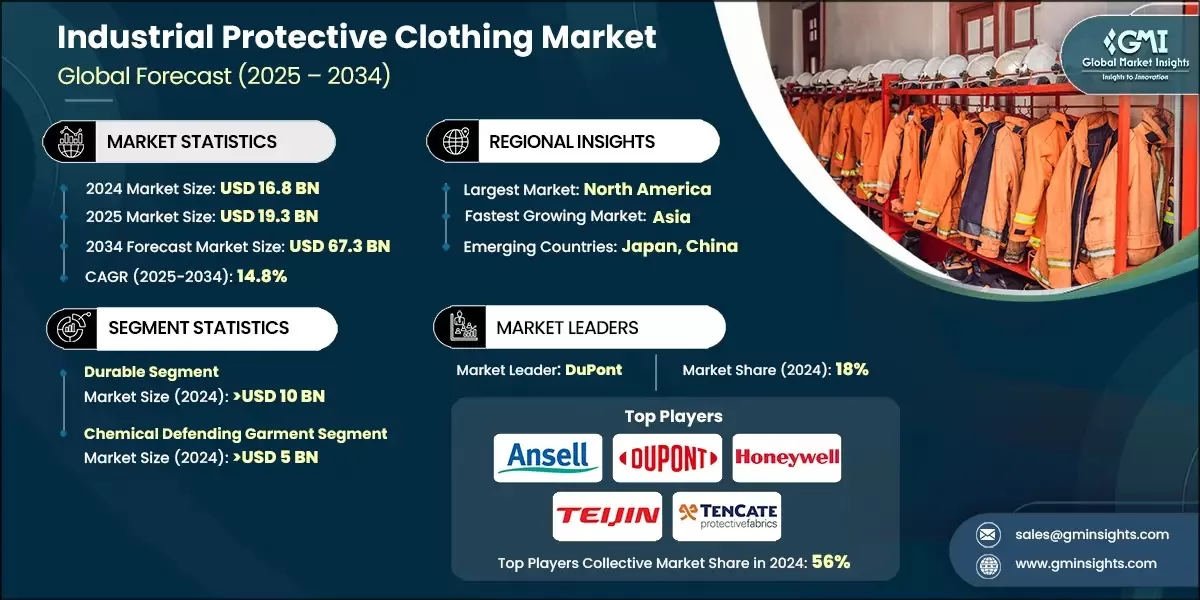
The industrial protective clothing market was estimated at USD 16.8 billion in 2024. The market is expected to grow from USD 19.3 billion in 2025 to USD 67.3 billion in 2034, at a CAGR of 14.8% according to the latest report published by Global Market Insights Inc.
Industrial Protective Clothing Market Key Takeaways
Market Size & Growth
- 2024 Market Size: USD 16.8 Billion
- 2025 Market Size: USD 19.3 Billion
- 2034 Forecast Market Size: USD 67.3 Billion
- CAGR (2025–2034): 14.8%
Regional Dominance
- Largest Market: North America
- Fastest Growing Region: Asia
Key Market Drivers
- Shift to smart protective gear.
- Push for sustainable fabrics.
- Rising demand for multi-hazard protection.
- Smart Clothing Integration.
Challenges
- High cost of advanced gear.
- Material performance limitations.
Opportunity
- Bioengineered self-healing textiles.
- Sustainability as a competitive edge.
- Demand for enhanced comfort and protection.
Key Players
- Market Leader: DuPont led with over 18% market share in 2024.
- Leading Players: Top 5 players in this market include Ansell Limited, DuPont, Honeywell International Inc., Teijin Ltd., TenCate Fabrics EU, which collectively held a market share of 56% in 2024.
Get Market Insights & Growth Opportunities
- The industrial protective clothing market encompasses garments designed especially to protect the person from hazards, such as fire, chemicals, abrasion, biohazards, and extreme weather. These clothes form an integral part of workers’ safety in industries where physical, chemical, or biological hazards are unavoidable. While these clothes are important for compliance with the law, perhaps have greater importance for growing global culture promoting worker well-being and safety.
- Increasing safety awareness and stringent regulations all over the world have propelled the market growth so that industry such as oil and gas, construction, manufacturing, and healthcare starts prioritizing work safety for its employees. Pandemics are also other worldwide events that have created an emphasis on hygiene and boosted the market growth of contamination-resistant apparel.
- Flame-resistant clothing has been growing rapidly due to an ever-increasing need with fire-prone industries such as steel and utilities. Chemical-resistant equipment is gaining strength in sectors that handle hazardous substances while high-visibility and cut-resistant apparel continually flourish on the grounds of construction and mining activity. Healthcare protective wear is also developing along the lines of infection and contamination prevention.
- The industrial protective clothing market is highly affected by technological advancement. Much modern fabric uses nanotechnology to provide the best resistance against liquid, chemicals, and flames without compromising flexibility. Enhancement of smart textiles with sensors can now monitor workers' vitals or environmental hazards, including breaches in protection. Also, advancements in material science have produced lighter and more breathable yet durable protective clothing to enhance workers' comfort and compliance. Sustainability is becoming a focus, and manufacturers are looking into eco-friendly and recyclable materials to lessen the impact on the environment.
 To get key market trends
Industrial Protective Clothing Market Trends
- The industrial protective clothing industry is growing, due to increased safety awareness in sectors such as construction, oil and gas, and manufacturing. An increasing medium of incidents regarding workplace hazards has compelled companies to make protective gear mandatory and not optional equipment. Several manufacturers have revamped their safety protocols after witnessing some high-profile industrial accidents and are now enforcing protective clothing more consistently. The increasing awareness of the importance of safety is thus an important driver for demand and market growth.
- Technological improvements have been the most vital force driving growth within this market, contributed specifically by the innovation of high-performance fibers and treatments. Such materials have aramid fibers where durability and stain resistance are usually incorporated for industry standards through nano-coatings.
- Innovation in fabric layering technologies improves both protection and comfort in wearables while addressing the already existing pain points regarding wearability. Thus, these improvements translate to gear that workers will be using them more often, hence improving their use and ultimately resulting in market growth.
- Integration with smart technology has transformed traditional protective clothing into smart connected gear with real-time monitoring. Embedded sensors are lately monitoring environmental factors such as temperature, poisonous gas exposure, and even biometric details of the wearer, alerting supervisors instantly to impending dangers. Some companies are beginning to associate themselves with technology firms to provide IoT devices into industrial safety suits used in the hazardous chemical plants. This is truly for advancing workers' safety and efficiency as it opens new geographical markets for development, satisfying the latest demands of modern industries.
- The market has changed considerably due to the evolving regulatory framework for the global push toward sustainability. Governments have tightened the safety standards for protective clothing to mandate companies to meet certification criteria with stricter compliance.
- The continued higher demand for eco-friendly packaging, recyclable, and biodegradable materials will further push manufacturers into sustainable fabric technologies. The increased use of recycled polyester fibers for protective garments by leading brands with the intent to reduce the products' environmental impact. These shifts set in regulations and the environment ensure that the protective clothing will evolve not only in function but also in responsibility, promoting market growth on a continual basis.
Industrial Protective Clothing Market Analysis
 Learn more about the key segments shaping this market
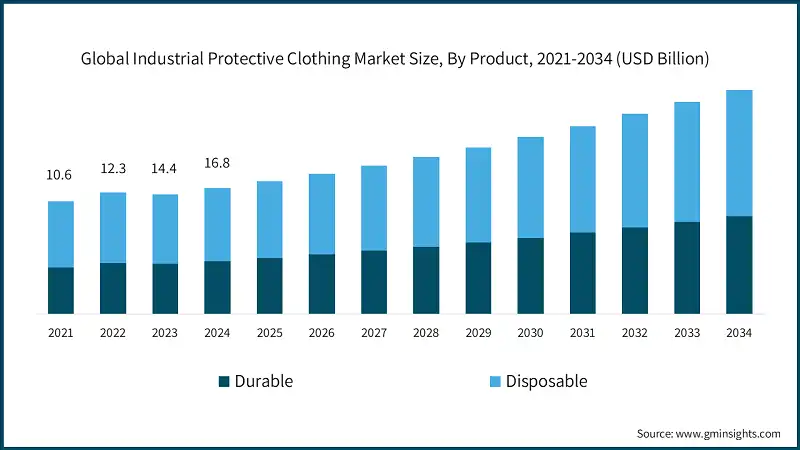
Based on product, market is divided into durable and disposable. The durable segment crossed USD 10 billion in 2024 and is expected to grow at a CAGR of over 15.1% through 2034.
- The durable protective clothing segment is witnessing rapid growth of market due to industries like oil & gas, construction, and manufacturing because workers face extremely harsh conditions and need shelter from harshness for a long time. These garments are provided with high-performance material like aramid fibers that impart resistance to heat, flame, and mechanical wear. Due to their ability to withstand even the rigors of frequent washing and use, durable clothing is considered a cost-effective solution for most safety-and-compliance-conscious companies. Companies like DuPont are integrating innovations such as nano-coatings and layering fabrics to enhance comfort and durability of their durable protective gear, thus helping accelerate its acceptance within industries.
- The disposable protective clothing segment is steadily increasing, primarily from industries such as healthcare, pharmaceuticals, and food processing as they are at high contamination risk.
Disposable clothing may be able to wear not to expose the person to cross-contamination as well as eliminate the need for washing, which is important to hygiene standards. The high demand of disposable protective suits and coveralls is because during COVID-19 they play a critical role for controlling infection. Although they are less durable, disposable ones can be quickly used for single use and are indispensable for use in places where contamination control is crucial.
 Learn more about the key segments shaping this market
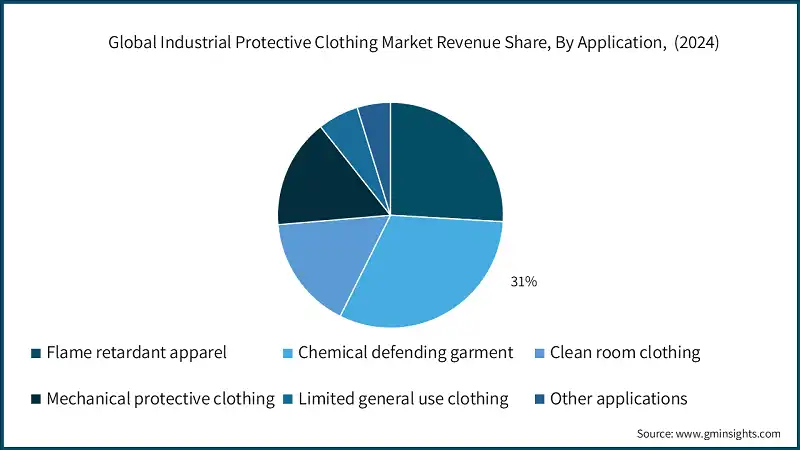
Based on applications, industrial protective clothing market is segmented into flame retardant apparel, chemical defending garment, clean room clothing, mechanical protective clothing, limited general use clothing and other applications. The chemical defending garment segment crossed USD 5 billion in 2024.
- In the industrial protective clothing market, chemical defending garment has the fastest growing segment due to increased awareness of chemical exposure risks in industries like pharmaceuticals, manufacturing, and hazardous waste management. These garments provide protection against harmful chemical splashes, vapors, and toxic substances. The increasing usage of chemical-resistant suits in laboratories and chemical plants, therefore, would come to signify this growing demand
- Flame retardant apparel closely followed, and this growth is fueled by increasing safety regulations as well as the increasing number of industries, like oil and gas, electrical, construction, hotels and many others, that require workers to be protected from fire hazards as well as high-temperature environments. Flame-retardant clothing made from special fibers and provided an advanced chemical treatment is seen in these important areas as it provides protection from burns and injury.
 Looking for region specific data?
North America Industrial Protective Clothing Market
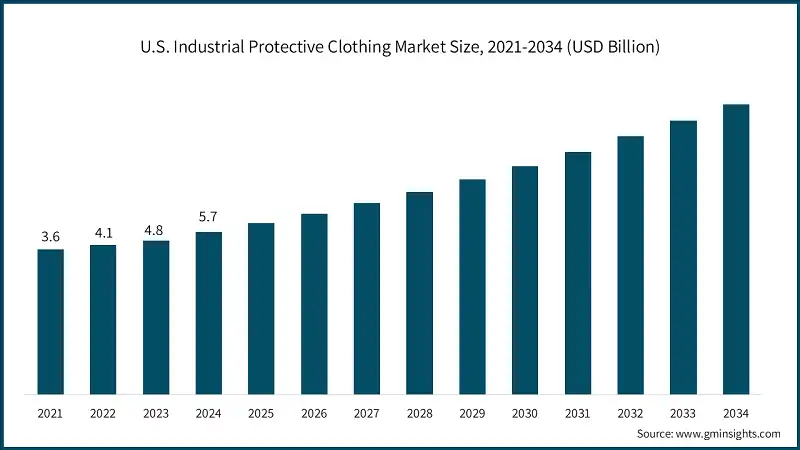
U.S. region dominated around 87% market share of industrial protective clothing with USD 5.7 billion revenue in 2024.
- The U.S. market is very well developed and robust because of the advanced industrial infrastructure in the country and robust workplace safety regulations. It has always been a priority for the United States to use the latest technology in smart protective gear and high-performance materials.
- Some industries that drive the demand for flame, chemical and multi-hazard protective gear include oil and gas, aerospace, and chemical processing. Furthermore, strong government oversight and compliance measures also manage the constant innovation and investment in protective solutions that complement the changing risk landscape in industries.
- In the North American region, one of the driving factor for market growth is the increasing industrial activities in Canada and Mexico, within manufacturing, mining, and automotive sectors. These countries reform their safety regulations to meet global standards requirements and others to create new opportunities for manufacturers of protective clothing.
Europe Industrial Protective Clothing Market
The Germany market is expected to experience significant and promising growth from 2025 to 2034.
- Europe's protective clothing market is steadily growing, accounting for USD 3.7 billion in 2024 owing to the increasing regulatory standards, industrialization in Eastern Europe, and the growing awareness of worker health and safety. Strict directives issued by the European Union such as the PPE Regulation (EU) 2016/425 necessitated industries to upgrade their safety gear to meet certification standards.
- Increasing demand is seen in sectors such as construction, pharmaceuticals, and energy in countries like France, Italy, and Poland. A strong sustainability push also exists in Europe for the utilization of biodegradable, recyclable, and low-impact materials.
- Germany certainly plays a crucial role in Europe’s industrial protective clothing market due to its sturdy industrial base and stringent regulations for workplace safety. High-demanding sectors such as automotive, engineering, and chemicals require worker protection equipment and gears, and therefore demand high-quality protective clothing all along.
Asia Pacific Industrial Protective Clothing Market
The China market is expected to experience significant and promising growth from 2025 to 2034.
- Growth of market within the Asia-Pacific region is due to both industrialization as well as increased emphasis on the safety of workers. Countries such as India, Vietnam, and Indonesia are making extensive investments as they are expanding their manufacturing and infrastructure sectors hence demand for protective equipment has increased.
- Governments have enacted more stringent safety norms, particularly in hazardous industries like construction, mining, and chemicals. There is, furthermore, increased awareness among employers about the legal and ethical need to provide safe working conditions. Modernization is indeed happening in the region, and on-demand technology is the adoption of breathable, advanced, and sustainable protective clothing.
- China is emerging as a key market for industrial protective clothing, largely due to its strong regulatory push and industrial upgrading efforts. Industries are facing obligations to follow safety rules, which give rise to the need for advanced and more specialized protective wear. This requires domestic manufacturers to innovate and create protective fabrics using sustainable and high-performance materials. This shift is policy-driven yet a deep-rooted cultural change all at the same time as worker safety becomes a core value of responsibility in business for China.
Middle East and Africa Industrial Protective Clothing Market
The UAE market is expected to experience significant and promising growth from 2025 to 2034.
- The Middle East and Africa market is equally influenced by expanding construction, oil & gas, and other manufacturing activities, Some areas in this region push for tougher worker safety and sustain major drives on large infrastructure and energy projects, thus leading to a steady rise in demand for flame-resistant, chemical-protective, and high-visibility apparel types.
- Countries like Nigeria, Egypt, and South Africa experience industrial growth within the African continent that is complemented by wider workplace safety compliance-not previously met by standards. An emerging consciousness of worker rights, higher levels of unionization in parts, and international pressure to improve labor standards encourage the production and use of good quality protective clothing among all parts of the region.
- The industrial protective clothing market in the UAE is expected to grow significantly until 2034. This is due to the ambitious development of national plans for the country and the strict regulations on occupational safety. The UAE is the most progressive in the region when it comes to health and safety enforcement. There is improvement in awareness concerning worker wellbeing, hence endeavoring to adopt and develop innovative breathable, multi-hazard protective garments expected to move the market for another decade.
Latin America Industrial Protective Clothing Market
The Brazil market is expected to experience significant and promising growth from 2025 to 2034.
- The Latin American market for industrial protective clothing is expected to conceal steady development, with regional manufacturers, mining, and energy development contributing behind the demand. Governments in Latin America are implementing stronger labor laws and safety requirements, which has enhanced demand for protective wear that is compliant and durable.
- Chile and Peru are raising safety levels in mining, while Mexico and Argentina are both investing in infrastructure, creating a further need for the protection. However, it is Brazil that rules in this category due to its scale of industry and matured regulatory regime. An increasing awareness of worker health and safety issues within the philosophy of protection is leading the region from production of basic level-gear towards advanced and multi-functional protective clothing.
Industrial Protective Clothing Market Share
- The top 5 companies in industrial protective clothing industry are Ansell Limited, DuPont, Honeywell International, Inc., Kimberly-Clark Corporation, W. L. Gore & Associates, Inc., contributing around 56% of the market in 2024.
- Worldwide presence and strong distribution networks give companies exceptional advantages, allowing them to serve various markets efficiently. Their commitment to environmentally friendly products, including low-VOC coatings and sustainable materials, aligns with the growing global emphasis on eco-conscious products. This commitment helps position products differently and meet evolving consumer and regulatory expectations.
- These market players consistently invest heavily in product innovation and region-wise market development, especially in fast-growing regions like North America and Europe. The demand for advanced industrial protective clothing in these regions is mainly due to rapidly changing urban patterns, government regulations, awareness about workplace hazards, and technological advancement.
- Companies stay ahead of competition and set benchmarks for future growth and sustainability by providing region-specific formulations and tailored applicability solutions.
- Multifunctional coatings provide the right combination of UV protection, waterproofing, and self-cleansing. These features are necessary for people working in outdoor areas as UV protection helps in extending fabric life, waterproofing ensures comfort and safety, and self-cleaning reduces maintenance.
Industrial Protective Clothing Market Companies
Major players operating in industrial protective clothing industry are:
- Ansell Limited
- Australian Defence Apparel
- Bennett Safetywear Ltd.
- DuPont
- Honeywell International, Inc.
- Kimberly-Clark Corporation
- KOLON Industries
- Lakeland Industries, Inc
- PBI Performance Products, Inc
- Royal Ten Cate NV
- Teijin Ltd.
- TenCate Fabrics EU
- VF Imagewear
- W. L. Gore & Associates, Inc.
- Others
- DuPont
DuPont has pioneered industrial protective clothing and is known for its flagship fibers Kevlar and Nomex. They are flame resistant, cut protective, and offer high durability and both exist in the firefighting, military, and industrial worlds. DuPont has invested heavily in R&D to create energy-efficient, green fabric solutions on a continuous basis so that it remains in the leadership position through the constant improvement of performance and abiding by new safety standards.
Honeywell International Inc. offers environmentally advanced protective textiles featuring Spectra fibers for exceptionally high cut resistance, flame retardance, and chemical protection. Their fabrics feature critical application sectors such as oil & gas, manufacturing, and emergency services.
Teijin Ltd. is one of the largest companies working in aramid fibers and high-performance protective fabrics. These products have been developed for extreme durability, heat resistance, and chemical protection, factors usually required by industrial protective clothing and suits for firemen. Innovative developments by Teijin focus mainly on fabric-layering technologies and on sustainable materials that contribute to wearability and acceptance, with suitable safety features, in broad sections of industry.
TenCate Fabrics EU manufactures flame-retardant and chemical-resistant textiles for the industrial and protective clothing markets. Coating their fabrics with multifunctional coatings provides UV protection, waterproofing, and durability. With a broad focus on sustainability and regulations, TenCate opts for eco-friendly methods to conform to the stringent development standards of countries across the globe, especially in construction and heavy industry.
Industrial Protective Clothing Market Report AttributesKey Takeaway Details Market Size & Growth Base Year 2024 Market Size in 2024 USD 16.8 Billion Market Size in 2025 USD 19.3 Billion Forecast Period 2025 – 2034 CAGR 14.8% Market Size in 2034 USD 67.3 Billion Key Market Trends Drivers Impact Shift to smart protective gear Industries are increasingly adopting protective clothing equipped with integrated sensors to monitor body temperature, gas leaks, or fatigue. This shift reflects a broader move toward real-time workplace safety and predictive risk management. The demand is especially visible in mining, oil, and heavy manufacturing, where immediate hazard detection can prevent serious incidents Push for sustainable fabrics There’s a noticeable transition from synthetic, non-biodegradable materials to eco-conscious alternatives like organic fibers, recycled polymers, and plant-based coatings. This trend is driven by stricter environmental policies and growing internal sustainability goals within manufacturing and energy firms. Many companies now view eco-friendly PPE as part of their brand image and compliance strategy. Rising demand for multi-hazard protection Industries are increasingly exposed to multiple risks—chemical, thermal, electrical—at once. This has pushed employers to invest in garments that provide all-in-one protection. Workers in oil & gas, construction, and manufacturing now demand clothing that doesnt just meet minimum safety standards but exceeds them. Smart Clothing Integration IoT-enabled protective gear with sensors for heat, gas exposure, or biometric monitoring is becoming mainstream. These smart textiles enhance real-time safety monitoring and reduce response time during incidents, leading to faster adoption, especially in high-risk industries like mining and heavy engineering. Pitfalls & Challenges Impact High cost of advanced gear Protective clothing with multi-layered protection or smart tech integration often comes at a premium. Small and mid-sized enterprises struggle with these costs, slowing down widespread adoption despite the clear safety benefits. Material performance limitations Many industrial protective clothing struggle to balance durability, flexibility, and comfort. When materials sacrifice comfort for protection, worker compliance drops, limiting widespread adoption. Opportunities: Impact Bioengineered self-healing textiles Bioengineering presents a future where protective clothing can self-repair minor damage and resist chemical or fire exposure more effectively. This breakthrough offers a competitive edge by improving worker safety and reducing replacement frequency. Sustainability as a competitive edge Growing environmental concerns and inconsistent material sources have created demand for eco-friendly, certified materials. Companies investing in sustainable fabrics and transparent supply chains can differentiate themselves and attract environmentally conscious buyers. Demand for enhanced comfort and protection Current protective fabrics often force a trade-off between safety and wearer comfort, leading to low adoption rates. This gap drives market growth for manufacturers developing fabrics that maintain high protection while improving breathability and flexibility, addressing a critical user challenge. Market Leaders (2024) Market Leaders - DuPont
18% market shareTop Players - Ansell Limited
- DuPont
- Honeywell International Inc.
- Teijin Ltd.
- TenCate Fabrics EU
Collective market share in 2024 is 56%Competitive Edge - The competitive edge is driven by global reach, cutting-edge material innovation, sustainable fabric solutions, and rising demand for advanced fabric across industries.
Regional Insights Largest Market North America Fastest growing market Asia Emerging countries Japan, China Future outlook - The steady growth of the industrial protective clothing market is largely fueled by increasing regulatory mandates focused on worker safety, which compel industries worldwide to adopt compliant protective solutions. Rising awareness about sustainability has also driven demand for eco-friendly and recyclable materials, aligning with global environmental goals. This combination of stringent regulations, sustainability trends, and growing industrialization shapes a positive future outlook for the market globally.
What are the growth opportunities in this market?Industrial Protective Clothing Market News
- In February 2025, France passed a law that establishes a ban on per- and polyfluoroalkyl substances (PFASs), popularly referred to as "forever chemicals," in clothing, cosmetics, and any other products scheduled for a cutoff in 2026 and a total ban in all kinds of textiles by 2030. There is a persistent hazardous substance contaminating the environment, PFAS has been associated with various health risks. The law forbids the manufacture, import, export, or sale of any PFAS-containing substances, with some exceptions in the future based on limit values; it also creates liability for PFAS emissions. The OEKO-TEX standards for certification will be revised to fit these regulations in 2026.
- On January 15, 2025 Marina Textil launched new high-performance fabrics recently to meet the need for wildland firefighter gear due to growing climate change that can result in wildfire. The recent textile to be released by the company, Marko AS70RS EA, enhances mobility through elastane incorporation, while Aramar V240 offers a traditional aramid blend with additional flexibility. The two materials comply with UNE-EN 16689:2017, demonstrating the company mandate of innovation, safety, and comfort for firefighters working in conditions that are becoming increasingly extreme.
- On June 11, 2024, Stahl announces that it has developed an Integra performance coating portfolio that will feature a new product, Stainless Integra Dry 725, which is a fluorine-free waterproof coating for technical materials. The product is developed by StayDry DWR technology, has very high-water repellency and durability and is compatible with other coatings for application in camping and luggage. It supports low-temperature curing, reducing environmental impact while maintaining fabric quality. This modular Integra toolbox by Stahl is meant to provide customized coating solutions compliant to regulatory demands while improving mechanical performance across various technical textile markets.
The industrial protective clothing market research report includes in-depth coverage of the industry with estimates & forecasts in terms of revenue (USD Billion) and volume (Kilo Tons) from 2021 to 2034, for the following segments:
Market, By Product
- Durable
- Disposable
Market, By Application
- Flame retardant apparel
- Chemical defending garment
- Radiation protection
- Particulate matter
- Others
- Clean room clothing
- Mechanical protective clothing
- Limited general use clothing
- Other applications
The above information is provided for the following regions and countries:
- North America
- U.S.
- Canada
- Europe
- Germany
- UK
- France
- Italy
- Spain
- Rest of Europe
- Asia Pacific
- China
- India
- Japan
- Australia
- South Korea
- Rest of Asia Pacific
- Latin America
- Brazil
- Mexico
- Argentina
- Rest of Latin America
- MEA
- South Africa
- Saudi Arabia
- UAE
- Rest of MEA
- The industrial protective clothing industry is growing, due to increased safety awareness in sectors such as construction, oil and gas, and manufacturing. An increasing medium of incidents regarding workplace hazards has compelled companies to make protective gear mandatory and not optional equipment. Several manufacturers have revamped their safety protocols after witnessing some high-profile industrial accidents and are now enforcing protective clothing more consistently. The increasing awareness of the importance of safety is thus an important driver for demand and market growth.
Frequently Asked Question(FAQ) :
What is the market size of the industrial protective clothing in 2024?
The market size was USD 16.8 billion in 2024, with a CAGR of 14.8% expected through 2034 driven by increasing regulatory mandates focused on worker safety.
What is the projected value of the industrial protective clothing market by 2034?
The industrial protective clothing market is expected to reach USD 67.3 billion by 2034, propelled by smart protective gear adoption, sustainable fabric innovations, and multi-hazard protection demand.
What is the current industrial protective clothing market size in 2025?
The market size is projected to reach USD 19.3 billion in 2025.
How much revenue did the durable segment generate in 2024?
The durable segment generated over USD 10 billion in 2024, because workers face extremely harsh conditions and need shelter from harshness for a long time
What was the valuation of chemical defending garment segment in 2024?
Chemical defending garment segment generated over USD 5 billion in 2024, representing the fastest growing application segment.
Which region leads the industrial protective clothing market?
The U.S. dominating around 87% market share and generating USD 5.7 billion revenue in 2024, supported by advanced industrial infrastructure and robust workplace safety regulations.
What are the upcoming trends in the industrial protective clothing market?
Key trends include integration of smart textiles with sensors for real-time monitoring, shift toward sustainable and eco-friendly fabrics, development of multi-hazard protection garments, and bioengineered self-healing textiles.
Who are the key players in the industrial protective clothing market?
Key players include Ansell Limited, DuPont, Honeywell International Inc., Teijin Ltd., TenCate Fabrics EU, Kimberly-Clark Corporation, W. L. Gore & Associates Inc., KOLON Industries, Lakeland Industries Inc., PBI Performance Products Inc., Royal Ten Cate NV, VF Imagewear, Australian Defence Apparel, and Bennett Safetywear Ltd.
Industrial Protective Clothing Market Scope
Related Reports