Summary
Table of Content

Industrial Machinery Components & Sensors Market
Get a free sample of this report
Form submitted successfully!
Error submitting form. Please try again.
Thank you!
Your inquiry has been received. Our team will reach out to you with the required details via email. To ensure that you don't miss their response, kindly remember to check your spam folder as well!
Request Sectional Data
Thank you!
Your inquiry has been received. Our team will reach out to you with the required details via email. To ensure that you don't miss their response, kindly remember to check your spam folder as well!
Form submitted successfully!
Error submitting form. Please try again.
Industrial Machinery Components & Sensors Market Size
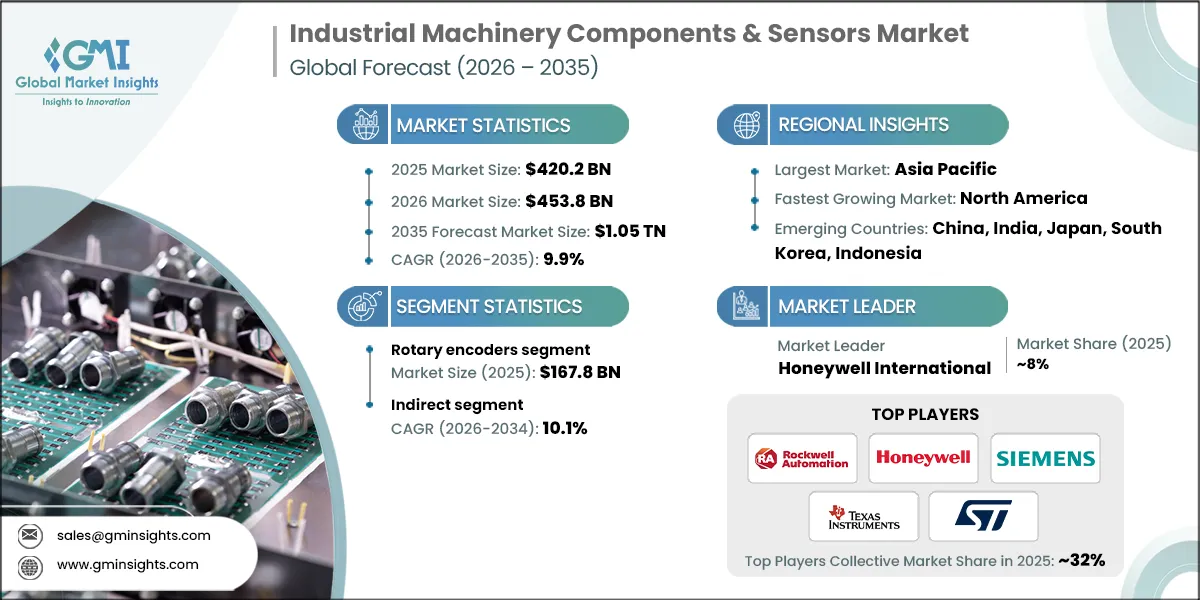
The industrial machinery components & sensors market was estimated at USD 420.2 billion in 2025. The market is expected to grow from USD 453.8 billion in 2026 to USD 1.05 trillion in 2035, at a CAGR of 9.9%, according to latest report published by Global Market Insights Inc.
Industrial Machinery Components & Sensors Market Key Takeaways
Market Size & Growth
- 2025 Market Size: USD 420.2 Billion
- 2026 Market Size: USD 453.8 Billion
- 2035 Forecast Market Size: USD 1.05 Trillion
- CAGR (2026–2035): 9.9%
Regional Dominance
- Largest Market: Asia-Pacific
- Fastest Growing Region: North America
Key Market Drivers
- Expansion of industrial automation and robotics adoption.
- Rising deployment of predictive maintenance solutions.
- Implementation of Industry 4.0 and smart manufacturing frameworks.
Challenges
- High integration and installation costs.
- Interoperability issues with legacy machinery.
Opportunity
- Expansion of smart factories and connected ecosystems.
- Development of cybersecurity-enabled sensor networks.
Key Players
- Market Leader: Honeywell International led with over market share of ~8% in 2025.
- Leading Players: Top 5 players in this market include Honeywell International, Rockwell Automation, Siemens, Texas Instruments Incorporated, STMicroelectronics, which collectively held a market share of 32% in 2025.
Get Market Insights & Growth Opportunities
- Expanded adoption of industrial automation and robotics is driving growth in the market for industrial machinery components and sensors. Increased deployment of automated systems to increase productivity, accuracy and consistency of operations in manufacturing facilities establishes a demand for advanced sensors and components used to accurately control motion and monitor activities within robotics. Reliable components that are vital to the continuous operation of an industrial automation system enable industrial automation systems to continue operating. Sensors provide the ability to collect real-time data to coordinate motion and optimize processes between machines. As manufacturers invest in automation, these investments will compound the demand for long-lasting components capable of functioning effectively within the harsh environments typically encountered in the manufacturing sector. High-performance actuators, controllers and sensors are required to provide a safe operating environment for robotic installs/systems. In addition, the continued expansion of smart factory initiative requires interconnectivity of equipment and machinery, paired with advanced sensing technology. Industrial sectors view automation to reduce human error and improve operational efficiency.
- The industrial machinery components and sensors market is experiencing good growth because of the increased use of predictive maintenance solutions in industry. Industrial operators are increasingly using condition monitoring technologies to identify issues with their equipment early and prevent costly failures. Predictive maintenance technology uses advanced sensors to measure and monitor the vibration, temperature, and performance of machines. This allows manufacturers to detect faults early on, thus reducing unwanted downtime and maintenance costs. With the growing trend towards predictive maintenance, monitored equipment is becoming increasingly popular amongst industrial manufacturers, as there is a growing need for sensing devices that provide real-time analysis of machine health. Companies that are implementing data-driven maintenance programs must have reliable sensing devices to provide accurate analytical insights into machine health. The integration of analytics platforms into predictive maintenance systems is also leading to greater reliance upon sensor-enabled equipment. Therefore, manufacturing facilities are looking at maintenance as a core component for their production processes and will increasingly rely on predictive maintenance technology to upgrade existing machinery. Furthermore, with a higher focus on operational reliability, companies will have higher replacement rates for components and higher installation rates for sensors as they look to improve their equipment's lifespan and usage.
- In the industrial machinery components and sensor market, rotary encoders have been identified as an important segment. Their ability to accurately measure the position and speed of rotating objects plays a key role in motion control within an automated manufacturing facility. The increasing use of industrial automation to improve efficiency has also increased the need for reliable devices that provide feedback about the equipment's operation. Rotary encoders are compatible with many different types of CNC machines, robots, and conveyor systems, increasing their importance and overall market share. Furthermore, innovations in digital encoder technology have beget improvements in resolution and stability of the signal output. The improved long-term durability of rotary encoders when compared to traditional encoders, along with their ability to function effectively in extreme conditions, makes them increasingly viable for industrial use. Finally, the continuous upgrading of production equipment will continue to create demand growth for rotary encoder products on a global scale.
To get key market trends
Industrial Machinery Components & Sensors Market Trends
- Smart sensors that collect vibration and temperature information to detect early signs of component wear, allowing operators to perform predictive maintenance (PM), are becoming increasingly important in the industrial machinery components and sensors market. With these systems, operators can be proactive to minimize unexpected breakdowns, prolonging the life of their equipment throughout the facility.
- Manufacturers are looking for smaller, more precise components to support modern automation systems. With these components, manufacturers can improve their ability to operate with tighter tolerances and increase the responsiveness of their machines in complex operations. This increased precision has a positive impact on productivity as it helps to reduce errors and improves the repeatability of manufacturing tasks. Manufacturers prefer to purchase updated component technologies to take advantage of these performance improvements.
- Wireless and IoT technologies combined with the components and sensors enable businesses to monitor their machinery's operational performance with greater efficiency and effectiveness. Being able to seamlessly transfer data from the shop floor to a centralized analytics platform allows businesses to have access to real-time insights, enabling them to quickly make decisions and adjust their processes during production runs. This increased visibility leads to a greater level of operational efficiency in all types of industrial environments.
- Extreme temperatures and chemical exposure in rugged industrial environments require components and sensors that are designed for ruggedness. As a result, engineers specify rugged designs with durable housings and robust internal designs so that they continue to perform and are usable where a standard part may be put out of commission prematurely. With this inherent reliability, there is less frequent maintenance and more uptime for the overall industrial systems of heavy industry.
- Increasingly popular modular sensors allow easier adaptation to various machine types and tasks by installing only the number of modules required for each unique monitoring application in various environments. This type of modular design supports lowering initial costs and allows for easy upgrade of systems as user needs change. In addition, modular products are more versatile than non-modular designs and are therefore better able to meet the growing demands on industrial manufacturing by supporting scalable growth.
Industrial Machinery Components & Sensors Market Analysis
Learn more about the key segments shaping this market
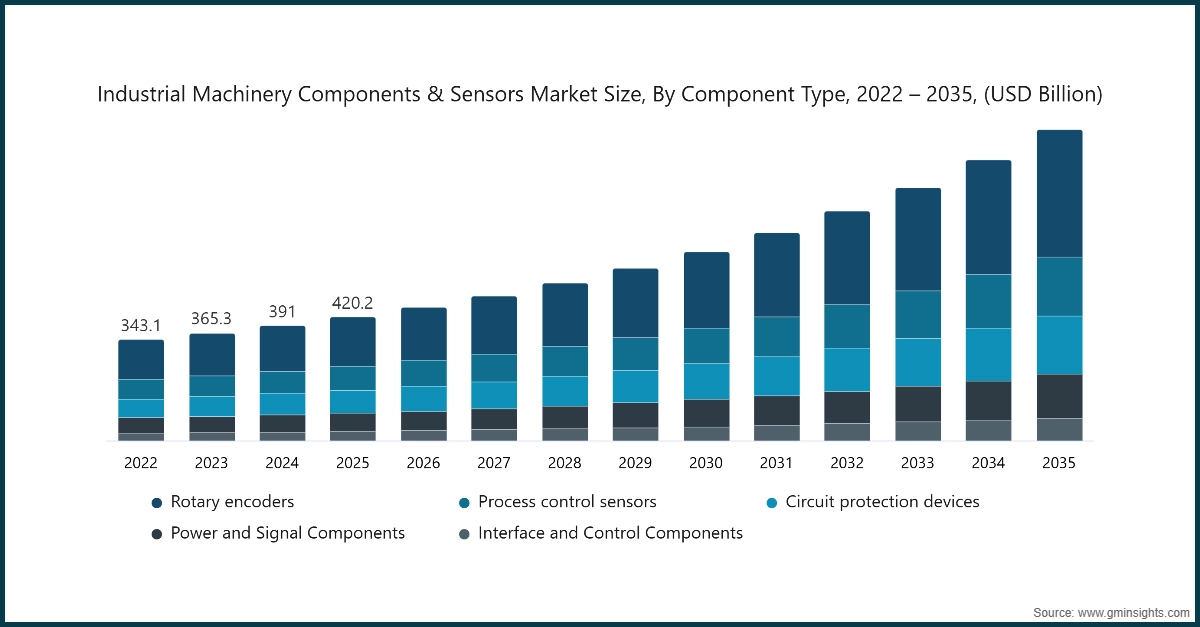
Based on component type, the industrial machinery components & sensors market is categorized into rotary encoders, process control sensors, circuit protection devices, power and signal components, and interface and control components. The rotary encoders segment accounted for revenue of around USD 167.8 billion in 2025 and is anticipated to grow at a CAGR of 10.2% from 2026 to 2035.
- Rotary encoders dominate the industrial machinery components and sensors market due to precise motion feedback capabilities. Accurate position and speed detection improves control efficiency across automated machinery. Strong adoption in robotics, CNC equipment, and material handling systems supports high demand. Reliability under continuous operation enhances preference among manufacturers.
- Compact design enables easy integration into modern industrial setups. Advancements in digital signal processing improve resolution and performance stability. Increased focus on factory automation strengthens sustained market leadership of rotary encoders.
Based on end-use industry, industrial machinery components & sensors market consists of automotive industry, electronics and semiconductor, food and beverage, pharmaceutical and biotechnology, energy and utilities, aerospace and defense, chemical and process industries, and mining and metals. The automotive industry segment emerged as leader and held 20.54% of the total market share in 2025 and is anticipated to grow at a CAGR of 10.4% from 2026 to 2035.
- The automotive industry represents a major end use segment within industrial machinery components and sensors market. High automation levels in vehicle manufacturing drive strong demand for precision sensors and components. Rotary encoders support accurate motion control across assembly lines and robotic systems. Growing electric vehicle production increases reliance on advanced sensing technologies.
- Quality control requirements enhance adoption of reliable feedback and monitoring solutions. Continuous production operations require durable components ensuring minimal downtime. Technological upgrades in automotive plants strengthen long-term demand across global manufacturing hubs.
Learn more about the key segments shaping this market
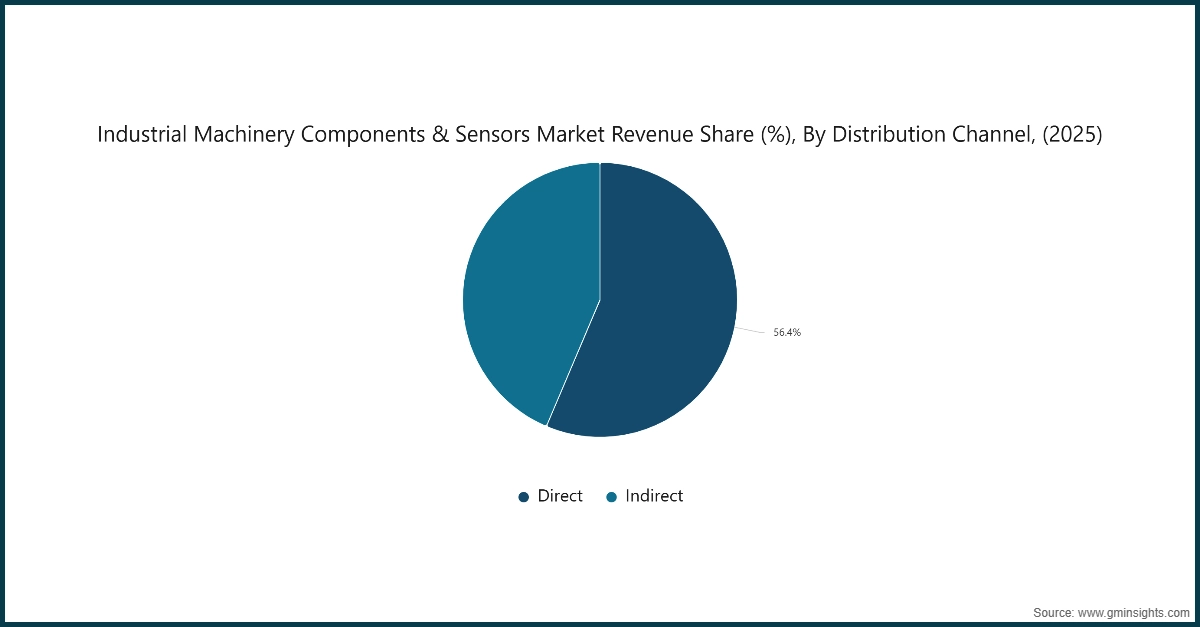
Based on distribution channel, industrial machinery components & sensors market consists of direct and indirect. The indirect segment in the industrial machinery components & sensors market is expected to grow at a CAGR of 10.1% between 2026 and 2035.
- Indirect distribution channels lead the market due to extensive supplier and distributor networks. Authorized distributors provide technical support and inventory availability across diverse industrial regions. OEM partnerships enhance component accessibility for small and mid-sized manufacturing facilities. Bulk procurement through intermediaries reduces logistical complexity for component manufacturers.
- Value-added services strengthen buyer confidence during selection of precision sensors and machinery components. Regional distributors improve lead times and aftersales service quality for industrial customers. Established channel relationships support consistent supply across automotive, manufacturing, and process industries.
Asia Pacific Industrial Machinery Components & Sensors Market
Looking for region specific data?
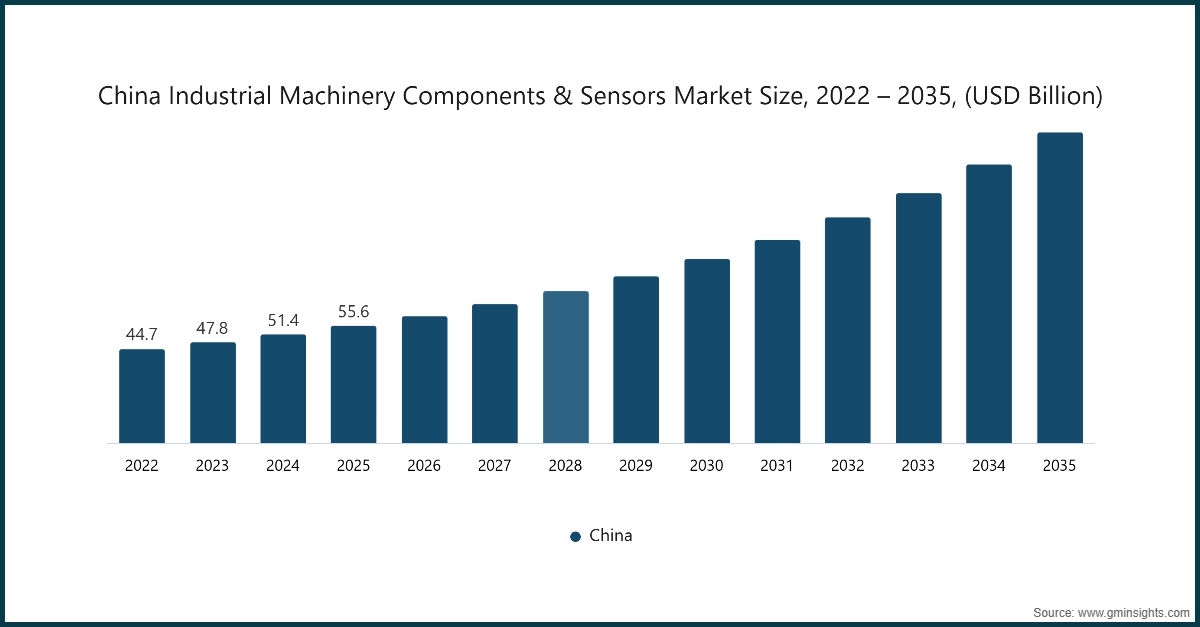
China dominates overall Asia Pacific industrial machinery components & sensors market with USD 55.6 billion in 2025 and is estimated to grow at a CAGR of 10.4% from 2026 to 2035.
- The China industrial machinery components and sensors market shows strong growth supported by extensive manufacturing activity. National industrial automation initiatives increase adoption of advanced sensors across production facilities. High-volume machinery usage creates continuous demand for durable mechanical components. Expansion of smart manufacturing zones accelerates integration of real-time monitoring sensor systems. Electric vehicles and battery production supports demand for precision sensors and control components.
- Domestic equipment manufacturers benefit from localized supply chains and cost advantages. Export-driven machinery production sustains consistent component replacement cycles. Focus on improving production efficiency drives investment in high-accuracy sensing technologies. Government-backed modernization programs support long-term market expansion across industrial sectors.
North America Industrial Machinery Components & Sensors Market
In the North America industrial machinery components & sensors industry, the U.S. held 84.3% share in 2025 and is anticipated to grow at a CAGR of 10.4% from 2026 to 2035.
The North America industrial machinery components and sensors market is supported by advanced manufacturing adoption. High deployment of automated production lines increases demand for precision sensors and components. Strong presence of aerospace and defense industries drives usage of high-performance sensing technologies. Aging manufacturing infrastructure encourages upgrades to modern machinery components. Focus on predictive maintenance increases integration of condition monitoring sensors.
- Research-driven innovation improves development of advanced sensing solutions. Presence of global technology providers ensures reliable supply and technical support. High capital investment capacity enables adoption of premium industrial components. Emphasis on operational safety sustains long-term demand across facilities.
Europe Industrial Machinery Components & Sensors Market
In the Europe industrial machinery components & sensors industry, Germany is expected to experience significant and promising growth at a CAGR of 9.1% from 2026 to 2035.
The Europe industrial machinery components and sensors market benefits from strong industrial engineering capabilities. Adoption of Industry 4.0 technologies increases demand for smart sensors. Automotive manufacturing clusters support consistent consumption of machinery components. Energy efficiency regulations influence upgrades to advanced sensing and control systems.
- Precision engineering standards encourage demand for high-accuracy components. Robotics integration across factories supports steady sensor deployment. Strong export-oriented machinery production sustains component replacement cycles. Established industrial automation vendors strengthen regional supply networks.
Middle East and Africa Industrial Machinery Components & Sensors Market
In the Middle East and Africa industrial machinery components & sensors industry, Saudi Arabia held a significant market share in 2025 promising growth from 2026 to 2035.
The Middle East and Africa industrial machinery components and sensors market develops through infrastructure expansion. Industrial diversification programs increase demand for modern machinery components. Oil and gas operations require robust sensors for process monitoring. Power generation projects support installation of heavy industrial equipment.
- Limited local manufacturing increases reliance on imported components and sensors. Harsh operating conditions drive demand for durable and rugged sensor designs. Government-backed industrial zones encourage gradual adoption of automated systems. Long project lifecycles support steady demand for replacement components.
Industrial Machinery Components & Sensors Market Share
- In 2025, the prominent manufacturers in industrial machinery components & sensors industry are Honeywell International, Rockwell Automation, Siemens, Texas Instruments Incorporated, and STMicroelectronics collectively held the market share of ~32%.
- Honeywell International is a diversified technology company with strong capabilities in industrial sensors, automation systems, and integrated control solutions. The company’s offerings enhance predictive maintenance, remote monitoring, and real-time analytics for factories and process industries. Honeywell invests in IIoT platforms, smart sensor technologies, and cybersecurity for industrial control systems. Its global reach and broad product portfolio support adoption across manufacturing, energy, aerospace, and logistics sectors.
- Rockwell Automation specializes in industrial automation, sensors, and control systems that connect devices, data, and analytics for manufacturing operations. Its FactoryTalk platform unifies data visualization, analytics, and control, enhancing operational transparency and process optimization. Rockwell’s focus on digital transformation includes cloud automation, edge computing, and augmented reality training tools. Strategic collaborations with major tech firms strengthen its automation and smart factory solutions.
Industrial Machinery Components & Sensors Market Companies
Major players operating in the industrial machinery components & sensors industryinclude:
- Amphenol Corporation
- Denso Corporation
- di-soric GmbH & Co. KG
- First Sensor
- Honeywell International
- KELLER AG
- Merit Sensor Systems
- Pepperl+Fuchs
- Robert Bosch
- Rockwell Automation
- SICK AG
- Siemens
- STMicroelectronics
- Texas Instruments Incorporated
Siemens is a global industrial technology leader offering sensors and automation solutions within its Digital Industries division. The company integrates PLCs, SCADA, HMI, and IoT platforms like MindSphere to support real-time data, predictive maintenance, and energy-efficient manufacturing. Siemens emphasizes digital twin technology and AI-driven process optimization. Its strategic alliances and sustainability focus support digital industrial transformation across sectors including automotive, energy, and logistics.
Texas Instruments Incorporated develops precision analog, mixed-signal, and embedded processing sensor technologies tailored for industrial automation and robotics. The company’s focus on low-power, high-accuracy solutions supports real-time sensing, control, and signal processing in harsh environments. TI enhances adoption through robust design tools and reference platforms, speeding development cycles. Its semiconductor expertise underpins reliable, scalable solutions for modern industrial systems.
STMicroelectronics is a global semiconductor company focused on MEMS-based industrial sensors and mixed-signal devices. Its portfolio includes AI-integrated sensors for predictive maintenance, condition monitoring, and smart factory applications. ST’s commitment to innovation is highlighted by development of low-power edge processing and real-time anomaly detection at the sensor level. Strategic moves, including acquisitions of complementary sensor units, support portfolio expansion and future growth.
Industrial Machinery Components & Sensors Market Report Attributes
| Key Takeaway | Details |
|---|---|
| Market Size & Growth | |
| Base Year | 2025 |
| Market Size in 2025 | USD 420.2 Billion |
| Market Size in 2026 | USD 453.8 Billion |
| Forecast Period 2026-2035 CAGR | 9.9% |
| Market Size in 2035 | USD 1.05 Trillion |
| Key Market Trends | |
| Drivers | Impact |
| Expansion of industrial automation and robotics adoption | Increases the need for precision components and sensors to support robotics, autonomous systems, and automated production lines. |
| Rising deployment of predictive maintenance solutions | Drives the integration of condition-monitoring sensors that help reduce downtime and maintenance costs for critical assets. |
| Implementation of Industry 4.0 and smart manufacturing frameworks | Boosts demand for advanced sensors and components that enable real-time monitoring, automation, and data-driven decision-making across industrial operations. |
| Pitfalls & Challenges | Impact |
| High integration and installation costs | Large upfront capital requirements for modern sensor and component systems can deter small and mid-sized enterprises from adoption, slowing market growth. |
| Interoperability issues with legacy machinery | Difficulties in integrating advanced sensors and components with older industrial equipment create technical and operational barriers. |
| Opportunities: | Impact |
| Expansion of smart factories and connected ecosystems | Offers growth potential for manufacturers to develop tailored, connected solutions that enable autonomous operations and enhanced factory intelligence. |
| Development of cybersecurity-enabled sensor networks | Growing importance of security in industrial IoT creates opportunities for secure sensing and communication solutions. |
| Market Leaders (2025) | |
| Market Leader |
Market share of ~8% |
| Top Players |
Collective market share of ~32% |
| Competitive Edge |
|
| Regional Insights | |
| Largest Market | Asia-Pacific |
| Fastest growing market | North America |
| Emerging countries | China, India, Japan, South Korea, Indonesia |
| Future outlook |
|
What are the growth opportunities in this market?
Industrial Machinery Components & Sensors Industry News
- In May 2025, Honeywell International launched a new Hydrogen Leak Detection sensor solution to detect microscopic hydrogen leaks in industrial equipment and infrastructure. This sensing solution uses thermal conductivity detection for real-time safety applications in power generation and industrial hydrogen systems.
- In September 2025, Honeywell International announced the introduction of its 13MM Pressure Sensor designed for cleanroom and high-purity industrial environments. This new pressure sensor delivers enhanced accuracy under high pressure and temperature conditions and supports semiconductor and other high-precision manufacturing processes.
- In September 2025, SICK AG launched the OD200 compact optical displacement sensor, providing high-performance short-range distance measurement that supports industrial automation tasks across varied applications. SICK also expanded its digital portfolio with new 2D/3D LiDAR and camera sensor models to enhance sensing capabilities for industrial systems.
- In May 2025, Honeywell International launched a new Hydrogen Leak Detection sensor solution to detect microscopic hydrogen leaks in industrial equipment and infrastructure. This sensing solution uses thermal conductivity detection for real-time safety applications in power generation and industrial hydrogen systems.
- In January 2025, Siemens unveiled new industrial AI and digital twin innovations at CES 2025, including the Siemens Industrial Copilot for Operations aimed at edge-level intelligence and automated decision-making in production environments. These solutions enhance the integration of sensors and data analytics for smarter industrial workflows.
The industrial machinery components & sensors market research report includes in-depth coverage of the industry, with estimates & forecast in terms of revenue (USD Billion) and volume (Thousand Units) from 2022 to 2035, for the following segments:
Market, By Component Type
- Rotary encoders
- Process control sensors
- Circuit protection devices
- Power and Signal Components
- Interface and Control Components
Market, By End Use Industry
- Automotive Industry
- Electronics and Semiconductor
- Food and Beverage
- Pharmaceutical and Biotechnology
- Energy and Utilities
- Aerospace and Defense
- Chemical and Process Industries
- Mining and Metals
Market, By Distribution Channel
- Direct
- Indirect
The above information is provided for the following regions and countries:
- North America
- U.S.
- Canada
- Europe
- Germany
- UK
- France
- Italy
- Spain
- Asia Pacific
- China
- Japan
- India
- South Korea
- Australia
- Latin America
- Brazil
- Mexico
- Argentina
- MEA
- Saudi Arabia
- UAE
- South Africa
Frequently Asked Question(FAQ) :
What is the market size of the industrial machinery components & sensors in 2025?
The market size was USD 420.2 billion in 2025, with a CAGR of 9.9% expected through 2035 driven by expanded adoption of industrial automation and robotics along with increased use of predictive maintenance solutions.
What is the projected value of the industrial machinery components & sensors market by 2035?
The industrial machinery components & sensors market is expected to reach USD 1.05 trillion by 2035, propelled by advancements in wireless and IoT technologies, development of miniaturized and high-precision components, and increasing demand for ruggedized sensors for harsh industrial environments.
What is the current industrial machinery components & sensors market size in 2026?
The market size is projected to reach USD 453.8 billion in 2026.
How much revenue did the rotary encoders segment generate in 2025?
The rotary encoders segment generated USD 167.8 billion in 2025 and is anticipated to grow at a CAGR of 10.2% from 2026 to 2035, driven by their precise motion feedback capabilities and strong adoption in robotics and CNC equipment.
What was the market share of the automotive industry segment in 2025?
The automotive industry segment held 20.54% market share in 2025 and is anticipated to grow at a CAGR of 10.4% from 2026 to 2035.
What is the growth outlook for the indirect distribution channel from 2026 to 2035?
The indirect distribution channel is expected to grow at a CAGR of 10.1% between 2026 and 2035, leading the market due to extensive supplier and distributor networks and value-added services.
Which region leads the industrial machinery components & sensors market?
Asia Pacific is a major market with China dominating at USD 55.6 billion in 2025 and estimated to grow at a CAGR of 10.4% from 2026 to 2035,
What are the upcoming trends in the industrial machinery components & sensors market?
Key trends include adoption of smart sensors with predictive maintenance capabilities for early fault detection, development of miniaturized high-precision components for modern automation systems.
Who are the key players in the industrial machinery components & sensors market?
Key players include Honeywell International, Rockwell Automation, Siemens, Texas Instruments Incorporated, STMicroelectronics, Amphenol Corporation, Denso Corporation, di-soric GmbH & Co. KG, First Sensor, KELLER AG, Merit Sensor Systems, Pepperl+Fuchs, Robert Bosch, and SICK AG.
Industrial Machinery Components & Sensors Market Scope
Related Reports