Summary
Table of Content

Industrial Labels Market
Get a free sample of this report
Form submitted successfully!
Error submitting form. Please try again.
Thank you!
Your inquiry has been received. Our team will reach out to you with the required details via email. To ensure that you don't miss their response, kindly remember to check your spam folder as well!
Request Sectional Data
Thank you!
Your inquiry has been received. Our team will reach out to you with the required details via email. To ensure that you don't miss their response, kindly remember to check your spam folder as well!
Form submitted successfully!
Error submitting form. Please try again.
Industrial Labels Market Size
The growth of the industrial labels market is attributed to increasing demand for supply chain traceability, rising focus on product safety and security, growth in e-commerce and retail sectors, increasing concerns about counterfeit products, and expansion of industrial sectors.
Industrial Labels Market Key Takeaways
Market Size & Growth
- 2025 Market Size: USD 67.8 Billion
- 2026 Market Size: USD 72.6 Billion
- 2035 Forecast Market Size: USD 139.1 Billion
- CAGR (2026–2035): 7.5%
Regional Dominance
- Largest Market: Asia Pacific
- Fastest Growing Region: Asia Pacific
Key Market Drivers
- Increasing demand for supply chain traceability.
- Rising focus on product safety and security.
- Growth in e-commerce and retail sectors.
- Increasing concerns about counterfeit products.
Challenges
- Counterfeit labeling solutions.
- Technological integration costs.
Opportunity
- Growing ULD retrofit and replacement cycle.
- Expansion of air cargo in emerging markets.
Key Players
- Market Leader: Avery Dennison led with over 6.4% market share in 2025.
- Leading Players: Top 5 players in this market include Avery Dennison, 3M, CCL Industries, Zebra Technologies, HID Global, which collectively held a market share of 20.8% in 2025.
Get Market Insights & Growth Opportunities
The increasing industrial activities of automotive, health care and e-commerce are also increasing the need for labels. Furthermore, a paradigm shift to eco-friendly recyclable and biodegradable labels has taken place due to sustainability concerns. High customizability and efficiency through digital printing and digital labels technology have turned into cost-effective solutions. Industrial growth and expansion are continuing in regions such as North America due to the pace of technological growth. For instance, in March 2024, UPM Raflatac and Mark Andy agreed to extend their partnership for another five years and to continue their commitment to innovative labeling solutions. The renewal of the partnership, which focuses on sustainability, will use UPM Raflatac's extensive product catalogue to provide Mark Andy with the most advanced printing technology in the market.
Growth in e-commerce and retail sectors is significantly driving demand for industrial labels due to rising requirements for efficient logistics, inventory tracking, and shipment identification. Expanding online retail operations require durable barcode and tracking labels to ensure accurate order fulfillment, warehouse automation, and supply chain visibility. Increasing parcel volumes and omnichannel distribution models further accelerate label consumption across transportation and logistics networks. Global B2C e-commerce revenue is expected to reach USD 5.5 trillion by 2027, growing at a steady CAGR of 14.4%, reinforcing long-term market expansion.
The industrial labels market increased steadily from USD 55.6 billion in 2022 and reached USD 67.8 billion in 2025, to rising industrial automation, increasing adoption of asset tracking and barcode labeling systems, and stricter regulatory compliance requirements across manufacturing and logistics sectors. Growth in e-commerce logistics, expansion of automotive and electronics production, and higher demand for durable, high-performance labeling solutions further supported market.
The global industrial labels market was valued at USD 67.8 billion in 2025. The market is expected to grow from USD 72.6 billion in 2026 to USD 103.2 billion in 2031 & USD 139.1 billion in 2035, at a CAGR of 7.5% during the forecast period according to the latest report published by Global Market Insights Inc.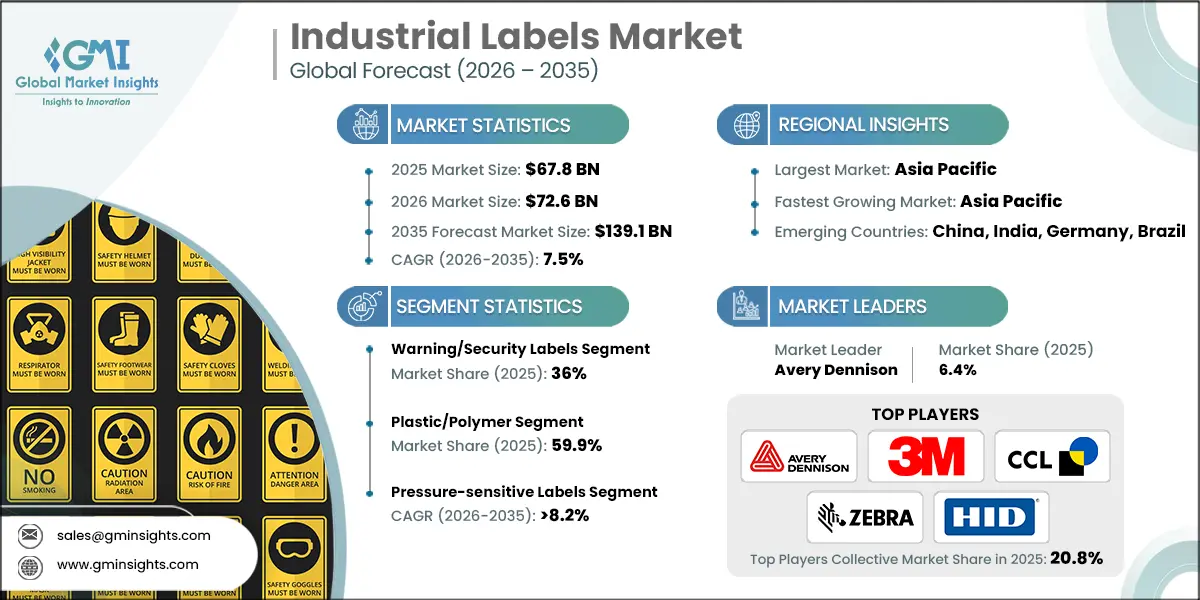
To get key market trends
Industrial Labels Market Trends
- Industrial labels are intelligent and interactive, such as RFID and QR codes, for the better tracking of products and consumer involvement. The business consideration becomes more relevant in the choice of materials because of competition and technology, since many manufacturers use the recycled, biodegradable, and compostable materials to suit consumers' preference. Digital printing technology is being adopted more because it makes production easier, reduces setup costs, and accelerates production cycles. The usage of automation and artificial intelligence in this process allows manufacturers to increase the efficiency of operations, to reduce the rate of errors, and to cut down on the operational costs. The same trend is also revealed in the growing demand for customized labeling that emphasizes specific brand names, regulatory controls, and performance labels in specific industries.
- Industrial labels with RFID, NFC, and IoT-enabled capabilities are increasingly adopted for real-time asset tracking, inventory visibility, and supply chain automation. This trend, emerging around 2021, is projected to continue through 2032, enhancing operational efficiency and reducing losses.
- Adoption of weatherproof, chemical-resistant, and heat-stable labels is growing across manufacturing, logistics, and automotive sectors. Accelerated since 2020, this trend supports long-term asset identification, regulatory compliance, and operational reliability.
Industrial Labels Market Analysis

Learn more about the key segments shaping this market
Based on product type, the market is segmented into warning/security labels, branding labels, tracking labels, identification labels, and others.
- The warning/security labels segment led the market in 2025, holding a 36% share due to increasing regulatory compliance requirements, rising workplace safety standards, and widespread adoption across manufacturing, logistics, automotive, and healthcare sectors. Durable, chemical- and temperature-resistant labels ensure hazard communication, tamper evidence, and equipment safety, driving consistent demand in industrial operations globally.
- Tracking labels are anticipated to grow at a CAGR of 11.3% over the forecast period as rising adoption of barcode, QR code, and RFID-enabled solutions in logistics, e-commerce, and warehouse automation. Increasing need for real-time asset visibility, inventory accuracy, and smart supply chain management across industrial sectors fuels demand for durable, trackable, and IoT-integrated labeling solutions worldwide.
Based on material, the market is segmented into metal, plastic/polymer, and paper.
- The plastic/polymer segment is dominating the market with a market share of 59.9% in 2025. Due to its durability, versatility, and cost-effectiveness, the plastic/polymer segment dominates in the industrial labels market. Industrial-grade polypropylene and polyethylene offer excellent humidity, chemical, and temperature resistance for a wide variety of industrial applications. These materials are also light in weight, flexible, and easy to handle, which has enabled large-scale label production in many industries.
- The paper segment is expected to grow at a CAGR of 7.1% during the forecast period due to its cost-effectiveness, ease of customization, and wide applicability across packaging, identification, and short- to medium-life industrial labeling applications. Growing demand in logistics, retail, and light manufacturing sectors further supports adoption of paper-based industrial labels globally.
Learn more about the key segments shaping this market
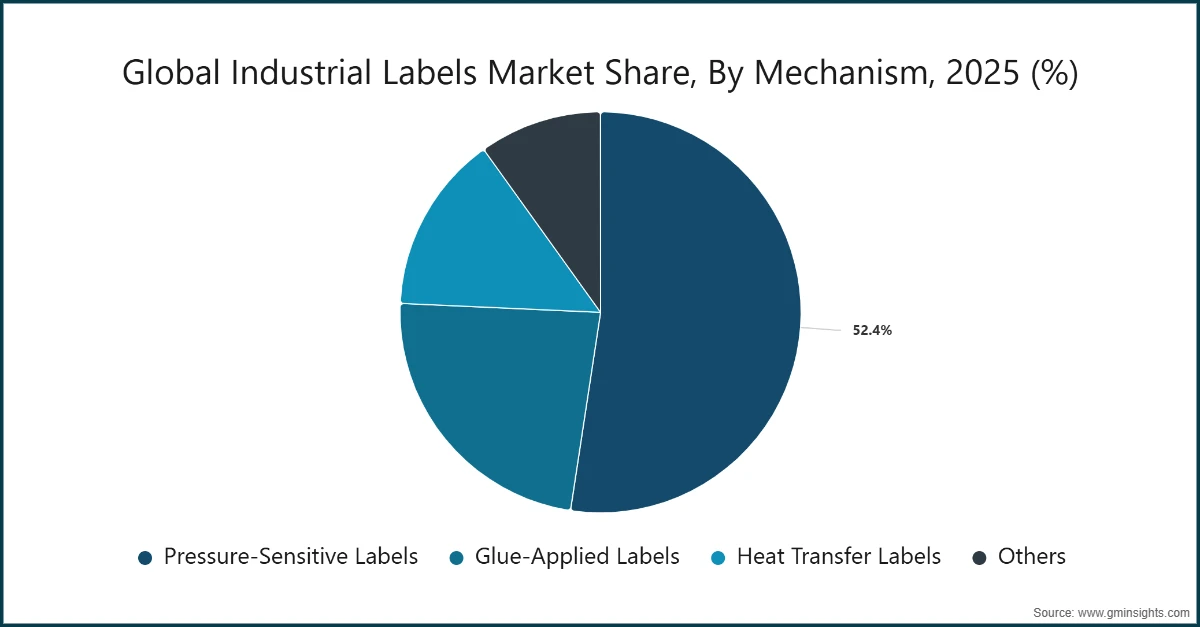
Based on mechanism, the industrial labels market is divided into pressure-sensitive labels, glue-applied labels, heat transfer labels, and others.
- The pressure-sensitive labels segment is projected to grow at a CAGR of over 8.2% during the forecast period. The growth of the pressure sensitive label is attributed to their ease of application and use in automotive, consumer goods, and healthcare. The pressure sensitive labels are self-adhesive and economically effective for large-scale labeling tasks. Its ease of use, combined with its durability and high printing quality, increases its adoption in all sectors.
- The heat transfer labels segment is expected to grow at a CAGR of 7.1% during the forecast period due to their durability, high-resolution printing capability, and resistance to abrasion, chemicals, and temperature variations. Increasing use in automotive, electronics, and machinery industries for long-lasting identification and branding drives consistent demand worldwide.
Looking for region specific data?
North America Industrial Labels Market
North America held around 31.7% of industrial labels industry share in 2025.
- Growing industrial automation and advanced manufacturing in North America are boosting demand for durable and trackable labels across automotive, aerospace, and electronics sectors. Companies increasingly deploy barcodes, RFID, and IoT-enabled labels to improve asset visibility, reduce errors, and comply with strict safety and regulatory standards, driving steady market expansion.
- E-commerce logistics and warehouse modernization further support industrial label adoption. Rising air cargo volumes, integrated supply chains, and demand for efficient inventory management systems enhance reliance on high-performance labels, particularly in transportation, retail, and healthcare sectors, strengthening the region’s overall industrial labeling market.
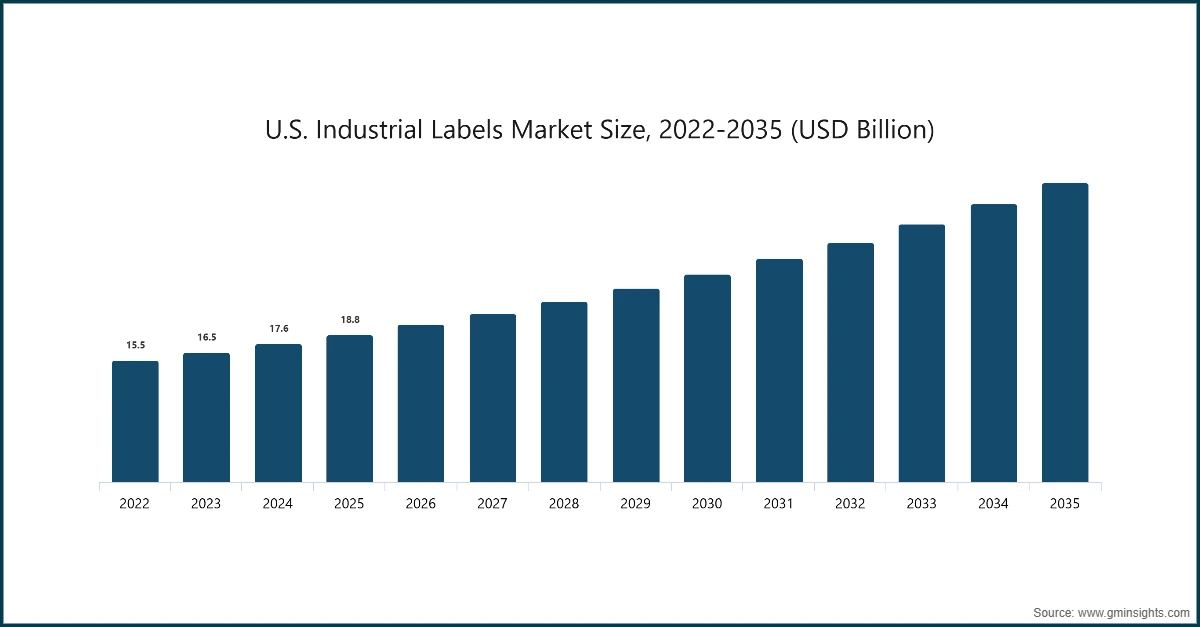
The U.S. industrial labels market was valued at USD 15.5 billion and USD 16.5 billion in 2022 and 2023, respectively. The market size reached USD 18.8 billion in 2025, growing from USD 17.6 billion in 2024.
- The U.S. industrial label has the highest market share, as compared to other countries globally, due to the robust automotive, healthcare, and e-commerce sectors. Moreover, for brand protection, anti-theft, and management of supply chain operations, the demand for RFID, and smart labels is growing.
- Digital printing and automated labeling solutions are advancing and are generating exponential growth. In addition, there is a movement towards more environmentally friendly label designs, as they do in the US market.
Europe Industrial Labels Market
Europe market was valued at USD 14.6 billion in 2025 and is anticipated to show lucrative growth over the forecast period.
- Stringent safety and environmental regulations across European manufacturing and logistics sectors are encouraging the use of compliant industrial labels. Labels for hazardous materials, equipment identification, and operational safety are increasingly adopted to meet EU standards and certification requirements.
- The rise of automated warehouses, smart factories, and e-commerce fulfillment centers in Europe drives demand for trackable, high-performance labels. Integration of RFID and IoT-enabled labeling solutions enhances operational efficiency, inventory visibility, and supply chain reliability across key industrial sectors.
Germany dominates the Europe industrial labels market, showcasing strong growth potential.
- Germany's label market for the industrial sector mainly thrives through automotive, pharma, and manufacturing industries. The country mainly focuses on innovative development, with an increasing focus on smart labels, RFID tags, and automated labeling systems to make improvements in their management of operation efficiency. This country therefore emphasizes the use of environmentally friendly packaging materials such as recyclable and biodegradable packaging for global sustainable development.
- Germany's strict waste policies and commitment to environmental protection will bring additional advantages to the economy, because green labeling may bring economic benefits.
Asia Pacific Industrial Labels Market
The Asia Pacific market is anticipated to grow at a highest CAGR of 8.5% during the forecast period.
- Rapid industrialization and manufacturing expansion across Asia Pacific are driving demand for industrial labels in electronics, automotive, and chemical sectors. Companies increasingly require durable, high-performance labels for traceability, safety, and regulatory compliance.
- The region’s booming e-commerce and logistics networks further stimulate demand for trackable labels. Adoption of RFID, IoT-enabled solutions, and automation in warehouses enhances operational efficiency, inventory accuracy, and real-time asset monitoring across supply chains, accelerating market growth.
China industrial labels market is estimated to grow with a significant CAGR, in the Asia Pacific market.
- The China market is driven by the established manufacturing industry, and an increase in the consumer base. The country's well-developed electronics, automotive, and retail sectors also require and demand more advanced labeling technologies such as RFID and barcode labels.
- China's continuous investment in intelligent technologies and process automation is also beneficial to the use of digital and pressure-sensitive labels. In addition, due to the general environmental problems, the use of eco-friendly and biodegradable labels is more likely.
Middle East and Africa Industrial Labels Market
UAE industrial labels industry to experience substantial growth in the Middle East and Africa.
- UAE’s growing logistics, aviation, and manufacturing sectors are driving adoption of industrial labels for cargo tracking, safety compliance, and equipment identification. High-value exports and re-export operations increased reliance on durable, regulatory-compliant labeling solutions.
- Smart warehouse development and e-commerce expansion in the UAE further support adoption of RFID, IoT-enabled, and trackable industrial labels. Integration with automated inventory and asset management systems enhances operational efficiency, supply chain visibility, and reliability across industrial and logistics operations.
Industrial Labels Market Share
The industrial labels industry is led by players such as Avery Dennison, 3M, CCL Industries, Zebra Technologies, and HID Global, which together account for 20.8% share of the global market. These companies hold strong competitive positions with their extensive portfolios in pressure-sensitive, smart, RFID, and durable labeling solutions across manufacturing, logistics, automotive, healthcare, and electronics sectors.
Their broad global manufacturing and converting presence, established customer relationships, and focus on regulatory compliance and high-performance materials have helped these companies achieve market leadership. Additionally, ongoing investment in smart labeling, IoT-enabled solutions, eco-friendly materials, and digital integration supports sustained growth and increasing adoption across key industrial and logistics applications worldwide.
Industrial Labels Market Companies
Prominent players operating in the industrial labels industry are as mentioned below:
- 3M
- Avery Dennison
- AWT
- Camcode
- CCL Industries
- Dura-ID
- DYMO
- Fuji Seal
- HERMA
- HID Global
- ID Images
- Inovar
- Linepro Controls
- MaverickLabel
- Multi-Color
- Novexx Solutions
- Resource Label
- SATO
- Taghleef
- UPM Raflatac
- Zebra Technologies
- Avery Dennison: Avery Dennison provides a comprehensive portfolio of industrial labels, including pressure-sensitive, RFID, and specialty identification solutions, leveraging global converting capabilities, certified manufacturing, and supply chain integration across automotive, electronics, healthcare, and logistics industries worldwide.
- 3M: 3M delivers high-performance industrial labels and safety labeling solutions, emphasizing durability, chemical and temperature resistance, and compliance with regulatory standards for manufacturing, transportation, and asset identification applications globally.
- CCL Industries: CCL Industries offers a diverse range of industrial labels, including durable, branding, and identification labels, combining engineering expertise, global converting capacity, and aftermarket support to serve automotive, healthcare, consumer goods, and industrial sectors.
- Zebra Technologies: Zebra Technologies specializes in track-and-trace and smart labeling solutions, providing barcode, RFID, and IoT-enabled industrial labels integrated with enterprise systems, supporting inventory management, asset tracking, and logistics automation for industrial and retail supply chains worldwide.
- HID Global: HID Global delivers secure identification and smart industrial labels, including RFID, NFC, and serialized tracking solutions, focusing on anti-counterfeit authentication, digital integration, and regulatory compliance across manufacturing, logistics, and high-value equipment industries.
Industrial Labels Market Report Attributes
| Key Takeaway | Details |
|---|---|
| Market Size & Growth | |
| Base Year | 2025 |
| Market Size in 2025 | USD 67.8 Billion |
| Market Size in 2026 | USD 72.6 Billion |
| Forecast Period 2026-2035 CAGR | 7.5% |
| Market Size in 2035 | USD 139.1 Billion |
| Key Market Trends | |
| Drivers | Impact |
| Increasing demand for supply chain traceability | Drives 22% growth as industries adopt barcode, QR, and RFID labels to improve inventory visibility, asset tracking, and real-time monitoring across increasingly complex global supply chains. |
| Rising focus on product safety and security | Supports 18% growth due to stricter regulatory requirements for hazard communication, compliance labeling, and workplace safety standards across manufacturing, chemicals, healthcare equipment, and logistics sectors. |
| Growth in e-commerce and retail sectors | Contributes 17% growth as expanding parcel volumes and omnichannel distribution increase demand for durable tracking and identification labels supporting automated warehousing and last-mile logistics operations. |
| Increasing concerns about counterfeit products | Adds 15% growth driven by adoption of tamper-evident, authentication, and serialized labels to ensure product authenticity and protect brand integrity across industrial and electronics supply chains. |
| Pitfalls & Challenges | Impact |
| Counterfeit labeling solutions | Restrains market growth as low-cost imitation labels reduce reliability, create compliance risks, and intensify price competition, particularly in emerging markets with fragmented supplier ecosystems. |
| Technological integration costs | Limits adoption due to high upfront investments required for RFID infrastructure, smart labeling systems, and integration with enterprise resource planning (ERP) and warehouse management platforms. |
| Opportunities: | Impact |
| Growing ULD retrofit and replacement cycle | Contributes 15% growth as aging ULD fleets are replaced or upgraded with advanced containers and pallets. |
| Expansion of air cargo in emerging markets | Adds 10% growth driven by Asia-Pacific, Middle East, and Latin America, increasing OEM and pooled ULD demand. |
| Market Leaders (2025) | |
| Market Leader |
6.4% market share in 2025 |
| Top Players |
Collective Market Share is 20.8% in 2025 |
| Competitive Edge |
|
| Regional Insights | |
| Largest Market | Asia Pacific |
| Fastest growing market | Asia Pacific |
| Emerging countries | China, India, Germany, Brazil |
| Future outlook |
|
What are the growth opportunities in this market?
Industrial Labels Industry News
- In January 2026, CCL Industries has agreed to acquire ALT Technologies (Advanced Safety Technologies and its subsidiaries) in an all‑cash, debt‑free transaction valued at approximately USD 32 million.
- In September 2023, CCL Industries Inc. acquired Faubel & Co., a German Pharmaceutical labels company. This acquisition has helped CCL in clinical trials and other healthcare labeling, which further formed the core of CCL business within North America.
- In July 2024, AWT Labels & Packaging acquired American Label Technologies (ALT). The acquisition will strengthen the RFID and label solutions business of AWT. However, this deal will increase the options for healthcare, retail, warehouse, and automotive clients.
The industrial labels market research report includes in-depth coverage of the industry with estimates and forecast in terms of revenue (USD Billion) and volume (Units) from 2022 – 2035 for the following segments:
Market, By Product Type
- Warning/security labels
- Branding labels
- Tracking labels
- Identification labels
- Others
Market, By Material
- Metal
- Plastic/polymer
- Paper
Market, By Mechanism
- Pressure-sensitive labels
- Glue-applied labels
- Heat transfer labels
- Others
Market, By Printing Technology
- Digital printing
- Lithography
- Flexography
- Screen printing
- Others
Market, By End-use Industry
- Transportation & logistics
- Construction
- Automotive
- Healthcare
- Electronics & electrical
- Chemicals
- Others
The above information is provided for the following regions and countries:
- North America
- U.S.
- Canada
- Europe
- Germany
- UK
- France
- Spain
- Italy
- Netherlands
- Asia Pacific
- China
- India
- Japan
- Australia
- South Korea
- Latin America
- Brazil
- Mexico
- Argentina
- Middle East and Africa
- South Africa
- Saudi Arabia
- UAE
Frequently Asked Question(FAQ) :
What is the market size of the industrial labels in 2025?
The market size was USD 67.8 billion in 2025, with a CAGR of 7.5% expected through 2035, driven by rising focus on product safety and security.
What is the projected value of the industrial labels industry by 2035?
The industrial labels market is expected to reach USD 139.1 billion by 2035, propelled rising e-commerce logistics demand, shift toward eco-friendly biodegradable labeling materials, and accelerating digital printing and automation technologies.
What is the current industrial labels industry size in 2026?
The industrial labels market size is projected to reach USD 72.6 billion in 2026, supported by rising industrial automation, increasing asset tracking and barcode labeling adoption.
How much market share did the warning/security labels segment hold in 2025?
The warning/security labels segment led the industrial labels market with a 36% share in 2025, driven by increasing regulatory compliance requirements, rising workplace safety standards, and widespread adoption across manufacturing, logistics, automotive, and healthcare sectors.
What was the market share of the plastic/polymer material segment in 2025?
The plastic/polymer segment dominated the industrial labels market with a 59.9% share in 2025, owing to its durability, versatility, cost-effectiveness, and excellent resistance to humidity.
What is the growth outlook for the pressure-sensitive labels segment?
The pressure-sensitive labels segment is projected to grow at a CAGR of over 8.2% through 2035, due to supporting widespread adoption in automotive, consumer goods, and healthcare large-scale labeling operations globally.
Which region leads the industrial labels market?
North America led the industrial labels market with approximately 31.7% share in 2025, with the U.S. valued at USD 18.8 billion, driven by growing RFID and smart label demand, advancement of digital printing and automated labeling solutions.
What are the key trends shaping the industrial labels market?
Key trends include rising adoption of RFID, growing use of weatherproof and chemical-resistant durable labels, and increasing integration of AI and digital printing technologies for efficient customized label production.
Who are the key players in the industrial labels market?
Key players include Avery Dennison, 3M, CCL Industries, Zebra Technologies, HID Global, UPM Raflatac, SATO, Fuji Seal, Multi-Color, Taghleef, Novexx Solutions, HERMA, Camcode, Dura-ID, and DYMO.
Industrial Labels Market Scope
Related Reports