Summary
Table of Content

Industrial Heater Market
Get a free sample of this report
Form submitted successfully!
Error submitting form. Please try again.
Thank you!
Your inquiry has been received. Our team will reach out to you with the required details via email. To ensure that you don't miss their response, kindly remember to check your spam folder as well!
Request Sectional Data
Thank you!
Your inquiry has been received. Our team will reach out to you with the required details via email. To ensure that you don't miss their response, kindly remember to check your spam folder as well!
Form submitted successfully!
Error submitting form. Please try again.
Industrial Heater Market Size
The industry is witnessing robust growth, fueled by rising demand across a broad range of application areas. Technological advancements are accelerating the shift toward energy-efficient and environmentally sustainable heating solutions, as industries increasingly prioritize reduced energy consumption, lower operating costs, and compliance with stringent environmental regulations while maintaining high process performance and reliability.
Industrial Heater Market Key Takeaways
Market Size & Growth
- 2025 Market Size: USD 5.9 Billion
- 2026 Market Size: USD 6.3 Billion
- 2035 Forecast Market Size: USD 10.7 Billion
- CAGR (2026–2035): 6.2%
Regional Dominance
- Largest Market: Asia Pacific
- Fastest Growing Region: Middle East & Africa
Key Market Drivers
- Increasing investments toward the development of manufacturing sector.
- Stringent government regulations related to emissions.
- Flourishing industrial sector.
- Integration of renewable energy sources.
Challenges
- High initial investment.
Opportunity
- Expansion in emerging economies.
- Integration of smart and IOT enabled heaters.
- Shift toward energy-efficient solutions.
- Industry-specific customized heating solutions.
Key Players
- Market Leader: Watlow Electric Manufacturing Company led with over 7% market share in 2025.
- Leading Players: Top 5 players in this market include Chromalox, Watlow Electric Manufacturing Company, Durex Industries, Backer Hotwatt, ELMATIC, which collectively held a market share of 30% in 2025.
Get Market Insights & Growth OpportunitiesAn industrial heater is a specialized system or device engineered to generate and supply controlled heat for diverse industrial processes. These heaters are essential across multiple industries, enabling applications such as heating liquids, gases, air, or solids, and ensuring accurate temperature control for manufacturing, drying, curing, and related operations.
For reference, in 2025, China’s manufacturing sector attracted USD 40 billion in foreign direct investment, underscoring strong global confidence in the industrial capabilities. This substantial inflow of capital highlights ongoing expansion in manufacturing activities, modernization of production facilities, and sustained interest from international investors seeking long-term growth opportunities.
The industrial heater market was valued at USD 5.1 billion in 2022 and grew at a CAGR of approximately 4% through 2025. Furthermore, industries requiring accurate and consistent temperature control in manufacturing processes are boosting demand for specialized process heating solutions.
The industry is experiencing steady growth, fueled by expanding industrial activities and demand for efficient thermal solutions. Industries increasingly rely on heaters for processes requiring precise temperature control, durability, and consistent output. Market growth is expected to continue, driven by technological innovations and rising industrial production worldwide.
For instance, in March 2025, the petrochemical sector in the Middle East launched a coordinated initiative to modernize refinery heating systems, introducing high-capacity electric immersion heaters to enhance process efficiency and lower fuel-related emissions in crude distillation units.
Rising demand for energy-efficient and high-performance heating solutions is a major growth driver. Industrial heaters support critical processes such as drying, curing, melting, and heat treatment, helping industries optimize efficiency and reduce operational costs. Environmental sustainability initiatives also encourage adoption of advanced, low-emission heating technologies.
Smart technologies and IoT-enabled heating systems are reshaping the industrial heater market. These advancements allow real-time monitoring, automated control, and predictive maintenance, improving process efficiency and minimizing downtime. Electric, infrared, and induction heaters are increasingly preferred for their energy efficiency, precision, and rapid heat delivery.
The industrial heater market was estimated at USD 5.9 billion in 2025. The market is expected to grow from USD 6.3 billion in 2026 to USD 10.7 billion by 2035, at a CAGR of 6.2%, according to a recent study by Global Market Insights Inc.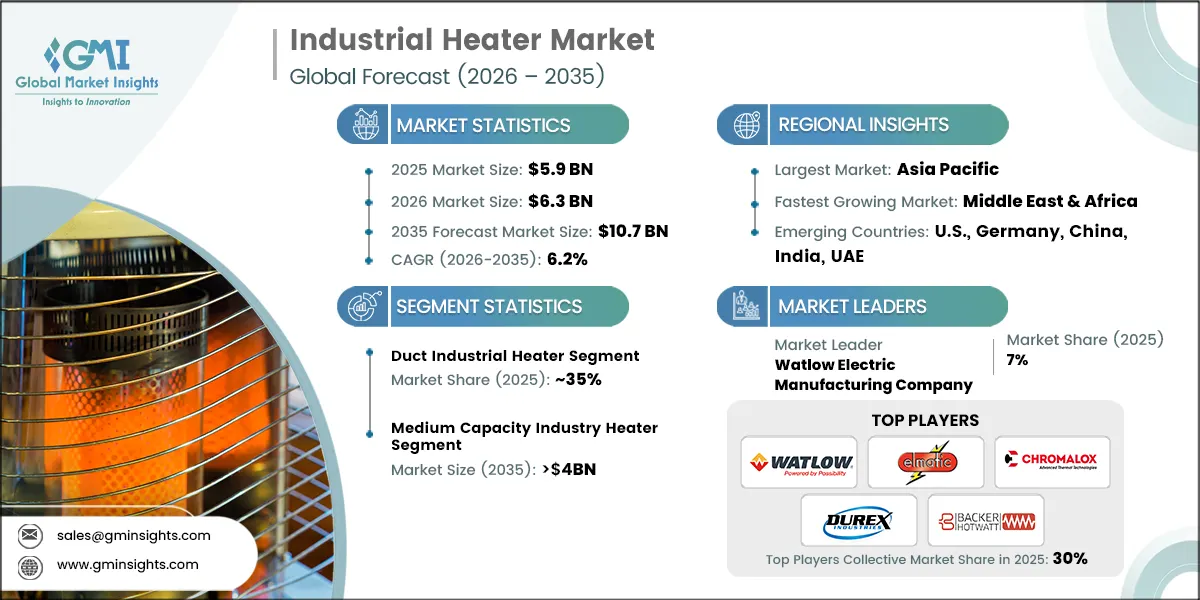
To get key market trends
Industrial Heater Market Trends
The increasing emphasis on energy-efficient and environmentally friendly heating solutions is set to strengthen the overall business environment. These heaters are progressively incorporating smart technologies and connectivity features that enable remote monitoring, advanced control, and system optimization. These innovations improve operational efficiency, reduce downtime, and support predictive maintenance, accelerating the product adoption.
Industrial heaters are widely used in metal processing, chemical manufacturing, food & beverage production, pharmaceuticals, and oil & gas operations. They enable process heating, pipeline heating, material curing, and viscosity control. Accurate temperature management ensures product quality, operational safety, and process efficiency across industries.
Industries are extensively adopting these units designed for energy efficiency, reducing power consumption and emissions. Modern heaters integrate advanced insulation, optimized heating elements, and automated controls to maximize energy utilization. This shift toward sustainable heating aligns with operational cost reduction and environmental responsibility.
For citation, in July 2024, the global steel manufacturing industry initiated a modernization program in Asia to integrate induction-based preheating solutions in forging and rolling mills, aiming to boost operational throughput while cutting energy consumption by up to 20%.
Industrial heaters are now integrated with automated manufacturing systems to enhance production precision and reliability. Sensors, controllers, and software allow adaptive heating, real-time adjustments, and predictive maintenance. Such automation minimizes waste, improves consistency, and supports smart manufacturing initiatives across various industrial sectors.
The market is poised for robust growth, driven by technological innovation and increasing demand for precise heating solutions. Future trends include enhanced energy efficiency, connected systems, and specialized heaters tailored for unique industrial processes. Rising automation and digital monitoring will continue to shape the market landscape.
For instance, in January 2026, the chemical processing sector in Europe announced plans for broad adoption of corrosion-resistant inline heaters in high-temperature acid handling lines, as part of a wider safety compliance roadmap aligned with updated EU chemical plant standards.
Industrial Heater Market Analysis
 Learn more about the key segments shaping this market
Learn more about the key segments shaping this market
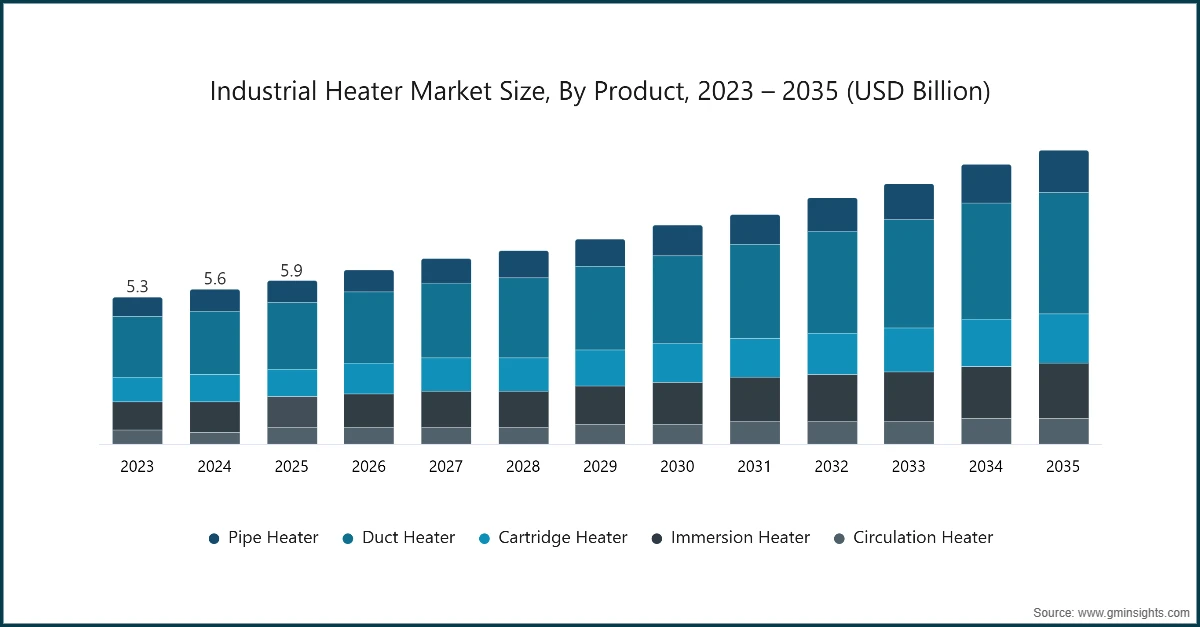
Based on product, the industry is segmented into pipe heater, duct heater, cartridge heater, immersion heater and circulation heater. The duct industrial heater market holds a share of about 35% in 2025 and is projected to grow at a growth rate of over 6% through 2035.
The market supports controlled air heating across ventilation, drying, and process systems. Demand is driven by industrial automation, stringent temperature control requirements, and integration with HVAC infrastructure. Advancements in electric and gas-fired designs improve efficiency, reliability, and uniform heat distribution for continuous industrial operations across diverse manufacturing sectors.
For instance, in October 2025, the semiconductor fabrication sector in South Korea started deploying advanced cleanroom duct heaters engineered for ultra-precise air temperature control in lithography and etching environments, supporting the next generation of chip miniaturization.
The pipe heater industry is set to exceed USD 1.2 billion by 2035. The product addresses process heating needs in pipelines carrying liquids, gases, and viscous materials. These heaters ensure temperature stability, prevent solidification, and support efficient material flow. Rising adoption of electric and immersion-based pipe heaters enhances operational reliability, energy efficiency, and precise thermal control in continuous industrial processing applications.
The cartridge heater segment was valued at USD 1 billion in 2025. These heaters are widely used in molds, dies, packaging, and plastic processing equipment. Growing emphasis on precision heating, fast heat-up rates, and durable stainless-steel designs is strengthening adoption across automated and high-performance industrial operations.
For instance, in December 2024, the global oil and gas sector introduced enhanced freeze-protection heater systems for drilling operations in the Arctic and sub-Arctic regions, aiming to prevent equipment failures during extreme temperature drops at remote extraction sites.
Learn more about the key segments shaping this market
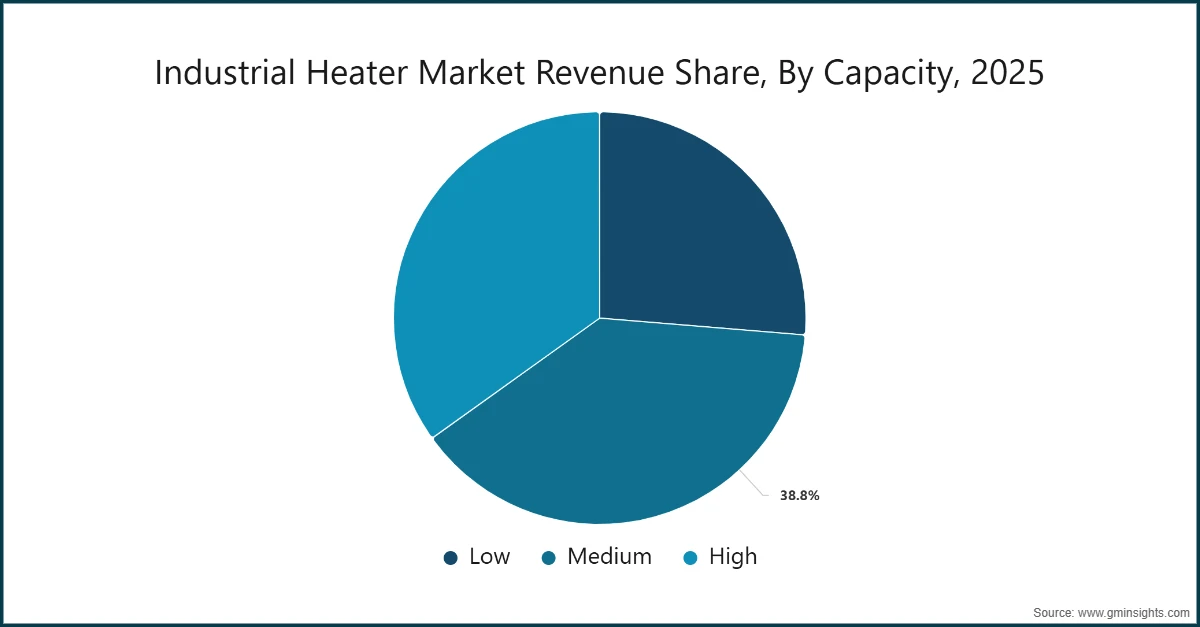
Based on capacity, the industrial heater market is divided into low, medium and high. The medium capacity industry heater market holds a share of 38.8% in 2025 and is set to reach over USD 4 billion by 2035.
The demand is supported by flexibility, cost efficiency, and compatibility with automated systems, offering reliable temperature control without the complexity of large-scale heating installations. It caters to applications requiring balanced heating output with moderate energy consumption.
Low capacity segment was estimated at USD 1.6 billion in 2025. These heaters are used in laboratories, small manufacturing units, and equipment preheating. Growing demand is driven by compact design, ease of installation, energy efficiency, and suitability for precise temperature control in intermittent operations.
For reference, in November 2025, the aerospace components sector in France adopted micro-precision heating technologies to support thermal cycling processes essential for curing advanced composite materials, enhancing manufacturing uniformity for next-generation aircraft structures, which in turn will fuel the product penetration.
The high capacity industrial heater market is set to grow at a rate of 5.5% from 2026 to 2035. These units are preferred for batch operations, equipment warm-up, and secondary process heating. Their modular configuration, scalability, and balanced power ratings support efficient integration into diverse industrial workflows, accelerating the business potential.
For instance, in April 2025, the automotive manufacturing sector in Mexico began a large-scale shift from boiler-based drying systems to energy-efficient strip heaters for paint shops and adhesive curing lines, aiming to cut plant-wide energy consumption by about 15%.
Based on technology, the industry is bifurcated into electric, oil, solid and gas. The electric fired heater industry will witness a CAGR of 7.5% by 2035. The market is driven by the need for clean, controllable, and efficient heating solutions across industrial processes. These heaters offer precise temperature regulation, rapid response times, and easy integration with automation systems.
The oil industrial heater market supports applications requiring high-temperature, indirect heating using thermal oil as the transfer medium. These heaters deliver uniform heat distribution, operational safety, and temperature stability. They are widely used in chemical processing, plastics, and food manufacturing where precise control and continuous heating are essential for process efficiency.
For instance, in March 2025, the chemical fiber production sector in Asia started installing high-temperature tubular heaters in continuous polymerization lines to enhance melt flow consistency and minimize downtime caused by thermal fluctuations.
The solid industrial heater industry includes heating systems powered by solid fuels or solid-state heating elements for industrial applications. The demand is supported by applications requiring stable heat output, long service life, and dependable performance in continuous processing environments.
The gas industrial heater market supports high-capacity and rapid heating requirements across manufacturing and processing operations. These heaters offer strong thermal output, cost-effective fuel usage, and reliable performance for continuous processes.
For reference, in August 2025, the South American biofuel sector announced a new thermal‑efficiency upgrade program for ethanol distillation facilities. Central to the program is the integration of low‑watt‑density immersion heaters designed to minimize scaling and improve heat transfer efficiency.
Looking for region specific data?
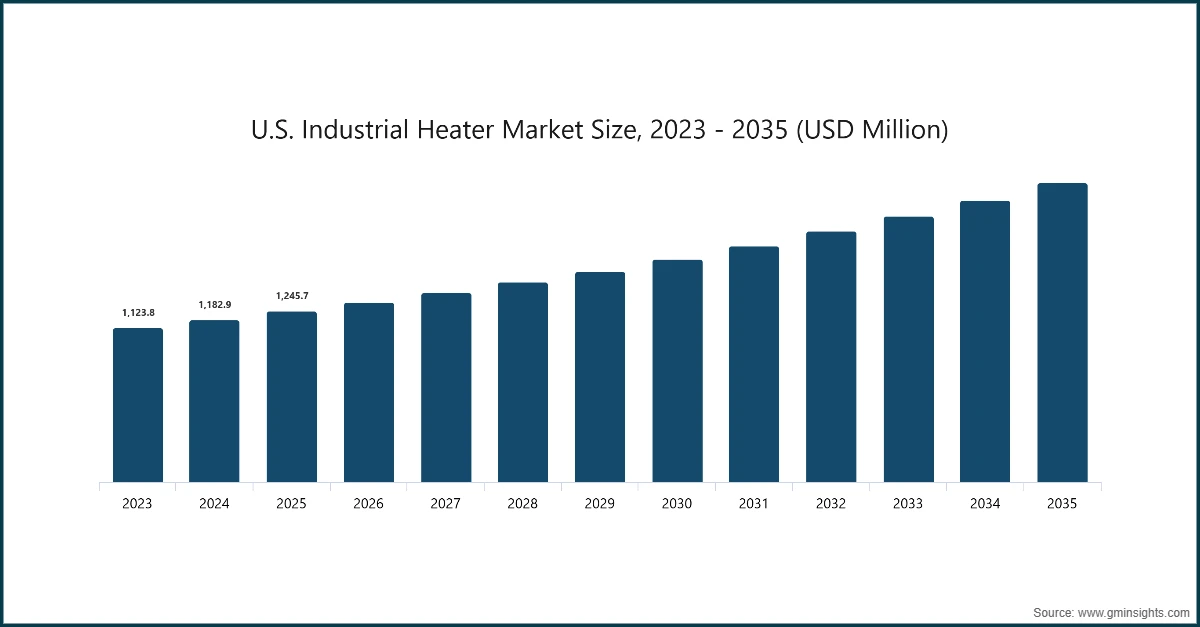
The U.S. dominated the industrial heater market in North America with around 72% share in 2025 and generated USD 1,245.7 million in revenue. The industry is driven by manufacturing modernization, energy efficiency upgrades, and automation adoption, supporting demand for heaters across industrial applications.
The North America industrial heater industry is projected to surge USD 2.5 billion by 2035. The industry is witnessing strong growth on account of increasing adoption of energy-efficient and eco-friendly heating solutions. Industries are integrating smart technologies, automation, and digital controls to optimize operations. Rising demand for reliable, precise, and sustainable heating in manufacturing and processing sectors is shaping market trends.
For illustration, in February 2026, the Canadian mining sector adopted ruggedized convection heating units across multiple ore‑processing plants. These units are intended to ensure thermal consistency during winter months and stabilize workflow disruptions caused by harsh climatic conditions.
The Europe market accounts for about 20% of the industrial heater market in 2025. Industries prioritize digital automation, smart controls, and reduced emissions to enhance operational performance. Regulatory focus on decarbonization and renewable integration accelerates demand. Collaboration, innovation, and retrofit solutions shape competitive market dynamics across key sectors strategically.
For reference, in September 2025, the European food‑processing sector introduced hybrid solar‑electric heating modules for large drying and dehydration plants. The integration aims to cut operational energy costs and support regulatory decarbonization targets.
The Asia Pacific industrial heater industry is set to grow at a rate of over 6.5% by 2035. Rising industrialization, adoption of automation, and sustainability initiatives drive demand. Digital controls and smart technologies improve performance, while regulatory support and retrofit projects shape competitive growth across key regional landscapes.
For instance, in May 2024, the pharmaceutical manufacturing sector in India announced plans to establish dedicated thermal validation laboratories to test high-purity heater systems for sterile processing applications, supporting rising demand for injectable drug production.
The Middle East & Africa industrial heater market is advancing as industries prioritize efficiency, reliability, and sustainable operations. Growing demand in oil & gas, petrochemical, and manufacturing sectors is driving adoption of advanced heating technologies. Smart controls, automation, and eco-friendly solutions are increasingly integrated to optimize performance and reduce energy consumption.
The Latin America market is expanding as manufacturing, oil and gas, and chemical industries prioritize energy efficiency and modernization. Adoption of advanced technologies, automation, and digital controls improves operational performance. Sustainability initiatives and infrastructure investments further support demand for reliable & high-performance heating solutions.
Industrial Heater Market Share
The top 5 players in industrial heater industry are Chromalox, Watlow Electric Manufacturing Company, Durex Industries, Backer Hotwatt and ELMATIC contribute around 30% of the market share in 2025.
The industry is highly competitive, dominated by established global players. Companies compete on the basis of technology innovation, energy efficiency, and customization capabilities. Strategic initiatives like mergers, partnerships, and expansion of product portfolios help firms strengthen their market presence. Additionally, after-sales service, reliability, and compliance with industrial standards are key differentiators influencing customer preference and shaping the overall competitive landscape.
Chromalox is one of the global leaders in electric heating solutions, offering industrial heaters with high efficiency, durability, and advanced control systems. Its products serve diverse sectors including chemical processing, power generation, and food manufacturing, emphasizing reliability and energy optimization.
Watlow Electric Manufacturing Company specializes in configurable industrial heating systems, combining heaters, sensors, and controllers for precise thermal management. With a strong global footprint, it serves industries such as semiconductors, life sciences, and energy, focusing on innovation, safety, and performance.
Durex Industries delivers robust industrial heaters tailored for heavy-duty applications. Its product range includes immersion heaters, circulation heaters, and custom heating solutions, catering to chemical, petrochemical, and manufacturing industries with emphasis on long-term durability and cost-effective performance.
Backer Hotwatt provides energy-efficient heating elements and systems designed for industrial processes. Its offerings include tubular and cartridge heaters, prioritizing precision, reliability, and reduced energy consumption across manufacturing, food processing, and laboratory applications.
ELMATIC focuses on precision industrial heating solutions, producing heaters and control systems that ensure consistent performance. Its products serve automotive, electronics, and industrial machinery sectors, with an emphasis on accuracy, efficiency, and adaptability to complex industrial requirements.
Industrial Heater Market Companies
Major players operating in the industrial heater industry are:
Accutherm
Backer Hotwatt
Chromalox
Durex Industries
Elmec Heaters
Elmatic
ExcelHeaters
Friedr Freek
Heatcon Sensors
Heatrex
Heatco
Indeeco
Marathon Heater
Omega Engineering
Powrmatic
Tempco Electric Heater Corporation
Tutco Heating Solutions Group
Ulanet
Warren Electric Heating Technologies
Watlow Electric Manufacturing Company
Winterwarm Heating Solutions
Zoppas Industries
In 2025, Watlow Electric Manufacturing Company achieved a robust financial performance, generating revenues of USD 473.7 million. This strong showing reflects the company’s continued growth, operational efficiency, and effective market strategies, reinforcing its position as a leading provider of industrial heating solutions and demonstrating resilience in a competitive global marketplace.
In 2025, Durex Industries recorded a revenue of USD 99.1 million, highlighting steady financial growth and effective market presence. This performance underscores the company’s ability to maintain operational efficiency, expand its customer base, and strengthen its position within the industry, reflecting resilience and strategic execution amid competitive market conditions.
In 2024, Powrmatic achieved impressive sales revenue of USD 9.1 million, reflecting strong market demand and effective business strategies. This significant performance highlights the company’s operational excellence, robust growth trajectory, and competitive positioning, underscoring its ability to deliver value to customers and shareholders while maintaining a leading presence in the global industrial equipment market.
Industrial Heater Market Report Attributes
| Key Takeaway | Details |
|---|---|
| Market Size & Growth | |
| Base Year | 2025 |
| Market Size in 2025 | USD 5.9 Billion |
| Market Size in 2026 | USD 6.3 Billion |
| Forecast Period 2026-2035 CAGR | 6.2% |
| Market Size in 2035 | USD 10.7 Billion |
| Key Market Trends | |
| Drivers | Impact |
| Increasing investments toward the development of manufacturing sector | Rising investments in manufacturing expand industrial activities, creating higher demand for reliable and efficient heating solutions. Industrial heaters play a crucial role in process optimization, productivity enhancement, and meeting growing production requirements across multiple sectors. |
| Stringent government regulations related to emissions | Strict emission standards compel industries to adopt cleaner and energy-efficient heating systems. Industrial heaters with low emissions help companies comply with environmental regulations, reduce carbon footprint, and enhance sustainability, driving demand for advanced and regulatory-compliant heating technologies. |
| Flourishing industrial sector | A growing industrial sector across regions increases the need for process heating in manufacturing, chemical, and metal industries. Expanding production volumes and complex processes drive the adoption of advanced industrial heaters to ensure operational efficiency and consistent output. |
| Integration of renewable energy sources | The shift toward renewable energy encourages the use of heaters compatible with solar, biomass, and other sustainable sources. Industrial heaters integrated with renewables improve energy efficiency, reduce operational costs, and support greener manufacturing practices, boosting the product adoption. |
| Pitfalls & Challenges | Impact |
| High initial investment | High upfront costs of advanced industrial heaters, including installation and integration expenses, can deter small and medium enterprises. This financial barrier limits widespread adoption despite efficiency benefits, slowing market growth and delaying return on investment for industrial users. |
| Opportunities: | Impact |
| Expansion in emerging economies | Rising industrialization and manufacturing activities in emerging economies create substantial demand for industrial heaters, presenting opportunities for market expansion and strategic partnerships with local industries. |
| Integration of smart and IOT enabled heaters | Digitalization in industries creates opportunities for connected heaters with remote monitoring, predictive maintenance & automation, enhancing efficiency and reducing the operational costs. |
| Shift toward energy-efficient solutions | Stricter energy regulations and sustainability goals push industries to adopt high-efficiency heaters, fostering demand for innovative, low-energy industrial heating technologies. |
| Industry-specific customized heating solutions | Providing tailored heaters for industries allows companies to capture niche markets, meet precise process requirements, and strengthen customer loyalty. |
| Market Leaders (2025) | |
| Market Leader |
Market Share of 7% |
| Top Players |
Collective Market Share of 30% |
| Competitive Edge |
|
| Regional Insights | |
| Largest Market | Asia Pacific |
| Fastest growing market | Middle East & Africa |
| Emerging countries | U.S., Germany, China, India, UAE |
| Future outlook |
|
What are the growth opportunities in this market?
Industrial Heater Industry News
In February 2026, Watlow showed innovations in its industrial heating lineup, introducing high-performance technologies including the FLUENT in-line heater, POWERSAFE medium-voltage thermal system, and ULTRAMIC advanced ceramic heater. Designed to replace fossil fuel-based systems, these solutions offer cleaner, electric alternatives while ensuring safer, more reliable heating. This advancement represents a significant step toward energy-efficient, next-generation thermal systems for manufacturing, air handling, and precision heating applications.
In April 2025, Watlow Electric Manufacturing Company expanded its footprint in India by establishing a new facility in Bangalore, aimed at enhancing industrial heating and thermal control solutions. This strategic move addresses growing regional manufacturing needs, supports innovation ecosystems, and strengthens local production capabilities, positioning Watlow to better serve customers with advanced, efficient, and reliable thermal management technologies.
In January 2025, Indeeco enhanced its Ultra Safe Explosion‑Proof Unit Heater, 233 Series, by introducing a higher rating of up to 35 kW. This upgrade underscores the company’s dedication to industrial safety and delivering high‑performance, power‑dense heating solutions tailored for demanding, heavy‑duty industrial environments, meeting the evolving needs of modern manufacturing and processing facilities.
In January 2024, Powermatic introduced the EUX unit heater, a sustainable electric heating solution tailored for warehouses, factories, workshops, garages, and manufacturing facilities. The unit provides an energy-efficient way to heat spaces, delivering exceptional warmth and comfort while emphasizing eco-friendly features, representing a meaningful move toward a greener and sustainable future.
The industrial heater market research report includes in-depth coverage of the industry with estimates & forecast in terms of revenue (USD Million) & volume (Units) from 2022 to 2035, for the following segments:
Market, By Technology
Electric
Oil
Solid
Gas
Market, By Capacity
Low
Medium
High
Market, By Product
Pipe heater
Duct heater
Cartridge heater
Immersion heater
Circulation heater
Market, By Application
Oil & gas
Chemical
Food & beverage
Manufacturing
Automotive
Others
The above information has been provided for the following regions and countries:
North America
U.S.
Canada
Mexico
Europe
Germany
Italy
France
Netherlands
Spain
Norway
UK
Sweden
Asia Pacific
China
Japan
India
Australia
South Korea
Thailand
Singapore
Malaysia
Philippines
Vietnam
Indonesia
Middle East & Africa
Saudi Arabia
UAE
Iran
Iraq
Turkey
South Africa
Latin America
Brazil
Chile
Argentina
Frequently Asked Question(FAQ) :
What is the market size of the industrial heater in 2025?
The market was valued at USD 5.9 billion in 2025, with a CAGR of 6.2% expected through 2035. The market growth is driven by rising demand across diverse applications and advancements in energy-efficient and sustainable heating solutions.
What is the projected value of the industrial heater market by 2035?
The market is poised to reach USD 10.7 billion by 2035, fueled by technological innovations, automation, and the increasing need for precise heating solutions.
What is the expected size of the industrial heater industry in 2026?
The market size is projected to reach USD 6.3 billion in 2026.
What was the market share of the duct industrial heater segment in 2025?
The duct industrial heater segment held a 35% market share in 2025 and is expected to grow at a rate exceeding 6% through 2035.
What was the market share and projected value of the medium capacity industrial heater segment?
The medium capacity industrial heater segment accounted for 38.8% of the market in 2025 and is set to surpass USD 4 billion by 2035.
What is the growth outlook for the electric fired heater segment by 2035?
The electric fired heater segment is anticipated to expand at a CAGR of 7.5% till 2035, led by the demand for clean, efficient, and controllable heating solutions.
Which region dominated the industrial heater market in 2025?
The U.S. dominated the market in North America, holding a 72% share and generating USD 1,245.7 million in revenue in 2025. This growth is attributed to manufacturing modernization, energy efficiency upgrades, and automation adoption.
What are the upcoming trends in the industrial heater market?
Key trends include smart monitoring, predictive maintenance, energy-efficient systems, connected technologies, and automation-driven digital monitoring solutions.
Who are the key players in the industrial heater industry?
Major players in the industrial heater market include Accutherm, Backer Hotwatt, Chromalox, Durex Industries, Elmec Heaters, Elmatic, ExcelHeaters, Friedr Freek, Heatcon Sensors, Heatrex, and Heatco.
Industrial Heater Market Scope
Related Reports