Summary
Table of Content

Industrial Gas Regulator Market
Get a free sample of this report
Form submitted successfully!
Error submitting form. Please try again.
Thank you!
Your inquiry has been received. Our team will reach out to you with the required details via email. To ensure that you don't miss their response, kindly remember to check your spam folder as well!
Request Sectional Data
Thank you!
Your inquiry has been received. Our team will reach out to you with the required details via email. To ensure that you don't miss their response, kindly remember to check your spam folder as well!
Form submitted successfully!
Error submitting form. Please try again.
Industrial Gas Regulator Market Size
The primary demand for high-precision industrial gas regulators is increasing mainly because of the growing emphasis on automation-enabled process control and the increasing global safety norms for gas handling. The demand for gas regulators is further boosted by the increasing number of strategic mergers and acquisitions among gas flow equipment manufacturers, as they seek to expand their product offerings and improve their operational efficiency in various industries. The market consolidation among key players is leading to substantial technological advancements, material engineering, and a stronger global presence, especially in the chemical, oil & gas, healthcare, and manufacturing industries.
Industrial Gas Regulator Market Key Takeaways
Market Size & Growth
- 2025 Market Size: USD 17.2 Billion
- 2026 Market Size: USD 18.1 Billion
- 2035 Forecast Market Size: USD 29.3 Billion
- CAGR (2026–2035): 4.3%
Regional Dominance
- Largest Market: Asia Pacific
- Fastest Growing Region: Asia Pacific
Key Market Drivers
- Labor shortages & reshoring.
- Energy transition & stricter safety regulations.
Challenges
- High integration complexity.
- Increasing risks related to data privacy & cybersecurity.
Opportunity
- Rising demand for Regulator-as-a-Service (RaaS).
- Shift toward hydrogen economy & renewable-energy gases.
Key Players
- Market Leader: Air liquids led with over 8% market share in 2025.
- Leading Players: Top 5 players in this market include Air liquids, Air products and Chemicals, Airgas Inc, Cavanga Group, Colfax Corporation, which collectively held a market share of 35% in 2025.
Get Market Insights & Growth Opportunities
The traditional basic gas regulators, designed using fixed and low-sensitivity mechanical designs, are being increasingly replaced by high-performance, digitally monitored gas regulation systems. The advanced gas regulators with smart sensors, IoT connectivity, and automated pressure control systems enable more precise gas flow measurement, leak detection, and stability in fluctuating industrial environments. These advanced systems reflect the industrial sector's need for high-efficiency operations and strict compliance requirements, making them a key driving force behind the overall market growth.
The rising trend of industrial expansion, energy transition policies in North America and Europe, and increasing investments in manufacturing and chemical processing in the Asia-Pacific region are some of the most important factors that contribute to the commercial viability of next-generation gas regulators. Plant operators and system integrators are increasingly turning to technologically enhanced gas regulators that offer greater durability, improved accuracy, and reduced maintenance costs. Furthermore, safety-focused design improvements, such as advanced sealing mechanisms, vibration-damping materials, and ergonomic interfaces, are enhancing user experience and enabling safer human–equipment interaction. These combined factors are contributing to positive financial performance across the market, supported by consistently increasing adoption rates, the global shift toward process automation, and the demand for energy‑efficient gas management solutions.
The evolution of industrial gas regulators from basic mechanical devices to robust, smart-enabled systems—is heavily driven by advancements in materials such as corrosion‑resistant alloys, high‑resilience polymers, and reinforced composites. These materials extend product lifespan, improve pressure-handling capacity, and ensure stability in extreme temperature and environmental conditions. Some of the most important factors that drive the market include the increasing adoption of multi-stage, high-accuracy gas control systems that incorporate automated shut-off valves, real-time pressure measurement, and corrosion-resistant materials. Such systems are highly prized for their improved operational safety, reduced downtime, and improved gas utilization efficiency. The market is heavily driven by industry recognition of the long-term benefits of digital monitoring, smart calibration, and predictive maintenance, resulting in the rapid adoption of smart gas regulator technologies.
The industrial gas regulator market was estimated at USD 17.2 billion in 2025. The market is expected to grow from USD 18.1 billion in 2026 to USD 29.3 billion in 2035, at a CAGR of 4.3% according to latest report published by Global Market Insights Inc.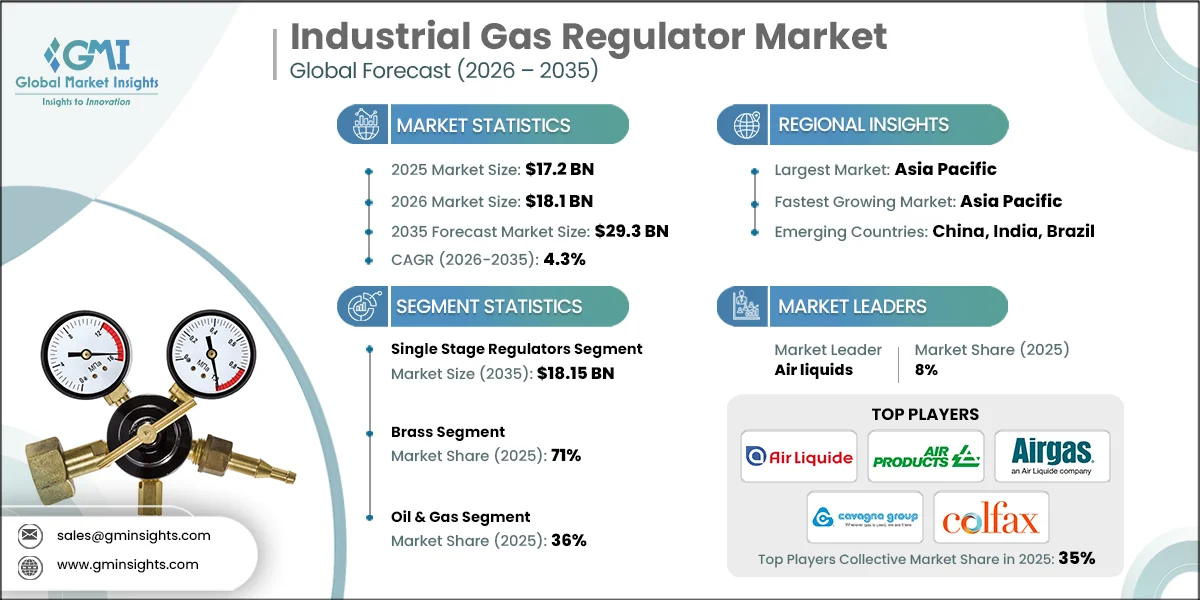
To get key market trends
Industrial Gas Regulator Market Trends
The industrial gas regulator industry is the increasing demand for high purity and specialty gases in various industries such as electronics, healthcare metallurgy and energy. These gases require precise and reliable regulation to ensure optimal performance quality and safety. Therefore, the market is witnessing the development and adoption of advanced gas regulators that can handle high pressure temperature and flow rates as well as corrosive and toxic gases. These regulators also offer features such as digital control remote monitoring and self-diagnosis which enhance the efficiency and convenience.
The industrial gas regulator market is the growing awareness and regulation of environmental and occupational health and safety issues related to gas handling and usage. Industrial gases can post significant risk of fire explosion and pollution if not properly regulated and controlled. Therefore, the market is experiencing a rising demand for gas regulators that can reduce gas emissions, leaks and wastage as well as comply with the stringent standards and norms of various regions and industries. These regulators also help in saving energy and cost as well as improving the sustainability and social responsibility of the gas user.
The rising number of end-use industries like oil & gas, energy generation, and chemical industries, along with the rising technological advancements and product developments in the industrial gas regulators market, are the key factors driving the growth of the market. In addition, the government investments in the development of new oil & gas and energy generation units and maintenance are also key factors driving the growth of the market.
In addition, the rising demand for industrial gases in power generation and industrial operations, along with the rising adoption of natural gas instead of conventional fossil fuels, are the key factors expected to drive the growth of the global industrial gas regulators market. However, the rising demand in the medical and beverages industry is a factor expected to restrain the growth of the market.
- Energy transition & hydrogen-ready regulators: The world is undergoing a massive transition towards the use of clean energy alternatives like LNG, hydrogen, biogas, and other low-carbon fuels. Consequently, the demand for specialized high-pressure, corrosion-resistant regulators has risen dramatically with the growing investments in hydrogen transport infrastructure, LNG facilities, and renewable gas storage.
- Linde and Air Products are leading the way with the supply of sophisticated regulator systems for hydrogen fueling stations, cryogenic LNG pipelines, and carbon capture projects, thereby establishing new benchmarks for safety and reliability. These trends are increasing product development requirements and challenging manufacturers to accelerate R&D efforts on hydrogen-compatible alloys, leak-proof sealing technologies, and ultra-high-precision pressure control solutions. Thus, the energy transition trend is creating new high-growth opportunities and fundamentally changing the market landscape in both mature and emerging markets.
- Digitalization & smart equipment integration: Digitalization is increasingly impacting gas flow management, with industries embracing smart regulators with pressure sensors, telemetry modules, and remote monitoring functionality. Emerson and Air Products are at the forefront of these innovations by developing smart regulators with IoT-based diagnostic and automated shut-off functionality for use in chemical processing, healthcare, and gas distribution applications.
- Product diversification into high-purity & specialty segments: With industries like pharmaceuticals, semiconductors, medical laboratories, and food & beverage demanding ultra-clean and precisely controlled gas flow, the market is witnessing rapid product diversification.
- Companies such as Matheson and Cavagna Group are expanding their portfolios of ultra‑high‑purity (UHP), medical‑grade, beverage‑grade, LPG, and laboratory regulators to serve niche application requirements. These specialized regulators often require advanced filtration, corrosion-resistant materials, and ultra‑stable outlet pressure to maintain gas purity and performance consistency. The growing reliance on specialty gases and application-specific regulators is broadening the overall addressable market and encouraging manufacturers to design highly customized solutions. In addition, expansion into UHP and medical gas categories brings long-term aftermarket revenue streams through routine calibration, replacement components, and compliance-driven maintenance services.
Industrial Gas Regulator Market Analysis
Learn more about the key segments shaping this market
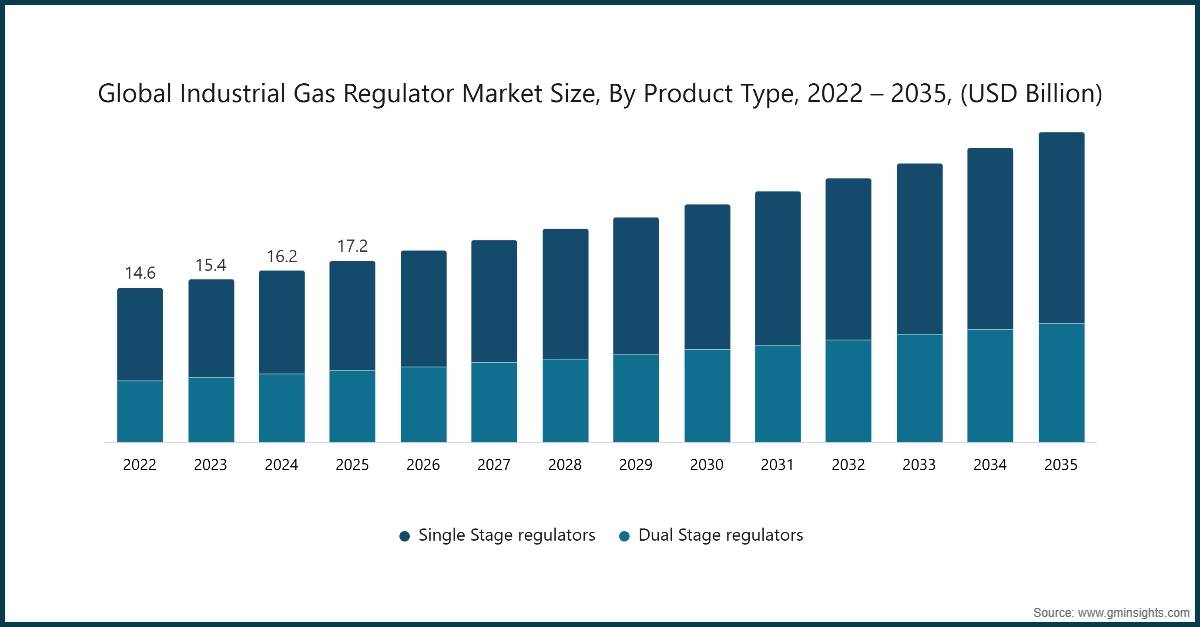
Based on product type, the industrial gas regulator market is segmented into single stage regulator and dual stage regulator. The single stage regulators segment reached USD 10.41 billion in 2025 and expected to reach USD 18.15 billion by 2035.
- Single stage regulator reduces the pressure of the gas in one step while dual stage regulators do it in two steps. Single stage regulators are simpler and cheaper but less accurate and stable than dual stage regulators.
- Dual stage regulators are more suitable for application that require precise and constant pressure. Both these types help to understand the market dynamics and 10 towards the technological advancements and product innovations.
- In contrast, dual-stage regulators employ a two-step pressure reduction process that allows for greater accuracy, long-term pressure stability, and superior delivery consistency. This makes them better suited for high‑purity gas applications, laboratory environments, medical gas handling, semiconductor manufacturing, and specialty gas distribution areas where even minor variations in pressure can affect product quality or operational safety.
- Their advanced performance characteristics are driving increasing adoption in industries transitioning toward precision‑dependent workflows, particularly in Asia-Pacific and North America, where electronics, R&D, and healthcare sectors are expanding rapidly
Learn more about the key segments shaping this market
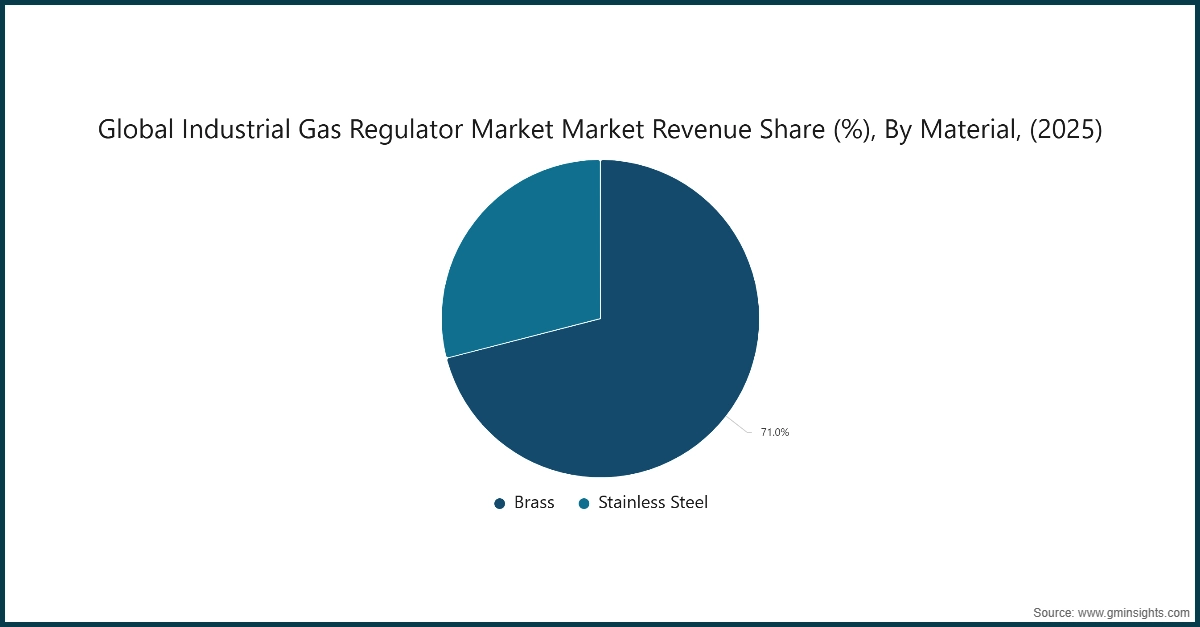
- Brass regulators are widely used across general-purpose industrial applications, HVAC systems, welding, LPG distribution, and beverage gas systems because they provide a favourable balance of affordability and functional durability. Brass is a common and economical material that can withstand moderate pressure and temperatures.
- Stainless steel is more durable and resistance material that can handle high pressure and temperature as well as corrosive and toxic gases. Stainless steel regulators are more expensive than brass regulators but also more reliable and efficient.
- Stainless steel regulators represent the premium segment of the market, offering significantly higher durability, corrosion resistance, and operational stability under extreme conditions.
- Stainless steel materials can withstand high pressure, high temperature, toxic gases, reactive chemicals, and harsh industrial environments, making them essential for sectors such as pharmaceuticals, petrochemicals, hydrogen fuel systems, semiconductor manufacturing, laboratories, and medical gas distribution.
Based on end use, the industrial gas regulator market can be segmented into metallurgy, food & beverage, pharmaceuticals, electric power, chemical, oil & gas and others. In 2025, the oil & gas segment accounted for a market share of about 36%.
- Each industrial different needs and demands for gas regulations depending on the type and quantity of gas used type and the quality and safety tenders and the specific process and applications.
- Food and beverage industries use gas regulators for carbonation preservation and packaging of food and drinks.
North America Industrial Gas Regulator Market
Looking for region specific data?
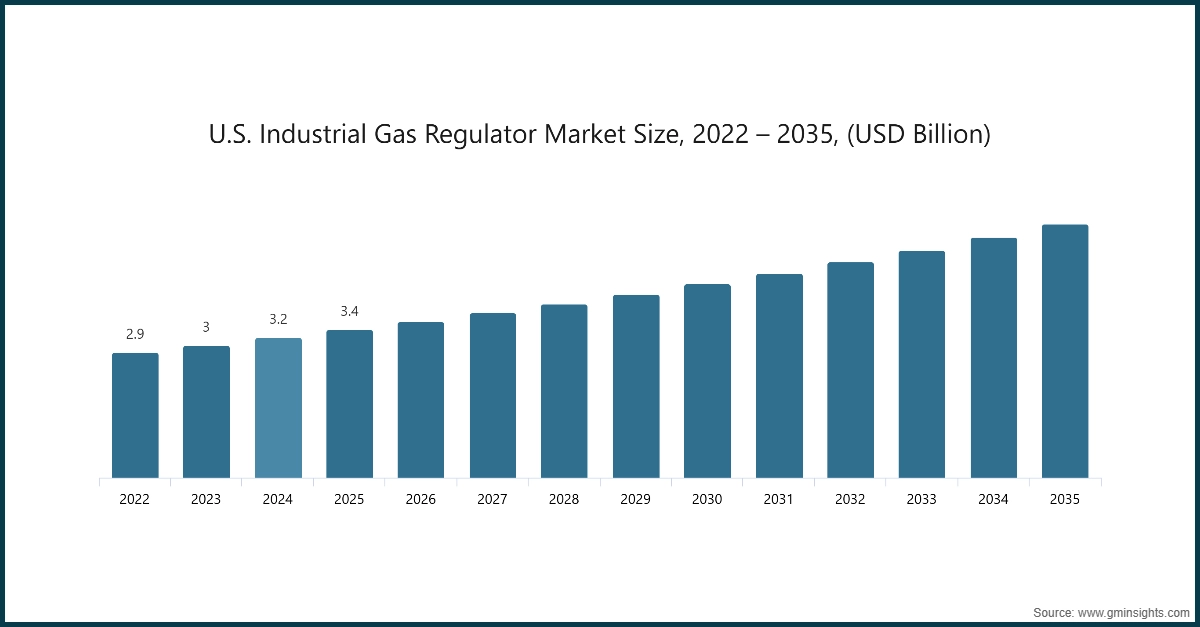
U.S. remains one of the strongest and most stable markets for industrial gas regulator market reached to USD 3.4 billion in 2025. This steady expansion is primarily driven by mature end-use industries such as oil & gas, petrochemical processing, healthcare, and advanced manufacturing.
- The United States continues to dominate due to stringent safety standards enforced by OSHA, NFPA, and FDA, which mandate the use of high-performance gas regulators across industrial operations. The rapid rise of hydrogen fuel projects, LNG terminals, and semiconductor fabrication plants further contributes to the region’s growth.
- Additionally, strong investments in automation, digital monitoring systems, and high-purity gas applications support continuous demand for premium stainless steel and dual-stage regulators.
- North America’s overall trajectory reflects its shift toward energy transition technologies and modernization of legacy industrial infrastructure.
- This steady expansion is primarily driven by mature end-use industries such as oil & gas, petrochemical processing, healthcare, and advanced manufacturing. The United States continues to dominate due to stringent safety standards enforced by OSHA, NFPA, and FDA, which mandate the use of high-performance gas regulators across industrial operations.
- The rapid rise of hydrogen fuel projects, LNG terminals, and semiconductor fabrication plants further contributes to the region’s growth.
Europe Industrial Gas Regulator Market
Europe demonstrates consistent growth, increasing from USD 3.63 billion in 2022 to USD 4.23 billion in 2025, supported by strict regulatory frameworks and a major push toward decarbonization.
- Countries such as Germany, the UK, France, and the Netherlands are investing heavily in hydrogen infrastructure, carbon-neutral manufacturing, and green energy systems, all of which require advanced gas handling and precision regulators.
- The region’s strong pharmaceutical, chemical processing, and food & beverage industries drive additional demand for high-purity and specialty gas regulators.
- Furthermore, EU‑wide standards emphasizing leak prevention, emission reduction, and environmental safety are pushing industries to upgrade outdated regulator systems.
- Europe’s increasing adoption of automation and digital gas monitoring solutions is also reinforcing demand across both industrial and laboratory segments.
Asia Pacific Industrial Gas Regulator Market
Asia-Pacific is the fastest-growing region, expanding from USD 4.44 billion in 2022 to USD 5.29 billion in 2025, driven by rapid industrialization and large-scale manufacturing expansion.
- China, India, South Korea, and Japan are major contributors, with substantial growth in electronics, semiconductors, automotive, metal fabrication, and pharmaceutical production. APAC’s massive LNG import terminals, refinery expansions, and booming chemical manufacturing clusters significantly increase demand for both brass and stainless-steel regulators.
- Additionally, rising healthcare infrastructure, laboratory investments, and the push for hydrogen-based mobility systems are accelerating adoption of precision and specialty regulators.
- Lower production costs, availability of raw materials, and high-volume industrial activities make Asia-Pacific the most dynamic market, with strong prospects for both volume-based and high-tech segments.
Latin America Industrial Gas Regulator Market
- Latin America shows moderate but steady growth, rising from USD 1.39 billion in 2022 to USD 1.61 billion in 2025. Key regional markets Brazil, Mexico, Argentina, and Chile are witnessing gradual upgrades in industrial infrastructure, especially within oil & gas, mining, food processing, and LPG distribution networks.
- Despite economic fluctuations, LATAM’s demand for reliable gas regulators is increasing due to safety compliance requirements and modernization of chemical and manufacturing facilities.
- Brazil leads the region with expanding petrochemical and energy sectors, while Mexico sees rising adoption driven by manufacturing growth and cross-border industrial partnerships. Though the market is still price-sensitive, adoption of higher-grade stainless-steel regulators is slowly rising, particularly in industries that handle corrosive gases and require better operational reliability.
Industrial Gas Regulator Market Share
Air Liquide is leading the market with approximately 8% market share. Top players including Air Liquide, Air products and Chemicals, Airgas Inc, Cavagna Group, Colfax Corporation collectively held a substantial 35% market share. The market is highly fragmented. These industry leaders are actively engaged in strategic initiatives, such as mergers & acquisitions, facility expansions, and partnerships, to broaden their product portfolios, reach a wider customer base, and strengthen their market presence. These companies continuously invest in research & development to improve their products and incorporate new technologies, allowing them to stay ahead of the competition.
ControlAir introduced the Type 855BP Miniature Back Pressure Regulator, providing users with a compact pressure relief solution. This valve, featuring an adjustable set point, ensures efficient and high-performance pressure relief at a cost-effective rate. Functioning as a typically closed valve, it remains shut until the regulator surpasses its set point.
ESAB, a prominent industrial company, revealed the introduction of its latest gas regulators designed for various industrial and commercial purposes. The FE300 and ProStage gas regulators originate from an advanced, state-of-the-art gas equipment facility located within the European Union.
Industrial Gas Regulator Market Companies
Major players operating in the industrial gas regulator industry are:
- Air Liquide
- Air products and Chemical
- Airgas Inc
- Cavagna Group
- Colfax Corporation
- Emerson Electric
- GCE Group
- Iceblick Ltd
- Itron Inc
- Iwatani
- Linde Group
- Matheson Tri-gas
- Messer Group
- Praxair Inc
- Rotarex
Emerson has finished its acquisition of National Instruments (NI) for USD 8.2 billion, which is a major milestone in the automation sector. This acquisition is expected to strengthen Emerson's position in software-integrated automated test and measurement solutions by incorporating NI into a new Test & Measurement business unit within Emerson's Software and Control division. Emerson also expects to gain access to high-growth markets such as semiconductors, transportation, and aerospace, as well as the industrial software market, in addition to realizing USD 165 million in cost synergies over five years. This will further strengthen Emerson's position as a global leader in automation
Industrial Gas Regulator Market Report Attributes
| Key Takeaway | Details |
|---|---|
| Market Size & Growth | |
| Base Year | 2025 |
| Market Size in 2025 | USD 17.2 Billion |
| Market Size in 2026 | USD 18.1 Billion |
| Forecast Period 2026-2035 CAGR | 4.3% |
| Market Size in 2035 | USD 29.3 Billion |
| Key Market Trends | |
| Drivers | Impact |
| Labor shortages & reshoring | Ongoing labor shortages in manufacturing and processing industries—combined with reshoring initiatives—are accelerating the adoption of automated gas handling systems and advanced regulators that reduce human intervention and improve operational safety. |
| Energy transition & stricter safety regulations | The global push toward cleaner fuels (hydrogen, LNG, industrial specialty gases) and stricter compliance standards has increased the need for high precision, leak proof, and certified industrial gas regulators. |
| Pitfalls & Challenges | Impact |
| High integration complexity | Retrofitting old plants with smart sensors, digital pressure controllers, or electronic regulators is technically complex. Interoperability issues between legacy pipelines and modern regulators slow down adoption. |
| Increasing risks related to data privacy & cybersecurity | As regulators become IoT-enabled, centralized, and cloud monitored, vulnerabilities increase—raising concerns over unauthorized access, gas system tampering, and industrial cyber threats. |
| Opportunities: | Impact |
| Rising demand for Regulator-as-a-Service (RaaS) | Subscription-based gas regulation systems—offering remote monitoring, calibration, and predictive maintenance—enable SMEs to adopt advanced regulators without high upfront investment. |
| Shift toward hydrogen economy & renewable-energy gases | The rapid global expansion of hydrogen fuel, green ammonia, medical gases, and high-purity gases opens major opportunities for specialized, corrosion-resistant, and ultra precision regulators. |
| Market Leaders (2025) | |
| Market Leader |
8% market share |
| Top Players |
Consolidate share of 35% |
| Competitive Edge |
|
| Regional Insights | |
| Largest Market | Asia Pacific |
| Fastest growing market | Asia Pacific |
| Emerging countries | China, India, Brazil |
| Future outlook |
|
What are the growth opportunities in this market?
Industrial Gas Regulator Industry News
- In February 2025, Air Liquide revealed two major hydrogen electrolyzer projects in Europe 200 MW and 250 MW, developed in partnership with TotalEnergies. These projects incorporate advanced hydrogen‑ready regulation systems engineered for high‑pressure electrolyzer operations, safe gas transfer, and optimized distribution. The initiative supports Europe’s industrial decarbonization goals while accelerating adoption of specialized hydrogen-compatible regulators.
- In June 2024, Air Liquide announced a USD 250 million investment to build a next‑generation ultra‑high‑purity (UHP) gas production and regulation facility in Idaho, USA. This plant will supply semiconductor fabrication units with UHP gases and integrated regulator systems designed for precise flow control, contamination‑free delivery, and high‑pressure stability. The facility is expected to be fully operational by the end of 2025, reinforcing Air Liquide’s leadership in high‑purity gas regulation technology.
- In June 2024, Air Products initiated construction on a USD 70 million expansion of its membrane and gas‑equipment manufacturing facility in Missouri. This upgrade is designed to significantly increase production capacity for biogas upgrading systems, hydrogen distribution equipment, and advanced gas regulation assemblies. The expansion includes high‑precision regulator fabrication lines and automated testing units, supporting rising global demand for clean‑energy gas control technologies and high‑performance industrial regulators.
- In January 2024, Linde group and air liquid signed a long-term agreement to supply industrial gases to Samsung Electronics new semiconductor fabrication plant in South Korea.
- In November 2023, Emerson Electric company announce the launch of its new Fisher EZH and EZHSO regulators design to help reduce emission and improve safety performance in natural gas transmission and distribution systems.
The industrial gas regulator market research report includes in-depth coverage of the industry with estimates & forecasts in terms of revenue (USD Million) and volume (Million Units) from 2022 to 2035, for the following segments:
Market, By Product Type
- Single Stage Regulators
- Dual Stage regulators
Market, By Material
- Brass
- Stainless Steel
Market, By End Use
- Metallurgy
- Food & Beverage
- Pharmaceuticals
- Chemical
- Electric power
- Oil & Gas
- Others
The above information is provided for the following regions and countries:
- North America
- U.S.
- Canada
- Europe
- Germany
- UK
- France
- Italy
- Spain
- Asia Pacific
- China
- India
- Japan
- Australia
- South Korea
- Latin America
- Brazil
- Mexico
- Argentina
- Middle East and Africa
- South Africa
- Saudi Arabia
- UAE
Frequently Asked Question(FAQ) :
What is the market size of the industrial gas regulator in 2025?
The market size was USD 17.2 billion in 2025, with a CAGR of 4.3% expected through 2035. The growth is driven by automation in process control and stringent global safety norms for gas handling.
What is the projected value of the industrial gas regulator market by 2035?
The market is poised to reach USD 29.3 billion by 2035, fueled by technological advancements, material engineering, and increasing demand across industries like oil & gas, healthcare, and manufacturing.
What is the expected size of the industrial gas regulator industry in 2026?
The market size is projected to reach USD 18.1 billion in 2026.
How much revenue did the single-stage regulators segment generate in 2025?
The single-stage regulators segment generated approximately USD 10.41 billion in 2025 and is expected to reach USD 18.15 billion by 2035.
What was the market share of the brass segment in 2025?
The brass segment accounted for a market share of about 71% in 2025, owing to its cost-effectiveness, machinability, and reliable performance under moderate conditions.
Which region leads the industrial gas regulator sector?
The U.S. remains one of the strongest markets, valued at USD 3.4 billion in 2025, supported by mature industries such as oil & gas, petrochemical processing, healthcare, and advanced manufacturing.
What are the upcoming trends in the industrial gas regulator market?
Trends include the shift to clean fuels like hydrogen and LNG, IoT-enabled smart regulators, expansion into specialty segments, and advances in hydrogen-compatible and high-precision pressure control technologies.
Who are the key players in the industrial gas regulator industry?
Key players include Air Liquide, Air Products and Chemicals, Airgas Inc., Cavagna Group, Colfax Corporation, Emerson Electric, GCE Group, Iceblick Ltd, Itron Inc., and Iwatani.
Industrial Gas Regulator Market Scope
Related Reports