Summary
Table of Content

Industrial Dryers Market
Get a free sample of this report
Form submitted successfully!
Error submitting form. Please try again.
Thank you!
Your inquiry has been received. Our team will reach out to you with the required details via email. To ensure that you don't miss their response, kindly remember to check your spam folder as well!
Request Sectional Data
Thank you!
Your inquiry has been received. Our team will reach out to you with the required details via email. To ensure that you don't miss their response, kindly remember to check your spam folder as well!
Form submitted successfully!
Error submitting form. Please try again.
Industrial Dryers Market Size
- The industrial dryers market is experiencing growth due to increased food processing and packaged food production, as food manufacturers need drying equipment to remove moisture from products and ensure quality during the manufacturing process. By using industrial dryers, food manufacturers can extend their products' shelf life and keep the ingredients in packaged foods stable. In addition, food processing facilities depend on efficient drying equipment to meet the demands of heavy production on a continuing basis. Packaged snack food, dairy powders, and instant food products all need controlled drying operations to achieve the right texture and ensure an acceptable length of time they can be stored. Reliable dryers help manufacturers meet food safety standards by providing consistent moisture levels in products. Consequently, food manufacturers are investing in the latest dryer technology to achieve greater energy savings and processing reliability. Large production lines require drying systems that can maintain a continuous and uniform drying process throughout the entire production cycle. Food processors place great emphasis on selecting systems that allow for sanitation of the product and provide uniform quality of the product being produced. As demand for packaged food products increases, so does the need for moisture removal technology that operates with high efficiency.
- The industrial dryers market is being influenced by the growth of pharmaceutical and chemical manufacturing, which are using more precise drying processes to eliminate moisture in powders, granules and chemicals. Dryers are helping to provide consistent quality by providing control over what temperature is used and reducing moisture equally within a product. In pharmaceutical production, the stabilization of an active ingredient or formulation depends upon having a continuous stream of drying systems that can provide reliability throughout the life of that product. For chemical manufacturers, drying systems are produced for various specialized materials manufactured during synthesis and processing. The drug production and specialty chemical manufacturing industries are expanding, resulting in the purchase of advanced drying systems. Equipment that provides an environment that is clean and operates consistently is highly desirable for processing facilities. There is a push to implement energy efficient dryers into the supply chain that will meet the requirements of large-scale production.
- Rotary dryers are an important part of many different industries because they are very flexible and can dry a wide variety of materials. A rotary dryer also uses hot air or gas to dry your material by passing through a rotating drum. The drum spins while hot air or gas exits the dryer, ensuring that each piece of material has the same amount of heat applied to it, allowing for consistent drying and moisture removal. Rotary dryers are used in many industries to dry products like powders, and ores and grains, among many other types of materials. Some common examples of these industries are mineral, chemical, food processing, and biomass drying operations. The versatility to dry large amounts of material, the ability to run continuously, and the durability of construction make rotary dryers ideal for applications that require a heavy-duty industrial application.
The industrial dryers market was estimated at USD 8.2 billion in 2025. The market is expected to grow from USD 8.5 billion in 2026 to USD 13.4 billion in 2035, at a CAGR of 5.1%, according to latest report published by Global Market Insights Inc.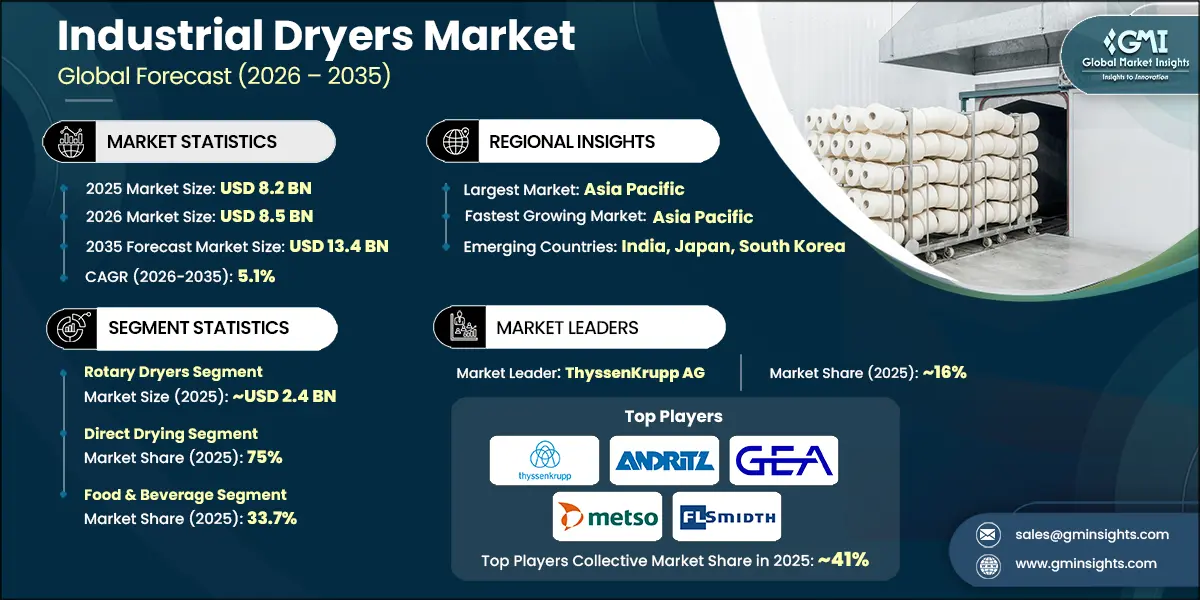
Industrial Dryers Market Key Takeaways
Market Size & Growth
- 2025 Market Size: USD 8.2 Billion
- 2026 Market Size: USD 8.5 Billion
- 2035 Forecast Market Size: USD 13.4 Billion
- CAGR (2026–2035): 5.1%
Regional Dominance
- Largest Market: Asia Pacific
- Fastest Growing Region: Asia Pacific
Key Market Drivers
- Expansion of food processing and packaged food production.
- Growing pharmaceutical and chemical manufacturing activities.
- Rising demand for efficient moisture control in manufacturing processes.
Challenges
- High energy consumption associated with industrial drying operations.
- High price sensitivity in mass-market segments.
Opportunity
- Growing demand for energy-efficient and heat recovery drying technologies.
- Integration of digital monitoring and automated process control systems.
Key Players
- Market Leader: ThyssenKrupp AG led with over 16% market share in 2025.
- Leading Players: Top 5 players in this market include ThyssenKrupp AG, ANDRITZ AG, GEA Group, METSO, FLSmidth & Co. A/S, which collectively held a market share of 41% in 2025.
Get Market Insights & Growth Opportunities
To get key market trends
Industrial Dryers Market Trends
- Manufacturers of industrial facilities are increasingly focusing on developing energy efficient processes to improve energy consumption when drying materials. Newer designs for industrial dryers are using improved insulation covering and optimised systems of airflow control. Efficient heat transfer when drying can ensure a smoothly balance across large volumes of product being created. Manufacturers are continually refining dryer design due to the desire to supply reduced energy requirements to the end user.
- Automation of industrial drying equipment has rapidly emerged as the norm within value-added processing industries. Automated digital control systems now regulate temperature, airflow and duration of drying while producing goods. Providing consistent control enables all products to be produced uniformly with respect to moisture content. Production managers rely on the use of automated equipment to enable them to maintain a steady operating environment.
- Agricultural and food processing facilities require sufficient controls over the drying processes of their products to ensure high quality standards will be maintained. By using industrial drying equipment, agricultural and food producing companies are able to; prolong the shelf life of finished goods, maintain consistency in product's characteristics, and provide themselves with a safe method of storing and transporting agricultural products.
- All food production companies need to have high-quality and sanitary drying facilities. Smooth surface industrial drying equipment allows for easier cleaning and is made for industrial cleanliness with corrosion-proofing materials. Stainless steel provides sanitary processing conditions. Industrial production facilities seek equipment that minimizes the risk of contamination during the process of drying products. Food safety regulations will affect the equipment choice for the food industry.
- There are often unique materials and processing conditions in the industrial sector that make it necessary for drying systems to be specifically designed to fit those materials and conditions. Custom equipment ensures that precise moisture levels are achieved while maintaining product quality. Manufacturers work in partnership with clients to design drying systems that meet the specific process requirements of each client.
Industrial Dryers Market Analysis
Learn more about the key segments shaping this market
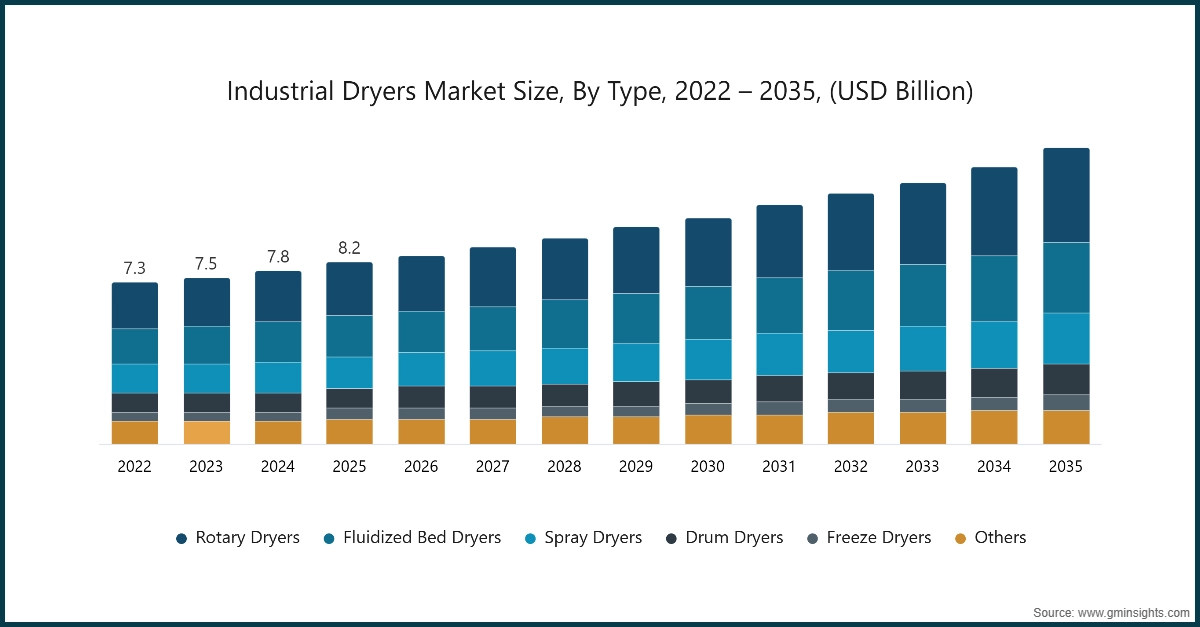
Based on type, the market is categorized into rotary dryers, fluidized bed dryers, spray dryers, drum dryers, freeze dryers, and others. The rotary dryers segment accounted for revenue of around USD 2.4 billion in 2025 and is anticipated to grow at a CAGR of 6% from 2026 to 2035.
- The rotary dryers segment dominates the industrial dryers market due to its high efficiency, versatility, and capacity to handle bulk and granular materials across various industries. These dryers use a rotating drum with controlled hot air or gas flow to ensure uniform moisture removal, making them ideal for minerals, chemicals, food processing, and biomass applications.
- Their ability to operate continuously, manage large volumes, and withstand harsh industrial conditions makes them a preferred choice for heavy-duty drying processes. Growing demand for reliable, energy-efficient, and high-capacity drying equipment continues to reinforce the strong position of rotary dryers in the global market.
Based on technology, of industrial dryers market consists of direct drying and indirect drying. The direct drying emerged as leader and held 75% of the total market share in 2025 and is anticipated to grow at a CAGR of 5% from 2026 to 2035.
- The direct drying technology segment holds a leading position in the market due to its simplicity, efficiency, and cost-effectiveness. In direct drying systems, hot air or gas comes into direct contact with the material, enabling rapid moisture removal and high thermal efficiency. This technology is widely used across industries such as food processing, chemicals, minerals, and biomass, where fast and uniform drying is critical.
- Direct drying systems are favored for their lower energy consumption, easier operation, and reduced equipment complexity compared to indirect methods. The combination of efficiency, reliability, and operational simplicity supports the dominance of direct drying technology in the global market.
Learn more about the key segments shaping this market
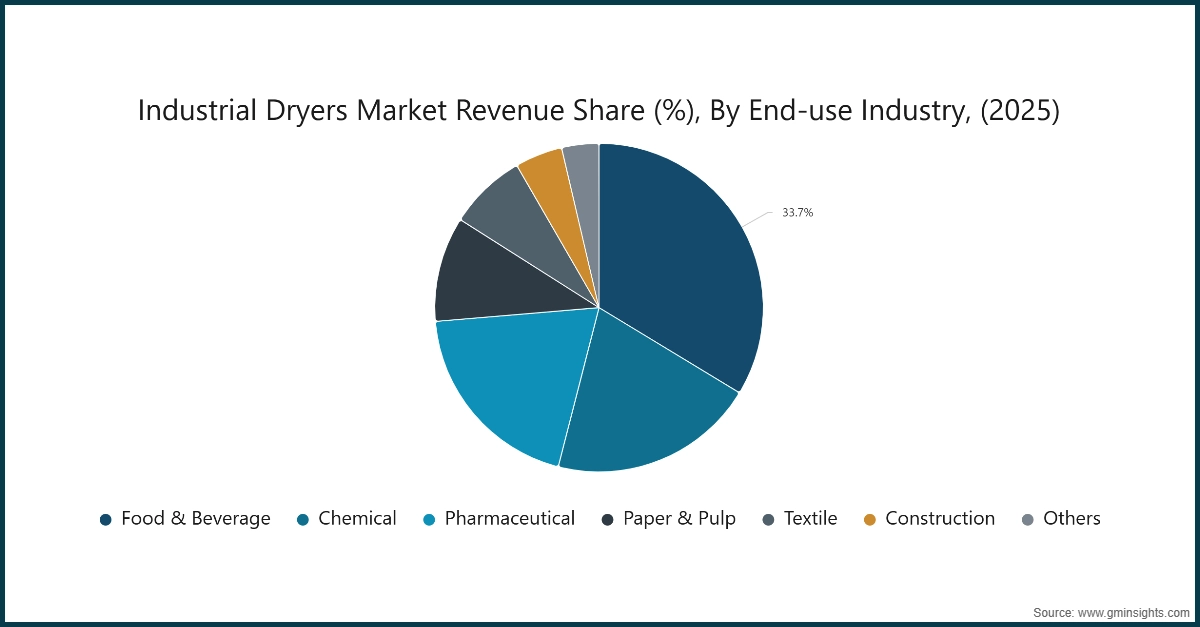
Based on end-use industry, industrial dryers market consists of food & beverage, chemical, pharmaceutical, paper & pulp, textile, and construction. The food & beverage emerged as leader and held 33.7% of the total market share in 2025 and is anticipated to grow at a CAGR of 4% from 2026 to 2035.
- The food & beverage segment holds the largest share in the market due to the critical role of drying in preserving, processing, and extending the shelf life of products. Industrial dryers are extensively used for dehydration of fruits, vegetables, dairy products, grains, and powdered ingredients, ensuring product quality, safety, and consistency.
- Rising demand for processed, packaged, and ready-to-eat foods is driving the adoption of high-capacity, efficient drying solutions in food and beverage processing facilities. The need for energy-efficient operations, consistent moisture control, and compliance with food safety standards reinforces the leading position of the food & beverage industry in the global market.
Asia Pacific Industrial Dryers Market
Looking for region specific data?
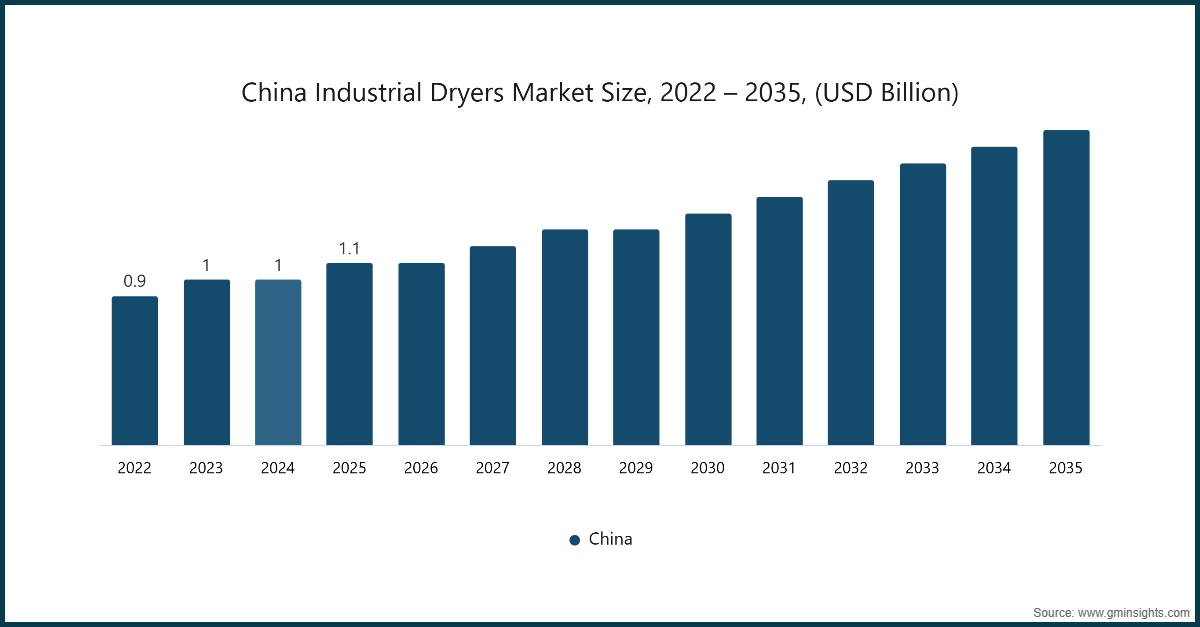
China dominates an overall Asia Pacific industrial dryers industry and was valued at USD 1.03 billion in 2025 and is estimated to grow at a CAGR of 6.3% from 2026 to 2035.
- The China market is expanding rapidly due to the country’s growing chemical, food processing, pharmaceuticals, and textiles industries. High demand for drying solutions in large-scale production facilities drives adoption of equipment such as rotary dryers, fluidized bed dryers, spray dryers, and vacuum dryers. Manufacturers prioritize high-capacity, energy-efficient designs to reduce operational costs and improve productivity while maintaining consistent product quality. Technological innovations, including precise temperature control, automated monitoring systems, and advanced moisture removal techniques, enhance process efficiency and reduce material waste.
- The booming pharmaceutical sector requires dryers capable of handling sensitive powders and granules under controlled conditions. Similarly, the food and beverage industry increasingly relies on industrial dryers to process bulk products such as grains, dairy powders, and processed foods. Domestic production of dryers is growing, while imported high-performance equipment remains in demand for specialized applications.
North America Industrial Dryers Market
In the North America industrial dryers industry, the U.S. held 76.2% share in 2025 and is anticipated to grow at a CAGR of 5.7% from 2026 to 2035.
- The North American industrial dryers industry is driven by large-scale chemical, pharmaceutical, and food processing operations across the U.S., Canada, and Mexico. Manufacturers focus on high-capacity rotary, spray, and fluidized bed dryers to handle continuous production demands while maintaining consistent moisture levels and product quality. Energy efficiency and compliance with environmental regulations, such as emissions control and heat recovery standards, influence equipment design and adoption.
- The pharmaceutical and specialty chemical sectors increasingly require dryers with precise temperature and humidity control to ensure safety and product integrity. Industrial food producers utilize advanced dryers for bulk ingredients such as powders, grains, and dairy products. Suppliers emphasize automated monitoring systems, modular designs, and ease of maintenance to reduce downtime and operational costs. Demand is further supported by retrofit projects in older processing plants, which aim to improve productivity and meet evolving regulatory standards.
Europe Industrial Dryers Market
In the Europe industrial dryers industry, Germany is expected to experience significant and promising growth from 2026 to 2035.
- Europe’s market is shaped by stringent environmental and energy-efficiency regulations across countries such as Germany, France, and Italy. Manufacturers prioritize sustainable and eco-friendly designs capable of reducing energy consumption and minimizing emissions while maintaining high throughput. The chemical, pharmaceutical, and food industries require dryers tailored for sensitive materials, including high-value powders and bioactive compounds, where precise moisture and temperature control is critical.
- Investment in advanced technologies, such as vacuum, freeze, and spray drying, ensures product consistency and meets EU safety and hygiene standards. Retrofit and modernization of existing processing facilities drive replacement demand for high-efficiency industrial dryers. Growing adoption of automation and IoT-enabled monitoring systems enhances process control and minimizes operational errors. Specialty applications in pharmaceuticals and biotechnology sectors further support market expansion in Europe.
Middle East and Africa Industrial Dryers Market
In the Middle East and Africa industrial dryers industry, UAE held a significant share in 2025 promising growth from 2026 to 2035.
- The MEA market is emerging, driven by the growth of chemical processing, food production, and pharmaceuticals in countries such as Saudi Arabia, UAE, and South Africa. Industrial operators rely on durable, high-capacity dryers that can perform reliably under high-temperature and high-humidity conditions. The food and beverage sector adopts rotary and fluidized bed dryers for bulk processing of grains, dairy powders, and processed foods.
- Imported high-performance equipment dominates due to limited local manufacturing, with suppliers emphasizing corrosion resistance and energy efficiency. Industrial parks, free zones, and large-scale food production facilities contribute to rising adoption of advanced dryers. Equipment integration with automated control systems, remote monitoring, and modular designs allows operators to improve productivity while maintaining consistent product quality.
Industrial Dryers Market Share
- In 2025, the prominent manufacturers in industrial dryers industry are ThyssenKrupp AG, ANDRITZ AG, GEA Group, METSO, and FLSmidth & Co. A/S collectively held the market share of ~41%.
- ThyssenKrupp provides industrial drying systems for minerals, chemicals, and food processing industries. Its equipment emphasizes energy efficiency, process optimization, and robust engineering. Global service networks, customized solutions, and strong R&D support its leadership in industrial dryers for high-demand manufacturing applications.
- ANDRITZ supplies industrial dryers and complete processing lines for pulp, paper, biomass, and food industries. The company focuses on energy-efficient designs, precise temperature control, and scalable solutions. Its global installation experience and engineering expertise strengthen adoption in industrial-scale drying applications.
Industrial Dryers Market Companies
Major players operating in the industrial dryers industry include:
- Akona Process Solutions
- ANDRITZ AG
- ANIVI Ingenieria SA
- Buhler Holding AG
- Carrier Vibrating Equipment, Inc.
- Dürr CTS Inc.
- FLSmidth & Co. A/S
- GEA Group
- Lanly Company
- METSO
- Mitchell Dryers
- SPX Flow
- Ventilex B.V.
- Wuxi Modern Spray Drying Equipment Co., Ltd.
- YAMATO SANKO MFG. CO. LTD.
GEA Group offers industrial drying systems for food, chemical, and dairy industries, emphasizing energy-efficient, hygienic, and high-throughput operations. Its process expertise and global service network enable tailored solutions for diverse industrial drying applications.
METSO provides drying and thermal processing solutions for minerals, cement, and aggregates industries. Its dryers focus on throughput optimization, energy efficiency, and reliability under harsh conditions. Engineering capabilities and strong aftermarket support reinforce METSO’s presence in heavy industrial dryer markets.
FLSmidth designs and supplies industrial drying systems for minerals, cement, and chemical applications. The company emphasizes energy efficiency, process reliability, and integration with bulk material handling systems. Its global engineering services and experience in large-scale industrial installations strengthen its market position.
Industrial Dryers Market Report Attributes
| Key Takeaway | Details |
|---|---|
| Market Size & Growth | |
| Base Year | 2025 |
| Market Size in 2025 | USD 8.2 Billion |
| Market Size in 2026 | USD 8.5 Billion |
| Forecast Period 2026-2035 CAGR | 5.1% |
| Market Size in 2035 | USD 13.4 Billion |
| Key Market Trends | |
| Drivers | Impact |
| Expansion of food processing and packaged food production | Increased drying requirements for ingredients and finished products drive demand for industrial dryers. |
| Growing pharmaceutical and chemical manufacturing activities | Process industries rely on precise moisture removal, increasing equipment adoption. |
| Rising demand for efficient moisture control in manufacturing processes | Industrial dryers help improve product quality and consistency across production lines. |
| Pitfalls & Challenges | Impact |
| High energy consumption associated with industrial drying operations | Operating cost concerns limit adoption among energy-sensitive industries. |
| High price sensitivity in mass-market segments | Cost pressures restrict penetration of premium and smart dryers. |
| Opportunities: | Impact |
| Growing demand for energy-efficient and heat recovery drying technologies | Sustainable solutions attract industries aiming to reduce energy expenses. |
| Integration of digital monitoring and automated process control systems | Smart drying systems improve performance tracking and operational reliability. |
| Market Leaders (2025) | |
| Market Leader |
Market share of ~16% |
| Top Players |
Collective market share of ~41% |
| Competitive Edge |
|
| Regional Insights | |
| Largest Market | Asia Pacific |
| Fastest growing market | Asia Pacific |
| Emerging countries | India, Japan, South Korea |
| Future outlook |
|
What are the growth opportunities in this market?
Industrial Dryers Industry News
- In January 2026, GEA introduced a contactless industrial dryer designed to reduce product damage and cross‑contamination in sensitive powder processing. The technology enables precise moisture control while improving energy efficiency in continuous drying operations.
- In June 2025, ANDRITZ AG completed the acquisition of Dinnissen Process Technology B.V., a Dutch specialist in drying, milling, mixing, and pneumatic conveying systems for powders and bulk solids. The acquisition expands ANDRITZ’s product portfolio in powder handling and industrial drying technologies.
- In March 2025, SPX FLOW unveiled the APV Continuous Belt Dryer Series. The APV Continuous Belt Dryer line was released to handle high‑capacity drying applications in food, chemical, and pharmaceutical sectors. SPX highlighted enhanced air flow management and reduced energy consumption compared with prior generations.
- In November 2024, FLSmidth & Co. A/S inaugurated a new Dryer Technology Centre in Copenhagen. The new facility is dedicated to research, testing, and demonstration of FLSmidth drying solutions for minerals, cement, and industrial powders. FLSmidth intends to accelerate innovation and support customer trials of commercial drying equipment.
The industrial dryers market research report includes in-depth coverage of the industry, with estimates & forecast in terms of revenue (USD Billion) and volume (Thousand Units) from 2022 to 2035, for the following segments:
Market, By Type
- Rotary Dryers
- Fluidized Bed Dryers
- Spray Dryers
- Drum Dryers
- Freeze Dryers
- Others
Market, By Technology
- Direct Drying
- Indirect Drying
Market, By End Use Industry
- Food & Beverage
- Chemical
- Pharmaceutical
- Paper & Pulp
- Textile
- Construction
- Others
Market, By Distribution Channel
- Direct sales
- Indirect sales
The above information is provided for the following regions and countries:
- North America
- U.S.
- Canada
- Europe
- Germany
- UK
- France
- Italy
- Spain
- Asia Pacific
- China
- Japan
- India
- South Korea
- Australia
- Latin America
- Brazil
- Mexico
- Argentina
- MEA
- Saudi Arabia
- UAE
- South Africa
Frequently Asked Question(FAQ) :
What is the market size of the industrial dryers in 2025?
The global industrial dryers market was valued at USD 8.2 billion in 2025, driven by increased food processing and packaged food production.
What is the projected value of the industrial dryers industry by 2035?
The industrial dryers market is projected to reach USD 13.4 billion by 2035, growing at a CAGR of 5.1% from 2026 to 2035, supported by growing demand for energy-efficient and heat recovery drying technologies.
What is the industrial dryers industry size in 2026?
The industrial dryers market size is projected to reach USD 8.5 billion in 2026, fueled by increasing adoption of advanced dryer technology for energy savings, and expanding pharmaceutical and chemical sector requirements for precise drying systems.
Which type segment dominated the industrial dryers market in 2025?
The rotary dryers segment accounted for revenue of approximately USD 2.4 billion in 2025 and is anticipated to grow at a CAGR of 6% from 2026 to 2035.
Which technology segment led the industrial dryers market in 2025?
The direct drying technology segment dominated with a 75% market share in 2025 and is anticipated to grow at a CAGR of 5% through 2035, driven by widely adopted in food processing, chemicals, minerals, and biomass industries.
Which end-use industry segment held the largest share in the industrial dryers market in 2025?
The food & beverage segment led the market with a 33.7% share in 2025 and is anticipated to grow at a CAGR of 4% through 2035, driven by extensive use of industrial dryers for dehydration of fruits.
Which region leads the industrial dryers market?
China dominated the Asia Pacific industrial dryers market, valued at USD 1.03 billion in 2025, and is projected to grow at a CAGR of 6.3% from 2026 to 2035.
What are the upcoming trends in the industrial dryers market?
Key trends include growing demand for sanitary and corrosion-resistant equipment in food processing, and expanding customization of drying systems for specialty pharmaceutical and chemical applications.
Who are the key players in the industrial dryers market?
Key players include ThyssenKrupp AG, ANDRITZ AG, GEA Group, METSO, FLSmidth & Co. A/S, Buhler Holding AG, SPX Flow, Ventilex B.V., Carrier Vibrating Equipment, Dürr CTS Inc., Mitchell Dryers, Akona Process Solutions, Lanly Company, ANIVI Ingenieria SA, and YAMATO SANKO MFG.
Industrial Dryers Market Scope
Related Reports