Summary
Table of Content

Industrial Carbon Credit Market
Get a free sample of this report
Form submitted successfully!
Error submitting form. Please try again.
Thank you!
Your inquiry has been received. Our team will reach out to you with the required details via email. To ensure that you don't miss their response, kindly remember to check your spam folder as well!
Request Sectional Data
Thank you!
Your inquiry has been received. Our team will reach out to you with the required details via email. To ensure that you don't miss their response, kindly remember to check your spam folder as well!
Form submitted successfully!
Error submitting form. Please try again.
Industrial Carbon Credit Market Size
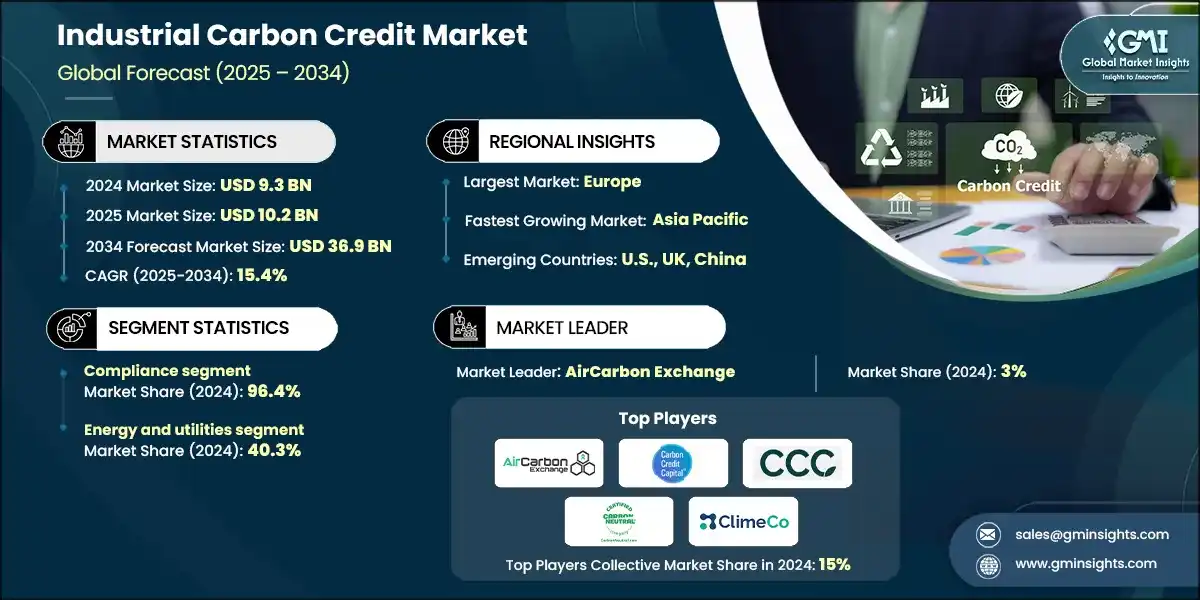
According to a recent study by Global Market Insights Inc., the industrial carbon credit market was estimated at USD 9.3 billion in 2024. The market is expected to grow from USD 10.2 billion in 2025 to USD 36.9 billion in 2034, at a CAGR of 15.4%.
To get key market trends
- Global climate frameworks such as the Paris Agreement continue to evolve, creating stronger compliance obligations for industries. The implementation of Article 6 mechanisms under the Paris Agreement has opened new pathways for cross-border carbon credit trading, enabling industrial players to participate in international markets.
- These agreements provide clarity on methodologies, reporting, and verification, which enhances trust and accelerates adoption. For industries, this means carbon credits are no longer optional, they are integral to meeting national and corporate net-zero targets. The alignment of industrial strategies with these frameworks ensures long-term market stability and growth.
- For instance, at COP29 in Baku (2024), parties finalized rules for Article 6 implementation, including authorization, reporting, and tracking requirements for country-to-country trading. This milestone provides a clear roadmap for industrial sectors to engage in international carbon markets under high-integrity standards.
- Industrial companies are increasingly committing to net-zero targets, creating a surge in demand for carbon credits to offset hard-to-abate emissions. These commitments are not just reputational, they are tied to investor expectations and regulatory compliance.
- As industries like steel, cement, and chemicals face technological limitations in achieving full decarbonization, carbon credits serve as a practical bridge. This trend is reinforced by ESG frameworks, where carbon neutrality is a key metric for sustainability performance.
- For instance, the UNFCCC Yearbook of Global Climate Action 2025 reports that over 43,000 businesses and non-state actors are actively engaged in climate action, doubling from 2020 levels. This includes industrial players integrating carbon credits into their decarbonization strategies.
- The credibility of carbon credit is critical for industrial adoption. Recent initiatives focus on ensuring environmental and social integrity, making credits more attractive for compliance and voluntary markets. High-integrity standards guarantee that credits are real, additional, and measurable, reducing reputational risks for industries. This trend is supported by global institutions working to standardize verification processes and prevent double counting, which has historically undermined confidence in carbon markets.
- For instance, in December 2023, the World Bank launched its Engagement Roadmap for High-Integrity Carbon Markets, aiming to scale transparent carbon markets globally. The initiative supports 15 countries in producing verified credits, ensuring environmental and social integrity.
Industrial Carbon Credit Market Report Attributes
| Key Takeaway | Details |
|---|---|
| Market Size & Growth | |
| Base Year | 2024 |
| Market Size in 2024 | USD 9.3 Billion |
| Market Size in 2025 | USD 10.2 Billion |
| Forecast Period 2025 - 2034 CAGR | 15.4% |
| Market Size in 2034 | USD 36.9 Billion |
| Key Market Trends | |
| Drivers | Impact |
| Regulatory push for emission reduction | Governments worldwide are enforcing stricter carbon regulations, compelling industries to adopt carbon credit as part of compliance strategies. |
| Corporate sustainability goals | Industrial companies are committing to ambitious net-zero targets, driving demand for carbon credits to offset unavoidable emissions. |
| Technological advancements in carbon capture | Innovations in carbon capture and storage technologies are enabling industries to generate and trade high-quality carbon credit efficiently. |
| Pitfalls & Challenges | Impact |
| Verification and compliance challenges | Ensuring accurate verification and adherence to evolving compliance standards remains a major hurdle for industrial carbon credit integrity. |
| Opportunities: | Impact |
| Growth in voluntary carbon markets | The rapid expansion of voluntary carbon markets offers industries flexible pathways to offset emissions and showcase climate leadership. |
| Integration with ESG frameworks | Embedding carbon credits into ESG reporting strengthens corporate sustainability strategies and attracts responsible investment. |
| Market Leaders (2024) | |
| Market Leaders |
3% market share |
| Top Players |
Collective market share in 2024 is 15% |
| Competitive Edge |
|
| Regional Insights | |
| Largest Market | Europe |
| Fastest Growing Market | Asia Pacific |
| Emerging Country | U.S., UK, China |
| Future outlook |
|
What are the growth opportunities in this market?
Industrial Carbon Credit Market Trends
- Governments are introducing stringent policies to accelerate industrial decarbonization. These regulations often include carbon pricing mechanisms, emissions trading systems, and mandatory reporting requirements. For industries, compliance with these frameworks necessitates participation in carbon credit markets. Regulatory certainty also encourages investment in low-carbon technologies, creating a dual impact direct emissions reduction and increased demand for credits to cover residual emissions.
- For reference, The European Commission’s Clean Industrial Deal (2025) mobilizes over USD 100 billion to decarbonize energy-intensive industries including steel and chemicals. It includes measures to boost demand for clean products and accelerate industrial transformation through carbon pricing and innovation funding.
- Digital technologies including blockchain, AI, and IoT are transforming carbon credit markets by improving transparency, traceability, and efficiency. Blockchain ensures immutable records of credit transactions, reducing fraud risks. AI-driven platforms optimize emissions monitoring and forecasting, enabling industries to manage carbon portfolios effectively. These innovations make carbon markets more accessible and reliable for industrial participants, fostering growth.
- For illustration, the World Economic Forum (2025) highlights AI-driven approaches for industrial decarbonization, enabling scalable low-carbon infrastructure projects. This integration accelerates project timelines and ensures accurate emissions accounting, which is crucial for generating verified credits.
- Collaborative industrial hubs are gaining traction as a strategy to pool resources and share infrastructure for carbon reduction. These hubs bring together manufacturers, energy providers, and technology firms to implement large-scale decarbonization projects. By creating economies of scale, hubs reduce costs and accelerate the deployment of carbon capture and clean energy solutions, generating significant volumes of carbon credits.
- For instance, the Mission Possible Partnership (2025), supported by RMI and the Bezos Earth Fund, is developing clean industrial hubs in the U.S., with 90 commercial-scale net-zero projects already in progress across steel, cement, and chemicals sectors.
- While compliance markets remain dominant, voluntary carbon markets are expanding rapidly as corporations seek to demonstrate climate leadership. Industrial firms are leveraging voluntary credits to offset emissions beyond regulatory requirements, often linked to brand reputation and investor confidence.
- This trend is particularly strong in sectors where technological decarbonization is slow, making voluntary credits an attractive interim solution. For instance, the World Bank’s FCPF programs (2023) enable countries to generate voluntary credits through forest conservation, creating opportunities for industrial buyers to source high-integrity credits for voluntary commitments.
- Carbon credits are increasingly integrated into ESG frameworks and financial disclosures. Investors and regulators demand transparency on emissions and offset strategies, making carbon credits a key component of sustainability reporting. This integration drives industrial firms to adopt structured carbon credit portfolios, aligning with global standards such as the ISSB and TCFD.
- For reference, The UNFCCC Yearbook (2025) confirms that 95% of new climate plans (NDCs) involve non-state actors, including businesses, in implementing emissions reduction strategies, reinforcing the link between carbon credits and ESG compliance.
Industrial Carbon Credit Market Analysis

Learn more about the key segments shaping this market
- Based on type, the market is segmented into voluntary & compliance. The compliance industry held a market share of 96.4% in 2024 and is projected to grow at a CAGR of 15.3% through 2034. Compliance markets are expanding rapidly, with new ETS programs emerging in both developed and developing economies.
- These systems incentivize industries to reduce emissions through cap-and-trade mechanisms, covering sectors such as power, steel, cement, and chemicals. The inclusion of hard-to-abate sectors reflects a strategic shift toward comprehensive decarbonization. ETS expansion also drives demand for offset credits, as regulated entities seek cost-effective compliance solutions.
- For instance, in April 2025, the International Carbon Action Partnership (ICAP) Status Report confirmed that 38 ETSs are now operational globally, with China expanding its system beyond power to include steel, cement, and aluminum, covering an additional 3 GtCO2e.
- Compliance markets are introducing CBAMs to prevent carbon leakage and maintain competitiveness. These mechanisms impose carbon costs on imports from jurisdictions with weaker climate policies, incentivizing global industries to adopt low-carbon practices.
- For industrial sectors like steel and cement, CBAMs create additional compliance obligations and increase reliance on carbon credits to offset emissions. For instance, in May 2024, the European Commission advanced its CBAM framework during the transitional phase, targeting sectors such as iron, steel, aluminum, and cement to align with EU ETS objectives.
- The voluntary industry carbon credit industry will grow at a faster rate of 17.6% by 2034. Corporations are increasingly using voluntary carbon credits to demonstrate climate leadership and meet ESG commitments. This trend is fueled by investor pressure, consumer expectations, and the absence of uniform global regulations. Voluntary credits allow companies to offset emissions beyond compliance requirements, particularly in hard-to-abate sectors like cement and steel.
- The market is evolving toward high-quality credits linked to nature-based solutions and carbon removal technologies, ensuring credibility and impact. This shift positions voluntary markets as a critical enabler of near-term climate action while complementing long-term decarbonization strategies.
- For instance, in January 2025, Verra emphasized in its yearly outlook that voluntary carbon markets are essential for immediate climate action, enabling companies to offset emissions while global regulations mature. The company reported significant growth in demand for high-quality credits from REDD+ and carbon removal projects.
- Voluntary markets are witnessing a clear price differentiation based on credit quality. Credits from nature-based carbon removal projects and those certified under rigorous standards command premium prices. Buyers increasingly prioritize transparency, permanence, and co-benefits such as biodiversity and community development.
Learn more about the key segments shaping this market
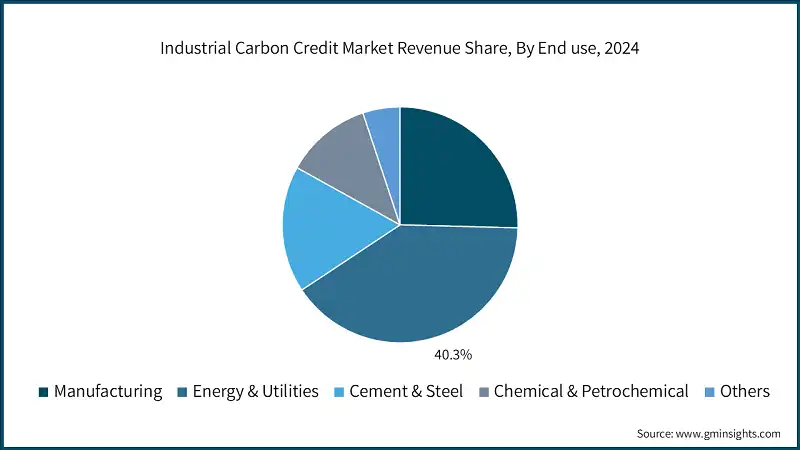
- Based on end use, the market is segmented into manufacturing, energy & utilities, cement & steel, chemical & petrochemical, others. The energy and utilities sector represents the largest end-use segment of the industrial carbon credit market with a 40.3% share in 2024 and a projected 14.5% CAGR through 2034.
- This dominance reflects both the sector's substantial emissions footprint and its advanced adoption of carbon pricing mechanisms through emissions trading systems. Power generation facilities are the primary participants in compliance markets, with over half of global power-sector emissions now covered by carbon pricing as per the World Bank's State and Trends of Carbon Pricing 2025.
- Renewable energy projects have historically been a major source of voluntary carbon credits, but their role is evolving as additionality criteria tighten. In many developed markets, renewable energy is now cost-competitive or cheaper than fossil alternatives, raising questions about whether new projects require carbon finance to proceed.
- The manufacturing sector accounts for 25.4% of the industrial carbon credit market share in 2024 with a robust 16.3% CAGR projected through 2034, reflecting the sector's diverse emissions profile and increasing regulatory inclusion in emissions trading systems. Manufacturing encompasses a wide range of subsectors including automotive, electronics, textiles, and general industrial production, each with distinct decarbonization pathways and carbon credit strategies.
- For instance, in March 2025, China's expansion of its national ETS to include aluminum smelting brought a major manufacturing subsector under compliance obligations according to the International Carbon Action Partnership. Aluminum production is highly energy-intensive and also generates process emissions of perfluorocarbons (CF4 and C2F6), which are potent greenhouse gases.
- The cement and steel sector represents 17.3% of the industrial carbon credit market share with a 15.7% CAGR, driven by the sector's high emissions intensity and the deployment of carbon capture technologies that generate removal credits. Cement and steel together account for approximately 15% of global CO2 emissions according to Carbon Direct, making them critical focus areas for industrial decarbonization and carbon credit generation.
- For instance, Holcim's GO4ZERO project at Obourg, Belgium, aims to produce approximately 2 million tonnes of carbon-neutral cement by 2029, while its Carbon2Business project at Lägerdorf is designed to capture over 1.2 million tonnes of CO2 annually as per GCCA reporting.
- The chemical and petrochemical sector accounts for 11.8% of the industrial carbon credit market with a 15.4% CAGR, driven by the sector's diverse emissions sources including process emissions, energy consumption, and fugitive releases. The sector is characterized by complex value chains and opportunities for both emissions reduction through efficiency improvements and carbon capture from concentrated CO2 streams.
- Ethanol production facilities represent another high-potential source of carbon credits due to low-cost CO2 capture from fermentation processes. The U.S. Department of Energy identified sustainable aviation fuel from ethanol with CCS as particularly promising due to the low capture costs and synergies with regional CO2 hub infrastructure according to DOE.
Looking for region specific data?
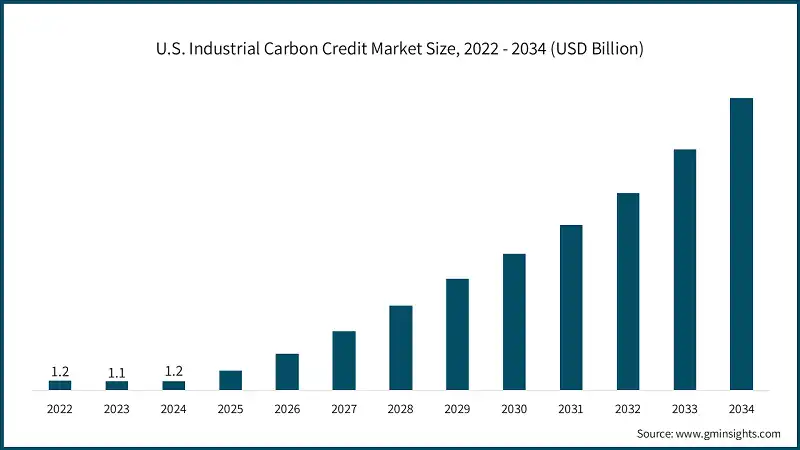
- U.S. dominated the industrial carbon credit market in North America and generated USD 1.2 billion revenue in 2024. The region is characterized by a patchwork of federal incentives, state-level carbon pricing programs, and robust voluntary market activity driven by corporate leadership. The region benefits from substantial geological storage capacity, established CO2 pipeline infrastructure in certain areas, and significant public funding for carbon management technologies.
- The U.S. Inflation Reduction Act, enacted in August 2022, fundamentally transformed the economics of carbon capture by raising the 45Q tax credit to USD 85 per tonne for CO2 permanently stored in geological formations and USD 60 per tonne for CO2 utilized in products or enhanced oil recovery according to S&P Global Commodity Insights.
- Europe dominates the industrial carbon credit market with a 74.2% share in 2024, while growing at a moderate 13.2% CAGR through 2034 as the market matures and other regions accelerate adoption. This leadership position is underpinned by the EU Emissions Trading System, which has been operational since 2005 and now covers approximately 40% of the European Union's greenhouse gas emissions across 30 countries according to the International Carbon Action Partnership.
- The 2023 reforms to the EU ETS, adopted as part of the Fit for 55 package, significantly strengthened the system's ambition and scope. The emissions cap was rebased downward with a target of 62% reduction versus 2005 levels by 2030 as per ICAP.
- The UK, though no longer part of the EU ETS, maintains a linked carbon market and released six principles for voluntary carbon and nature market integrity in late 2024 for consultation as per Manulife Investment Management. The UK is advancing its own industrial decarbonization strategy with high landfill taxes that incentivize waste-to-energy and carbon capture projects, and a sustainable aviation fuel mandate commenced in 2025 as per to the IEA.
- Asia Pacific is the fastest-growing region in the industrial carbon credit market with a 25.2% CAGR projected through 2034. This growth is driven by China's emissions trading system expansion, India's emerging carbon market frameworks, and Southeast Asian nations' increasing climate policy ambition.
- For instance, in March 2025, China's national ETS expansion to steel, cement, and aluminum sectors represents the single largest addition to global carbon market coverage, adding approximately 3 billion tonnes of CO2 equivalent and bringing total system coverage to roughly 8 billion tonnes, about 15% of global emissions according to the International Carbon Action Partnership.
- The Middle East and Africa region represents 0.19% of the industrial carbon credit market in 2024, driven by Gulf Cooperation Council countries' economic diversification strategies, Africa's carbon sequestration potential, and increasing international climate finance flows to the region.
- African nations are developing carbon market frameworks with support from international organizations. The UNDP's High Integrity Carbon Markets Initiative is supporting multiple African countries in building policy, legal frameworks, and technical readiness according to UNDP.
- Latin America accounts for 6.2% of the industrial carbon credit market in 2024 with a 10.2% CAGR, characterized by abundant renewable energy resources, significant forestry and land-use carbon sequestration potential, and emerging regulatory frameworks. The region is positioning itself as a major supplier of nature-based carbon credits while developing domestic compliance markets.
Industrial Carbon Credit Market Share
- The top 5 companies in industrial carbon credit industry including AirCarbon Exchange, Carbon Credit Capital, Carbon Credits Consulting, CarbonNeutral, and ClimeCo held over 15% market share in the year 2024. This fragmentation reflects the market's diverse structure, encompassing compliance allowance trading platforms, voluntary credit registries, project developers, brokers, and technology providers.
- AirCarbon Exchange leads the market with a 3% share, leveraging its blockchain-based trading platform that provides transparency and real-time settlement capabilities. The competitive landscape is characterized by distinct business models serving different market segments.
- Compliance markets are dominated by government-operated auction platforms and exchanges including EEX (European Energy Exchange), ICE (Intercontinental Exchange), and regional platforms such as WCI Inc., which administers quarterly auctions for California and Québec according to the International Carbon Action Partnership.
Industrial Carbon Credit Market Companies
Major players operating in the industrial carbon credit industry are:
- AirCarbon Exchange
- Carbon Credit Capital
- Carbon Credits Consulting
- CarbonBlue
- CarbonNeutral
- Climate Impact Partners
- ClimateCare
- ClimateTrade CarbonCredits
- ClimeCo
- Core CarbonX Solutions Pvt Ltd
- Earthshot Labs
- EcoAct
- Gold Standard Foundation
- Mission Zero Technologies
- Natural Capital Partners
- Pachama
- South Pole
- Sylvera
- Terrapass
- Verra
- AirCarbon Exchange operates a blockchain-based carbon trading platform that provides transparency, real-time settlement, and fractional trading capabilities. The exchange lists carbon credits as digital assets, enabling 24/7 trading and instant settlement that reduces counterparty risk.
- Carbon Credit Capital specializes in structured carbon credit transactions and portfolio management for institutional investors and corporations. The firm provides advisory services for carbon credit procurement strategies, portfolio optimization, and risk management.
- Carbon Credits Consulting offers end-to-end services for carbon credit project development, validation, verification, and registration across multiple standards including Verra VCS, Gold Standard, and American Carbon Registry. The firm's technical expertise spans diverse project types including renewable energy, energy efficiency, forestry, and industrial gas destruction.
Industrial Carbon Credit Industry News
- In October 2025, as per to ESMA, the European Securities and Markets Authority released its EU carbon markets report for 2025 covering the 2024 reporting period, showing annual average EUA spot prices fell 22% to EUR 65 per tonne CO2. The purchases made by entities without direct compliance obligations, indicating significant financial sector participation.
- In March 2025, China's Ministry of Ecology and Environment released a work plan approved by the State Council to expand the national emissions trading system beyond power generation to include cement, steel, and aluminum smelter sectors, with the first compliance deadline at end-2025 covering 2024 emissions according to the International Carbon Action Partnership.
- In June 2024, CF Industries Holdings announced a carbon capture and sequestration project at its Yazoo City, Mississippi complex targeting capture of up to 500,000 metric tons of CO2 annually from ammonia production, with sequestration expected to start in 2028 according to CF Industries.
This industrial carbon credit market research report includes in-depth coverage of the industry with estimates & forecast in terms of revenue (USD Million) from 2025 to 2034, for the following segments:
Market, By Type
- Voluntary
- Compliance
Market, By End Use
- Manufacturing
- Energy & Utilities
- Cement & Steel
- Chemical & Petrochemical
- Others
The above information has been provided for the following regions & countries:
- North America
- U.S.
- Canada
- Mexico
- Europe
- Denmark
- Norway
- France
- Sweden
- UK
- Asia Pacific
- China
- Japan
- India
- New Zealand
- Middle East & Africa
- UAE
- South Africa
- Latin America
- Argentina
- Chile
Frequently Asked Question(FAQ) :
Who are the key players in the industrial carbon credit market?
Key players include AirCarbon Exchange, Carbon Credit Capital, Carbon Credits Consulting, CarbonBlue, CarbonNeutral, Climate Impact Partners, ClimateCare, ClimateTrade CarbonCredits, ClimeCo, Core CarbonX Solutions Pvt Ltd, Earthshot Labs, EcoAct, Gold Standard Foundation, Mission Zero Technologies, Natural Capital Partners, Pachama, South Pole, Sylvera, Terrapass, and Verra.
Which region leads the industrial carbon credit market?
The U.S. industrial carbon credit market surpassed USD 1.2 billion in 2024, supported by evolving global climate frameworks and stronger industrial compliance requirements.
What are the upcoming trends in the industrial carbon credit market?
Key trends include expansion of emissions trading systems globally, integration of blockchain and AI technologies for transparency, development of collaborative industrial hubs for carbon reduction, growth in voluntary carbon markets, and increasing integration with ESG frameworks and financial disclosures.
What was the valuation of the energy & utilities end-use segment in 2024?
The energy and utilities sector represents the largest end-use segment with a 40.3% share in 2024, reflecting the sector's substantial emissions footprint and advanced adoption of carbon pricing mechanisms.
What is the growth outlook for the voluntary carbon credit segment from 2025 to 2034?
The voluntary segment is projected to grow at a faster rate of 17.6% through 2034, supported by corporations using voluntary carbon credits to demonstrate climate leadership and meet ESG commitments beyond compliance requirements.
How much revenue did the compliance segment generate in 2024?
The compliance segment held a market share of 96.4% in 2024, driven by expanding emissions trading systems covering sectors such as power, steel, cement, and chemicals.
What is the market size of the industrial carbon credit in 2024?
The market size was USD 9.3 billion in 2024, with a CAGR of 15.4% expected through 2034 driven by evolving global climate frameworks, stricter industry compliance requirements, and corporate net-zero commitments.
What is the projected value of the industrial carbon credit market by 2034?
The industrial carbon credit market is expected to reach USD 36.9 billion by 2034, propelled by regulatory push for emission reduction, corporate sustainability goals, and technological advancements in carbon capture.
What is the current industrial carbon credit market size in 2025?
The market size is projected to reach USD 10.2 billion in 2025.
Industrial Carbon Credit Market Scope
Related Reports