Summary
Table of Content

Industrial Air Filtration Market
Get a free sample of this report
Form submitted successfully!
Error submitting form. Please try again.
Thank you!
Your inquiry has been received. Our team will reach out to you with the required details via email. To ensure that you don't miss their response, kindly remember to check your spam folder as well!
Request Sectional Data
Thank you!
Your inquiry has been received. Our team will reach out to you with the required details via email. To ensure that you don't miss their response, kindly remember to check your spam folder as well!
Form submitted successfully!
Error submitting form. Please try again.
Industrial Air Filtration Market Size
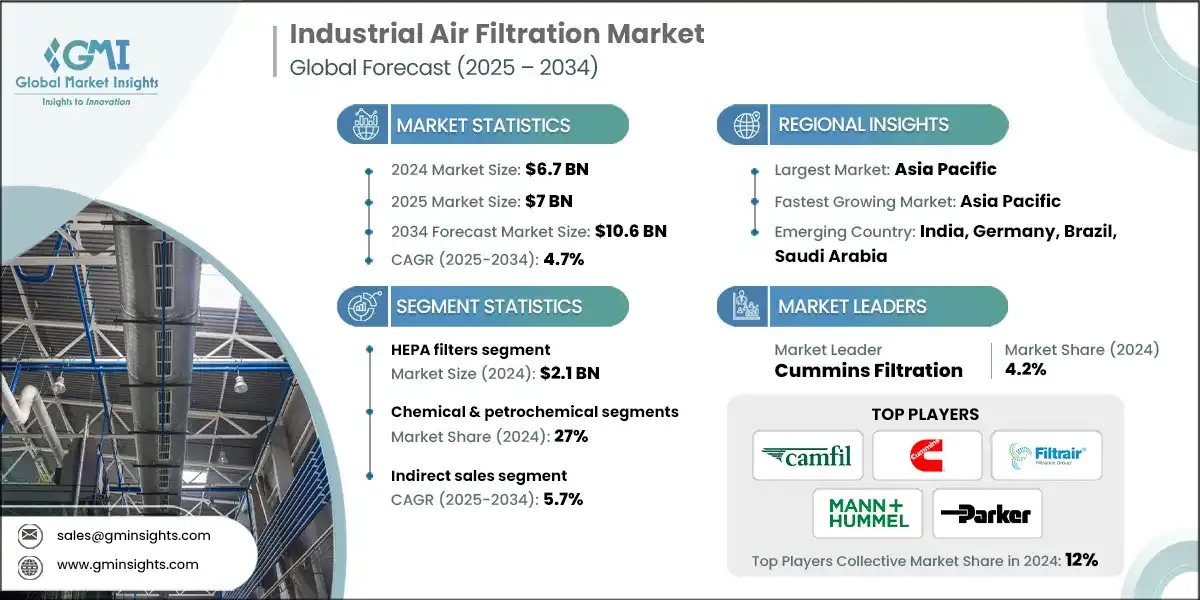
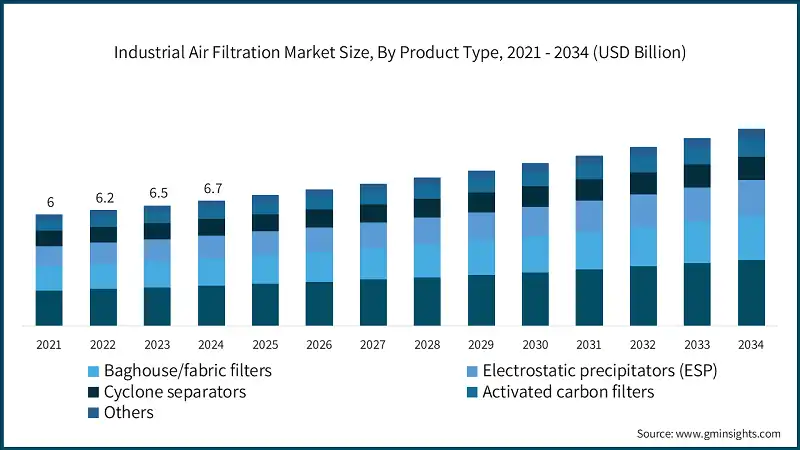
The global industrial air filtration market was estimated at USD 6.7 billion in 2024. The market is expected to grow from USD 7 billion in 2025 to USD 10.6 billion in 2034, at a CAGR of 4.7%.
Industrial Air Filtration Market Key Takeaways
Market Size & Growth
- 2024 Market Size: USD 6.7 Billion
- 2025 Market Size: USD 7 Billion
- 2034 Forecast Market Size: USD 10.6 Billion
- CAGR (2025–2034): 4.7%
Regional Dominance
- Largest Market: Asia Pacific
- Fastest Growing Region: Asia Pacific
Key Market Drivers
- Stringent environmental regulations.
- Rising awareness of workplace safety.
Challenges
- High initial investment costs.
- Maintenance and operational costs.
Opportunity
- Technological advancements.
- Expansion in emerging economies.
Key Players
- Market Leader: Cummins Filtration led with over 4.2% market share in 2024.
- Leading Players: Top 5 players in this market include Camfil, Cummins Filtration, Filtration Group Corporation, Mann+Hummel, Parker Hannifin, which collectively held a market share of 12% in 2024.
Get Market Insights & Growth Opportunities
- The industrial air filtration market is growing with the surging emphasis on the safety of workplaces and stringent government regulations on air quality standards pressurizing industries to implement sophisticated air filtration systems. The growing emphasis on emission reductions and ensuring a hygienic working environment is also driving demand.
- As per the World Health Organization, 7 million premature deaths occur every year due to air pollution and cause global health damage of USD 2.9 trillion, which is about 3.3% of the GDP of the world. These statistics prove investing in industrial air filtering systems.
- In 2022, the Bureau of Labor Statistics found 2.6 million nonfatal occupational illnesses and injuries in private businesses. The manufacturing industry suffered a large number of respiratory cases, which had 3.2 per 100 full-time employees.
- The increasing industrialization in the developing economies is propelling the market growth, as economies in these economies are investing increasingly in air filtration systems to meet environmental regulations and enhance operational efficiency.
- Technological improvements in filtration systems, such as the development of high-efficiency particulate air (HEPA) and ultra-low penetration air (ULPA) filters, are also driving market growth. These systems offer superior filtration efficacy and resistance to deterioration, which is greatly desired across various sectors such as manufacturing, healthcare, and food and beverages.
- The industrial industry is projected by the Department of Energy to account for nearly 23% of all energy used in the United States. This presents huge opportunities for energy-efficient air filtration systems.
- Advanced filtration, as emphasized by a Camfil study, can lead to probable annual savings of USD 6.1 million in 2,000 air handling units with every unit saving 6,000 kWh per year. This is particularly important because air filters contribute up to 30% of the energy expense of ventilators.
- OECD statistics indicate that aging worker populations in mature economies are behind other drivers. Employees aged 55 and older now make up a growing share of factory workers, boosting demand for air quality protection. They have more exposure to respiratory hazards, more healthcare costs due to age-related occupation illnesses, more employer exposure to liability, and more regulatory attention to guarding against aging segments of workers.
- The US manufacturing industry continues to change and grow, as seen through typical production increases monitored by the US Census Bureau and Annual Survey of Manufactures. Demand is also being fueled for air filtration systems by modernization initiatives at facilities seeking air quality improvement.
To get key market trends
Industrial Air Filtration Market Trends
- Enforcement of regulations has picked up momentum heavily, inducing a firm and sustained trends towards industrial air filtering solutions in the world's prominent markets. In the 2023 fiscal year, OSHA imposed USD 1.6 billion in penalties that reflect more regulatory focus on industrial sites.
- This growth has provided more inspections, more penalties for air quality violations, more requirements to measure air pollutants, and added stress on engineering controls as the compliance strategy of choice.
- The industrial air filtration industry is also seeing considerable consolidation and strategic readjustment as the major players react to changing technological needs, regulatory, and market conditions. Firms are making specific acquisitions, divestitures, and strategic investments in response to these changes.
- Sogefi Group divested its Filtration business segment in 2024 for a consideration of USD 404.8 million. This move is indicative of market consolidation and strategic streamlining in the filtration business, with companies concentrating on their core businesses and divesting non-core businesses.
- 3M Company is structurally transforming by promising to stop producing all PFAS by 2025. It also plans to stop using PFAS in its product lines. This means massive research and development investments in new technology and corresponds to industry move toward sustainable and green solutions.
- The future of industrial air filtration is increasingly centered on the integration of artificial intelligence (AI) and predictive analytics, triggering system optimization and operational efficiency enhancement.
- Predictive maintenance using AI allows failure analysis, optimal replacement time scheduling, and performance optimization through machine learning-based algorithms applied to analyzing performance trends and scheduling maintenance at the most optimal time.
- The convergence of industrial air filtration with smart manufacturing and Industry 4.0 platforms is propelling major advancements in system integration, operational efficiency, and value creation across industries.
- Manufacturers are able to reduce energy consumption, realize maximum production efficiency, and ensure worker safety through the integration of air filtration systems with overarching facility management platforms. This is accomplished through end-to-end data integration and analytics, which deliver rich insights into the interdependencies among air quality, production performance, and operating costs.
- Digital twin technology allows businesses to virtually test and optimize filtration systems prior to the actual installation. This is easier for businesses to try out different configurations, forecast performance results, and design systems that are specifically aligned with particular operating and environmental requirements, minimizing the necessity for expensive physical trials.
- Real-time monitoring permits ongoing optimization of filtration effectiveness, energy consumption, and maintenance planning. Real-time visibility into system performance, compliance, and cost metrics at a thousand-plus sites and geographies is provided by digital dashboards. This centralized management ability enables companies to effectively manage complex industrial processes.
Industrial Air Filtration Market Analysis
Learn more about the key segments shaping this market
Based on the product type, the industrial air filtration industry is divided into HEPA filters, baghouse/fabric filters, electrostatic precipitators (ESP), cyclone separators, activated carbon filters and others. In 2024, HEPA filters dominated the market generating revenue of USD 2.1 billion and expected to grow at a CAGR of 5.2% during the forecast period.
- High-Efficiency Particulate Air (HEPA) filters are used extensively in industrial air filtration because they can trap extremely fine particles, such as dust, pollen, and microorganisms. More emphasis on occupational safety and tighter environmental regulations is propelling the use of HEPA filters. Besides, improvements in filter technology have been boosting their effectiveness and lifespan, increasing their application in the market further.
- Electrostatic precipitators are commonly applied within the industrial air cleaning business owing to their capability of collecting small particles and fumes from industrial emissions. They have been discovered to be very effective at power plants, pulp and paper mills, and chemical processing plants.
- The increasing demand to regulate air pollution and comply with strict emission standards is fueling the usage of ESPs. In addition, technological improvements in ESP with increased energy efficiency and lower maintenance are fueling high demand for utilization in the market.
Learn more about the key segments shaping this market
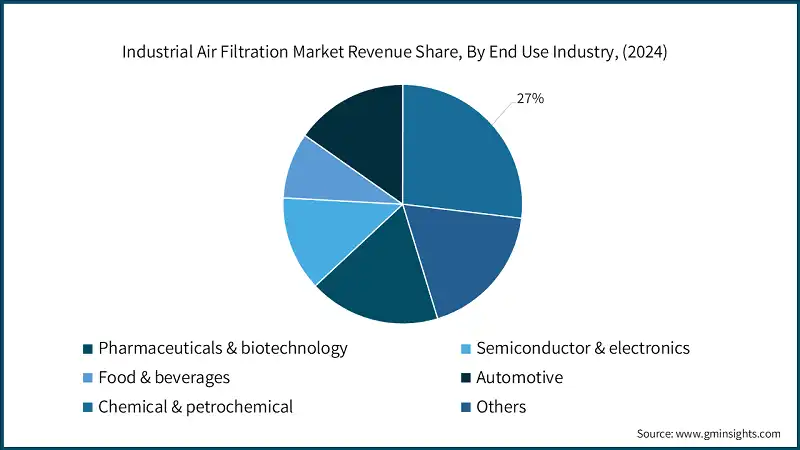
Based on end use industry, the industrial air filtration market is segmented into pharmaceuticals & biotechnology, semiconductor & electronics, food & beverages, automotive, chemical & petrochemical and others. In 2024, chemical & petrochemical segments dominate the market with 27% market share and the segment is expected to grow at a CAGR of 5.2% from 2025 to 2034.
- The petrochemicals and chemicals industry needs strong air filtration systems such that they can handle toxic exhaust and provide safety to the employees. The systems will be absolutely essential in keeping the air pure and avoiding contamination since the production process is being carried out. Furthermore, development of the chemical sector, especially in the world's developing nations, will be an outright industrial air filtration demand driver in the coming years.
- Pharmaceuticals and biotechnology are among the largest contributors to the market. Regulation demands for air quality in the manufacturing process are some of the most important drivers of the need for top-of-the-line systems for filtration. Growing emphasis on biologics and personalized medicine also increases the use of air filtration solutions. The growing number of pharmaceutical manufacturing facilities across the world is also likely to continue driving the growth of the segment in the forecast period.
- The electronics and semiconductor industry are in dire demand of cleanroom facilities, and air filter systems become a necessity. Ultra-low penetration air (ULPA) and high-efficiency particulate air (HEPA) filters are in increased demand owing to the usage requirements for contamination control during microchip and electronic component manufacturing. As technology advances in more intricate and diminutive components, there is an increasing demand for better air filtration systems.
Based on distribution channel, the industrial air filtration market is segmented into direct sales and indirect sales. In 2024, the indirect sales segment is expected to grow at a CAGR of 5.7% from 2025 to 2034.
- Indirect selling, through distributors, retailers, and e-commerce platforms, is a major distribution channel in the industrial air filtration industry. This distribution channel is best positioned to serve small and medium businesses (SMEs) and geographically remote customers. Growth through e-commerce websites has also increased the distribution of industrial air filtration equipment, making it more convenient and competitive. Indirect sales channels will grow incrementally through the support of rising penetration of e-commerce sites and expanding distributor networks worldwide.
- The direct sales channel plays an important role in the market for industrial air filtration as it enables manufacturers to have direct contact with end-users. This channel is especially favored for large-scale industrial uses, where technical service and tailor-made solutions are essential. Increased need for sophisticated filtration systems in manufacturing, pharmaceuticals, and food processing sectors is fueling the use of this channel.
Looking for region specific data?
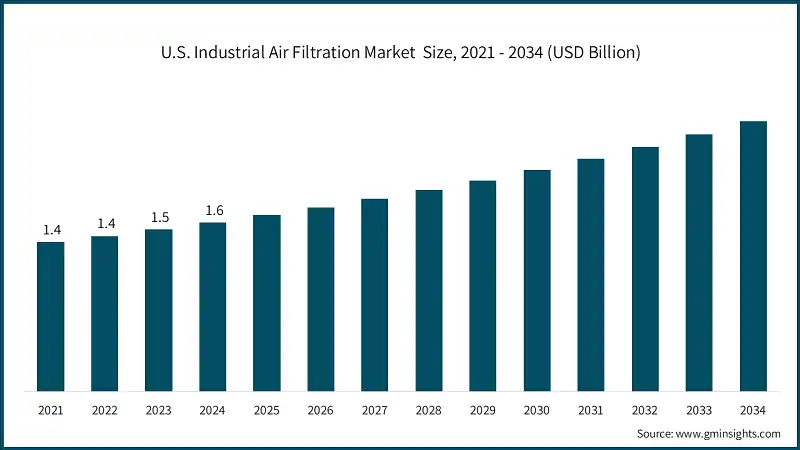
In terms of country, the United States led the industrial air filtration market with 77% of the North American market share and estimated USD 1.6 billion in revenue during 2024.
- The growth of the U.S. industrial air filtration industry is led mainly by growing industrialization and more stringent environmental regulations. Greater interest in workplace safety and air quality levels has also contributed significantly to boosting demand for high-level air filtration systems among different sectors, such as manufacturing, pharmaceutical, and food processing.
- Increasing usage of energy-saving and eco-friendly filtration technologies is driving market development. Introduction of technology upgrades and access by major market players to filtration systems drive the growth of the region.
- The robust structure of the U.S. market along with high R&D spendings makes it a robust platform in the industrial air filtration industry as well.
The Europe industrial air filtration market was valued at USD 1.7 billion in 2024 and is projected to grow at a CAGR of 4.2% between 2025 and 2034.
- The European market is growing significantly due to the presence of strict environmental policies and growing interest in occupational safety. Among the top industrial hubs within the region, Germany ranks among the leading propellers of the market.
- The strong manufacturing industry of the nation, especially in segments like auto, chemicals, and pharma, has necessitated the heightened demand for advanced air filtering devices in order to meet the requirements of emission control as well as to maximize indoor air quality inside industrial buildings.
The Asia Pacific industrial air filtration market was valued at USD 2.3 billion in 2024 and is projected to grow at a CAGR of 5.3% between 2025 and 2034.
- The Asia-Pacific market is expected to see high growth over the forecast period driven by rapid industrialization and tough environment regulations.
- China, India, and Japan are at the forefront of this development, with China taking the lead as it possesses a strong manufacturing base and giving greater emphasis to curbing industrial emissions.
The Middle East and Africa market was valued at USD 274.3 million in 2024 and is projected to grow at a CAGR of 3.4% between 2025 and 2034.
- Middle East and African market is growing at a fast pace, fueled by growing industrialization and strict environment regulations. Regional key player Saudi Arabia is also seeing strong demand due to growing industrialization and government efforts to curb air pollution.
- The Kingdom's Vision 2030 strategy, focusing on sustainable development, has similarly triggered the use of high-tech air filtration systems in industries such as oil and gas, manufacturing, and power generation.
Industrial Air Filtration Market Share
- The top 5 companies in the industrial air filtration industry are Camfil, Cummins Filtration, Parker Hannifin, Mann+Hummel, Filtration Group Corporation collectively hold a share of 12% in the market.
- These companies continue to acquire and merge with others, expand facilities, and make various collaborations to increase their product offerings, access customer bases, and secure their market positions.
- Camfil is increasing market share by emphasizing innovation and sustainability in its products. Camfil invests heavily in research and development to design innovative solutions in filtration that comply with strict environmental and safety regulations. Strategic acquisition and partnership have also cemented its grip in the industrial air filtration business.
- Cummins Filtration utilizes its competence in engine filtration systems to drive growth in its industrial air filtration business. The company is committed to providing high-performance products that enhance equipment reliability and efficiency. Through the use of new technologies, including nanofiber media, Cummins Filtration provides improved filtration performance. Its extensive aftermarket support and customer service enable customers to establish long-term relationships. In addition to this, the company also ventures positively into new markets and into local manufacturing to fulfill the local demand, thus increasing its market share.
- MANN+HUMMEL relies on innovation in technology and sustainability to stay ahead in the industrial air filtration sector. It has implemented eco-friendly filtration technology that aligns with environmental policies and meets customers' needs for purer air. MANN+HUMMEL also invests in digitalization, providing intelligent filtration systems that optimize performance at a lower cost of maintenance.
- To improve the product and market share key players are constantly investing in technological activities and are also entering into partnerships to provide improved and better solutions for the customers. These investments are benefiting both companies and customers as they help develop and offer solutions as per the changing technological trends and thus the customer requirements.
- AAF (American Air Filter) is a worldwide manufacturer of air filtration products with great experience in industrial filters optimized for improved air quality and overall performance. AAF provides an extensive line of products from high-efficiency particulate air (HEPA) filters, gas-phase filters, and dust collectors to cover various industrial processes including manufacturing, pharmaceuticals, and power generation.
- Donaldson Company is a leading manufacturer of industrial air filters, best known for its cutting-edge filtration technology that is applied across numerous industries. The company has been in existence since 1915 and has its headquarters located in Minnesota. Donaldson has become the leading air filtration technology. The high-end mist, fume, and dust collectors and high-performance air filters that clean the air and enhance equipment efficiency are the product lines of the company. Donaldson provides industries like agriculture, construction, food and beverage, and manufacturing with customized solutions based on precise operating requirements.
- Freudenberg Group is a world-diversified technology group and industry leader in the industrial air filter business, offering premium filtration solutions for numerous industrial applications. Headquartered in Weinheim, Germany, Freudenberg has operations across multiple industries, including automobile, healthcare, and manufacturing, and provides innovative products that improve productivity and air quality. Its industrial air filter series consists of HEPA filters, activated carbon filters, as well as multi-stage systems to ensure the stringent demands of industries.
Industrial Air Filtration Market Companies
Major players operating in the industrial air filtration industry are:
- AAF
- Absolent
- BWF
- Camfil
- Cummins Filtration
- Donaldson
- Filtration Group Corporation
- Fives Group
- Freudenberg
- Lydall Gutsche
- Mann+Hummel
- Nederman
- Pall
- Parker Hannifin
- Universal Air Filter
Industrial Air Filtration Market Report Attributes
| Key Takeaway | Details |
|---|---|
| Market Size & Growth | |
| Base Year | 2024 |
| Market Size in 2024 | USD 6.7 Billion |
| Market Size in 2025 | USD 7 Billion |
| Forecast Period 2025 - 2034 CAGR | 4.7% |
| Market Size in 2034 | USD 10.6 Billion |
| Key Market Trends | |
| Drivers | Impact |
| Stringent environmental regulations | Governments across the globe are enforcing strict regulations to control industrial emissions, driving the demand for advanced air filtration systems. |
| Rising awareness of workplace safety | Increasing awareness about the health hazards caused by poor air quality in industrial settings is encouraging companies to invest in air filtration solutions. |
| Pitfalls & Challenges | Impact |
| High initial investment costs | The significant upfront costs associated with installing industrial air filtration systems pose a challenge, particularly for SME’s |
| Maintenance and operational costs | Regular maintenance and operational expenses can deter some industries from adopting these systems |
| Opportunities: | Impact |
| Technological advancements | HEPA filters and nanotechnology-based solutions are creating new opportunities for market players. |
| Expansion in emerging economies | Rapid industrialization in developing countries presents significant growth opportunities for the industrial air filtration market |
| Market Leaders (2024) | |
| Market Leaders |
4.2% market share |
| Top Players |
Collective market share in 2024 is 12% |
| Competitive Edge |
|
| Regional Insights | |
| Largest Market | Asia Pacific |
| Fastest Growing Market | Asia Pacific |
| Emerging Countries | India, Germany, Brazil, Saudi Arabia |
| Future outlook |
|
What are the growth opportunities in this market?
Industrial Air Filtration Industry News
- In July 2025, American Air Filter introduces the BioCel VXL RC and VariCel VXL RC V-Bank Class of air filters, ushering in a new generation of high-performance air filters designed to perform better, last longer, and reduce maintenance time and total cost of ownership. Designed for use in HVAC systems in hospitals, schools, manufacturing plants, hotels, and other commercial facilities.
- In October 2024, Camfil USA announces the launch of the Absolute VG V-Bank HEPA filter an innovative solution for industries requiring high air purity, including life sciences, healthcare, and microelectronics.
- In September 2024, Donaldson Company is expanding its presence in the food and beverage markets by launching its filtration services in France, Germany and Austria. This initiative reinforces the company’s commitment to product and process integrity, with Donaldson specialists delivering their renowned innovation directly to customers' locations.
- In August 2024, Mann+Hummel launched Mann-Filter Frecious Plus featuring nanofibers for cabin air filtration. The new filter is designed to effectively filter ultra-fine particles, as well as pollutants from both outside and inside the vehicle. It also offers proven protection against allergens, bacteria, and mold.
The industrial air filtration market research report includes in-depth coverage of the industry with estimates & forecasts in terms of revenue (USD Billion) and volume (Thousand Units) from 2021 to 2034, for the following segments:
Market, By Product Type
- HEPA filters
- Baghouse/fabric filters
- Electrostatic precipitators (ESP)
- Cyclone separators
- Activated carbon filters
- Others (ULPA filters etc.)
Market, By Application
- Cleanroom air filtration
- Industrial process air cleaning
- HVAC system filtration
- Dust collection systems
- Emission control
Market, By End Use Industry
- Pharmaceuticals & biotechnology
- Semiconductor & electronics
- Food & beverages
- Automotive
- Chemical & petrochemical
- Others (healthcare & hospitals etc.)
Market, By Distribution Channel
- Direct sales
- Indirect sales
The above information is provided for the following regions and countries:
- North America
- U.S.
- Canada
- Europe
- Germany
- UK
- France
- Spain
- Italy
- Netherlands
- Asia Pacific
- China
- Japan
- India
- Australia
- South Korea
- Latin America
- Brazil
- Mexico
- Argentina
- MEA
- South Africa
- Saudi Arabia
- UAE
Frequently Asked Question(FAQ) :
What is the market size of the industrial air filtration market in 2024?
The market size was USD 6.7 billion in 2024, with a CAGR of 4.7% expected through 2034 driven by stringent environmental regulations and workplace safety standards.
What is the current industrial air filtration market size in 2025?
The market size is projected to reach USD 7 billion in 2025.
What is the projected value of the industrial air filtration market by 2034?
The industrial air filtration market is expected to reach USD 10.6 billion by 2034, driven by rapid industrialization, energy-efficient solutions, and stricter environmental policies.
How much revenue did the HEPA filters segment generate in 2024?
HEPA filters generated USD 2.1 billion in 2024, dominating the market due to superior efficiency and increasing use across cleanrooms, healthcare, and manufacturing sectors.
What was the valuation of the chemical & petrochemical segment in 2024?
The chemical & petrochemical segment held 27% market share and generated the largest revenue among end-use industries in 2024.
What is the growth outlook for indirect sales channels from 2025 to 2034?
Indirect sales are projected to grow at a CAGR of 5.7% till 2034.
Which region leads the industrial air filtration market?
The United States led the market with USD 1.6 billion in 2024, representing 77% of the North American market. Growth is fueled by stringent environmental regulations and strong adoption of energy-efficient and advanced filtration systems.
What are the upcoming trends in the industrial air filtration market?
Key trends include AI-driven predictive maintenance, digital twin technology, IoT-enabled filtration systems, and the shift towards eco-friendly and nanotechnology-based filters.
Who are the key players in the industrial air filtration market?
Key players include Camfil, Cummins Filtration, Parker Hannifin, Mann+Hummel, Filtration Group Corporation, Donaldson, Freudenberg, Nederman, AAF, and Pall.
Industrial Air Filtration Market Scope
Related Reports