Summary
Table of Content

Indoor Farming Equipment Market
Get a free sample of this report
Form submitted successfully!
Error submitting form. Please try again.
Thank you!
Your inquiry has been received. Our team will reach out to you with the required details via email. To ensure that you don't miss their response, kindly remember to check your spam folder as well!
Request Sectional Data
Thank you!
Your inquiry has been received. Our team will reach out to you with the required details via email. To ensure that you don't miss their response, kindly remember to check your spam folder as well!
Form submitted successfully!
Error submitting form. Please try again.
Indoor Farming Equipment Market Size
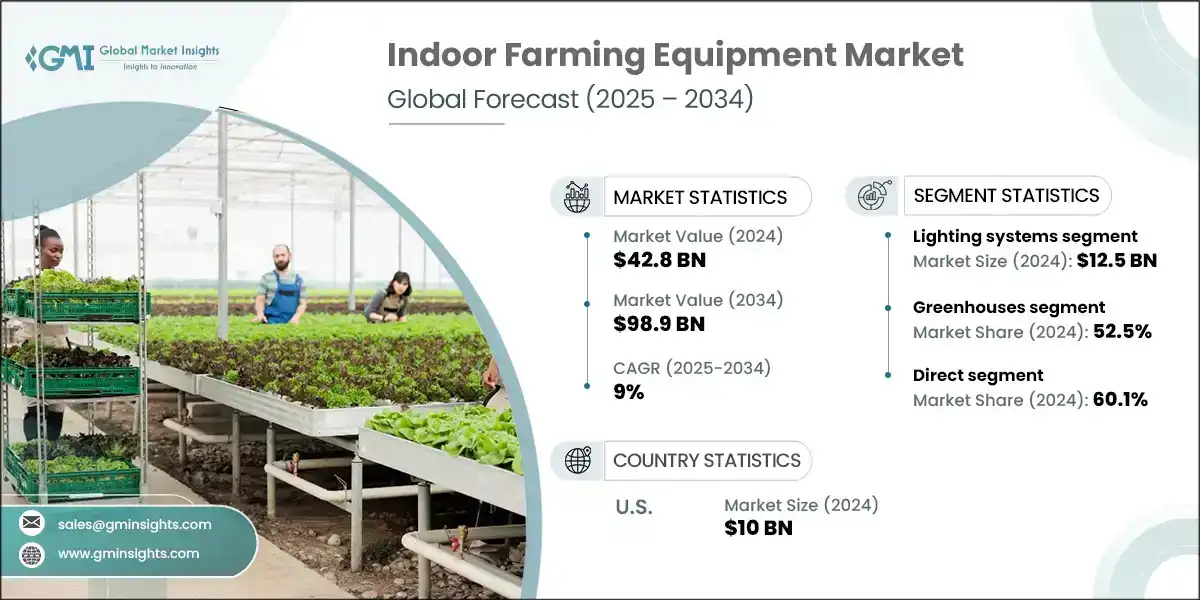
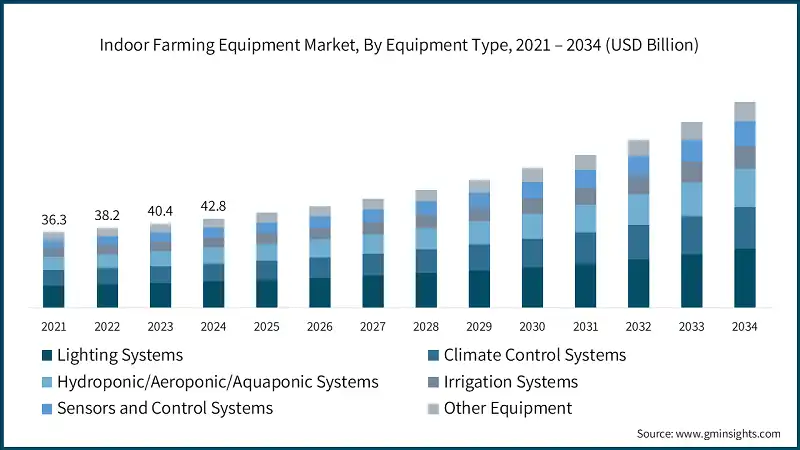
The global indoor farming equipment market was estimated at USD 42.8 billion in 2024. The market is expected to grow from USD 45.6 billion in 2025 to USD 98.9 billion in 2034, at a CAGR of 9%, according to Global Market Insights Inc.
Indoor Farming Equipment Market Key Takeaways
Market Size & Growth
- 2024 Market Size: USD 42.8 Billion
- 2034 Forecast Market Size: USD 98.9 Billion
- CAGR (2025–2034): 9%
Key Market Drivers
- Increasing demand for sustainability and food security.
- Rising urbanization and population growth.
- Technological advancements.
Challenges
- High initial capital investment.
- Complexity in system integration and operation.
Opportunity
- Customization for Specialty Crops.
- Vertical Farming Infrastructure.
Key Players
- Market Leader: GrowGeneration Corp. led with over 3% market share in 2024.
- Leading Players: Top 4 players in this market include Heliospectra AB, Hydrofarm Holdings Group, Signify, GrowGeneration Corp., which collectively held a market share of 10% in 2024.
Get Market Insights & Growth Opportunities
- Sustainability issues, as well as food security, are major factors in the increased demand for indoor farm equipment. Urban clientele prefers locally grown produce, which is fresher and healthier while being pesticide-free and traceable. Consumers need this change alongside densely populated regions that are climate-sensitive where traditional agriculture cannot keep up with demand. Further, urban sprawl combined with widespread soil degradation is diminishing arable land, causing both governments and private sectors to shift towards vertical farming and container system-based farms within city limits. As highlighted by Food and Agriculture Organization (FAO), around 33% of soil worldwide has already faced degradation which calls for innovation in farming methods. Moreover, the United Nations forecasts that by 2050, almost 68% of the population will live in urban areas further straining the need for urban farming solutions.
- This market’s growth is also advanced by urbanization and new technologies. With increasing city populations comes a higher demand for food systems situated near population centers which leads to integration of vertical as well as rooftop gardens into smart city frameworks. At the same time, advancements in indoor farming technologies make these systems more efficient commercially usable on a large scale. Advanced soilless growing systems like hydroponics, aquaponics, and aeroponics permit the cultivation of crops year-round with high yields and minimum resource utilization. This is coupled with energy-efficient LED lighting specific to crop requirements, sensor networks, real-time monitoring tools, and AI-powered climate control technology.
- As noted by the USDA, indoor farming offers a maximum acre yield of 10 times compared to traditional agriculture. Additionally, the USDA claims that indoor agricultural systems can reduce water consumption by as much as 95% in comparison to outdoor conventional practices. Indoor farming has low operating costs; this makes it an essential solution for addressing future food production challenges.
- The indoor farming equipment industry has great potential, but it faces important risks that could slow its growth and scalability. One major challenge is the high startup cost. Setting up vertical farms, hydroponic systems, or aeroponic setups requires a large investment in technology, machines, and infrastructure. These financial problems can discourage new businesses and hinder the growth of existing ones.
- Moreover, energy consumption is another operational risk. Indoor farms rely on artificial lighting, climate control, and irrigation systems, all of which drive up energy costs. This impacts profitability and raises concerns about sustainability, particularly when they rely on fossil fuels. Changing energy prices and environmental concerns make the industry’s long-term future even more complex.
To get key market trends
Indoor Farming Equipment Market Trends
- The integration of AI, machine learning, and robotics is revolutionizing indoor farming. These technologies are enabling precise crop monitoring, automated nutrient management, and robotic harvesting. This transformation allows farms to improve operational efficiency, reduce labour reliance, and maintain consistent crop quality. Real-time intelligent decision-making systems also aid in resource optimization and proactive intervention for plant health concerns.
- At the same time, advancements in LED lighting technology are aiding in more efficient indoor guided growth of plants. Specifically, manufacturers are designing spectrum illumination devices that serve specific grower requirements depending on the type of crop and growth stages, starting from seedlings to flowering stages.
- These specific-use LEDs augment not only plant performance and yield but also exhaust lower amounts of energy as compared to conventional systems which makes such farming techniques more sustainable surpassing traditional methods. Combined with other technological innovations mentioned above assistance outdoor based agriculture indoor farming on a highly automated future powered by data.
- Vertical farming is quickly becoming a major trend in agriculture, especially in cities where space is tight and traditional farming is hard to manage. This method involves growing crops in layered stacks, often in controlled indoor spaces, which makes the best use of vertical space. It stands out because it can produce high yields throughout the year, regardless of the weather, while using much less land. As city populations increase and available farmland shrinks, vertical farming provides a sustainable way to produce food locally, cutting down on transportation costs and reducing environmental impact. Its ability to grow on a larger scale and adapt to different settings makes it particularly appealing in crowded areas and cities aiming for food security and sustainability.
Indoor Farming Equipment Market Analysis
Learn more about the key segments shaping this market
Based on equipment type, the market of indoor farming equipment is categorized into lighting systems, climate control systems, hydroponic/aeroponic/aquaponic systems, irrigation systems, sensors and control systems and other equipment. The lighting systems accounted for revenue of around USD 12.5 billion in the year 2024 and is estimated to grow at a CAGR of 8.7% from 2025 to 2034.
- Improvements in illumination techniques handicap where indoor farming is concerned since it depends on artificial lights to replace the sun. Recently developed LED technologies, particularly with respect to spectrum tuning and wavelength tailoring, have greatly helped growers achieve crop-specific lighting for growth stages which substantially increases yield and improves quality. Moreover, their use in traditional lighting results in significant savings for commercial growers due to reduced operational cost because of consuming less energy and requiring lower maintenance costs through longer lifespans. The increased demand vertical farming, cannabis farming, and urban agriculture cultivates while simultaneously requiring greater light performance strictly heightens need for sharper precision controls that lead to repeatable outcomes in confined spaces. Together these factors contribute towards stronger revenue growth as well as projected CAGR lighting systems segments.
- However, Climate control systems is expected to grow at a CAGR of 9.2% during the forecast period driven by the increasing demand for precision agriculture and optimized crop environments. As indoor farming relies heavily on controlled conditions to ensure consistent yields, climate control systems such as HVAC units, dehumidifiers, and CO2 enrichment technologies have become essential for regulating temperature, humidity, and air quality. These systems enable growers to cultivate crops year-round, regardless of external weather conditions, and are especially critical in vertical farms and high-tech greenhouses.
Based on facility type, indoor farming equipment market consists of greenhouses, vertical farms, indoor grow rooms and container farms. The greenhouses emerged as leader and held 52.5% of the total market share in 2024 and is anticipated to grow at a CAGR of 8.7% from 2025 to 2034.
- Greenhouses not only utilize natural sunlight they can be paired with artificial lighting and climate control systems, requiring less energy than fully enclosed systems. They are used in both developed and emerging markets because of their capital efficiency and operational versatility for mass crop production, including vegetables, herbs, and flowers.
- Productivity and resource use efficiency have been improved even further by the incorporation of modern technology like automated ventilation or shading systems and hydroponics. These benefits coupled with government policy support and increased funding for sustainable agricultural practices are expected to retain greenhouses as the primary structure type dominating the indoor farming equipment market throughout the forecasted period.
Learn more about the key segments shaping this market
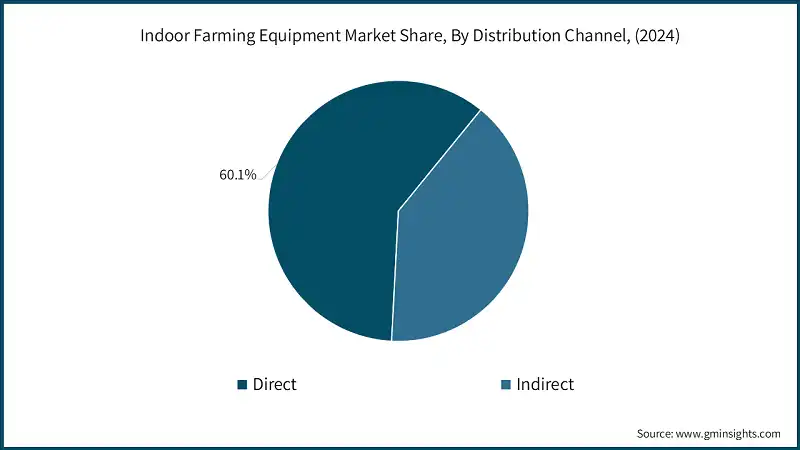
The distribution channel of indoor farming equipment market consists of direct and indirect platforms. The direct segment emerged as leader and held 60.1% of the total market share in 2024 and is anticipated to grow at a CAGR of 9.3% from 2025 to 2034.
- The direct distribution segment has become the primary channel in the indoor farming equipment market because commercial growers and large-scale indoor farming operators prefer sourcing directly from manufacturers or specialized suppliers. By purchasing through this method, buyers receive tailored solutions, technical consultations, more competitive pricing, and dedicated after-sales support which are critical for the effective implementation and operation of indoor farming systems. Furthermore, as technology continues to progress within the industry, buyers expect direct access to vendors for seamless system integration (lighting and climate control) monitoring for scheduled updates. The expansion of e-commerce channels operated by manufacturers further simplifies this method in remote or emerging markets.
- Furthermore, the indirect distribution channel is expected to grow at a CAGR of 8.5% during the forecast period, largely due to its ability to offer broader market reach and operational efficiency. Indirect channels such as third-party distributors, retailers, and e-commerce platforms enable manufacturers to penetrate diverse geographic regions without the need for extensive infrastructure or direct sales teams. This approach is particularly beneficial for small and mid-sized equipment producers who may lack the resources for direct distribution.
Looking for region specific data?
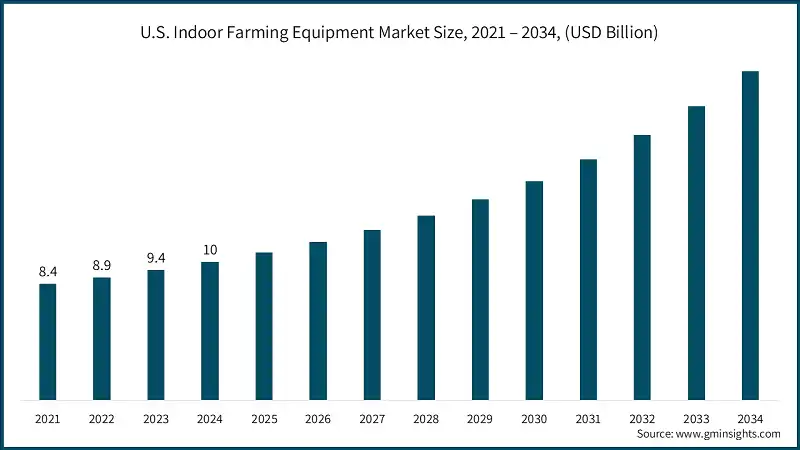
The U.S. dominates an overall North America indoor farming equipment market and valued at USD 10 billion in 2024 and is estimated to grow at a CAGR of 9.3% from 2025 to 2034.
- The U.S. holds the largest share of North America’s indoor farming equipment market due to early adoption of sophisticated agricultural technologies along with its well-developed ecosystem including vertical and indoor farmers alongside dedicated equipment manufacturing companies and research institutions. There is increased urban-and vertically integrated farming in response to locally grown food demand alongside the need for climate-resilient food security.
- The market expansion has also been supported by recent private equity and aggrotech funding as well as the U.S. regulated cultivators embracing precision agriculture like hydroponic systems, AI-powered climate control, and LED lighting which increases equipment demand. Lastly, sustainable farming policies reinforce this growth further.
The indoor farming equipment market in Europe, Germany is expected to experience significant and promising growth from 2025 to 2034.
- Germany's dedication to innovation and its strong emphasis on sustainability alongside food security serve as the primary factors driving market growth. The limited arable land within vertically constrained regions coupled with increased climate change variability is leading the country towards investing in alternative cultivation practices such as vertical farms, CEA, or urban greenhouses.
- Subsidies covering research funding and green energy initiatives are other forms of government support that accelerate adoption alongside Germany’s engineering prowess aimed at improving controlled environment systems along with high-end indoor farming modules including automated energy-efficient lights and climate control systems. Pace consumer demand for locally grown urban produce served without pesticides elevates Germany’s positioning over the bordering decade making it a focal growth region for Europe’s indoor farming industry.
The Asia Pacific indoor farming equipment market, the China held 31.5% market share in 2024 and is anticipated to grow at a CAGR of 10.2% from 2025 to 2034.
- The driving factor behind this development is the need to cater to the large and rapidly urbanizing population of the country as well as diminishing farmland and mounting concerns regarding environmental impact. To mitigate these issues, China allocates a large portion of its spending to smart agriculture such as vertical and indoor farming. Policies directed towards technological advancement in farming along with the city's high demand for quality pesticide-free produce have led to increased usage of sophisticated equipment like climate control systems, hydroponics, LED lighting, and precast greenhouse structures.
- Moreover, Canada’s firm construction response capabilities combined with tech-centric country infrastructure positions it favorably against faster adaptation to indoor farming systems which will ensure sustained growth over the projected period.
In the Middle East and Africa indoor farming equipment market, South Africa held 29.4% market share in 2024 and is anticipated to grow at a CAGR of 9.6% from 2025 to 2034.
- Shifts towards controlled-environment agriculture are the result of mounting concerns over food security, water shortages, and climate change. With its developing urban population and better infrastructure, South Africa is experiencing increased investment in high-tech greenhouse and vertical farm systems with hydroponics, LED lighting, as well as automated irrigation.
- Additionally, the implemented policies focusing on sustainable entrepreneurship coupled with private investments in Agri-tech startups are actively driving growth in the market. Indoor farming technology adoption and use for final production is progressively establishing South Africa as one of the main contributors to growth within MEA nations.
Indoor Farming Equipment Market Share
- In 2024, the top company like Signify, Hydrofarm Holdings Group, Heliospectra AB and GrowGeneration Corp. held around ~10% market share in the global market. These manufacturers have developed brand recognition along with an extensive network in distribution channels which allows them to service both large scale commercial farmers and new emerging players in urban farming. Their market dominance is bolstered by sustained expenditure in product development, specifically with cutting edge LED lights, nutrient delivery systems, and climate control technology which focus on the evolving needs of high efficiency and sustainable farming practices.
- Further to this, these companies are looking for strategic collaborations as well as acquisitions and geographic growth to strengthen their position in the competition. For example, Signify has been focusing on expanding its global horticulture lighting segment while Grow Generation continues purchasing retail outlets and hydroponics product lines to widen their offerings.
- Signify stands out as a leader in lighting products and is widely known for her creativity concerning the horticulture of LED systems meant for indoor gardening. The company also offers specific energy efficient crop growing lights through its Philips horticulture brand enabling proper growth of plants within greenhouses and vertical farms. Through indoor sustainability-themed precision agriculture focus by Signify makes them a go-to partner for most commercial indoor growers around the globe. With unwavering research investment as well as strategic collaborations geared towards enabling cutbacks of energy usage paired with boosted productivity intensive indoor farming solutions, Signify is actively reshaping the future of indoor farming.
- As a leading manufacturer and distributor of hydroponic and controlled environment agricultural (CEA) systems in North America, Hydrofarm Holdings Group develops a range of products which include grow lights, climate control systems, irrigation equipment, and hydroponics for both home-based gardeners as well as commercial growers. With an aggressive growth strategy that spans numerous retail outlets and acquisitions, the company has been able to widen their reach throughout the market. In addition to this, its focus on eco-friendly indoor farming makes it one of the most important companies in the emerging area of under-cover farming.
Indoor Farming Equipment Market Companies
Major players operating in the indoor farming equipment market include:
- AeroFarms
- Autogrow Systems
- Everlight Electronics Co., Ltd.
- Fluence Bioengineering
- Freight Farms
- GrowGeneration Corp.
- Heliospectra AB
- Hydrofarm Holdings Group
- iFarm
- Illumitex
- LumiGrow
- Netafim
- Priva
- Richel Group
- Signify
- Vertical Future
Netafim, a leader in precision irrigation, is a global leader in providing turnkey solutions for greenhouse and agricultural projects. Specializing in drip and micro-irrigation technologies, Netafim offers efficient solutions that deliver water and nutrients directly to plant roots in controlled settings. Their systems support hydroponic and aeroponic farming, helping growers achieve consistent crop yields while saving water and reducing energy use. With a strong global presence and a focus on sustainability, Netafim helps indoor farmers reach high productivity with less environmental impact.
The Richel Group is a global leader in providing complete solutions for greenhouse and controlled environment agriculture projects. In indoor farming, Richel stands out in designing and making advanced greenhouse structures that have modern climate control systems, automated shading, and energy-efficient lighting. Their modular solutions are customized to fit the needs of vertical farms, hydroponic setups, and urban agriculture projects. By using smart technologies and precise engineering, Richel helps farmers optimize crop production in enclosed spaces, allowing for year-round growth with minimal resource use.
Indoor Farming Equipment Market Report Attributes
| Key Takeaway | Details |
|---|---|
| Market Size & Growth | |
| Base Year | 2024 |
| Market Size in 2024 | USD 42.8 Billion |
| Forecast Period 2025 - 2034 CAGR | 9% |
| Market Size in 2034 | USD 98.9 Billion |
| Key Market Trends | |
| Drivers | Impact |
| Increasing demand for sustainability and food security | Encourages eco-friendly technologies like hydroponics for sustainable food production. |
| Rising urbanization and population growth | Drives demand for vertical farms and modular equipment in urban areas. |
| Technological advancements | Boosts growth through automation and precision farming to enhance productivity. |
| Pitfalls & Challenges | Impact |
| High initial capital investment | High capital costs deter new entrants and SME growth. |
| Complexity in system integration and operation | Integration complexities raise costs and limit scalability. |
| Opportunities: | Impact |
| Customization for Specialty Crops | Empowers growers to enhance yield and quality for premium crops, broadening market access and boosting profits. |
| Vertical Farming Infrastructure | Optimizes space and scalability, paving the way for sustainable food production in cities. |
| Market Leaders (2024) | |
| Market Leaders |
~3% market share |
| Top Players |
Collective market share in 2024 is ~10% |
| Competitive Edge |
|
| Regional Insights | |
| Largest Market | North America |
| Fastest Growing Market | Europe, Asia Pacific |
| Emerging Country | U.S., UK, China, Japan, South Africa |
| Future Outlook |
|
What are the growth opportunities in this market?
Indoor Farming Equipment Market News
- In October 2024, Netafim partnered with Phytech LTD to advance smart irrigation solutions. The partnership leverages Netafim’s extensive distribution and service network to deliver real-time insights into irrigation performance and provide data-driven recommendations to mutual customers. By integrating GrowSphere’s advanced control and automation capabilities, the collaboration ensures precise and adaptive irrigation tailored to specific crop requirements. It also enables early identification of issues like water and fertilizer wastage or low pressure, which can cause inefficiencies and raise operational costs.
- In June 2023, Certhon collaborated with Living Greens Farm to globally expand the reach of its innovative aeroponic growing technology. As the only large-scale Controlled Environment Agriculture grower using this method, Living Greens Farm is setting a new standard in sustainable food production. Through this partnership, Certhon aims to introduce the advanced growing system to markets outside North America.
- In January 2023, Priva announced a strategic alliance with Aranet to address the increasing demand for advanced greenhouse sensors. This partnership focuses on integrating wireless sensor platforms with other data sources in greenhouses to enhance data collection and utilization.
The indoor farming equipment market research report includes in-depth coverage of the industry, with estimates & forecast in terms of revenue (USD Billion) and volume (Thousand Units) from 2021 to 2034, for the following segments:
Market, By Equipment type
- Lighting systems
- Climate control systems
- Hydroponic/Aeroponic/Aquaponic systems
- Irrigation systems
- Sensors and control systems
- Other equipment
Market, By Growing Method
- Hydroponics
- Aeroponics
- Aquaponics
- Soil-based indoor farming
Market, By Facility Type
- Greenhouses
- Vertical farms
- Indoor grow rooms
- Container farms
Market, By Crop Type
- Fruits & vegetables
- Herbs & microgreens
- Flowers & ornamentals
- Cannabis
- Others (e.g., mushrooms, specialty crops)
Market, By Distribution Channel
- Direct
- Indirect
The above information is provided for the following regions and countries:
- North America
- U.S.
- Canada
- Europe
- Germany
- UK
- France
- Italy
- Spain
- Asia Pacific
- China
- Japan
- India
- South Korea
- Australia
- Indonesia
- Malaysia
- Latin America
- Brazil
- Mexico
- MEA
- Saudi Arabia
- UAE
- South Africa
Frequently Asked Question(FAQ) :
What is the market size of the indoor farming equipment in 2024?
The market size was USD 42.8 billion in 2024, with a CAGR of 9% expected through 2034 driven by increasing demand for sustainability and food security.
What is the projected value of the indoor farming equipment market by 2034?
The market size for indoor farming equipment is expected to reach USD 98.9 billion by 2034, driven by urbanization, technological advancements, and the need for climate-resilient food production.
How much revenue did the lighting systems segment generate in 2024?
Lighting systems segments generated USD 12.5 billion in 2024.
What was the valuation of the greenhouse facility segment in 2024?
Greenhouses held 52.5% market share and generated the largest revenue among facility types in 2024, supported by operational versatility and capital efficiency.
What is the growth outlook for climate control systems from 2025 to 2034?
Climate control systems are projected to grow at a 9.2% CAGR till 2034.
Which region leads the indoor farming equipment market?
North America led the market with USD 10 billion in 2024, supported by early adoption of advanced agricultural technologies and strong urban farming infrastructure.
What are the upcoming trends in the indoor farming equipment industry?
Key trends include vertical farming adoption, AI-driven climate control, spectrum-tuned LED lighting, and increased automation through robotics and sensor networks.
Who are the key players in the indoor farming equipment market?
Key players include GrowGeneration Corp., Signify, Hydrofarm Holdings Group, Heliospectra AB, AeroFarms, Netafim, Priva, Richel Group, Fluence Bioengineering, and Vertical Future.
Indoor Farming Equipment Market Scope
Related Reports