Summary
Table of Content

Indonesia Medical and Wellness Tourism Market
Get a free sample of this report
Form submitted successfully!
Error submitting form. Please try again.
Thank you!
Your inquiry has been received. Our team will reach out to you with the required details via email. To ensure that you don't miss their response, kindly remember to check your spam folder as well!
Request Sectional Data
Thank you!
Your inquiry has been received. Our team will reach out to you with the required details via email. To ensure that you don't miss their response, kindly remember to check your spam folder as well!
Form submitted successfully!
Error submitting form. Please try again.
Indonesia Medical and Wellness Tourism Market Size
The market is driven by numerous factors such as rising healthcare costs in western countries, expansion of healthcare infrastructure and international partnerships, integration of medical and wellness services, and government support and destination promotion initiatives, among other factors.
The rise of chronic diseases requiring cost‑effective care, the expansion of internationally accredited hospitals, and the growing demand for cosmetic and dental tourism are important factors that are expected to fuel the industry growth. Bali International Hospital, COMO Hotels and Resorts, Siloam Hospitals, Marriot International, and REVIVO Wellness Resort are among the key players operating in the market. These players mainly focus on geographic expansion, integration of advanced technologies, and collaboration with regional and international healthcare providers, among others.
Indonesia Medical and Wellness Tourism Market Key Takeaways
Market Size & Growth
- 2025 Market Size: USD 7 Billion
- 2026 Market Size: USD 7.9 Billion
- 2035 Forecast Market Size: USD 20.6 Billion
- CAGR (2026–2035): 11.3%
Key Market Drivers
- Rising healthcare costs in Western countries.
- Government support and destination promotion initiatives.
- Integration of medical and wellness services.
- Expansion of healthcare infrastructure and international partnerships.
Challenges
- Competition from established regional medical tourism hubs.
Opportunity
- Development of special economic zones for health tourism.
- Expansion of wellness resorts and rehabilitation centers.
Get Market Insights & Growth Opportunities
The market has increased from USD 2.8 billion in 2022 and reached USD 6.1 billion in 2024, with the historic growth rate of 46%. Patients in the developed countries of North America, Europe, and other parts of the world are increasingly turning to overseas providers for their elective surgical procedures, dental work, cosmetic surgery, and other long-term wellness care because of the rapidly increasing cost of healthcare in their home countries. The patient may find the procedure costs up to 60-70% in comparison to the cost in western nations. For example, the cost of dental implants that may go up to USD 5,000 in the U.S. can be performed within USD 1,500 in Indonesia. The price difference for these types of services between developed and developing countries continues to drive patients toward the relatively low cost of these outpatient-based services offered in Indonesia. Further, as the number of patients who have no insurance or are underinsured increases, it in turn fuels the need for outpatient-based services.
Additionally, Indonesia's governmental initiatives, including the development of medical tourism zones, support for hospital accreditation, easing of travel restrictions, and improved airport-to-hospital connectivity, have continued to positively shape the medical tourism market's growth. National branding that highlights Bali, Jakarta, Batam, and Medan as medical and wellness destinations has been increasing visibility in international markets. Moreover, government-provided incentives for the private healthcare sector, as well as collaborative partnerships between the hospitality and travel sectors, are also supporting Indonesia's overall medical and wellness tourism sector development. Lastly, by leveraging the natural attributes of the country and including wellness tourism within the broader tourism segment, the government's active promotion provides opportunities to expand the audience for wellness tourism and international partnerships, thereby further enhancing the overall growth of the medical and wellness tourism sectors.
Further, Indonesia’s unique combination of clinical treatment and other methods of healing, including wellness practices, is among the leading competitive advantages the country has over other competitors in the Asian region. Various travelers are looking for ways to combine both medical-related procedures with relaxing, restorative experiences into one travel experience. Hospitals that collaborate with wellness resorts, spas, and traditional forms of healing help create a seamless connection between the two types of services, creating a more positive recovery experience, as well as enhancing the overall experience for the patient. The combination of these types of services attracts patients who wish to access preventative health services, receive post-treatment rehabilitation, participate in a detox program, and engage in therapy for mental health. The rich history and cultural heritage of Indonesia in the wellness section include practices such as Javanese healing and Bali’s holistic therapies, supporting the differentiation of Indonesia as a destination of choice for an integrated, focused journey to improved health.
Medical and wellness tourism refers to individuals traveling across borders to obtain medical treatments, preventive healthcare, and wellness services, combining clinical care with holistic, spa, and rejuvenation-focused experiences.
The Indonesia medical and wellness tourism market was estimated at USD 7 billion in 2025. The market is expected to grow from USD 7.9 billion in 2026 to USD 20.6 billion in 2035, at a CAGR of 11.3% during the forecast period, according to the latest report published by Global Market Insights Inc.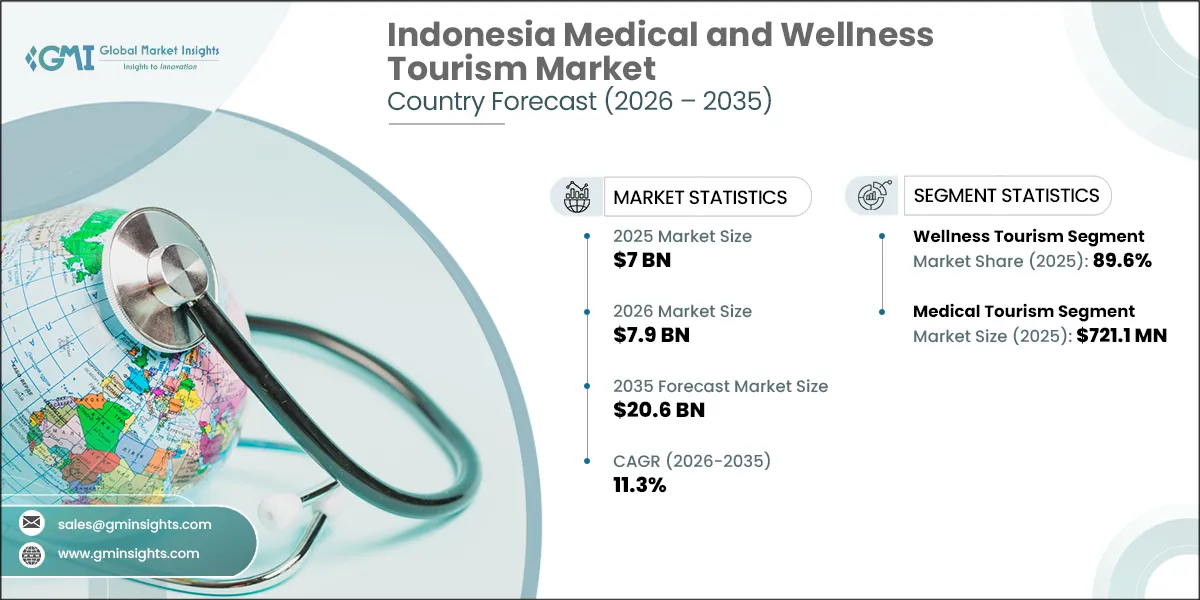
To get key market trends
Indonesia Medical and Wellness Tourism Market Trends
Rising preference for integrated medical–wellness experiences, digital health adoption and telemedicine integration, increasing wellness tourism centered on nature and culture, and expansion of healthcare provider–hospitality partnerships are among the key trends fueling the market growth.
- There is a rising trend of travelers seeking medical treatment and well-being services in away destinations, as well as a growing interest in wellness travel. Indonesia has developed a unique combination of spa culture, traditional methods of natural healing, and wellness resorts that offer holistic experiences for patients through the integration of medical facilities/hospitals and wellness centers. This integration improves patient satisfaction, enhances the healthcare recovery outcomes of patients, and boosts Indonesia's position as a healing destination.
- Additionally, teleconsultations, online treatment planning, digital medical records, and virtual follow‑ups are becoming standard. Indonesian hospitals use these tools to streamline pre‑arrival assessments and maintain continuity of care after patients return home. Patients can feel more confident in seeking treatment across borders using these technology-based services.
- Further, Indonesia’s natural landscapes, Bali, Lombok, and Yogyakarta, support strong growth in wellness retreats, detox camps, traditional healing therapies, and mindfulness programs. People choose to travel to Indonesia for stress relief, mental wellness, and proactive care, as its combination of nature, culture, and treatment options is second to none.
- Moreover, collaborations between healthcare providers, luxury resorts, and travel operators are becoming more common. These partnerships offer bundled packages covering medical procedures, accommodation, transportation, and recovery experiences. The availability of these types of packages makes it easier for international patients to plan their trips to Indonesia, thus enhancing its overall competitiveness in the Southeast Asia market.
Indonesia Medical and Wellness Tourism Market Analysis
Learn more about the key segments shaping this market
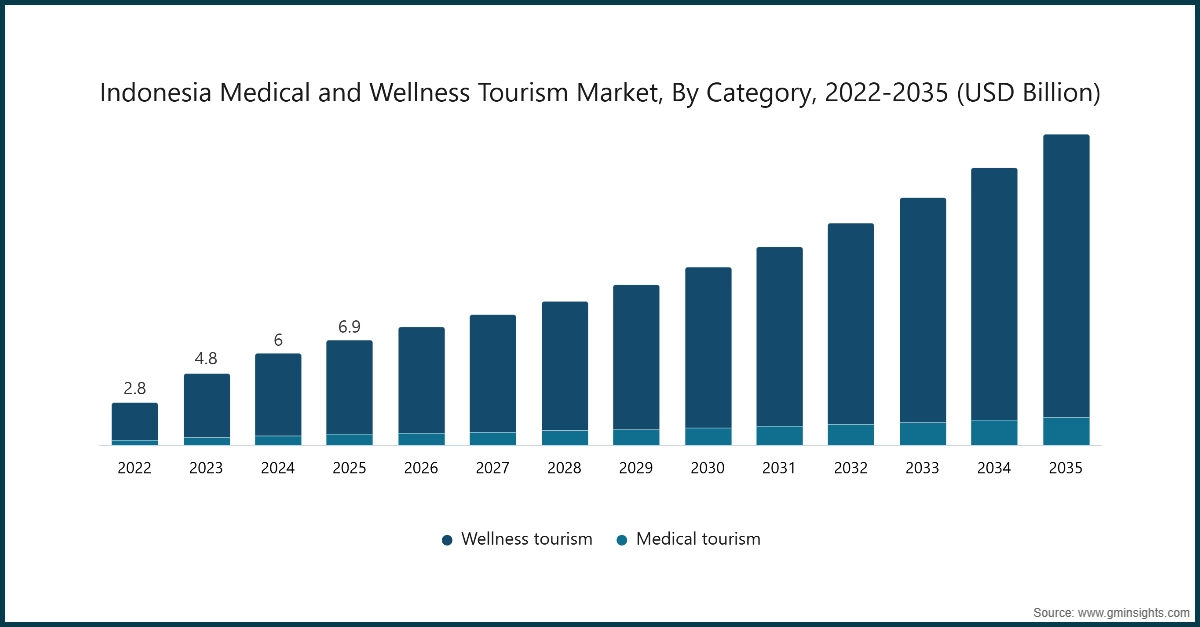
In 2022, the market was valued at USD 2.8 billion and grew to USD 4.8 billion in 2023, reaching USD 6.1 billion by 2024. Increasing collaborations with global insurance and travel facilitators is a key factor contributing to industry growth.
Based on category, the Indonesia medical and wellness tourism market is segmented into wellness tourism, and medical tourism. The wellness tourism segment accounted for a dominating share of 89.6% in 2025. Promotion of traditional Indonesian therapies (e.g., Javanese wellness) is anticipated to fuel the segmental growth. The segment is expected to reach USD 18.8 billion by 2035, growing at a CAGR of 11.5% during the forecast period.
- The wellness tourists in Indonesia are driven by the country's incredible culture, beautiful scenery, and established reputation as a key player in wellness tourism.
- Additionally, foreign visitors come to Indonesia to engage in preventative healthcare, mental wellness, relaxation, and rejuvenation through spa therapy, yoga retreats, detox and rehab centers, traditional Javanese medicine, Balinese medicine, holistic therapy, and nature‑based wellness experiences.
- Bali, Yogyakarta, Lombok, and Ubud are some of the major destinations, which have luxury wellness resorts, places for spiritual retreats, eco-therapy, and wellness experiences for both short-term and long-term visitors.
- Further, increasing global focus on stress reduction improves their lifestyle, finds balance between body and mind, and contributes to a growing number of people traveling to Indonesia as their preferred destination for wellness travel.
- The medical tourism segment was valued at USD 721.1 million in 2025. Indonesia's medical tourism industry has begun to focus on attracting international patients looking for metastatic care that is lower in price compared to other regional countries. Such specialties that have gained significant popularity are plastic surgery, dental, cardiology, reproductive, and general surgery.
- Furthermore, various hospitals located throughout Jakarta, Batam, and Bali have made significant investments in upgrading facilities and implementing newer technologies along with a rise in the number of internationally accredited facilities.
- The competitiveness in pricing, as well as the growing number of specialist physicians, along with the patient wait times, makes Indonesia a preferable destination for patients from Western countries and other regional competitors.
- In addition, through the development of medical tourism zones, the Indonesian Government aims to form partnerships between medical facilities and hospitality providers to combine care, as well as create options for integrated recovery packages for patients that allow for scenic destinations to be complemented with care after surgery.
Indonesia Medical and Wellness Tourism Market Share
Indonesia's medical and wellness tourism market is fragmented with many private hospital systems, specialized clinics, and globally recognized wellness resorts. The leading private hospital networks, including Siloam Hospitals and BIMC Hospitals, among others, provide advanced medical services, offering international patient departments, having multilingual staff, and developing partnerships with other global health care providers. In addition to competing on price, these hospitals have enhanced their clinical capabilities, improved their accreditation standards, and developed many specialty services that include cosmetic surgery, fertility care, cardiology, orthopedics, and dental treatment.
Additionally, in the wellness tourism segment, Bali‑based resorts and wellness centers dominate, including Fivelements Retreat, COMO Shambhala Estate, REVIVO Wellness Resort, and various luxury spa chains. These operators differentiate through holistic programs combining traditional Indonesian healing, detox therapies, yoga, meditation, nutrition planning, and nature‑driven recovery experiences. Their global brand appeal attracts high‑spending wellness travelers seeking immersive healing environments.
Competition is further intensified by hospital–hospitality collaborations, where resorts partner with medical providers to offer integrated medical‑wellness packages. Additionally, emerging medical tourism zones and government‑supported infrastructure upgrades are encouraging new entrants. Overall, the market is shifting toward higher service quality, stronger branding, technological integration, and internationally benchmarked patient experiences.
Indonesia Medical and Wellness Tourism Market Companies
A few of the prominent players operating in the Indonesia medical and wellness tourism industry include:
- Bali International Hospital
- COMO Hotels and Resorts
- Fivelements Retreat
- Four Seasons Hotels
- Gojek
- Grab Holdings Ltd.
- Hilton Worldwide Holdings Inc.
- InterContinental Group
- Marriot International
- Radisson Hotel Group
- REVIVO Wellness Resort
- Rosewood Hotel Group
- Siloam Hospitals
Focus on advanced specialty care, international accreditation, and premium patient services. Build partnerships with global healthcare institutions, enhance medical tourism packages, and leverage Bali’s tourism ecosystem to attract regional and international patients.
Strengthen luxury wellness positioning through personalized retreats, holistic therapies, and integrated medical‑wellness collaborations. Expand experiential programs, enhance sustainability practices, and leverage strong global branding to attract affluent health‑conscious travelers.
Prioritize immersive wellness programs combining mindfulness, nutrition, fitness, and traditional healing. Form partnerships with health experts, expand retreat themes, and enhance data‑driven personalization to attract long‑stay wellness travelers seeking transformative health experiences.
Indonesia Medical and Wellness Tourism Market Report Attributes
| Key Takeaway | Details |
|---|---|
| Market Size & Growth | |
| Base Year | 2025 |
| Market Size in 2025 | USD 7 Billion |
| Market Size in 2026 | USD 7.9 Billion |
| Forecast Period 2035 CAGR | 11.3% |
| Market Size in undefined | USD 20.6 Billion |
| Key Market Trends | |
| Drivers | Impact |
| Rising healthcare costs in Western countries | Encourages more patients to seek affordable treatments abroad, increasing inbound demand for Indonesia’s medical and wellness tourism services |
| Government support and destination promotion initiatives | Boosts market visibility, enhances infrastructure, and increases patient confidence, directly driving higher tourist inflows and industry participation |
| Integration of medical and wellness services | Improves treatment experience and recovery outcomes, attracting travelers seeking holistic care and strengthening Indonesia’s competitive positioning |
| Expansion of healthcare infrastructure and international partnerships | Enhances service quality, expands specialty offerings, and increases credibility, encouraging more international patients to choose Indonesian facilities |
| Pitfalls & Challenges | Impact |
| Competition from established regional medical tourism hubs | Diverts potential patients to neighboring countries offering stronger branding, more advanced facilities, and widely recognized medical tourism ecosystems |
| Opportunities | Impact |
| Development of special economic zones for health tourism | Will attract major healthcare investors, enhance global-standard infrastructure, streamline regulations, and position Indonesia as a leading integrated medical‑wellness destination |
| Expansion of wellness resorts and rehabilitation centers | Will strengthen Indonesia’s global wellness appeal, support long‑stay recovery tourism, diversify offerings, and draw high-value travelers seeking comprehensive healing experiences |
| Market Leaders (2025) | |
| Competitive Edge |
|
| Regional Insights | |
| Future outlook | Indonesia’s medical‑wellness tourism industry will grow through stronger international partnerships, upgraded hospital infrastructure, and integrated healing experiences that enhance global competitiveness and attract higher‑value international patients., Government‑backed health tourism zones, expanding wellness resorts, and rising demand for holistic recovery programs will position Indonesia as a leading Asia-Pacific hub for combined medical and wellness travel. |
What are the growth opportunities in this market?
Indonesia Medical and Wellness Tourism Industry News:
- In December 2025, GOCO Hospitality has acquired Fivelements Retreat in Bali, Indonesia, from health and wellness group Evolution Wellness. The company plans to rebrand Fivelements Retreat in late 2026. The brand will also be scaled globally, with locations in Thailand, Montenegro, and Spain already in design development.
- In October 2025, Hilton Worldwide Holdings Inc. announced the expansion of its luxury and lifestyle portfolio in Southeast Asia with the signing of three new properties. These developments will add nearly 4,000 new rooms across key markets such as Malaysia, Singapore, Thailand, Indonesia, Vietnam, and the Philippines, strengthening Hilton’s industry position.
- In July 2024, Bali International Hospital (BIH) and HK Asia Medical Group signed a Memorandum of Understanding (MoU) to establish a state-of-the-art heart center in Bali. This strategic partnership allowed for the improvement of cardiovascular healthcare standards and provided world-class medical services.
The Indonesia medical and wellness tourism market research report includes an in-depth coverage of the industry with estimates and forecasts in terms of revenue in (USD Million) from 2022 - 2035 for the following segments:
Market, By Category
- Wellness tourism, by service
- Wellness activities
- Transport
- Lodging
- Other services
- Medical tourism, by application
- Cosmetic surgery
- Breast augmentation
- Hair transplant
- Other cosmetic surgeries
- Cardiovascular surgery
- Orthopedic surgery
- Knee replacement
- Hip replacement
- Spinal surgeries
- Shoulder replacement
- Ankle replacement
- Other orthopedic surgeries
- Oncology treatment
- Surgery
- Radiation therapy
- Chemotherapy
- Other therapies
- Dental surgery
- Dental implants
- Orthodontics
- Dental cosmetics
- Dental prosthetics
- Other dental services
- Bariatric surgery
- Fertility treatment
- Other applications
- Cosmetic surgery
Frequently Asked Question(FAQ) :
What is the market size of the Indonesia medical and wellness tourism in 2025?
The market size was USD 7 billion in 2025, growing at a CAGR of 11.3% through 2035, driven by rising healthcare costs in Western countries, government destination promotion initiatives, and integration of medical and wellness services.
What is the projected value of the Indonesia medical and wellness tourism market by 2035?
The market is expected to reach USD 20.6 billion by 2035, propelled by development of special economic zones for health tourism, expansion of wellness resorts and rehabilitation centers, and stronger international healthcare partnerships.
What is the current Indonesia medical and wellness tourism market size in 2026?
The market size is projected to reach USD 7.9 billion in 2026.
What was the revenue generated by the medical tourism segment in 2025?
The medical tourism segment generated USD 721.1 million in 2025, driven by cost-competitive specialty services including plastic surgery, dental care, cardiology, reproductive health, and increasing internationally accredited facilities across Jakarta, Batam, and Bali.
What is the growth outlook for the wellness tourism segment through 2035?
The wellness tourism segment is projected to grow at a CAGR of 11.5% through 2035, fueled by increasing global focus on stress reduction, growing demand for traditional Javanese and Balinese holistic therapies, and expansion of luxury wellness resorts.
What are the key trends in the Indonesia medical and wellness tourism market?
Key trends include rising preference for integrated medical-wellness experiences, adoption of telemedicine and digital health platforms for pre-arrival assessments, expansion of nature and culture-centered wellness tourism, and growing healthcare provider-hospitality partnerships offering bundled recovery packages.
Who are the key players in the Indonesia medical and wellness tourism market?
Key players include Bali International Hospital, COMO Hotels and Resorts, Fivelements Retreat, Four Seasons Hotels, Gojek, Grab Holdings, Hilton Worldwide, InterContinental Group, Marriott International, Radisson Hotel Group, REVIVO Wellness Resort, Rosewood Hotel Group, and Siloam Hospitals.
Indonesia Medical and Wellness Tourism Market Scope
Related Reports