Summary
Table of Content

India Bio-based Construction Materials Market
Get a free sample of this report
Form submitted successfully!
Error submitting form. Please try again.
Thank you!
Your inquiry has been received. Our team will reach out to you with the required details via email. To ensure that you don't miss their response, kindly remember to check your spam folder as well!
Request Sectional Data
Thank you!
Your inquiry has been received. Our team will reach out to you with the required details via email. To ensure that you don't miss their response, kindly remember to check your spam folder as well!
Form submitted successfully!
Error submitting form. Please try again.
India Bio-based Construction Materials Market Size
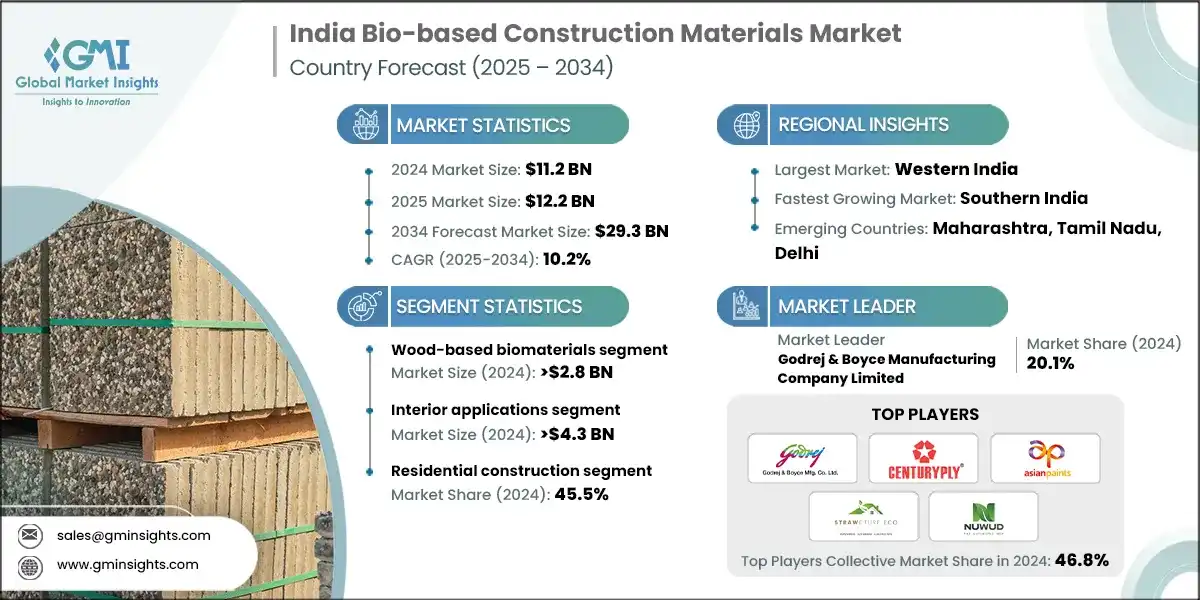
The India bio-based construction materials market was valued at USD 11.2 billion in 2024. The market is expected to grow from USD 12.2 billion in 2025 to USD 29.3 billion in 2034 at a CAGR of 10.2%, according to the latest report published by Global Market Insights Inc.
India Bio-based Construction Materials Market Key Takeaways
Market Size & Growth
- 2024 Market Size: USD 11.2 Billion
- 2025 Market Size: USD 12.2 Billion
- 2034 Forecast Market Size: USD 29.3 Billion
- CAGR (2025–2034): 10.2%
Regional Dominance
- Largest Market: Western India
- Fastest Growing Country: Southern India
Key Market Drivers
- Rising Green Building Adoption and Regulations.
- Consumer Shift Toward Eco-Friendly and Healthy Living Spaces.
- Government Housing and Infrastructure Initiatives.
Challenges
- High Cost of Bio-based Materials Compared to Conventional Options.
- Durability and Supply Chain Challenges.
Opportunity
- Utilization of Agricultural Waste for Green Building Materials.
- Circular Economy & Agricultural Waste Utilization.
Key Players
- Market Leader: Godrej & Boyce Manufacturing Company Limited led with over 20.1% market share in 2024.
- Leading Players: Top 5 players in this market include Godrej & Boyce Manufacturing Company Limited, centuryPly, Asian Paints Limited, Strawcture Eco, Nuwud Solutions, which collectively held a market share of 46.8% in 2024.
Get Market Insights & Growth Opportunities
- The Indian bio-based construction materials market indicates a high regional difference which starts with Western India with aggressive urbanization in Maharashtra and Gujarat, and heavy infrastructure development. Northern India is next pursued by Delhi-NCR and state-led green building policies and Southern India by IT-led commercial building in Bengaluru, Chennai, and Hyderabad. Eastern and Central areas, despite having comparatively lesser market shares, are experiencing consistent growth in the direction of state-sponsored affordable housing programs and rural housing programs.
- There is a high adoption of green buildings and regulatory push that is driving the demand of bio-based construction material. States like Maharashtra, Uttar Pradesh, and Gujarat are ranked as the pioneers in registering the green buildings in IGBC standards. This level of green certification means developers are now specifying sustainable materials of low-VOC coats, natural fiber insulation, certified wood/engineered biomaterials to achieve these ratings, further increasing the demand-side of bio-based construction materials directly.
- In parallel, the consumer trends are changing to healthier and more environmentally friendly living conditions. Demand and interest in natural materials, low-VOC paints, eco-adhesives, and wood/ bamboo-based interiors is growing due to the increasing concern of indoor air quality, the environmental impact of materials, and overall wellness. As an illustration, the IGBC-certified green homes are being sold as an attraction in some of the metros. IGBC has registered approximately 900 green building projects in West Bengal; government subsidies are available to developers of green buildings.
- Government housing and infrastructure projects have been an important factor in speeding the adoption of bio-based construction materials in India. Pradhan Mantri Awas Yojana has approved investments of USD 260,400 million, of which approximately USD 203, 577 million has already been used in houses built and supplied. Equally, in rural India, there are other commitments like the recent sanction of USD 22,351 million to Maharashtra in FY 202526 that underscores the ongoing attention of the government on affordable large-scale housing. To sum everything up, Maharashtra alone is engaged in investments of approximately USD 96,999 million as a sub-program of PMAY-Gramin, which makes it a leader in the development of eco-friendly rural housing.
To get key market trends
India Bio-based Construction Materials Market Trends
- The market of bio-based construction materials in India is being transformed by the growing use of prefabricated and modular construction. Prefab systems enables the assembly of manufactured components like wood panels, engineered bamboo, and natural fiber composites to be produced in controlled environments off-site, which is more precise, less wastage, and accelerates the project completion schedule. This trend is closely connected to the sustainability objectives, since the regulated production reduces the waste of raw materials and provides uniformity of green products.
- One of the biggest trends that influence the market is the move towards the use of agricultural waste and local bio-resource, including rice husk, wheat straw, and bamboo, in the construction process. This helps towards the circular economic objective by minimizing the use of virgin raw materials and minimizing the cost of imports and long-range logistics. The inter-linkage is that local sourcing does not only increase the affordability but also increases the supply chains in Tier-2 and Tier-3 cities where the housing demands are increasing.
- The regulatory compliance brings about the lowest requirement of sustainable alternatives, whereas the availability of green financing mechanisms reduces the barrier of funds that can be utilized by the builders to invest in environmentally friendly projects. Regulations and financing are interconnected since developers that use certified bio-based solutions can more conveniently access credit and receive preferential conditions of investors.
- There is an expanding range of opportunities present to the bio-based construction materials market because of the increasing popularity of digital technologies, including Building Information Modeling (BIM), traceability using blockchain technology, and digital procurement platforms. Digitalization and sustainability are closely connected: the ability of efficient supply chains to reduce carbon footprint and contribute to cost transformation. To manufacturers and developers, this means that there will be a transition to a leaner and more intelligent approach to operations, where material decisions are informed by data and data is used to optimize logistics.
India Bio-based Construction Materials Market Analysis
Learn more about the key segments shaping this market
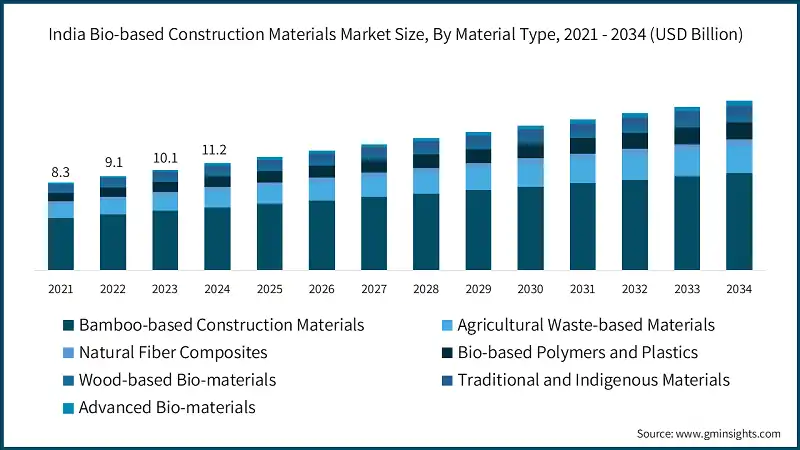
Based on material type, the market is segmented into bamboo-based construction materials, agricultural waste-based materials, natural fiber composites, bio-based polymers and plastics, wood-based biomaterials, traditional and indigenous materials, and advanced biomaterials. The wood-based biomaterials segment exceeded USD 2.8 billion in 2024.
- Wood-based Biomaterials constitute the biggest portion of the Indian bio-based construction materials market because they are widely used in the construction industry, in the form of interior fittings, flooring, and modular furniture. The increasing residential and commercial construction demand in India and more so in the metros and Tier-II cities is driving the demand towards engineered wood, plywood, MDF and laminated boards. The increase in the use of green-certified wood products (FSC-certified, low-VOC laminates) contributes to the development of this segment as well. The use of biomaterials which are made of wood is popular among builders and architects since they are more sustainable and stronger, at the same time flexible in design and with an affordable cost.
- Next Major category is Agricultural Waste-based Materials and Bamboo-based Construction Materials. Bio-based products Agricultural waste such as rice husk, bagasse, wheat straw among others is increasingly being used as sources of particle boards, bio-based panels and insulation materials, which provide cost-effective solutions to lower stubble burning and pollution. In the state of Kerala, Assam, and even in the Maharashtra, bamboo is becoming a popular choice of structural and decorative material in eco-tourism resorts, inexpensive housing and in prefabricated buildings. Its high strength to weight ratio and renewability makes it a good strategic alternative to traditional wood in places where there is plenty of bamboo.
- Advanced Biomaterials, Natural Fiber Composites, Bio-based Polymers and Plastics are the new segments with high growth potential. Natural fiber composites (jute, coir, hemp) in the form of panels, roofing, and insulation are under development, particularly in sustainable housing. Although bio-based polymers and plastics remain a niche product, they are used in flooring, wall cladding, and coatings, and this demand is on the increase as India implements a more stringent environmental policy.
Based on applications, the market is segmented into structural applications, insulation applications, interior applications, and exterior applications. The Interior applications segment crossed USD 4.3 billion in 2024.
- In India, the bio-based construction materials market is dominated by the Interior Application which takes the largest portion of this market since it is widely used in flooring, furniture, wall panels, modular kitchen, and decorative finishes. As the Indian middle-class has grown, and disposable incomes increase, the demand of environmentally friendly and stylish interiors has shot up, especially in cities such as Mumbai, Bengaluru, and the Delhi NCR. Wood-based biomaterials (plywood, MDF, laminates), bamboo composites, natural fiber board, and low-VOC paints are products that are very popular in residential and commercial projects.
- Structural and Exterior Applications have stable shares especially on infrastructure and business to business projects. Other niche structural applications include bio-based cement substitutes, bamboo reinforcement, and natural fiber composite but these are not widely adopted as they are still being questioned with durability and regulatory compliance issues. Exterior uses, including facade panels, roofing systems, and exterior paints are slowly finding a home in luxurious residential and hotel developments, as well as smart city programs.
Learn more about the key segments shaping this market
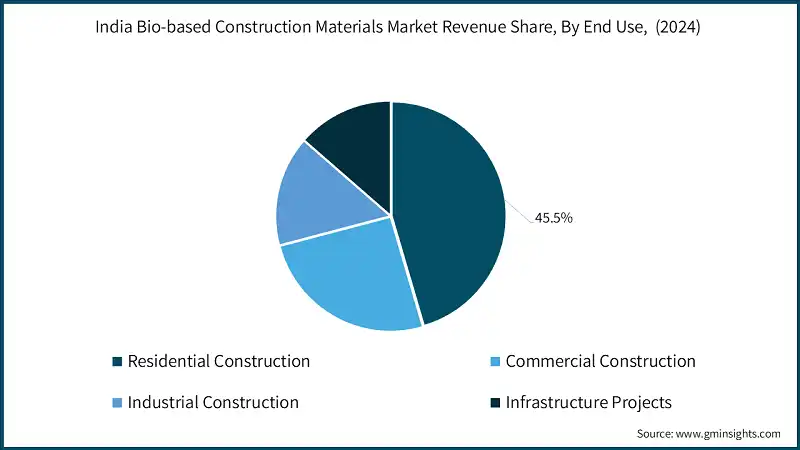
With respect to end use sector, the market is segmented into residential construction, commercial construction, industrial construction, and infrastructure projects. The residential construction dominated 45.5% share of the India bio-based construction materials market in 2024.
- The end-use market in bio-based construction materials in India is mainly dominated by Residential Construction since the segment holds the highest portion due to the huge housing demand in the country. Increase in urbanization, population and the Pradhan Mantri Awas Yojana (PMAY) and affordable housing programs, which are supported by the government, are leading to the use of environment-friendly cost-effective materials in residential projects. Flooring, furniture, wall panels, interiors and semi-urban housing tremendous applications of wood-based biomaterials, bamboo, bio-based paints and adhesives are used in urban and semi-urban apartments and semi-urban residential applications.
- Another high demand segment is Commercial Construction which is spearheaded by IT parks, office complexes, and commercial spaces in metros like Bengaluru, Hyderabad, and Gurgaon. Green buildings which promote the use of sustainable paints, adhesives and natural composites are also enhanced as developers and corporates seek to obtain IGBC and GRIHA certifications. As an example, HITEC City in Hyderabad and Whitefield in Bengaluru have deployed a large office project that incorporates eco-friendly interior products, which are being used to attract international tenants who require the buildings to meet their ESG expectations.
Looking for region specific data?
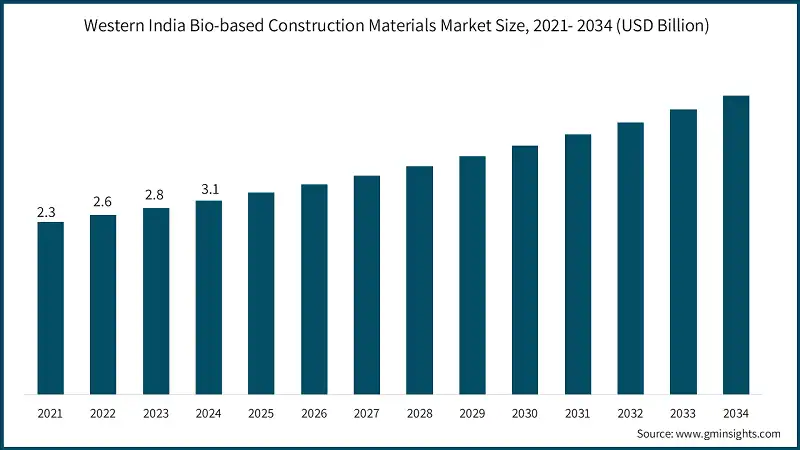
- Western India led the bio-based construction materials market with a 27.8% share with USD 3.1 billion in 2024.
- Western India, with Maharashtra and Gujarat in the lead, has a considerable market share in construction materials of bio-based origin in India. The key demand centers are Mumbai, Pune and Ahmedabad because of large scale urban housing projects, smart city initiatives and impressive industrial clusters. Maharashtra is also making its big contribution in terms of infrastructure development, especially the metro rail, real estate growth in the Pune-Mumbai belt, and commercial construction in Navi Mumbai driving the demand of sustainable building material. The proactive policies of Gujarat regarding the industries and incentives to build green and environmentally friendly constructions further increase the use of bio-based composites, bamboo products, or low carbon cement alternatives.
- The most significant growth in drivers in this region are the rapid urbanization and the government support of green building projects. GRIHA ratings and Indian Green Building Council (IGBC) are also commonly followed in Western India, especially in IT software companies like Pune and financial cities such as Mumbai as a way of attracting environmentally friendly tenants and investors. As an example, Maharashtra is among the leaders in switching to sustainable construction since it boasts more than 1,500 registered green building projects.
- The other driver of growth is the high consumer and corporate demand of environmentally friendly solutions. The real estate industry in Western metros is promoting residential and office spots with a green label with an eye toward winning the younger generation and multinational companies. Cities such as Pune and Ahmedabad are becoming centers of environmentally friendly affordable housing development, and the GIFT City project, in Gujarat also encourages the development of a sustainable infrastructure.
The bio-based construction materials market in Northern India expected to experience significant and promising growth from 2025 to 2034.
- Northern India which is a region that includes states like Delhi, Uttar Pradesh, Haryana and Punjab have a market share of approximately 25.2% of the national market of bio-based construction materials. This share is motivated by the fact that there is a lot of construction going on in the National Capital Region (NCR) especially Gurgaon, Noida and Delhi where commercial and residential projects are being undertaken on a large scale. The rapid urbanization, and the heavy investments in the infrastructure of the population, such as the expansion of the Delhi Metro or smart cities in Uttar Pradesh, has led to a high demand of materials that are sustainable and green-certified. The industrial hubs of Haryana (Gurgaon, Manesar) contribute to the increased use of bio-based materials in business complexes and IT parks as well.
- Adoption is being hastened by government initiatives and green building certifications. The penetration of projects that are certified and registered under the IGBC and GRIHA is highest in Delhi NCR, especially in corporate offices and mixed-use development projects. Policy-based demand is occurring in states such as Punjab and Haryana where energy efficient building codes and the encouragement of low carbon construction is being implemented. As an example, Chandigarh has been encouraging the use of solar-integrated, green building constructions as part of its Model Solar City initiative, which indirectly encourages the use of natural fiber insulation, bamboo-based composites, and low-volatile paints.
The bio-based construction materials market in Southeast region is expected to experience significant growth from 2025 to 2034.
- Southern India occupies almost 22.7 % of the total bio-based construction materials market housed in the country with Karnataka, Tamil Nadu, Telangana and Kerala as the main driver of growth. Bengaluru and Hyderabad are also the key demand centres owing to the fast pace of urbanization and commercial real estate development, which are driven by the IT sector. Chennai is also an ambitious industrial and port city, and this is an added push to its residential and infrastructure developments. The area enjoys the advantage of being a pioneer in green building standards - Bengaluru alone hosts more than 1,200 IGBC-registered projects (as of 2024) - which is indicative of a significant interest in corporate and institutional green building materials like bamboo composites, low-VOC paints and natural fiber insulation.
- Tamil Nadu and Karnataka have introduced the energy conservation building codes (ECBC) to persuade builders to use friendly building methods. The HITES city project of Hyderabad and the IT areas in Bengaluru frequently encourage green-certified buildings, which can be used by multinational tenants, and this encourages the multinational to use bio-based paints, adhesive materials and other energy-saving materials. Kerala, which has eco-tourism and sustainable housing projects, is increasing in the demand of bamboo-based materials and Agri-waste based materials. This local focus on climate responsible construction has turned Southern India into a center of pilot projects and widespread implementation of new bio-based solutions.
The bio-based construction materials market in Eastern India is expected to experience significant growth from 2025 to 2034.
- Eastern India has a share of approximately 14.5 % in the total market in bio-based construction materials in the country with West Bengal, Odisha, Bihar and Jharkhand leading the growth. Kolkata is still the big urban demand center, and it is backed by the residential and commercial construction projects, although Bhubaneswar and Ranchi are evolving hubs supported by the smart city projects. The infrastructure push in the region, including the Bharatmala project of building new highways and industrial corridors in Odisha and Jharkhand, is driving up construction activity and slowly prompting the use of more environmentally friendly materials, including bio-based polymers, bamboo composites and low-carbon cement.
- The availability of resources and government initiatives give it a special advantage. The powerful mining and steel sectors in Odisha and Jharkhand are facing the pressure to cut down on carbon footprints and this is increasing the number of green building materials that are being used in industrial projects. The municipal policies on redevelopment schemes in the city of Kolkata in West Bengal are encouraging the use of energy efficient housing and sustainable materials in the development of houses. Moreover, agricultural by-products that Eastern India can offer rice husk, jute (West Bengal and Bihar), are becoming valuable in insulation and fiber composite applications.
The bio-based construction materials market in Central India is expected to experience significant and promising growth from 2025 to 2034.
- Central India with Madhya Pradesh and Chhattisgarh has approximately 9.8 percent of the bio-based construction materials market in India. This zone, which is smaller in share than the western and northern region, is developing progressively as infrastructure development and affordable housing projects take off. The example is cities like Bhopal, Indore, and Raipur that are the significant demand agents, and the implementation of smart cities and the development of industries lead to the utilization of green materials. Indore, by example, has been continuously rated as the cleanest city in India in the Swachh Survekshan survey, which provides a positive atmosphere towards environmentally friendly building materials, such as bamboo building materials and natural fiber building materials.
- Government projects and the rising awareness of sustainable construction favor the development of the region. Madhya Pradesh has been proactively investing green construction guidelines in urban development especially in the smart city missions in Bhopal, Jabalpur and Indore. Frankly speaking, Raipur, the expanding industrial center of Chhattisgarh, is experiencing greater needs in industrial and infrastructure construction, which opens to bio-based materials such as low-VOC coating, adhesives, and natural fiber composite. Moreover, the fact that there is plenty of agricultural residues in both states provides bio-based insulation and composites with raw material, which mitigates cost barriers to adoption.
India Bio-based Construction Materials Market Share
The five leading firms in the Indian building materials industry are UltraTech Cement Ltd., Asian Paints Ltd., Ambuja Cements Ltd., Shree Cement Ltd and Pidilite Industries Ltd. which have a combined market share of approximately 50-55 % of the organized market share due to their extensive distribution network, brand recognition and product diversification. They reinforce their dominance through regular investments in innovation, sustainability and customer engagement.
UltraTech Cement and Ambuja Cements are also at the forefront in the cement industry with their economies of scale, modernized manufacturing plants, and expansive dealer networks, which allow them to sustain the infrastructure and home development in India. Driven by branding, innovation and consumer loyalty on the coatings side, Asian Paints and Pidilite have established a standard in the market, whereas Shree Cement is enhancing its presence in high demand markets with cost effectiveness, sustainability-based production and market expansion.
Strategic alliances, acquisitions and backward integration will continue to be the major ways through which these market leaders will be able to ensure that they have access to raw materials and they will be able to increase their margins. Green building and smart city projects are driving sustainability to the heart of competitive differentiation: firms are ramping up the production of low-VOC paints and green cement, as well as construction chemicals that are eco-friendly, to keep pace.
Small players and local manufacturers, in contrast, compete based on cost effective products or specific geographical focus with localized services. These companies tend to depend on competitive pricing and local dealer networks instead of big-time innovation. Nevertheless, niche players can still hope in the following areas: bio-based adhesives, decorative coating using natural pigments, energy saving cement products which will be needed most where environmental laws and customer preference will be the momentum.
India Bio-based Construction Materials Market Companies
Major players operating in the India bio-based construction materials industry are:
- Godrej & Boyce Manufacturing Company Limited
- centuryPly
- Asian Paints Limited
- Strawcture Eco
- Nuwud Solutions
Godrej and Boyce Manufacturing Company Ltd. is a company that has been a steady innovator in the Indian building materials industry with a vast portfolio of furniture, appliances, construction materials, and security solutions. In construction materials, the company focuses on the environmentally friendly products and energy saving technology that correlates with the objectives of green buildings and smart infrastructure in India.
CenturyPly (Century Plyboards India Ltd.) is a leading manufacturer of wood-based construction material in India, which comprises of plywood, laminates, MDF, particle boards, veneers and fibre cement boards. Established in 1986, the company has enhanced its position with the latest facilities such as the largest particle board plant in India, located in Chennai and an enormous integrated plant located in Andhra Pradesh. It controls almost 30 percent of the organized plywood market. CenturyPly focuses on green and innovation using waterproof, eco-certified and fireproof products. Supported by broad distribution network of more than 3,900trade partners.
Asian Paints Ltd. has continued to dominate the decorative paints segment in India and its portfolio comprises of interior and exterior, waterproofing and industrial paints. Brand equity, color technology innovation and entry into adjacencies such as waterproofing and decor solutions are the competitive advantages that the company has. Asian Paints is also committed to sustainability through the creation of low-VOC paint and the use of digital media to interact with customers.
Strawcture Eco is an Indian manufacturer of agricultural residues such as wheat straw, paddy straw, and sugarcane bagasse, which are used to form 100% biobased panels (AgriBioPanels). They have panels that can be used in various interior purposes such as drywall, furniture, false ceilings, flooring, and doors, with such properties as fire resistance (2-hour), moisture resistance, termite protection, and low thermal conductivity. They boast a saved cost of production (20% more) over traditional materials, and they also provide more environmentally friendly options that lessen the carbon footprint embodied within building envelopes.
Nuwud Solutions. is another company in Archit Group, which has become a force in the Indian bio-based construction materials industry with its emphasis on wood-based panels and ornamental surfaces. It focuses on the high-density, water-resistant fiber boards, laminates, MDF, and flooring solutions in the interior market segment where the durability and the look are critical elements. Supported with massive capacity growth, with a new MDF/HDHWR plant of 1,000 cubic meters per day, Nuwud has increased its manufacturing base to cater to the spiking demand in the country.
India Bio-based Construction Materials Market Report Attributes
| Key Takeaway | Details |
|---|---|
| Market Size & Growth | |
| Base Year | 2024 |
| Market Size in 2024 | USD 11.2 Billion |
| Market Size in 2025 | USD 12.2 Billion |
| Forecast Period 2025 - 2034 CAGR | 10.2% |
| Market Size in 2034 | USD 29.3 Billion |
| Key Market Trends | |
| Drivers | Impact |
| Rising Green Building Adoption and Regulations | Increases baseline demand for certified bio-based products as developers comply with IGBC/GRIHA and energy codes. |
| Consumer Shift Toward Eco-Friendly and Healthy Living Spaces | Boosts adoption of bio-based interiors and finishes, especially in urban residential and premium housing markets. |
| Government Housing and Infrastructure Initiatives | Creates large-scale demand for affordable and sustainable materials in mass housing and rural infrastructure projects. |
| Pitfalls & Challenges | Impact |
| High Cost of Bio-based Materials Compared to Conventional Options | Limits penetration in cost-sensitive projects, making bio-based materials more viable in premium or government-backed segments. |
| Durability and Supply Chain Challenges | Slows adoption for structural/exterior uses due to concerns on long-term performance, consistency, and logistics reliability. |
| Opportunities: | Impact |
| Utilization of Agricultural Waste for Green Building Materials | Transform low-value crop residues into affordable, eco-friendly building materials, reducing construction costs and promoting sustainable rural development. |
| Circular Economy & Agricultural Waste Utilization | Expands local supply chains and reduces costs, driving competitive advantage and scalability for bio-based material manufacturers. |
| Market Leaders (2024) | |
| Market Leaders |
20.1% market share |
| Top Players |
Collective market share in 2024 is 46.8% |
| Competitive Edge |
|
| Regional Insights | |
| Largest Market | Western India |
| Fastest growing market | Southern India |
| Emerging states | Maharashtra, Tamil Nadu, Delhi |
| Future outlook |
|
What are the growth opportunities in this market?
India Bio-based Construction Materials Industry News
- In June 2025, IIT Guwahati researchers created a novel bamboo composite material that used Bambusa tulda and biodegradable polymers and was strong, thermal stable, and low in moisture absorption, to be used in automotive interiors, but could have spillover into interiors and finishes in buildings.
- In May 2025, the Government of Mizoram launched several bamboo processing units in the National Bamboo Mission. These consist of Bamboo Treatment & Seasoning Plant, Bamboo Depot and godown and Activated Charcoal Unit. Investment in these units was small, yet an indication of increasing institutional support of bamboo-based bio-materials in constructions and other related industries.
- In Feb 2025, Balrampur Chini Mills Ltd (BCML) plans to establish the first industrial scale Polylactic Acid (PLA) bio-polymer production plant in Kumbhi, Uttar Pradesh. It will be 100 percent totally renewed energy powered and located near their sugar plant and have a capacity of approximately 80 000 tons annually to make 100 percent bio-based, industrially compostable PLA.
The India bio-based construction materials market research report includes in-depth coverage of the industry, with estimates & forecast in terms of revenue (USD Million) & volume (Units) from 2021 to 2034, for the following segments:
Market, By Material Type
- Bamboo-based construction materials
- Engineered bamboo products
- Bamboo fiber composites
- Bamboo plywood and panels
- Bamboo reinforcement materials
- Traditional bamboo construction materials
- Agricultural waste-based materials
- Rice husk-based materials
- Rice husk ash concrete
- Rice husk particle boards
- Rice husk insulation materials
- Wheat straw-based materials
- Wheat straw particle boards
- Wheat straw bricks and blocks
- Wheat straw insulation products
- Sugarcane bagasse-based materials
- Bagasse particle boards
- Bagasse pulp and paper products
- Bagasse-based building blocks
- Cotton stalk-based materials
- Other agricultural residue materials
- Rice husk-based materials
- Natural fiber composites
- Jute fiber composites
- Coir fiber materials
- Hemp-based construction materials
- Sisal and other plant fiber composites
- Bio-based polymers and plastics
- Bio-based polyurethanes
- Polylactic acid (PLA) materials
- Biodegradable construction plastics
- Bio-based adhesives and binders
- Wood-based bio-materials
- Engineered wood products
- Wood fiber composites
- Reclaimed and recycled wood products
- Plantation wood materials
- Traditional and indigenous materials
- Mud and clay-based materials
- Lime-based construction materials
- Stone and aggregate alternatives
- Bio-based coatings and finishes
- Advanced bio-materials
- Mycelium-based materials
- Algae-based construction materials
- Bacterial cellulose materials
- Protein-based materials
Market, By Application
- Structural applications
- Load-bearing elements and frameworks
- Foundation systems and ground works
- Roofing systems and structures
- Wall systems and panels
- Flooring and decking materials
- Insulation applications
- Thermal insulation systems
- Acoustic insulation materials
- Moisture and weather protection
- Multi-functional insulation solutions
- Interior applications
- Interior wall coverings and panels
- Ceiling systems and components
- Interior fittings and fixtures
- Furniture and built-in elements
- Decorative and finishing materials
- Exterior applications
- Facade systems and cladding
- External weather protection
- Landscaping and outdoor applications
- Infrastructure and civil works
Market, By End Use Sector
- Residential construction
- Individual houses and villas
- Apartment buildings and housing complexes
- Affordable housing and government schemes
- Rural housing and village development
- Slum rehabilitation and urban renewal
- Commercial construction
- Office buildings and business centers
- Retail and shopping centers
- Hotels and hospitality facilities
- Educational institutions and schools
- Healthcare facilities and hospitals
- Industrial construction
- Manufacturing facilities and factories
- Warehouses and storage facilities
- Agricultural processing plants
- Specialized industrial structures
- Infrastructure projects
- Transportation infrastructure
- Utilities and energy infrastructure
- Public buildings and government facilities
- Smart cities
- Rural infrastructure
The above information is provided for the following regions and countries:
- India
- North India
- Delhi NCR
- Punjab
- Haryana
- Rajasthan
- Uttar Pradesh
- West India
- Maharashtra
- Gujarat
- Goa
- South India
- Karnataka
- Tamil Nadu
- Andhra Pradesh
- Telangana
- Kerala
- East India
- West Bengal
- Odisha
- Northeast States
- Central India
- Madhya Pradesh
- Chhattisgarh
- North India
Frequently Asked Question(FAQ) :
What is the market size of the India bio-based construction materials in 2024?
The market size was USD 11.2 billion in 2024, with a CAGR of 10.2% expected through 2034 driven by rapid urbanization in Maharashtra, Gujarat, and strong infrastructure development in Western India.
What is the projected value of the India bio-based construction materials market by 2034?
The India bio-based construction materials market is expected to reach USD 29.3 billion by 2034, propelled by rising green building adoption, government housing initiatives, and consumer shift toward eco-friendly living spaces.
What is the current India bio-based construction materials market size in 2025?
The market size is projected to reach USD 12.2 billion in 2025.
How much revenue did the wood-based biomaterials segment generate in 2024?
Wood-based biomaterials generated USD 2.8 billion in 2024, leading the material type segment due to widespread use in interior fittings, flooring, and modular furniture.
What was the valuation of interior applications segment in 2024?
Interior applications held the largest share and generated USD 4.3 billion in 2024, supported by demand for eco-friendly flooring, furniture, wall panels, and decorative finishes.
What was the market share of residential construction in 2024?
Residential construction dominated with 45.5% market share in 2024, expected to continue strong growth due to urbanization, government housing schemes like PMAY, and increasing demand for sustainable materials.
Which region leads the India bio-based construction materials market?
Western India held 27.8% share with USD 3.1 billion in 2024. Maharashtra and Gujarat's aggressive urbanization, smart city initiatives, and green building certifications fuel the region's dominance.
What are the upcoming trends in the India bio-based construction materials market?
Key trends include prefabricated construction, use of agri-waste materials, regulatory push for sustainability, and digital tools like BIM and blockchain for supply chain efficiency.
Who are the key players in the India bio-based construction materials market?
Key players include UltraTech Cement Limited, ACC Limited, Ambuja Cements Limited, Shree Cement Limited, JSW Steel Limited, Godrej & Boyce Manufacturing Company Limited, Kajaria Ceramics Limited, Somany Ceramics Limited, Asian Paints Limited, Strawcture Eco, Nuwud Solutions, and centuryPly.
India Bio-based Construction Materials Market Scope
Related Reports