Summary
Table of Content

Inboard Boat Engine Market
Get a free sample of this report
Form submitted successfully!
Error submitting form. Please try again.
Thank you!
Your inquiry has been received. Our team will reach out to you with the required details via email. To ensure that you don't miss their response, kindly remember to check your spam folder as well!
Request Sectional Data
Thank you!
Your inquiry has been received. Our team will reach out to you with the required details via email. To ensure that you don't miss their response, kindly remember to check your spam folder as well!
Form submitted successfully!
Error submitting form. Please try again.
Inboard Boat Engine Market Size
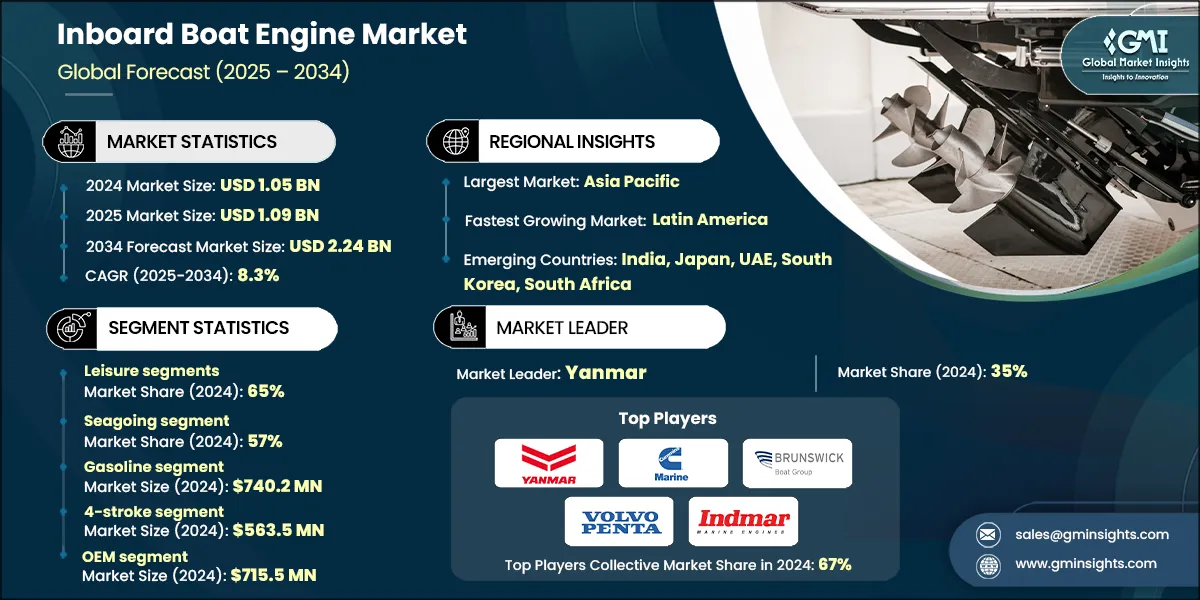
The global inboard boat engine market size was estimated at USD 1.05 billion in 2024. The market is expected to grow from USD 1.09 billion in 2025 to USD 2.24 billion in 2034, at a CAGR of 8.3% according to latest report published by Global Market Insights Inc.
Inboard Boat Engine Market Key Takeaways
Market Size & Growth
- 2024 Market Size: USD 1.05 Billion
- 2025 Market Size: USD 1.09 Billion
- 2034 Forecast Market Size: USD 2.24 Billion
- CAGR (2025–2034): 8.3%
Regional Dominance
- Largest Market: Asia Pacific
- Fastest Growing Region: Latin America
Key Market Drivers
- Increasing recreational boating activities.
- Rising Production and Sales of Yachts.
- Growth in Commercial Maritime Operations.
- Growing tourism industry.
Challenges
- High Initial Cost.
- Maintenance & Operational Activities.
Opportunity
- Growth Catalyst and Market Accelerators.
- Seasonal Demand Patterns and Cyclical Trends.
Key Players
- Market Leader: Yanmar led with over 35% market share in 2024.
- Leading Players: Top 5 players in this market include Yanmar, Cummins Marine, Brunswick, Volvo Penta, Indmar, which collectively held a market share of 67% in 2024.
Get Market Insights & Growth Opportunities
The inboard boat engine market is experiencing consistent growth due to demand for recreational boating, premium watercraft, and marine tourism activities in various countries. Increased interest in high-performance engines that have improved torque, efficiency, and lower emissions is prompting manufacturers to pursue advanced propulsion technologies with fuel-injected engines or hybrid powertrains. Demand for inboard engines is increasing due to emerging trends such as the use of inboard engines in wake sports, a growing luxury yacht market, and patrol boats, in a consistent fleet renewal cycle with rising incomes in many developed and developing economies.
The overall growth in recreational boating worldwide is a growth drive for the inboard engines market base. Participation is at an all-time high; for example, in 2021, more than 47 million Americans participated in motorized boating, approximately 16% of the population greater than six years of age, resulting in $230 billion in economic benefits to the US economy projected for 2023, an increase of 36% from 2018. Increased participation directly drives demand for new boats, repowered engines, and aftermarket services. This trend is not exclusive to those with higher incomes; however, higher-income households are likely to purchase large boats with inboard engines while participation is expanding across an age and income spectrum.
At the start of 2020, the COVID-19 pandemic caused complete shock to the in-board boat engine market, as lockdowns, travel restrictions, and the closure of marinas reduced both consumer demand and manufacturing. Based on surveys from the National Marine Manufacturers Association (NMMA), of priced and motorized boat builders, 81% reported a decline in business during Q1 2020, with 54% of those reporting moderate to severe declines in sales and 15% permanently closing their facility. However, the pandemic also created a somewhat contradictory effect: because travel was restricted and outdoor leisure pursuits became more popular, some categories of recreational boating gained ground.
North America is where the most advanced market in marine inboard engines is located, with the market including the U.S. recreational boating market growing in 2021 to $56.7 billion with 218,868 new powerboat units sold and where the experience-based market really shows its strength in high-performance recreational uses and many commercial marine applications (nmma.org). North America is recognized globally for being first in technology adoption for recreational use. Engine manufacturers like Mercury Marine, Indmar, and PCM are designing engines specific to high-performance engines with value on superior performance characteristics, a high degree of digital integration, and robust service support networks.
Europe has become the global benchmark for environmental marine engine technology and related regulations, with the Blue Economy generating €623.6 billion in turnover, employing 3.59 million people, while embarking on the most robust and aggressive strategies in the world to adopt electric, hybrid, and alternative fuel propulsion systems. The region's position as the global benchmark is fostered by engine manufacturers like MAN Energy Solutions, Wärtsilä, and Volvo Penta, who led the global development of dual-fuel engines, digitalization technologies, and other sustainable propulsion systems, all supported by marina electrification initiatives and government policies that promote marine transportation with zero emissions.
To get key market trends
Inboard Boat Engine Market Trends
The commercial maritime sector worldwide is on the rise, due mostly to increasing trade volumes, fleet renewal, and the demand for more efficient and compliant propulsion systems. Seaborne trade is expected to grow by 2.4% annually compound through 2029, and containerized trade is expected to increase by 2.7% annually compound. The expected growth is being driven by symptoms of continued demand for bulk commodities, energy products, and containerized trade, infrastructure investment, and technological upgrades with ports and shipping fleets.
The regulatory / policy environment is a critical accelerant to market growth, especially with more stringent emissions allowances and standards, prompting the elimination and/or upgrading of older engines. The regulatory environment is creating a narrow and stable market for compliant inboard propulsion systems, especially in newly designated Emission Control Areas.
Marine and coastal tourism serve as a strong engine for demand in recreational boats, yachts, and related inboard engines. According to a 2022 report from the EU, coastal tourism generated €82 billion in GVA and employed 2.56 million people, and 2023 was a record year for coastal regions with over 1.4 billion tourist nights. The U.S. ocean-based tourism and recreation sector contributes $143 billion to the nation's GDP and employs 2.5 million workers. Post-pandemic recovery is continuing, fueled by demand for travel and outdoor pursuits, resulting in increased charter activity, marina visits, and boat rentals.
Another characteristic of the inboard engine’s market is its seasonality, with relatively high demand on new installations as well as maintenance and repair services for the aftermarket during the boating season, which runs from approximately May–October in the Northern Hemisphere. Data from various locations suggest that spring commissioning and fall winterization drive peaks in engine use, repair and replacement.
The replacement and retrofit product markets will be a significant opportunity driven by age and regulatory requirements. In the U.S., used boat retail sales reached over 1 million units, and repowering engines are considered a more viable option than purchasing new vessels to lower costs and minimize regulatory compliance. For commercial operators, retrofits to meet Tier 4 or zero-emission standards are often more cost-effective than new builds, especially for workboats, ferries, and fishing vessels operating in regulated waters.
Cyclical trends are also affected by macroeconomic conditions, weather events, and regulatory changes. Economic downturns, for instance, may push purchases into the future and lead to greater aftermarket activity, but when the economy is strong, company purchases are likely to be greater than new vessels or repowers. Weather events may cause fast fluctuations in demand for repair or replacement services. Suppliers and service providers must have an awareness and prepare for these seasonal and cyclical tendencies to optimize inventory/stock, staffing, and marketing initiatives.
Inboard Boat Engine Market Analysis
Learn more about the key segments shaping this market
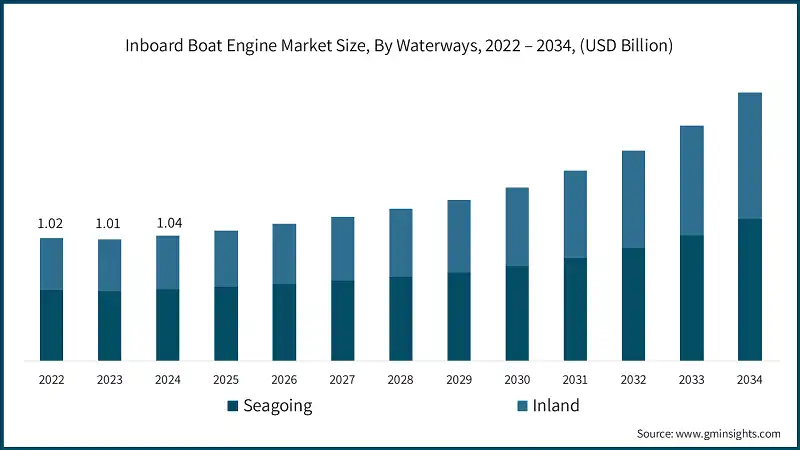
Based on waterways, the inboard boat engine market is divided into seagoing and inland. Seagoing segment dominated the market accounting for around 57% share in 2024 and is expected to grow at a CAGR of 7.5% from 2025 to 2034.
- Seagoing inboard engine applications have the broadest range of vessel types and operational requirements from high-speed recreational craft to giant commercial vessels all requiring unique engine characteristics that are optimized for not only saltwater operation but also longer-than-average trip durations and adherence to international maritime regulations.
- Commercial seagoing applications constitute the largest segment (by total market value) in this area with nearly 102,899 ships making up the global merchant fleet. Most of the market demand is expected to be focused on engines that range from ~1,000 kW to over 20,000 kW emphasizing conservation for least cost, reliability, and adherence to International Maritime Organization (IMO)-declared regulations regarding limits on NOx emissions, sulfur content, and potential emissions reductions for greenhouse gases.
- Inland waterway inboard engine applications operate in entirely different environments than seagoing applications, having freshwater operation, shorter trips, and being located closer to populated areas which creates an entirely different set of operational requirements as well as different regulatory regimes that favor different engine technologies and characteristics.
Learn more about the key segments shaping this market
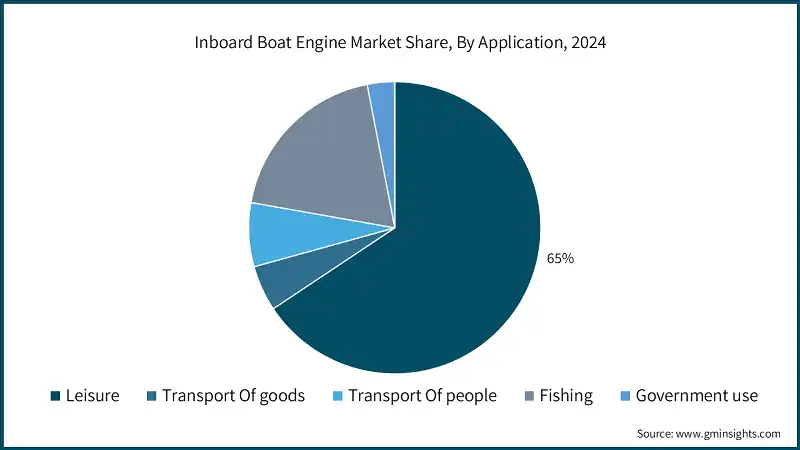
Based on applications, the inboard boat engine market is categorized into leisure, transport of goods, transport of people, fishing, and government use. Leisure segments dominate the market with 65% share in 2024, and the segment is expected to grow at a CAGR of 8% between 2025 and 2034.
- The inland leisure segment is a rapidly growing segment of the inboard marine engines market that involves different leisure activities on rivers, lakes, and canals. Engines that are designed for shallow water operation, viability for the environment and connectivity to recreational vessel systems are needed in the inland leisure segment. The inland leisure segment supports innovation in propulsion technologies that are more environmentally friendly than combustion propulsion systems.
- In September of 2024, Vision Marine Technologies Inc., a leader in electric marine propulsion, is excited to unveil its game-changing E-Motion 180e Inboard electric motor system, which provides 180hp continuously at the propeller. This electric system captures an imperative segment of the market for Vision Marine and expands the number of boats that can take advantage of Vision Marine's electric propulsion technology.
- Inland fishing applications consist of commercial and recreational fishing activities on rivers, lakes, and inland water bodies using specialized inboard engines optimized for shallow water operation, fuel economy, and compliance with freshwater environments. Inland commercial fishing operations typically utilize smaller engines relative to seagoing commercial fishing vessels, as power requirements range from 50 kw to 500 kw depending on the size of the vessel, fishing methods, and operational environments.
Based on propulsion, the market is divided into gasoline, diesel, and electric. Gasoline segment dominates the market and was valued at USD 740.2 million in 2024.
- The gasoline segment of the inboard boat engine market continues to show steady but not spectacular growth, for the most part relying on leisure and smaller commercial craft where ease of use and cost are the priority. Although not the fastest segment, gasoline persists because most boat owners still prefer the familiar fuel station infrastructure, lighter engine weight versus diesel, and simpler maintenance ways of gas engines.
- Manufacturers are addressed by introducing gasoline inboards with better combustion, direct fuel injection, better efficiencies and lower emissions. For example, PCM introduced its ZZ8R and ZZ8S supercharged gasoline inboard motors (570 hp & 630 hp) with ratings to run off REC-90 regular ethanol-free gasoline compared to premium octane fuel.
- Electric inboard propulsion is the bright spot for growth. The inboard electric engine sub-market is growing faster than gasoline or diesel inboards, driven without hesitation from the move to zero emissions, regulatory pressure and greater acceptance from recreational boaters. We see electric inboard motors capturing an increasing share of new pleasure craft launches, especially in inland and lake-based applications.
Based on Engine, the market is divided into 2-stroke, 4-stroke, and electric. 4-stroke segment dominates the market and was valued at USD 563.5 million in 2024.
- The inboard boat engine market for four-stroke internal combustion engines is seeing moderate and consistent growth resulting from improved efficiencies, emissions regulations, and retrofits. For example, "marine 4-stroke engines" are predicted to have a CAGR of around 8.3% from 2025 to 2035.
- Four-stroke inboard engines are available with advanced fuel-injections, electronic engine management, turbocharging, digital diagnostics, and emissions control packages. For example, product examples "Series 4 Stroke Inboard Diesel Marine Propulsion Engine 125-205 kW" illustrate higher power and higher efficiency, and compliance with emissions regulations.
- The electric inboard propulsion category, by contrast, is the fastest-growing category and rapid expansion due to emissions mandates becoming stricter, especially in inland waterways, and technological advances in battery efficiency and power management. Companies like ePropulsion and Torqeedo are leading this transition with high-performance models ePropulsion I-Series (10 - 40 kW) and Torqeedo Deep Blue inboards that can achieve zero-emission propulsion, silent operation, and modular integration for recreational and commercial fleets.
Based on sales channel, the market is divided into OEM and Aftermarket. OEM segment dominates the market and were valued at USD 715.5 million in 2024.
- The original equipment manufacturer (OEM) segment remains at the forefront of the inboard boat engine market, fueled by flourishing collaboration between boatbuilders and engine manufacturers, with both groups emphasizing efficiency, performance, and regulated compliance for each new boat hull. Significant contributors are also investing in research and development collaborations with naval engineers to ensure recent engine models are built to maximize hull design, load factors, and hydrodynamic efficiency. These developments ultimately lock the OEM channel into a leading position in the industry, unmatched by any aftermarket.
- For example, Correct Craft made headlines in November 2022 by acquiring Indmar Marine Engines, which further solidifies its OEM channel position across several inboard engine brands. Indmar will now operate under Correct Craft’s subsidiary Liberty Technologies, which also owns PCM Engines, Crusader Engines, Levitator Engines, and Velvet Drive Transmissions.
- The aftermarket channel includes replacement engines, upgrades and retrofits, spare parts, service, and repairs for the existing fleet. The aftermarket channel is becoming increasingly important, as fleets age, emissions rules tighten, and owners want improved performance or digitized monitoring. The aftermarket channel is growing because clients utilize online parts sales, diagnostics from afar, and retrofit electric propulsion kits.
Looking for region specific data?
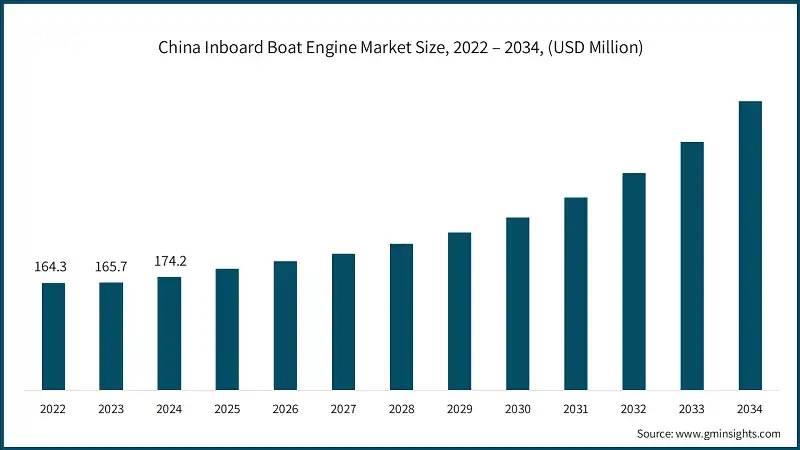
The China dominated Asia-Pacific inboard boat engine market with revenue of USD 174.2 million in 2024.
- Asia-Pacific dominates the market with 32.5% share and the highest growth rate at 9.1% between 2025 and 2034. The region led by China, South Korea, and Japan is the uncontested global production center for marine engines, specifically inboard propulsion units making up over 90% of all new vessel deliveries and a very notable share of inboard engine production.
- The growth in this region is being driven by China, and it holds a market share of over 51% in the Asia Pacific region. China has emerged as a significant OEM integration hub providing propulsion systems for both the domestic and export markets. Demand is further supported through fleet growth, construction activity, and strong demand pipelines, with 316 yachts over 30 meters delivering in 2025, all contributing to continued demand for factory-installed engines.
- Australia is experiencing significant growth as well, primarily due to its leading role in superyacht ownership and construction in the Asia-Pacific region. Australia has 146 superyachts, the most in the region, which demonstrates the strength of domestic demand for factory-installed engines. This growth is supported through construction activity, with 691 superyachts over 30 meters under construction across APAC in 2024, and 228 completions recorded, the highest since 2008.
US inboard boat engine market will grow tremendously with CAGR of 8.7% between 2025 and 2034.
- North America comprises 29.8% of the market value. The North America market is strong in high-performance recreational applications, commercial fishing, offshore energy support, and specialized marine applications with advanced propulsion and service support networks. The U.S. recreational boating market created $56.7 billion of economic impact in 2021, selling 218,868 new powerboat units that further support demand for inboard propulsion systems across all power and fuel categories.
- Similarly, the inboard market in Canada is growing, supported by a strong recreational boating culture, and by a vast freshwater network. Approximately 1.3–1.5 million boats are registered in the provinces, and inboard boats make up about 20–22% of the total craft population. The boating participation rate is approximately 45% of the adult population, with around 32 boats for every thousand people. The country has around 3,000 marinas, with significant facilities-related services.
The inboard boat engine market in Italy will experience robust growth during 2025-2034.
- Europe holds a 30% share of market in 2024. Italy remains a leading European hub for inboard propulsion, supported by a very long coastline, and a strong luxury boating culture. There are approximately 500,000 recreational boats registered with inboard engines accounting for 40-45% of the total. Leisure boating participation is about 18-20% of the adult population. There are over 1,200 marinas, and average occupancy is around 90% in summer months.
- The inboard market in Sweden is characterized by advanced technology and a preference for sustainable boating. Approximately 950,000 of boats are registered in Sweden, which is among the highest number of boats per capita in the world, with inboard boats comprising 28–30% of that total. It has a boat ownership rate of 90 boats for every 1,000 inhabitants, which means nearly 35% of adults participate in recreational boating. Germany also has an extensive network of inland waterways and good engineering standards. Germany has an estimated of 420,000 boats, with inboard boats at a registration rate of between 32–35%.
The inboard boat engine market in Brazil will experience significant growth between 2025 & 2034.
- Latin America holds a 3% share of market in 2024. Brazil is the leading inboard market in Latin America because of a favorable number of waterways and a developing marine tourism base. The country has an estimated boat pool of about 750,000 boats with inboards at 28–30%. Estimates show about 10-12% of adults participate in boating while domestic production of engines is about 65% of the total. The amount of electrification is small (1-2%) but modernization efforts are starting to improve electrification and efficiency.
- Argentina’s inboard market benefits from inland connectivity and domestic boatbuilding. About 300,000 boats are active, with inboard share of around 25%. Leisure participation stands near 8–9% of adults, concentrated in the Paraná River basin. Imports fulfill 60% of engine demand inboard, and electrification is below 2% but is gaining momentum. Average power output is 220–260 HP, and engine lifespan averages 10 years.
The inboard boat engine market in UAE is expected to experience robust growth between 2025 & 2034.
- In 2024, the MEA market generated a revenue of USD 44.9 million, with expectations to grow at a compound annual growth rate (CAGR) of 7.7% from 2025 to 2034. The Middle East & Africa (MEA) inboard engine market is strongly influenced by regional fleet characteristics, which are dominated by non-motorized or small-scale vessels, particularly in Africa.
- According to FAO 2022 data, Africa holds 19% of the global fishing fleet, the second-largest share after Asia, but most vessels are non-motorized, indicating limited penetration of inboard engines. However, the region shows pockets of high-value opportunities in the Gulf and North Africa, where commercial fishing, leisure, and transport vessels are increasingly adopting modern propulsion systems to improve efficiency, performance, and regulatory compliance.
- In the Gulf Cooperation Council (GCC) countries, vessel ownership is concentrated in the UAE and Saudi Arabia, where modern fleets demand high-quality inboard engines. UNCTAD statistics for 2023–2024 indicate UAE owns 1,427 vessels totaling 51.2M dwt (almost entirely foreign-flagged) and Saudi Arabia owns 300 vessels totaling 16.6M dwt, reflecting opportunities for OEM-installed engines in new commercial, leisure, and offshore vessels.
Inboard Boat Engine Market Share
The top 7 companies in the market are Cummins Marine, Yanmar, Brunswick, Volvo Penta, Pleasurecraft, Indmar, and PCM Engines. These companies hold around 60% of the market share in 2024.
- Yanmar has established itself as one of the premier manufacturers of marine diesel engines globally, with over 110 years of engineering expertise and a portfolio that includes small 8.5 kW recreational engines and large commercial solutions of more than 1,000 kW for a variety of marine applications worldwide. Yanmar’s manufacturing footprint is comprised of facilities located in Japan, Europe, and the Americas.
- Volvo Penta is a subsidiary of the Volvo Group that produces advanced marine propulsion systems and has also been innovating for over 100 years. Volvo Penta manufactures complete inboard marine systems ranging from 75 kW oriented recreational gasoline engines to over 1,000 kW commercial diesel systems. Volvo Penta’s manufacturing facilities are in Sweden, the United States, and Brazil, and uses a distributor network to provide service and support with parts in over 130 countries.
- Cummins Marine is a division of Cummins Inc. and manufacturers marine propulsion which range from recreational diesel engines of 150 kW to commercial diesel solutions over 4,000 kW. The marine portfolio benefits from Cummins leadership position manufacturing commercial engines with high-pressure common rail fuel injection, variable geometry turbocharging, SCR aftertreatment and electronic control systems which optimize performance while meeting EPA Tier 3, IMO Tier III, and emerging green-house gas standards.
- Brunswick is one of the largest manufacturers of marine engines in the world, with its Mercury Marine division producing both gasoline and diesel inboard engines from 200 HP for recreational use to more than 1,000 HP for high-performance applications. Brunswick has manufacturing sites in the U.S., Mexico, and Belgium with a robust network of dealers that provide service to more than 100 countries.
- Indmar Marine Engines is the largest manufacturer of gasoline-powered marine engines in the world for watersports applications. Indmar has been an expert in high-performance inboard systems for wakeboard, wakesurf, and ski boats for over 50 years. Indmar's series of engines are built for outstanding low-end torque and smooth throttle response, as well as integration with various specialized propulsion systems that include some wake-enhancing technologies.
- PCM specializes in high-performance gasoline marine engines for recreational and light commercial applications. PCM has built over 50 years of engineering experience in producing marine engines. Their family of engines include naturally aspirated and supercharged configurations that vary from 300 HP to more than 600 HP. The engines utilize electronic fuel injection, engine management systems, and marine-focused cooling and exhaust systems.
Inboard Boat Engine Market Companies
Major players operating in the inboard boat engine industry include:
- Brunswick
- Chris-Craft
- Cummins Marine
- Indmar
- PCM Engines
- Perkins Marine
- Pleasurecraft
- Volvo Penta
- Yanmar
- The inboard boat engines market is characterized by significant consolidation in which limited players take control of most sales. For example, Cummins Marine has established a substantial foothold in the commercial segment and high-performance recreational segments, using its reputation for reliability, durability, and wide-ranging service networks to its advantage.
- The organization’s engines are prominent in ferries, workboats, and offshore vessels, and have a strong market position especially in North America and Asia Pacific. Cummins’ ongoing research and commercialization of hybrid and lower emission propulsion technology also provides an advantage in today’s increasingly regulated market.
- Yanmar and Volvo Penta are the dominant players in the OEMs for the leisure vessels and mid-sized commercial segments, providing compact, fuel-efficient 4-stroke and diesel inboard engines. Yanmar supports a solid market share with a global presence, solid dealer networks, and offers a range of engines specific to yachts, commercial vessels, and fishing boats, particularly in Asia Pacific.
- Volvo Penta has continued to be a leader within the OEMs in Europe and North America by continuing to leverage integrated propulsion solutions and collaboration with yacht and boat builders. Both Yanmar and Volvo Penta benefit from continued investment in innovative technologies including hybrid-engine options and digitally monitored engines, which both support a premium price position and brand loyalty among users.
- Brunswick, Pleasurecraft, Indmar, and PCM Engines mainly cater to the upscale recreational and watersports markets. These companies occupy a more modest, but nevertheless strategically meaningful, share of the market based on performance engines for luxury yachts, performance boats, and aftermarket alternatives. For instance, Indmar and PCM Engines, which are now part of Liberty Technologies, benefit from vertical integration with OEMs and boatbuilders that allow them to establish long-term supply agreements.
- Pleasurecraft and Brunswick benefit from brand recognition in North America that permits them to maintain their leadership position in the leisure inboard category. Together, these companies offset the market share of Cummins, Yanmar, and Volvo Penta and form a market structure in which a few global leaders control volume while niche businesses serve the high-margin space.
Inboard Boat Engine Market Report Attributes
| Key Takeaway | Details |
|---|---|
| Market Size & Growth | |
| Base Year | 2024 |
| Market Size in 2024 | USD 1.05 Billion |
| Market Size in 2025 | USD 1.09 Billion |
| Forecast Period 2025 - 2034 CAGR | 8.3% |
| Market Size in 2034 | USD 2.24 Billion |
| Key Market Trends | |
| Drivers | Impact |
| Increasing recreational boating activities | The global surge in recreational boating is a foundational growth engine for the inboard engines market. |
| Rising Production and Sales of Yachts | Yacht production and sales, particularly in the luxury and superyacht segments, are experiencing a sustained boom. |
| Growth in Commercial Maritime Operations | Global commercial maritime operations are on an upward trajectory, driven by expanding trade volumes, fleet renewal, and the need for more efficient and compliant propulsion. |
| Growing tourism industry | Marine and coastal tourism is a powerful engine of demand for recreational boats, yachts, and associated inboard engines. |
| Pitfalls & Challenges | Impact |
| High Initial Cost | The high upfront cost of inboard engines, especially for diesel and hybrid/electric propulsion, remains a substantial barrier to adoption for recreational and commercial buyers. |
| Maintenance & Operational Activities | Inboard engines, especially those installed in larger vessels, present higher maintenance and operational complexity compared to outboards. |
| Opportunities: | Impact |
| Growth Catalyst and Market Accelerators | Technological innovation and regulatory incentives are powerful accelerators for the inboard engines market |
| Seasonal Demand Patterns and Cyclical Trends | Seasonality is a defining feature of the inboard engines market, with pronounced peaks in demand for new installations, maintenance, and after-market services. |
| Market Leaders (2024) | |
| Market Leaders |
35% market share |
| Top Players |
Collective market share in 2024 is 67% |
| Competitive Edge |
|
| Regional Insights | |
| Largest Market | Asia Pacific |
| Fastest growing market | Latin America |
| Emerging countries | India, Japan, UAE, South Korea, South Africa |
| Future outlook |
|
What are the growth opportunities in this market?
Inboard Boat Engine Industry News
- In September 2025, Brunswick announced plans to consolidate its global fiberglass boat manufacturing business. The plan is to provide lower fixed costs, implement more efficient operational practices, and improve productivity, while maintaining adequate capacity and flexibility to support future growth in the market.
- In May 2025, Malibu Boats, the top global seller of wakeboats, renewed their long-standing alliance with General Motors, designating Chevy as the official vehicle brand for Malibu Boats. This continued partnership reinforces Malibu Boats commitment to technological advancement and product quality, all while furthering GM Marine’s position in the integrated propulsion category.
- In September 2024, Rolls-Royce entered into a partnership agreement with the Azimut Benetti Group to equip Azimut’s Grande series yachts with MTU propulsion systems. The relationships will enhance the system to include hybrid propulsion technologies that will provide improved fuel economy and maneuverability.
- In March 2023, Ferretti has acquired a new production site of over 70,000 square meters, given it has a dry dock facility in San Vitale, Ravenna. As part of Ferretti's intention to strengthen its production capability, facilitate higher-output levels, and sustain the increasing global demand for luxury yacht supply, the new acquisition highlights the continued trend of investment activity in production infrastructure across the marine industry.
The inboard boat engine market research report includes in-depth coverage of the industry with estimates & forecasts in terms of revenue ($Mn) & Volume (Units) from 2021 to 2034, for the following segments:
Market, By Waterways
- Seagoing
- Inland
Market, By Propulsion
- Gasoline
- Diesel
- Electric
Market, By Application
- Leisure
- Transport of goods
- Transport of people
- Fishing
- Government use
Market, By Engine
- 2-stroke
- 4-stroke
- Electric
Market, By Power
- Low
- Mid
- High
Market, By Ignition
- Electric
- Manual
Market, By Sales Channel
- OEM
- Aftermarket
The above information is provided for the following regions and countries:
- North America
- US
- Canada
- Europe
- UK
- Germany
- France
- Italy
- Spain
- Russia
- Belgium
- Netherlands
- Sweden
- Asia Pacific
- China
- India
- Japan
- Australia
- Singapore
- South Korea
- Vietnam
- Indonesia
- Latin America
- Brazil
- Mexico
- Argentina
- MEA
- South Africa
- Saudi Arabia
- UAE
Frequently Asked Question(FAQ) :
What is the market size of the inboard boat engine in 2024?
The market size was estimated at USD 1.05 billion in 2024, with a CAGR of 8.3% expected through 2034. The growth is driven by increasing demand for recreational boating, premium watercraft, and marine tourism activities.
What is the projected value of the inboard boat engine market by 2034?
The market is poised to reach USD 2.24 billion by 2034, fueled by advancements in propulsion technologies, rising incomes, and growing interest in high-performance engines.
What is the expected size of the inboard boat engine industry in 2025?
The market size is projected to reach USD 1.09 billion in 2025.
How much revenue did the gasoline segment generate in 2024?
The gasoline segment generated approximately USD 740.2 million in 2024, due to its ease of use, lighter engine weight, and simpler maintenance compared to diesel engines.
What was the market share of the seagoing segment in 2024?
The seagoing segment accounted for around 57% of the market share in 2024 and is expected to witness over 7.5% CAGR till 2034.
What is the growth outlook for the leisure segment?
The leisure segment, which held a 65% market share in 2024, is set to expand at a CAGR of 8% between 2025 and 2034.
Which region leads the inboard boat engine sector?
Asia-Pacific leads the market with a 32.5% share in 2024 and the highest growth rate of 9.1% through 2034.
What are the upcoming trends in the inboard boat engine market?
Trends include the adoption of hybrid powertrains, increased use of inboard engines in wake sports, fleet renewals driven by regulatory compliance, and rising demand for retrofitting and replacement engines to meet emission standards.
Who are the key players in the inboard boat engine industry?
Key players include Brunswick, Chris-Craft, Cummins Marine, Indmar, PCM Engines, Perkins Marine, Pleasurecraft, Volvo Penta, and Yanmar.
Inboard Boat Engine Market Scope
Related Reports