Summary
Table of Content

Impact Sound Insulation Acoustic Mat Market
Get a free sample of this report
Form submitted successfully!
Error submitting form. Please try again.
Thank you!
Your inquiry has been received. Our team will reach out to you with the required details via email. To ensure that you don't miss their response, kindly remember to check your spam folder as well!
Request Sectional Data
Thank you!
Your inquiry has been received. Our team will reach out to you with the required details via email. To ensure that you don't miss their response, kindly remember to check your spam folder as well!
Form submitted successfully!
Error submitting form. Please try again.
Impact Sound Insulation Acoustic Mat Market Size
As cities and regions implement stricter building codes focused on acoustical performance, there is a rising expectation among end users for quieter living and working environments. This shift has compelled developers, contractors, and floor covering installers to prioritize products that effectively address impact sound issues. Impact sound insulation mats have emerged as a critical solution in this context. These mats not only enable construction teams to comply with legal acoustical performance standards but also provide substantial improvements in reducing floor noise. Their ability to enhance sound insulation has made them an essential component in modern construction practices, aligning with the growing demand for improved acoustic comfort in residential and commercial spaces.
Impact Sound Insulation Acoustic Mat Market Key Takeaways
Market Size & Growth
- 2025 Market Size: USD 4.3 Billion
- 2026 Market Size: USD 4.5 Billion
- 2035 Forecast Market Size: USD 7.7 Billion
- CAGR (2026–2035): 6%
Regional Dominance
- Largest Market: Asia Pacific
- Fastest Growing Region: Asia Pacific
Key Market Drivers
- Stringent building acoustic standards.
- Growth of renovation and retrofitting projects.
- Technological advancements in materials.
Challenges
- High product and installation costs.
- Performance variability across materials.
Opportunity
- Expansion of sustainable & green construction.
- Integration with smart building technologies.
Key Players
- Market Leader: Saint-Gobain led with over 9% market share in 2025.
- Leading Players: Top 5 players in this market include Saint-Gobain, Owens Corning, Rockwool, Knauf Insulation, Armacell, which collectively held a market share of 30% in 2025.
Get Market Insights & Growth Opportunities
With a higher rate of enforcement for acoustic requirements, end users can expect to have healthier indoor environments with reduced noise-induced stress and discomfort. Additionally, this change has an impact on the way consumers purchase homes and other spaces; for instance, many consumers are now seeking acoustically comfortable homes, offices, and rental units. As a result, builders who do not meet today’s standards for sound risk frustrating occupants, whereas builders who utilize high performance acoustical mats will be better able to meet consumer expectations. Furthermore, the movement for certification of acoustical compliance provides end users with a greater sense of security and confidence about long term comfort in their spaces.
Consumers, when renovating or retrofitting projects, often want to upgrade their current living or workspace without making large-scale changes to the structure. Impact sound insulation mats meet this need perfectly since they can be placed under the flooring with very little disruption. Many people who live in older apartments or multi-story buildings are looking for inexpensive solutions to reduce footsteps on their floors or less vibration caused by movement by their neighboring homes. Currently, acoustic mats provide consumers with an easy way to fix these issues and have become a popular option in remodeling projects that help enhance the quality of their lives.
As property owners continue to invest on renovations of older buildings, end-users are now able to enjoy acoustic benefits in buildings constructed decades ago due to modern advancements that have occurred over the years. By retrofitting with impact sound insulation mats, end-users can expect to have improved privacy from noise from above as well as be able to reduce interruptions on a day-to-day basis and increase property value. For homeowners who want to create an upgrade without significant height changes to the floor or through long-term renovations, retrofitting is a very attractive option. In addition, as the rate of retrofitting continues to increase, the overall demand for acoustic mats will also grow as consumers look for peaceful, quiet and comfortable surroundings.
The global impact sound insulation acoustic mat market was estimated at USD 4.3 billion in 2025. The market is expected to grow from USD 4.5 billion in 2026 to USD 7.7 billion in 2035, at a CAGR of 6% according to latest report published by Global Market Insights Inc.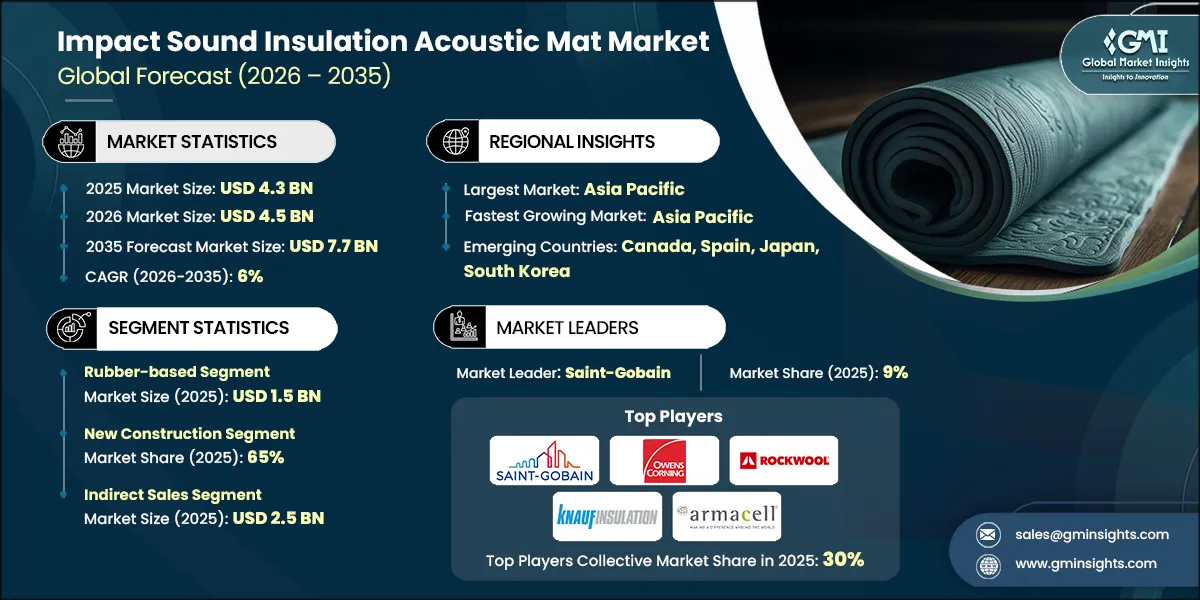
To get key market trends
Impact Sound Insulation Acoustic Mat Market Trends
There’s an increase in demand for impact sound insulation acoustic mats by end-users and consumers as they have become more aware of the need for a quiet indoor environment; moreover, in recent times, there has been an increase in interest from builders and developers towards more sustainable building products overall. Consequently, demand for impact sound insulation acoustic mats, primarily for residential buildings but also for commercial and mixed-use buildings, continues to increase due to the rising expectations of acoustic comfort among people around the world. Developers are beginning to choose higher performing acoustic mats to achieve efficient impact noise reduction while having the ability to install them easily and have them compatible with modern floor covering systems.
- With today’s consumers demanding more noise protection from their home, office, and common living spaces than ever before, builders are responding by using acoustic mats as a common solution, rather than optional. Better impact noise reduction supports increased comfort for end users, especially in multi‑story apartments, co‑living spaces, and busy urban environments.
- A significant trend toward environmentally friendly building products has led manufacturers to create innovative new products made from recycled tire rubber, cork, and/or other renewable or low-impact materials. Environmentally conscious customers prefer flooring systems that reduce noise while also supporting green building practices. This trend contributes to the increased use of acoustic mats manufactured with sustainability in mind.
- Many old buildings were not built with modern noise control features; therefore, consumers who are involved with building renovations are leaning towards using acoustic mats, as they provide a quick and efficient way to improve the sound quality of their space. They can be installed quickly and efficiently without affecting the structure of the building or the height of the floor so that they will work very well with buildings that have been used for long periods of time or when the end users need an immediate improvement in their level of comfort without having to undergo extensive renovations.
- Acoustic manufacturers are developing their products by offering thinner versions of their acoustic mats that provide more efficiency and durability for various types of flooring. Better multilayer construction, improved sound absorption properties, and better compatibility with modern floor finishes have enabled acoustic manufacturers to produce higher quality sound results with less difficult installation. These changes will make the product more appealing to all types of residential, commercial and industrial applications.
Impact Sound Insulation Acoustic Mat Market Analysis
Learn more about the key segments shaping this market
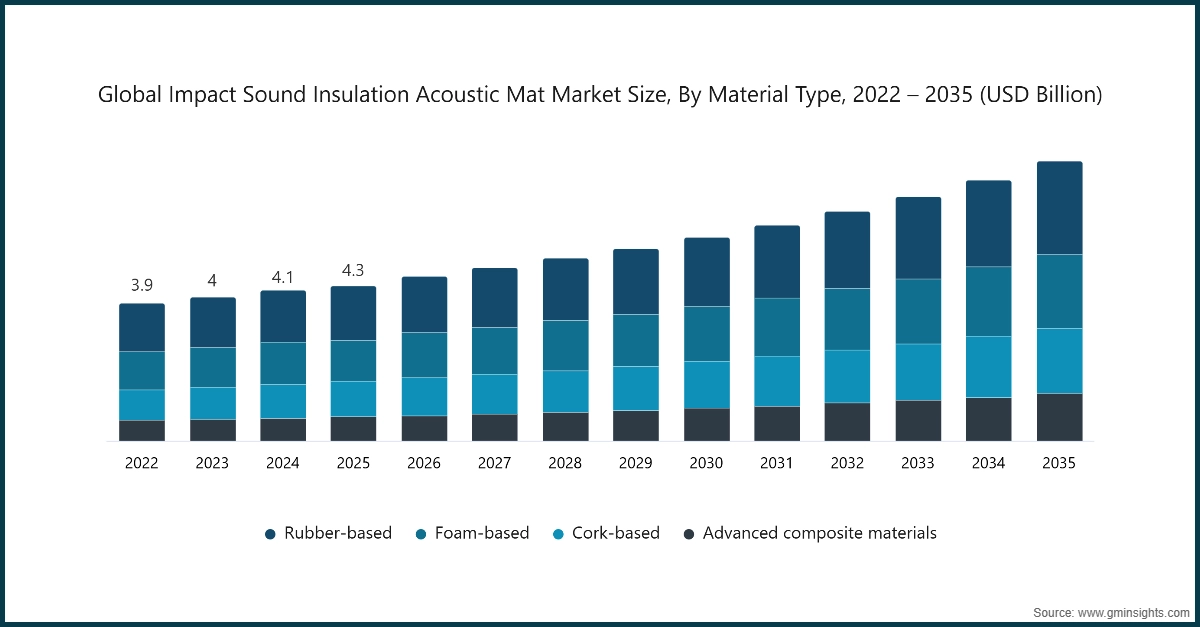
Based on material type, the market is divided into rubber-based, foam-based, cork-based and advanced composite materials. In 2025, rubber-based held the major market share, generating a revenue of USD 1.5 billion.
- Acoustic mats made from rubber have high impact noise reducing qualities and are therefore highly sought after by end users who require excellent sound insulation in multi-store buildings, being able to absorb and dissipate vibrations created by foot traffic, items being dropped, and moving furniture due to the natural elasticity of rubber. Due to this level of flexibility, acoustic mats reduce noise levels in the indoor environment and provide improved acoustic comfort between floors of a building than consumers would experience without them. Rubber mats are also compatible with most flooring systems, so they have a high degree of versatility for use in residential, commercial and mixed-use spaces.
- Rubber mats are also extremely durable and provide a long life, as rubber continues to maintain its resiliency despite being subjected to constant loads over time; thus, end users enjoy a consistent level of acoustic performance over extended periods of time due to no sagging or compressing of the mat, making them an ideal solution for use in high-traffic areas such as office buildings, gyms, hotels, and multi-family dwellings. Another attribute of rubber is that it is resistant to moisture, mold, and changes in temperature, so consumers are able to use rubber mats in environments where the elements could otherwise affect the performance of the product.
- Sustainability goals can also be achieved by utilizing rubber flooring mats. Many consumers look out for eco-friendly building options and rubber flooring mats provide a balance of outstanding performance and environmental consciousness. To help achieve the bid for both acoustic and environmentally friendly finishes, rubber flooring mats are a great choice for green building; retrofit older structures to meet current performance standards and have greater demand from end users needing predominately recycled material that performs well and leaves a small ecological footprint.
Learn more about the key segments shaping this market
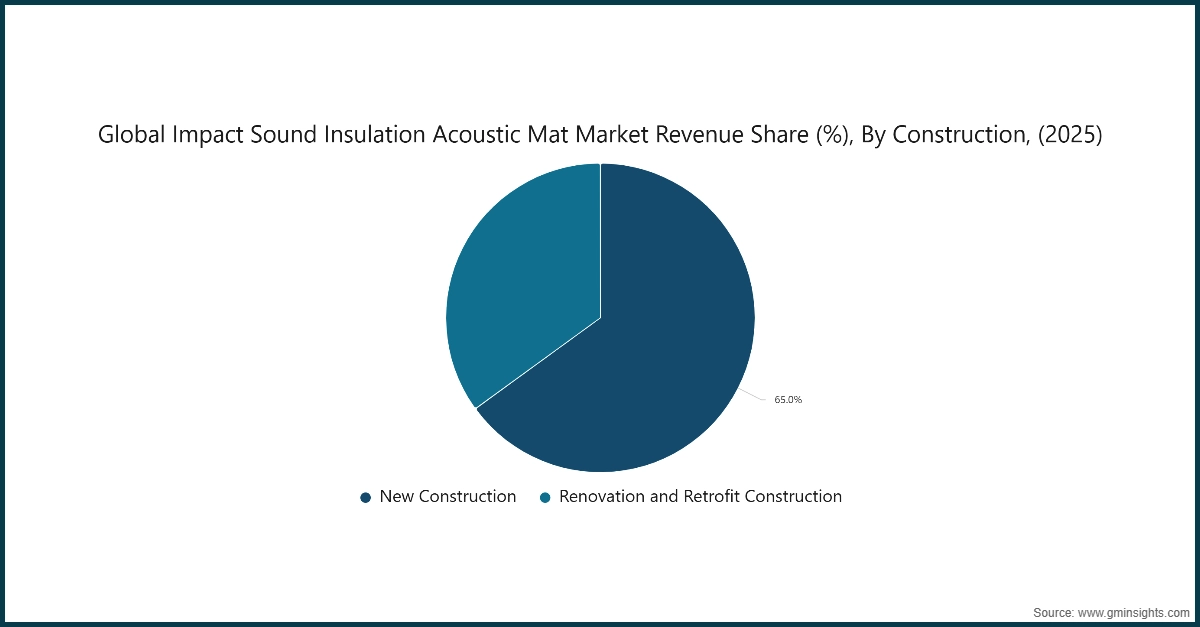
Based on construction, the impact sound insulation acoustic mat market is segmented in new construction and renovation & retrofit construction. The new construction segment held the largest share, accounting for 65% of the global market in 2025.
- New construction projects provide the end user with a unique advantage: they can include acoustic performance at the start of their project by using flooring systems with impact sound insulation mats built-in, so that there is noise control built into a building rather than added later, providing more comfort for the end user from the time they move into a new building. By planning for acoustic requirements early in construction, builders can design floor assemblies to meet changing demands for comfort and minimize the need for expensive retrofits.
- As builders focus on providing the best possible combination of structural and acoustic performance, they are choosing to use sound insulation mats as part of their strategy to construct new residential and commercial facilities. Because sound insulation mats can be placed under virtually all types of flooring, construction teams now have the flexibility to provide contemporary sound insulation performance, while still giving the end user the ability to create the spaces they want. The combination of acoustic properties with functional characteristics of sound insulation mats provides a dependable, modern approach to construction.
- With new construction, there is also a chance to achieve both sustainability and performance targets at the same time. By utilizing eco-friendly acoustic mats during the construction of a new building, builders will provide users with both improved sound insulation as well as green materials used in the construction of the building. Additionally, as buildings evolve to become more sophisticated, sound impact insulation mats are part of the overall solution to modern comfort. Consumers can expect to receive a building that appears premium, durable, and prepared for the future, starting from the very first day of moving into the building.
Based on distribution channel, the impact sound insulation acoustic mat market is segmented into direct sales and indirect sales. In 2025, indirect sales segment held the largest market share, generating a revenue of USD 2.5 billion.
- Impact sound insulation acoustic mats reach the end user through indirect sales, which is critical given that distributors, building-material retailers, flooring-wholesalers, and online markets provide easy access to a broad selection of products. As many end-users want to compare brands, obtain installation advice, and find out where the building materials they need are located quickly for construction or renovation projects, it benefits contractors and installers to work with established distributors that provide consistent inventory; local availability; and convenience by being able to bundle the sale of acoustic mats with other construction materials needed to complete a project.
- Indirect sales also provide an additional benefit through the strong influence that retailers and distributors have on consumers’ awareness of products and purchasing decisions. Retailers/distributors frequently promote specific product brands, demonstrate the products, and discuss performance differences between competing products to help consumers make informed purchasing decisions. Retailers/distributors assist manufacturers in reaching geographical areas and customer groups that are challenging to serve directly; thus, indirect distribution will remain the dominant method of distributing products because they are connecting end-users with dependable options of product solutions while creating more efficient procurement processes whether the end-user is undertaking a small-scale or large-scale construction or renovation project.
North America Impact Sound Insulation Acoustic Mat Market
Looking for region specific data?
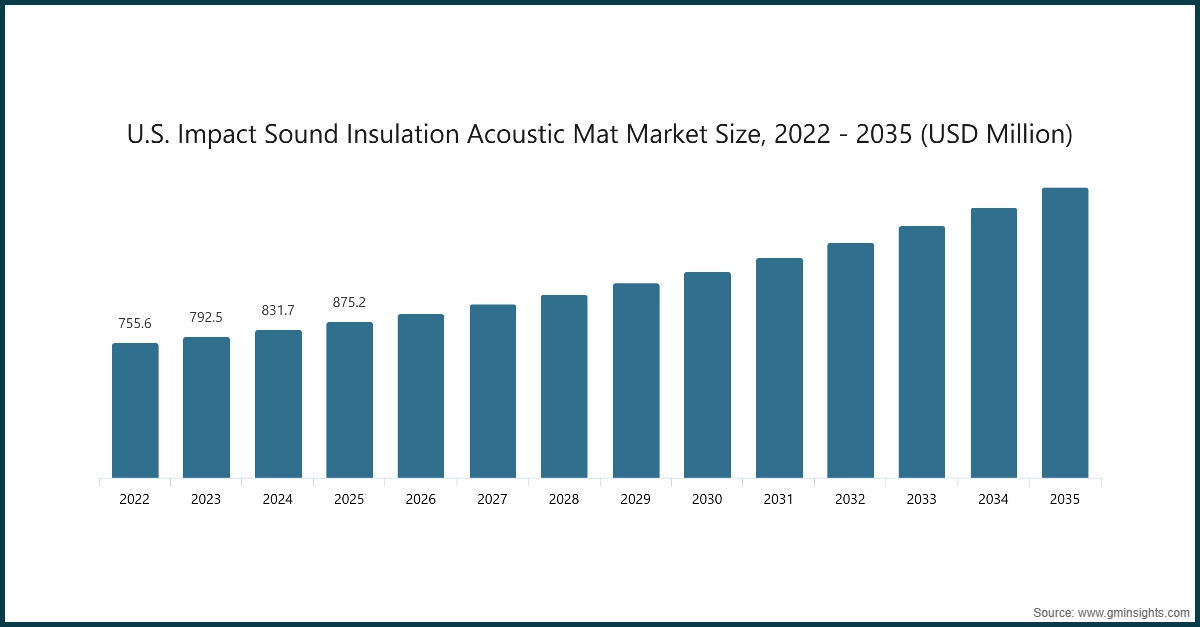
In 2025, the U.S dominated the North America market, accounting for around 77% and generating around USD 875.2 million revenue in the same year.
- Sound insulated impact mats are demanded by end-users and consumers at a high level in the U.S. as trends towards quieter living environments to support modern lifestyle trends along with newly constructed energy-efficient buildings and enhanced acoustic performance are placed high on both residential and commercial building interiors. The construction of new multi-family homes, open-plan office space and mixed-use buildings have led to the increased acceptance of using acoustic mats early on in new commercial and residential construction to keep pace with anticipated consumer expectations and new acoustic guidelines.
- Renovation activity in the U.S. also creates opportunities for more established properties to have inadequate sound control, resulting in a strong opportunity for those types of properties to have a successful retrofit floor sound insulation product supply providing consumers the ability to improve their comfort without having to do significant renovations to their properties.
- Throughout North America, end-users are compelling developers to utilize materials that enhance privacy and minimize everyday noise disruptions, particularly in busy urban centers and developing suburban areas. In addition, builders are being influenced by increasing attention to sustainability and superior indoor air quality when choosing an acoustic mat with an optimal balance of performance, durability, and eco-friendly materials. As new construction continues to increase, renovation activity has expanded and commercial construction has also shown consistent growth; therefore, the North American market will continue to provide consistent opportunities for advanced impact sound insulation products.
Europe Impact Sound Insulation Acoustic Mat Market
Europe market held 21.5% share in 2025 and is expected to grow at 6.3 % during the forecast period.
- Europe is considered a leading region for the use of impact sound insulation acoustic mats, as both end-users and consumers prioritize acoustically comfortable environments and stricter construction rules within the European market. There are many residential buildings, hotels, and office buildings located in Europe in urban settings that require effective impact noise-reducing solutions due to the high density of the urban environment and the proximity of living spaces. Builders typically install acoustic mats into their floor systems to satisfy the comfort expectations of their buyers as well as to comply with the acoustic criteria for their region.
- At the same time, an increasing number of European consumers are making purchasing decisions based on a combination of both sustainability and long-term performance. This is a good fit with acoustic mats made from recycled rubber or environmentally friendly composite materials. The continued renovation of older European building stock is supporting the demand for easier to install mats that provide noise insulation without requiring extensive structural work. As a result, Europe continues to generate a consistent demand in both new construction and retrofitting applications.
Asia Pacific Impact Sound Insulation Acoustic Mat Market
The Asia Pacific leads the market with share of 36.9% in 2025 and is anticipated to grow with a CAGR of around 6.5% from 2026 to 2035.
- The APAC region has become the top market for impact sound insulation acoustic mats for many reasons; there is an increase in urbanization and population density in high-rise buildings as well as an increased expectation for quality living coming from the middle class. Many large cities are also seeing a large increase in vertical housing, resulting in floor-to-floor noise being an everyday concern for consumers. This increase in demand for impact sound insulation during the construction of new buildings has resulted in acoustic comfort being viewed by developers as a major selling feature of new apartments, condominiums, and mixed-use properties. The combination of size and pace of the construction market in the APAC makes it the largest market, as builders design-in acoustic solutions to help with livability in crowded urban areas.
- The increasing awareness of the stress that noise creates will motivate developers to use acoustic mats to meet compliance, but also to provide differentiation in a competitive real estate market. Countries in the APAC region are focused on improving the quality and comfort of buildings and on developing sustainable buildings furthering the need for acoustic mats as a standard feature of both premium and mid-range construction projects. The combination of significant construction activity, rising lifestyle expectations, and increased commercial development are the three factors that clearly establish the APAC region as the market leader in the acoustic mats industry.
Latin America Impact Sound Insulation Acoustic Mat Market
Latin America market is growing at a CAGR of 5% during the forecast period.
- In Latin America, urbanization is rising with the growing number of people in the middle class, therefore expanding demand for housing, along with the increasing number of construction sites and population density are leading to greater interest in improving acoustic comfort by the end-user. In LATAM the consumers are experiencing increased noise due to densely populated areas and more units being added to the developer's building, therefore the developer/homeowner will pay more attention to the advantages of using impact sound insulation mats in the construction of modern apartments and when renovating older concrete buildings where sound transmission is high.
- LATAM's renovation market has seen remarkable growth over the past few years, as consumers are looking for economical solutions to improve in-home comfort levels without having to go through significant or complete renovation. Acoustic mats are an easy-to-use solution for reducing the transmission of sound from floor to floor and are becoming an attractive alternative for the homeowner as well as small-scale developers. With an increase in awareness and improvement in the quality of construction practices and standards, LATAM is continuing to emerge as a growth market for impact sound insulation products.
Impact Sound Insulation Acoustic Mat Market Share
Saint-Gobain is leading with 9% market share. Saint-Gobain, Owens Corning, Rockwool, Knauf Insulation, Armacell, collectively hold around 30%, indicating moderately fragmented market concentration. These prominent players are proactively involved in strategic endeavors, such as mergers & acquisitions, facility expansions & collaborations, to expand their product portfolios, extend their reach to a broad customer base, and strengthen their market position.
Saint‑Gobain is widely recognized as one of the most established names in the building‑materials industry, offering a broad portfolio that includes insulation, interior solutions, glass technologies, and high‑performance construction materials. The company is known for its strong focus on innovation, sustainability, and energy‑efficient building systems, positioning it as a preferred partner for modern construction and renovation projects. Through its long heritage and global presence, Saint‑Gobain consistently influences industry standards and trends across both residential and commercial markets.
Knauf Insulation is a prominent insulation solutions provider known for combining performance, sustainability, and user‑friendly product design. The company offers a wide range of thermal and acoustic insulation materials used in homes, offices, industrial facilities, and specialized applications. Its brand is closely associated with environmentally conscious manufacturing and innovation in healthier indoor environments, making it a strong contender in markets where comfort, efficiency, and greener building practices are becoming increasingly important.
Impact Sound Insulation Acoustic Mat Market Companies
Major players operating in the impact sound insulation acoustic mat industry are:
- Armacell
- Enka Solutions
- Fletcher Insulation
- Getzner Werkstoffe
- Hush Acoustics
- JCW Acoustic Flooring
- Kingspan Group
- Knauf Insulation
- KRAIBURG Relastec
- Owens Corning
- Paroc Group
- REGUPOL BSW
- Rockwool
- Saint-Gobain
- Trocellen
Kingspan Group is a leading manufacturer of advanced insulation and building envelope solutions, recognized for its focus on high‑performance materials and sustainability‑driven construction technologies. The company emphasizes energy‑efficient building systems, low‑impact materials, and modern building envelopes that support long‑term environmental goals. Kingspan’s continuous investment in innovation and its expansion into multiple construction segments have positioned it as an influential force in shaping future‑ready, high‑efficiency buildings worldwide.
Trocellen specializes in polyolefin foam solutions used across multiple industries, including construction, automotive, sports, packaging, and consumer comfort applications. The company is known for creating flexible, lightweight, and durable foam materials that enhance safety, comfort, and performance. With its wide application range and adaptability, Trocellen plays an important role in supplying both industrial partners and end‑consumer markets with foam‑based solutions that improve insulation, cushioning, and overall product functionality.
Impact Sound Insulation Acoustic Mat Market Report Attributes
| Key Takeaway | Details |
|---|---|
| Market Size & Growth | |
| Base Year | 2025 |
| Market Size in 2025 | USD 4.3 Billion |
| Market Size in 2026 | USD 4.5 Billion |
| Forecast Period 2026-2035 CAGR | 6% |
| Market Size in 2035 | USD 7.7 Billion |
| Key Market Trends | |
| Drivers | Impact |
| Stringent building acoustic standards | New regulations now require builders to utilize better-quality acoustic mats. This will provide better noise reduction for users in new construction buildings. |
| Growth of renovation and retrofitting projects | As renovations continue to increase, many more consumers desire to install easy-to-install acoustic mats into their older buildings, as they would like to enhance the comfort of their older building without making significant renovations. |
| Technological advancements in materials | Advancement of new, efficient materials, there are now acoustic mats available that are both thinner, lighter, and more durable than other flooring materials while providing superior sound insulation. |
| Pitfalls & Challenges | Impact |
| High product and installation costs | The price of using acoustic mats can be a significant factor when selecting these products as budget-conscious consumers may choose not to invest in the purchase of new acoustic flooring products; therefore, the willingness to implement these types of sound insulating materials is limited. |
| Performance variability across materials | If the acoustic mat does not perform well for the sound insulation requirements, then end users may have an uncertain expectation when they purchase low-quality acoustic mats. |
| Opportunities: | Impact |
| Expansion of sustainable & green construction | As all consumers are now more focused on sustainability and as a result, eco-friendly acoustic materials are in high demand therefore recycled and low-impact materials will increase in demand for acoustic mats. |
| Integration with smart building technologies | Smart building systems provide a vehicle to measure the performance of acoustic mats and allow end users to improve the comfort of indoor spaces in a monitored and measurable way. |
| Market Leaders (2025) | |
| Market Leader |
9% market share |
| Top Players |
The collective market share in 2025 is 30% |
| Competitive Edge |
|
| Regional Insights | |
| Largest market | Asia Pacific |
| Fastest growing market | Asia Pacific |
| Emerging countries | Canada, Spain, Japan, South Korea |
| Future Outlook |
|
What are the growth opportunities in this market?
Impact Sound Insulation Acoustic Mat Industry News
- In August 2025, Enka Solutions expanded its EnkaSonic acoustic underlay portfolio 125/250/400/750 and “Plus” variants, adding thickness/performance options for impact and airborne sound control in floor assemblies and publishing an architect toolkit for specifications.
- In June 2025, Armacell expanded its manufacturing footprint with a new aerogel insulation plant in India to support its ArmaGel XG line, aimed at delivering lighter, thinner, and higher‑performance insulation solutions for buildings and industry improving local availability and shortening lead times for specifiers.
- In January 2025, KRAIBURG Relastec showcased updates to its DAMTEC acoustic/vibration line at BAU 2025 and introduced SHIELDTAC, a separate rubber systems brand for specialized protective applications signalling ongoing product platform diversification.
- In October 2024, Knauf Group agreed to acquire a low‑carbon rock mineral wool operation in Uzbekistan, adding electric‑melting capability that lowers production CO₂ intensity and extends mineral‑wool supply in adjacent regions.
The impact sound insulation acoustic mat market research report includes in-depth coverage of the industry with estimates & forecasts in terms of revenue (USD Billion) & volume (Million Sq. Meters) from 2022 to 2035, for the following segments:
Market, by Material Type
- Rubber-based
- Synthetic rubber
- Natural rubber
- Foam-based
- Polyurethane foam
- Recycled foam
- Cork-based
- Pure cork
- Composite cork
- Advanced composite materials
- Bio-based composites
- Smart materials with embedded sensors
Market, by Installation Type
- Floating floor underlayment systems
- Adhesive-applied direct systems
- Mechanically fastened systems
- Integrated building panel systems
Market, by Thickness
- Low (<5mm)
- Medium (5-15mm)
- High (>15mm)
Market, by Construction
- New construction
- Renovation and retrofit construction
Market, by End User
- Architect and design professional
- General contractor and builder
- Specialty contractor and installer
- Owner/developer
Market, by Application
- Residential
- Commercial
- Office buildings and corporate facilities
- Healthcare facilities
- Educational institutions
- Hospitality and entertainment venues
- Industrial
- Manufacturing facilities
- Data centers
- Warehouses and distribution centers
Market, by Distribution Channel
- Direct sales
- Indirect sales
The above information is provided for the following regions and countries:
- North America
- U.S.
- Canada
- Europe
- Germany
- UK
- France
- Italy
- Spain
- Asia Pacific
- China
- India
- Japan
- Australia
- South Korea
- Latin America
- Brazil
- Mexico
- Argentina
- Middle East and Africa
- South Africa
- Saudi Arabia
- UAE
Frequently Asked Question(FAQ) :
What is the market size of the impact sound insulation acoustic mat market in 2025?
The global impact sound insulation acoustic mat market was valued at USD 4.3 billion in 2025, driven by increasing demand for quieter indoor environments and improved acoustic comfort in residential and commercial buildings.
What is the expected market size of the impact sound insulation acoustic mat market in 2026?
The market is projected to reach USD 4.5 billion in 2026, supported by rising construction activities and growing adoption of soundproofing materials.
What is the projected value of the impact sound insulation acoustic mat market by 2035?
The market is expected to reach USD 7.7 billion by 2035, expanding at a CAGR of 6%, driven by increasing urbanization, renovation activities, and rising awareness of acoustic comfort in buildings.
How much revenue did the rubber-based material segment generate in 2025?
The rubber-based material segment generated USD 1.5 billion in 2025, due to its excellent vibration absorption, durability, and compatibility with various flooring systems.
Which distribution channel leads the impact sound insulation acoustic mat industry?
The indirect sales channel led the market with USD 2.5 billion in revenue in 2025, supported by the strong presence of distributors, building material retailers, and flooring wholesalers.
What is the market outlook for Europe in the impact sound insulation acoustic mat market?
Europe held a 21.5% market share in 2025 and is expected to grow at a CAGR of 6.3%, supported by strict building acoustic regulations and strong renovation activity across older building infrastructure.
Who are the key players in the impact sound insulation acoustic mat market?
Major companies include Armacell, Enka Solutions, Fletcher Insulation, Getzner Werkstoffe, Hush Acoustics, JCW Acoustic Flooring, Kingspan Group, Knauf Insulation, KRAIBURG Relastec, Owens Corning, Paroc Group, REGUPOL BSW, Rockwool, Saint-Gobain, and Trocellen.
Impact Sound Insulation Acoustic Mat Market Scope
Related Reports