Summary
Table of Content

Hypercharger Market
Get a free sample of this report
Form submitted successfully!
Error submitting form. Please try again.
Thank you!
Your inquiry has been received. Our team will reach out to you with the required details via email. To ensure that you don't miss their response, kindly remember to check your spam folder as well!
Request Sectional Data
Thank you!
Your inquiry has been received. Our team will reach out to you with the required details via email. To ensure that you don't miss their response, kindly remember to check your spam folder as well!
Form submitted successfully!
Error submitting form. Please try again.
Hypercharger Market Size
Sustainability and zero-emission targets have pushed the demand and adoption of electric vehicles across the world. This enabled automakers to shift towards EVs. Simultaneously, charging infrastructures are expanding to better propel the demand for EVs. Major EV charging infrastructure market players are looking to advance the charging speed that also reduces the barriers for the EV adoption.
Hypercharger Market Key Takeaways
Market Size & Growth
- 2025 Market Size: USD 6.2 Billion
- 2026 Market Size: USD 7.4 Billion
- 2035 Forecast Market Size: USD 25.2 Billion
- CAGR (2026–2035): 14.6%
Regional Dominance
- Largest Market: Asia Pacific
- Fastest Growing Region: Europe
Key Market Drivers
- Accelerating global electric vehicle (EV) adoption.
- Growing demand for reduced charging time and high-power infrastructure.
- Government incentives and national EV infrastructure programs.
- Expansion of highway and corridor-based fast charging networks.
Challenges
- Grid capacity constraints and power distribution limitations.
- High capital expenditure for installation and grid upgrades.
Opportunity
- Integration with renewable energy and energy storage systems.
- Expansion in emerging EV markets.
- Public-private partnerships for infrastructure expansion.
- Increasing electrification of commercial and fleet vehicles.
Key Players
- Market Leader: Alpitronic led with over 11.4% market share in 2025.
- Leading Players: Top 5 players in this market include ABB, Alpitronic, Delta Electronics, Siemens, Tesla, which collectively held a market share of 28% in 2025.
Get Market Insights & Growth Opportunities
Some electric vehicles (EVs) can charge up to 80% in 15–30 minutes using 350 kW DC fast chargers. In comparison, a level 1 charger takes 40-50 hours or more to charge a Battery Electric Vehicle (BEV) to 80% from empty and 5-6 hours for a Plug-in Hybrid Electric Vehicle (PHEV). Companies like Tesla, ABB, and Ionity have introduced these fast chargers to support both city and long-distance travel.
US fast‑charging networks added more than 18,000 new DC fast‑charging ports in 2025. According to the International Council on Clean Transportation, publicly announced investments in charging infrastructure from retailers, automakers, and charging providers sum up to 164,000 new DC fast chargers and 1.5 million new Level 2 chargers in the years ahead. These investments cover a substantial share of the chargers that we estimate will be needed by 2030.
Regional sizing patterns align with policy and infrastructure realities: Europe’s 15.9% CAGR leads on regulation; APAC holds the largest base; Latin America and MEA grow from smaller starting points due to financing and grid constraints. Because of this, investment theses are shifting. CPOs favor modular platforms to future‑proof sites and reduce truck rolls, while energy majors lean on retail footprints and power‑market expertise to tame demand charges.
Governments are central to accelerating hypercharger deployments with supportive funding and policy frameworks. Investments in infrastructure programs across the U.S., EU and Asia promote broader adoption of high-power charging technologies, while emission-reduction targets are spurring initiatives that prioritize ultra-fast chargers along freight corridors and major travel routes.
The global hypercharger market was valued at USD 6.2 billion in 2025. The market is expected to grow from USD 7.4 billion in 2026 to USD 25.2 billion in 2035 at a CAGR of 14.6%, according to latest report published by Global Market Insights Inc.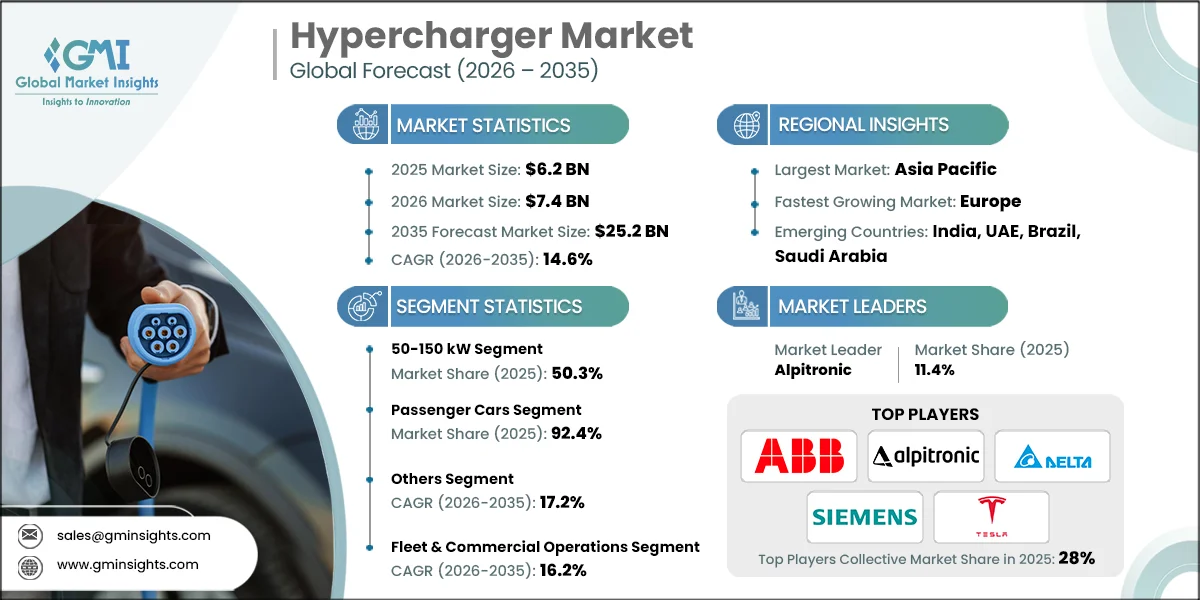
To get key market trends
Hypercharger Market Trends
Ultra-fast charging technology evolution (350 kW+ systems) Silicon carbide (SiC) power electronics and liquid‑cooled cables are unlocking reliable 350-500 kW delivery, pushing 10–12 minute 10–80% sessions for compatible 800V vehicles-an inflection that directly addresses the time penalty versus gasoline refueling, as documented by IEEE, Power Electronics News, and SAE International.
Consumer intent shifts alongside: about 83% of prospective buyers say they’d choose BEVs over PHEVs if fast‑charge times reach the 10-15 minute range now feasible on 350 kW hardware, according to Pew Research Center survey data. Timeline: 2024–2026 scale-up for 350-400 kW at public hubs; 2026-2028 early MCS truck corridors; 2028+ broader 800–1000V passenger adoption.
Government‑backed infrastructure deployment acceleration policy is the single biggest accelerator in the hypercharger market: governments have earmarked well over USD 35 billion for fast‑charging rollouts through 2030 via national programs and binding obligations, according to IEA tracking. In the U.S., NEVI sets minimums ≥150 kW per port, four ports per site, 97% uptime, and ≤50‑mile spacing across 163,000 corridor miles with over USD 2.8 billion approved as of early 2025 and projects moving from award to commissioning as permitting teams gain speed, as reported by FHWA and the U.S. Department of Transportation.
As charging networks grow, power supply and grid integration are becoming more important. Utilities, infrastructure companies, and OEMs are working together to ensure charging stations are supported by strong energy networks and smart grid systems. Some companies are combining high-power charging with energy storage and renewable energy to reduce pressure on the grid and improve reliability. Advanced technologies like vehicle-to-grid (V2G) and bidirectional charging are being tested and are starting to enter the market.
China’s 14th Five‑Year Plan codifies service‑area fast charging on expressways; Japan funds up to 50% of fast‑charger CapEx; South Korea allocates billions under its Green New Deal, based on publications from NDRC, METI Japan, and MOTIE Korea all supports the market for hyperchargers.
Leading companies are introducing new products and expanding their networks. For instance, in January 2026, Delta announced the launch of its 350kW (HPC 350) fast EV Charger in the EMEA market for electric passenger vehicles, buses, trucks and heavy-duty vehicles. Suited to the requirements of charge point operators, highway charging hubs, logistics and fleet operators, service/gas station operators as well as commercial and industrial application sectors, the HPC 350 is an ideal solution for highway rest stops, traditional fuel stations, and large-scale charging hubs.
Hypercharger Market Analysis
Learn more about the key segments shaping this market
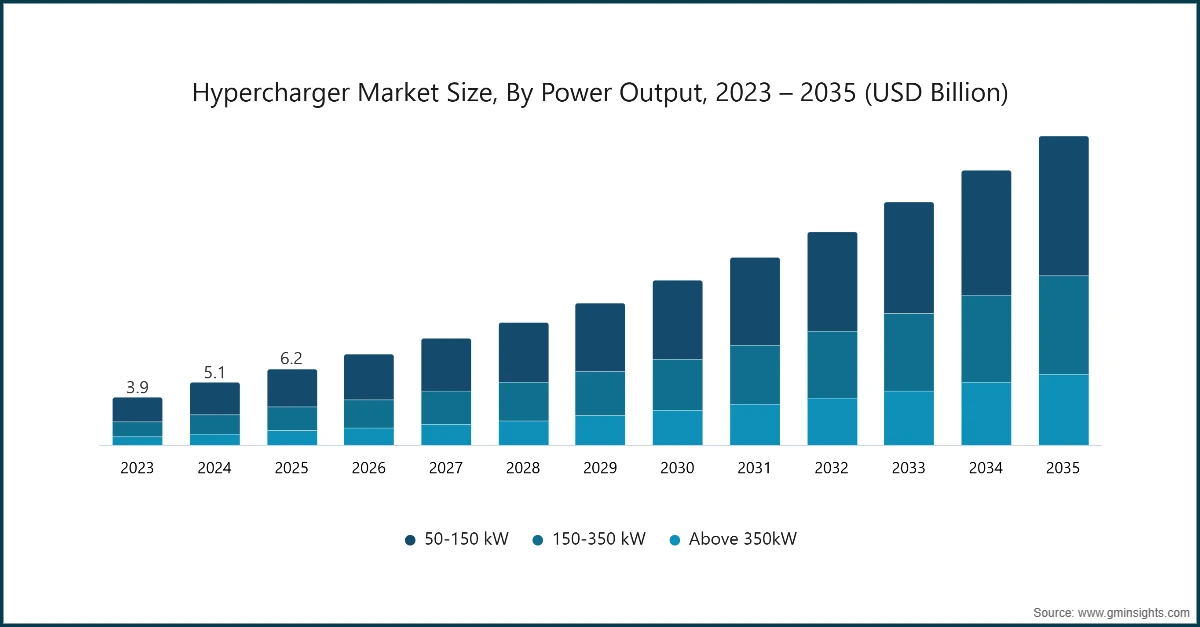
Based on power output, the hypercharger market is divided into 50-150 kW, 150-350 kW and above 350kW. The 50-150 kW segment dominated the market with market share of around 50.3% and generating revenue of around USD 3.1 billion in 2025.
- The 50–150 kW tier remains the workhorse of the market by value and count, underpinned by near‑universal vehicle compatibility and materially lower installed costs versus ultra‑high‑power gear. In 2024, systems in this band typically added 100–180 miles of range per charging hour and slotted naturally into workplaces, retail parking, and municipal garages where 1–3 hour dwell times are common, as described in SAE technical summaries.
- Turnkey costs per port often land in the USD 80,000–150,000 range including make‑ready, which is meaningfully below multi‑hundred‑kilowatt sites that can require distribution upgrades, according to RMI and EPRI studies. Because almost every BEV on the road can accept ≥50 kW, utilization tends to be stable even as newer 800V models arrive, and European cities continue deploying 50–100 kW assets to serve residents without home charging, based on EAFO data and municipal planning reports.
- Growth here leans on geographic expansion, urban infill, and replacements of first‑generation hardware with modular designs that allow step‑ups to higher power over time, per IEEE standards updates. The 150–350 kW class is the present sweet spot for highway corridors and urban fast‑charging hubs, offering 15–25 minute sessions that align with consumer expectations for convenience.
- NEVI’s ≥150 kW minimum standard and Europe’s corridor obligations are channeling deployments into this tier, while SiC electronics and liquid‑cooled cables keep efficiency high and ergonomics manageable, per FHWA and European Commission requirements and Power Electronics News coverage.
- The 350 kW category is becoming more popular for heavy-duty and high-use vehicles. In January 2026, Delta, a global leader in power and green solutions, launched its HPC 350 fast EV Charger in the EMEA region. This charger is designed for electric cars, buses, trucks, and other heavy vehicles. It works well in areas with limited grid capacity and high usage. It is a good fit for highways, logistics fleets, and commercial charging routes, showing strong growth potential in this market.
Learn more about the key segments shaping this market
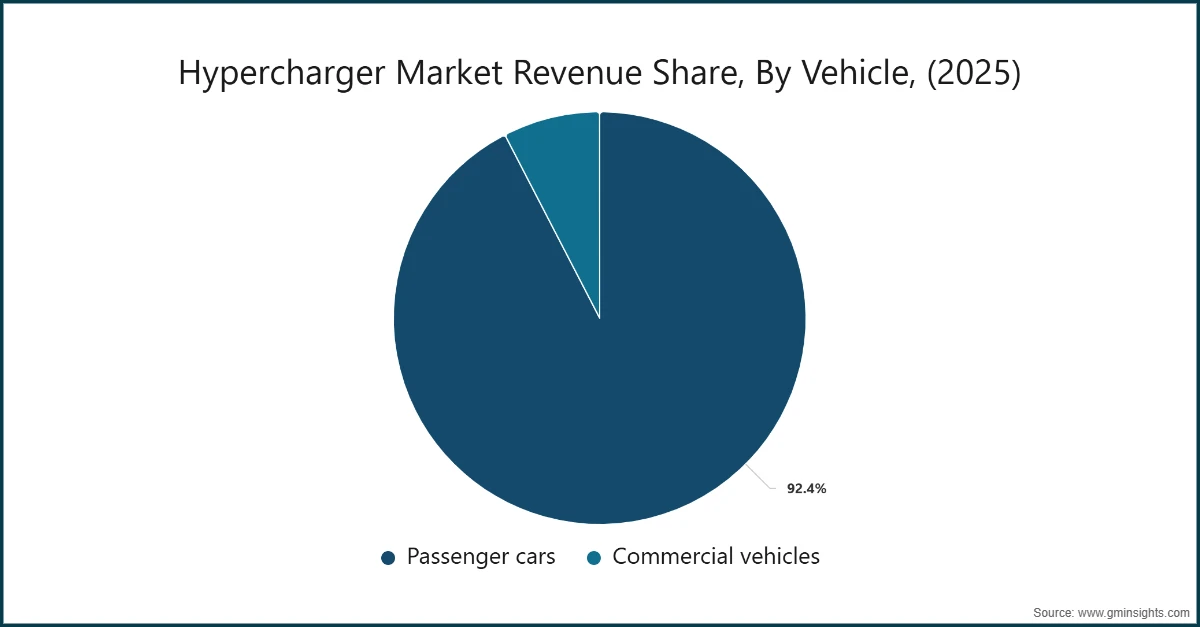
Based on vehicle, the hypercharger market is divided into passenger cars and commercial vehicles. The passenger cars segment accounts for 92.4% in 2025 and is expected to reach USD 22.6 billion by 2035.
- Passenger cars account for the vast majority of hypercharger sessions and revenue today, shaped by two realities: most charging happens at home or work, and public fast charging covers long trips and apartment dwellers. Federal statistics indicate roughly 70–80% of passenger charging is residential, with corridor spacing of 50–80 miles and urban hubs near multi‑family districts filling the remaining need, per the U.S. Department of Energy and CharIN initiative data.
- Sites adjacent to retail and food service match 25–35 minute session durations, while 800V platforms reduce dwell time further for premium and some mid‑market BEVs, as described by SAE. Consumer surveys keep pointing to time at the plug as the top perceived barrier; 350 kW availability materially improves intent to purchase, per Pew Research Center.
- Commercial vehicles, while a smaller revenue base today, are the fastest‑growing customer set for the hypercharger market because of strong total‑cost‑of‑ownership math and policy pressure. Depot charging in the 50–150 kW range dominates overnight operations, while 150–350 kW public hubs and MCS corridors enable opportunity charging for transit, last‑mile, and regional haul use cases, according to CALSTART, ICCT, and CharIN documentation.
- California’s Advanced Clean Fleets and similar rules in Europe tighten timelines, and fleet‑grade managed charging shifts load to off‑peak windows to tame demand charges, per CARB rulemaking and EPRI studies. Expect technology like robotic connectors and inductive pads to show up first in high‑utilization depots where every minute of uptime counts, as profiled by SAE.
Based on connector, the hypercharger market is divided into CCS (Combined Charging System), CHAdeMO, GB/T and others. The others segment is expected to grow at the fastest CAGR of 17.2% between 2026 and 2035.
- CCS dominates the market in Europe and remains essential in North America through the mid‑2020s due to regulatory requirements and the installed vehicle base. AFIR mandates CCS on public DC fast chargers across the EU, and NEVI funding in the U.S. requires CCS availability at every funded site, which sustains network buildouts even as other standards evolve, per European Commission and FHWA guidance.
- Technically, CCS’s ISO 15118 stack enables plug‑and‑charge, encrypted comms, and bidirectional features that feed both consumer ease and grid‑services integration, as documented by ISO. The North American shift toward Tesla’s NACS (now SAE J3400) is real and accelerating—with virtually all major OEMs onboard but unfolds over multiple model years and requires dual‑standard sites during the transition, according to SAE and Automotive News.
- China remains GB/T‑only for domestic vehicles and infrastructure, reflecting policy autonomy and domestic supply chain scale, according to SAC notices and CPCA statistics. CHAdeMO plays a managed‑decline role outside Japan, retained primarily for backward compatibility and V2G pilots, while ChaoJi development indicates a longer‑term Asian pathway for high power with limited global uptake to date, as described by the CHAdeMO Association and CharIN China.
- Tesla’s Supercharger network (CCS2 in Europe; NACS in North America) remains the largest high‑power footprint globally and is increasingly accessible to non‑Tesla drivers in the U.S. via adapters and new vehicle integration, reinforcing the case for dual‑connector dispensers at new sites through 2027–2028, per Tesla updates and SAE documentation.
Based on application, the hypercharger market is divided into public charging hubs, fleet & commercial operations and retail & convenience. The fleet & commercial operations segment is expected to grow at the fastest CAGR of 16.2% between 2026 and 2035.
- Public charging hubs remain the backbone of the market by value, designed for 24/7 access, multi‑port configurations, and seamless payments. Site selection blends traffic analytics, amenity partnerships, and competitive heat maps, highway sites target rest stops and travel plazas, while urban hubs cluster around multi‑family housing and job centers, per FHWA and DOE resources.
- Reliability is the differentiator networks pushing toward 98%+ uptime combine robust hardware with remote diagnostics and rapid service‑level agreements, as described in manufacturer service literature and network operator disclosures. Revenue mixes are evolving, too: dynamic pricing, idle fees, and memberships smooth peaks and lift utilization, as tracked by CharIN initiative reports.
- Government programs supplying 40–80% of CapEx keep new corridors bankable while utilization ramps, according to FHWA and European Commission documentation. Fleet and commercial operations, including delivery depots, bus yards, rental facilities, and taxi/rideshare sites, are scaling faster than public hubs in many regions because operators can underwrite the entire TCO equation.
- Managed‑charging software aligns departures with off‑peak tariffs, and utilities are rolling out make‑ready and special rate programs to accelerate builds, based on EPRI and IEEE Smart Grid program reviews. Retail and convenience locations are another bright spot: co‑location with shopping and dining fits 25–35 minute dwell times, and big‑box chains are moving to thousands of sites in the next two to three years, per DOE case studies and company announcements from Walmart and Shell Recharge.
Looking for region specific data?
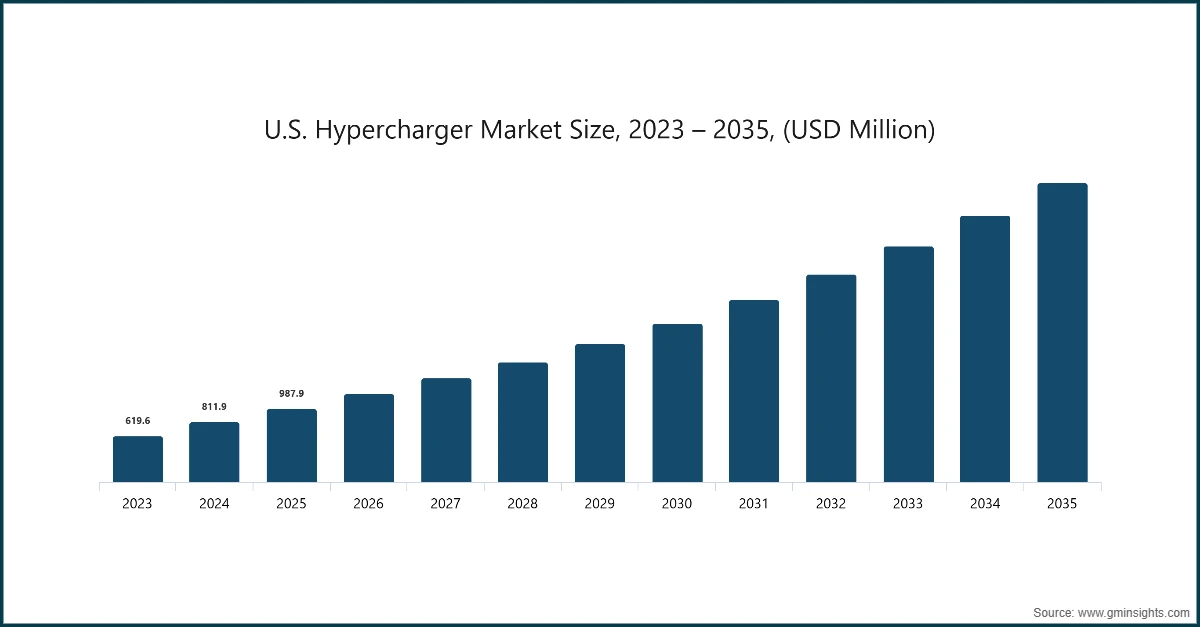
The US hypercharger market reached USD 987.9 million in 2025, growing from USD 811.9 million in 2024.
- Federal and state programs in the U.S. are helping the market grow. These programs aim to make long-distance travel easier and cut emissions. The National Electric Vehicle Infrastructure (NEVI) Formula Program and other federal plans under the Infrastructure Investment and Jobs Act (IIJA) are giving money to expand EV charging networks. These programs focus on building fast chargers along key routes to make high-power charging available across the country. The goal is to connect and standardize chargers to support zero-emission vehicles and reduce drivers' worries about running out of charge.
- Private companies like retailers, utility providers, and car manufacturers are also playing a big role. They are investing in DC fast chargers and ultra-fast charging hubs. This is happening more in states like California, Oregon, and New York, where more people are using EVs.
- New rules requiring more U.S.-made materials for federally funded chargers could make it harder to get the needed equipment. This might delay installations and create uncertainty in the public charging system. These problems are part of larger debates about how quickly electrification should happen.
- Overall, demand for hyperchargers is increasing as more people based in the country are buying EVs, ride-hailing services are using electric cars, and companies are working to make chargers more reliable. The industry is also improving compatibility between different systems (like CCS and NACS) and setting standards to support the changing transportation sector.
The North America hypercharger market is estimated to reach USD 4.5 billion by 2035 and expected to grow at a CAGR of 14.4% between 2026 and 2035.
- North America’s market is accelerating on the back of EV incentives, NEVI corridor funding, and the NACS transition. The United States anchors regional demand with federal purchase credits and USD 5 billion NEVI formula funding that requires ≥150 kW power, four ports, ≤50‑mile spacing, and 97% uptime, while approved projects surpassed 7,500 ports by early 2025, as reported by the IEA, FHWA, and the Joint Office of Energy and Transportation.
- The U.S. hypercharger market is also navigating a multi‑year connector shift to SAE J3400 as OEMs adopt NACS, which keeps dual‑standard deployments common through the decade, per SAE and Automotive News. Canada’s EV market expands under federal and provincial incentives, yet long distances, harsh winters, and sparse rural grids demand careful corridor planning and grid‑hardening, according to the Canada Energy Regulator and Natural Resources Canada.
The Europe region holds 17.2% of the hypercharger market in 2025 and is expected to grow at the fastest CAGR of 8.1% between 2026 and 2035.
- Europe leads on policy certainty and standardized deployments. AFIR mandates CCS on public DCFC and sets power‑density and spacing rules on TEN‑T routes, while national programs such as Germany’s Deutschlandnetz add tender‑based high‑power parks across the country, according to the European Commission and Germany’s Federal Ministry of Transport.
- As government policies play a big role, they are mainly responsible in shaping the automotive market in Europe. The European Green Deal aims to cut CO₂ emissions and plans to stop the sale of new combustion engine vehicles by 2035. However, recent changes in regulations give manufacturers more flexibility to meet the 2030 and 2035 emission targets.
- Still, increasing EV registration numbers will potentially create more demand in coming years for near availability of charging stations. According to ACEA, in 2025, around 1.9 million new battery-electric cars were registered. The four largest markets, including Germany, accounted for over 43% growth, the Netherlands 18.1%, Belgium 12.6%, and France 12.5% cumulatively accounted for 62% of these registrations and showed strong growth.
Germany's hypercharger market is growing quickly in Europe, with a CAGR of 15.3% between 2026 and 2035.
- Germany is one of the top markets in Europe for EV charging infrastructure, supported by government policies and EU rules. The government and private companies are building high-power charging stations on highways and in cities to encourage EV use and reduce emissions.
- The National Center for Charging Infrastructure in Germany says more hyperchargers need to be installed before the EV market grows further. Studies show that by 2030, hundreds of thousands of chargers, including many high-power ones, will be needed to meet demand and make charging easy for users.
- The main reasons for this growth are strict emission reduction goals, Germany’s strong position in car technology, and EU rules that require ultra-fast chargers on major European routes. Energy companies, carmakers, and local governments are working together to grow the high-power charging network.
The Asia Pacific hypercharger market is expected to grow at the CAGR of 14.2% between 2026 and 2035.
- Asia Pacific is both the largest market by value and the most diverse. The China hypercharger industrybenefits from policy mandates, State Grid investment, and domestic manufacturing scale, with public charging surpassing 2.7 million points in 2024 and GB/T as the universal standard, per the China Charging Alliance and NDRC notices.
- India expands via FAME II and corridor programs, while Japan’s subsidies and V2G leadership sustain dense fast‑charging in major metros; South Korea’s Green New Deal pushes 50,000 fast chargers by 2030 alongside 800V passenger adoption, as reported by FAME India, METI Japan, and MOTIE Korea.
- APAC maintains leadership on manufacturing cost and deployment velocity, with China setting pace and India/Southeast Asia driving the next demand wave, based on IEA and outlooks. Investment trends favor integrated smart charging networks capable of load management and interoperability, catering to diverse use cases from urban commuting to logistics electrification.
China hypercharger market is estimated to grow with a CAGR of 6.2% in the projected period between 2026 and 2035, in the Asia Pacific market.
- China is the top country in building public EV charging stations and hyperchargers. This is because of strong government support, investments by state-owned companies, and high EV use in cities. China has the fastest growth in fast chargers and a better EV-to-charger ratio than many other places.
- According to the IEA, China has reached a level where there is now more than 1 public charger for every 10 electric cars in China. China maintained its position as the leading country for fast charging installation during the previous year because it accounted for 80 percent of worldwide expansion while fast charger installations increased from 1.2 million in 2023 to 1.6 million in 2024.
- The government is working to build a large charging network. Companies are helping by making and standardizing GB/T connectors. This allows ultra-fast and megawatt-class chargers for cars and trucks to be set up quickly.
- Key trends include building chargers in cities and highways at the same time, using renewable energy, and improving grid stability. National and local plans are encouraging more chargers in areas with many people.
Brazil is estimated to grow with a CAGR of 10.6% between 2026 and 2035, in the Latin America hypercharger market.
- Brazil is in the early stages of adopting hyperchargers, supported by the creation of EV charging corridors and growing private investments in high-power charging infrastructure. The rise in urban EV sales and efforts to electrify commercial fleets are increasing the need for large-capacity charging hubs.
- The main factors driving the market include municipal climate goals, more electric car registrations, and partnerships between utilities and OEMs to test ultra-fast charging stations on key routes connecting major cities.
- With ongoing investments and the adoption of industry standards, Brazil’s high-power charging market is becoming a key part of the country’s EV growth. BYD, in partnership with Shell’s Raízen Power, plans to install 600 new DC fast-charging points in eight major Brazilian cities over the next three years. Starting in 2024, this project will add 18 MW of power to the Shell Recharge network in cities like São Paulo, Rio de Janeiro, and Brasília.
UAE to experience substantial growth in the Middle East and Africa hypercharger market in 2025.
- The market in the UAE is growing as part of the country’s plan to reduce emissions and promote clean mobility. The National Electric Vehicles Policy and EV charging network projects are helping more people use electric vehicles (EVs) and increasing the number of fast and ultra-fast charging stations in cities.
- Dubai has set up rules and licenses for public charging operators to make it easier to install fast chargers. The EV Green Charger Program has many charging points, and agreements with fleet operators aim to add more ultra-fast chargers for taxis and commercial vehicles.
- ADNOC Distribution opened its first 60-point superfast electric vehicle charging station on the E11 highway at Saih Shuaib which offers charging from empty to 80 percent within 20 minutes. Similarly, the new DEWA-compliant DC fast chargers were introduced by FYSH in Dubai while Parkin and e& are establishing more than 200 ultra-fast charging stations.
Hypercharger Market Share
The top 7 companies in the hypercharger industry are Alpitronic, ABB, Delta Electronics, Kempower, Schneider Electric, Siemens and Tesla contributing 29.7% of the market in 2025.
- Alpitronic makes the Hypercharger HYC series, which includes DC fast chargers with power from 50 kW to over 300 kW. These chargers are used for highways and fleets. They support CCS charging, have liquid-cooled cables, share power dynamically, and include scalable power cabinets.
- ABB makes Terra DC fast chargers, which can deliver up to 350 kW. They also make chargers for heavy-duty vehicles. These chargers support CCS standards, manage power dynamically, allow remote monitoring, and work with energy management systems.
- Delta Electronics offers DC fast chargers up to 350 kW. These chargers are for public and commercial use. They include smart energy management, modular design, backend connectivity, and support global charging standards.
- Kempower makes DC fast chargers with modular designs. They include distributed power units and satellite dispensers. These chargers share power across multiple points and are good for public charging hubs, bus depots, and fleets.
- Schneider Electric makes high-power DC chargers for commercial and highway use. These chargers include load management, energy optimization, backend connectivity, and support CCS standards and charging for multiple vehicles.
- Siemens makes the SICHARGE line of DC fast chargers. These chargers are scalable and support high-power charging. They include modular power units, share power dynamically, connect to the grid, and work for passenger and fleet charging.
- Tesla makes Supercharger systems, including V3 and V4 chargers. These are mainly for Tesla vehicles but are becoming compatible with other EVs in some markets. They offer fast charging, liquid-cooled cables, and network integration.
Hypercharger Market Companies
Major players operating in the hypercharger industry are:
- Alpitronic
- ABB
- Delta Electronics
- Eaton
- EVgo Services
- Kempower
- Schneider Electric
- Siemens
- Tesla
- Tritium
- Alpitronic is well-known for its modular Hypercharger designs. These chargers use Power-Stack technology, which makes them scalable and efficient. They are widely used in Europe, with partnerships like EnBW and Ionity.
- ABB provides a wide range of chargers, from multi-vehicle DC chargers to the MCS1200 megawatt-class solution. Their chargers are used globally and come with strong service and support.
- Tesla is expanding its Supercharger network with high-power V4 stalls and better compatibility with other vehicles. Tesla has one of the largest fast-charging networks for passenger EVs.
- Siemens offers scalable charging solutions like the Sicharge Flex platform. This platform supports both AC and DC charging and is used in commercial charging worldwide.
- Delta focuses on fast chargers that are efficient and work well with the power grid. Their DC chargers are designed for public and commercial use.
- Schneider provides high-power chargers like the StarCharge Fast 720. Their chargers support multiple vehicles and include energy management features for fleets and industrial sites.
- Kempower specializes in fast chargers that can handle many vehicles at the same time. They also support EV infrastructure projects like ChargeUp Europe.
Hypercharger Market Report Attributes
| Key Takeaway | Details |
|---|---|
| Market Size & Growth | |
| Base Year | 2025 |
| Market Size in 2025 | USD 6.2 Billion |
| Market Size in 2026 | USD 7.4 Billion |
| Forecast Period 2026-2035 CAGR | 14.6% |
| Market Size in 2035 | USD 25.2 Billion |
| Key Market Trends | |
| Drivers | Impact |
| Accelerating global electric vehicle (EV) adoption | Rising EV ownership directly increases demand for hyperchargers, encouraging network expansion, higher utilization rates, and investments in ultra-fast charging infrastructure across urban and highway locations. |
| Growing demand for reduced charging time and high-power infrastructure | Consumer preference for faster charging pushes deployment of 150 kW to 350 kW+ hyperchargers, improving convenience, reducing dwell time, and enabling long-distance EV travel viability. |
| Government incentives and national EV infrastructure programs | Public funding, subsidies, and national corridor mandates reduce financial risks for operators, accelerate installations, and strengthen private-sector participation in high-power charging deployment. |
| Expansion of highway and corridor-based fast charging networks | Corridor-focused hypercharger installations enhance intercity mobility, support long-haul EV adoption, and improve consumer confidence in electric mobility reliability. |
| Pitfalls & Challenges | Impact |
| Grid capacity constraints and power distribution limitations | Limited grid readiness and transformer capacity delays deployments, increases upgrade costs, and restricts simultaneous high-power charging, especially in rural and high-demand urban areas. |
| High capital expenditure for installation and grid upgrades | Significant upfront investment for equipment, land, and grid interconnection extends payback periods, challenging profitability and slowing expansion for smaller charging operators. |
| Opportunities: | Impact |
| Integration with renewable energy and energy storage systems | Pairing hyperchargers with solar, wind, and battery storage reduces grid stress, lowers operating costs, and supports sustainability goals while enabling peak load management. |
| Expansion in emerging EV markets | Growing EV adoption in developing economies creates untapped demand for high-power charging networks, offering first-mover advantages and long-term infrastructure revenue opportunities. |
| Public-private partnerships for infrastructure expansion | Collaborative funding models accelerate deployment, share financial risks, and improve site accessibility, particularly along highways, urban hubs, and commercial freight corridors. |
| Increasing electrification of commercial and fleet vehicles | Fleet electrification requires reliable high-power charging hubs, driving demand for dedicated hypercharger depots that ensure operational efficiency and minimized vehicle downtime. |
| Market Leaders (2025) | |
| Market Leader |
11.4% market share |
| Top Players |
Collective market share in 2025 is 28% |
| Competitive Edge |
|
| Regional Insights | |
| Largest Market | Asia Pacific |
| Fastest growing market | Europe |
| Emerging countries | India, UAE, Brazil, Saudi Arabia |
| Future outlook |
|
What are the growth opportunities in this market?
Hypercharger Industry News
- In January 2026, Delta launched its 350kW (HPC 350) fast EV Charger in the EMEA region. It is made for electric cars, buses, trucks, and heavy-duty vehicles. The HPC 350 works well in areas with limited grid power and high usage. It offers fast charging and smart energy management.
- In January 2026, ADNOC Distribution opened the world’s sixth-largest superfast EV charging hub. It also shared plans to electrify the UAE highway network by the end of 2027. This shows ADNOC Group’s focus on using smart technology to create sustainable energy solutions.
- In August 2025, ChargePoint and Eaton, a power management company, introduced a new ultrafast charging system. Called ChargePoint Express Grid, it provides up to 600kW of power for electric cars and megawatt charging for heavy-duty vehicles. It also supports vehicle-to-everything (V2X) technology.
- In January 2025, Lotus and its official dealer in Kuwait, Lotus Al Ghanim, installed and tested a new Hyper-Charger. This liquid-cooled charger is designed to give excellent charging for electric vehicles in Kuwait and the Middle East.
The hypercharger market research report includes in-depth coverage of the industry with estimates & forecasts in terms of revenue ($ Mn/Bn) and volume (thousand units) from 2022 to 2035, for the following segments:
Market, By Power Output
- 50-150 kW
- 150-350 kW
- Above 350kW
Market, By Vehicle
- Passenger cars
- Hatchback
- Sedan
- SUV
- Commercial vehicles
- LCV
- MCV
- HCV
Market, By Connector
- CCS (Combined Charging System)
- CHAdeMO
- GB/T
- Others
Market, By Application
- Public charging hubs
- Highway corridors
- Urban charging plazas
- Fleet & commercial operations
- Retail & convenience
- Shopping centers and outlets
- Service stations
Market, By Charging Location
- Urban
- Sub-Urban / highway corridors
The above information is provided for the following regions and countries:
- North America
- US
- Canada
- Europe
- Germany
- UK
- France
- Italy
- Spain
- Belgium
- Russia
- Netherlands
- Asia Pacific
- China
- India
- Japan
- South Korea
- Australia
- Singapore
- Malaysia
- Indonesia
- Vietnam
- Thailand
- Latin America
- Brazil
- Mexico
- Argentina
- Colombia
- MEA
- South Africa
- Saudi Arabia
- UAE
Frequently Asked Question(FAQ) :
What is the market size of the hypercharger market in 2025?
The global market was valued at USD 6.2 billion in 2025. Growth in the industry is driven by accelerating EV adoption, expansion of ultra-fast charging corridors, and strong public-private investments in high-power charging infrastructure.
What is the projected hypercharger market size in 2026?
The market is expected to reach USD 7.4 billion in 2026. Rising deployment of 150 kW to 350 kW+ charging stations across highways and urban hubs is supporting steady expansion of the industry.
What is the forecast value of the hypercharger market by 2035?
The market is projected to reach USD 25.2 billion by 2035, growing at a CAGR of 14.6% during 2026–2035. Industry growth is fueled by megawatt charging system (MCS) adoption, fleet electrification, renewable energy integration, and supportive government infrastructure programs worldwide.
How much revenue did the 50–150 kW power output segment generate in 2025?
The 50–150 kW segment generated around USD 3.1 billion in 2025 and accounted for approximately 50.3% share of the hypercharger industry. This segment dominates the industry due to broad vehicle compatibility, lower installation costs, and strong deployment across urban, workplace, and municipal charging locations.
What is the revenue outlook for the passenger cars segment in the hypercharger industry?
The passenger cars segment accounted for 92.4% of the market in 2025 and is expected to reach USD 22.6 billion by 2035. Strong private EV ownership, highway travel demand, and the expansion of public fast-charging hubs are key growth drivers in this segment.
Which connector segment is expected to grow the fastest in the hypercharger market?
The “others” connector segment is projected to grow at the fastest CAGR of 17.2% between 2026 and 2035. Industry transition toward new high-power standards and evolving connector technologies to support ultra-fast and megawatt charging systems is accelerating this growth.
Which application segment is growing fastest in the hypercharger industry?
The fleet & commercial operations segment is expected to grow at the fastest CAGR of 16.2% from 2026 to 2035. Increasing electrification of delivery fleets, buses, and logistics vehicles is driving demand for dedicated high-power charging depots and managed charging solutions.
What is the size of the U.S. hypercharger market?
The U.S. market reached USD 987.9 million in 2025, growing from USD 811.9 million in 2024. Growth in the U.S. hypercharger industry is supported by federal funding programs, corridor-based infrastructure mandates, and rising EV adoption across key states.
What is the outlook for the North America hypercharger industry?
The North America market is projected to reach USD 4.5 billion by 2035, expanding at a CAGR of 14.4% between 2026 and 2035. Regional industry growth is driven by EV incentives, large-scale corridor funding, and rapid deployment of high-power charging infrastructure.
Which region leads the hypercharger market?
Asia Pacific is the largest market in the hypercharger industry by value. Strong government mandates, large EV fleets, and rapid infrastructure rollout across China and emerging economies are supporting regional dominance.
Which region is growing the fastest in the hypercharger market?
Europe is expected to grow at the fastest CAGR of 8.1% between 2026 and 2035. Strict emission targets, corridor charging regulations, and rising battery-electric vehicle registrations are accelerating growth in the European industry.
Who are the key players in the hypercharger industry?
Key players in the market include Alpitronic, ABB, Delta Electronics, Siemens, Tesla, Schneider Electric, Kempower, Eaton, EVgo Services, and Tritium. These companies compete through modular high-power charger designs, megawatt-class systems, smart energy management integration, and large-scale charging network expansion strategies.
Hypercharger Market Scope
Related Reports