Summary
Table of Content

Hydronic Radiator Market
Get a free sample of this report
Form submitted successfully!
Error submitting form. Please try again.
Thank you!
Your inquiry has been received. Our team will reach out to you with the required details via email. To ensure that you don't miss their response, kindly remember to check your spam folder as well!
Request Sectional Data
Thank you!
Your inquiry has been received. Our team will reach out to you with the required details via email. To ensure that you don't miss their response, kindly remember to check your spam folder as well!
Form submitted successfully!
Error submitting form. Please try again.
Hydronic Radiator Market Size
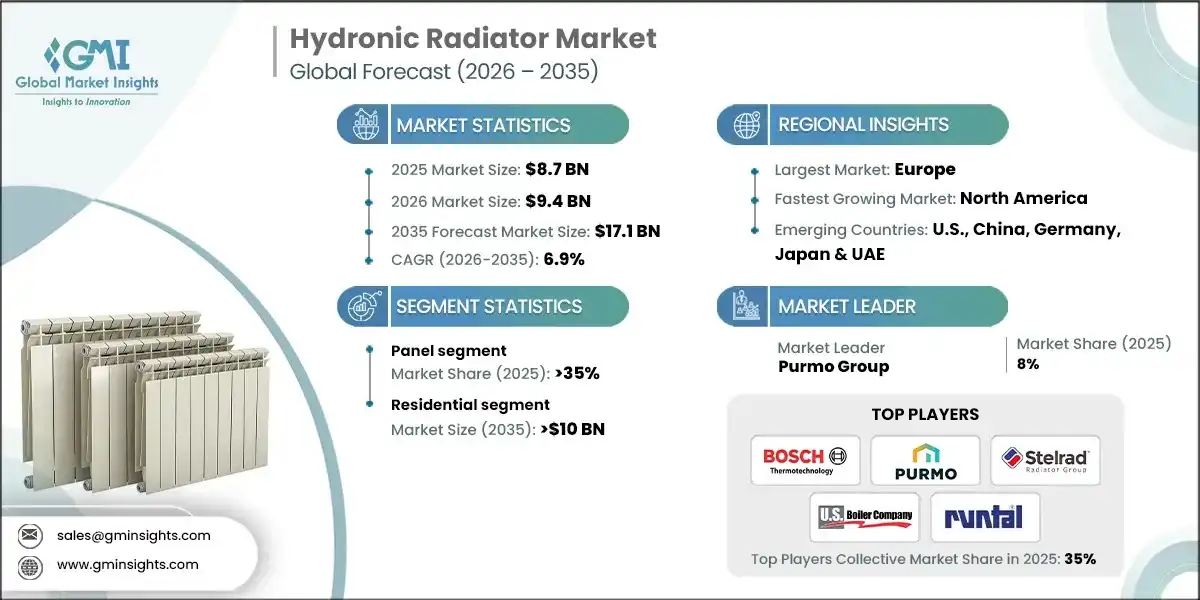
The hydronic radiator market was estimated at USD 8.7 billion in 2025. The market is expected to grow from USD 9.4 billion in 2026 to USD 17.1 billion by 2035, at a CAGR of 6.9%, according to a recent study by Global Market Insights Inc.
Hydronic Radiator Market Key Takeaways
Market Size & Growth
- 2025 Market Size: USD 8.7 Billion
- 2026 Market Size: USD 9.4 Billion
- 2035 Forecast Market Size: USD 17.1 Billion
- CAGR (2026–2035): 6.9%
Key Market Drivers
- Stringent government policies and standards toward GHG emissions.
- Increasing focus toward energy efficiency.
- Technological advancements.
Challenges
- Rising demand for underfloor heating.
Opportunity
- Smart home and building connectivity.
- Sustainability-driven product innovation.
- Design-focused and space-saving solutions.
- Integration with renewable energy systems.
Key Players
- Market Leader: Purmo Group led with over 8% market share in 2025.
- Leading Players: Top 5 players in this market include Purmo Group, Bosch Thermotechnology, Stelrad, U.S. Boiler Company, Runtal North America, which collectively held a market share of 35% in 2025.
Get Market Insights & Growth Opportunities
- The increasing focus on environmental responsibility along with growing awareness around energy efficiency will strengthen the industry outlook. Continuous advancements in technology coupled with exceptional adaptability and superior comfort management will drive broader acceptance of these products across a wide multitude of applications.
- A hydronic radiator is a heating component that operates by circulating hot water or steam to generate warmth. It functions within a hydronic heating system, where water is heated in a boiler and then distributed through a network of pipes connected to installed radiators.
- The modern radiator designs are increasingly focused on blending functionality with aesthetics, creating heating solutions that complement contemporary interiors. Manufacturers are introducing sleek profiles, minimalist finishes, and a wide range of color options to cater to design conscious homeowners.
- For instance, in April 2025, Stelrad Group, a major UK-based steel panel radiator manufacturer, unveiled its strategy to expand into premium and energy-efficient radiator solutions. The plan includes leveraging its low-cost, flexible manufacturing base in Europe and Turkey to meet growing demand for decarbonization-ready heating systems across the UK and continental Europe.
- The hydronic radiator market was valued at USD 7 billion in 2022 and grew at a CAGR of over 3.5% through 2025. Growing emphasis on energy-efficient heating systems in line with stringent environmental regulations will positively sway the industry potential.
- Government-backed incentive programs designed to encourage sustainable practices have accelerated the uptake of these systems. Initiatives including tax benefits and allowances have motivated property owners to invest in renewable heating options, further boosting the business scenario.
- Energy efficiency has become a central theme in the evolution of hydronic radiators, driven by sustainability goals and rising energy costs. Advances in heat transfer technology, improved water circulation systems, and compatibility with low-temperature heating sources will stimulate business dynamics.
- These developments allow radiators to deliver consistent warmth while reducing energy consumption, making them an attractive choice for eco-conscious consumers. The integration of smart controls and thermostatic valves enhances efficiency by enabling precise temperature regulation and adaptive heating schedules, contributing to overall energy savings.
- For citation, according to the International Energy Agency (IEA), investments in building energy efficiency surged by nearly 14%, surpassing USD 250 billion in 2022. This growth reflects accelerating global efforts to enhance sustainability, reduce operational costs, and meet stringent environmental standards through advanced energy-efficient technologies.
To get key market trends
Hydronic Radiator Market Trends
- The industry is positioned for robust growth, propelled by a strategic shift toward energy-efficient technologies, heightened environmental responsibility, and tightening regulatory mandates. Accelerating demand for sustainable heating solutions coupled with an increased focus on indoor air quality and occupant well-being will propel the business growth.
- Governments across regions are tightening climate frameworks that directly influence heating technology choices in buildings, pushing stakeholders toward cleaner, lower-carbon pathways that align with national and city-level decarbonization roadmaps.
- Compliance pressure is reshaping procurement criteria, design practices, and lifecycle planning, as building owners and developers recalibrate asset strategies to align with emission thresholds, mandatory reporting obligations, and evolving regulatory frameworks. Performance-based building codes and stricter compliance mandates are accelerating the adoption of high-efficiency solutions, thereby significantly enhancing industry outlook.
- For instance, in April 2024, the U.S. DOE confirmed compliance with Congress’s directive to reduce emissions from new and renovated federal buildings. This initiative, under the Clean Energy for New Federal Buildings and Renovations Rule, is designed to lower pollution, enhance air quality, and deliver cost savings through the adoption of energy-efficient technologies and sustainable building practices.
- Energy efficiency has evolved from a cost-saving preference into a core strategic pillar for building portfolios, influencing specification decisions, retrofit pipelines, and operational management across various segments. Construction and renovation activities in conjunction with government-backed funding initiatives and economic stimulus programs will drive the business momentum.
- Rising energy prices, tightening corporate sustainability commitments, and more rigorous tenant expectations converge to make efficiency gains a central metric for heating systems, elevating solutions that deliver strong seasonal performance, fast response, and lower total energy draw without sacrificing comfort.
- Stakeholders now look beyond nameplate ratings, emphasizing controllability, zoning capability, hydraulic balancing, and intelligent modulation that minimize losses and align heat delivery with real demand profiles throughout changing occupancy patterns.
- For illustration, in December 2025, Zehnder Group finalized the modernization of its French radiator facility, installing three new automated production lines for Clarian models. This upgrade boosts capacity by 30% and positions the plant as the sole European site for custom-made flat-tube radiators, employing 160 staff and supporting Zehnder’s long-term growth strategy.
- Rapid innovation in heating technologies is transforming product design, system architecture, and user experience, with digitalization, materials engineering, and integration with low-temperature sources redefining expectations for performance and reliability.
- New heat exchanger geometries, improved flow management, and sophisticated control logic elevate thermal transfer while mitigating noise and stratification. Intelligent platforms enable predictive maintenance, remote tuning, and data-driven optimization, bringing clarity to operations and enabling technicians to address issues before they cascade into downtime or excess energy use.
Hydronic Radiator Market Analysis
Learn more about the key segments shaping this market
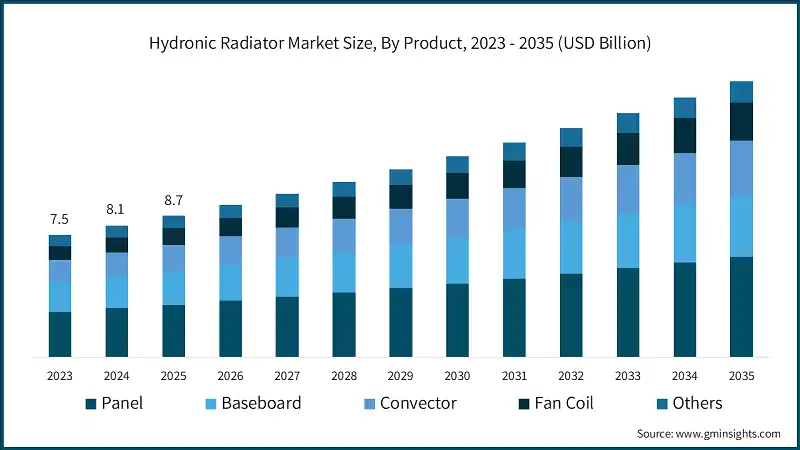
- Based on product, the industry is segmented into panel, baseboard, convector, fan coil, and others. The panel hydronic radiator market holds a share of over 35% in 2025 and is set to grow at a CAGR of 6.5% from 2026 to 2035.
- The growth is driven by a strong design-led evolution that seamlessly integrates high thermal efficiency with architectural minimalism. Manufacturers are increasingly prioritizing slim profiles, clean lines, and unobtrusive installations that align with contemporary interior aesthetics, enabling heating solutions to complement modern residential and commercial spaces without compromising performance, comfort, or energy efficiency standards.
- The industry participants are expanding finish palettes, offering matte textures, powder-coated colorways, and corrosion-resistant treatments that hold up in varied humidity conditions while complementing premium decor. Moreover, rising preference for aesthetic and space-saving designs in association with modern architectural trends will elevate the business opportunities.
- The baseboard hydronic radiator market is set to surpass USD 3.5 billion by 2035. These radiators are finding renewed relevance in renovation-heavy markets where quick installation, low-profile appearance, and minimal structural intervention are decisive advantages for property owners and contractors.
- For citation, EV adoption is accelerating in emerging markets including India and China, driven by significant price reductions and supportive policies. By the end of 2024, India recorded a 20% surge in electric car sales, surpassing 80,000 units, which is fueling demand for advanced energy infrastructure, including efficient panel-based heating systems.
- Convector hydronic radiator market was estimated at USD 1.6 billion in 2025. These systems are progressing through targeted enhancements in airflow optimization and heat exchange surface design. The focus is on achieving faster thermal response times and higher output density, enabling consistent and uniform heat delivery in demanding spaces. This approach supports efficient temperature control while eliminating the need for bulky equipment, making solutions more adaptable to compact and performance-critical environments.
- The fan coil hydronic radiator market will witness a CAGR of over 8% by 2035. These units are evolving into highly configurable comfort platforms that combine hydronic efficiency with sophisticated air-side control, enabled by quieter fans, variable-speed drives, and smarter control electronics that deliver precision across diverse occupancy profiles.
- For instance, at COP28 this year, nearly 200 nations endorsed a landmark agreement to accelerate global energy efficiency improvements by 2030. This commitment is expected to drive large-scale decarbonization, foster economic growth, diversify energy sources, and spur innovation in operational efficiency across industries worldwide.
Learn more about the key segments shaping this market
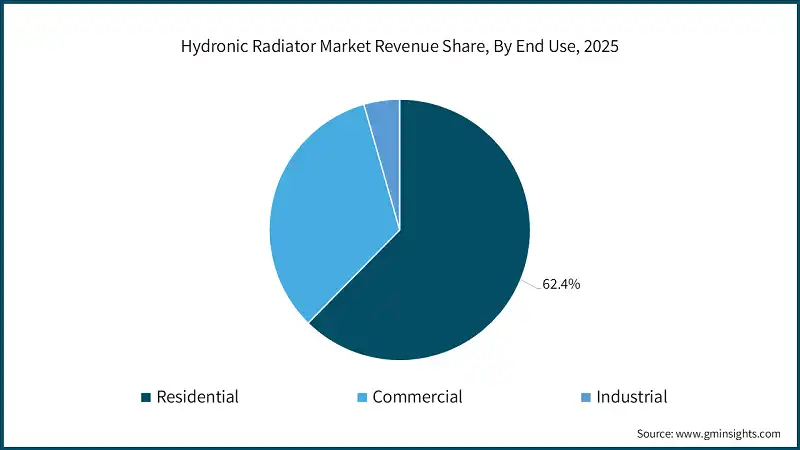
- Based on end use, the industry is divided into residential, commercial and industrial. The residential hydronic radiator market holds a share of 62.4% in 2025 and is set to surpass USD 10 billion by 2035. Heightened awareness around energy conservation is prompting homeowners to explore advanced heating solutions, driving strong demand for these units.
- The growing integration of smart home technologies coupled with the desire for superior comfort and precise climate control is accelerating business expansion. Rising home renovation activity in tandem with the seamless incorporation of these systems with solar energy solutions will escalate the industry landscape.
- The commercial application will witness a CAGR of over 6.5% by 2035. These facilities prioritize dependable comfort, controllability, and lifecycle economics, driving investment in hydronic systems that integrate with building automation, support granular zoning, and align with stringent energy and emissions targets across offices, hospitality, healthcare, education, and retail.
- For instance, in December 2024, the European Commission updated energy performance regulations for non-residential buildings, enforcing progressively stricter minimum efficiency standards. These new requirements aim to elevate energy performance across the building portfolio, driving upgrades in insulation, HVAC systems, and technology integration.
- The industrial hydronic radiator segment was estimated at USD 386.8 million in 2025. These facilities demand heating solutions that deliver durability, operational safety, and consistent thermal performance. As a result, hydronic systems are increasingly designed around robust emitters and advanced control architectures capable of managing wide thermal loads, operating reliably in harsh industrial environments, and sustaining high uptime requirements across manufacturing plants, logistics centers, and specialized workshop facilities.
Looking for region specific data?
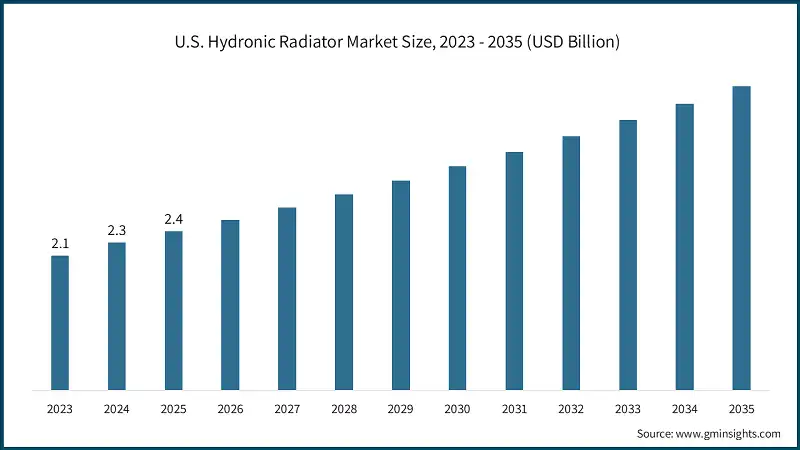
- The U.S. dominated the hydronic radiator market in North America with over 75% share in 2025 and generated above USD 2.4 billion in revenue. Growing inclination toward low-temperature heating systems coupled with compatibility for renewable energy sources will enhance the country scenario.
- For instance, in 2025, the U.S. HUD allocated USD 35.2 billion over 11% of its total USD 296.2 billion budget toward strategic initiatives focused on community revitalization, affordable housing development, and urban infrastructure enhancement. This significant investment underscores HUD’s commitment to driving sustainable growth and addressing critical housing challenges.
- The North America hydronic radiator market is projected to surge over USD 5.5 billion by 2035. Rising preference for aesthetically refined and space-saving radiators, coupled with continuous innovation in lightweight aluminum and steel designs that deliver enhanced heat output and efficiency, is expected to significantly strengthen the industry’s growth.
- The Europe hydronic radiator industry is set to grow at a rate of over 7.5% by 2035. The industry is being propelled by advances in modern control technologies and their seamless compatibility with smart home ecosystems. At the same time, a stronger emphasis on lowering lifecycle costs aligned with sustainable building & energy-efficient construction practices, is set to reinforce the business prospects.
- For citation, in January 2024, Stelrad delivered a major energy-efficiency upgrade at Barnsley Hospital, South Yorkshire, by installing over 300 K3 radiators featuring a triple-panel, triple-fin design optimized for low-temperature heating systems. This initiative accompanied the replacement of traditional gas boilers with air-source heat pumps, significantly improving sustainability. Funded under the UK government’s decarbonization program, the project aims to reduce emissions and operational costs across public buildings.
- The Asia Pacific hydronic radiator market was valued at USD 2.5 billion in 2025. The growing pace of urbanization, alongside expanding residential construction activity, is expected to significantly boost demand for these units. In addition, the increasing adoption of renewable energy systems, supported by rising disposable incomes, will further influence the overall business dynamics.
- For citation, in January 2024, severe winter conditions across Scandinavia drove temperatures sharply lower, resulting in a significant surge in demand for heating equipment. This spike underscores the critical role of reliable heating solutions in mitigating weather-related risks and highlights growth opportunities for manufacturers and suppliers in the region.
- Ongoing technological advancement in heating systems coupled with urban infrastructure development will foster the Middle East & Africa hydronic radiator industry. Additionally, the adoption of smart control technologies and IoT-enabled solutions is set to improve operational efficiency while enhancing user comfort and convenience, which in turn will augment the industry landscape.
- Latin America’s hydronic radiator market is evolving on the back of macroeconomic stabilization, increasing urban density, and stricter energy-efficiency requirements in buildings. A growing emphasis on lowering operating expenses, combined with wider adoption of energy conservation initiatives, is driving greater acceptance of heating systems.
Hydronic Radiator Market Share
- The top 5 players in hydronic radiator industry Bosch Thermotechnology, Purmo Group, Stelrad, U.S. Boiler Company, and Runtal North America contribute around 35% of the market share in 2025.
- The industry is characterized by a steady, efficiency-driven demand profile, shaped by long replacement cycles, regulatory influence, and gradual technological refinement rather than rapid disruption. Market growth is largely retrofit-led, supported by tightening energy efficiency norms, decarbonization goals, and the shift toward low-temperature heating systems compatible with heat pumps and condensing boilers.
- Innovations are increasingly centered on IoT-enabled controls, smart automation features, and enhanced connectivity with home management systems, enabling precise temperature regulation and energy optimization. Manufacturers are also focusing on high-efficiency designs compatible with low-temperature heating sources including solar thermal systems, reinforcing sustainability goals and compliance with stringent energy standards.
- Bosch Thermotechnology delivers advanced hydronic radiator solutions engineered for superior energy efficiency and smart functionality. Its portfolio emphasizes integration with IoT-enabled controls, compatibility with renewable energy systems, and high-performance designs that meet stringent sustainability standards across residential and commercial applications.
- Purmo Group offers a comprehensive range of hydronic radiators focused on combining modern aesthetics with cutting-edge thermal performance. The company’s products feature lightweight materials, advanced heat transfer technology, and seamless integration with smart home platforms, catering to evolving consumer preferences for comfort and efficiency.
- Stelrad specializes in high-quality hydronic radiators designed for durability, energy savings, and contemporary styling. The product portfolio features advanced panel configurations, precise thermal regulation, and seamless integration with low-temperature heating systems, delivering efficient and reliable performance across both new construction and renovation applications.
- U.S. Boiler Company provides robust hydronic radiator solutions tailored for reliability and operational efficiency. The company focuses on advanced engineering, modular configurations, and smart control integration, enabling precise heat management and compliance with modern energy standards in residential and light commercial settings.
- Runtal North America delivers premium hydronic radiators that combine sleek, space-saving designs with exceptional thermal efficiency. Its offerings include custom finishes, advanced heat distribution technology, and smart connectivity features, making them ideal for high-end residential and architectural applications where design and performance converge.
Hydronic Radiator Market Companies
Major players operating in the hydronic radiator industry are:
- Advanced Hydronics
- Bosch Thermotechnology
- Cambro Hydronic Heating
- Chappee
- De’Longhi Appliances
- Embassy Industries
- Fondital
- Governale Company
- Haverland
- Henrad
- Hudson Reed
- IRSAP
- Jaga
- KORADO
- KERMI
- Myson
- Purmo Group
- Runtal North America
- Seltron
- Stelrad
- U.S. Boiler Company
- VASCO
- WISELIVING
- Zehnder Group
- Bosch Thermotechnology reported strong performance in fiscal year 2024, achieving sales of approximately USD 3.3 billion. The company continues to strengthen its position in the global heating and hot water solutions market, driven by innovation in energy-efficient technologies and growing demand for sustainable systems. Strategic investments in smart heating solutions and integration with renewable energy platforms have further reinforced its competitive edge.
- U.S. Boiler’s parent company, Burnham Holdings, reported revenues of USD 167 million during the first nine months of 2025, supported by steady demand for heating solutions. Moreover, gross profit for the same period reached USD 36.5 million, reflecting operational efficiency and disciplined cost management.
- Stelrad posted revenues of approximately USD 159.4 million during the first half of 2025, supported by steady demand for heating solutions across key markets. EBITDA for the same period reached USD 25.5 million, reflecting strong operational performance and disciplined cost management. The company continues to focus on product innovation and strategic expansion to reinforce its leadership in the radiator segment.
Hydronic Radiator Market Report Attributes
| Key Takeaway | Details |
|---|---|
| Market Size & Growth | |
| Base Year | 2025 |
| Market Size in 2025 | USD 8.7 Billion |
| Market Size in 2026 | USD 9.4 Billion |
| Forecast Period 2026-2035 CAGR | 6.9% |
| Market Size in 2035 | USD 17.1 Billion |
| Key Market Trends | |
| Drivers | Impact |
| Stringent government policies and standards toward GHG emissions | Stringent regulations targeting greenhouse gas emissions are accelerating the transition to cleaner heating technologies. These policies are pushing manufacturers and businesses to adopt low-emission systems that align with sustainability objectives. |
| Increasing focus toward energy efficiency | Rising emphasis on reducing energy consumption is driving demand for heating solutions that deliver maximum performance with minimal waste. This trend is encouraging the adoption of advanced systems designed for optimal efficiency. |
| Technological advancements | Continuous innovation in heating technology is enhancing system performance, reliability, and user control. Integration of smart features, improved heat transfer mechanisms, and integration with renewable sources are reshaping the business landscape. |
| Pitfalls & Challenges | Impact |
| Rising demand for underfloor heating | The growing preference for underfloor heating can divert attention and investment away from traditional radiator systems, potentially reducing market share for hydronic radiators and creating competitive pressure in the heating solutions segment. |
| Opportunities: | Impact |
| Smart home and building connectivity | The rise of smart home ecosystems and intelligent building platforms is driving demand for IoT-enabled hydronic radiators with remote access, predictive maintenance, and integration into centralized energy management systems. |
| Sustainability-driven product innovation | Increasing focus on green building certifications and carbon reduction goals is creating opportunities for radiators designed for low-temperature operation, advanced heat transfer, and eco-friendly materials. |
| Design-focused and space-saving solutions | Urbanization and modern architectural trends are boosting demand for slim-profile, vertical, and customizable radiators that combine aesthetics with high thermal efficiency for compact spaces. |
| Integration with renewable energy systems | Growing adoption of solar thermal and heat pump technologies is opening avenues for hydronic radiators engineered for compatibility with renewable sources, supporting energy savings and decarbonization targets. |
| Market Leaders (2025) | |
| Market Leaders |
8% |
| Top Players |
|
| Competitive Edge |
|
| Regional Insights | |
| Largest Market | Europe |
| Fastest Growing Market | North America |
| Emerging Country | U.S., China, Germany, Japan & UAE |
| Future Outlook |
|
What are the growth opportunities in this market?
Hydronic Radiator Industry News
- In December 2025, Hudson Technologies announced the strategic acquisition of Refrigerants, an EPA-certified reclaimer and distributor, for USD 2.5 million. This move strengthens Hudson’s refrigerant lifecycle management capabilities and expands its presence in key markets, ensuring a steady supply of recovered refrigerants critical for sustainable HVACR practices and aftermarket growth.
- In September 2025, Stelrad’s Green Compact hydronic radiator series leverages XCarb recycled and renewably produced steel, cutting CO2 emissions by 66% compared to conventional steelmaking. Backed by an ISO 14025-compliant Environmental Product Declaration, this range aligns with its sustainability goals, offering 60 horizontal models that are 100% recyclable and packaged without plastic delivering both performance and environmental responsibility.
- In April 2025, Zehnder Group has announced a strategic consolidation of its flat-tube radiator manufacturing operations, shifting production from Switzerland to its facility in Vaux-Andigny, France. This move is intended to streamline manufacturing, enhance operational efficiency, and optimize capacity utilization, while strengthening the company’s European production footprint and supporting cost competitiveness across its hydronic radiator portfolio.
- In October 2024, Purmo Group enhanced its climate solutions portfolio through the acquisition of Unitherm Heating Systems, a Dublin-based company specializing in advanced heat pump technology. The company provides comprehensive services, including system design, supply, installation, and maintenance for residential and commercial applications. Its product range encompasses heat pumps of varying capacities, complemented by integrated heating and ventilation solutions.
The hydronic radiator market research report includes in-depth coverage of the industry with estimates & forecast in terms of revenue (USD Million) from 2022 to 2035, for the following segments:
Market, By Product
- Panel
- Baseboard
- Convector
- Fan coil
- Others
Market, By End Use
- Residential
- Commercial
- Industrial
The above information has been provided for the following regions and countries:
- North America
- U.S.
- Canada
- Europe
- UK
- Germany
- France
- Italy
- Spain
- Finland
- Denmark
- Austria
- Belgium
- Asia Pacific
- China
- Japan
- India
- South Korea
- Australia
- Middle East & Africa
- Saudi Arabia
- UAE
- Turkey
- South Africa
- Latin America
- Brazil
- Argentina
- Mexico
Frequently Asked Question(FAQ) :
What was the market size of the hydronic radiator in 2025?
The market size was USD 8.7 billion in 2025, with a CAGR of 6.9% expected through 2035. Increasing focus on environmental responsibility and energy efficiency is driving market growth.
What is the projected value of the hydronic radiator market by 2035?
The market is poised to reach USD 17.1 billion by 2035, driven by advancements in technology, adaptability, and superior comfort management.
What is the expected size of the hydronic radiator industry in 2026?
The market size is projected to reach USD 9.4 billion in 2026.
What was the market share of the panel hydronic radiator segment in 2025?
The panel hydronic radiator segment held over 35% of the market share in 2025 and is expected to grow at a CAGR of 6.5% till 2035.
What was the valuation of the residential hydronic radiator segment in 2025?
The residential hydronic radiator market accounted for 62.4% of the market share in 2025 and is set to surpass USD 10 billion by 2035.
What is the growth outlook for the U.S. hydronic radiator sector?
The U.S. dominated the North American market with over 75% share in 2025, generating more than USD 2.4 billion in revenue.
What are the upcoming trends in the hydronic radiator market?
Stricter regulations, energy-efficient technologies, digitalization with intelligent modulation and hydraulic balancing, low-temperature integration, advanced heat-exchanger designs, and predictive maintenance platforms.
Who are the key players in the hydronic radiator industry?
Key players include Advanced Hydronics, Bosch Thermotechnology, Cambro Hydronic Heating, Chappee, De’Longhi Appliances, Embassy Industries, Fondital, Governale Company, Haverland, Henrad, and Hudson Reed.
Hydronic Radiator Market Scope
Related Reports