Summary
Table of Content

Hybrid Textile Market
Get a free sample of this report
Form submitted successfully!
Error submitting form. Please try again.
Thank you!
Your inquiry has been received. Our team will reach out to you with the required details via email. To ensure that you don't miss their response, kindly remember to check your spam folder as well!
Request Sectional Data
Thank you!
Your inquiry has been received. Our team will reach out to you with the required details via email. To ensure that you don't miss their response, kindly remember to check your spam folder as well!
Form submitted successfully!
Error submitting form. Please try again.
Hybrid Textile Market Size
- The term hybrid textile describes a type of fabric material which creates new textile products through the combination of multiple fiber types and material components and various functional characteristics into one fabric design. The textiles achieve their goal of providing performance, comfort, durability and cost efficiency through their use of both natural materials and synthetic materials. The use of hybrid textiles extends to multiple fields because their fabrics provide better performance than traditional single-material fabrics which can only deliver one specific function.
- The demand for hybrid textile materials has grown because industries require materials which can deliver multiple performance capabilities without requiring new fiber development. The combination of strength and breathability and flexibility together with resistance properties creates hybrid textiles which allow manufacturers to create custom fabrics for specific end uses. This method allows manufacturers to create flexible products which can function in different markets including apparel and technical textiles and interior applications.
- The research on hybrid textiles focuses on fiber blending technique improvements and fabric engineering enhancement and manufacturing process development. The development of spinning and weaving and knitting and bonding technologies enables users to control both material combinations and structural performance in specific ways. The introduction of digital textile machinery together with process automation creates a system which enables hybrid textile manufacturing to achieve higher consistent production levels at scalable capacity while maintaining operational efficiency.
- Hybrid textiles achieve functional balance through their design which enables them to function in spaces which require both comfortable space and productive work. Natural fiber textiles combined with engineered materials can achieve better moisture control and strength and durability while keeping the material soft to the touch. The existing balance between these two factors enables the material to find applications in both regular clothes and special purpose textiles.
- The hybrid textiles now meet contemporary industry standards which require companies to focus on achieving resource efficiency and optimizing their material usage. The use of strategic fiber combinations enables manufacturers to decrease their dependency on individual raw materials while increasing their ability to create functional fabrics. The use of hybrid textiles in material design enables manufacturers to create products which meet their functional requirements while delivering multiple product benefits.
The global hybrid textile market was valued at USD 352.7 million in 2025. The market is expected to grow from USD 372.3 million in 2026 to USD 864.3 million in 2035, at a CAGR of 9.8% according to the latest report published by Global Market Insights Inc.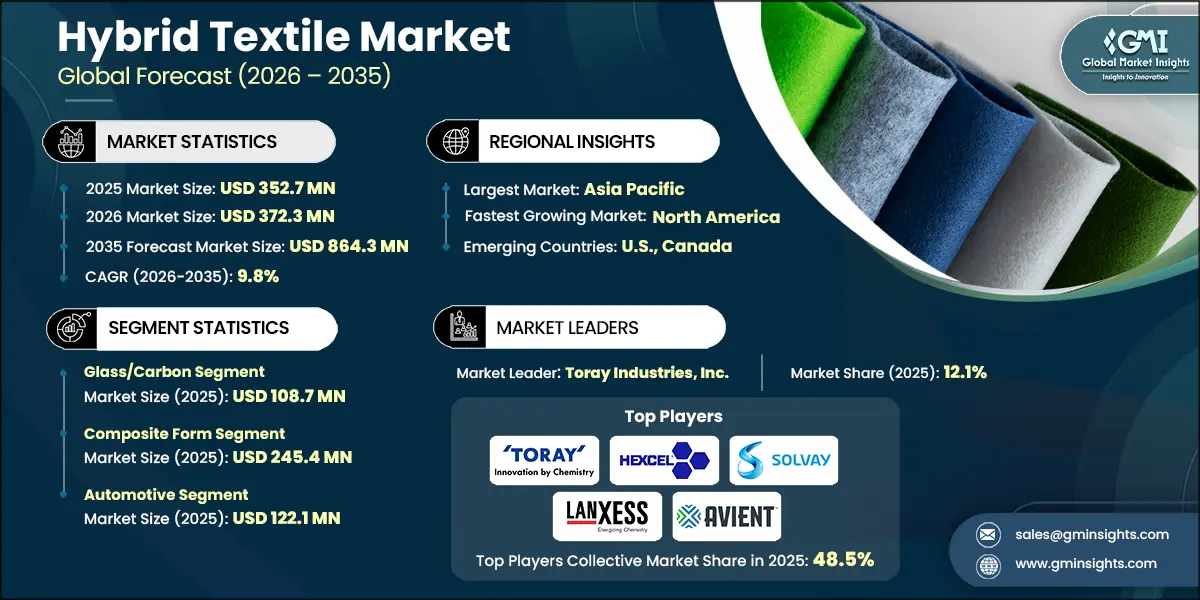
Hybrid Textile Market Key Takeaways
Market Size & Growth
- 2025 Market Size: USD 352.7 Million
- 2026 Market Size: USD 372.3 Million
- 2035 Forecast Market Size: USD 864.3 Million
- CAGR (2026–2035): 9.8%
Regional Dominance
- Largest Market: Asia Pacific
- Fastest Growing Region: North America
Key Market Drivers
- Increasing demand for multifunctional and performance-based textile materials.
- Expansion of technical textiles across diverse industrial applications.
- Rising focus on material efficiency and functional integration.
Challenges
- Complex manufacturing processes increase production coordination challenges.
- Higher development costs restrict adoption among cost-sensitive buyers.
Opportunity
- Integration of smart functionalities within hybrid textile structures.
- Growing use of hybrid textiles in product design.
Key Players
- Market Leader: Toray Industries, Inc. led with over 12.1% market share in 2025.
- Leading Players: Top 5 players in this market include Toray Industries, Hexcel Corporation, Solvay, LANXESS, Avient Corporation, which collectively held a market share of 48.5% in 2025.
Get Market Insights & Growth Opportunities
To get key market trends
Hybrid Textile Market Trends
- The main trend which defines hybrid textiles now involves manufacturers who utilize blended material structures to create products which deliver balanced performance. The manufacturing process combines fibers in specific ways to create a single fabric system which provides increased durability and comfort and functional capabilities.
- The rising demand for hybrid textile serves as a specific application which represents another major industry shift. The textile industry now creates fabrics which fulfill specific performance requirements for apparel and industrial and interior textile products instead of making general-purpose materials.
- The textile industry now uses process innovation to develop hybrid textiles which benefit from advances in spinning and bonding and fabric creation methods. The new technologies enable companies to manage various materials better while they achieve constant production output and product quality.
- Production approach emphasizes hybrid construction methods as a way to decrease material waste. The combination of fibers enables manufacturers to enhance material usage because they can achieve fabric performance balance while decreasing their reliance on resources.
- The design and usability requirements create ongoing changes which affect hybrid textile development. The fabric needs to function in different environments because its design requires multiple usage applications while maintaining comfort and long-lasting durability and flexibility.
Hybrid Textile Market Analysis
Learn more about the key segments shaping this market
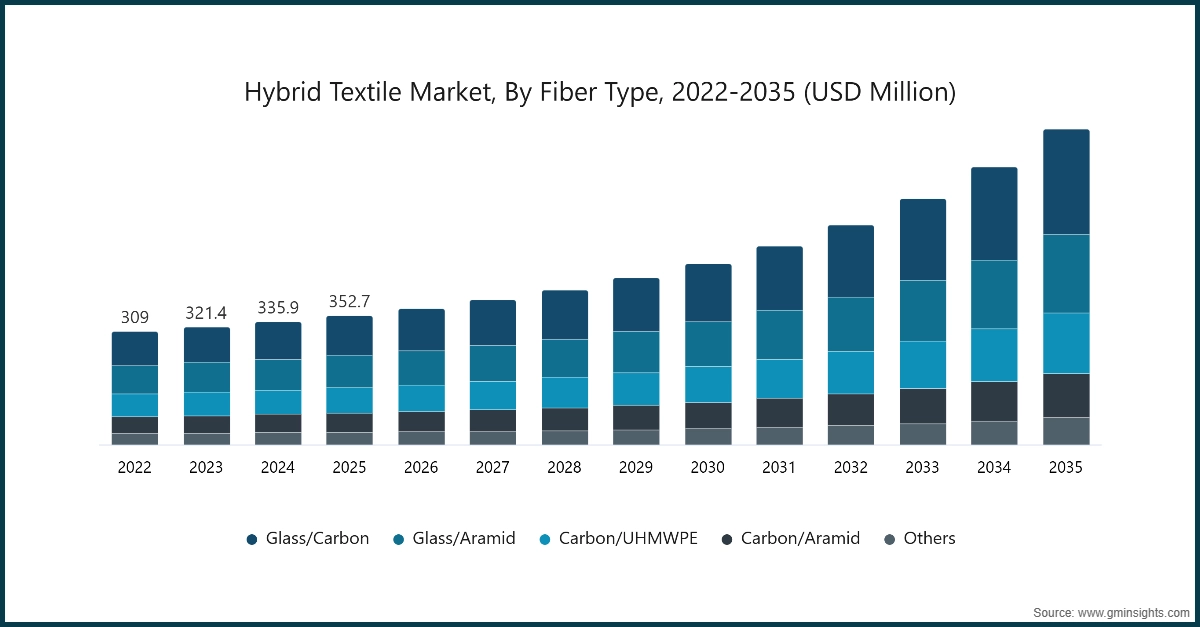
Based on fiber type, the market is segmented into glass/carbon, glass/aramid, carbon/UHMWPE, carbon/aramid and others. Glass/ Carbon holds the largest market value of USD 108.7 million in 2025.
- The usage of composite-form hybrid textiles is increasing because they provide strong structural properties, enable material combination, permit lightweight operations, and meet the requirements of advanced manufacturing processes which are used in transportation industrial components and high-performance technical applications throughout the world.
- The market for non-composite hybrid textiles maintains its demand because these materials provide flexibility and affordable cost and comfortable performance and straightforward processing, which enables their application in apparel production and interior design and filtration systems and functional textile products that need specific performance characteristics.
The hybrid textile market by form is segmented into composite form and non-composite form. Composite form holds the largest market value of USD 245.4 million in 2025.
- The glass/carbon hybrid textiles exhibit expansion because they provide a combination of stiffness and strength properties which maintains their cost efficiency for structural and industrial applications. The glass/aramid combinations maintain steady demand because they deliver impact resistance and durability which serves transportation systems and protective systems and vibration-sensitive environments.
- The carbon/UHMWPE and carbon/aramid hybrid materials establish themselves as important for lightweight applications which require strength and energy absorption and thermal performance in aerospace and defense and high-performance consumer products. The basalt/carbon and glass/nylon blends experience slow market growth because material diversification and durability requirements and cost-performance optimization for construction and specialized textile applications drive their demand.
Learn more about the key segments shaping this market
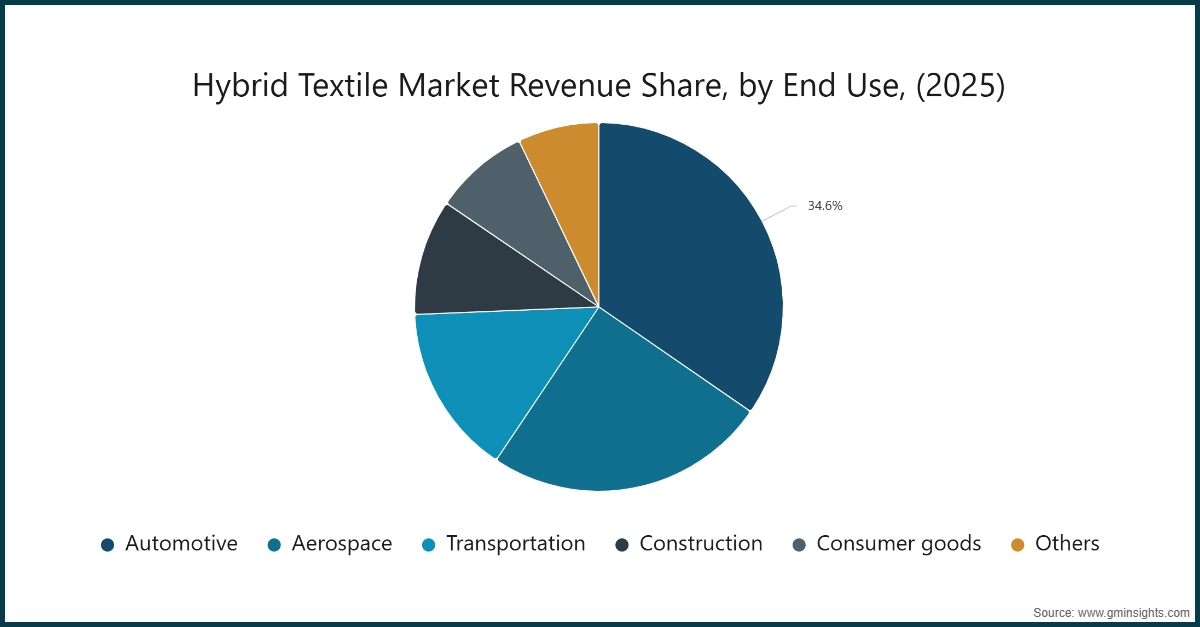
The hybrid textile market by end use is segmented into automotive, aerospace, transportation, construction, consumer goods and others. Automotive holds the largest market value of USD 122.1 million in 2025.
- Automotive applications show growing use of hybrid textiles to support lightweight structures, durability, and integration of multifunctional materials in vehicle interiors and structural components. Aerospace applications continue adopting hybrid textiles for strength‑to‑weight balance, thermal performance, and structural reliability in interior, secondary, and selected load‑bearing components. The transportation sectors including rail and commercial mobility have started using hybrid textiles because these materials provide better vibration control and increased durability and higher material efficiency for their interior panels and structural elements.
- Hybrid textiles are being used in construction applications to enhance infrastructure and architectural components through better material durability and improved long-term performance of building materials. Hybrid textiles benefit consumer products through better comfort and flexibility with increased durability which meets both performance needs and functional product design requirements. Hybrid textiles are used by other sectors such as energy and marine to provide materials which can withstand corrosion while maintaining structural strength in extreme environmental conditions.
Looking for region specific data?
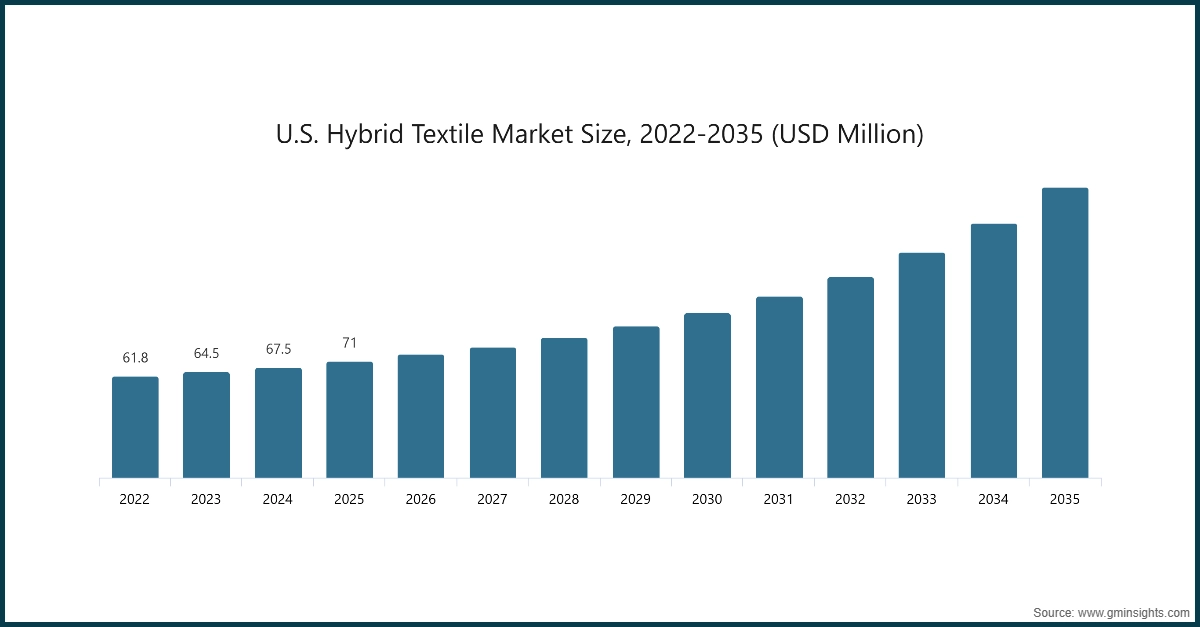
- North American market shows an increasing pattern of hybrid textile usage because multiple industries require different functions and new material technologies emerge. Textile manufacturers focus on achieving equal levels of durability and comfort and efficiency for their three different product lines which include apparel and industrial textiles and interior textiles. The United States market adopts hybrid textiles for both technical apparel and industrial applications because performance standards demand the use of multiple material features which follow current development trends.
The market in the Europe is expected to experience significant and promising growth from USD 83.6 million in 2025 to USD 196.9 million in 2035.
- Europe hybrid textile patterns show a need for functional performance and efficient manufacturing processes and flexible material combinations in the fashion industry and automotive sector and home textile production. The company develops solutions which combine natural materials with engineered materials to fulfill diverse customer requirements. German industries use hybrid textiles because they require precise manufacturing and dependable performance for their multi-material fabric systems which serve essential production fields.
The hybrid textile market in Asia Pacific is expected to experience increasing growth from USD 118.5 million in 2025 to USD 305.8 million in 2035.
- Asia Pacific region experiences increasing interest in hybrid textiles because manufacturers need to reduce costs while producing textile products for various business sectors which require different usage purposes. The area enables textile researchers to build scalable manufacturing systems which enable them to test new materials through combined textile material designs. Hybrid textiles find application in both apparel and industrial sectors in China through its national production network which connects supply chain processes and implements ongoing improvements to production methods.
Middle East & Africa hybrid textile market is expected to experience significant and promising growth from USD 19 million in 2025 to USD 42.5 million in 2035.
- In the Middle East and Africa, the development of hybrid textile applications emphasizes three main requirements which include enduring materials and environmental adaptability and functional capabilities which apply to distinct use cases. The area requires textiles which can serve three main purposes which include infrastructure development and hospitality services and industrial plant operations. Hybrid textiles in the United Arab Emirates function as interior design elements and technical components which need reliable performance and design versatility to meet building standards for all industrial and commercial uses.
Latin America is expected to experience significant and increasing growth from USD 33.6 million to USD 76.8 million in 2035.
- In Latin America the development of hybrid textile applications results from two factors which include the establishment of industrial operations and the development of local manufacturing facilities and the rising demand for functional textile products. The producers create versatile fabrics which can be used in different weather situations and various applications. Brazilian fashion and interior design markets use hybrid textiles because their combination of comfort and durability helps domestic manufacturers meet emerging consumer demands throughout the country.
Hybrid Textile Market Share
- Hybrid textile industry are moderately consolidated with players like Toray Industries, Inc., Hexcel Corporation, Solvay, LANXESS and Avient Corporation holding 48.5% market share and Barilla Group being the market leader holding the market share of 12.1% in 2025.
- The organizations maintain their market edge through ongoing financial commitments which fund their product development activities. The new product developments help the company create distinct products which maintain brand value throughout intense market competition.
- Competitiveness depends on organizations developing strong supply chain management systems. Companies achieve price stability and product delivery through their ability to procure raw materials efficiently while they control distribution expenses.
- Companies use brand development and strategic marketing activities to establish their market position. The companies use targeted advertising and promotional campaigns and retailer partnerships to improve their market presence while they create customer loyalty and establish brand recognition in important markets.
- The company achieves sustainable competitive advantage through its operational efficiency and technological progress. The combination of automation and quality control systems and data-driven demand forecasting methods enables businesses to increase productivity while they decrease waste and maintain product quality.
- The companies make distribution channel expansion and geographic growth their primary strategic objectives. Businesses can enter new consumer markets through emerging market entry and online retail expansion which decreases their reliance on existing customer markets.
Hybrid Textile Market Companies
Major players operating in the hybrid textile industry are:
- TORAY INDUSTRIES, INC.
- Avient Corporation
- COLAN AUSTRALIA
- Exel Fabric
- Hexcel Corporation
- LANXESS
- Quantum Fabric
- Rock West Fabric
- Solvay
- Talon Technology
- Urja Fabrics
Toray Industries, Inc operates as a materials enterprise which produces fibers and textiles and chemicals and advanced materials. The textile division of the company produces synthetic fibers and blended fabrics and composite textiles which incorporate performance features for use in industrial and technical and clothing products. The company maintains vertically integrated operations which enable material research and production and widespread distribution to various industry sectors.
Hexcel Corporation provides advanced material solutions which include textile-based reinforcements and composite fabrics. The company produces industrial textile structures which include woven and nonwoven and multi-material textile structures for use in transportation and aerospace and industrial applications. The company provides hybrid textile solutions through its engineered fabric designs which integrate multiple fiber systems to meet both structural and performance requirements.
Solvay operates in the field of specialty materials and chemicals through its three business divisions which include polymers and composites and textile-related materials. The company offers textile products through its three product categories which include woven composite fabrics and resin-impregnated textiles and multi-material fabric systems which serve industrial and technical purposes. The company establishes material relationships which enable process functions and maintain performance standards throughout textile-composite production networks.
LANXESS operates as a specialized chemical company which produces thermoplastic materials and continuous-fiber textile products. The company produces hybrid textile materials through its manufacturing processes which include fabric-reinforced thermoplastic sheets and multi-material textile structures required for lightweight and structural applications. The company provides material engineering services which enable textile-composite integration through its development of processing methods and application-specific material development.
Avient Corporation provides polymer-based materials which include additives and specialty solutions that enhance textile and fabric performance. The company supplies functional additives and color systems and ink technologies which help improve multi-fiber and blended textile products for the hybrid textile market. The applications of its offerings extend to apparel and industrial and technical textile markets which demand both material performance and customization.
Hybrid Textile Market Report Attributes
| Key Takeaway | Details |
|---|---|
| Market Size & Growth | |
| Base Year | 2025 |
| Market Size in 2025 | USD 352.7 Million |
| Market Size in 2026 | USD 372.3 Million |
| Forecast Period 2026-2035 CAGR | 9.8% |
| Market Size in 2035 | USD 864.3 Million |
| Key Market Trends | |
| Drivers | Impact |
| Increasing demand for multifunctional and performance-based textile materials | Demand rises as industries seek fabrics delivering combined strength, comfort, and functionality, enabling single textile solutions to meet multiple performance requirements across apparel, industrial, and interior applications and commercial usage. |
| Expansion of technical textiles across diverse industrial applications | Technical textile adoption supports hybrid materials by requiring properties like durability, flexibility, and resistance, which hybrid constructions can provide efficiently across transportation, construction, and protective use environments in varied sectors. |
| Rising focus on material efficiency and functional integration | Material efficiency encourages combining fibers to reduce waste while enhancing performance, allowing manufacturers to optimize raw material usage, improve lifecycle value, and balance functional outcomes without overengineering fabrics across processes. |
| Pitfalls & Challenges | Impact |
| Complex manufacturing processes increase production coordination challenges | Hybrid textile production involves coordination between different materials and processes, increasing operational complexity and requiring skilled workforce management to maintain consistency, efficiency, and controlled output throughout manufacturing stages worldwide facilities. |
| Higher development costs restrict adoption among cost-sensitive buyers | Development and processing expenses can limit hybrid textile adoption, especially where pricing pressures exist, making cost-benefit evaluation critical for manufacturers and buyers operating within budget-focused market segments across varied industries. |
| Opportunities: | Impact |
| Integration of smart functionalities within hybrid textile structures | Smart functionality integration enables hybrid textiles to support sensing, responsiveness, and adaptive behavior, opening use cases in areas requiring interaction between materials, environments, and end-user performance feedback systems and applications. |
| Growing use of hybrid textiles in product design | Product design increasingly incorporates hybrid textiles to balance functionality and resource use, supporting development approaches that improve material utilization, extend product lifespan, and address evolving environmental and operational considerations needs. |
| Market Leaders (2025) | |
| Market Leader |
Market share 12.1% |
| Top Players |
Collective market share of 48.5 % in 2025 |
| Competitive Edge |
|
| Regional Insights | |
| Largest Market | Asia Pacific |
| Fastest growing market | North America |
| Emerging countries | U.S., Canada |
| Future outlook |
|
What are the growth opportunities in this market?
Hybrid Textile Industry News
- In February 2026, Porcher Industries unveiled a new range of multilayer shape‑memory thermoplastic composite (TPC) hybrid textiles, targeting applications across sports, leisure, automotive, and medical sectors.
- In September 2025, Toray Industries (H.K.) Ltd. and MAS Holdings announced a joint venture named Toray MAS Apparel India to set up a new apparel manufacturing facility at the MAS Apparel Park in Bhuinpur, Odisha, India.
The hybrid textile market research report includes an in-depth coverage of the industry with estimates and forecast in terms of revenue in USD Million and volume in terms of kilo tons from 2022–2035 for the following segments:
Market, By Fiber Type
- Glass/carbon
- Glass/aramid
- Carbon/UHMWPE
- Carbon/aramid
- Others (basalt/carbon, glass/nylon)
Market, By Form
- Composite form
- Non-composite form
Market, By End Use
- Automotive
- Aerospace
- Transportation
- Construction
- Consumer goods
- Others (energy, marine)
The above information is provided for the following regions and countries:
- North America
- U.S.
- Canada
- Europe
- Germany
- UK
- France
- Spain
- Italy
- Rest of Europe
- Asia Pacific
- China
- India
- Japan
- Australia
- South Korea
- Rest of Asia Pacific
- Latin America
- Brazil
- Mexico
- Argentina
- Rest of Latin America
- Middle East and Africa
- Saudi Arabia
- South Africa
- UAE
- Rest of Middle East & Africa
Frequently Asked Question(FAQ) :
What is the market size of the hybrid textile in 2025?
The global hybrid textile market was valued at USD 352.7 million in 2025, driven by growing industrial demand for materials that deliver multiple performance capabilities including strength, breathability, flexibility, and resistance properties.
What is the projected value of the hybrid textile industry by 2035?
The hybrid textile market is projected to reach USD 864.3 million by 2035, supported by advancements in spinning, weaving, knitting, and bonding technologies.
What is the hybrid textile industry size in 2026?
The hybrid textile market size is projected to reach USD 372.3 million in 2026, fueled by increasing demand from automotive manufacturers for lightweight structural and interior components.
Which fiber type segment dominated the hybrid textile market in 2025?
The glass/carbon segment was valued at USD 108.7 million in 2025, driven by its combination of stiffness and strength properties at cost-efficient levels suited for structural and industrial applications.
Which form segment dominated the hybrid textile market in 2025?
The composite form segment was valued at USD 245.4 million in 2025, driven by its strong structural properties, material combination flexibility, lightweight operations, and compatibility with advanced manufacturing processes.
Which end-use segment dominated the hybrid textile market in 2025?
The automotive segment held the largest market value of USD 122.1 million in 2025, driven by growing use of hybrid textiles to support lightweight vehicle structures.
Which region leads the hybrid textile market?
The North American hybrid textile market is projected to hit USD 242.3 million by 2035, driven by rising demand across industries and advancements in material technologies.
What are the upcoming trends in the hybrid textile market?
Key trends include adoption of hybrid construction methods to decrease material waste and resource dependency, and growing focus on scalable manufacturing systems through digital textile machinery and process automation.
Who are the key players in the hybrid textile market?
Key players include Toray Industries Inc., Hexcel Corporation, Solvay, LANXESS, Avient Corporation, COLAN AUSTRALIA, Exel Fabric, Quantum Fabric, Rock West Fabric, Talon Technology, and Urja Fabrics.
Hybrid Textile Market Scope
Related Reports