Summary
Table of Content

Hybrid Hydrogen-Electric Powertrain Market
Get a free sample of this report
Form submitted successfully!
Error submitting form. Please try again.
Thank you!
Your inquiry has been received. Our team will reach out to you with the required details via email. To ensure that you don't miss their response, kindly remember to check your spam folder as well!
Request Sectional Data
Thank you!
Your inquiry has been received. Our team will reach out to you with the required details via email. To ensure that you don't miss their response, kindly remember to check your spam folder as well!
Form submitted successfully!
Error submitting form. Please try again.
Hybrid Hydrogen-Electric Powertrain Market Size
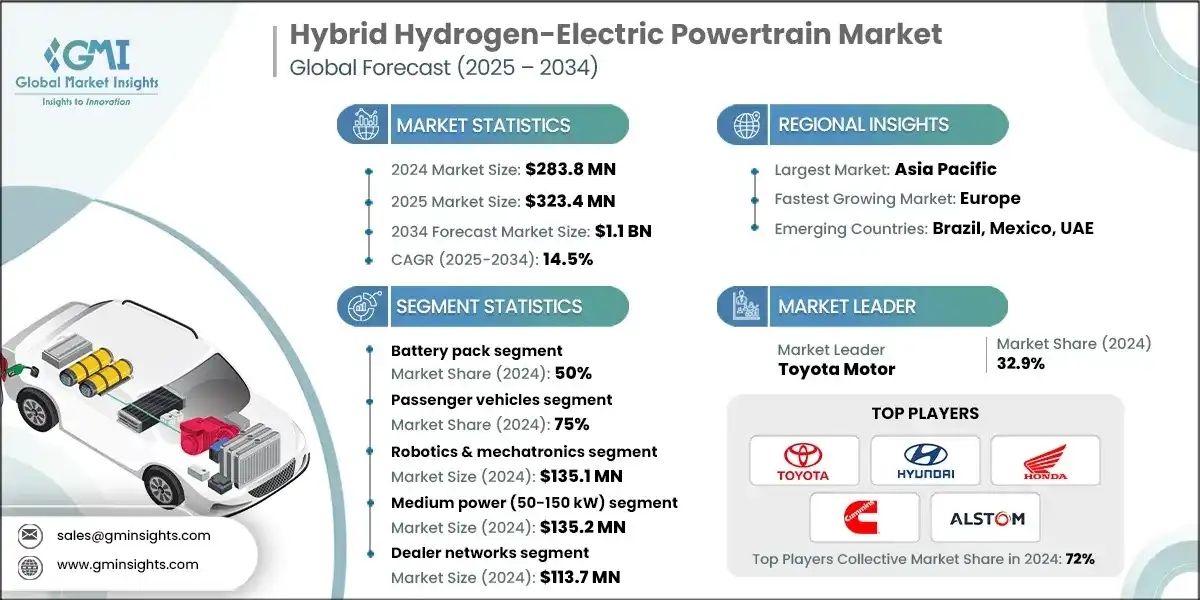
The global hybrid hydrogen electric powertrain market size was valued at USD 283.8 million in 2024. The market is expected to grow from USD 323.4 million in 2025 to USD 1.1 billion in 2034, at a CAGR of 14.5%, according to the latest report published by Global Market Insights Inc.
Hybrid Hydrogen-Electric Powertrain Market Key Takeaways
Market Size & Growth
- 2024 Market Size: USD 283.8 Million
- 2025 Market Size: USD 323.4 Million
- 2034 Forecast Market Size: USD 1.1 Billion
- CAGR (2025–2034): 14.5%
Regional Dominance
- Largest Market: Asia Pacific
- Fastest Growing Region: Europe
Key Market Drivers
- Government Decarbonization Policies & Hydrogen Strategies.
- Technology Maturation & Commercial Viability Demonstration.
- Heavy-Duty Application Advantages Over Battery-Only Solutions.
- Infrastructure Investment & Public-Private Partnerships.
Challenges
- High System Costs & Component Price Premiums.
- Limited Hydrogen Refueling Infrastructure.
Opportunity
- Rail Electrification Gap & Diesel Replacement Potential.
- Marine Decarbonization Requirements.
Key Players
- Market Leader: Toyota Motor led with over 32.9% market share in 2024.
- Leading Players: Top 5 players in this market include Toyota Motor, Hyundai Motor, Honda Motor, Cummins, Alstom SA, which collectively held a market share of 72% in 2024.
Get Market Insights & Growth Opportunities
The hybrid hydrogen-electric powertrain market is projected to witness significant growth, fueled by increasing demand for sustainable, high-efficiency automotive solutions and the global shift toward low-emission transportation. Rising adoption of hybrid hydrogen-electric powertrains across passenger, commercial, and specialty vehicles is being driven by the need for improved fuel efficiency, reduced carbon emissions, and compliance with stringent government regulations. Additionally, advancements in powertrain technology, lightweight materials, and energy storage solutions are accelerating market penetration.
Integration of smart manufacturing and Industry 4.0 initiatives is further supporting the market, as automotive OEMs and suppliers leverage IoT-enabled production monitoring, AI-driven process optimization, and predictive maintenance to enhance manufacturing efficiency. These technologies enable data-driven, fully automated production ecosystems, resulting in higher productivity, reduced downtime, enhanced quality control, and cost optimization, while facilitating a transition toward connected and intelligent manufacturing operations.
For instance, in 2024, leading automotive OEMs and technology providers, including Toyota Motor Corporation, Hyundai Motor Group, Ballard Power Systems, and Siemens, intensified deployment of AI-driven manufacturing and predictive analytics platforms to optimize powertrain production, improve component reliability, and streamline real-time process monitoring. These initiatives underscore the growing trend of smart, connected, and sustainable manufacturing frameworks in the hybrid hydrogen-electric powertrain market.
The market is also witnessing rapid technological advancements in fuel cell integration, high-performance electric motors, and energy management systems, driven by AI-enabled analytics, IoT connectivity, cloud-based factory platforms, and collaborative robotics. Increasing investment in interoperable automation systems, predictive maintenance tools, and secure digital integration is transforming the hybrid hydrogen-electric powertrain landscape, enabling faster, smarter, and greener production aligned with global decarbonization and net-zero emission targets.
To get key market trends
Hybrid Hydrogen-Electric Powertrain Market Trends
The demand for advanced hybrid hydrogen-electric powertrain solutions is increasingly driven by growing collaboration among OEMs, suppliers, technology vendors, and IT service providers to accelerate the adoption of efficient, scalable, and interoperable production and assembly platforms. Companies are leveraging shared expertise to optimize system integration, improve manufacturing efficiency, enhance component quality, and reduce time-to-market for next-generation hydrogen-electric powertrains. Key technologies include AI-driven predictive maintenance, IoT-enabled process monitoring, digital twin simulations, cloud-integrated platforms, and low-code/no-code configurability.
For instance, in 2024, Toyota and Siemens announced joint initiatives to implement enterprise-grade digital factory automation for hydrogen-electric powertrain production. These collaborations integrate AI-powered predictive analytics, real-time machine and process monitoring, energy optimization, and compliance tracking to improve operational efficiency, throughput, and scalability while supporting sustainability and regulatory objectives.
Regional localization of production systems is another emerging trend. Companies such as Hyundai and BMW are establishing regional deployment centers in Europe, North America, and Asia-Pacific to ensure powertrain systems meet local production standards, environmental regulations, and energy efficiency requirements. These strategies enhance responsiveness to OEMs, suppliers, and regulatory bodies while optimizing integration with existing manufacturing ecosystems.
The entry of emerging technology players offering modular, lightweight, and scalable powertrain solutions is gaining traction. Startups specializing in AI analytics, IoT-enabled sensors, fuel cell monitoring, and cloud-based production platforms are introducing solutions that improve component accuracy, accelerate operational reporting, and support innovative manufacturing initiatives, including hydrogen-electric vehicle assembly, energy efficiency optimization, and predictive quality control.
Finally, the development of modular and interoperable system architectures is enabling providers to deliver production solutions compatible with diverse powertrain types, multi-vendor equipment, and enterprise IT systems. For example, Cummins and Alstom are deploying modular hydrogen-electric powertrain manufacturing platforms that support multiple vehicle categories, production scales, and regional compliance requirements, reducing integration costs, shortening deployment timelines, and enabling reliable, efficient, and future-ready hydrogen-electric powertrain production ecosystems.
Hybrid Hydrogen-Electric Powertrain Market Analysis
Learn more about the key segments shaping this market
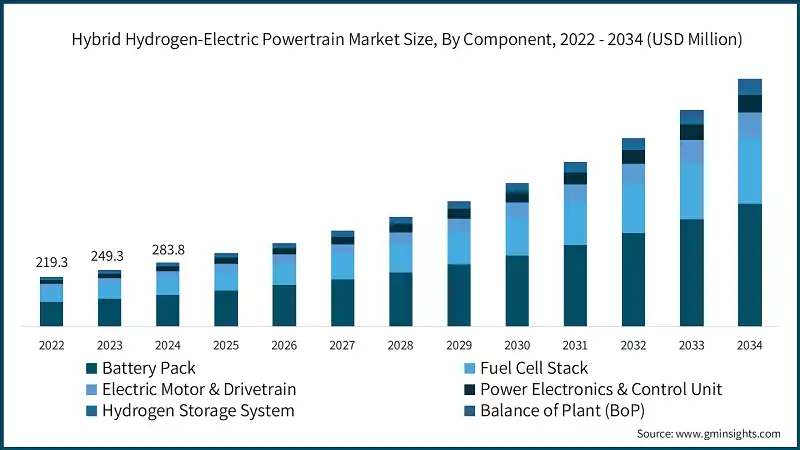
Based on component, the hybrid hydrogen-electric powertrain market is divided into battery pack, fuel cell stack, electric motor & drivetrain, power electronics & control unit, hydrogen storage system, and balance of plant (BoP). The battery pack segment dominated the market accounting for around 50% share in 2024 and is expected to grow at a CAGR of over 14.5% from 2025 to 2034.
- The battery pack segment dominated the hybrid hydrogen-electric powertrain market due to its central role in storing and delivering energy efficiently. Advanced lithium-ion and solid-state battery systems enable regenerative braking, extended vehicle range, and seamless integration with fuel cells and electric drivetrains. OEMs and Tier-1 suppliers rely on high-performance battery packs to ensure reliability, energy efficiency, and smooth hybrid powertrain operation.
- The fuel cell stack and electric motor & drivetrain segments are experiencing strong growth. Fuel cell stacks provide zero-emission electricity for hydrogen-electric propulsion, with increasing efficiency, durability, and cost-effectiveness driving adoption in passenger, commercial, and heavy-duty vehicles. Electric motors and drivetrains deliver optimized torque, speed control, and energy recovery, ensuring high-performance, efficient, and responsive vehicle operation.
- Supporting segments such as power electronics & control units, hydrogen storage systems, and balance of plant (BoP) are also expanding. Power electronics and control units manage real-time energy flow and integration between components, hydrogen storage systems ensure safe and reliable supply for long-range applications, and BoP components including pumps, compressors, and thermal management systems enhance system stability, operational efficiency, and compliance with safety and environmental standards.
Learn more about the key segments shaping this market
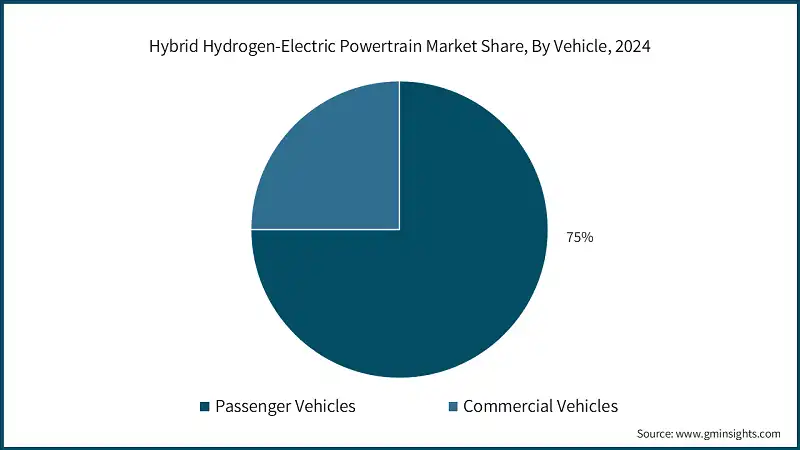
Based on vehicles, the market is divided into passenger vehicles and commercial vehicles. Passenger vehicles segment dominates the market accounting for around 75% share in 2024, and the segment is expected to grow at a CAGR of over 14.4% from 2025 to 2034.
- The passenger vehicles segment dominates the hybrid hydrogen-electric powertrain market, driven by the growing production of hybrid and hydrogen-electric cars, stringent emissions regulations, and the increasing emphasis on smart manufacturing. OEMs are heavily investing in digital factory automation technologies, including robotics, AI-driven production analytics, IoT-enabled process monitoring, and cloud-integrated platforms to improve operational efficiency, precision, and compliance.
- These advanced automation systems support high-volume, multi-variant production, providing real-time visibility across the supply chain, ensuring consistent quality, and minimizing operational downtime. By integrating predictive analytics and IoT-based monitoring, manufacturers can optimize production processes, enhance energy efficiency, and maintain high reliability in passenger vehicle assembly.
- The commercial vehicles segment is experiencing steady growth as hybrid hydrogen-electric powertrains are increasingly adopted in trucks, buses, and vans. Manufacturers leverage AI-driven predictive maintenance, robotic assembly, and IoT-connected production monitoring to manage production complexity, optimize costs, and meet sustainability and regulatory requirements. Automation in this segment enhances throughput, resource utilization, and lifecycle performance for commercial fleets while ensuring compliance with emissions and safety standards.
Based on technology, the hybrid hydrogen-electric powertrain market is divided into proton exchange membrane (PEM) fuel cell systems, solid oxide fuel cell (SOFC) systems, phosphoric acid fuel cell (PAFC) systems, molten carbonate fuel cell (MCFC) systems and alkaline fuel cell (AFC) systems. The robotics & mechatronics segment dominated the market and was valued at USD 135.1 million in 2024.
- The proton exchange membrane (PEM) fuel cell systems segment dominates the hybrid hydrogen-electric powertrain market, driven by widespread adoption of PEM fuel cells in passenger, commercial, and heavy-duty vehicles due to their high-power density, rapid start-up, and efficient hydrogen-to-electricity conversion. OEMs and Tier-1 suppliers are increasingly integrating advanced PEM stacks with electric drivetrains, power electronics, and energy management systems to enhance vehicle efficiency, reliability, and operational performance. The combination of PEM fuel cells with predictive diagnostics and modular system design further improves scalability, maintainability, and system optimization across production environments.
- The solid oxide fuel cell (SOFC) and phosphoric acid fuel cell (PAFC) segments are witnessing strong growth as manufacturers explore applications in heavy-duty vehicles, stationary power generation, and industrial transport solutions. SOFCs offer high efficiency and fuel flexibility, while PAFCs provide durability and reliability for large-scale applications. Integration with AI-enabled monitoring, IoT sensors, and predictive maintenance platforms supports real-time performance optimization, reduces downtime, and enables energy-efficient operation for fleet and industrial deployments.
- Emerging technologies, including molten carbonate fuel cell (MCFC) and alkaline fuel cell (AFC) systems, are gaining traction as part of long-term innovation strategies. These systems are combined with digital twin simulations, cloud-based analytics, and edge computing platforms to enable virtual testing, system optimization, and decentralized monitoring. Together, these technologies facilitate the transition toward intelligent, agile, and fully connected hybrid hydrogen-electric powertrain manufacturing ecosystems, improving performance, reducing operational costs, and supporting sustainability goals.
Based on power output, the hybrid hydrogen-electric powertrain market is divided into medium power (50-150 kW), high power (150-300 kW), low power (<50 kW) and ultra-high power (>300 kW). The medium power (50-150 kW) segment dominated the market and was valued at USD 135.2 million in 2024.
- The medium power (50–150 kW) segment dominates the hybrid hydrogen-electric powertrain market, driven by its suitability for passenger vehicles, light commercial vehicles, and urban mobility applications. Medium-power systems provide an optimal balance of efficiency, performance, and cost, making them ideal for mass-market deployment. OEMs and Tier-1 suppliers are integrating advanced battery packs, fuel cell stacks, and electric drivetrains with AI-enabled energy management and predictive diagnostics to ensure consistent power delivery, operational reliability, and seamless vehicle performance.
- The high power (150–300 kW) and low power (<50 kW) segments are witnessing strong growth as manufacturers explore applications in heavy-duty vehicles, buses, and micro-mobility solutions. High-power systems support long-range commercial and industrial operations, while low-power systems are suited for lightweight urban vehicles. Integration with IoT-enabled monitoring, digital twins, and AI-based predictive maintenance enables efficient energy management, reduces downtime, and ensures operational safety and compliance.
- Emerging ultra-high power (>300 kW) systems are being adopted in niche applications such as commercial trucks, rail, and specialized industrial vehicles. These systems are paired with cloud-connected analytics, edge computing, and advanced thermal management solutions to optimize performance, improve energy efficiency, and support scalable deployment. Together, these technologies contribute to the development of intelligent, high-performance, and sustainable hybrid hydrogen-electric powertrain ecosystems.
Based on hybrid configuration, the hybrid hydrogen-electric powertrain market is divided into series hybrid (fc charges battery, battery drives motor), parallel hybrid (fc and battery both drive motor), series-parallel hybrid (combined configuration) and plug-in hybrid (external charging capability). The series hybrid (fc charges battery, battery drives motor) segment dominated the market and was valued at USD 146.7 million in 2024.
- The series hybrid (fuel cell charges battery, battery drives motor) segment dominates the hybrid hydrogen-electric powertrain market, driven by its efficiency, simplicity, and suitability for passenger and light commercial vehicles. OEMs are increasingly adopting series hybrid configurations to optimize energy management, reduce emissions, and enhance vehicle reliability. Integration with AI-driven energy management systems, IoT-enabled battery monitoring, and predictive diagnostics enables real-time performance optimization, operational efficiency, and seamless power delivery across varying driving conditions.
- The parallel hybrid and series-parallel hybrid segments are witnessing strong growth as manufacturers explore configurations that combine fuel cell and battery power for higher performance and flexibility. Parallel hybrids allow both the fuel cell and battery to drive the motor simultaneously, while series-parallel hybrids provide adaptive power distribution for diverse vehicle applications. Integration with digital twin simulations, predictive maintenance tools, and connected monitoring platforms ensures improved energy efficiency, durability, and reliability in commercial and heavy-duty applications.
- The plug-in hybrid segment, featuring external charging capability, is also expanding, supported by increasing consumer demand for long-range, low-emission vehicles with flexible charging options. Manufacturers are deploying cloud-connected energy management, smart charging, and IoT-enabled battery monitoring to optimize power usage, extend battery life, and ensure compliance with environmental regulations. Together, these configurations contribute to the development of efficient, scalable, and sustainable hybrid hydrogen-electric powertrain ecosystems.
Based on sales channel, the market is divided into dealer networks, fleet sales, leasing companies and OEM direct sales. The dealer networks segment dominated the market and was valued at USD 113.7 million in 2024.
- The dealer networks segment dominates the hybrid hydrogen-electric powertrain market, driven by its extensive reach, established customer base, and ability to provide end-to-end sales, support, and after-sales services. Dealers play a critical role in delivering hybrid hydrogen-electric vehicles to end consumers while ensuring installation, maintenance, and warranty services. Integration with digital ordering systems, IoT-enabled vehicle tracking, and predictive maintenance analytics enables dealers to enhance operational efficiency, customer satisfaction, and service reliability.
- The fleet sales and leasing company’s segments are witnessing strong growth as commercial and corporate customers increasingly adopt hydrogen-electric vehicles to meet sustainability and emission reduction targets. Fleet operators leverage connected vehicle monitoring, predictive maintenance, and energy management platforms to optimize fleet performance, reduce operational costs, and ensure regulatory compliance across passenger, commercial, and heavy-duty applications.
- The OEM direct sales segment is also expanding, supported by growing demand for customized, high-performance, and technology-integrated vehicles. OEMs are deploying cloud-connected sales platforms, smart customer engagement tools, and IoT-enabled vehicle monitoring to streamline direct-to-consumer transactions, enhance delivery efficiency, and provide real-time performance insights. Together, these sales channels contribute to the efficient distribution, adoption, and lifecycle management of hybrid hydrogen-electric powertrain vehicles globally.
Looking for region specific data?
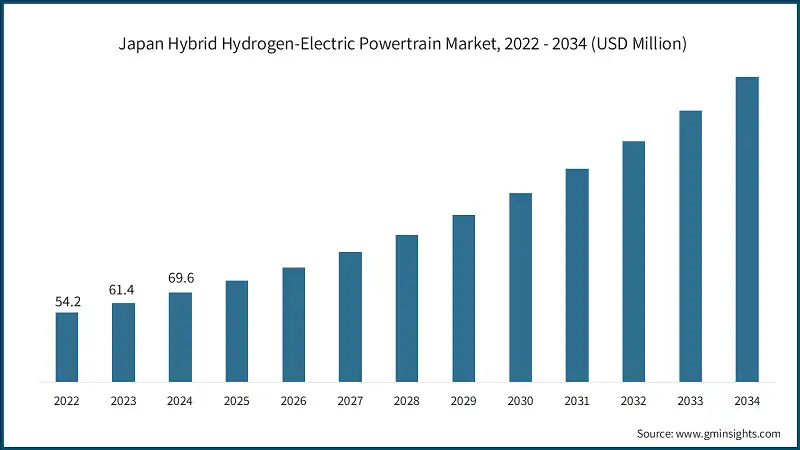
In 2024, Japan dominated the Asia Pacific hybrid hydrogen electric powertrain market with around 33% market share and generated approximately USD 69.6 million in revenue.
- Asia-Pacific accounted for a significant share of the market in 2024, driven by strong regulatory support, advanced automotive and technology ecosystems, and increasing adoption of sustainable and energy-efficient manufacturing practices. The region is witnessing steady growth as OEMs, suppliers, and technology providers deploy AI-driven lifecycle analytics, IoT-enabled monitoring, and cloud-integrated production platforms to enhance operational efficiency, quality control, and resource optimization across vehicle manufacturing and hydrogen-electric powertrain integration.
- Japan represents Asia-Pacific’s largest market, supported by substantial demand from OEMs, Tier-1 and Tier-2 suppliers, and technology providers requiring reliable, intelligent, and high-performance hybrid hydrogen-electric powertrain solutions. Key trends include the deployment of AI-enabled predictive maintenance, digital twin simulations, IoT-connected fuel cell and battery monitoring, and cloud-based energy management platforms across vehicle production, powertrain integration, and battery lifecycle operations. Japanese companies are adopting modular, interoperable, and scalable systems to meet stringent national regulations while improving operational efficiency, vehicle reliability, and sustainability performance.
- Other Asia-Pacific markets, including China, South Korea, and India, are also experiencing growth, supported by investments in digital infrastructure, smart manufacturing, and cloud-native systems. China emphasizes high-performance automated production and regulatory compliance, South Korea focuses on fuel cell integration and industrial-scale electrification, and India is advancing modular manufacturing and energy optimization. Organizations in these regions face challenges including regulatory diversity, infrastructure gaps, and operational cost efficiency, creating demand for robust, flexible, and scalable hybrid hydrogen-electric powertrain platforms capable of supporting complex supply chains and manufacturing ecosystems.
Germany holds share of 40% in Europe hybrid hydrogen electric powertrain market and it will grow tremendously between 2025 and 2034.
- Europe accounted for a significant share of the market in 2024, driven by strong regulatory frameworks, advanced manufacturing ecosystems, and the accelerating shift toward sustainable and circular automotive production. Within the region, Germany dominated the market, supported by its robust industrial base, technological innovation, and leadership in smart manufacturing adoption. Major automotive OEMs, including Volkswagen, BMW, Mercedes-Benz, and Audi, are implementing AI-driven lifecycle analytics, IoT-enabled monitoring, robotics, and digital twin simulations to optimize production efficiency, ensure product quality, and comply with stringent EU environmental and circular economy regulations.
- Germany’s leadership is further reinforced by its commitment to sustainability, automation, and compliance with EU directives such as the European Green Deal and End-of-Life Vehicles (ELV) Directive. OEMs and suppliers are investing in blockchain-based traceability systems, cloud-integrated reporting platforms, and AI-powered predictive analytics to enhance transparency, material recovery, and regulatory alignment. These solutions enable seamless tracking of components and materials throughout the vehicle lifecycle, promoting operational efficiency, data integrity, and sustainable production.
- The country also benefits from the presence of global automation and technology leaders such as Siemens, Bosch Rexroth, and SAP, driving innovation in factory automation, cloud integration, and industrial IoT. These companies support automotive manufacturers with modular, interoperable, and scalable automation solutions, fostering seamless digitalization across production lines and supply chains. As a result, Germany stands as the undisputed leader in Europe’s market, setting benchmarks in efficiency, regulatory compliance, and sustainable manufacturing excellence across the region.
US holds share of 88% in North America hybrid hydrogen electric powertrain market and it is expected to grow tremendously between 2025 and 2034.
- North America accounted for a major share of the market in 2024, supported by a mature automotive and technological ecosystem, advanced manufacturing capabilities, and strong regulatory and sustainability frameworks. The region is witnessing steady growth as OEMs, suppliers, and technology providers increasingly implement AI-driven, IoT-enabled, and cloud-integrated powertrain solutions to enhance vehicle performance, energy efficiency, and compliance with environmental and emissions regulations.
- The U.S. represents the largest market in North America, driven by substantial demand from OEMs, Tier-1 and Tier-2 suppliers, technology providers, and regulatory bodies requiring reliable, intelligent, and end-to-end hybrid hydrogen-electric powertrain systems. Key trends include the adoption of AI-enabled predictive analytics, IoT-connected fuel cell and battery monitoring, cloud-integrated energy management, and digital twin simulations across vehicle manufacturing, powertrain integration, and component lifecycle management. U.S. manufacturers are deploying modular, interoperable, and scalable platforms to optimize operational efficiency, ensure vehicle reliability, and comply with federal and state-level sustainability and emission standards.
- Regions such as California, Michigan, and Texas are increasingly implementing advanced hybrid hydrogen-electric vehicle production and testing facilities. Leading technology and automation providers, including Siemens, Honeywell, Cummins, and ABB, are pioneering AI-powered powertrain analytics, IoT-enabled monitoring, and cloud-based optimization solutions, delivering scalable, high-performance systems that improve production efficiency, reduce emissions, and support long-term sustainability initiatives.
The hybrid hydrogen electric powertrain market in Brazil will experience significant growth between 2025 and 2034.
- Latin America accounted for a 1% share of the market in 2024, driven by increasing adoption of digital manufacturing, AI-enabled production analytics, IoT-connected monitoring, and cloud-based factory platforms. Within the region, Brazil dominated the market, supported by investments in smart manufacturing infrastructure, fuel cell and battery integration facilities, and deployment of predictive and automated powertrain management systems. OEMs, suppliers, and technology providers in Brazil are leveraging these solutions to enhance vehicle assembly efficiency, fuel cell and battery system integration, energy management, and compliance with environmental and emissions regulations.
- Brazilian manufacturers are implementing scalable, modular, and interoperable automation platforms for hybrid hydrogen-electric powertrain production, enabling real-time monitoring, predictive maintenance, and component-level tracking. These systems optimize energy usage, improve throughput, ensure high-quality assembly, and support circular economy initiatives such as battery recycling and sustainable material management.
- Other Latin American countries, including Mexico, Argentina, and Chile, are emerging markets for hybrid hydrogen-electric powertrains, adopting AI-powered monitoring, IoT-enabled process control, and cloud-integrated factory solutions. Despite these emerging opportunities, Brazil remains the largest and most mature market in Latin America for hybrid hydrogen-electric powertrain manufacturing, setting benchmarks for efficiency, sustainability, and advanced production practices in the region.
The hybrid hydrogen electric powertrain market in UAE will experience significant growth between 2025 and 2034.
- Middle East & Africa (MEA) accounted for a modest share of the market in 2024, supported by steady adoption of advanced manufacturing technologies, expanding digital infrastructure, and growing investments in smart factory initiatives. Within the region, the United Arab Emirates (UAE) dominated the market, driven by strong demand from OEMs, suppliers, technology providers, and service firms for scalable, secure, and high-performance hybrid hydrogen-electric powertrain production solutions across vehicle assembly, fuel cell and battery integration, supply chain monitoring, and lifecycle management.
- Enterprises and technology providers in the UAE are emphasizing reliability, security, and operational efficiency, deploying cloud-based platforms, IoT-enabled monitoring, AI-driven predictive maintenance, and digital twin simulations for hybrid hydrogen-electric powertrain manufacturing. Automotive OEMs and associated stakeholders are leveraging these systems for real-time powertrain performance tracking, component-level traceability, predictive diagnostics, and seamless integration across production lines and IT ecosystems.
- A key trend in the UAE market is the adoption of AI-driven lifecycle analytics, predictive defect detection, energy optimization tools, cloud-integrated monitoring platforms, and low-code/no-code configurable systems. Large enterprises, government initiatives, and technology service providers are advancing these solutions to support scalable automation, continuous production optimization, regulatory compliance, and enhanced operational transparency. These efforts position the UAE as the leading market for hybrid hydrogen-electric powertrains in the MEA region, enabling intelligent, sustainable, and data-driven manufacturing practices.
Hybrid Hydrogen-Electric Powertrain Market Share
The top 7 companies in the market are Toyota motor, Hyundai motor, Honda motor, Cummins, BMW group, Alstom SA and Kawasaki heavy. These companies hold around 75% of the market share in 2024.
- Toyota Motor Corporation develops advanced hybrid hydrogen-electric powertrain systems, emphasizing fuel cell and battery integration, AI-driven energy management, and IoT-enabled performance monitoring. Toyota focuses on modular, scalable, and interoperable platforms that optimize vehicle efficiency, powertrain reliability, and lifecycle management. Its solutions support predictive maintenance, regulatory compliance, and sustainable mobility, enabling OEMs and suppliers to enhance operational transparency and resource utilization.
- Hyundai Motor Company offers a comprehensive portfolio of hydrogen-electric powertrains for passenger and commercial vehicles, integrating AI-enabled energy optimization, IoT-connected monitoring, and cloud-based fleet analytics. Hyundai emphasizes scalable, high-performance, and interoperable systems to improve production throughput, fuel cell efficiency, and vehicle performance while ensuring compliance with global emissions standards and sustainability initiatives.
- Honda Motor Co., Ltd. provides hybrid hydrogen-electric powertrain solutions with a focus on compact fuel cell stacks, battery management, and AI-driven predictive diagnostics. Honda emphasizes flexible and modular platforms for integration across passenger vehicles and light commercial applications, supporting OEMs and suppliers in enhancing operational efficiency, quality assurance, and environmental compliance.
- Cummins Inc. specializes in heavy-duty hydrogen fuel cell systems and hybrid powertrain integration for commercial vehicles. Cummins leverages IoT-enabled performance monitoring, AI-based predictive maintenance, and cloud-integrated energy management to optimize reliability, efficiency, and emissions reduction. Its modular and scalable solutions support large-scale deployment and regulatory compliance in commercial transport and logistics applications.
- BMW Group delivers hybrid hydrogen-electric powertrain systems integrated with digital twin simulations, AI-driven energy management, and IoT-connected monitoring platforms. BMW focuses on high-performance, interoperable, and scalable platforms to ensure production efficiency, reliability, and compliance with stringent EU environmental and circular economy regulations.
- Alstom SA develops hydrogen-electric traction systems for rail and heavy transport, emphasizing fuel cell stack integration, real-time monitoring, and predictive maintenance analytics. Alstom’s solutions are modular, interoperable, and scalable, enabling enhanced operational efficiency, lifecycle management, and compliance with regional and international emission standards.
- Kawasaki Heavy Industries provides hydrogen-electric propulsion and hybrid powertrain systems for marine, rail, and industrial applications. Kawasaki emphasizes AI-enabled performance optimization, IoT-connected monitoring, and cloud-integrated control systems to improve energy efficiency, reliability, and compliance. Its modular and scalable platforms support diverse vehicle types, operational scenarios, and regulatory frameworks, driving sustainable and high-performance hybrid hydrogen-electric powertrain adoption.
Hybrid Hydrogen-Electric Powertrain Market Companies
Major players operating in the hybrid hydrogen electric powertrain industry include:
- Alstom SA
- Ballard Power System
- BMW Group
- Cummins
- Honda Motor
- Hyundai Motor
- Kawasaki Heavy
- PowerCell Sweden AB
- Symbio
- Toyota Motor
- The hybrid hydrogen-electric powertrain market is highly competitive, with leading technology and mobility providers such as Toyota Motor Corporation, Hyundai Motor Company, Honda Motor, BMW Group, Cummins, Alstom SA, Ballard Power Systems, Symbio, PowerCell Sweden AB, and Kawasaki Heavy Industries occupying key segments across fuel cell systems, battery-electric integration, hybrid powertrains, and heavy-duty hydrogen mobility solutions.
- Toyota, Hyundai, Honda, and BMW lead the market with comprehensive portfolios that integrate fuel cell technology, battery management systems, electric drivetrains, and vehicle-level powertrain integration. These companies focus on optimizing energy efficiency, vehicle performance, sustainability, and compliance with regional and global emissions regulations for passenger and commercial vehicles.
- Cummins, Alstom, Ballard Power Systems, Symbio, PowerCell Sweden, and Kawasaki Heavy Industries specialize in hydrogen fuel cell stacks, hybrid drivetrain systems, and heavy-duty applications such as buses, trucks, trains, and industrial mobility. Their solutions emphasize modularity, scalability, and seamless integration with batteries, electric motors, and energy management systems, supporting efficient, low-emission, and commercially viable hybrid hydrogen-electric mobility solutions.
- Overall, the market is characterized by intense competition, with companies continuously innovating in fuel cell technology, battery-electric integration, hybrid powertrain systems, and heavy-duty hydrogen mobility. Market players are focused on delivering scalable, reliable, and sustainable solutions that support the global transition toward low-emission, hydrogen-powered vehicles across passenger, commercial, and industrial applications.
Hybrid Hydrogen-Electric Powertrain Market Report Attributes
| Key Takeaway | Details |
|---|---|
| Market Size & Growth | |
| Base Year | 2024 |
| Market Size in 2024 | USD 283.8 Million |
| Market Size in 2025 | USD 323.4 Million |
| Forecast Period 2025 – 2034 CAGR | 14.5% |
| Market Size in 2034 | USD 1.1 Billion |
| Key Market Trends | |
| Drivers | Impact |
| Government Decarbonization Policies & Hydrogen Strategies | Stringent emissions regulations and net-zero targets across regions, particularly in Europe, North America, and Asia Pacific, are driving the adoption of hybrid hydrogen-electric powertrains. Government incentives, subsidies, and national hydrogen strategies are encouraging OEMs and fleet operators to invest in low-emission transportation solutions. |
| Technology Maturation & Commercial Viability Demonstration | Technology Maturation & Commercial Viability Demonstration Advancements in fuel cell efficiency, electric motor integration, and energy management systems have increased the commercial viability of hybrid hydrogen-electric powertrains. Demonstration projects and pilot fleets are proving technology reliability, performance, and operational benefits, thereby accelerating market confidence and adoption. |
| Heavy-Duty Application Advantages Over Battery-Only Solutions | Hybrid hydrogen-electric powertrains offer significant benefits for heavy-duty vehicles, such as trucks, buses, and commercial fleets, including longer driving ranges, faster refueling times, and reduced weight impact compared to battery-only solutions, making them suitable for long-haul and high-utilization operations. |
| Infrastructure Investment & Public-Private Partnerships | Strategic investments in hydrogen refueling stations, fuel cell supply chains, and collaborative partnerships between governments and private stakeholders are facilitating the deployment of hybrid hydrogen-electric vehicles, mitigating adoption barriers, and supporting scalable infrastructure development. |
| Pitfalls & Challenges | Impact |
| High System Costs & Component Price Premiums | Fuel cells, hydrogen storage systems, and high-performance electric components remain cost-intensive, increasing the total cost of ownership compared to conventional and battery-electric vehicles, which restrains market growth. |
| Limited Hydrogen Refueling Infrastructure | The availability of hydrogen refueling stations is currently limited, especially in emerging markets, creating challenges for mass adoption and fleet deployment of hybrid hydrogen-electric vehicles. |
| Opportunities: | Impact |
| Rail Electrification Gap & Diesel Replacement Potential | Hybrid hydrogen-electric trains and locomotives offer a viable alternative for rail routes that are difficult to electrify, enabling diesel replacement, reducing emissions, and enhancing operational efficiency. |
| Marine Decarbonization Requirements | Increasing global regulations on marine emissions are creating opportunities for hybrid hydrogen-electric powertrains in ferries, cargo ships, and coastal vessels, particularly where electrification is challenging. |
| Market Leaders (2024) | |
| Market Leaders |
32.9% market share |
| Top Players |
Collective market share in 2024 is 72% |
| Competitive Edge |
|
| Regional Insights | |
| Largest Market | Asia Pacific |
| Fastest growing market | Europe |
| Emerging countries | Brazil, Mexico, UAE |
| Future outlook |
|
What are the growth opportunities in this market?
Hybrid Hydrogen-Electric Powertrain Industry News
- In March 2025, Toyota Motor announced the rollout of its next-generation hybrid hydrogen-electric powertrain for passenger and commercial vehicles, integrating advanced fuel cell systems, battery-electric management, and AI-enabled energy optimization. The initiative aims to enhance vehicle efficiency, range, and reliability while supporting global emissions reduction targets.
- In February 2025, Hyundai Motor Company unveiled a new line of hydrogen-electric trucks and buses in Europe and North America, featuring modular fuel cell stacks, high-capacity batteries, and predictive powertrain analytics. The deployment supports scalable hybrid solutions to improve operational efficiency and sustainability compliance for commercial fleets.
- In January 2025, Cummins Inc. partnered with a leading European OEM to implement hybrid hydrogen-electric powertrains in heavy-duty vehicles, integrating AI-driven energy management, IoT-based system monitoring, and predictive maintenance tools. The collaboration focuses on lifecycle optimization, performance reliability, and regulatory compliance across multi-tier vehicle applications.
- In December 2024, Ballard Power Systems Inc. launched advanced fuel cell modules for hybrid hydrogen-electric mobility, including trucks, buses, and industrial applications in the Asia-Pacific region. The systems aim to enhance energy efficiency, reduce operational downtime, and support sustainability initiatives for OEMs and fleet operators.
- In October 2024, BMW Group expanded its hybrid hydrogen-electric powertrain programs in North America, deploying high-performance fuel cell and battery integration platforms. The initiative leverages IoT-enabled monitoring, AI-driven predictive analytics, and modular powertrain architecture to improve vehicle reliability, energy efficiency, and compliance with regional and global emissions standards.
The hybrid hydrogen electric powertrain market research report includes in-depth coverage of the industry with estimates & forecasts in terms of revenue ($ Mn) and volume (Units) from 2021 to 2034, for the following segments:
Market, By Component
- Battery pack
- Fuel cell stack
- Electric motor & drivetrain
- Power electronics & control unit
- Hydrogen storage system
- Balance of plant (BOP)
Market, By Vehicle
- Passenger vehicles
- Hatchbacks
- Sedans
- SUV
- Commercial vehicles
- Light commercial vehicles (LCV)
- Medium commercial vehicles (MCV)
- Heavy commercial vehicles (HCV)
Market, By Technology
- Proton exchange membrane (PEM) fuel cell systems
- Solid oxide fuel cell (SOFC) systems
- Phosphoric acid fuel cell (PAFC) systems
- Molten carbonate fuel cell (MCFC) systems
- Alkaline fuel cell (AFC) systems
Market, By Power Output
- Medium power (50-150 kW)
- High power (150-300 kW)
- Low power (<50 kW)
- Ultra-High power (>300 kW)
Market, By Hybrid Configuration
- Series hybrid (FC charges battery, battery drives motor)
- Parallel hybrid (FC and battery both drive motor)
- Series-Parallel hybrid (Combined configuration)
- Plug-in hybrid (External charging capability)
Market, By Sales Channel
- Dealer Networks
- Fleet Sales
- Leasing Companies
- OEM Direct Sales
The above information is provided for the following regions and countries:
- North America
- US
- Canada
- Europe
- UK
- Germany
- France
- Italy
- Spain
- Belgium
- Netherlands
- Sweden
- Asia Pacific
- China
- India
- Japan
- Australia
- Singapore
- South Korea
- Vietnam
- Indonesia
- Latin America
- Brazil
- Mexico
- Argentina
- MEA
- South Africa
- Saudi Arabia
- UAE
Frequently Asked Question(FAQ) :
What is the market size of the hybrid hydrogen electric powertrain in 2024?
The market size was valued at USD 283.8 million in 2024, with a CAGR of 14.5% expected through 2034. Increasing demand for sustainable automotive solutions and low-emission transportation is driving market growth.
What is the projected value of the hybrid hydrogen electric powertrain market by 2034?
The market is poised to reach USD 1.1 billion by 2034, driven by advancements in powertrain technology, lightweight materials, and energy storage solutions.
What is the expected size of the hybrid hydrogen electric powertrain industry in 2025?
The market size is projected to reach USD 323.4 million in 2025.
How much revenue did the battery pack segment generate in 2024?
The battery pack segment accounted for approximately 50% of the market share in 2024 and is expected to witness over 14.5% CAGR from 2025 to 2034.
What was the valuation of the series hybrid segment in 2024?
The series hybrid segment was valued at USD 146.7 million in 2024, led by its efficiency, simplicity, and suitability for passenger and light commercial vehicles.
What is the growth outlook for the passenger vehicles segment?
The passenger vehicles segment, which dominated the market with a 75% share in 2024, is set to expand at a CAGR of over 14.4% till 2034.
Which region leads the hybrid hydrogen electric powertrain sector?
Japan led the Asia-Pacific market in 2024 with a 33% share, generating approximately USD 69.6 million in revenue. The market is driven by regulatory support, advanced automotive ecosystems, and sustainable manufacturing practices.
What are the upcoming trends in the hybrid hydrogen electric powertrain market?
Trends include regionalized production systems, AI-based predictive maintenance, IoT process monitoring, digital twin simulations, modular interoperable architectures, and cloud-integrated platforms.
Who are the key players in the hybrid hydrogen electric powertrain industry?
Key players include Alstom SA, Ballard Power System, BMW Group, Cummins, Honda Motor, Hyundai Motor, Kawasaki Heavy, PowerCell Sweden AB, Symbio, and Toyota Motor.
Hybrid Hydrogen-Electric Powertrain Market Scope
Related Reports