Summary
Table of Content

HVAC Air Handling Units Market
Get a free sample of this report
Form submitted successfully!
Error submitting form. Please try again.
Thank you!
Your inquiry has been received. Our team will reach out to you with the required details via email. To ensure that you don't miss their response, kindly remember to check your spam folder as well!
Request Sectional Data
Thank you!
Your inquiry has been received. Our team will reach out to you with the required details via email. To ensure that you don't miss their response, kindly remember to check your spam folder as well!
Form submitted successfully!
Error submitting form. Please try again.
HVAC Air Handling Units Market Size
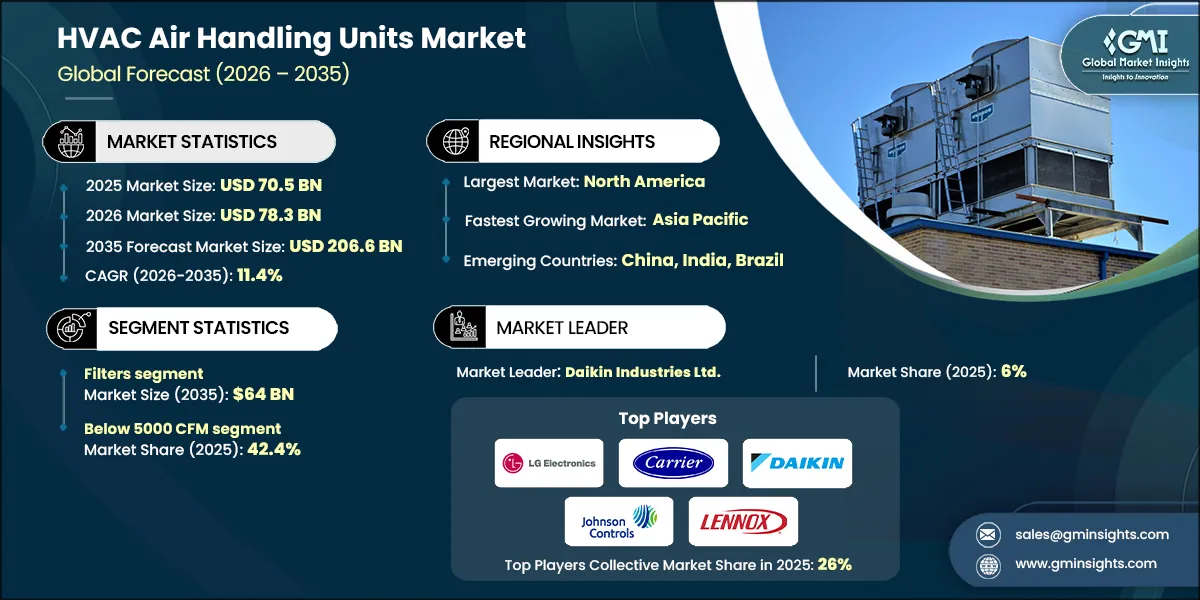
The HVAC air handling units market was estimated at USD 70.5 billion in 2025. The market is expected to grow from USD 78.3 billion in 2026 to USD 206.6 billion in 2035, at a CAGR of 11.4% according to latest report published by Global Market Insights Inc.
HVAC Air Handling Units Market Key Takeaways
Market Size & Growth
- 2025 Market Size: USD 70.5 Billion
- 2026 Market Size: USD 78.3 Billion
- 2035 Forecast Market Size: USD 206.6 Billion
- CAGR (2026–2035): 11.4%
Regional Dominance
- Largest Market: North America
- Fastest Growing Region: Asia Pacific
Key Market Drivers
- Strict Energy Efficiency Regulations.
- Growing Focus on Indoor Air Quality (IAQ).
- Rapid Urbanization and Construction Boom in APAC.
Challenges
- High Upfront Cost and Complexity of Advanced AHUs.
- Supply Chain Volatility and Material Price Fluctuations.
Opportunity
- Exploding Demand from Data Centers.
- Integration with IoT and Smart Building Technologies.
Key Players
- Market Leader: Daikin Industries Ltd. led with over 6% market share in 2025.
- Leading Players: Top 5 players in this market include LG Electronics Inc., Carrier Global Corporation, Daikin Industries Ltd., Johnson Controls International plc, Lennox International Inc., which collectively held a market share of 26% in 2025.
Get Market Insights & Growth Opportunities
The air handling units market is a significant part of the heating, ventilation, and air conditioning (HVAC) ecosystem. It is the market for designing, producing, and distributing equipment that not only controls but also moves the air. These units that come off the assembly line generally have a fan, heating and cooling coils, filters, and dampers. They take care of many functions such as purifying the air, regulating the temperature, humidifying, and ventilating. The AHU represents the central equipment in a large proportion of commercial and industrial HVAC configurations. It prepares a combination of fresh air and recycled air and then distributes it to the various sections of a building through the ductwork.
The worldwide market is exhibiting growth of a stable nature, it is mostly propelled by the factors such as the rise of the construction sector, the public getting more conscious of indoor air quality (IAQ), and the implementation of stringent energy efficiency regulations. As urban centers expand and become more complicated in terms of their building infrastructures, the requirement for effective and reliable air handling solutions does not wane. This phenomenon is helping the AHU market to rise steadily.
The global drive towards keeping the environment clean and cutting down on carbon emissions has resulted in a situation where the rules and regulations concerning energy performance and the environmentally friendly aspect of HVAC systems imposed by governments and international bodies have become more stringent. These regulations are a major, long-term factor pushing building owners and operators to buy efficient air handling units (AHUs), thus a leading factor in market growth and technological innovation.
- European Union’s Ecodesign Directive and corresponding regulations are always in a state of flux to define the toughest minimum performance standards, such as specific fan power (SFP) limits and fixed energy recovery efficiency targets for ventilation units.
- One of the immediate effects of this law is the quickened tempo with which the AHU market embraces technology migration to advanced AHUs equipped with energy recovery ventilators (ERVs) and variable frequency drives (VFDs) for fan control. These elements are necessary for compliance as they very much contribute to the overall energy consumption of the unit by, on the one hand, recovering the energy from the exhaust air, and, on the other hand, by matching the fan speed with the airflow needed very accurately.
This regulatory effort thereby gradually abolishes the performance of more inefficient, older AHU designs and assists producers in innovating with feature such as better insulation, direct-drive plenum fans, and low-GWP (global warming potential) refrigerant coils, which results in a continuous investment cycle in the market.
The ever-growing awareness of indoor air quality deeply affecting human health, productivity, and even general well-being, and global public health events having doubled the effect, have put IAQ improvement on the top of the agenda for all types of buildings - be it commercial offices, healthcare facilities, or educational institutions. Such a fundamental shift in priority is a direct indication of the long-term AHU demand equipped with advanced air filtration, purification, and precise air management capabilities.
- The speedy worldwide implementation of green building certification schemes like the WELL Building Standard and LEED (leadership in energy and environmental design) can indeed be seen as tangible proof of this driver. WELL, puts significant emphasis on air quality and often requires the employment of high-efficiency filtration (e.g., MERV 13 or higher filters) and considerable outside air ventilation rates to dilute airborne contaminants.
- Building owners who desire these certifications that are a signal for the commitment to the health of the occupants and, in turn, command a premium in rent, need to specify AHUs that can fulfill these stringent IAQ requirements. This has led to a rise in demand for some specialized AHU components such as HEPA filters in critical applications (e.g., operating rooms, cleanrooms), UV-C germicidal irradiation lamps for coil sterilization, and sophisticated demand-controlled ventilation (DCV) systems that use sensors to modulate fresh air intake based on occupancy.
The long-term effect is a non-negotiable minimum level of AHU performance that is far beyond basic thermal comfort. All demonstrated in the market signs of growing further as technology develops and the respective demand continues.
To get key market trends
HVAC Air Handling Units Market Trends
The HVAC market for air handling units (AHUs) is expected to grow significantly over the next few years due to factors such as tight energy efficiency standards, fast urbanization, and a permanent, increased worldwide focus on indoor air quality (IAQ). As the worldwide commercial and residential building stock grows and worries about building operating costs and occupant health become louder, there is a considerable movement toward advanced, modular, and energy-efficient air management technologies. Most advanced AHU systems are chosen since they can link the operations (filtration, conditioning, ventilation) to one dependable, centralized unit.
- The Asia-Pacific (APAC) region is predicted to be the most rapidly expanding market, driven by the trend toward urban living and the need for new infrastructure in such countries as China and India, according to market research. The increase in modular and personalized AHU design, together with the incorporation of variable frequency drives (VFDs) in fan control as well as energy recovery ventilators (ERVs), will improve operational efficiency and, on the other hand, reduce energy consumption in the long run.
- Fast commercialization and acceptance of energy recovery and direct-drive EC fan technology: The AHU market is undergoing a monumental technological change of its kind, which will result in the replacement of conventional belt-driven fans and fixed-speed motors with electronically commuted (EC) fans and high-efficiency energy recovery ventilators (ERVs) or heat recovery ventilators (HRVs).
- The use of EC motors and direct-drive systems, in general, is associated with the elimination of energy loss that occurs when belts are used, while ERVs/HRVs recover thermal energy from the exhaust air, thus significantly enhancing the energy efficiency of the AHU and, consequently, meeting the requirements of highly energy-efficient global building codes.
- Explosive growth in high-efficiency filtration and air purification applications: This pattern is especially clear for the non-residential user sector that comprises healthcare facilities, data centers, and premium commercial spaces. multiplex stage filtration (e.g., MERV 13 or HEPA filters) and supplementary air cleaning technology such as the UV-C germicidal irradiation for the reduction of airborne pathogens and the prevention of the microbial contamination of coils (that ensures thermal efficiency) are the components with which AHUs are currently being frequently integrated in routine practice.
- Integration of smart, IoT-enabled monitoring and control systems: Technically, AHU units are becoming less dependent on each other and achieving higher autonomy thanks to the transformation to integrated, smart platforms. The market is witnessing a boom in the demand for IoT-enabled sensors and building management system (BMS) interfaces that allow real-time monitoring of the most critical parameters like temperature, pressure drop across filters.
- Evolving regulations concerning building energy use (ASHRAE, European Directives), IAQ, as well as the mandatory use of energy-efficient components, are some of the reasons why more building developers and facility managers are opting for modern AHU technologies.
Also, the market is going to receive a boost from the trend towards green building certifications (LEED, WELL), especially in the developed areas where the main hurdle for gaining the certificate as well as attracting the high-end tenants is the use of high-performance AHUs. Producers are always coming up with new ideas, mainly concentrating on turning their products into modules, lessening the surface area, and bettering the sound quality. Consequently, the worldwide AHU market is projected to follow a positive trend in which it will expand gradually with the farther penetration of newly built and deep energy retrofit projects.
HVAC Air Handling Units Market Analysis
Learn more about the key segments shaping this market
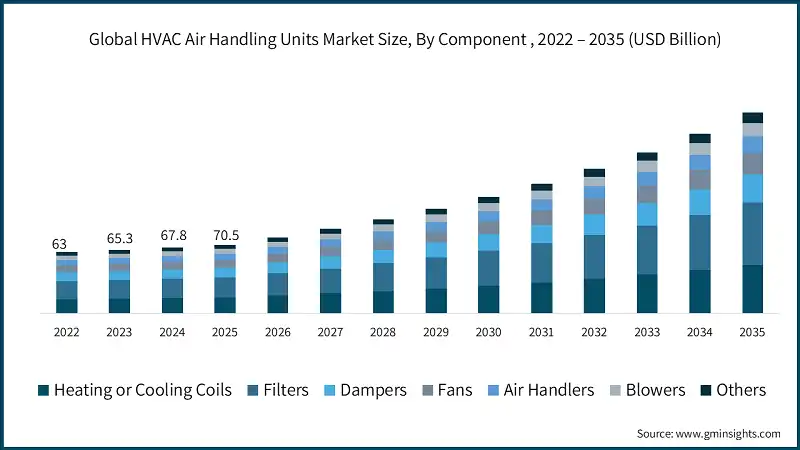
Based on the component segmentation, the global HVAC air handling units market is segmented into filters, heating or cooling coils, dampers, fans, air handlers, blowers, and others. The filters segment is the established market leader as of 2025 and is set to maintain its dominance through 2035.
- The filters segment accounted for over 29.2% of the global market share in 2025, with a value of USD 20.6 billion. This segment is projected to significantly accelerate its dominance to 31% by 2035, reaching a projected value of USD 64 billion.
- Filters maintain the highest CAGR of 12.1% through 2035. This strong growth is fueled by the escalating global focus on indoor air quality (IAQ), which mandates the use of higher-efficiency filtration (e.g., MERV 13+) and drives a consistent, high-volume demand for replacement filter media across all commercial and industrial AHU applications.
- The heating or cooling coils segment holds the second-largest share at 23.4% in 2025, valued at USD 16.5 billion. This segment is projected to maintain a strong presence, increasing its value to USD 50 billion by 2035, and exhibiting the second-highest CAGR of 11.8%. This reflects the critical, high-value nature of coils in both new systems and in energy-efficiency retrofit projects that often involve coil upgrades.
- Dampers capture highest market share in 2025 and show a robust growth trajectory with an 11.3% CAGR till 2035. This indicates the increasing importance of precise airflow control and zoning capabilities in modern energy-optimized AHU systems.
- The fans segment accounts for 11.2% of the market share in 2025. Its healthy CAGR is driven by the market's rapid transition to high-efficiency EC motors and variable frequency drives (VFDs), which are essential for meeting stringent energy efficiency regulations.
- The remaining segments, air handlers, blowers, and others (humidifiers/dehumidifiers, isolators, etc.), collectively account for approximately 21.9% of the market in 2025, with growth rates reflecting steady demand across niche and ancillary AHU functions.
Learn more about the key segments shaping this market
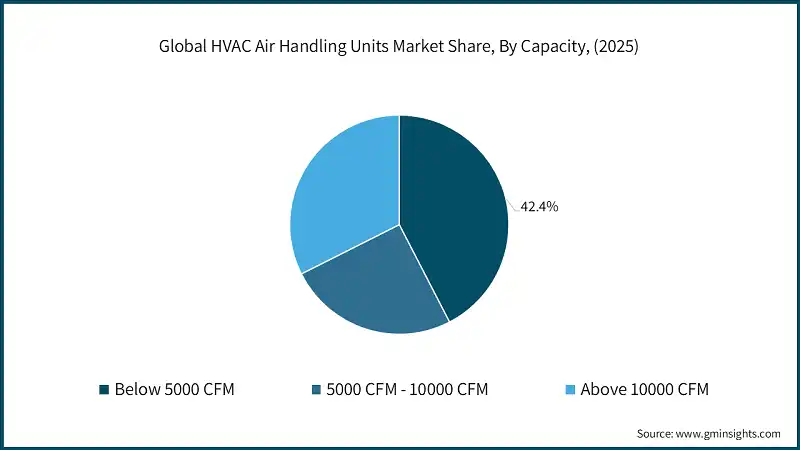
Based on the capacity segmentation, the global HVAC air handling units market is segmented into below 5000 CFM, 5000 CFM - 10000 CFM, and above 10000 CFM. The below 5000 CFM segment is the dominant force in the market as of 2025.
- The below 5000 CFM segment held about 42.4% of the global market share in 2025. This segment is projected to maintain its substantial dominance, reaching a projected value.
- This segment is the primary market driver, underpinned by its widespread use in small to medium commercial buildings, retail establishments, and light industrial applications, which represent the largest volume of new construction projects globally. The units in this range are often preferred for their ease of installation, modularity, and cost-effectiveness.
- The above 10000 CFM segment represents the second-largest segment, holding 32.3% of the market share in 2025. This segment is projected to grow aggressively and exhibit the highest growth rate of 11.5% CAGR till 2035.
- Its strong growth is driven by the expansion of large-scale infrastructure, such as data centers, hospitals, airports, and high-rise commercial complexes, which require high-capacity, custom-engineered AHU solutions.
- The 5000 CFM - 10000 CFM segment holds the third-largest share. It maintains a robust growth rate with a 10.8% CAGR and is set to reach USD 49.5 billion by 2035. This segment serves as a crucial middle ground, catering to medium-sized commercial and institutional buildings that balance the need for high-performance with manageable unit size and cost.
Based on the distribution channel, the HVAC air handling unit (AHU) market is broadly segmented into direct sales and indirect sales.
- The direct sales model is the dominant channel for the highest value and most complex AHU applications, such as custom and large modular AHUs for data centers, hospitals, industrial facilities, and large commercial projects.
- The manufacturer retains full control over the AHU’s highly specific engineering design, manufacturing quality, field installation support, and long-term service agreements. This is vital for complex, made-to-order AHUs where failure to meet design specifications (e.g., airflow, pressure, energy efficiency, cleanroom standards) is highly consequential. This model facilitates a close, long-term technical relationship with consulting engineers and large design-built contractors for future system upgrades and component replacements.
- The indirect sales model relies on third-party channels, primarily manufacturer's representatives and distributors, to reach a broader, more dispersed customer base, primarily in the smaller-scale commercial and rapidly expanding residential/light commercial.
Looking for region specific data?
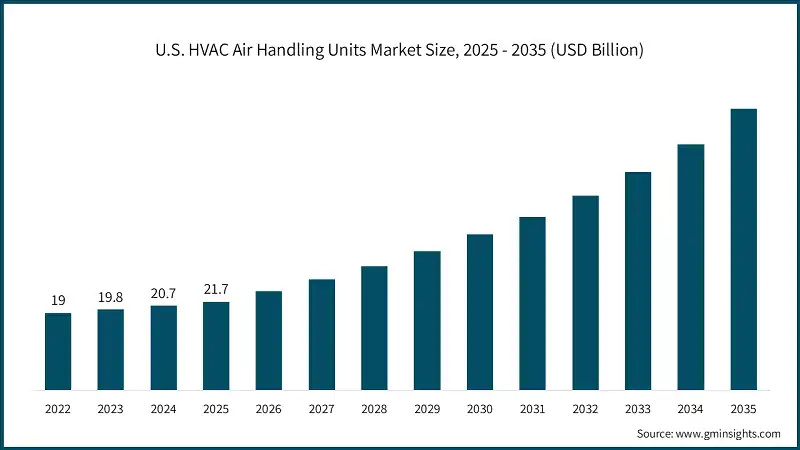
North America is projected to dominate the global HVAC air handling units market with about 36.5% share with an estimated revenue of USD 25.7 billion in 2025.
- North America maintains market leadership, driven by its massive installed base of commercial and institutional buildings, stringent and continuously updated energy efficiency regulations (e.g., ASHRAE standards), and a high rate of commercial adoption of advanced, integrated AHU systems for improved indoor air quality (IAQ).
- The region's growth is heavily fueled by the U.S., which is the primary engine, accounting for 84.5% of the regional revenue. The U.S. is projected to grow at the fastest regional CAGR of 12.3% till 2035.
- This dominance is supported by continuous investment in energy retrofits and system upgrades, high labor costs favoring automated, smart AHU controls and predictive maintenance systems, and a strong culture of adopting new, high-efficiency technologies like direct-drive EC fans and sophisticated energy recovery systems.
- This is supported by continuous investment in advanced technologies, high labor costs favoring automation, and a strong culture of tech-driven commercial building products.
Europe HVAC air handling units market is projected to account for 27.4% of the revenue share in 2025, with a revenue of USD 19.3 billion. Germany is the regional market leader, accounting for 24.1% of the European revenue in 2025 at USD 4.7 billion.
- European demand is centered on achieving compliance with strict EU energy performance directives and a strong societal push towards highly sustainable and energy-efficient building operations. The region's stringent quality standards drive the adoption of sophisticated, customized, and low-specific fan power (SFP) AHU machinery.
- The larger European market benefits from sustainability initiatives and continuous investment in aging infrastructure modernization and replacement. This encourages the adoption of energy-efficient and highly automated AHU systems featuring energy recovery ventilators (ERVs).
- Germany projects a strong CAGR of 11.7% till 2035, leveraging its robust industrial manufacturing sector and focus on high-quality, precision-engineered AHU solutions.
- Countries like the UK and France are also key markets, steadily investing in high-efficiency AHU technology to meet demands for modern, green-certified commercial spaces.
The Asia Pacific region is projected to account for 21.9% of the global market in 2025. China holds the highest market share in the region, with 32.5% of the APAC revenue. APAC’s market growth is driven by rapid industrialization, unprecedented urbanization, and massive governmental and private investments in new commercial, residential, and industrial infrastructure across developing economies.
- The region is rapidly adopting modern, centralized AHU technology as a standard for new commercial builds, often surpassing older, decentralized HVAC methods. This is driven by environmental concerns, rising demand for clean indoor air quality, and increasing construction activity in high-density urban centers.
- China is a major engine for growth, projecting a high CAGR till 2035. India is another key market with a CAGR of 10.8%, with its domestic manufacturing and infrastructure gaps supporting strong future adoption of both large-scale commercial AHU plants and smaller, more packaged units.
Latin America HVAC Air Handling Units Market
Latin America is projected to represent 7.7% of the global market in 2025, with a revenue of USD 5.4 billion. Brazil is the market leader, accounting for 48.3% of the regional revenue in 2025.
- Growth in LATAM is driven by rising urbanization and middle-class expansion, which increases the demand for improved commercial and institutional building infrastructure. Market modernization in key economies like Brazil (CAGR 11.1%) and Mexico (CAGR 10.8%) is driving investment in new air conditioning and ventilation facilities.
- While smaller than mature markets, the region is characterized by steady investment aimed at improving comfort standards and energy efficiency in new construction projects, moving toward more reliable, centralized AHU solutions over fragmented cooling systems.
HVAC Air Handling Units Market Share
- Daikin Industries Ltd. is leading with 6% market share. LG Electronics Inc., Carrier Global Corporation, Daikin Industries Ltd., Johnson Controls International plc (JCI), and Lennox International Inc. claiming almost 25-30% of the global market share in HVAC Air Handling Units s for wastewater treatment. These companies lead in innovation, investing in research and development to make UV systems more efficient and sustainable. Their advanced technologies, like energy-saving lamps and modern control systems, set them apart in the market. They have built strong brand reputations over the years, making them trusted providers for municipalities, industries, and utilities worldwide.
- Their wide range of products serves various needs, from small industrial setups to large municipal plants. Their extensive distribution and service networks ensure timely support and maintenance, which strengthens customer loyalty. Strategic acquisitions have helped them expand their technology and market reach. Their products meet strict global water treatment regulations, keeping them competitive in regions with high standards. The growing demand for water reuse and sustainable solutions has increased the adoption of their UV systems, positioning them as leaders in eco-friendly, chemical-free disinfection technologies.
HVAC Air Handling Units Market Companies
Major players operating in the HVAC air handling units industry are:
- Airedale International Air Conditioning Ltd.
- Carrier Global Corporation
- Daikin Industries Ltd.
- GEA Group AG
- Johnson Controls International plc
- Lennox International Inc.
- LG Electronics Inc.
- Mitsubishi Electric Corporation
- Munters Group AB
- Rheem Manufacturing Company
- Systemair AB
- Titus HVAC
- Toshiba Corporation
- Trane Technologies plc
- York International Corporation
HVAC Air Handling Units Market Report Attributes
| Key Takeaway | Details |
|---|---|
| Market Size & Growth | |
| Base Year | 2025 |
| Market Size in 2025 | USD 70.5 Billion |
| Market Size in 2026 | USD 78.3 Billion |
| Forecast Period 2026 - 2035 CAGR | 11.4% |
| Market Size in 2035 | USD 206.6 Billion |
| Key Market Trends | |
| Drivers | Impact |
| Strict Energy Efficiency Regulations | Mandates like the EUs Ecodesign or ASHRAE standards force the adoption of high-efficiency components (e.g., EC fans, ERVs). This increases the market value for premium, technologically advanced AHUs and accelerates replacement cycles for older, less efficient systems. |
| Growing Focus on Indoor Air Quality (IAQ) | Post-pandemic awareness in commercial and institutional spaces (hospitals, schools) drives demand for advanced filtration (e.g., HEPA) and UV disinfection in AHUs. This significantly boosts the market size for high-value filter and component segments, improving system performance. |
| Rapid Urbanization and Construction Boom in APAC | Massive infrastructure, commercial, and mixed-use building development in countries like China and India fuels high volume demand for AHUs. This results in the fastest regional growth, particularly for mid-range and large-capacity modular units. |
| Pitfalls & Challenges | Impact |
| High Upfront Cost and Complexity of Advanced AHUs | The initial investment for high-efficiency, smart-controlled AHUs is a significant barrier for small and medium-sized enterprises (SMEs) and budget-sensitive retrofit projects. This limits the adoption rate of advanced systems in price-sensitive developing markets. |
| Supply Chain Volatility and Material Price Fluctuations | Shortages in key materials (e.g., copper, semiconductors) and logistics bottlenecks increase manufacturing costs and lead times. This pressures manufacturers profit margins and causes project delays for end-users, leading to customer dissatisfaction. |
| Opportunities: | Impact |
| Exploding Demand from Data Centers | The exponential growth of AI and cloud computing creates immense demand for specialized, high-capacity, precision-cooling AHUs and computer room air handlers (CRAHs). This opens a high-margin niche market for custom-engineered thermal management solutions. |
| Integration with IoT and Smart Building Technologies | Embedding AHUs with sensors and AI-based controls allows for real-time optimization, predictive maintenance, and energy savings. This increases the units value proposition and aligns the market with the broader smart building and digitalization trend. |
| Market Leaders (2025) | |
| Market Leaders |
6% market share |
| Top Players |
Collective market share in 2025 is 26% |
| Competitive Edge |
|
| Regional Insights | |
| Largest market | North America |
| Fastest growing market | Asia Pacific |
| Emerging countries | China, India, Brazil |
| Future outlook |
|
What are the growth opportunities in this market?
HVAC Air Handling Units Market News
- In November 2025, Daikin Applied expanded its data center cooling portfolio with the acquisition of Chilldyne, a move designed to strengthen its offerings in advanced liquid cooling and thermal management solutions. This strategic acquisition positions Daikin to better serve the explosive growth in high-density AI data centers, which require specialized, high-capacity Air Handling and cooling systems.
- In September 2025, Trane Technologies announced the launch of a new comprehensive thermal management system reference design in collaboration with NVIDIA, setting new standards for performance and rapid deployment in next-generation AI data centers. This pioneering solution, coupled with the launch of AI control and ARIA (digital optimization tools), is aimed at helping building owners dramatically reduce energy waste and maintain the precise environmental conditions required by high-density computing loads, which is a major driver for high-end AHU demand.
- In March 2025, Daikin Applied announced a strategic investment in Poppy, an organization focused on advancing energy-efficient and healthy-building solutions. This investment underscores the industry's shift toward combining advanced AHU hardware with intelligent, digital platforms to optimize ventilation, filtration, and energy use in real-time, aligning with the rising global focus on building health and net-zero targets.
- In January 2024, Johnson Controls highlighted its strategy at the AHR Expo, focusing on innovative solutions to accelerate electrification and digitization in buildings. JCI announced plans to accelerate the production of domestic heat pump manufacturing, including cold-climate air source heat pumps, by expanding three of its U.S.-based factories. While focusing on heat pumps, this initiative directly influences the AHU market by driving demand for air handling units designed to seamlessly integrate with and optimize high-efficiency electric heating and cooling sources.
- In October 2024, Daikin launched the Compact L Air Handling Unit Range, designed specifically for the 'compact' decentralized ventilation market. This Eurovent-certified line, available in capacities up to 4,000 cubic meters per hour, features advanced airflow management and dual-stage filtration to improve IAQ in spaces like offices, restaurants, and schools. The launch directly addresses the demand for smaller, high-efficiency AHUs that comply with stringent hygiene (VDI6022-1) and green building standards (LEED, WELL).
The HVAC air handling units market research report includes in-depth coverage of the industry with estimates & forecasts in terms of revenue (USD Billion) and volume (Thousand Units) from 2022 to 2035, for the following segments:
Market, By Component Type
- Heating or cooling coils
- Filters
- Dampers
- Fans
- Air handlers
- Blowers
- Others (Humidifiers or dehumidifiers, isolators, etc)
Market, By Capacity
- Below 5,000 CFM
- 5,000 CFM – 10,000 CFM
- Above 10,000 CFM
Market, By Application
- Residential
- Commercial
- Industrial
Market, By Distribution Channel
- Direct
- Indirect
The above information is provided for the following regions and countries:
- North America
- U.S.
- Canada
- Europe
- Germany
- UK
- France
- Italy
- Spain
- Asia Pacific
- China
- India
- Japan
- Australia
- South Korea
- Latin America
- Brazil
- Mexico
- Argentina
- Middle East and Africa
- South Africa
- Saudi Arabia
- UAE
Frequently Asked Question(FAQ) :
What is the market size of the HVAC air handling units in 2025?
The market size was USD 70.5 billion in 2025, with a CAGR of 11.4% expected through 2035 driven by rising demand for AHUs that enhance air movement and climate control within modern HVAC systems.
What is the projected value of the HVAC air handling units market by 2035?
The HVAC air handling units market is expected to reach USD 206.6 billion by 2035, propelled by strict energy efficiency regulations, growing focus on indoor air quality, and rapid urbanization.
What is the current HVAC air handling units market size in 2026?
The market size is projected to reach USD 78.3 billion in 2026.
How much revenue did the filters segment generate in 2025?
Filters generated USD 20.6 billion in 2025, leading the market with 29.2% share and projected to reach USD 64 billion by 2035.
What was the valuation of the below 5000 CFM capacity segment in 2025?
The below 5000 CFM segment held 42.4% market share in 2025, dominating due to widespread use in small to medium commercial buildings and retail establishments.
What is the growth outlook for the above 10000 CFM capacity segment from 2025 to 2035?
The above 10000 CFM segment is projected to grow at the highest CAGR of 11.5% till 2035, driven by expansion of large-scale infrastructure like data centers, hospitals, and airports.
Which region leads the HVAC air handling units market?
The U.S. accounts for 84.5% of regional revenue in 2025, with stringent ASHRAE standards fueling growth.
What are the upcoming trends in the HVAC air handling units market?
Key trends include adoption of EC fans and energy recovery ventilators, high-efficiency filtration (MERV 13+/HEPA), IoT-enabled monitoring systems, integration with smart building technologies, and demand from AI data centers.
Who are the key players in the HVAC air handling units market?
Key players include Airedale International Air Conditioning Ltd., Carrier Global Corporation, Daikin Industries Ltd., GEA Group AG, Johnson Controls International plc, Lennox International Inc., LG Electronics Inc., Mitsubishi Electric Corporation, Munters Group AB, Rheem Manufacturing Company, Systemair AB, Titus HVAC, Toshiba Corporation, Trane Technologies plc, and York International Corporation.
HVAC Air Handling Units Market Scope
Related Reports