Summary
Table of Content

Hovercraft Market
Get a free sample of this report
Form submitted successfully!
Error submitting form. Please try again.
Thank you!
Your inquiry has been received. Our team will reach out to you with the required details via email. To ensure that you don't miss their response, kindly remember to check your spam folder as well!
Request Sectional Data
Thank you!
Your inquiry has been received. Our team will reach out to you with the required details via email. To ensure that you don't miss their response, kindly remember to check your spam folder as well!
Form submitted successfully!
Error submitting form. Please try again.
Hovercraft Market Size
The growth of the market is attributed to rising Arctic and shallow-water patrol deployments, growing coastal disaster response requirements and demand for multi-terrain mobility platforms. Additionally, the need for rapid access in environmentally sensitive zones such as marshlands, deltas, and tidal flats is strengthening procurement across defense, energy, and emergency response agencies.
Hovercraft Market Key Takeaways
Market Size & Growth
- 2025 Market Size: USD 231.1 Million
- 2026 Market Size: USD 240.4 Million
- 2035 Forecast Market Size: USD 353.5 Million
- CAGR (2026–2035): 4.4%
Regional Dominance
- Largest Market: North America
- Fastest Growing Region: Asia Pacific
Key Market Drivers
- Rising Arctic and shallow-water patrol deployments.
- Expanding offshore wind farm service logistics.
- Growth in amphibious military modernization programs.
- Oil spill response and environmental monitoring needs.
- Increased coastal disaster response requirements.
Challenges
- High fuel consumption and operating costs.
- Limited skilled maintenance workforce availability.
Opportunity
- Hybrid-electric propulsion system integration.
- Autonomous unmanned hovercraft for defense surveillance.
Key Players
- Market Leader: Griffon Hoverwork Ltd. led with over 25.4% market share in 2025.
- Leading Players: Top 5 players in this market include Griffon Hoverwork Ltd., Textron Systems, Neoteric Hovercraft Inc., Airlift Hovercraft Pty Ltd., Hovertechnics LLC, which collectively held a market share of 72.5% in 2025.
Get Market Insights & Growth Opportunities
Rising Arctic and shallow-water patrol deployments are strengthening demand for amphibious hovercraft capable of operating over ice, mud, and littoral terrain. In June 2022, the Government of Canada committed USD 3.6 billion to its NORAD modernization plan to improve Arctic domain awareness and northern operational capabilities, including increased mobility and rapid response infrastructure. This move highlights the growing importance of Arctic security, thereby creating a long-term demand for ice-capable, shallow-draft platforms such as hovercraft that have the ability to ensure year-round patrol and rapid response in areas that are inaccessible to conventional ships.
The hovercraft market is also growing due to the expansion of amphibious military modernization initiatives that emphasize rapid littoral deployment and expeditionary mobility. In August 2025, the U.S. Navy accepted delivery of the Ship-to-Shore Connector (LCAC 114) from Textron Systems, further improving coastal rapid assault capabilities and over-the-beach movement of heavy equipment as part of the Navy’s Amphibious Assault and Connectors Programs. This further supports the long-term modernization of hovercraft forces in response to changing operational demands.
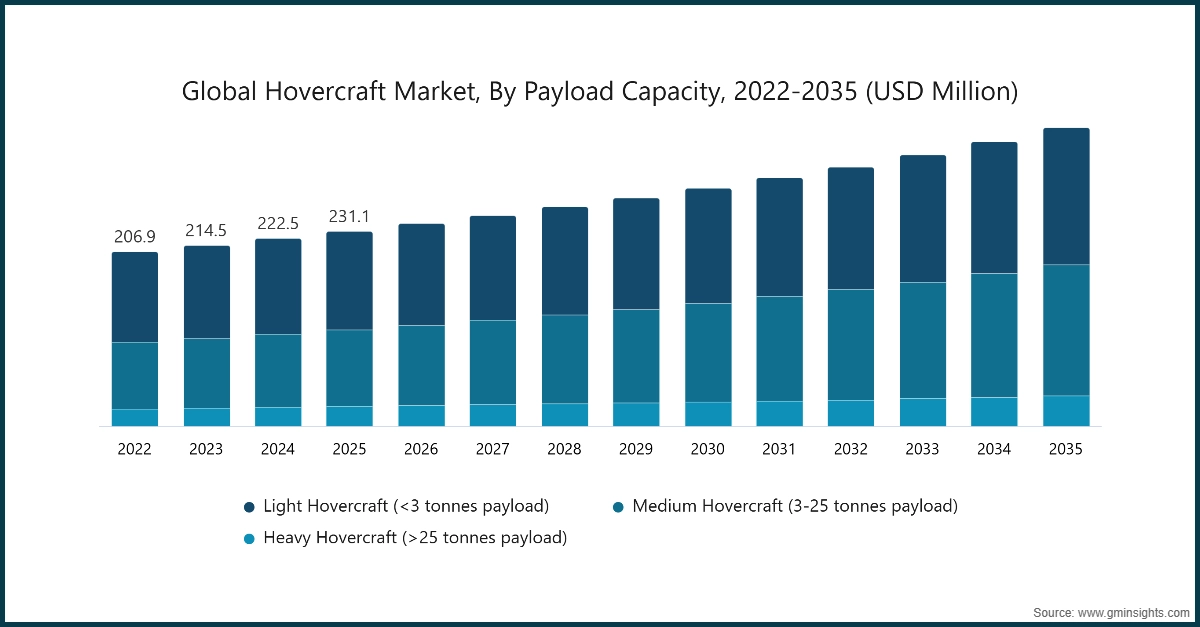
Between 2022 and 2024, the market witnessed considerable growth, increasing from USD 206.9 million in 2022 to USD 222.5 million in 2024. This was driven by the renewed focus on defense modernization budgets and investments in coastal security. The governments made it a priority to upgrade their old amphibious vehicles, while the expansion of offshore renewable energy sources created new logistics needs in shallow coastal areas. Procurement during this period was also driven by increased planning for disaster response due to climate change and strategic investments in Arctic and littoral mobility solutions.
The global hovercraft market was valued at USD 231.1 million in 2025. The market is expected to grow from USD 240.4 million in 2026 to USD 293.9 million in 2031 & USD 353.5 million in 2035, at a CAGR of 4.4% during the forecast period according to the latest report published by Global Market Insights Inc.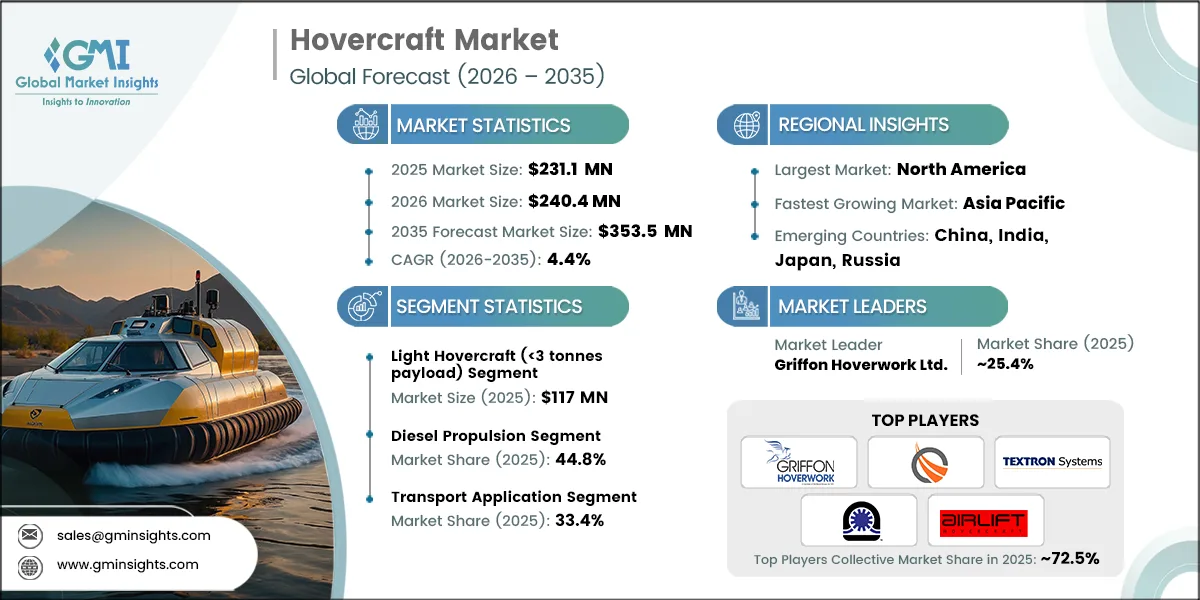
To get key market trends
Hovercraft Market Trends
- The market shows substantial growth through its key technological trend which involves hybrid-electric and low-emission propulsion systems. The EU and Asian maritime emission regulations became stricter in 2021 which led operators to search for fuel solutions that would lower their total operational costs. The transition will gain speed until 2032 because coastal authorities now focus on adopting more environmentally friendly fleet operations. The new system will boost productivity while allowing operations in protected water environments.
- Next-generation hovercraft now use digital navigation together with fly-by-wire control systems and advanced situational awareness packages. The adoption of these technologies was accelerated after 2020 as defense and coast guard organizations highlighted the importance of crew safety and precision maneuverability in complex littoral environments. The adoption will continue until 2030 as part of naval modernization cycles.
- Leasing and service procurement is also slowly being introduced into the hovercraft industry, especially for disaster response and offshore utility missions. This approach began gaining prominence after 2022 as budget-strapped organizations sought alternative acquisition solutions. The adoption is expected to continue until 2031 as governments seek to alleviate capital expenditures.
Hovercraft Market Analysis
Learn more about the key segments shaping this market
Based on payload capacity, the hovercraft market is segmented into light hovercraft (<3 tonnes payload), medium hovercraft (3–25 tonnes payload), and heavy hovercraft (>25 tonnes payload).
- The light hovercraft (<3 tonnes payload) segment held the largest share of the market in 2025 and was valued at USD 117 million. Light hovercraft lead the market due to strong adoption in rescue operations, patrol services, tourism, and inland transport across shallow rivers and marshlands. Public safety agencies and commercial operators prefer these products because they have lower acquisition costs and can be operated easily without needing special facilities. The operational flexibility of the system together with its access to remote locations maintains its high demand throughout developing economies and coastal regions.
- The medium hovercraft (3–25 tonnes payload) segment is expected to register growth at a CAGR of 5.5% over the forecast period. The military logistics requirements together with the offshore energy support operations and inter-island cargo transport needs drive this growth. The defense modernization process together with coastal infrastructure development projects benefits from the medium-capacity platforms which provide enhanced payload capacity while preserving their ability to move between land and water. The system enables users to achieve fast acquisition processes because it offers three capabilities which include speed and payload and operational reach.
Learn more about the key segments shaping this market
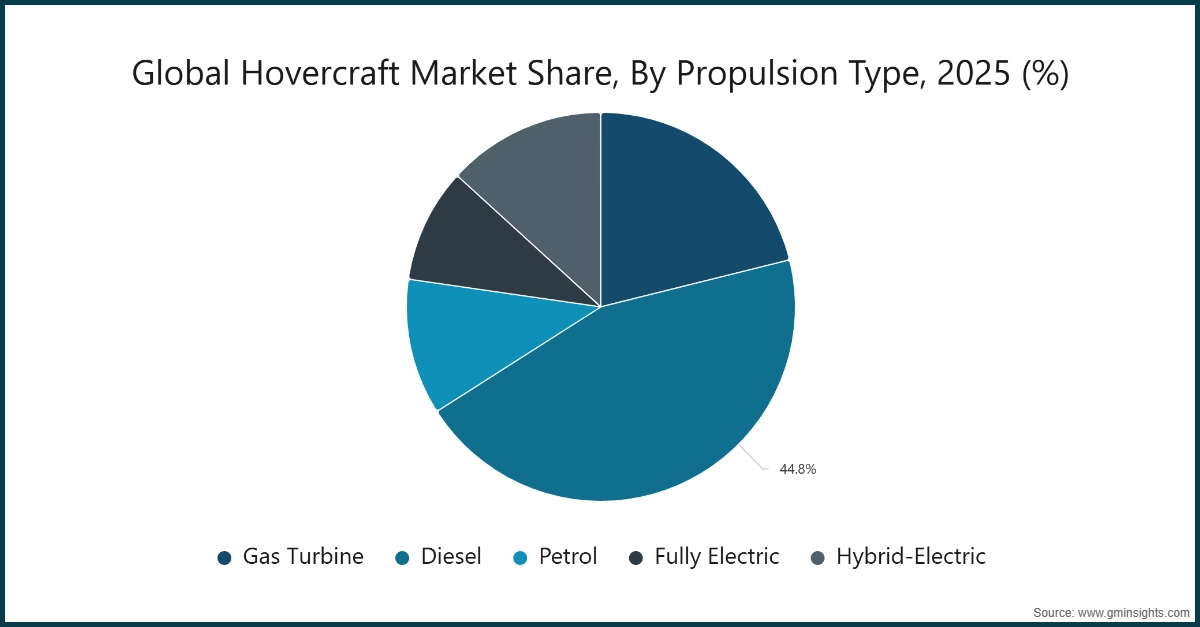
Based on propulsion type, the hovercraft market is segmented into gas turbine, diesel, petrol, fully electric, and hybrid-electric systems.
- The diesel propulsion segment dominated the market with share of 44.8% in 2025, because of its ability to deliver extensive power, maintain operational dependability and perform effectively in military and commercial applications that require heavy payloads. Diesel-powered hovercraft are essential for defense landing operations, offshore support and long-range patrol missions because their established fueling infrastructure enables them to operate continuously while their engines deliver reliable performance. Naval and industrial operators continue to prefer these systems because of their ability to maintain performance during extreme environmental conditions and high-demand operational scenarios.
- The fully electric propulsion segment is anticipated to grow at a CAGR of 8.9% over the forecast period due to rising emission regulations in coastal regions and growing demand for low-noise operations. Electric propulsion systems are gaining traction in tourism, environmental monitoring, and protected wetland transport where sustainability is prioritized. Advancements in battery density and hybrid integration are improving range feasibility, positioning electric hovercraft as a high-growth niche in environmentally regulated markets.
Based on application, the hovercraft market is segmented into transport, security & patrol, emergency response, offshore/industrial support, and specialized industrial & environmental operations.
- The transport application segment led the market in 2025 with a market share of 33.4%, supported by increasing demand for passenger and light cargo connectivity in remote islands, delta regions, and shallow coastal corridors. Hovercraft provide reliable year-round service where conventional ferries face draft limitations. Their ability to operate across water, mud, and sand without port dependency ensures strong deployment in regions with underdeveloped maritime infrastructure.
- The specialized industrial & environmental operations segment is expected to grow at a CAGR of 6.7% during the forecast period. This is due to the increasing use of the product in oil spill response activities, marshland access for pipeline inspection, offshore wind farm maintenance support, and ecological surveillance missions. The rising number of climate change-related environmental management projects and the expansion of the energy infrastructure sector are fueling the demand for multi-functional amphibious vehicles that can operate in sensitive and difficult-to-access environments.
Looking for region specific data?
North America Hovercraft Market
The North America held a market share of 29.7% of market in 2025.
- In North America, the hovercraft industry is expanding owing to the increasing defense modernization, coastal patrol, and disaster response capabilities. Government agencies are emphasizing rapid-deployment platforms that can operate in shallow waters and marshlands and Arctic environments.
- Adoption of next-generation hovercraft is rising across military, emergency response, and industrial support operations, positioning the region as a leader in amphibious technology and operational readiness through the next decade.
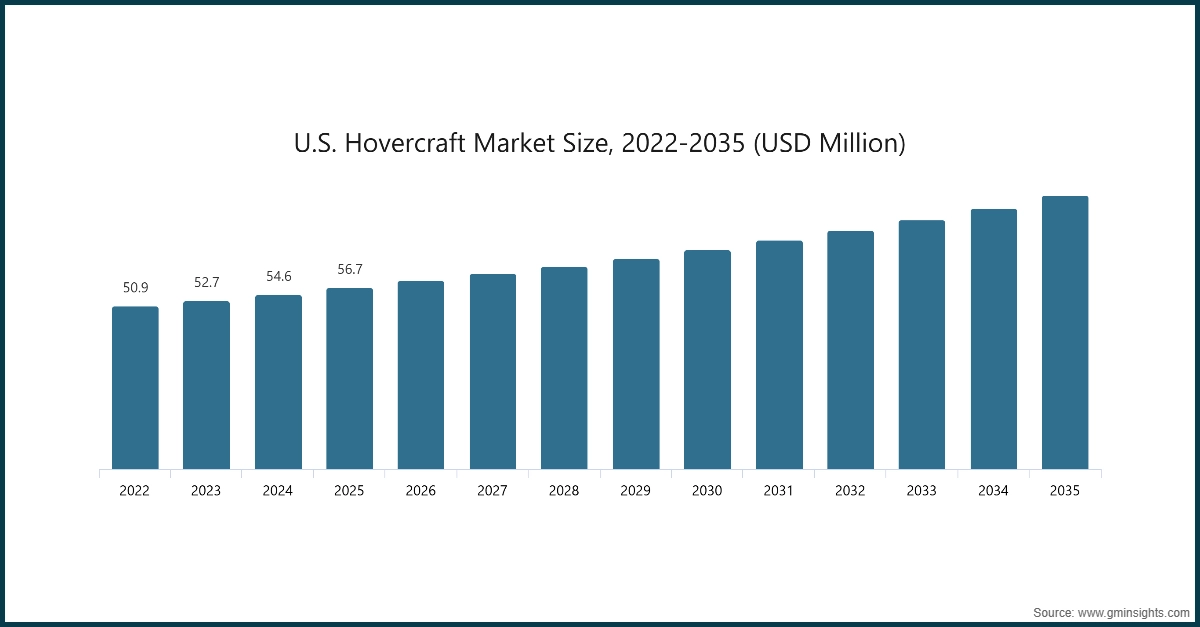
The U.S. hovercraft market was valued at USD 50.9 million and USD 52.7 million in 2022 and 2023, respectively. The market size reached USD 56.7 million in 2025, growing from USD 54.6 million in 2024.
- In the U.S., market expansion is driven by significant government contracts for next‑generation amphibious craft. In February 2025, the Pentagon awarded Rolls‑Royce a USD 167 million contract to supply engines for the U.S. Navy’s SSC hovercraft fleet, part of an ongoing multi‑billion‑dollar Ship‑to‑Shore Connector acquisition program.
- Federal initiatives to strengthen littoral mobility and support multi-mission operations are encouraging procurement of versatile, high-speed hovercraft platforms. This focus on advanced amphibious capabilities establishes the U.S. as the primary growth driver for the North American market.
Europe Hovercraft Market
Europe market accounted for USD 63.1 million in 2025 and is anticipated to show lucrative growth over the forecast period.
- Europe’s hovercraft industry is expanding as coastal nations prioritize multi-terrain vessels for shallow waters, tidal flats, and estuaries. Countries in the Nordic region, the Netherlands, and the British Isles increasingly deploy hovercraft for coastal patrol, border surveillance, flood response, and ecosystem monitoring, where conventional boats are constrained by draft or ice conditions.
- Collaborations between European defense agencies and domestic OEMs drive procurement of advanced hovercraft with modular payloads, lightweight composites, and digital navigation systems. Environmental agencies also adopt hovercraft for wetland conservation, marine research, and emergency logistics, creating a sustained demand pipeline across both military and civil sectors through the next decade.
UK dominates the Europe market, showcasing strong growth potential.
- In the UK, hovercraft adoption is driven by the need for coastal connectivity, rapid flood response, and estuarial transport. Authorities leverage hovercraft to maintain passenger, commuter, and tourism services where tidal variations and shallow waters limit ferry or conventional boat access. Defense forces also rely on hovercraft for rapid littoral deployment and coastal security operations.
- Strategic initiatives focus on modernizing amphibious platforms with improved skirt systems, digital navigation, and mission-specific modularity. Coastal resilience programs increasingly integrate hovercraft for emergency response, equipment delivery, and personnel mobility in flood-prone and marshland zones, highlighting their operational versatility and reinforcing the UK as a key market in Europe.
Asia Pacific Hovercraft Market
The Asia Pacific market is anticipated to grow at the highest CAGR of 6% during the forecast period.
- The Asia‑Pacific market is gaining momentum as coastal and archipelagic nations seek versatile amphibious platforms for transport, patrol, and disaster response where shallow waters and tidal variations limit conventional vessels. Governments in regions such as Southeast Asia and the Pacific Islands are prioritizing connectivity solutions that can operate over mudflats, mangroves, and estuaries with minimal infrastructure. This geographic diversity uniquely positions hovercraft as a practical mobility choice.
- Increased offshore energy development, including tidal and nearshore renewable investments in Australia, Japan, and South Korea, is supporting demand for hovercraft logistics solutions. These platforms are being considered for crew transfer, maintenance support, and supply movement across shallow coastal zones where ports are limited. As regional cooperation expands for maritime security and humanitarian assistance, hovercraft adoption is poised to strengthen across multi‑sector requirements in the Asia‑Pacific through the forecast period.
India hovercraft market is estimated to grow with a significant CAGR, in the Asia Pacific market.
- In India, the market is advancing as coastal states and central agencies explore amphibious mobility to enhance connectivity along the Sundarbans, coastal Odisha, and Andaman & Nicobar archipelagos. The Indian government has shown increased interest in craft capable of traversing tidal flats and riverine estuaries where road and ferry access is constrained. This operational need supports potential adoption for both civilian transport and disaster evacuation.
- Strategic defense planning is also contributing to market growth, with the Indian Navy and Coast Guard evaluating shallow‑draft platforms for patrol and rapid response along the eastern and western seaboards. Hovercraft are seen as complementary to existing vessel fleets, enhancing littoral patrolling and rapid logistics in shallow waters. Local manufacturing interest and tie‑ups with domestic shipyards further support long‑term industrial capability development and operational deployment in coastal security and emergency operations.
Middle East and Africa Hovercraft Market
Saudi Arabia hovercraft industry to experience substantial growth in the Middle East and Africa market.
- Saudi Arabia’s market is gaining traction as the Kingdom expands its coastal security and maritime patrol capabilities along the Red Sea and Arabian Gulf littorals. With increasing focus on protecting offshore energy infrastructure and critical waterways, government agencies are exploring hovercraft platforms that can operate efficiently over shallow coastal zones, coral lagoons, and marshlands where traditional vessels have limited access.
- The country’s ambitious Vision 2030 economic diversification strategy is driving investments in maritime tourism, island connectivity, and emergency response readiness. Hovercraft are being evaluated for rapid evacuation, coastal disaster logistics, and support operations tied to large‑scale events and industrial hubs. Saudi authorities are increasing their interest in hovercraft technology through enhanced defense partnerships which enable them to expand their search for amphibious solutions that serve multiple security and transportation and humanitarian purposes.
Hovercraft Market Share
The market is led by players such as Griffon Hoverwork Ltd, Textron Systems, Neoteric Hovercraft Inc, Airlift Hovercraft Pty Ltd, and Hovertechnics, LLC. These five companies cumulatively accounted for approximately 72.5% of the global market share in 2025. Their leadership is supported by diversified portfolios spanning military-grade amphibious assault craft, commercial transport platforms, rescue hovercraft, and industrial utility models.
These companies maintain a competitive edge through specialized skirt engineering, multi-terrain performance optimization, modular payload configurations, and strong aftersales lifecycle support capabilities. The U.S. Navy amphibious programs which Textron Systems operates for the long term enable the company to maintain its market leadership position while Griffon Hoverwork uses its Arctic-capable platforms and patrol-proven systems to build its commercial success. The companies Neoteric and Hovertechnics develop products which enable clients to customize their operational capabilities while Airlift Hovercraft provides solutions for heavy-duty operations in mining and offshore logistics sectors. These companies achieve sustained worldwide demand through their ongoing research in lightweight composite materials and propulsion systems and mission-adaptable design technologies.
Hovercraft Market Companies
Prominent players operating in the market are as mentioned below:
- Aerohod Ltd.
- Airlift Hovercraft Pty Ltd
- Christy Hovercraft
- Griffon Hoverwork Ltd
- Hov Pod Hovercraft
- Hoverstream LLC
- Hovertechnics, LLC
- Kaiman Hovercraft
- Neoteric Hovercraft Inc
- Pacific Hovercraft
- Textron Systems
- Vanair Hovercraft
- Griffon Hoverwork Ltd.
Griffon Hoverwork Ltd. specializes in high-payload military and commercial craft. The company operates its business by creating exclusive designs for their skirt and hull products which let them work in Arctic regions and shallow waters and marshland areas. The platforms of the company support defense patrol operations and offshore logistics missions and emergency response operations which deliver dependable performance on multiple terrains to government and commercial users all over the world.
Textron Systems provides advanced amphibious military hovercraft together with the Ship-to-Shore Connector program which serves U.S. Navy operations. The Company delivers mission payloads which can operate at high speeds together with navigation systems that function as complete packages for its expeditionary and coastal surveillance and amphibious assault operations.
Neoteric Hovercraft Inc. develops light-to-medium hovercraft which focus on rescue and flood response and inland waterway transport activities. The company designs its products to enable emergency responders and tourists and commercial transport operators to use its products in various ways through their design of lightweight hulls and dependable lift systems.
specializes in developing heavy-duty utility hovercraft which can serve multiple purposes across industrial and offshore and mining sectors. The company creates products with reinforced hulls and high payload capacity and all-terrain capabilities to establish efficient operations in difficult coastal and riverine and island locations. Airlift’s platforms support offshore energy maintenance, cargo transport, and disaster logistics across Asia-Pacific and Oceania.
Hovertechnics, LLC designs amphibious hovercraft for specialized industrial, security, and environmental operations. It emphasizes modular configurations, enhanced lift and propulsion efficiency, and application-specific adaptations. Hovertechnics’ craft are widely used in law enforcement, environmental monitoring, and industrial inspection, providing reliable access to shallow, marshy, or otherwise inaccessible terrains while maintaining high operational versatility.
Hovercraft Market Report Attributes
| Key Takeaway | Details |
|---|---|
| Market Size & Growth | |
| Base Year | 2025 |
| Market Size in 2025 | USD 231.1 Million |
| Market Size in 2026 | USD 240.4 Million |
| Forecast Period 2026-2035 CAGR | 4.4% |
| Market Size in 2035 | USD 353.5 Million |
| Key Market Trends | |
| Drivers | Impact |
| Rising Arctic and shallow-water patrol deployments | Drives 18% growth as nations such as Canada and Nordic countries are increasing investment in ice-capable and low-draft patrol platforms that can operate year-round over water, mud, and ice where conventional vessels fail. |
| Expanding offshore wind farm service logistics | Supports 20% growth through expanding offshore wind farm service logistics, particularly in the North Sea and East Asia. Hovercraft provide efficient technician transfer and equipment transport in tidal flats and nearshore zones where draft restrictions limit traditional crew transfer vessels. |
| Growth in amphibious military modernization programs | Contributes 28% growth as defense forces in Asia-Pacific and the U.S. are upgrading legacy landing craft with higher-speed, multi-terrain hovercraft to strengthen littoral warfare and rapid coastal insertion capabilities. |
| Oil spill response and environmental monitoring needs | Adds 14% growth as government agencies and coastal authorities deploy hovercraft in marshlands and fragile ecosystems where conventional boats risk environmental damage. |
| Increased coastal disaster response requirements | Accounts for 20% growth as increasing cyclones, flooding, and storm surges in Southeast Asia and the Gulf region are driving procurement of hovercraft for evacuation, relief transport, and emergency logistics in inundated or debris-filled terrain. |
| Pitfalls & Challenges | Impact |
| High fuel consumption and operating costs | Restrains market growth as hovercraft propulsion and lift systems require significant fuel and maintenance expenditure. Continuous power demand for lift fans and propulsion engines increases operational costs compared to displacement vessels in long-range operations, limiting adoption among commercial operators in cost-sensitive transport markets. |
| Limited skilled maintenance workforce availability | Limits growth due to shortage of trained hovercraft technicians and specialized maintenance expertise. Complex skirt systems, lift-fan assemblies, and amphibious propulsion mechanisms require skilled servicing, and limited workforce availability in emerging markets delays fleet expansion and increases lifecycle costs. |
| Opportunities: | Impact |
| Hybrid-electric propulsion system integration | Presents significant growth potential by integrating hybrid-electric propulsion systems to reduce emissions and fuel costs. Combining diesel engines with battery-assisted lift and propulsion improves operational efficiency, supports compliance with tightening maritime emission standards, and enhances suitability for environmentally sensitive zones. |
| Autonomous unmanned hovercraft for defense surveillance | Offers opportunity by integration of AI-based navigation, remote command systems, and ISR payloads allows continuous patrol in shallow waters, reducing personnel risk while enhancing border security and maritime domain awareness capabilities. |
| Market Leaders (2025) | |
| Market Leader |
~25.4% market share. |
| Top Players |
Collective Market Share of ~72.5% |
| Competitive Edge |
|
| Regional Insights | |
| Largest Market | North America |
| Fastest growing market | Asia Pacific |
| Emerging countries | China, India, Japan, Russia |
| Future outlook |
|
What are the growth opportunities in this market?
Hovercraft Industry News
- In July 2025, Griffon Marine Ltd officiated the opening of the Oita Daiichi hovercraft passenger service in Japan, resuming a rare scheduled route between Oita Airport and Oita City that cuts travel time across Beppu Bay in half. The service, using Griffon 12000TD craft, is expected to carry ~300 000–400 000 passengers annually, boosting regional connectivity and economic activity.
- In January 2026, Neoteric Hovercraft Inc announced plans to showcase its rescue and utility hovercraft at FDIC International 2026, the world’s largest fire and rescue conference, featuring demo flights and live demonstrations to over 35 000 first responders. This expanded international exposure is likely to drive new procurement interest from emergency response and public safety agencies.
- In October 2022, Airlift Hovercraft Pty Ltd introduced its latest range of small to medium hovercraft models designed for passenger, search & rescue, and utility missions with customizable options across payloads and applications. Continued product range expansion reinforces its positioning in both commercial transport and specialized operational segments.
The hovercraft market research report includes in-depth coverage of the industry with estimates and forecast in terms of revenue (USD Million) from 2022 – 2035 for the following segments:
Market, By Payload Capacity
- Light hovercraft (<3 tonnes payload)
- Medium hovercraft (3-25 tonnes payload)
- Heavy hovercraft (>25 tonnes payload)
Market, By Propulsion Type
- Gas turbine
- Diesel
- Petrol
- Fully electric
- Hybrid-electric
Market, By Application
- Transport
- Security & patrol
- Emergency response
- Offshore/industrial support
- Specialized industrial & environmental operations
Market, By End-User
- Defense & military
- Civil government agencies
- Commercial operators
- Private owners
The above information is provided for the following regions and countries:
- North America
- U.S.
- Canada
- Europe
- Germany
- UK
- France
- Spain
- Italy
- Russia
- Asia Pacific
- China
- India
- Japan
- Australia
- South Korea
- Latin America
- Brazil
- Mexico
- Argentina
- Middle East and Africa
- South Africa
- Saudi Arabia
- UAE
Frequently Asked Question(FAQ) :
What is the market size of the hovercraft market in 2025?
The market was valued at USD 231.1 million in 2025, driven by increasing demand for amphibious platforms capable of operating across water, mud, ice, and marshlands for defense patrol, disaster response, and coastal logistics operations.
What is the current size of the hovercraft industry in 2026?
The industry is projected to reach USD 240.4 million in 2026, supported by growing investments in coastal security, Arctic patrol missions, and offshore energy logistics that require shallow-draft and multi-terrain mobility platforms.
What is the projected value of the hovercraft market by 2035?
The market is expected to reach USD 353.5 million by 2035, growing at a CAGR of 4.4%, fueled by defense modernization initiatives, expanding offshore wind infrastructure logistics, and increasing use of amphibious vehicles for emergency response and environmental monitoring.
Which payload capacity segment dominates the hovercraft market?
The light hovercraft (<3 tonnes payload) segment dominated the market and generated around USD 117 million in 2025 due to strong adoption in rescue operations, patrol services, tourism transport, and shallow-water mobility across rivers, marshlands, and coastal regions.
Which propulsion type leads the hovercraft industry?
The diesel propulsion segment led the market with a 44.8% share in 2025 because diesel engines provide reliable power, operational endurance, and strong performance in military landing operations, offshore support missions, and long-range coastal patrol activities.
Which application segment holds the largest share in the hovercraft industry?
The transport application segment accounted for the largest share of 33.4% in 2025, driven by increasing demand for passenger and cargo connectivity in remote islands, shallow coastal corridors, and delta regions where conventional ferries face draft limitations.
Which region leads the hovercraft market?
North America led the market with around 29.7% market share in 2025, supported by strong defense modernization programs, increasing coastal patrol operations, and government investments in amphibious platforms for disaster response and Arctic mobility.
Who are the key companies operating in the hovercraft industry?
Major companies operating in the market include Griffon Hoverwork Ltd., Textron Systems, Neoteric Hovercraft Inc., Airlift Hovercraft Pty Ltd., Hovertechnics LLC, Aerohod Ltd., Christy Hovercraft, Hov Pod Hovercraft, Pacific Hovercraft, and Vanair Hovercraft, focusing on advanced amphibious craft, multi-terrain mobility technologies, and mission-specific hovercraft solutions for defense, commercial, and emergency operations.
Hovercraft Market Scope
Related Reports