Summary
Table of Content

Household Robots Market
Get a free sample of this report
Form submitted successfully!
Error submitting form. Please try again.
Thank you!
Your inquiry has been received. Our team will reach out to you with the required details via email. To ensure that you don't miss their response, kindly remember to check your spam folder as well!
Request Sectional Data
Thank you!
Your inquiry has been received. Our team will reach out to you with the required details via email. To ensure that you don't miss their response, kindly remember to check your spam folder as well!
Form submitted successfully!
Error submitting form. Please try again.
Household Robots Market Size
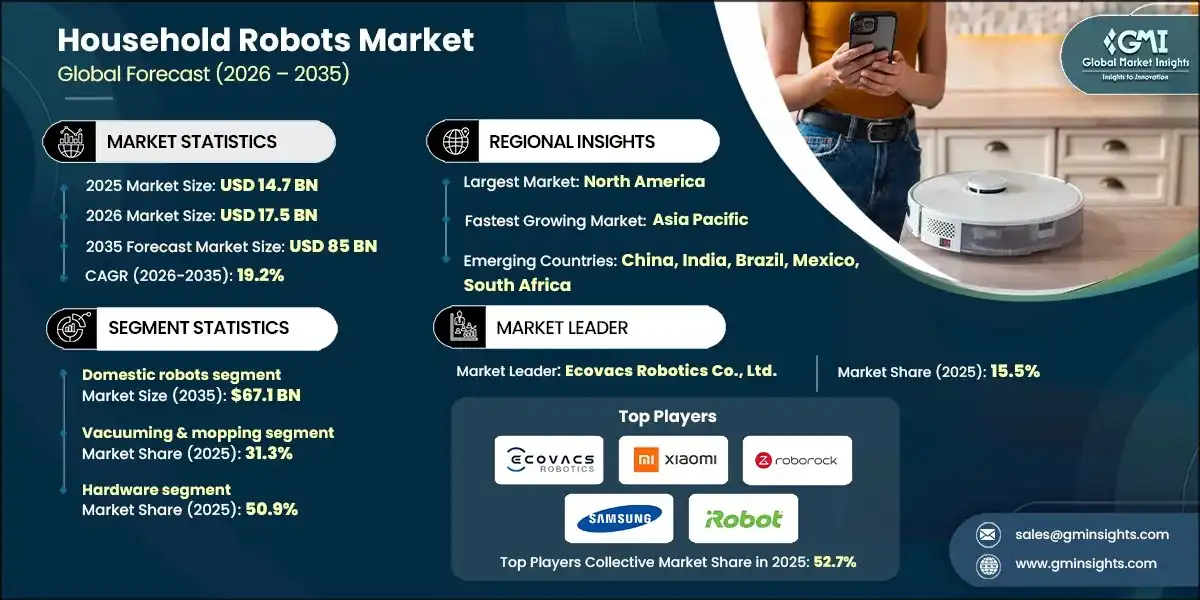
The global household robots market was estimated at USD 14.7 billion in 2025. The market is expected to grow from USD 17.5 billion in 2026 to USD 41.9 billion in 2031 and USD 85 billion by 2035 with a volume of 1,96,871 thousand units, at a CAGR of 19.2% during the forecast period of 2026–2035, according to the latest report published by Global Market Insights Inc.
Household Robots Market Key Takeaways
Market Size & Growth
- 2025 Market Size: USD 14.7 Billion
- 2026 Market Size: USD 17.5 Billion
- 2035 Forecast Market Size: USD 85 Billion
- CAGR (2026–2035): 19.2%
Key Market Drivers
- Rising adoption of smart homes and IoT integration.
- Growing consumer demand for convenience and automation.
- Growth in e-commerce and online retail for robotics.
- Increasing aging population and need for elderly assistance.
Challenges
- Evolving regulations related to data privacy and safety.
- Low consumer awareness in price-sensitive and rural markets..
Opportunity
- Increased focus on home security and indoor surveillance solutions..
- Integration of voice assistants and natural language processing for intuitive user interaction..
Key Players
- Market Leader: Ecovacs Robotics Co., Ltd. led with over 15.5% market share in 2025.
- Leading Players: Top 5 players in this market include Ecovacs Robotics Co., Ltd., Xiaomi Corporation, Beijing Roborock Technology Co. Ltd., Samsung Electronics Co., Ltd., iRobot Corporation, which collectively held a market share of 52.7% in 2025.
Get Market Insights & Growth Opportunities
The demand for household robots is growing significantly owing to increasing adoption of smart homes and the growth in e-commerce and online retail.
One of the most significant drivers in the market growth of household robots is the increasing adoption of smart homes. IoT and AI-based smart home ecosystems ensure instant inter-operability between a household robot and other devices such as voice assistants, security cameras, and kitchen appliances. This allows the robots to perform a range of more complex and effective tasks like cleaning, monitoring, and personal care. The adoption of home robots is bound to increase in the developed nations, where the infrastructure for smart home technology is being adopted at a very high pace. Statista projects that the smart appliances market will see the highest rise in market value, hitting USD 92.2 billion in 2028, indicating the increasing consumer trend towards automation and smart homes. This subsequently increases the demand for household robots as they are specifically being developed to be smart-home compatible.
The demand for household robots has increased with growing consumer awareness, increasing exposure of e-commerce sites and online retailers. Prices and reviews are being compared by customers on websites, boosting competition and interest in domestic robots. Home robots demand via global marketing is also being boosted, enabling quicker delivery, cheaper prices, and promotions. This demand momentum is reflected in industry data, as service robots for consumer use recorded a solid growth rate of 11%, with close to 20 million units sold globally in 2024, as cited by IFR, indicating strong and broad-based adoption of household robotic solutions.
The market for household robots consists of robotic products that cater to household tasks such as cleaning, protection, and companionship. These robots employ AI, IoT, and automation to improve domestic work with efficiency and convenience. Adoption of automated technology combined with higher adoption of smart homes and consumer behavior change are drivers of this market.
To get key market trends
Household Robots Market Trends
- A primary trend within the market for household robots is the rise in AI-based automation within cleaning robots. Smart robotic vacuum cleaners with self-cleaning, mapping, and improved suction features are in high demand to meet the rising needs of the customers. The adoption of AI and ML technologies within the industry allows easier maintenance, cleaning surface adaptation, and route optimization.
- For instance, in September 2024, Dreame Technology debuted its high-end robot vacuum cleaner, the Dreame X40 Ultra in India. This advanced device offers a comprehensive cleaning experience with AI-powered navigation, automatic dustbin emptying, and extremely powerful suction technology.
- Furthermore, there is a growing trend in the development of multifunctional household robots, extending beyond just cleaning. For example, users will now have the ability to own a device that can monitor the house’s security as well as assist with house chores and pet caretaking. This is very valuable and versatile for users.
Household Robots Market Analysis
Learn more about the key segments shaping this market
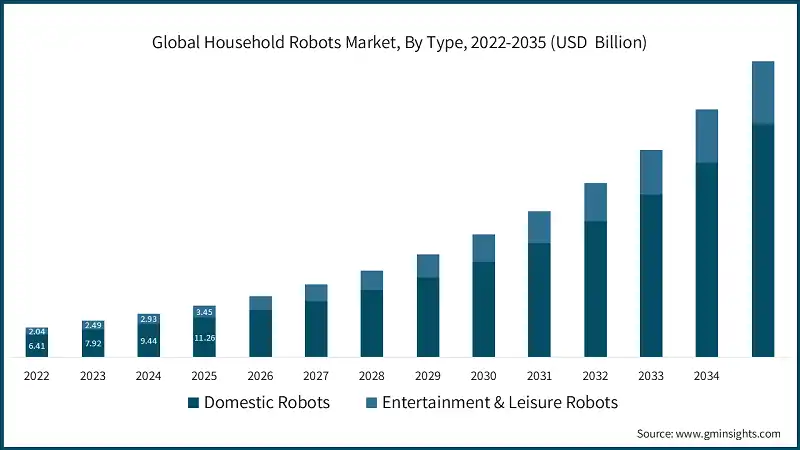
Based on type, the market is segmented into domestic robots and entertainment & leisure robots.
- The domestic robots market is anticipated to reach USD 67.1 billion by 2035. The proliferation of AI and machine learning technologies has made a substantial impact on the use of domestic robots, since it has significantly improved the capability of home automation systems. Consumers are searching for multi-capable robots that can perform a plethora of chores including cleaning and monitoring the house. Moreover, the adoption of smart home systems is considerably increasing the need for connected and intelligent domestic robots.
- The entertainment and leisure robots market is projected to grow at a CAGR of over 17.9% by 2035. The entertainment and leisure robots segment is now growing significantly because of the adoption of AI interaction features, voice recognition, and motion-enabled engagement. Interactive companions that can be used to play games with children and adults or for learning are now available. The growing use of storytelling AI and specially designed education and other personalized interactions in households are increasing the demand for such sophisticated entertainment robots.
Learn more about the key segments shaping this market
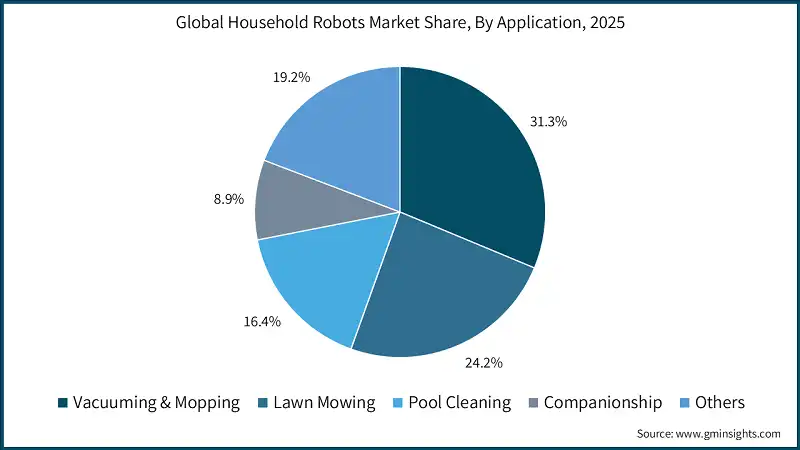
On the basis of application, the household robots market is segmented into vacuuming & mopping, lawn mowing, pool cleaning, companionship, and others.
- The vacuuming & mopping segment held a market share of 31.3% in 2025. Robots that vacuum and mop are transforming from being under constant supervision to completely autonomous machines that can avoid obstacles map the space and empty themselves in designated bins. Consumers now prefer multifunction devices that can vacuum, mop, and do self-cleaning. The adoption of AI-enabled routing, real-time app-controlled suction power, and device monitoring is changing the landscape of the robotic cleaning industry for the better.
- Companionship robots market is projected to reach USD 8.9 billion by 2035. Companion Robots are rapidly becoming popular with the old, aged people and youngsters as they provide emotional support and assistance. The development of social AI robots that can understand voice commands and respond to the user's feelings is meant to create engaging user experiences. Robots that serve as companions for mental-emotional well-being are in greater demand now.
On the basis of component, the household robots market is divided into hardware, software, and service.
- Hardware dominated the global market accounting for 50.9% market share in 2025. The development of new hardware has increased the effectiveness and reliability of household robots in addition to enabling improved multitasking capabilities. The integration of powerful miniaturized motors, high-performance sensors, and advanced batteries enables efficient navigation and longer operational periods. The incorporation of AI chips and edge computing technology also enhances the autonomy and responsiveness of robots.
- The service robots market is projected to grow at a CAGR of 20.1% by 2035. AI facial recognition and voice command technologies, along with real-time monitoring, are being integrated into enhance AI-powered service robots in homes, which improves the safety and convenience of everyday activities. Service robots that require less supervision are being used to assist elderly, secure homes, or even prepare meals.
Looking for region specific data?
North America Household Robots Market
The North America market held a 32.7% share of the global market in 2025.
- The growth of smart home technologies along with AI enabled automation is enabling faster adoption of household robots across North America.
- A market is emerging for advanced robots that serve multiple purposes, such as cleaning, security and companionship.
- The surge in AI integration with smart devices has increased the demand for advanced robotics at home.
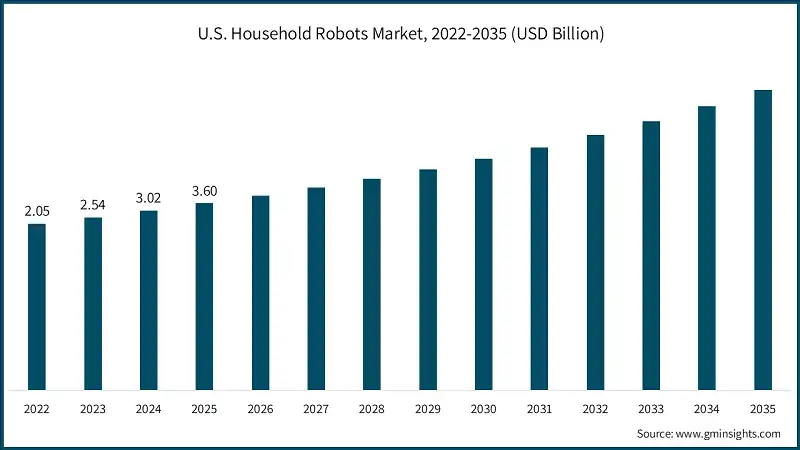
The U.S. household robots market was valued at USD 2 billion and USD 2.5 billion in 2022 and 2023, respectively. The market size reached USD 3.6 billion in 2025, growing from USD 3 billion in 2024.
- The United States has the biggest market of household robots due to high living standards and early smart home adoption.
- Consumers are employing AI driven robots for cleaning and handling numerous chores in the home.
- The growth in AI and IoT investment is also driving the growth of the market and propelling innovation in the U.S.
- The market for household robots in Canada is growing alongside the development of smart home devices. There is an increasing demand for smart robotic aids as consumers embrace more sophisticated smart home systems. As per the predictions made by Statistics Canada, the Canadian smart home device market is expected to reach USD 3.1 billion by 2024, which will increase the prevalence of robotics use in Canadian homes.
Europe Household Robots Market
Europe market accounted for USD 3.5 billion in 2025 and is anticipated to show lucrative growth over the forecast period.
- Europe is registering notable improvements in AI powered household robots due to increasing consumer interest in automation, smart living, and robotics.
- Increasing energy efficiency standards and sustainability forces also create a requirement for greener robotic solutions.
- The robotics industry's increased emphasis on innovation and R&D is facilitating growth across the region.
Germany dominates the Europe household robots market, showcasing strong growth potential.
- Germany leads Europe's household robot market due to strong technological infrastructure and adoption of smart homes.
- German consumers are willing to pay for premium AI robotic home automation devices.
- The focus on engineering and innovation continues to fuel the development of advanced performance household robots.
Asia Pacific Household Robots Market
The Asia Pacific market is anticipated to grow at the highest CAGR of 20.8% during the analysis timeframe.
- The most advanced region in the household robot market is the Asia Pacific, where the growth of artificial intelligence, smart home technology, and increasing disposable incomes are leading the demand.
- China, India, and Japan are at the forefront of the innovation achieving the development of highly efficient Integrated AI robotic systems for automation targeted to households.
China household robots market is estimated to grow with a significant CAGR, in the Asia Pacific market.
- China remains one of the foremost drivers of the global household robot market. The primary reason is the extensive development made in China in artificial intelligence and robotics.
- Innovations in the AI technologies, the government’s support and a reliable manufacturing industry is driving the growth of the market.
- According to the People Republic of China the demand for AI based household robots will grow as China's core AI industry is estimated to exceed USD 81 billion dollars in 2023.
Latin America Household Robots Market
Brazil leads the Latin American market, exhibiting remarkable growth during the analysis period.
- Brazil is experiencing a gradual increase in household robot sales owing to increased smart home adoption and growth of the e-commerce industry.
- AI powered robotic solutions for maintaining homes are preferred by consumers. Furthermore, the growing presence of robotic products over retail and online stores is enhancing the growth of the market’s reach in Brazil.
Middle East and Africa Household Robots Market
South Africa market experience substantial growth in the Middle East and Africa market in 2025.
- South Africa is witnessing growing adoption of household robots, particularly in urban regions that are adopting smart home technologies.
- Users are purchasing AI robotic cleaners and assistants for the home. Increased popularity of autonomous, voice-controlled robot solutions aligns with South Africa’s shift to a smart living and home automation future.
Household Robots Market Share
The market is highly competitive. The top 5 players in the market are Ecovacs Robotics, Xiaomi, Beijing Roborock Technology, Samsung Electronics, and iRobot, accounting for a significant share of over 52% in the market.
The competitors in the household robot market are emphasizing AI and innovation, as well as smart home integration, to stay competitive. iRobot, Samsung, and Dyson, for example, are using self-cleaning advanced navigation, and voice activated command products to boost their efficiency. Companies are focusing on expanding their product range and enhance client satisfaction through targeting M&A, strategic alliances, and Research and Development.
Increased sales are in turn fostered by e-commerce and retail partnerships in addition to entry into new regions by established market players. Companies have segmented the consumer market aimed at low to high end spending households. Robotic solutions are being designed with sustainable and energy efficient elements to serve as effective market differentiators. Businesses are responding to the increasing consumer demands by strengthening marketing activities, allocating funds, and developing regional policies that will serve the purpose of fostering consumer acceptance and expansion into emerging markets.
Household Robots Market Companies
Prominent players operating in the household robots industry are as mentioned below:
- iRobot Corporation
- Ecovacs Robotics Co., Ltd.
- Xiaomi Corporation
- Maytronics Ltd
- Samsung Electronics Co., Ltd.
- Neato Robotics, Inc.
- Dyson Limited
- LG Electronics Inc.
- LEGO A/S
- Hayward Holdings, Inc.
- UBTECH Robotics
- Ecovacs Robotics
Ecovacs Robotics holds a significant market share of around 15.5% in the household robots market. Ecovacs Robotics implements a focus on automation, low cost, and AI-powered features as the primary focus of their marketing strategy. The company allocates its resources to research and development aimed at improving the effectiveness of mobility, object evasion, and voice command control. Ecovacs seeks to expand its international presence via the internet and through retail partnerships in order to make smart household robots affordable for more consumers.
Samsung Electronics is a leading player in the household robots market with a market share of approximately 8.3%. Samsung Electronics uses a strategic approach directed towards AI innovation and smart home systems. The company enhances its robotic solution’s capabilities with sophisticated sensors, self-learning algorithms, and interconnection with the SmartThings ecosystem. By utilizing premium technology and broadening its product scope, Samsung increases its foothold in the high-end household mobile robot market.
iRobot Corporation commands a market share of approximately 4.6% in the market. iRobot Corporation is a leading household robot manufacturer, known for its robotic vacuums and smart home integration, benefiting from growing demand for automated home solutions.
Household Robots Market Report Attributes
| Key Takeaway | Details |
|---|---|
| Market Size & Growth | |
| Base Year | 2025 |
| Market Size in 2025 | USD 14.7 Billion |
| Market Size in 2026 | USD 17.5 Billion |
| Forecast Period 2026-2035 CAGR | 19.2% |
| Market Size in 2035 | USD 85 Billion |
| Key Market Trends | |
| Drivers | Impact |
| Rising adoption of smart homes and IoT integration | Accelerates demand for connected and interoperable household robots capable of seamless integration within smart home ecosystems. |
| Growing consumer demand for convenience and automation | Drives higher adoption rates of household robots as consumers seek time-saving, automated domestic solutions. |
| Growth in e-commerce and online retail for robotics | Expands market reach and improves product accessibility, supporting faster sales growth and wider consumer penetration. |
| Increasing aging population and need for elderly assistance | Creates sustained demand for assistive and companion robots tailored to elderly care and independent living. |
| Pitfalls & Challenges | Impact |
| Evolving regulations related to data privacy and safety | Introduces compliance costs and design constraints, potentially slowing product innovation and market entry timelines |
| Low consumer awareness in price-sensitive and rural markets. | Limits market penetration and volume growth in emerging and cost-sensitive regions |
| Opportunities: | Impact |
| Increased focus on home security and indoor surveillance solutions. | Boosts demand for robotic solutions focused on monitoring, surveillance, and enhanced home safety |
| Integration of voice assistants and natural language processing for intuitive user interaction. | Enhances user experience and adoption by enabling natural, hands-free interaction with household robots |
| Market Leaders (2025) | |
| Market Leaders |
15.5% market share |
| Top Players |
|
| Competitive Edge |
|
| Regional Insights | |
| Largest Market | North America |
| Fastest Growing Market | Asia Pacific |
| Emerging Country | China, India, Brazil, Mexico, South Africa |
| Future Outlook |
|
What are the growth opportunities in this market?
Household Robots Market Industry News
- In November 2025, robotics firm 1X Technologies (formerly Halodi Robotics) officially launched NEO, its first consumer-ready home assistant, designed to handle mundane chores.
- In December 2023, Samsung Electronics announced its plans to launch the Bespoke Jet Bot Combo vacuum cleaner series in 2024. The product is a robotic mop and vacuum cleaner that incorporates AI technology and steam cleaning.
- In September 2023, iRobot Corp, launched the flagship Roomba Combo j9+ robot vacuum and mop, as well as the Roomba j9+ vacuum, which solves problems presented by competing robots. The Roomba Combo j9+ has an innovative feature – Clean Base Auto-Fill Dock – that brings automation to a whole new level by emptying debris from the robot’s bin and refilling the cleaning solution.
The household robots market research report includes in-depth coverage of the industry with estimates and forecast in terms of revenue in (USD Million) & Volume (Units) from 2022 – 2035 for the following segments:
Market, By Type
- Domestic robots
- Entertainment & leisure robots
Market, By Component
- Hardware
- Software
- Service
Market, By Application
- Vacuuming & mopping
- Lawn mowing
- Pool cleaning
- Companionship
- Others
Market, By Distribution Channel
- Online sales
- Offline sales
- Retail stores
- Home improvement stores
- Appliance stores
The above information is provided for the following regions and countries:
- North America
- U.S.
- Canada
- Europe
- Germany
- UK
- France
- Spain
- Italy
- Netherlands
- Asia Pacific
- China
- India
- Japan
- Australia
- South Korea
- Latin America
- Brazil
- Mexico
- Argentina
- Middle East and Africa
- South Africa
- Saudi Arabia
- UAE
Frequently Asked Question(FAQ) :
What was the market size of the household robots market in 2025?
The market size was USD 14.7 billion in 2025, with a CAGR of 19.2% expected during the forecast period of 2026–2035, driven by advancements in AI-based automation and increasing demand for multifunctional robots.
What is the projected value of the household robots market by 2035?
The market is expected to reach USD 85 billion by 2035, supported by the proliferation of AI and machine learning technologies, as well as the growing adoption of smart home systems.
What is the projected size of the household robots market in 2026?
The household robots market is expected to reach USD 17.5 billion in 2026.
What was the market share of the vacuuming & mopping segment in 2025?
The vacuuming & mopping segment held a 31.3% market share in 2025, driven by the shift towards fully autonomous robots with features like obstacle avoidance, space mapping, and self-emptying capabilities.
What was the market share of the hardware segment in 2025?
The hardware segment dominated the market with a 50.9% share in 2025, owing to advancements in miniaturized motors, high-performance sensors, advanced batteries, and AI chips.
Which region led the household robots market in 2025?
North America led the market with a 32.7% share in 2025, driven by strong consumer adoption of smart home technologies and advanced robotic solutions.
What are the upcoming trends in the household robots market?
Key trends include the integration of AI and ML technologies for enhanced autonomy, the development of multifunctional robots, and the increasing adoption of connected smart home systems.
Who are the key players in the household robots market?
Key players include iRobot Corporation, Ecovacs Robotics Co., Ltd., Xiaomi Corporation, Maytronics Ltd, Samsung Electronics Co., Ltd., Neato Robotics, Inc., Dyson Limited, and LG Electronics Inc.
Household Robots Market Scope
Related Reports