Summary
Table of Content

Household Kitchen Sink Market
Get a free sample of this report
Form submitted successfully!
Error submitting form. Please try again.
Thank you!
Your inquiry has been received. Our team will reach out to you with the required details via email. To ensure that you don't miss their response, kindly remember to check your spam folder as well!
Request Sectional Data
Thank you!
Your inquiry has been received. Our team will reach out to you with the required details via email. To ensure that you don't miss their response, kindly remember to check your spam folder as well!
Form submitted successfully!
Error submitting form. Please try again.
Household Kitchen Sink Market Size
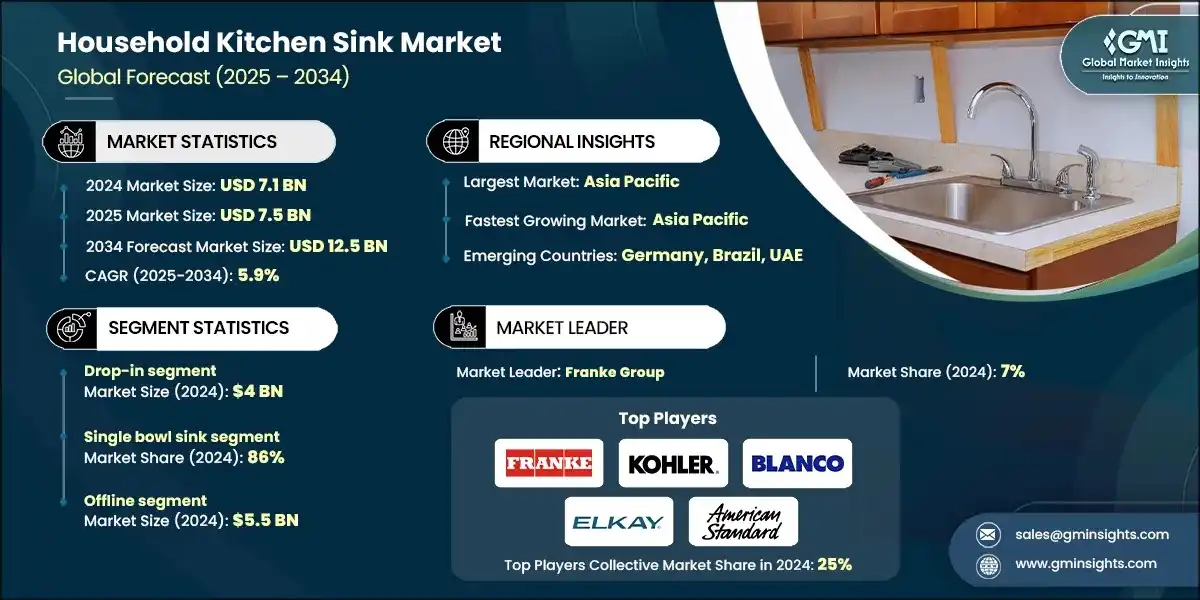
The global household kitchen sink market was estimated at USD 7.1 billion in 2024. The market is expected to grow from USD 7.5 billion in 2025 to USD 12.5 billion in 2034, at a CAGR of 5.9% according to latest report published by Global Market Insights Inc.
Household Kitchen Sink Market Key Takeaways
Market Size & Growth
- 2024 Market Size: USD 7.1 Billion
- 2025 Market Size: USD 7.5 Billion
- 2034 Forecast Market Size: USD 12.5 Billion
- CAGR (2025–2034): 5.9%
Key Market Drivers
- Rising Home Renovation and Remodeling Activities.
- Urbanization and New Residential Construction.
- Technological Advancements and Smart Kitchen Integration.
Challenges
- High Raw Material and Manufacturing Costs.
- Limited Awareness and Adoption in Rural Areas.
Opportunity
- Rising Urbanization and Modern Living Standards.
- Increasing Focus on Water Conservation and Sustainability.
Key Players
- Market Leader: Franke Group led with over 7% market share in 2024.
- Leading Players: Top 5 players in this market include Franke Group, Kohler Co., Blanco GmbH + Co KG, Elkay Manufacturing Company, American Standard Brands (LIXIL), which collectively held a market share of 25% in 2024.
Get Market Insights & Growth Opportunities
The increased focus on home renovation projects globally is a key driver for household water sinks. Consumers are now participating in kitchen and bathroom renovations due to lifestyle changes, increased disposable income, and a need to modernize functionality and appearance. Home renovation trends show a strong focus on modern designs, quality finishes, and integrated accessories; this creates opportunities for manufacturers to create new, modern, and customizable sink options for consumers.
The rise of modular kitchen categories and luxury fitting and fixture categories creates a developable opportunity in the market for high-quality sinks fitting into modern kitchen layouts. Overall, this renovation trend positions the renovation category as a critical growth engine for water sinks, especially in developed markets with limited new builds.
According to the National Kitchen and Bath Association (NKBA), spending on kitchen and bathroom remodeling in the U.S. reached approximately USD 85 billion in 2023, reflecting a growing consumer focus on enhancing home functionality and aesthetics. This trend is fueled by lifestyle changes, rising disposable incomes, and a preference for modern, efficient living spaces.
Rapid urban growth is changing the housing landscape, as more residential homes are being built in developing economies. Increasing density and urban migration are putting pressure on smaller, multifunction, stylish kitchens and bathrooms. Developers are also responding to growing consumer expectations for sink style and functionality, by adding more contemporary sinks into new housing. There is a lot of momentum for this trend, particularly in Asia-Pacific and Latin America, where urban growth is accelerating rapidly. Manufacturers that partner with builders to provide lower cost, but still high quality and valuable products can secure longer-term contracts providing recurring revenue. Urbanization continues to define the fundamental driver of global market growth.
According to the United Nations, 56.2% of the global population resided in urban areas in 2020, and this figure is expected to reach 68% by 2050. This urban shift is creating a heightened demand for compact, efficient, and aesthetically appealing kitchen and bathroom fixtures, as urban residents prioritize functionality and modern design in increasingly limited living spaces.
The Asia-Pacific region leads the household kitchen sink market due to rapid urbanization, rising disposable income, and a spike in residential construction. Countries, such as China, India, and Southeast Asian countries, are experiencing robust activity in housing projects as well as kitchen remodeling activity. A growing middle class in APAC places importance on not only functional yet visually appealing kitchen accessories, and this, too, is contributing to robust market expansion. The added benefit of government policies designed to increase the housing affordability will work in favor of lower-cost kitchen sink options with reasonably durable materials, making APAC the fastest-growing regional market.
The drop-in segment is the primary installation type due to low pricing, installation ease, and compatible with various countertop materials. Drop-in sinks have significant appeal to both new construction and renovation projects, serving as an efficient solution without specialized labor or extensive customization. Additionally, they are a more compatible choice in emerging economies due to their practicality and convenient availability. Manufacturers, in response to changing consumer preferences, develop drop-in designs in premium finishes and, in some cases, with integrated accessories. The combination of the ongoing housing boom in APAC and the practicality of drop-in sinks will maintain the construction installation type at the forefront of the global market landscape.
To get key market trends
Household Kitchen Sink Market Trends
The market is evolving with three key trends: smart and touchless technologies enhancing hygiene and convenience, growing demand for eco-friendly materials driven by sustainability concerns, and rising preference for premium aesthetics and customization. These factors collectively shape innovation, consumer choices, and competitive strategies in the industry.
- There is a growing trend within the household kitchen sink category towards smart sinks featuring touchless faucets and features powered by the internet of things (IoT). The post-pandemic consumer is increasingly focused on hygiene and convenience, which is driving the use of motion-sensor technology and app-based control of water flow systems. These features improve usability but could also drive water savings through better management of flow rates. Manufacturers will continue to capitalize on this trend to stand out from and towards a tech-savvy homeowner. As the smart home ecosystem matures, the smart sink category will need to integrate into other connected platforms, whether as a primary product type or as part of a hybrid model, driving innovation in design, both from a product standpoint and as a competitive measure.
- Consumers are more aware of the social and environmental implications of products purchased and are leaning toward sinks made of recycled materials or sustainable materials, such as stainless steel, composite granite, and eco-certified ceramics. As users learn more about the environmental footprint associated with home fixtures, brands are invested in green manufacturing practices and highlighting sustainability credentials. Availability of resources, efficiency, and the environmental footprint are at the top of everyone's regulatory initiatives. Organizations that make investments in sustainability, or transparency in the supply chain, will benefit from increased trust from consumers and impact market position. Sustainability is not simply a recommendation; it is becoming a deciding factor in competition.
- Contemporary homes focus on the beauty and personalization of kitchens and bathrooms. Consumers are looking for sinks that match luxury design elements for kitchens and bathrooms, using beautiful finishes, bold colors, and custom options. The increase in consumer disposable income and demand for modular kitchens is driving this trend. Manufacturers are responding by adding more high-end finishes, matte finishes, and custom designs. Consumers are excited about the idea of customization and are almost requiring options in customization for size, shape, and built-in accessories. As home improvements and renovations grow worldwide, aspirational aesthetics will be an ongoing factor for revenue growth in the kitchen and bath space.
Household Kitchen Sink Market Analysis
Learn more about the key segments shaping this market
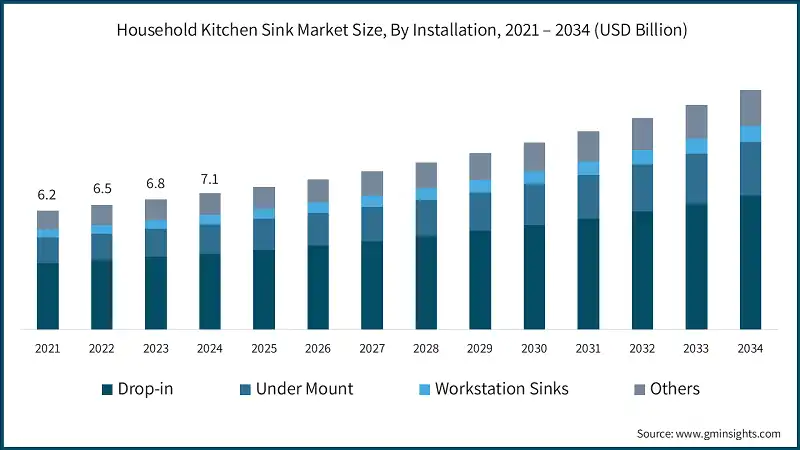
Based on installation, the market is divided into drop-in, under mount, workstation sinks, and others. In 2024, drop-in segment held the major market share, generating a revenue of USD 4 billion.
- The drop-in installation type has emerged as the leading segment in the global household kitchen sink market due to its practicality, affordability, and ease of installation. This design, which involves placing the sink into a pre-cut countertop opening, appeals to both homeowners and contractors for its simplicity and minimal labor requirements. Its compatibility with various countertop materials and styles makes it a versatile choice for new constructions and renovation projects alike.
- Additionally, drop-in sinks are widely available in diverse shapes, sizes, and finishes, catering to different aesthetic preferences without significantly increasing costs. Manufacturers are enhancing this segment with premium materials and integrated accessories to meet evolving consumer expectations for durability and design. As cost efficiency and convenience remain key purchasing factors, the drop-in installation type is expected to maintain its dominance, particularly in emerging markets where budget-friendly solutions are in high demand.
Learn more about the key segments shaping this market
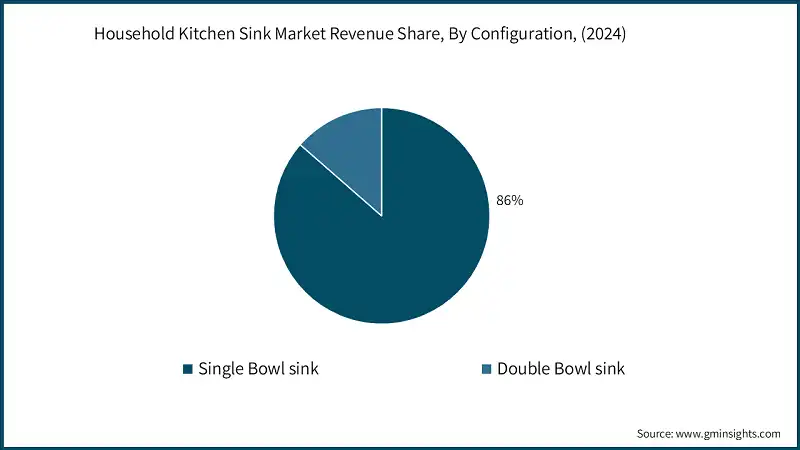
Based on configuration, the market is segmented into single bowl sink and double bowl sink. The single bowl sink segment held the largest share, accounting for 86% of the global market in 2024.
- The single bowl sink segment leads the global household kitchen sink market due to its practicality, space efficiency, and affordability. These sinks are particularly favored in compact kitchens and urban households where maximizing counter space is essential. Their simple design allows easy installation and maintenance, making them a cost-effective choice for both new constructions and renovation projects.
- Additionally, single bowl sinks accommodate larger cookware, appealing to consumers who prioritize functionality over multi-compartment designs. Manufacturers are enhancing this segment with premium materials, modern finishes, and integrated accessories to meet evolving aesthetic and durability standards. As urbanization accelerates and smaller living spaces become common, the demand for single bowl sinks is expected to remain strong, reinforcing their dominant position in the global market.
Based on distribution channel, the household kitchen sink market is segmented into online and offline. In 2024, offline held a major market share, generating a revenue of USD 5.5 billion.
- The offline distribution channel continues to dominate the market due to consumer preference for physical product inspection and immediate availability. Sinks are high-involvement purchases where buyers prioritize material quality, finish, and durability factors best assessed in person. Home improvement stores, specialty retailers, and dealer networks provide hands-on experience, expert guidance, and installation services, which online platforms often lack.
- Additionally, offline channels cater to bulk purchases for residential projects and renovations, strengthening their position in emerging markets where e-commerce penetration is still developing. Manufacturers maintain strong partnerships with brick-and-mortar retailers to ensure brand visibility and customer trust. While online sales are growing, the offline segment remains dominant because of its ability to deliver personalized service and build confidence in product quality, especially for premium and customized sink solutions.
Looking for region specific data?
Asia Pacific Household Kitchen Sink Market
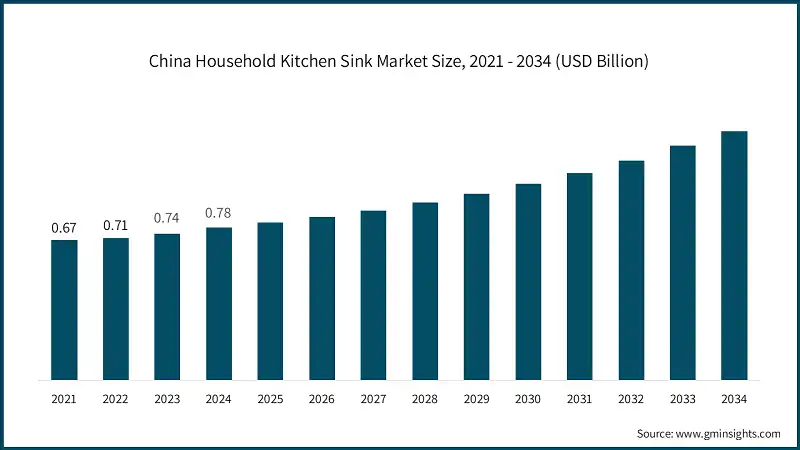
In 2024, the China dominated the Asia Pacific market, accounting for around 27% and generating around USD 0.78 billion revenue in the same year.
- China holds a dominant position in the APAC household water sink market, driven by rapid urbanization, large-scale residential construction, and rising disposable incomes. The country’s booming real estate sector and government initiatives promoting affordable housing have significantly increased demand for kitchen and bathroom fixtures. Additionally, China’s strong manufacturing base enables cost-efficient production and quick adoption of innovative designs, giving domestic brands a competitive edge.
- Consumers in China are increasingly seeking modern, space-saving sinks with premium finishes, aligning with the trend toward modular kitchens and contemporary interiors. The presence of robust distribution networks and expanding retail channels further strengthens market penetration. With growing emphasis on smart home integration and sustainability, China is expected to maintain its leadership, supported by technological advancements and evolving lifestyle preferences.
Europe Household Kitchen Sink Market
Europe market, Germany leads the market with 23% share in 2024 and is expected to grow at 5.4% during the forecast period.
- Germany leads the European household water sink market, supported by its strong housing sector, high standards of living, and emphasis on premium kitchen and bathroom designs. The country’s consumers prioritize quality, durability, and aesthetics, driving demand for sinks made from advanced materials such as stainless steel, composite granite, and ceramic. Germany’s leadership is further reinforced by the presence of renowned manufacturers like Blanco GmbH + Co KG, which focus on innovation, sustainability, and ergonomic designs.
- Additionally, the growing trend of smart kitchens and eco-friendly solutions aligns with Germany’s commitment to energy efficiency and environmental responsibility. Robust distribution networks and a mature retail infrastructure ensure widespread product availability, while customization options cater to diverse consumer preferences. With continued investment in technology and design excellence, Germany is expected to maintain its dominant position in Europe’s household water sink market.
North America Household Kitchen Sink Market
The U.S. leads the North America market with 80% of market share in 2024 and is anticipated to grow with a CAGR of around 5.7% from 2025 to 2034.
- The U.S. leads the North American household water sink market, supported by strong consumer spending on home improvement and advanced kitchen designs. High disposable incomes and a mature housing sector drive demand for premium sinks featuring modern aesthetics and smart functionalities. The U.S. market benefits from a robust renovation trend, where homeowners prioritize upgrades that enhance convenience and sustainability.
- Additionally, the presence of leading manufacturers such as Kohler and Elkay ensures continuous innovation in materials, finishes, and technology integration. Offline retail channels, coupled with growing e-commerce penetration, provide extensive product accessibility. With increasing adoption of smart kitchens and eco-friendly solutions, the U.S. is expected to maintain its dominance, fueled by technological advancements and a strong preference for high-quality, customizable fixtures.
Latin America Household Kitchen Sink Market
Latin America market is growing at a CAGR of 4.4% during the forecast period.
- Brazil leads the Latin American household water sink market, driven by its large population, expanding urban centers, and strong housing development. The country’s growing middle class and rising disposable incomes have fueled demand for modern kitchen and bathroom fixtures, including premium and functional sink designs. Government initiatives supporting residential construction and affordable housing projects further stimulate market growth.
- Additionally, Brazil’s vibrant home renovation sector reflects a cultural emphasis on stylish interiors, creating opportunities for manufacturers to introduce innovative and customizable sink solutions. Offline retail channels remain dominant, supported by well-established distribution networks and consumer preference for in-store product evaluation. With increasing adoption of modular kitchens and eco-friendly materials, Brazil is expected to maintain its leadership in LATAM, positioning itself as a key market for both domestic and international brands seeking long-term growth.
Household Kitchen Sink Market Share
Franke Group are leading with 7% market share. Franke Group, Kohler Co., Blanco GmbH + Co KG, Elkay Manufacturing Company, and American Standard Brands (LIXIL) collectively hold around 25%, indicating moderately fragmented market concentration. These prominent players are proactively involved in strategic endeavors, such as mergers & acquisitions, facility expansions & collaborations, to expand their product portfolios, extend their reach to a broad customer base, and strengthen their market position.
Franke focuses on premium product innovation and design differentiation. The company invests heavily in advanced materials and integrated accessories to cater to luxury kitchen segments. Its strategy emphasizes sustainability and ergonomic designs, aligning with eco-conscious consumer trends. Strong distribution partnerships and brand positioning in Europe reinforce its market leadership.
Kohler leverages technology integration and brand prestige to strengthen its position. The company introduces smart sinks with touchless faucets and IoT-enabled features, targeting high-end consumers. Kohler also emphasizes aggressive marketing and retail presence, ensuring visibility across offline and online channels. Its commitment to luxury aesthetics drives growth in mature markets.
Blanco adopts a sustainability-driven approach, focusing on eco-friendly materials and resource-efficient manufacturing. The brand emphasizes German engineering excellence and premium finishes, appealing to design-conscious buyers. Strategic collaborations with kitchen solution providers and expansion into emerging markets enhance its global footprint.
Household Kitchen Sink Market Companies
Major players operating in the household kitchen sink industry are:
- American Standard Brands
- Blanco GmbH + Co KG
- Elkay Manufacturing Company
- Franke Kitchen Systems
- Houzer Inc.
- Kingston Brass
- Kohler Co.
- Kraus USA
- Moen Incorporated
- Native Trails
- Rohl LLC
- Ruvati USA
- Thompson Traders
- VIGO Industries
- Zuhne
Elkay’s strategy centers on durability and commercial-grade quality, while expanding residential offerings. The company invests in product diversification and water-saving technologies to meet sustainability goals. Strong dealer networks and partnerships with builders ensure Elkay’s dominance in North America.
LIXIL leverages global scale and diversified portfolio to capture multiple price segments. Its strategy includes continuous innovation in smart and water-efficient sinks, supported by robust retail distribution. LIXIL’s focus on affordability and premium customization enables penetration in both developed and emerging markets.
Household Kitchen Sink Market Report Attributes
| Key Takeaway | Details |
|---|---|
| Market Size & Growth | |
| Base Year | 2024 |
| Market Size in 2024 | USD 7.1 Billion |
| Market Size in 2025 | USD 7.5 Billion |
| Forecast Period 2025 - 2034 CAGR | 5.9% |
| Market Size in 2034 | USD 12.5 Billion |
| Key Market Trends | |
| Drivers | Impact |
| Rising Home Renovation and Remodeling Activities | The surge in home renovation projects is a major catalyst for the Household Kitchen Sink Market. Consumers are increasingly investing in modern kitchens and bathrooms, driven by lifestyle upgrades and aesthetic preferences. |
| Urbanization and New Residential Construction | Rapid urbanization is fueling large-scale residential construction, particularly in emerging economies across Asia-Pacific and Latin America. |
| Technological Advancements and Smart Kitchen Integration | The integration of smart technologies into household sinks is transforming consumer expectations. Features such as touchless faucets, water flow sensors, and automated cleaning systems enhance convenience and hygiene, aligning with the growing smart home trend. |
| Pitfalls & Challenges | Impact |
| High Raw Material and Manufacturing Costs | The production of household sinks often involves premium materials such as stainless steel, quartz, and ceramic, which are subject to price volatility. Rising costs of raw materials and energy significantly impact on manufacturing expenses, leading to higher retail prices. |
| Limited Awareness and Adoption in Rural Areas | Despite urban demand, rural markets remain underpenetrated due to limited awareness of modern sink designs and functionalities. |
| Opportunities: | Impact |
| Rising Urbanization and Modern Living Standards | The rapid pace of urbanization globally is significantly influencing household infrastructure, including water sinks. As cities expand and living spaces become more compact, consumers are prioritizing functional yet aesthetically appealing kitchen and bathroom fixtures. |
| Increasing Focus on Water Conservation and Sustainability | Environmental awareness and regulatory pressures are reshaping consumer choices in household fixtures. Water-efficient sinks equipped with smart faucets and flow-control technologies are gaining traction as households aim to reduce water consumption without compromising usability. |
| Market Leaders (2024) | |
| Market Leaders |
7% market share |
| Top Players |
The collective market share in 2024 is 25% |
| Competitive Edge |
|
| Regional Insights | |
| Largest Market | Asia Pacific |
| Fastest Growing Market | Asia Pacific |
| Emerging Country | Germany, Brazil, UAE |
| Future Outlook |
|
What are the growth opportunities in this market?
Household Kitchen Sink Market News
- In February 2025, BLANCO launched the INTEOS workstation sink at KBIS 2025, introducing a design that anticipates user needs with integrated accessories and space-saving features. Available in stainless steel and SILGRANIT, INTEOS simplifies meal prep, serving, and cleanup through its Stack & Store system and multifunctional add-ons. This innovation reinforces BLANCO’s premium positioning and focuses on ergonomic, organized kitchen solutions.
- In July 2025, Franke Group inaugurated a state-of-the-art plant in San Luis Potosí, Mexico, investing USD 82 million to strengthen its Americas footprint. The 31,000 m² facility features advanced technologies, sustainability measures like solar panels and water reuse systems, and employs 200 people, with plans to scale to 500. This move enhances localized production, supply chain resilience, and operational agility across North, Central, and South America.
- In November 2025, Kohler introduced the Synthos Workstation sink collection, designed to enhance hosting, entertaining, and workflow efficiency in modern kitchens. This innovative range integrates multifunctional accessories and ergonomic design, reflecting Kohler’s commitment to premium aesthetics and smart functionality. The launch strengthens Kohler’s position in the high-end segment, addressing growing consumer demand for versatile and stylish kitchen solutions.
- In December 2024, Franke Group announced the acquisition of Nokite, a leading producer of high-quality stainless-steel kitchen taps and accessories. This strategic move strengthens Franke’s global portfolio and reinforces its position in premium kitchen solutions. By integrating Nokite’s expertise in sustainable and advanced tap designs, Franke aims to capitalize on growing demand for eco-friendly, innovative fixtures across international markets.
The household kitchen sink market research report includes in-depth coverage of the industry with estimates & forecasts in terms of revenue (USD Billion) and volume (Thousand Units) from 2021 to 2034, for the following segments:
Market, By Installation Type
- Drop-in
- Under mount
- Workstation sinks
- Others
Market, By Material
- Stainless steel
- Granite/Quartz
- Cast iron sink
- Fireclay sink
- Others
Market, By Configuration
- Single bowl sink
- Double bowl sink
Market, By Application
- Primary household kitchen
- Secondary/prep sink
- Outdoor residential kitchen
- Others
Market, By Distribution Channel
- Online
- E-commerce website
- Company website
- Offline
- Hypermarket & supermarket
- Specialty stores
- Others
The above information is provided for the following regions and countries:
- North America
- U.S.
- Canada
- Europe
- Germany
- UK
- France
- Italy
- Spain
- Asia Pacific
- China
- India
- Japan
- Australia
- South Korea
- Latin America
- Brazil
- Mexico
- Argentina
- Middle East and Africa
- South Africa
- Saudi Arabia
- UAE
Frequently Asked Question(FAQ) :
What is the market size of the household kitchen sink market in 2024?
The market size was USD 7.1 billion in 2024, with a CAGR of 5.9% expected through 2034, driven by advancements in smart technologies, sustainability trends, and growing demand for premium aesthetics.
What is the projected value of the household kitchen sink market by 2034?
The market is expected to reach USD 12.5 billion by 2034, fueled by the adoption of eco-friendly materials, smart home integration, and customization preferences.
What is the projected size of the household kitchen sink market in 2025?
The market is expected to reach USD 7.5 billion in 2025.
How much revenue did the drop-in installation segment generate?
The drop-in installation segment generated USD 4 billion in 2024, holding the largest market share.
What was the valuation of the single bowl sink segment?
The single bowl sink segment accounted for 86% of the global market in 2024.
Which distribution channel leads the household kitchen sink market?
The offline distribution channel led the market in 2024, generating USD 5.5 billion in revenue.
Which region leads the household kitchen sink industry?
In Europe, Germany led the market with a 23% share in 2024 and is projected to grow at a CAGR of 5.4% during the forecast period.
What are the upcoming trends in the household kitchen sink industry?
Key trends include the integration of smart and touchless technologies, increasing demand for eco-friendly materials, and a rising preference for premium aesthetics and customization.
Who are the key players in the household kitchen sink market?
Key players include American Standard Brands, Blanco GmbH + Co KG, Elkay Manufacturing Company, Franke Kitchen Systems, Houzer Inc., Kingston Brass, Kohler Co., Kraus USA, Moen Incorporated, Native Trails, Rohl LLC, Ruvati USA, Thompson Traders, and VIGO Industries.
Household Kitchen Sink Market Scope
Related Reports