Summary
Table of Content

Homeland Security Market
Get a free sample of this report
Form submitted successfully!
Error submitting form. Please try again.
Thank you!
Your inquiry has been received. Our team will reach out to you with the required details via email. To ensure that you don't miss their response, kindly remember to check your spam folder as well!
Request Sectional Data
Thank you!
Your inquiry has been received. Our team will reach out to you with the required details via email. To ensure that you don't miss their response, kindly remember to check your spam folder as well!
Form submitted successfully!
Error submitting form. Please try again.
Homeland Security Market Size
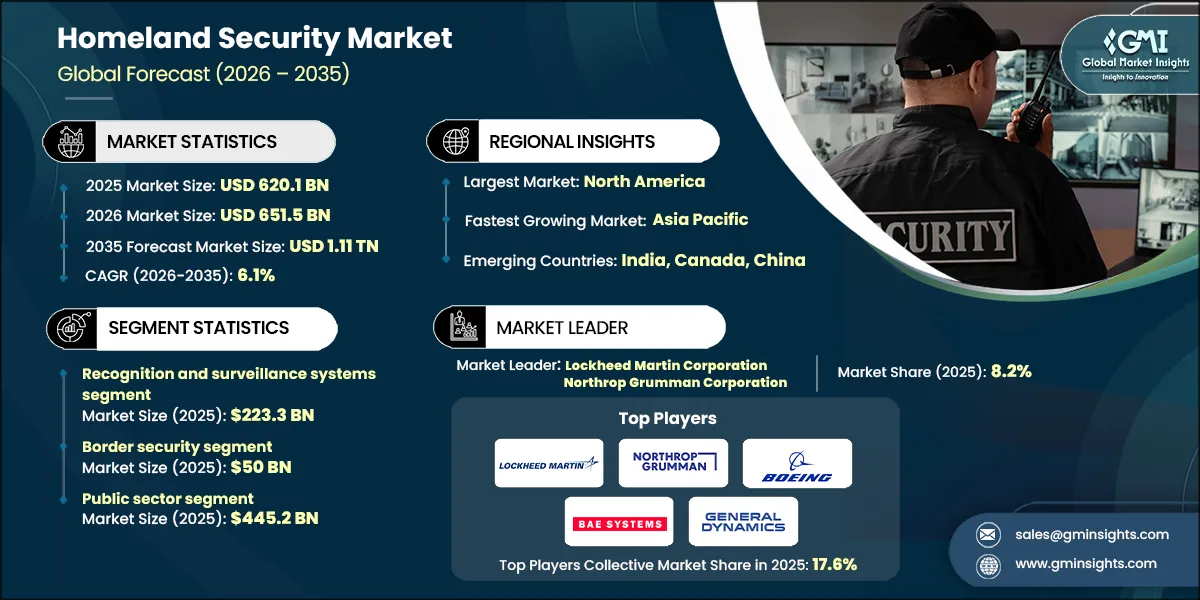
The global homeland security market was estimated at USD 620.1 billion in 2025. The market is expected to grow from USD 651.5 billion in 2026 to USD 923.9 billion in 2031 and USD 1.11 trillion by 2035, at a CAGR of 6.1%, according to latest report published by Global Market Insights Inc.
Homeland Security Market Key Takeaways
Market Size & Growth
- 2025 Market Size: USD 620.1 Billion
- 2026 Market Size: USD 651.5 Billion
- 2035 Forecast Market Size: USD 1.11 Trillion
- CAGR (2026–2035): 6.1%
Regional Dominance
- Largest Market: North America
- Fastest Growing Region: Asia Pacific
Key Market Drivers
- Government investments in protecting countries from cross-border disputes.
- Rising cases of smuggling and trafficking globally.
- Occurrence of natural disasters.
- Focus on border & immigration control.
- Rising prevalence of cyber threats.
Challenges
- Rapid technological advancements.
- High procurement and maintenance costs.
Opportunity
- Adoption of AI and machine learning technologies.
- Expansion of cybersecurity infrastructure.
Key Players
- Market Leader: Lockheed Martin Corporation led with over 8.2% market share in 2025.
- Leading Players: Top 5 players in this market include Lockheed Martin Corporation, Northrop Grumman Corporation, Boeing, BAE Systems, General Dynamics Corporation, which collectively held a market share of 17.6% in 2025.
Get Market Insights & Growth Opportunities
- The continued growth in demand for homeland security is being propelled by an increase in government investment to provide safety from cross-border disputes; rising incidences of global smuggling and trafficking; increasing numbers and types of natural disasters; increased focus on border and immigration control; and increased prevalence of cyber threats.
- Government funding for protecting jurisdictional borders has led to an influx of funding into the homeland security industry through bills like the U.S. One Big Beautiful Bill Act (FY2025), which allocates USD 46.5 billion for border security and USD 4.1 billion for Customs and Border Protection personnel. This investment creates a large amount of revenue for the homeland security market from investments in surveillance technologies (e.g., cameras), defensive systems, and operational enhancements that protect borders and increase the overall national security of our nation. With the increased funding for technology adoption comes an acceleration in the development and expansion of the homeland security sector.
- Occurrence of a natural disaster is one of the primary drivers for the homeland security industry. The United Nations Office for Disaster Risk Reduction (UNDRR) reports that natural disasters result in the death of approximately 40,000 to 50,000 people each year, with catastrophic events resulting in much greater loss of life and creating a need for global investment in risk reduction as a matter of urgency. Governments will respond to this by providing funding for advanced emergency management technology, early warning systems, and building resilient infrastructure to protect people. All these investments will be driving growth in the homeland security market, and thereby increase the demand for disaster preparedness solutions, risk mitigation technology, and recovery capability within the homeland security industry.
- The North America region dominated with over 36.9% market share in 2025. National defense investments, border security improvements, critical infrastructure updates, and the desire to reduce cyber risks fuel the North American market. This growing market is also a response to the increasing cyber threats, including the 4,194 reported ransomware incidents from 2022 to 2024, which resulted in payments of over USD 2.1 billion. In addition, the market is a response to the national defense investments, and the ongoing efforts to secure national defense.
To get key market trends
Homeland Security Market Trends
- The homeland security industry is experiencing significant investments to support the trend of using drone technology in surveillance and response. The FAA reports that USD 2.7 million has been allocated to fund research on integrating drones into the processes of disaster preparedness and emergency response, which reflects growing recognition that drones can be rapidly deployed in response to natural disasters as well as human-created disasters. The ability to improve situational awareness (SA) through the provision of real-time data is what has driven increased use of drones for homeland security purposes, which will peak between 2027 and 2030.
- The smart border security trend is aligned with advances in areas such as biometrics, sensors, and facial recognition that are being utilized to improve border controls. The CBP has created a cloud-based traveler verification service (TVS) for use at airports, land borders, and seaports that has reduced the time it takes to disembark for 30% and speeded up the process of checking identity for millions of travellers. The growth of the smart border security trend has been accelerated since 2018 due to increased digitization and modernization of security. This trend is expected to reach its peak between 2025-2030 as AI-driven systems continue to be developed.
- The cybersecurity integration trend reflects the expanding cooperative efforts between the various cyber and homeland security agencies to enhance and preclude the protection of critical elements of society. The Department of Homeland Security (DHS) estimates that cybercrime will result in damages exceeding USD 6 Trillion annually; therefore, the need to combine both cyber and homeland security will only increase because of the increase in national security risks. As cyber threats continued to proliferate throughout the decade of the 2010's and became more complex, this integration trend began to gain momentum. Between 2025 and 2030 there will be increasing demand for stronger cyber defense technologies and interagency partnerships leading to the peak of cybersecurity integration.
Homeland Security Market Analysis
Learn more about the key segments shaping this market
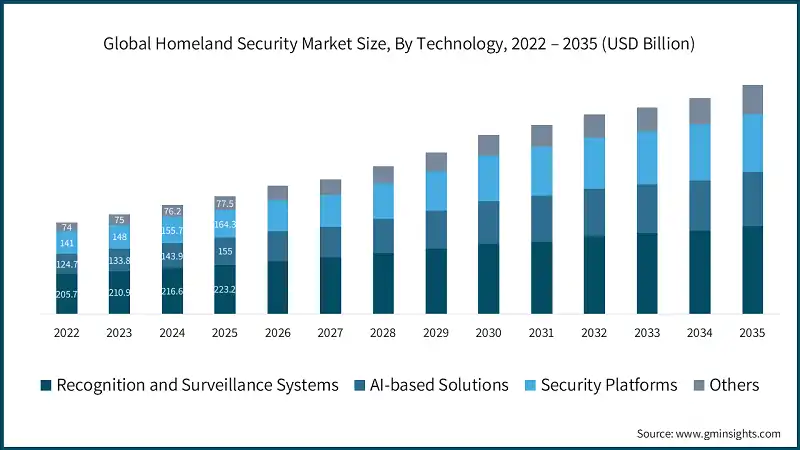
Based on the technology, the market is bifurcated into recognition and surveillance systems, AI-based solutions, security platforms & others.
- The recognition and surveillance systems segment was the largest market and was valued at USD 223.2 billion in 2025. The increase in global security concerns, advances in technologies (e.g., the proliferation of drones), and the need for greater protection from terrorism and global threats be a major driver of growth in the global market for recognition and surveillance systems.
- Companies should focus on developing advanced drone technologies, biometric recognition systems, AI-powered analytics, and enhanced security solutions to address growing global security and terrorism threats.
- The AI-based solutions segment is the fastest segment is anticipated to grow with a CAGR of 8.8% during the forecast period of 2026 – 2035. The increase in demand for AI-based security solutions is due to advances in machine learning technology, increased automation trends, improved predictive security capabilities and greater demand for more efficient and scalable security types in every industry throughout the world.
- Companies need to be focusing on investing in machine learning, improving their ability to automate processes, enhancing their predictive security capabilities and developing scalable AI security solutions.
Learn more about the key segments shaping this market
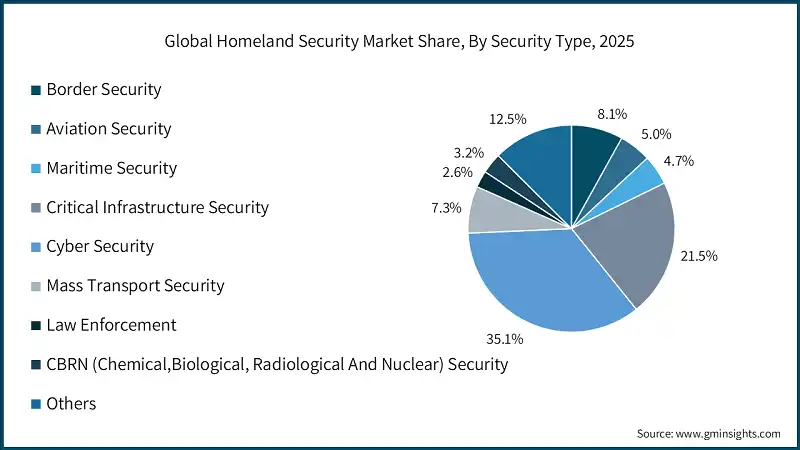
On the basis of security type, the homeland security market is segmented into border security, aviation security, maritime security, critical infrastructure security, cyber security, mass transport security, law enforcement, CBRN (chemical, biological, radiological and nuclear) security & others.
- The border security segment was the largest market and was valued at USD 50 billion in 2025. Border security systems are being influenced by the growing number of global security threats, increased immigration enforcement, technological innovations in law enforcement, and the need to address transnational crimes and terrorism.
- Companies should focus on creating intelligent surveillance equipment, modernising border enforcement systems, using AI to detect threats, and providing complete international security and immigration management systems.
- The cyber security segment is anticipated to grow with a CAGR of 8.2% during the forecast period of 2026 – 2035. The increasing number of cyber security breaches has created a need for more effective cyber solutions; increasing number of cyber security violations and an increase in digital transformation caused an increase in public concern over data privacy and data.
- Companies should focus on developing AI solutions to improve their security measures and addressing evolving digital threats to protect their private information through enhanced encryption systems and advanced threat detection technologies.
On the basis of end use, the homeland security market is categorized into public sector & private sector.
- The public sector segment was the largest market and was valued at USD 445.2 billion in 2025. The highest influence in public sector development is government funding for critical infrastructure protection, the escalating risk of cyber security breaches, compliance regulations and the requirement for advanced technologies to secure national resources.
- Companies need to develop and implement comprehensive cybersecurity plans, improve their partnerships with the public sector, and continue to enhance their processes to meet evolving compliance requirements.
- The private sector segment is the fastest growing market and is anticipated to grow with a CAGR of 6.9% during the forecast period of 2026 – 2035. Factors contributing to growth in the private sector are increased levels of digital transformation (DT), increasing levels of cloud service adoption, growing levels of cybercrime, and increasing levels of both demand and supply for better and more advanced security solutions for businesses to protect sensitive and private corporate data.
- Companies improve their existing cyber security framework, invests in flexible, scalable cloud-based cyber security solutions, expands their threat intelligence capabilities, and places a high priority on data protection to remain competitive against ever-evolving cyber threats.
Looking for region specific data?
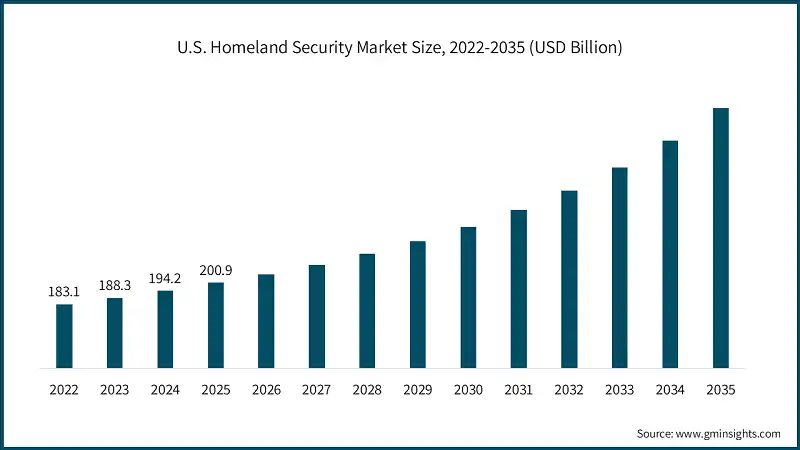
North America homeland security market was valued at USD 228.9 billion in 2025 and is anticipated to grow with a CAGR of 5.4% during the forecast period of 2026 – 2035. Geopolitical tensions, urbanization and security demands are all contributing to security growth around the North America.
- U.S. dominated the homeland security market and was valued at USD 200.9 billion in the year 2025. In the United States, the need for security has increased significantly because of increased border security requirements and the need for immigration reform (CISA). Also, the US has implemented various federal cybersecurity initiatives and counterterrorism/anti-extremism programs to provide an additional level of support for public safety and national defense.
- Manufacturers should develop new technologies to meet the new security requirements within the US. These technologies will include cybersecurity systems compliant with CISA standards; AI-powered surveillance systems; devices that enable law enforcement to identify individuals involved in counterterrorism activities.
- The homeland security market in Canada is anticipated to surpass USD 65.6 billion by 2035. In Canada, the security growth is being driven by the increased focus on public safety and emergency management. The Canadian government has also implemented several grant programs through the department of homeland security to provide financial assistance for equipment purchases to support safety and emergency management initiatives.
- Manufacturers should be focusing on developing modern technologies to support safety and emergency management initiatives, including emergency response technologies; integrated intelligence datasets; and cybersecurity systems.
The homeland security market in Europe is anticipated to grow with a CAGR of 5.2% during the forecast period of 2026 – 2035. In Europe, the growth of the security market will continue to be driven by the EU strategy to combat terrorism, the need for cross-border security improvements and the introduction of new cybersecurity and data protection regulations.
- Germany homeland security market was valued at USD 36.2 billion in the year 2025. In Germany, due to growing concerns regarding cybersecurity issues associated with critical infrastructure; smart border integration within the Schengen Area; and investments in defense modernization, which enabled enhanced security.
- Companies should concentrate on the areas of infrastructure protection, border control, and modernisation as represented by the rapidly expanding emphasis on cyber security solutions, smart border systems and advanced defensive capabilities created as the basis for Germany's strategic approach to homeland security.
- UK homeland security market is anticipated to surpass USD 64.5 billion by 2035. In the UK. the homeland security sector is driven primarily by new post-brexit border and immigration control laws, immediately followed by counter-terrorism strategies being established within key metropolitan locations as well as the introduction of the UK national cyber security strategy to increase overall security.
- Companies within the UK homeland security sector require an increased focus on innovative border protection, counter-terrorism technologies and advanced cyber security solutions.
The homeland security market in Asia Pacific is the largest market was valued 133.3 billion in 2025, driven by due to an extensive range of cyber threats to critical infrastructure systems, requiring both counter-disaster and emergency response systems and enhancements to military cooperation, along with modernization initiatives to address regional security challenges.
- China homeland security market is projected to reach USD 56 billion by 2035, driven by security requirements associated with the "Belt and Road" Initiative, artificial intelligence (AI) and facial recognition monitoring systems to support public safety, as well as counterespionage and cyber security in key industries that facilitate national protection of critical strategic assets.
- Companies operating within China’s homeland security market could look to elevate their focus on cyber security solutions, develop innovative ai based surveillance systems and create security technology services that support “Belt and Road” Initiatives.
- The homeland security market in Japan was valued at USD 15.5 billion in 2025. The demand for homeland security in Japan is driven by two overall areas of focus, preparedness for earthquakes and tsunamis; and securing Japan as a location for global events. The development of more sophisticated detection systems, security solutions for global events, and robotics used for public safety are three key points that can further increase public safety in Japan.
- Companies must focus on developing advanced earthquake and tsunami detection systems, security solutions for major events, and robotics for surveillance and disaster response to enhance public safety in Japan.
- India homeland security market is anticipated to grow with a CAGR of over 10.3% during the forecast period of 2026-2035, driven by the need for border security and management against potential border threats from Pakistan and China, increasing numbers of terrorist incidents, and the increasing urbanization of India's cities create an environment that will support the development of numerous new security solutions and technologies to address these challenges.
- Companies should focus on advanced border security solutions, counter-terrorism technologies, and smart city security systems to address India’s growing urbanization, cross-border security challenges, and evolving threats in metropolitan areas.
The homeland security market in Latin America was valued at USD 20.8 billion in 2025. The increase in the demand for homeland security solutions in Latin America is largely due to the increase of crime rates, the emergence of transnational organized crime organizations, and the requirement for improved disaster preparedness.
MEA homeland security market is projected to hit USD 120.8 billion by 2035. The increase in demand for homeland security solutions in MEA is associated with the increased number of refugees and migrant populations flowing through the region, increased concerns about cyber threats to critical energy infrastructures, and growing opportunity for acts of terrorism and extremism.
- South Africa homeland security market was valued at USD 10.7 billion in 2025, due to rising terrorist threats in Southern Africa; rising xenophobic violence and civil unrest; and the expansion of critical infrastructure security needs.
- Companies should focus on the enhancement of cyber security, the development of advanced technologies for surveillance, improvement of border security solutions, and the establishment of disaster response systems to meet South Africa’s specific security challenges.
- The homeland security market in Saudi Arabia is projected to grow with a CAGR of 7.3% during the forecast period of 2026-2035, due to the ongoing geopolitical instability in the region (the Yemen conflict) and Vision 2030's economic diversification initiatives, as well as the increasing number of investments in advanced cyber security solutions.
- Manufacturers need to develop advanced defense technologies, enhance cyber security solutions, create critical infrastructure protection systems, and assist in the development of technologies that support smart city initiatives to meet Saudi Arabia's evolving homeland security needs.
- The homeland security market in UAE is anticipated to surpass USD 38.7 billion by 2035, driven by investments being made to implement artificial intelligence (AI) technologies for security, the rising demand for protection of all high value individuals (VIPs) and critical infrastructures and developing stronger national counter-terrorism strategies to ensure public safety.
- Manufacturers should develop AI-based security solutions, enhance the technical capabilities of their VIP protection systems, improve critical infrastructure security technologies, and build counter-terrorism tools to help fulfill the United Arab Emirates' evolving homeland security needs.
Homeland Security Market Share
- The homeland security industry consists of several large and small businesses. In 2025, Lockheed Martin Corporation, Northrop Grumman Corporation, Boeing, BAE Systems, and General Dynamics Corporation were the largest competitors and comprised approximately 17.6% of the entire homeland security market.
- Lockheed Martin Corporation held a significant position in the global market in 2025, controlling 5.1% of the total market share. Lockheed Martin's commitment to R&D has made it the largest player in the global market due to its reputation as a comprehensive security solution provider, with partnerships with government clients that rely on its ability to provide the latest technology.
- Northrop Grumman Corporation held 3.1% of the market in 2025, Northrop Grumman Corporation dominate the global homeland security market because of its focus on producing advanced aerospace, cybersecurity solutions, and integrated defense systems, in addition to having large government contracts and extensive experience with critical infrastructure protection.
- Boeing ended with 3.9% of the market share in 2025. Boeing built its success by utilizing its extensive experience and knowledge in the development of advanced aerospace technologies, defending the nation with numerous large contracts, developing innovative unmanned systems and providing solutions for protecting the nation's critical infrastructure and defense industries.
- BAE Systems achieved an 2.9% market share in 2025. BAE Systems provides its customers with a wide variety of products, including advanced defense electronics, cybersecurity solutions, naval systems, military vehicles, and surveillance systems.
- General Dynamics Corporation secured 2.6% of the homeland security market share in 2025. General Dynamics Corporation supports its customer's defense and security operations around the world with a large number of solutions that include advanced communications, cybersecurity services, armored vehicles, and critical infrastructure technologies.
Homeland Security Market Company
The top prominent companies operating in the homeland security industry include:
- BAE Systems
- Amadeus IT Group SA
- Bharat Electronics Limited (BEL)
- Boeing
- CRFS
- Elbit Systems Ltd.
- Exiger
- General Dynamics
- IDEMIA
- Israel Aerospace Industries (IAI)
- Leidos
- Lockheed Martin
- Northrop Grumman
- OPSWAT Inc.
- Raytheon Technologies
- Rohde & Schwarz
- Securitas Technology
- SITA
- Thales Group
BAE Systems, Lockheed Martin, and Raytheon Technologies are leaders in the homeland security market. BAE Systems, Lockheed Martin, and Raytheon Technologies provide advanced technologies for defense, aerospace, and cybersecurity. Through these technologies, they support the enhancement of national security by providing support through surveillance, counterterrorism, missile defence and intelligence in securing governments and critical infrastructure worldwide.
Boeing, Northrop Grumman, and General Dynamics are challengers in the homeland security market, they provide advanced defence, aerospace, and cyber security solutions to the market as challengers. They focus their development efforts on radar systems, unmanned systems, secure communications, and intelligence technologies to enhance national security, and improve the operation of defence and surveillance services globally.
Amadeus IT Group, Securitas Technology, and Leidos are followers in the homeland security market. These three companies are all engaged in providing their customer base with enhanced airport security and protection of related facilities, as well as the provision of advanced physical surveillance and cybersecurity products/ technologies that enable companies to provide public safety solutions.
Niche players in the homeland security market are BEL, Elbit Systems, IDEMIA and Thales. These group have expertise in specific defence technologies related to radar systems, cyber security, biometric technology and secure communications. Their focus is on enhancing national security through innovative technologies to secure borders, enhance national security through border protection.
Homeland Security Market Report Attributes
| Key Takeaway | Details |
|---|---|
| Market Size & Growth | |
| Base Year | 2025 |
| Market Size in 2025 | USD 620.1 Billion |
| Market Size in 2026 | USD 651.5 Billion |
| Forecast Period 2026 - 2035 CAGR | 6.1% |
| Market Size in 2035 | USD 1.11 Trillion |
| Key Market Trends | |
| Drivers | Impact |
| Government investments in protecting countries from cross-border disputes | Drives 30% of market growth as rising geopolitical tensions and cross-border threats push governments to allocate more resources towards enhancing border security. Investments in surveillance systems, defense technologies, and intelligence tools strengthen national borders and improve response capabilities. |
| Rising cases of smuggling and trafficking globally | Drives 25% of market growth as growing challenges in drug smuggling, human trafficking, and illegal trade require advanced detection systems and border control technologies. The adoption of real-time surveillance, AI-driven analytics, and integrated management systems fuels the need for better security solutions. |
| Occurrence of natural disasters | Drives 20% of market growth as the increasing frequency of natural disasters calls for stronger disaster response systems, early warning technologies, and resilient infrastructure. These investments help protect citizens and minimize damage, driving demand for related Homeland Security technologies. |
| Focus on border & immigration control | Drives 15% of market growth as the demand for efficient border management and immigration control rises. Technologies such as biometric verification, automated entry/exit systems, and AI-based monitoring solutions are increasingly adopted to secure borders and streamline immigration processes. |
| Rising prevalence of cyber threats | Drives 10% of market growth as the frequency and sophistication of cyberattacks targeting critical infrastructure and government systems require robust cybersecurity solutions. Investments in advanced threat detection, AI-based security tools, and cybersecurity infrastructure contribute to market growth. |
| Pitfalls & Challenges | Impact |
| Rapid technological advancements | Restrains 20% of market growth as the constant evolution of technology in areas like AI, surveillance, and cybersecurity can lead to integration challenges. Governments and organizations may face difficulties in keeping up with new tech, causing delays in deployment and limiting efficiency. |
| High procurement and maintenance costs | Restrains 15% of market growth as the high costs associated with procuring and maintaining advanced security technologies (such as drones, AI systems, and border security tools) limit accessibility for some countries or organizations. This financial strain can slow down the adoption of essential systems. |
| Opportunities: | Impact |
| Adoption of AI and machine learning technologies | AI-driven systems enhance surveillance, threat detection, and data analysis, improving security measures and response times, thus driving innovation and growth in the Homeland Security sector. |
| Expansion of cybersecurity infrastructure | Increased demand for advanced cybersecurity solutions to protect critical infrastructure and data from cyberattacks fosters growth in the market, driving investment in encryption, firewalls, and real-time monitoring systems. |
| Market Leaders (2025) | |
| Market Leaders |
Top 2 company accounts for 8.2% |
| Top Players |
|
| Competitive Edge |
|
| Regional Insights | |
| Largest Market | North America |
| Fastest Growing Market | Asia Pacific |
| Emerging Countries | India, Canada, China |
| Future outlook |
|
What are the growth opportunities in this market?
Homeland Security Market News
- In 2024, Allegro Microsystems has recently introduced two new products, the ACS37030 and ACS37032 high bandwidth current sensors, which have been developed to help improve the performance, efficiency and reliability of SiC and GaN based power systems. These sensors also provide advanced digital functionality to support both Industrial and Automotive applications.
- In 2023, General Dynamics Information Technology, Inc. (GDIT) has received a task order to continue modernization of the infrastructure located at the US Department of Homeland Security's St. Elizabeths Campus located in Washington DC, valued at USD 712 million.
- In 2023, Infineon Technologies has developed and launched a new magnetic position sensor called the XENSIV™ TLI5590-A6W, which uses a unique form of advanced Tunneling Magnetoresistance (TMR) technology in a wafer-level package. The XENSIV™ magnetic sensor provides the user with the ability to detect precise position information in both Industrial and Consumer applications and can be used as a durable and reliable replacement for optical encoders, therefore improving the overall efficiency and performance of the application.
The homeland security market research report includes in-depth coverage of the industry with estimates and forecasts in terms of revenue (USD Billion) from 2022 – 2035 for the following segments:
Market, By Security Type
- Border security
- Aviation security
- Maritime security
- Critical infrastructure security
- Cyber security
- Mass transport security
- Law enforcement
- CBRN (chemical, biological, radiological and nuclear) security
- Others
Market, By Technology
- Recognition and surveillance systems
- AI-based solutions
- Security platforms
- Others
Market, By End Use
- Public sector
- Private sector
The above information is provided for the following regions and countries:
- North America
- U.S.
- Canada
- Europe
- Germany
- UK
- France
- Spain
- Italy
- Netherlands
- Asia Pacific
- China
- India
- Japan
- Australia
- South Korea
- Latin America
- Brazil
- Mexico
- Argentina
- Middle East and Africa
- Saudi Arabia
- South Africa
- UAE
Frequently Asked Question(FAQ) :
What is the market size of the homeland security in 2025?
The market size was USD 620.1 billion in 2025, with a CAGR of 6.1% expected through 2035 driven by rising security and cyber defense investments, cross-border disputes, and increasing natural disasters.
What is the projected value of the homeland security market by 2035?
The homeland security market is expected to reach USD 1.11 trillion by 2035, propelled by AI adoption, cybersecurity expansion, and government investments in border security and critical infrastructure protection.
What is the current homeland security market size in 2026?
The market size is projected to reach USD 651.5 billion in 2026.
How much revenue did the recognition and surveillance systems segment generate in 2025?
Recognition and surveillance systems generated USD 223.2 billion in 2025, leading the technology segment due to global security concerns and advances in drone and biometric technologies.
What was the valuation of public sector segment in 2025?
The public sector held the largest share and generated USD 445.2 billion in 2025, supported by government funding for critical infrastructure and escalating cyber security risks.
What is the growth outlook for AI-based solutions from 2026 to 2035?
AI-based solutions are projected to grow at a CAGR of 8.8% through 2035, due to advances in machine learning, automation trends, and improved predictive security capabilities.
Which region leads the homeland security market?
North America held 36.9% share with USD 228.9 billion in 2025. National defense investments, border security improvements, and cyber threat mitigation fuel the region's dominance.
What are the upcoming trends in the homeland security market?
Key trends include adoption of drone technology for surveillance and disaster response, smart border security using biometrics and facial recognition, and cybersecurity integration to protect critical infrastructure from evolving threats.
Who are the key players in the homeland security market?
Key players include Lockheed Martin Corporation, Northrop Grumman Corporation, Boeing, BAE Systems, General Dynamics Corporation, Raytheon Technologies, Leidos, Thales Group, Bharat Electronics Limited (BEL), Israel Aerospace Industries (IAI), Elbit Systems Ltd., IDEMIA, Amadeus IT Group SA, SITA, Securitas Technology, OPSWAT Inc., Rohde & Schwarz, CRFS, and Exiger.
Homeland Security Market Scope
Related Reports