Summary
Table of Content

Home Fragrance Market
Get a free sample of this report
Form submitted successfully!
Error submitting form. Please try again.
Thank you!
Your inquiry has been received. Our team will reach out to you with the required details via email. To ensure that you don't miss their response, kindly remember to check your spam folder as well!
Request Sectional Data
Thank you!
Your inquiry has been received. Our team will reach out to you with the required details via email. To ensure that you don't miss their response, kindly remember to check your spam folder as well!
Form submitted successfully!
Error submitting form. Please try again.
Home Fragrance Market Size
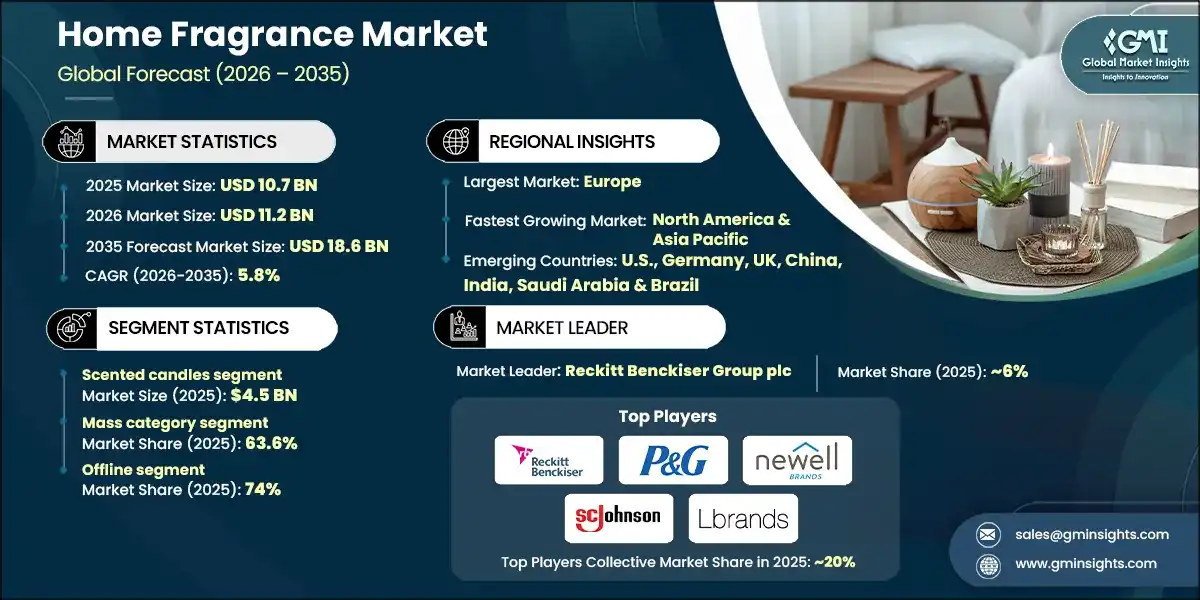
The global home fragrance market was estimated at USD 10.7 billion in 2025. The market is expected to grow from USD 11.2 billion in 2026 to USD 18.6 billion in 2035, at a CAGR of 5.8% according to latest report published by Global Market Insights Inc.
To get key market trends
- There has been a significant increase in the growth of the home fragrance business. Increasingly, people use home fragrances to enhance their house’s decor, atmosphere and overall appeal. Instead of being just functional products, the trend of using home fragrances has migrated into the world of décor and becomes an extension of lifestyle accessories. Major tools that have aided this trend are social media and hobbies where people are using influencer décor ideas. Home fragrance has become one of the main players in how consumers style their homes today.
- With the continual release of new product lines related to seasonal décor, consumers are also motivated to change the fragrance used in their homes based on whether there is a special season or occasion planned. According to the National Candle Association, nearly 70% of candle purchasers in the United States placed fragrance at the top of their list of criteria for making a purchase, which demonstrates how much of an impact scent will have on the décor of the home.
- The increasing trend of urbanization and disposable income has been one of the main forces driving the growth of the home fragrance market. With population growth and increasing incomes in many emerging markets, the middle class, especially through the growth of urban populations, has increased their investments in high-quality home fragrance products to enhance their home environment. The United Nations reported that the percentage of the world population living in urban areas was 56.2% in 2020. The United Nations estimates that by 2050, that number will increase to 68%. Urbanization has been seen especially in Asia-Pacific and Africa, with a rapid growth of the middle-class population. Due to these demographic changes, there has been a dramatic increase in the demand for both mass and luxury fragrance products, as many consumers are attempting to create stylish and comfortable environments in their smaller urban homes.
- The way in which personalization will impact our future expectations for the home fragrance industry is evolving with the use of modular scent experiences. Consumers are moving away from traditional mass-produced fragrances and looking for ways to express themselves through scent by searching for more unique, personalized fragrance options that resonate with their personality and mood. To address these changing expectations, brands are providing modular systems, mix & match scent kits, and subscription services to enable consumers to create their own scent profiles.
- Additionally, digital advancements, such as AI-generated scent recommendations and virtual scent profile discovery tools, are becoming increasingly available to allow fragrance companies to offer their customers individualized results. Increased focus on personalization not only creates a stronger bond between consumers and brands, but also establishes home fragrances as a premium experience, as opposed to being perceived as a mere commodity. The way consumers are creating personalized, interactive home spaces is contributing to the evolution of the market and providing manufacturers with new opportunities due to evolving technology and changing consumer preferences.
Home Fragrance Market Report Attributes
| Key Takeaway | Details |
|---|---|
| Market Size & Growth | |
| Base Year | 2025 |
| Market Size in 2025 | USD 10.7 Billion |
| Market Size in 2026 | USD 11.2 Billion |
| Forecast Period 2026 - 2035 CAGR | 5.8% |
| Market Size in 2035 | USD 18.6 billion |
| Key Market Trends | |
| Drivers | Impact |
| Home décor & ambiance trends | Increased focus on stylish interiors boosts demand for aesthetically pleasing home fragrance products like candles and diffusers. |
| Increasing disposable income & urbanization | Rising incomes and urban lifestyles drive higher spending on premium and diverse fragrance options for modern homes. |
| Personalization & modular scent experiences | Customizable fragrance solutions enhance consumer engagement and brand loyalty, creating a premium experience. |
| Pitfalls & Challenges | Impact |
| Environmental and sustainability concerns | Pressure to adopt eco-friendly materials and clean-label formulations raises production costs and limits fast innovation. |
| Supply chain disruptions | Delays in raw material sourcing and logistics affect product availability and seasonal launches, impacting revenue cycles. |
| Opportunities: | Impact |
| Premiumization & artisanal offerings | Growing demand for luxury, handcrafted, and niche fragrances opens high-margin segments for brands. |
| Wellness & aromatherapy integration | Positioning fragrances as mood-enhancing and stress-relief solutions strengthens consumer appeal and market differentiation. |
| Market Leaders (2025) | |
| Market Leaders |
Market share of ~6% |
| Top Players |
|
| Competitive Edge |
|
| Regional Insights | |
| Largest Market | Europe |
| Fastest growing market | North America & Asia Pacific |
| Emerging countries | U.S., Germany, UK, China, India, Saudi Arabia & Brazil |
| Future outlook |
|
What are the growth opportunities in this market?
Home Fragrance Market Trends
- Home fragrance has gone from traditional to a high-tech connected system through advancements in app-controlled and smart technologies. Home users now have access to automatic, scheduled release of home fragrances with the ability to set the intensity and even cycle through different fragrances during specific times of day or during certain seasons. The incredible advancements made in smart appliances and devices have made this possible for tech-savvy consumers who demand personalized convenience and seamless functionality as part of their digital lifestyles and who already use various smart home ecosystems, in addition to IoT connected devices and voice-controlled virtual assistants. All these products represent the modern trend towards the lessening of boundaries between the physical and the digital worlds by digitizing the content of products that enhance our daily lives. Home fragrance has become an essential component of the modern connected home.
- Another major force influencing the market is the increasing popularity of design-centric and multi-sensory products, where the integration of sensory stimulation into a product's visual design allows for an element of luxury and immersion that extends far beyond the fragrance itself. Today's consumers are looking for home fragrances that provide a pleasant aroma but also match their personal style and home decor. Therefore, brands are focusing on creating beautiful packaging, using premium materials, and offering collections that can serve as decorative pieces in addition to their scent-related function.
- In addition to the scent, luxury diffusers are being designed with additional sensory experiences (e.g., ambient light, tactile surfaces, and audio ambiance) to create a more complete overall experience. This design-driven model has transformed how home fragrances are viewed, moving them from a utilitarian item to an extension of a consumer's sense of style and lifestyle and aligning with consumers' increasing emphasis on home decor, ambiance, and wellness.
- In addition to personalization and modular scent products, the shift to greater focus on engagement has also been a catalyst for growth in the fragrance category, with many consumers looking for ways to express themselves through their scents. Brands have responded to this growing need for personalized fragrance solutions by providing a wide array of customizable fragrance kits, by giving consumers the ability to create their own fragrance combinations, as well as by offering subscription services to help customers build their scent journey over time.
- Additionally, with the introduction of digital technologies such as virtual discovery platforms and AI-powered fragrance recommendations, personalization has been enhanced further by providing consumers with customized, interactive experiences based on real-time data. As a result, home fragrances are now viewed as both emotional and experiential categories; therefore, they allow for more meaningful connections between consumers and brands and encourage continual loyalty and repeat purchasing.
Home Fragrance Market Analysis
Learn more about the key segments shaping this market
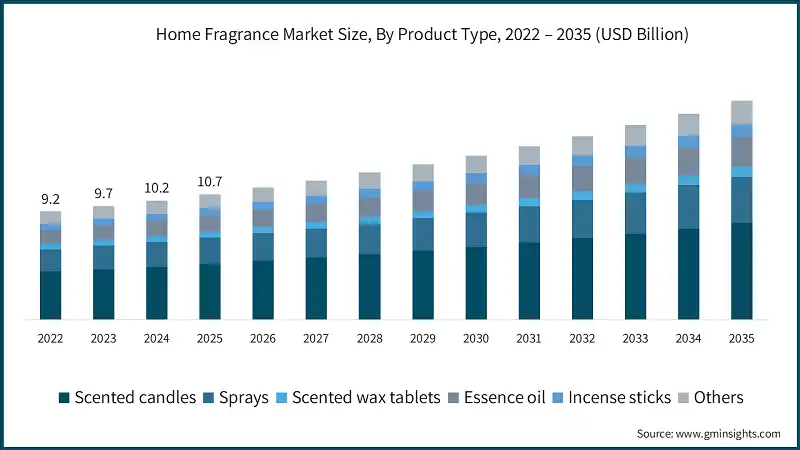
Based on product type, the home fragrance market is categorized into scented candles, sprays, scented wax tablets, essence oil, incense sticks, and others. The scented candles accounted for revenue of around USD 4.5 billion in 2025 and is anticipated to grow at a CAGR of 5.7% from 2026 to 2035.
- Consumers increasingly view candles as more than just fragrance products they are lifestyle accessories that enhance home décor and create a cozy, relaxing atmosphere. This trend is amplified by the growing focus on wellness and self-care, where scented candles are used for stress relief, aromatherapy, and mood enhancement. Premiumization is another key driver, with demand rising for high-quality, natural wax blends, clean-burning formulas, and artisanal designs that align with sustainability and health-conscious preferences. Seasonal and gifting occasions, such as holidays and celebrations, further boost sales, as candles are considered versatile and thoughtful gifts.
- Additionally, social media and influencer-driven home styling trends have popularized candles as essential décor elements, while e-commerce platforms make them widely accessible through subscription boxes and personalized scent options. These factors wellness integration, aesthetic appeal, sustainability, and digital retail growth collectively fuel the robust expansion of scented candles in the market.
Based on category of home fragrance market consists of mass and premium. The mass category emerged as leader and held 63.6% of the total market share in 2025 and is anticipated to grow at a CAGR of 5.5% from 2026 to 2035.
- Mass-market products cater to price-sensitive consumers who seek functional and aesthetic benefits without paying a premium, making them ideal for everyday use. The category benefits from strong distribution networks through supermarkets, hypermarkets, and online platforms, ensuring widespread availability.
- Additionally, frequent promotional campaigns, bundle offers, and seasonal discounts attract a large customer base. The rise in urbanization and middle-class households, especially in emerging economies, further drives demand for cost-effective home fragrance solutions. Mass brands are also innovating with improved scent longevity, eco-friendly packaging, and diverse fragrance options to meet evolving consumer preferences while maintaining competitive pricing.
Learn more about the key segments shaping this market
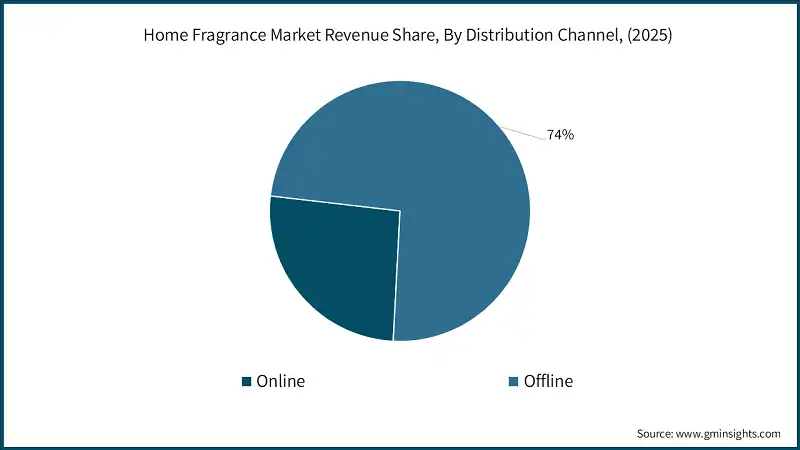
Based on distribution channel of home fragrance market consists of online and offline. The offline distribution channel emerged as leader and held 74% of the total market share in 2025 and is anticipated to grow at a CAGR of 5.4% from 2026 to 2035.
- Shoppers prefer to test scents in person before purchasing, as fragrance is highly subjective and influenced by individual preferences. Brick-and-mortar stores such as supermarkets, specialty shops, and department stores provide immediate product availability and allow customers to explore seasonal collections and curated displays, which enhances impulse buying.
- Additionally, offline channels benefit from strong brand visibility through attractive merchandising and in-store promotions, creating a premium shopping experience for both mass and luxury segments. Cultural habits in many regions still favor physical shopping for home décor and lifestyle products, reinforcing the dominance of offline retail.
Looking for region specific data?
North America Home Fragrance Market
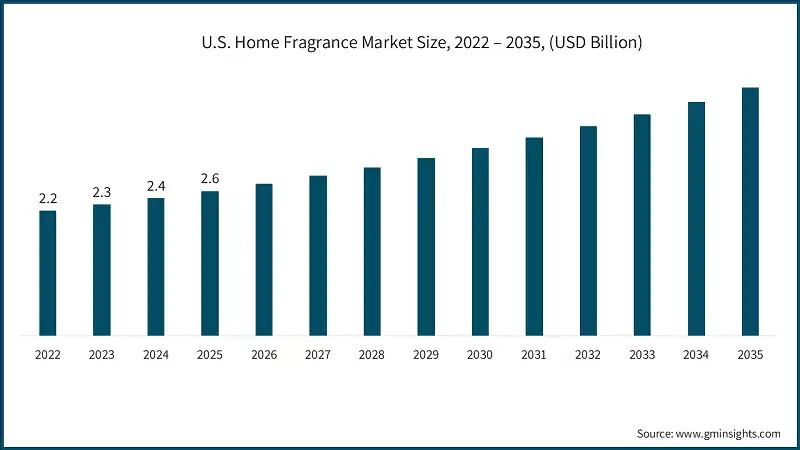
The U.S. dominates an overall North America market and valued at USD 2.6 billion in 2025 and is estimated to grow at a CAGR of 5.6% from 2026 to 2035.
- First, high disposable income and a strong culture of home décor encourage consumers to invest in products that enhance living spaces. Home fragrances are increasingly seen as affordable luxuries that contribute to wellness and relaxation, aligning with the growing trend of self-care and aromatherapy.
- Additionally, the rise of premium and eco-friendly products such as natural wax candles, refillable diffusers, and clean-label formulations has attracted health-conscious and sustainability-focused buyers. E-commerce expansion has further boosted accessibility, offering personalized experiences, subscription models, and convenient delivery options. Social media and influencer-driven home styling trends have amplified demand, while the pandemic-induced shift toward home-centric lifestyles reinforced the importance of creating comfortable, aesthetically pleasing environments.
Europe Home Fragrance Market
In the European market, Germany is expected to experience significant and promising growth from 2026 to 2035.
- Germans traditionally place a high cultural importance on maintaining clean, comforting, customized living environments considered sanctuaries so products like scented candles, sprays, and diffusers have become essential for enhancing ambiance. The country’s deep-rooted wellness traditions from herbal baths to forest-inspired aromatherapy have evolved into a broader demand for emotional well-being through natural scents like pine, lavender, and eucalyptus, especially in urban apartments embracing minimalist, design-conscious lifestyles. Environmental awareness further reinforces this growth: consumers are increasingly seeking eco-friendly, transparent, and ethically produced products, such as biodegradable packaging, clean-label ingredients, organic wax, and refillable diffusers compliant with certifications like EcoCert and NATRUE.
- Additionally, the acceleration of e-commerce has expanded accessibility, enabling brands to connect directly with consumers and offer customized subscription-based or sample-driven models. Altogether, Germany’s growth is propelled by a synergy of prized home environments, wellness-first habits, sustainability preferences, product innovation, and digital retail both reinforcing its leading role in Europe’s home fragrance outlook through 2035
Asia Pacific Home Fragrance Market
In the Asia Pacific market, the China held 23.9% market share in 2025 and is anticipated to grow at a CAGR of 6.3% from 2026 to 2035.
- Rapid urbanization and rising disposable incomes have led to a growing middle class that prioritizes lifestyle upgrades and home aesthetics. Consumers increasingly view home fragrances as a symbol of modern living and wellness, integrating scented candles, diffusers, and sprays into daily routines for relaxation and stress relief. Cultural preferences for pleasant indoor environments, combined with traditional practices like aromatherapy and herbal scents, further fuel demand.
- Additionally, the surge in e-commerce and social media influence has made premium and niche fragrance products more accessible, while local and international brands are investing in innovative, eco-friendly, and health-conscious formulations to cater to sustainability trends. Seasonal gifting traditions and the popularity of home décor during festivals also amplify consumption.
Middle East and Africa Home Fragrance Market
In the Middle East and Africa market, Saudi Arabia held 34.5% market share in 2025 promising growth from 2026 to 2035.
- Fragrance holds deep cultural significance in Saudi society, where scents like oud, bakhoor, and musk are integral to hospitality and daily rituals. This tradition, combined with rising disposable incomes and a growing preference for luxury lifestyle products, fuels demand for premium home fragrance solutions such as diffusers, scented candles, and incense. The country’s expanding urban population and modern housing trends have increased interest in home décor and ambiance-enhancing products.
- Additionally, the influence of global wellness trends and aromatherapy is encouraging consumers to adopt fragrances for relaxation and mood enhancement. E-commerce growth and digital marketing are making international and niche brands more accessible, while local manufacturers are innovating with sustainable, high-quality, and culturally inspired products.
Home Fragrance Market Share
- In 2025, the prominent manufacturers in market are Reckitt Benckiser Group plc, Procter & Gamble (P&G Prestige), Newell Brands, S.C. Johnson & Son, Inc. and L Brands collectively held the market share of ~20%.
- Reckitt, leveraging in-depth consumer insights and advanced AI-driven research and development, is revolutionizing its home fragrance offerings, particularly through its Air Wick line. The company has introduced cutting-edge formulations that significantly enhance odor neutralization and extend scent longevity, catering to evolving consumer preferences. Additionally, Reckitt is prioritizing the development of natural and eco-friendly product lines, aligning with sustainability trends. By streamlining its portfolio to focus on high margin "Powerbrands," the company ensures agility in responding to dynamic market demands and consumer expectations.
- P&G is leading innovation in sensory science by employing AI-powered fragrance design tools to analyze and interpret both emotional and functional scent preferences with precision. Their R&D team utilizes advanced data analytics to optimize fragrance appeal and create state-of-the-art malodor-control formulas. This approach enables P&G to deliver premium experiences, such as the highly anticipated "Scent of the Year," while ensuring consistent, high-quality performance across its diverse product portfolio, meeting the demands of a discerning consumer base.
Home Fragrance Market Companies
Major players operating in the home fragrance industry include:
- Blyth Inc.
- Candle-lite Company
- Colgate-Palmolive Company
- Henkel AG & Co. KGaA
- Illume
- Johnson & Johnson
- L Brands
- Lampe Berger
- Nest Fragrances
- Newell Brands
- P&G Prestige
- Reckitt Benckiser Group plc
- Revlon, Inc.
- S.C. Johnson & Son, Inc
- The Estee Lauder Companies Inc.
Newell, through its Yankee Candle brand, is redefining premiumization in the home fragrance market. The recently launched "YC Collection" exemplifies this strategy with meticulously crafted elegant vessel designs, dye-free wax blends, and natural wicks. The relaunch incorporates clean-burning formulas and sophisticated scent palettes, curated by elite perfumers to appeal to modern consumer tastes. Furthermore, the brand has undergone significant refreshes to enhance its market positioning and attract a younger, style-conscious demographic.
S. C. Johnson is setting a benchmark in fragrance transparency and consumer safety by adhering to rigorous proprietary ingredient standards. The company curates an exclusive fragrance palette and discloses nearly 100% of its formula contents, fostering trust and transparency. Its Glade line integrates innovative, performance-driven product designs, including the use of recycled packaging materials, fragrance-loaded oil diffusers, and advanced plug-ins. These products strike a balance between modern design, sustainability, and superior efficacy, addressing the growing consumer demand for environmentally responsible and high-performing solutions.
Home Fragrance Industry News
- In May 2025, Bath & Body Works, through its membership program, unveiled two limited-edition candles for Summer 2025. Members enjoyed exclusive access and promotional pricing on the reintroduced Caribbean Escape candle, featuring tropical melon, raspberry nectar, and coconut scents, and the debut Orchid Blooms candle, with blush orchid, jasmine, and English ivy aromas.
- In April 2025, ripple Home introduced REED, a premium residential fragrance diffuser line. Crafted by master perfumers in Grasse, France, the collection boasts six distinct scents. Encased in crystal glass droplet vessels with a single reed stick, these diffusers release fragrance for three months. Emphasizing sustainability, they use natural components and eco-friendly packaging. With a modern design, the line appeals to Generation Z and Millennial consumers.
- In September 2024, Air Wick unveiled its Essential Mist Diffuser, boasting adjustable fragrance controls, illumination features, and battery-operated convenience. Using proprietary essential oil cartridges, the diffuser offers a 45-day lifespan, ensuring consistent fragrance without needing an electrical outlet.
- In May 2024, Bottega Veneta debuted a collection of scented candles in distinct volcano-glazed ceramic pots. The brand emphasizes a blend of refined fragrances and artisanal Italian craftsmanship, underscoring its dedication to luxury home decor and sensory indulgence.
The home fragrance market research report includes in-depth coverage of the industry, with estimates & forecast in terms of revenue (USD Billion) and volume (Million Units) from 2022 to 2035, for the following segments:
Market, By Product Type
- Scented candles
- Sprays
- Scented wax tablets
- Essence oil
- Incense sticks
- Other (diffuser, scented cotton sack)
Market, By Fragrance Type
- Floral
- Fresh / citrus
- Woody
- Oriental / spicy
- Herbal
- Other (fruity, oceanic)
Market, By Category
- Mass
- Premium
Market, By Price
- Low
- Medium
- High
Market, By Distribution Channel
- Online
- E-commerce sites
- Company websites
- Offline
- Specialty stores
- Mega retail stores
- Others (departmental stores, individual stores, etc.)
The above information is provided for the following regions and countries:
- North America
- U.S.
- Canada
- Europe
- Germany
- UK
- France
- Italy
- Spain
- Asia Pacific
- China
- Japan
- India
- South Korea
- Australia
- Indonesia
- Malaysia
- Latin America
- Brazil
- Mexico
- Argentina
- MEA
- Saudi Arabia
- UAE
- South Africa
Frequently Asked Question(FAQ) :
What was the market share of the offline distribution channel in 2025?
The offline distribution channel accounted for 74% of the total market share in 2025 and is expected to grow at a CAGR of 5.4% through 2035.
Which region dominated the home fragrance market in 2025?
The U.S. led the North American market, valued at USD 2.6 billion in 2025, with an estimated CAGR of 5.6% through 2035. The region's dominance is attributed to strong consumer demand and the adoption of smart home technologies.
What are the key trends in the home fragrance industry?
Key trends include the adoption of app-controlled and smart technologies, automated fragrance release systems, and the integration of home fragrances into connected home ecosystems.
Who are the major players in the home fragrance market?
Key players include Blyth Inc., Candle-lite Company, Colgate-Palmolive Company, Henkel AG & Co. KGaA, Illume, Johnson & Johnson, L Brands, Lampe Berger, Nest Fragrances, Newell Brands, and P&G Prestige.
What was the market share of the mass category in 2025?
The mass category held 63.6% of the total market share in 2025 and is projected to grow at a CAGR of 5.5% from 2026 to 2035.
What was the market size of the home fragrance market in 2025?
The market size was USD 10.7 billion in 2025, with a CAGR of 5.8% expected through 2035, driven by advancements in smart technologies and increasing consumer demand for personalized home environments.
What is the projected value of the home fragrance market by 2035?
The market is expected to reach USD 18.6 billion by 2035, fueled by the integration of IoT-enabled devices and the growing trend of connected homes.
What was the revenue generated by the scented candles segment in 2025?
The scented candles segment generated approximately USD 4.5 billion in 2025 and is anticipated to grow at a CAGR of 5.7% through 2035.
Home Fragrance Market Scope
Related Reports