Summary
Table of Content

Holographic Data Storage Market
Get a free sample of this report
Form submitted successfully!
Error submitting form. Please try again.
Thank you!
Your inquiry has been received. Our team will reach out to you with the required details via email. To ensure that you don't miss their response, kindly remember to check your spam folder as well!
Request Sectional Data
Thank you!
Your inquiry has been received. Our team will reach out to you with the required details via email. To ensure that you don't miss their response, kindly remember to check your spam folder as well!
Form submitted successfully!
Error submitting form. Please try again.
Holographic Data Storage Market Size
The global holographic data storage market is expanding, owing to high data storage density and capacity compared to traditional storage solutions, rapid growth in cloud computing and big data applications, increasing demand for secure and long-term archival storage, rising need for high-speed data retrieval and processing, and growing adoption in defense, healthcare, and multimedia industries.
Holographic Data Storage Market Key Takeaways
Market Size & Growth
- 2025 Market Size: USD 2.4 Billion
- 2026 Market Size: USD 2.9 Billion
- 2035 Forecast Market Size: USD 12.6 Billion
- CAGR (2026–2035): 17.9%
Regional Dominance
- Largest Market: North America
- Fastest Growing Region: Asia Pacific
Key Market Drivers
- High data storage density and capacity compared to traditional storage solutions.
- Rapid growth in cloud computing and big data applications.
- Increasing demand for secure and long-term archival storage.
- Rising need for high-speed data retrieval and processing.
- Growing adoption in defense, healthcare, and multimedia industries.
Challenges
- High cost of implementation and maintenance.
- Complexity of technology integration with existing IT infrastructure.
Opportunity
- Advancement in next-generation holographic storage materials and architectures.
- Integration with AI, edge computing, and cloud applications.
Key Players
- Market Leader: InPhase Technologies led with over market share of 22% in 2025.
- Leading Players: Some of the top players in this market include InPhase Technologies, Optware Corporation, Aprilis Inc., Sony Corporation, Panasonic Holdings Corporation, which collectively held a market share of 68% in 2025.
Get Market Insights & Growth Opportunities
Holographic data storage’s fundamental advantage is its ability to encode data throughout the entire volume of a medium rather than only on a surface, enabling significantly higher storage densities. This potential has drawn attention from large public‑sector research initiatives exploring storage beyond conventional Hard Disk Drives and SSDs for future cloud infrastructures, as seen in cloud‑focused research programs reimagining holographic storage systems for high‑endurance, high‑density applications. These efforts show holographic methods could keep up with exponential data growth as traditional media near scaling limits, highlighting density as the main reason for interest and investment. For example, in December 2025 UK startup HoloMem revealed a working "HoloDrive" meant to retrofit existing data-center tape libraries. It’s designed to replace Linear Tape-Open (LTO) tapes, offering up to 200 TB per cartridge with a projected 50-year lifespan.
The overwhelming expansion of cloud infrastructure and big data workloads requires storage technologies that can scale both capacity and access performance. Governments and public research institutions are supporting explorations of novel storage paradigms capable of addressing these needs. For example, collaborations between major research labs and cloud service initiatives are investigating whether holographic storage can provide a viable cloud‑first storage layer with improved performance and efficiency compared with legacy media. Such programs highlight cloud demand as a primary impetus for continued R&D and potential future adoption of holographic storage systems in large‑scale data centres.
Holographic data storage is an advanced optical technique that records information in three dimensions inside a photosensitive medium, instead of just on the surface like traditional optical discs. It uses interference patterns from laser beams to pack data at very high density and to enable fast, parallel read and write operations. That combination makes it a good fit for secure, long-term, high-capacity needs such as archival systems, cloud infrastructure, and scientific data repositories.
The global holographic data storage market was valued at USD 2.4 billion in 2025. The market is expected to grow from USD 2.9 billion in 2026 to USD 6.4 billion in 2031 and USD 12.6 billion in 2035, at a CAGR of 17.9% during the forecast period, according to the latest report published by Global Market Insights Inc.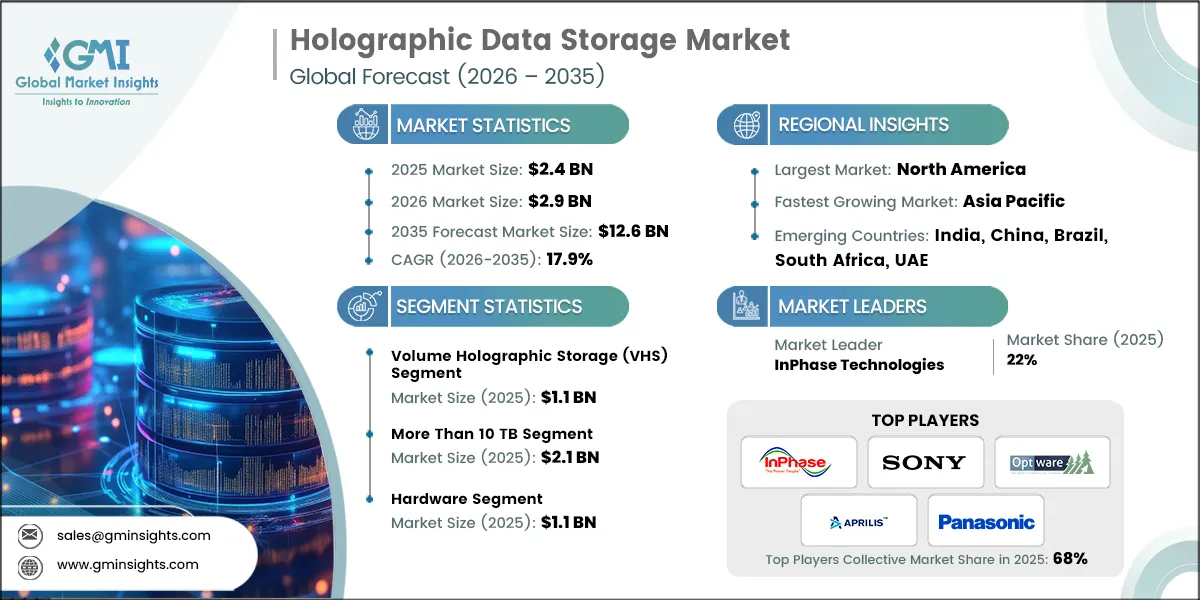
To get key market trends
Holographic Data Storage Market Trends
- The market is shifting towards the holographic storage systems, that can be made to work with existing IT infrastructure. Firms are considering the incorporation of holographic interventions in conventional data centres and archives enabling organizations to upgrade to high capacity storage without necessarily replacing the existing ones. The trend demonstrates the change toward the practical application rather than the laboratory research with a focus on ease of adoption and slow acceptance by the industry.
- Ongoing studies in the material of storage media, particularly the photopolymers are improving the holographic storage. The goal of innovations is to enhance the data retention and stability as well as the efficiency of read/write and decrease the degradation of media with time. Such material advances lead us to consider holographic storage as a more feasible solution to long-term archival and large business utilization, enhancing reliability and widening the range of industries that need high-density data storage solutions with high levels of reliability.
- Governments and government research organs are currently investing in research on holographic storage to provide the next generation in storage technology. It also has support, such as innovation grants, joint research projects, and pilot programs with universities and tech developers. This support will speed up the development cycles, stimulate technological breakthrough, and build the market credibility, which is of strategic significance to holographic storage as a tool of the national data infrastructure and long-term scientific use.
- Holographic storage is gaining more ground as an efficient energy storage that can be used in archival and cold storage. The technology enables organizations to store large datasets with minimal use of energy coupled with maintaining the integrity of data over a long period. The trend is compatible with the global objectives of sustainability and the increased interest in environmentally friendly and low-maintenance storage facilities, both in government and enterprise settings.
Holographic Data Storage Market Analysis
Learn more about the key segments shaping this market
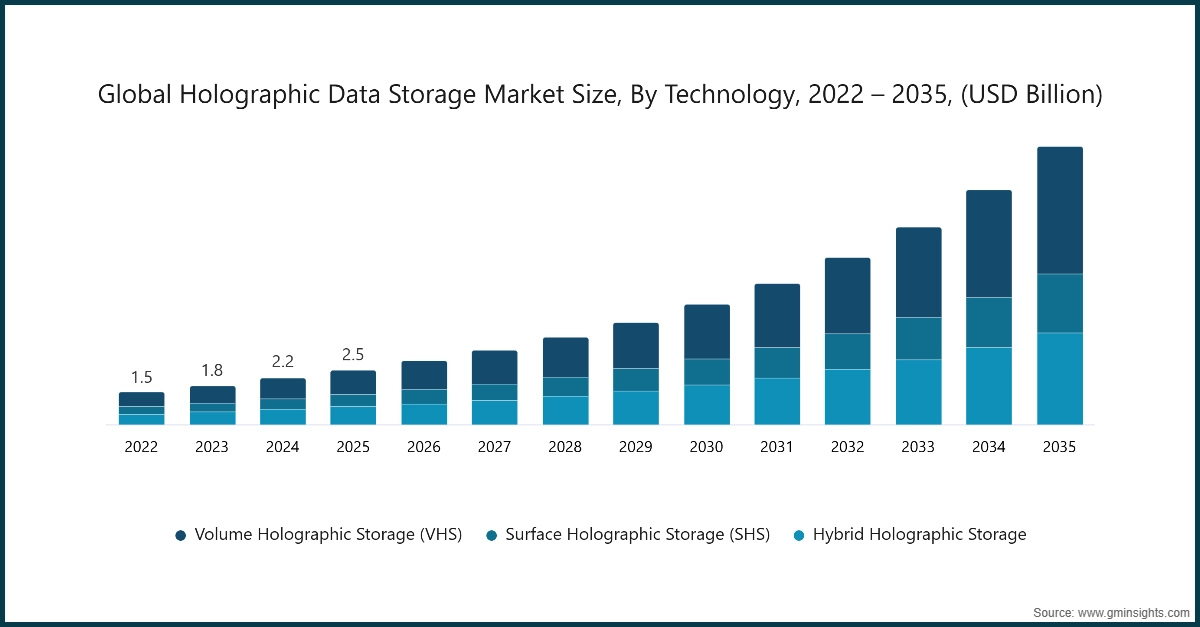
Based on technology, the market is divided into volume holographic storage (VHS), surface holographic storage (SHS), and hybrid holographic storage.
- The volume holographic storage (VHS) segment accounted for the largest market and was valued at USD 1.1 billion in 2025. Volume holographic storage benefits from its ability to store data throughout the full depth of the recording medium, enabling ultra-high storage density and fast parallel data access for large-scale archival and enterprise storage applications.
- Rising demand for long-term, secure data preservation in scientific research, defense, and cloud cold-storage environments is accelerating adoption of VHS, as the technology offers durability, data integrity, and reduced physical storage footprints.
- Manufacturers should prioritize scaling photopolymer media reliability and improving read/write stability to position VHS as a viable alternative to tape and optical archives for enterprise and government customers.
- The hybrid holographic storage segment is anticipated to grow at a CAGR of 18.1% during the forecast period. Hybrid holographic storage combines surface and volume recording advantages, offering a balanced approach that improves capacity while maintaining system flexibility, making it attractive for diverse enterprise and industrial data storage requirements.
- Growing demand for scalable and adaptable storage architectures is driving hybrid systems, as organizations seek solutions that can evolve from near-term deployments to higher-density configurations without complete infrastructure replacement.
- Manufacturers should invest in modular hybrid architectures that allow customers to scale storage density over time, supporting phased adoption across enterprise, cloud, and institutional data storage environments.
Learn more about the key segments shaping this market
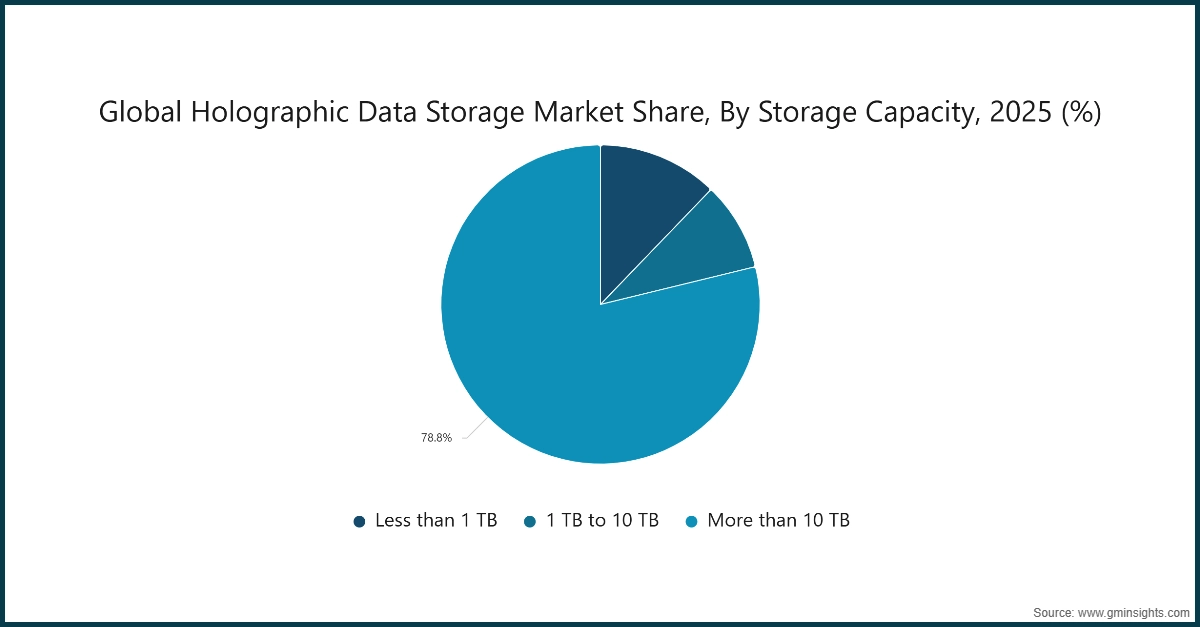
On the basis of storage capacity, the market is segmented into less than 1 TB, 1 TB to 10 TB, and more than 10 TB.
- The more than 10 TB segment accounted for the largest market and was valued at USD 2.1 billion in 2025. The more than 10 TB segment is driven by hyperscale data growth from cloud platforms, national archives, and defense applications that require ultra-high-capacity, long-term, and secure data preservation technologies.
- Increasing focus on energy-efficient cold storage solutions is accelerating demand for very high-capacity holographic systems that reduce physical footprint and long-term operational costs in large data environments.
- Manufacturers should focus on scalable architectures and strategic partnerships with hyperscale and government entities to commercialize ultra-high-capacity holographic storage for mission-critical archival use.
- The 1 TB to 10 TB segment is anticipated to grow at a CAGR of 14.8% during the forecast period. The 1 TB to 10 TB segment benefits from growing demand for mid-scale archival storage across enterprises, healthcare, and scientific research, where high data density and faster access outperform traditional optical and tape solutions.
- This segment aligns well with existing data center infrastructure, enabling organizations to adopt holographic storage without major system overhauls while addressing expanding data volumes and long-term retention requirements.
- Manufacturers should optimize reliability and integration compatibility for this segment, positioning solutions as practical replacements for enterprise archival storage and cold data repositories.
Based on component, the market is categorized into hardware, software, and services.
- The hardware segment accounted for the largest market and was valued at USD 1.1 billion in 2025. The hardware segment dominates the market due to the capital-intensive nature of holographic storage systems, including lasers, spatial light modulators, optical sensors, and recording media required for data writing and retrieval.
- Growing demand for high-capacity, long-term archival storage in data centres, defense, and scientific research is driving investments in robust and scalable holographic storage hardware platforms.
- Manufacturers should focus on improving hardware reliability, reducing system complexity, and achieving economies of scale to accelerate enterprise and institutional adoption of holographic storage systems.
- The software segment is anticipated to grow at a CAGR of 19.1% during the forecast period. The software segment is gaining momentum as holographic storage systems require advanced data encoding, error correction, metadata management, and retrieval algorithms to efficiently manage volumetric data recording.
- Increasing integration of holographic storage with cloud platforms and enterprise IT systems is driving demand for intelligent software layers that enable automation, monitoring, and seamless interoperability.
- Manufacturers should invest in proprietary software ecosystems that enhance system usability, optimize data access, and support integration with existing storage management and cloud orchestration tools.
Looking for region specific data?
North America Holographic Data Storage Market
North America dominated the holographic data storage industry and held a revenue share of 34.3% in 2025.
- North America leads holographic storage adoption due to a strong R&D ecosystem, advanced data center infrastructure, and early innovation uptake across enterprise and government sectors.
- The region’s leadership stems from robust digital transformation initiatives, push toward energy‑efficient archival storage, and integration of optical storage research into AI/IoT data management strategies.
- As hyperscale cloud and defense applications demand high‑density, low‑energy storage solutions, holographic data storage is increasingly viewed as a strategic technology to support future data workloads and digital resilience.
- Manufacturers should focus R&D partnerships with hyperscale cloud and defense contractors in North America to co‑develop scalable holographic storage systems tailored to high‑density enterprise and institutional archival needs.
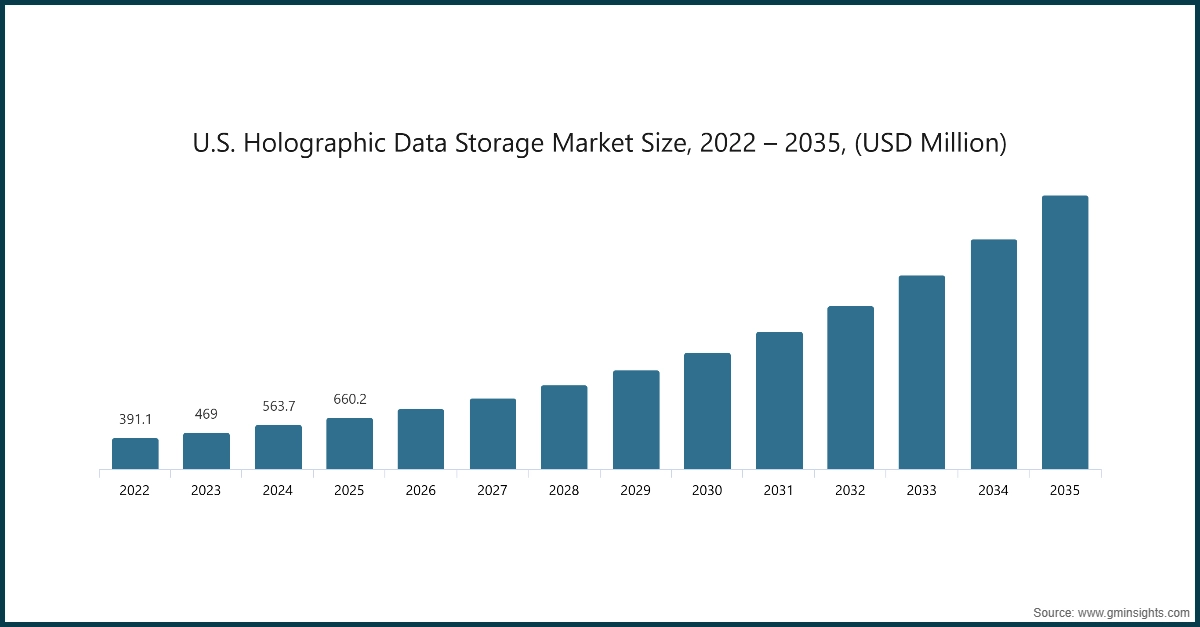
The U.S. holographic data storage market was valued at USD 391.1 million and USD 469 million in 2022 and 2023, respectively. The market size reached USD 660.2 million in 2025, growing from USD 563.7 million in 2024.
- In the United States, holographic data storage is gaining traction with active exploration by public research institutions and digital infrastructure funding programs that emphasize next‑generation storage systems.
- Government‑linked initiatives around advanced computing and data sustainability highlight interest in technologies that can alleviate storage bottlenecks in scientific, healthcare, and defense datasets.
- For instance, in February 2026, HoloMem Ltd. has successfully demonstrated its HoloDrive, a 3D holographic data storage technology, operating within existing BDT tape library infrastructure. This backward-compatible system aims for mass production by 2027, offering higher density, lower power consumption, and superior durability compared to traditional magnetic tape. The technology allows for multiple data layers to be stored in the same physical space.
- US manufacturers should pursue collaborative pilot programs with national labs to validate holographic storage in high‑performance computing and cloud infrastructure environments.
Europe Holographic Data Storage Market
Europe holographic data storage industry accounted for USD 506.9 million in 2025 and is anticipated to show lucrative growth over the forecast period.
- Europe’s holographic storage market growth is driven by strong regulatory emphasis on data security, digital transformation frameworks, and public‑sector digitization programs.
- Sustainable technology initiatives, smart city deployments, and national R&D ecosystems contribute to growing interest in high‑capacity, long‑term storage solutions.
- European tech strategies prioritize secure archival systems across healthcare and government data repositories, and the continent’s robust academic and public research collaborations support technology maturation. Adoption is further reinforced by cross‑border partnerships that align with EU digital strategies.
- European manufacturers should align product roadmaps with EU digital infrastructure priorities and offer solutions tailored to secure, compliant archival systems for public sector use.
Germany dominated the Europe holographic data storage market, showcasing strong growth potential.
- In Germany, industrial digitization and data protection priorities are shaping holographic storage interest through academia–industry partnerships and national research funding.
- The German academic and applied research community is exploring advanced optical data systems as part of broader digital infrastructure modernization.
- For instance, in 2024, the German National Research Data Infrastructure highlighted the launch of an enhanced secure data archive component aimed at supporting long‑term research data storage, signalling institutional backing for future storage innovations.
- German manufacturers should target collaborations with national research data infrastructure programs to integrate holographic storage into standardized research and compliance workflows.
Asia Pacific Holographic Data Storage Market
The Asia Pacific holographic data storage industry is fastest growing and is anticipated to grow at a CAGR of 19% during the analysis timeframe.
- The Asia Pacific region is rapidly advancing holographic data storage adoption, driven by expansive digital transformation agendas, increasing industrial automation, and robust domestic electronics ecosystems.
- Government programs in China, Japan, and India support next‑generation storage research and digital infrastructure modernization, stimulating local innovation.
- Rising data volumes from smart cities, mobile ecosystems, and AI computing use cases are creating demand for high‑capacity, energy‑efficient storage solutions. This dynamic environment encourages both global and indigenous technology developers to innovate and scale holographic storage applications across commercial sectors.
- Manufacturers should establish regional R&D centres in Asia Pacific to leverage government initiatives and customize holographic storage solutions for local digital transformation requirements.
China holographic data storage market is estimated to grow with a CAGR of 20.2% during the forecast period, in the Asia Pacific region.
- China’s holographic data storage trend is influenced by national digitalization policies, strong local manufacturing capabilities, and strategic investment in large‑scale data infrastructure.
- Government‑led smart city programs and critical sector digitization goals prioritize storage technologies that support expansive datasets, secure archival, and cloud integration.
- Domestic firms benefit from supportive policy frameworks that encourage indigenous innovation in photonics and optical storage, fostering an environment where holographic data systems can be developed and piloted at scale alongside broader digital initiatives.
- China‑focused manufacturers should build strategic alliances with national data infrastructure and cloud service enterprises to pilot holographic storage in government smart city projects.
Latin American Holographic Data Storage Market
Brazil leads the Latin American holographic data storage industry, exhibiting remarkable growth during the analysis period.
- Organizations in Brazil, particularly in the finance and healthcare sectors, are increasingly adopting next-generation storage solutions to address growing data requirements.
- This transition aligns with the broader digital transformation initiatives within enterprise IT and public administration. While traditional storage systems remain prevalent, there is a clear shift toward advanced storage technologies.
- Despite challenges such as infrastructure investment gaps, rising awareness and a stronger focus on digital policies suggest a favourable trajectory toward high-capacity storage investment models.
- Manufacturers should build pilot programs with Brazilian universities and large enterprises to demonstrate holographic storage advantages for regulated data archiving.
Middle East and Africa Holographic Data Storage Market
South Africa holographic data storage industry to experience substantial growth in the Middle East and Africa.
- South Africa’s holographic storage trend is at an emergent stage, with adoption concentrated among research institutions and select industrial applications. Digital transformation priorities in sectors like education, engineering, and government services are driving exploration of advanced data storage technologies.
- Constraints include limited high‑tech infrastructure and high initial investment costs, but partnerships with global technology firms and academic research collaborations are helping bridge capability gaps.
- Increasing interest in long‑term storage resilience and secure data systems is laying a foundation for future holographic storage use cases in both public and private sectors.
- South African manufacturers and global partners should invest in localized education programs and pilot deployments to build confidence and technical capacity for holographic storage solutions.
Holographic Data Storage Market Share
The holographic data storage industry is moderately concentrated, with leading manufacturers collectively holding a substantial share of global revenues. Top players such as InPhase Technologies, Optware Corporation, Aprilis Inc., Sony Corporation, and Panasonic Holdings Corporation dominate the competitive landscape, accounting for approximately 68% of the total market share.
These companies leverage advanced holographic storage architectures, high-density volumetric recording, and optimized optical and controller systems to serve enterprise storage, cloud data centers, scientific archives, and defense applications. Strategic partnerships, R&D investments, and pilot-scale deployments strengthen their positions across global holographic storage markets.
Despite this concentration, specialized and regional players remain active, focusing on niche archival solutions, energy-efficient designs, and emerging applications, ensuring sustained innovation and competitive intensity within the market.
Holographic Data Storage Market Companies
Prominent players operating in the holographic data storage industry are as mentioned below:
- InPhase Technologies
- Optware Corporation
- Aprilis Inc.
- Akonia Holographics
- Zebra Imaging
- Holographic Versatile Disc (HVD) Alliance
- Sony Corporation
- Panasonic Holdings Corporation
- Samsung Electronics
- Fujifilm Holdings Corporation
- Hitachi, Ltd.
- General Electric (GE Research)
- IBM Corporation
- Microsoft Corporation
- Toshiba Corporation
- Intel Corporation
- Western Digital Corporation
- Seagate Technology
- InPhase Technologies leads the Holographic Data Storage market with a 22% share, driven by its comprehensive portfolio of high-density, high-capacity, and enterprise-grade holographic storage solutions. The company focuses on volumetric holographic media, advanced recording optics, and optimized read/write controllers for data centers, cloud archival systems, and defense applications.
- Optware Corporation holds a 16.2% share, offering diverse holographic storage systems optimized for long-term archival, cost-efficient deployment, and high-speed data retrieval. The company works with enterprise IT departments, data centers, and research consortia to deliver secure, energy-efficient storage solutions that meet stringent performance and reliability standards.
- Aprilis Inc. controls 12.4% of the market, providing holographic storage solutions focused on high-density volumetric recording and hybrid optical media architectures. Its products are tailored for scientific archives, media and entertainment storage, and cloud-based cold storage applications. Aprilis partners with research laboratories, cloud operators, and technology integrators to ensure scalable, secure, and energy-efficient deployments that enable enterprise-level data management and long-term archival reliability.
- Sony Corporation accounts for 9.7% of the market, offering advanced holographic storage systems targeting enterprise, media, and consumer applications. Sony focuses on high-performance optical media, hybrid holographic solutions, and integration with existing IT infrastructures.
- Panasonic Holdings Corporation holds 7.7% of the market, specializing in innovative holographic media, high-capacity archival solutions, and energy-efficient storage systems. Panasonic works with industrial partners, research institutions, and cloud operators to deliver scalable, cost-effective holographic storage solutions.
Holographic Data Storage Market Report Attributes
| Key Takeaway | Details |
|---|---|
| Market Size & Growth | |
| Base Year | 2025 |
| Market Size in 2025 | USD 2.4 Billion |
| Market Size in 2026 | USD 2.9 Billion |
| Forecast Period 2026-2035 CAGR | 17.9% |
| Market Size in 2035 | USD 12.6 Billion |
| Key Market Trends | |
| Drivers | Impact |
| High data storage density and capacity compared to traditional storage solutions | Accelerates adoption of holographic storage systems, as enterprises, research institutions, and data centers seek ultra-high-density storage that reduces physical footprint while supporting large-scale archival and high-volume datasets. |
| Rapid growth in cloud computing and big data applications | Drives large-scale deployment of holographic storage to meet cloud, enterprise, and big data infrastructure needs, enabling faster parallel data access, improved scalability, and optimized management of voluminous datasets. |
| Increasing demand for secure and long-term archival storage | Strengthens market penetration as holographic storage offers high durability and data integrity, making it ideal for government, healthcare, scientific, and defense archives requiring long-term, tamper-resistant storage solutions. |
| Rising need for high-speed data retrieval and processing | Boosts deployment in enterprise and research applications that require low-latency access to large datasets, supporting real-time analytics, AI workloads, and high-performance computing environments. |
| Growing adoption in defense, healthcare, and multimedia industries | Enhances market growth as organizations in sensitive and high-data industries prioritize secure, high-capacity, and energy-efficient storage solutions for critical datasets, medical records, and multimedia content. |
| Pitfalls & Challenges | Impact |
| High cost of implementation and maintenance | Limits adoption among smaller enterprises and research institutions, as initial investment in holographic storage systems and specialized infrastructure is substantial, potentially slowing widespread deployment. |
| Complexity of technology integration with existing IT infrastructure | Increases implementation barriers, as organizations face challenges integrating volumetric holographic storage with legacy systems, data management platforms, and cloud workflows, requiring specialized expertise. |
| Opportunities: | Impact |
| Advancement in next-generation holographic storage materials and architectures | Enables manufacturers to offer higher-capacity, faster, and more energy-efficient storage solutions, meeting growing enterprise, cloud, and archival storage demands while enhancing competitive differentiation. |
| Integration with AI, edge computing, and cloud applications | Encourages adoption of specialized holographic storage optimized for low latency, high-speed access, and secure archival, supporting emerging use cases in smart healthcare, defense intelligence, and industrial automation. |
| Market Leaders (2025) | |
| Market Leader |
22% Market share |
| Top Players |
Collective market share in 2025 is 68% |
| Competitive Edge |
|
| Regional Insights | |
| Largest Market | North America |
| Fastest growing market | Asia Pacific |
| Emerging countries | India, China, Brazil, South Africa, UAE |
| Future outlook |
|
What are the growth opportunities in this market?
Holographic Data Storage Industry News
- In February 2026, HoloMem Ltd., based in London and founded in 2020, completed the first trial deployment of its HoloDrive storage system in an existing tape library at a data center run by German tape storage manufacturer BDT Media Automation GmbH. This trial demonstrated that HoloMem's HoloDrive holographic storage cartridge can run within an existing storage infrastructure. HoloMem plans to push for more trials with the goal of mass-producing HoloDrive by 2027.
The holographic data storage market research report includes in-depth coverage of the industry with estimates & forecasts in terms of revenue (USD Billion) from 2022 to 2035, for the following segments:
Market, By Technology
- Volume holographic storage (VHS)
- Surface holographic storage (SHS)
- Hybrid holographic storage
Market, By Storage Capacity
- Less than 1 TB
- 1 TB to 10 TB
- More than 10 TB
Market, By Component
- Hardware
- Software
- Services
Market, By Material
- Photopolymers
- Photorefractive crystals
- Silicon-based storage
- Polymer thin films
Market, By Application
- Enterprise data storage & data centres
- Archival storage & backup
- Real-time high-volume data access
- Critical secure storage
- Others
Market, By End-User Industry
- IT & telecommunications
- Banking, financial services & insurance (BFSI)
- Healthcare
- Media & entertainment
- Government
- Defense & aerospace
- Others (education, research institutions, etc.)
The above information is provided for the following regions and countries:
- North America
- U.S.
- Canada
- Europe
- Germany
- UK
- France
- Spain
- Italy
- Netherlands
- Asia Pacific
- China
- India
- Japan
- Australia
- South Korea
- Latin America
- Brazil
- Mexico
- Argentina
- Middle East and Africa
- Saudi Arabia
- South Africa
- UAE
Frequently Asked Question(FAQ) :
What is the market size of the holographic data storage in 2025?
The market size was USD 2.4 billion in 2025, with a CAGR of 17.9% expected through 2035 driven by high data storage density, rapid growth in cloud computing and big data, and increasing demand for secure long-term archival storage.
What is the projected value of the holographic data storage market by 2035?
The holographic data storage market is expected to reach USD 12.6 billion by 2035, propelled by advancement in next-generation holographic storage materials and integration with AI, edge computing, and cloud applications.
What is the current holographic data storage market size in 2026?
The market size is projected to reach USD 2.9 billion in 2026.
What was the market value of the volume holographic storage segment in 2025?
The volume holographic storage (VHS) segment was valued at USD 1.1 billion in 2025, dominating due to ultra-high storage density and fast parallel data access capabilities.
What was the market value of the more than 10 TB storage capacity segment in 2025?
The more than 10 TB segment was valued at USD 2.1 billion in 2025, driven by hyperscale data growth from cloud platforms, national archives, and defense applications.
What was the market value of the hardware component segment in 2025?
The hardware segment was valued at USD 1.1 billion in 2025, dominating due to the capital-intensive nature of holographic storage systems including lasers, modulators, and recording media.
Which region leads the holographic data storage market?
North America is the largest market with 34.3% market share in 2025, with the U.S. valued at USD 660.2 million in 2025.
What are the upcoming trends in the holographic data storage market?
Key trends include shift toward compatibility with existing IT infrastructure, ongoing research in photopolymer storage media, government support through innovation grants and pilot programs, and growing adoption as energy-efficient solution for archival and cold storage.
Who are the key players in the holographic data storage market?
Key players include InPhase Technologies, Optware Corporation, Aprilis Inc., Akonia Holographics, Zebra Imaging, Sony Corporation, Panasonic Holdings Corporation, Samsung Electronics, Fujifilm Holdings, Hitachi, GE Research, IBM, Microsoft, Toshiba, Intel, Western Digital, and Seagate Technology.
Holographic Data Storage Market Scope
Related Reports