Summary
Table of Content

High Voltage Composite Insulators Market
Get a free sample of this report
Form submitted successfully!
Error submitting form. Please try again.
Thank you!
Your inquiry has been received. Our team will reach out to you with the required details via email. To ensure that you don't miss their response, kindly remember to check your spam folder as well!
Request Sectional Data
Thank you!
Your inquiry has been received. Our team will reach out to you with the required details via email. To ensure that you don't miss their response, kindly remember to check your spam folder as well!
Form submitted successfully!
Error submitting form. Please try again.
High Voltage Composite Insulators Market Size
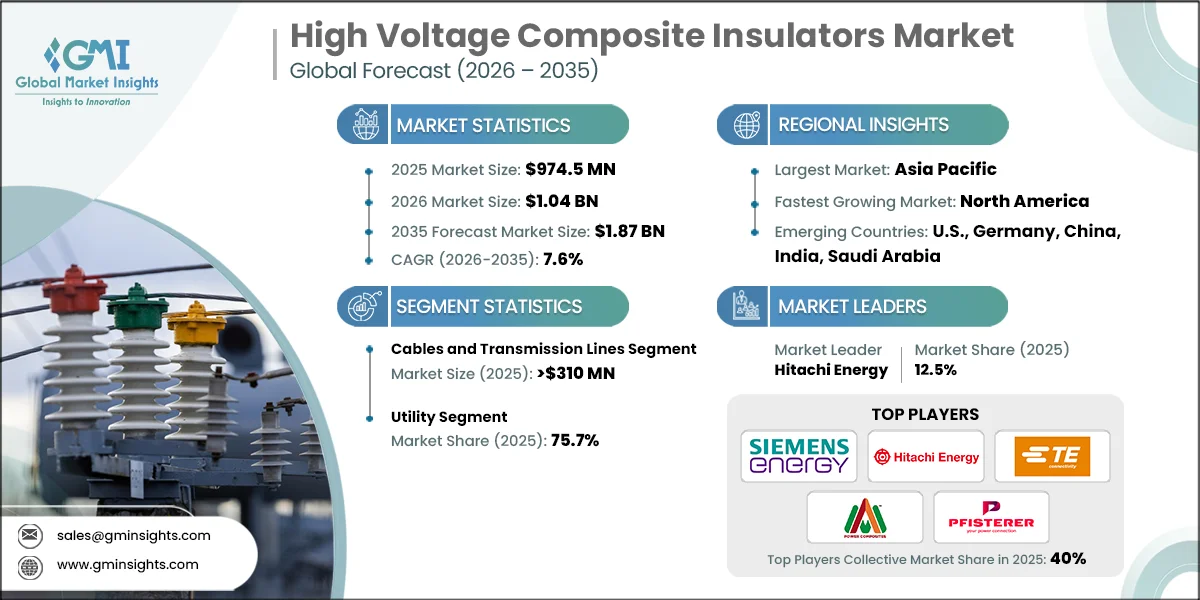
The global high voltage composite insulators market was valued at USD 974.5 million in 2025 and is estimated to grow from USD 1.04 billion in 2026 to USD 1.87 billion by 2035, at a CAGR of 7.6%, according to a recent study by Global Market Insights Inc.
High Voltage Composite Insulators Market Key Takeaways
Market Size & Growth
- 2025 Market Size: USD 974.5 Million
- 2026 Market Size: USD 1.04 Billion
- 2035 Forecast Market Size: USD 1.87 Billion
- CAGR (2026–2035): 7.6%
Regional Dominance
- Largest Market: Asia Pacific
- Fastest Growing Region: North America
Key Market Drivers
- Increasing investment toward power generation and development of electrical infrastructure.
- Ongoing refurbishment and expansion of existing grid networks.
- Increasing renewable integration.
Challenges
- Fluctuating raw material cost.
Opportunity
- Development of renewable energy infrastructure.
- Accelerating grid modernization programs.
- Rising adoption of smart grids and distributed energy resources.
- Increasing utility and government expenditure on transmission expansion.
Key Players
- Market Leader: Hitachi Energy led with over market share of: 12.5% in 2025.
- Leading Players: Top 5 players in this market include Siemens Energy, Hitachi Energy, TE Connectivity, Aditya Birla Power Composites, PFISTERER, which collectively held a market share of 40% in 2025.
Get Market Insights & Growth Opportunities
Continuous upgradation of transmission networks, along with favorable initiatives by respective government authorities toward development of prevailing electrical infrastructure will contribute to industry growth. Rising demand for electricity, driven by increasing urbanization, accelerating industrialization across various economies and growing capital expenditure toward strengthening gird networks further contributing to industry growth.
For instance, in September 2024, the Indian government introduced National Electricity Plan which allocated around USD 111 billion to strengthen transmission infrastructure and meet rising power demand. The program aims to expand the transmission network from 4.85 to 6.48 lakh ckm (lakh circuit‑kilometers) and increase transformation capacity to 2,342 GVA, preparing the system to support a projected peak load of 458 GW.
Rising integration of renewable energy systems, rapid adoption of smart grid and intra-regional high voltage transmission corridors have increased demand for high voltage composite insulators. Retrofitting of prevailing networks, expansion of transmission lines across remote areas requires insulation systems able to withstand extreme climatic conditions will augment product deployment.
For instance, in November 2025, the Nigeria-UK PACT Fund began its second phase, implementing eight technical assistance projects and experts in place to support Nigeria in implementing its Nationally Determined Contributions. This assistance aims to support the country in its capacity to achieve a 2060 net-zero goal as the country is facing limited electricity access. As part of the UK’s International Climate Finance initiative, the UK PACT brings together expertise, finance, and capacity-building to share with partner countries to move forward with a fair and inclusive transition.
Significant initiatives for advancements and development of grid infrastructure coupled with adoption of advanced components compelled utilities to support the expansion of renewables and adhere to environmental mandates. Moreover, growing inclination on refurbishment of aging high voltage transmission networks and replacement of traditional insulator components for maintaining uninterrupted power supply, will positively influence business dynamics.
For instance, in December 2025, Hitachi Energy announced a USD 22 million investment to expand and modernize its service operations in Canada, addressing rising electricity demand and aging grid infrastructure. The plan includes upgrading the Stoney Creek facility and establishing a new field service center in Cambridge. As part of Hitachi Energy’s USD 1 billion global service expansion, the investment strengthens Canada’s ability to maintain and refurbish large power transformers essential for achieving a net‑zero grid by 2050.
Asia Pacific holds a dominant position in the high voltage composite insulators market, owing to continuous demand for electricity, rapid infrastructure development, modernization of industries, increasing urbanization rate across developing economies and deployment of renewables. Favorable initiatives by respective authorities and utilities toward expansion of grid networks, modernization of prevailing transmission systems, adoption of smart grids and increasing development of intra-regional transmission corridors will complement industry landscape.
For instance, in January 2026, China’s State Grid planned to invest approximately USD 570 billion between 2026 and 2030 to modernize the national power grid under the 15th Five‑Year Plan, a 40% increase over the previous cycle. The program strengthens west‑to‑east ultra high voltage transmission corridors, supports annual integration of 200 GW of wind and solar capacity, expands cross‑regional transmission by over 30%, and upgrades urban and remote distribution networks while advancing off‑grid and microgrid solutions.
North America is one of the emerging markets across the high voltage composite insulators industry owing to flourishing investment in large‑scale infrastructure, including new power generation assets and expansion of high voltage transmission networks. Governments authorities and utilities are aiming toward grid modernization, upgrading outdated systems along with ongoing expenditure in development of HV transmission lines and increasing integration of renewable energy will positively influence business dynamics.
For instance, in December 2025, the Midcontinent Independent System Operator in the central U.S. authorized a USD 12.3 billion transmission expansion covering around 2,000 miles across its 14‑state region to address rising electricity demand. Out of the 432 approved high‑voltage lines, 49 projects valued at USD 5 billion will move forward under accelerated timelines, reflecting the growing urgency to support new data‑center loads and fast‑track power infrastructure development.
To get key market trends
High Voltage Composite Insulators Market Trends
High voltage composite insulators market is anticipated to grow owing to rising electricity demand driven by accelerating development of industrial and commercial infrastructure and expansion of transmission networks. Rapid adoption of smart grids and distributive energy sources along with ongoing refurbishment of prevailing T&D infrastructure and large-scale integration of renewable energy sources is shaping business dynamics.
For instance, in October 2025, the Australian Government introduced its Rewiring the Nation program, a major initiative to modernize the electricity grid and expand transmission infrastructure using concessional financing to reduce overall investment costs. The program supports the transition from aging coal‑fired assets to lower‑cost renewable energy, ensuring reliable supply for urban and regional communities.
Flourishing investments toward development of inter-regional and intra-regional transmission corridors along with expansion of ultra-high voltage grid networks to cater to rising electricity demand will complement business scenario. Significant initiatives toward replacement of traditional porcelain and glass insulators with advanced composite technologies to withstand extreme climatic conditions will positively influence business dynamics.
For instance, in January 2026, The European Investment Bank approved around USD 262.5 million (EUR 220 million) loan to WEMAG, supporting more than one‑third of the company’s planned grid investments over the next four years. This financing strengthens efforts to expand and modernize West Mecklenburg’s power infrastructure in Germany, ensuring households, businesses, and industrial consumers continue to receive reliable, competitively priced renewable electricity.
Continuous expansion of industrial infrastructure across major economies including U.S., China, India, and Germany, coupled with rising investment in power‑sector development, is accelerating product adoption. Their compatibility with modern line designs and advanced tower configurations supports deployment in industrial regions, further contributing to industry growth.
For instance, in March 2025, Germany introduced a major USD 596 billion infrastructure investment proposal aimed at stimulating economic revitalization, with significant benefits expected for the construction, defence, and energy sectors. Designed as a long‑term program, the initiative seeks to modernize aging infrastructure, strengthen competitiveness, and support broader digital and structural transformation across the economy.
High Voltage Composite Insulators Market Analysis
 Learn more about the key segments shaping this market
Learn more about the key segments shaping this market
Based on application, the market is divided into cables and transmission lines, switchgears, transformers, bus bars and others. The cable and transmission segment was evaluated at over USD 310 million in 2025. Rising demand for reliable transmission networks to cater to rising energy consumption, along with grid expansion initiatives, is contributing to industry growth.
Rising demand for composite insulators in cables and transmission‑line applications owing to accelerating grid expansion initiatives, renewable‑energy integration, and increasing power‑transfer requirements. Favorable initiatives by regulatory authorities toward expansion of electrical networks across remote areas coupled with utilities across developed and emerging regions are modernizing overhead networks with lightweight, and pollution‑resistant insulators that can operate in harsh environments.
For instance, in December 2025, Shemar awarded with the second phase of Chile’s Kimal–Lo Aguirre ±600 kV HVDC project, becoming the exclusive insulator supplier for the entire transmission corridor. The project’s demanding Atacama Desert conditions require Shemar’s long‑life composite insulators known for superior anti‑pollution and anti‑aging performance. The company also awarded with the third phase of Brazil’s Belo Monte ±800 kV UHVDC line, reinforcing its role in strengthening Latin America’s grid sustainability and reliability.
The switchgears segment is set to grow at a CAGR of over 7.3 % from 2026 to 2035. Utilities aiming to upgrade substations to support renewable integration and digital grid operations along with rising demand for reliable and low‑maintenance insulators driven by their high dielectric strength, and excellent resistance to contamination. Increasing adoption of gas‑insulated switchgear (GIS), hybrid substations, and environmentally friendly SF₆‑free systems coupled with advanced surface treatments and improved fiber‑reinforced materials to enhance service life and ensure high‑performance insulation under severe grid conditions further accelerates product adoption.
For instance, in May 2025, Hitachi Energy delivered the world’s first SF₆‑free 550 kV GIS (gas insulated switchgear) to the State Grid Corporation of China’s Central China branch, ensuring grid decarbonization and supporting China’s 2060 carbon‑neutrality target. The technology replaces SF₆ with a sustainable gas mixture, reducing environmental impact while maintaining compact design and high‑voltage performance.
Transformer application segment is anticipated to grow over USD 361.6 million by 2035. Increasing deployment of transformers across utility and commercial & industrial sectors driven by increasing renewable‑energy installations, grid modernization programs, adoption of smart grids, and UHV transmission corridors will augment product demand. Rising electricity consumption, development of urban substations, expansion initiatives by utilities have accelerated transformers to play pivotal role in transmitting and distributing electricity efficiently throughout electrical networks, further stimulating product penetration.
For instance, in May 2025, GE Vernova selected by POWERGRID India to supply over 70 units of extra‑high‑voltage transformers along with shunt reactors for critical transmission projects across India. The 765 kV units will support renewable‑energy evacuation under the Tariff‑Based Competitive Bidding framework. GE Vernova T&D India will manage supply, installation, testing, and commissioning, with manufacturing at the Vadodara facility and deliveries scheduled from 2026 through 2027.
Bus bars application segment evaluated with a revenue share of 17.7% in 2025. Utilities and industrial facilities seeking robust solutions for high‑voltage applications, modernization of transmission infrastructure and rising adoption of advanced bus bar configurations will propel demand for reliable composite insulators. Utilities are prioritizing enhanced network efficiency and lower transmission losses, driving the adoption of advanced busbar systems that support reliable performance and strengthen long‑term infrastructure planning and asset‑management initiatives.
For instance, in December 2025, Toshiba Energy Systems & Solutions commercialized a 550 kV gas‑insulated busbar that eliminates SF₆ by using only natural‑origin gases. Launched under the AEROXIA brand, the technology supports sustainable transmission infrastructure with significantly reduced environmental impact. The new high‑voltage GIB reflects the company’s ongoing shift toward eco‑efficient equipment free of synthetic fluorinated gases.
Learn more about the key segments shaping this market
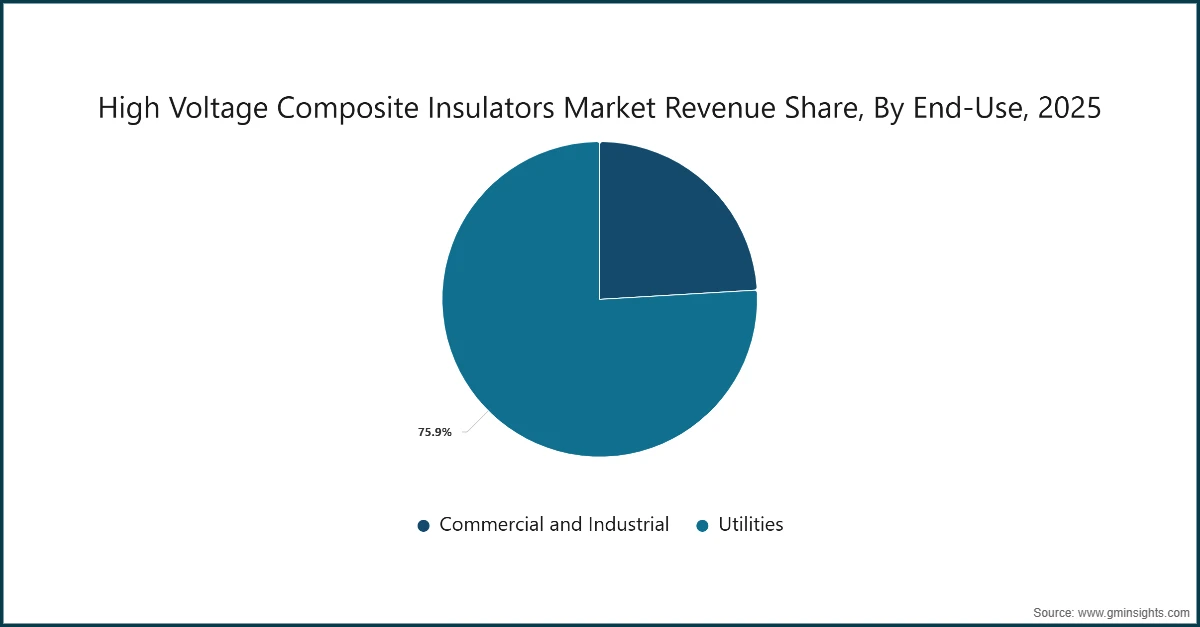
Based on end-use, the high voltage composite insulators market is categorized into commercial & industrial, and utilities. The utility segment accounted for 75.7% market share in 2025 and is set to grow at a CAGR of 7.4% from 2026 to 2035. Rising electricity demand, rapid industrialization, robust development of commercial infrastructure and increasing need for more reliable power infrastructure across manufacturing hubs are contributing to industry growth.
Accelerating investments in high and ultra -high voltage transmission infrastructure and growing inclination to modernize aging grids along with utility operators are prioritizing reliability, reducing outages, and improving grid efficiency further driving product adoption. Large scale renewable integration, development of new high‑voltage lines, ongoing grid‑expansion programs and upgradation of existing networks to manage fluctuating power flows driven by rising electricity consumption will contribute to industry growth.
For instance, in July 2025, Zhejiang Haivo awarded a contract to supply high‑voltage composite insulators rating up to 220 kV and 145kV & 220kV voltage rating substation surge arrestors for Kenya Power and Lighting Company (KPLC) to enhance country’s grid enhancement program. The products passed rigorous technical evaluation and are designed with specialized protection for tropical climates and comply with IEC standards, demonstrating the reliability of its advanced polymer insulation technology.
The commercial & industrial segment is anticipated to grow at a CAGR of above 8% from 2026 to 2035. High‑voltage composite insulators are witnessing significant adoption in commercial and industrial facilities owing to their ability to offer lighter weight, higher mechanical strength, superior pollution resistance, and reduced maintenance compared to porcelain or glass alternatives. Investments in grid modernization, replacement of aging components, renewable energy integration, and expansion of T&D networks that supply electricity to commercial and industrial establishments will further accelerate product demand.
For instance, in September 2025, in India, state authorities of Andhra Pradesh announced that the state is accelerating transmission expansion projects valued at over USD 1.6 billion across 400 kV, 220 kV, and 132 kV networks to address rising electricity demand. Authorities are directed to ensure timely and high‑quality execution, with approximately USD 655.1 million of priority transmission works targeted for completion by 2027 to strengthen electricity connectivity.

Looking for region specific data?
U.S. leads the high voltage composite insulators market in North America with around 72.3% share in 2025 and generated USD 122.4 million in revenue. Rising electricity demand, investments aimed at expanding power networks and deploying renewable‑integrated grid systems are shaping industry dynamics.
Favorable policies by respective government authorities toward expansion of high and ultra-high voltage transmission networks along with growing inclination toward renewable energy integration will shape industry landscape. Utilities aiming toward development of intra-regional transmission corridors, investments toward adoption of smart grid, microgrid and advanced technological solutions will accelerate demand of composite insulators.
For instance, in September 2025, the U.S. Department of Energy’s Grid Deployment Office introduced the Speed to Power Initiative to accelerate multi‑gigawatt generation and transmission projects required to meet soaring electricity demand from AI data centers and national reindustrialization. A related request for Information seeks input on regional project needs, transmission constraints, reconductoring opportunities, and potential use of DOE funding tools to advance timely, large‑scale grid expansion.
North America high voltage composite insulators market is set to grow owing to supportive government policies and increased funding to reinforce high voltage transmission networks and enhance grid stability are complementing industry landscape. Rising capital expenditure for new production facilities and refurbishment programs aimed at upgrading aging technologies is strengthening industry development. Additionally, ongoing transmission‑network expansion, modernization of grid infrastructure, and policy‑driven targets for renewable‑energy integration will stimulate industry growth.
For instance, in May 2025, Grain Belt Express, the largest U.S. electric transmission project, awarded around USD 1.7 billion in contract to Quanta Services and Kiewit Energy Group. The 800‑mile HVDC line, developed by Invenergy, covers Kansas, Missouri, Illinois, and Indiana, all of which have approved the project. The line will add 5,000 MW of transmission capacity and is anticipated to generate USD 52 billion in consumer energy‑cost savings over 15 years.
Europe high voltage composite insulators market is set to grow at a CAGR of over 6% by 2035. Accelerating grid‑modernization programs to support renewable‑energy integration and cross‑border electricity networks along with paradigm shift toward smart grids and digital substations is encouraging adoption of insulators compatible with condition‑monitoring technologies. Large‑scale expansion of transmission corridors along with accelerating investments under national energy‑transition plans, coupled with rise of HVDC transmission links for long‑distance renewable projects will augment industry outlook.
For instance, in December 2025, the European Commission introduced a major plan to modernize and expand the region’s electricity infrastructure through the European Grids Package and the Energy Highways initiative. This strategy with an estimated USD 1.4 trillion investment through 2040, accelerates cross‑border grid development, streamlines permitting, and strengthens energy security. By addressing infrastructure gaps and enhancing transmission and distribution capacity, the initiative aims to integrate more renewable energy.
Asia Pacific high voltage composite insulator market is set to grow over USD 840 million by 2035. Rising electricity demand driven by robust population growth, expansion of industrial infrastructure across emerging economies, accelerating energy consumption and large‑scale renewable‑energy deployment is contributing to industry growth. Major economies across the region are investing in new high‑voltage and ultra‑high‑voltage AC/DC corridors to connect remote generation zones along with growing inclination on grid modernization, government led electrification programs and refurbishment of existing transmission networks is shaping industry dynamics.
For instance, in December 2025, GE Vernova awarded a contract from Adani Energy Solutions to deliver and supply HVDC technology for Khavda–South Olpad renewable transmission corridor with a capacity of 2.5 GW in India. The project will transport large‑scale renewable energy from Gujarat into the national grid. The company will deliver a ±500 kV, 2,500 MW VSC‑based bipolar HVDC system, providing high‑capacity, reliable point‑to‑point transmission for this strategic clean‑energy corridor.
Middle East & Africa high voltage composite insulators market was valued at over USD 130 million in 2025. Favorable government programs focused on grid modernization and the development of inter‑regional transmission corridors are accelerating the adoption of composite insulators. Moreover, large‑scale smart‑grid initiatives across urban and industrial areas, coupled with the expansion of high‑voltage transmission networks to meet rising electricity demand, and supporting a more resilient and efficient power‑infrastructure landscape will positively influence industry dynamics.
For instance, in June 2025, Abu Dhabi Fund for Development agreed to provide around USD 252 million in financing to the GCC Interconnection Authority to enhance the linkage between the GCC power grid and the UAE’s electricity network. The strategic upgrade will expand cross‑border transmission capability and reinforce regional energy security, including a new 400 kV double‑circuit line connecting the Al Silaa (UAE) and Salwa (Saudi Arabia) substations.
High Voltage Composite Insulators Market Share
The major five players operating in the high voltage composite insulators industry comprises of Hitachi Energy, Siemens Energy, PFISTERER, Aditya Birla Power Composites Ltd., and TE Connectivity contribute around 40% of the market share in 2025.
Manufacturers in the high voltage composite insulators market are aiming toward making strategic collaborations, partnerships for large scale projects and are aiming for mergers and acquisitions to gain competitive edge over the others. Key players are aiming for regional expansion, product innovation initiatives, infrastructure modernization programs, and expansion across various regions to enhance their presence across the industry.
For instance, in November 2024, PFISTERER announced to permanently shift silicone composite insulator production to its established Kadaň facility located in the Czech Republic. The site’s existing capabilities, infrastructure, and skilled workforce ensure uninterrupted, high‑quality manufacturing. Centralizing operations in Kadaň strengthens company’s overhead line insulator expertise while maintaining customer reliability and flexibility in meeting their needs.
Siemens Energy designs and manufactures high voltage composite insulators including 3FL composite long rod insulators, rated up to 800 kV, offering exceptional electrical insulation and high mechanical tensile strength in a compact, lightweight single‑piece design. They are available with two sealing configurations to suit varied application needs. Every 3FL insulator is engineered and tested according to the international standards, ensuring dependable performance in modern high‑voltage systems.
PFISTERER Holding’s composite post insulators enhance substation reliability through their strong mechanical design and the proven durability of silicone materials. These units are suitable for busbar systems as well as disconnecting and earthing switches, driven by the company’s more than 30 years of expertise in composite insulators. These insulators installed worldwide, perform reliably in challenging environments comprising from hot desert climates to extremely low‑temperature regions.
Hitachi Energy offers composite station post insulators, designed for 245–800 kV high voltage applications, offering an enhanced alternative to porcelain insulators. These units are built with durable silicone rubber insulation and deliver strong performance in installations worldwide. With a broad product range and adaptable manufacturing, the company provides insulators suited for reactors, disconnectors, and busbar supports, covering ratings from 45 to 550 kV AC and up to 800 kV DC.
Aditya Birla Power Composites Ltd. offers composite hollow insulators designed to use advanced CHCI technology and high‑strength FRP tubes to deliver reliable performance for high‑voltage equipment. These insulators are designed for ratings up to 400 kV, provide excellent mechanical strength, electrical insulation, and long‑term durability. Their consistent quality, precision manufacturing, and complete traceability ensures reliability for power equipment manufacturers by getting advanced technology to its integrated manufacturing facility.
High Voltage Composite Insulators Market Companies
Some of the key market players operating across the high voltage composite insulators industry are:
Aditya Birla Power Composites
Bonomi Eugenio
Cowin Electrical
CYG Insulator
Dalian Hivolt Power System
Deccan Enterprises
DLIG
Hitachi Energy
Jilin Nengxing Electrical Equipment
Nanjing Electric Technology Group
Navitas Insulators
Nooa Electric
PFISTERER
SAA Grid Technology
Saravana Global Energy
Saver
Siemens Energy
Spark Insulators
TE Connectivity
Vexila
Wuhan Line Power Transmission Equipment
Yamuna Power & Infrastructure
PFISTERER Holding SE, a Germany based company, designs, manufactures, and supply high-performance composite insulators, that offer enhanced electrical and mechanical properties when compared to traditional insulators for overhead transmission lines. The company delivers advanced solutions for electrical T&D systems, ensuring improved reliability, efficiency and durability supporting modernization of grid infrastructure. The company’s revenue for the reported revenues of USD 384.2 million for nine months of 2025 and revenue of USD 450.7 million for the whole year 2024.
Hitachi Energy hollow composite insulators are designed for high‑voltage equipment, supporting ratings from 72 to 1,200 kV AC and up to 1,100 kV DC. Manufactured from advanced fiber‑reinforced composite materials, they can be produced in lengths up to 15 meters. These insulators provide long‑term reliability, strong mechanical performance, and dependable insulation throughout the operational life of high‑voltage systems. The company’s revenue for the first six months of 2025 was reported at USD 387.9 million and a revenue of around USD 731.2 million was recorded for the whole year 2024.
Siemens Energy composite long rod insulators deliver strong electrical insulation and high tensile performance in a lightweight, single‑piece design. These units are offered with two sealing configurations including System A, rated up to 210 kN, features a fully overmolded triple point within the HTV silicone housing while System B, covering 100 kN to 630 kN, seals triple point completely using flexible silicone gel. The company’s revenue for the year 2025 was reported at around USD 45.4 billion and for the year 2024, the revenue was reported at approximately USD 40 billion.
TE Connectivity recorded a revenue of USD 15.8 billion for the whole year 2024. The company’s Axicom Hollow Core composite insulators are built for reliable and enhanced performance in high‑voltage systems. These units are manufactured using a robust glass‑fiber reinforced resin tube, silicone rubber exterior, and aluminum flanges, supporting outdoor use up to 1100 kV AC and 800 kV DC. Their lightweight construction removes the need for extra support structures, reduced transport expenses, simplifies installation, and delivers a reliable, cost‑efficient solution for electrical applications.
High Voltage Composite Insulators Market Report Attributes
| Key Takeaway | Details |
|---|---|
| Market Size & Growth | |
| Base Year | 2025 |
| Market Size in 2025 | USD 974.5 Million |
| Market Size in 2026 | USD 1.04 Billion |
| Forecast Period 2026-2035 CAGR | 7.6% |
| Market Size in 2035 | USD 1.87 Billion |
| Key Market Trends | |
| Drivers | Impact |
| Increasing investment toward power generation and development of electrical infrastructure | Growing investment in generation and grid infrastructure, expansion of transmission projects, is accelerating demand for composite insulators, across lines and substations, while introducing lightweight, maintenance‑efficient designs. |
| Ongoing refurbishment and expansion of existing grid networks | Grid refurbishment and expansion replace aging components with advanced composite insulators ensures enhanced performance, easy installation, reducing outages and lifecycle costs. |
| Increasing renewable integration | Renewable integration will increase demand for contamination resistant composite insulators supporting long spans and rapid installation to accelerate interconnections and maintain reliability. |
| Pitfalls & Challenges | Impact |
| Fluctuating raw material cost | Volatile prices of core materials including silicone rubber, fiberglass, and metal fittings increase production uncertainty, variations in profit margins, cause difficulties in long term contracting, and impact competitive pricing for composite insulators. |
| Opportunities: | Impact |
| Development of renewable energy infrastructure | Growing solar and wind installations require durable insulators for new transmission lines, creating demand for lightweight, weather‑resistant composite insulators that enhance grid reliability and long‑distance electricity transfer. |
| Accelerating grid modernization programs | Increasing investments in modernizing aging transmission networks will create significant opportunities for advanced composite insulators that reduce outages, support higher voltages, and strengthen grid resilience. |
| Rising adoption of smart grids and distributed energy resources | Deployment of smart and digitally enabled grids increases the need for composite insulators compatible with fluctuating loads, renewable integration, and enhanced system monitoring. |
| Increasing utility and government expenditure on transmission expansion | Large scale investments in transmission lines, including high voltage upgrades and cross regional interconnections, stimulate demand for efficient, low maintenance composite insulators across utility networks. |
| Market Leaders (2025) | |
| Market Leader |
Market Share of: 12.5% |
| Top Players |
Collective Market Share of: 40% |
| Competitive Edge |
|
| Regional Insights | |
| Largest Market | Asia Pacific |
| Fastest growing market | North America |
| Emerging countries | U.S., Germany, China, India, Saudi Arabia |
| Future outlook |
|
What are the growth opportunities in this market?
High Voltage Composite Insulators Industry News
In December 2025, Trench Group signed an agreement to acquire Reinhausen Power Composites’ composite‑insulator manufacturing assets, including all production equipment, software, and intellectual property for its hollow‑core insulator line. The asset transfer, scheduled to begin in mid‑2026, will shift company’s operations to Trench Germany in Bamberg. This acquisition enhances Trench Group’s manufacturing depth while supporting a diversified sourcing and production strategy.
In December 2025, Havio Electricals Co., Ltd. participated in the International Electrical Grid Equipment Exhibition held in Russia, and showcased advancements in electrical protection and power‑distribution technologies. The company presented its key offerings including high voltage composite insulators, disconnect switches, separable connectors, and cable joint and termination kits among others highlighting durability, safety, and suitability for harsh environments.
In June 2025, Power Grid Components announced an exclusive agreement enabling its subsidiary Newell to add GAMMA Insulators’ composite distribution products to its North American portfolio, reflecting a strategic effort to enhance utility‑sector offerings. By leveraging GAMMA’s manufacturing capacity in Colombia, Newell significantly strengthens its nearshoring strategy, ensuring improved supply‑chain control, faster delivery timelines, and more reliable service for customers across the region.
In May 2025, Wuhan Line Power conducted and completed 500 kV suspension insulator lightning‑impulse testing at the China Electric Power Research Institute. Using a 5,400 kV impulse voltage system with a ±2% accuracy rating and in full accordance with IEC 61109 requirements, the test confirmed the insulator’s performance under simulated lightning‑strike conditions. Supported by nationally certified test equipment, this routine type‑test confirms the product’s reliability, performance integrity, and compliance with international high‑voltage requirements.
In December 2024, PFISTERER strengthened its international operations through an expanded partnership with Nippon Katan Co., Ltd., a Japanese systems supplier, focused on producing and marketing composite insulators for overhead electricity lines in Japan. The company will supply insulator components for final assembly at the Nippon Katan’s Hirakata facility, under a new cooperation and licensing agreement, with production started in 2025. The collaboration enhanced delivery flexibility and is set to double the company’s insulator volumes in Japan by 2030.
The high voltage composite insulators market research report includes in-depth coverage of the industry with estimates & forecast in terms of “USD Million” from 2022 to 2035 for the following segments:
Market, By Application
Cables and transmission lines
Switchgears
Transformer
Bus bars
Others
Market, By End-Use
Commercial & industrial
Utilities
Market, By Rating
> 145 kV to ≤ 220 kV
> 220 kV to ≤ 400 kV
> 400 kV to ≤ 800 kV
> 800 kV to ≤ 1,200 kV
> 1,200 kV
The above information has been provided for the following regions and countries:
North America
U.S.
Canada
Mexico
Europe
UK
Germany
France
Spain
Italy
Russia
Asia Pacific
China
Japan
India
South Korea
Australia
Middle East & Africa
Saudi Arabia
UAE
South Africa
Latin America
Brazil
Argentina
Frequently Asked Question(FAQ) :
What is the high voltage composite insulators market size in 2025?
The market size for high voltage composite insulators is valued at USD 974.5 million in 2025. Increasing investments in power generation and grid infrastructure are driving market growth.
What is the market size of the high voltage composite insulators industry in 2026?
The market size for high voltage composite insulators reached USD 1.04 billion in 2026, reflecting steady growth driven by grid modernization and renewable energy integration.
What is the projected value of the high voltage composite insulators market by 2035?
The market size for high voltage composite insulators is expected to reach USD 1.87 billion by 2035, growing at a CAGR of 7.6%. This growth is fueled by increasing renewable energy installations, grid expansion, and modernization programs.
What was the valuation of the cable and transmission segment in 2025?
The cable and transmission segment was valued at over USD 310 million in 2025. Rising demand for reliable transmission networks and grid expansion initiatives are contributing to its growth.
What is the growth outlook for the utility segment from 2026 to 2035?
The utility segment is projected to grow at a CAGR of 7.4% from 2026 to 2035. Factors such as rising electricity demand, rapid industrialization, and the need for reliable power infrastructure are driving this growth.
Which region leads the high voltage composite insulators market?
The U.S. led the high voltage composite insulators market in North America with a 72.3% share in 2025, generating USD 122.4 million in revenue. This dominance is attributed to rising electricity demand, power network expansion, and renewable-integrated grid systems.
What are the upcoming trends in the high voltage composite insulators industry?
Key trends include increasing adoption of lightweight, contamination-resistant insulators, grid modernization programs, renewable energy integration, and the development of smart grids. Investments in high voltage upgrades and cross-regional interconnections are also shaping the market.
Who are the key players in the high voltage composite insulators market?
Key players include Hitachi Energy, Siemens Energy, TE Connectivity, Aditya Birla Power Composites, PFISTERER, Bonomi Eugenio, Cowin Electrical, CYG Insulator, Dalian Hivolt Power System, Deccan Enterprises, DLIG, Jilin Nengxing Electrical Equipment, and Nanjing Electric Technology Group.
High Voltage Composite Insulators Market Scope
Related Reports