Summary
Table of Content

High Performance Wheels Market
Get a free sample of this report
Form submitted successfully!
Error submitting form. Please try again.
Thank you!
Your inquiry has been received. Our team will reach out to you with the required details via email. To ensure that you don't miss their response, kindly remember to check your spam folder as well!
Request Sectional Data
Thank you!
Your inquiry has been received. Our team will reach out to you with the required details via email. To ensure that you don't miss their response, kindly remember to check your spam folder as well!
Form submitted successfully!
Error submitting form. Please try again.
High Performance Wheels Market Size
The global high performance wheels market volume was estimated at 48.2 million units in 2025. The market is projected to grow from 50.9 million units in 2026 to 75.2 million units by 2035, registering strong double-digit growth over the forecast period.
High Performance Wheels Market Key Takeaways
Market Size & Growth
- 2025 Market Size: USD 27.5 Billion
- 2026 Market Size: USD 29.9 Billion
- 2035 Forecast Market Size: USD 54.5 Billion
- CAGR (2026–2035): 6.9%
Regional Dominance
- Largest Market: North America
- Fastest Growing Region: Asia Pacific
Key Market Drivers
- Rising demand for lightweight vehicles.
- Growth in premium & luxury vehicle sales.
- Expansion of motorsports industry.
- Aftermarket customization trends.
Challenges
- High manufacturing costs.
- Volatility in raw material prices.
Opportunity
- Increasing OEM partnerships.
- Growing EV aftermarket segment.
- Advancements in hybrid forging techniques.
- Emerging automotive markets.
Key Players
- Market Leader: Enkei led with over 9% market share in 2025.
- Leading Players: Top 5 players in this market include BBS, Borbet, Enkei, OZ Racing, Ronal, which collectively held a market share of 26% in 2025.
Get Market Insights & Growth Opportunities
Manufacturers are using lightweight material such as forged aluminum and carbon fiber to create wheels to lower emissions and achieve better fuel economy. In addition to the environmental advantages, using lightweight materials allows them to design wheels, will increase the travel range of battery-powered vehicles. For instance, in March 2025, Carbon Revolution expanded supply agreements for carbon fibre wheels for next-generation performance EV programs.
Many luxury and sport automobile manufacturers are continuing to use larger diameter forged aluminum and alloy wheels as standard equipment in their products to enhance performance of their vehicles, increase the attractiveness of their products to consumers and to distinguish their brands from others in the luxury automobile market. In January 2025, Porsche announced that they will offer performance wheel upgrades as part of their high-performance sports car offerings.
Expanding motorsport participation and consumer interest in performance tuning are driving aftermarket demand for lightweight, durable, and custom-designed wheels that enhance vehicle acceleration, braking, and cornering stability in both track and street applications. In May 2025, RAYS Engineering released a few new forged wheel designs made specifically for motorsport enthusiasts.
The increase in interest by consumers in electric vehicles has contributed to the increased demand for aerodynamic and lightweight wheels, which provide lower rolling resistance and increase efficiency of energy use. Manufacturers are designing their wheel products with these types of materials to provide performance-oriented wheel designs which will better serve the electric vehicle platforms.
The global high performance wheels market was valued at USD 27.5 billion in 2025. The market is expected to grow from USD 29.9 billion in 2026 to USD 54.5 billion in 2035 at a CAGR of 6.9%, according to latest report published by Global Market Insights Inc.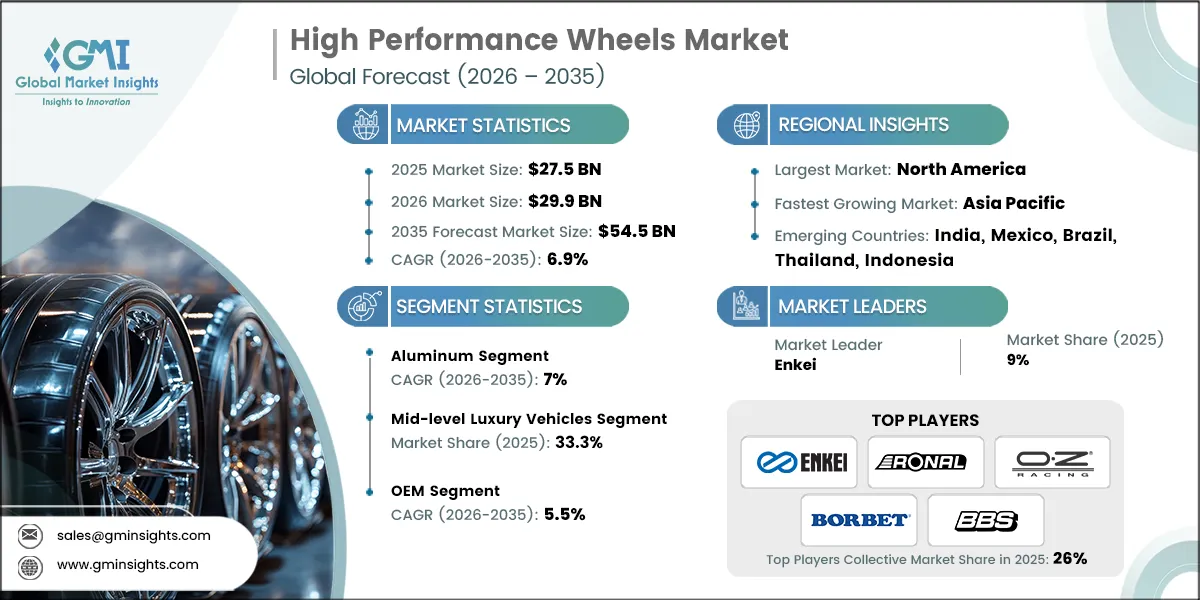
To get key market trends
High Performance Wheels Market Trends
Automotive companies are using carbon fiber wheels on high-performance cars because they help to decrease weight, enhance handling and increase rigidity in premium electric cars and sports cars. In February 2025, Lamborghini introduced carbon fiber wheel options in performance models.
Wheelmakers are using aerodynamic spoke arrangements and enclosed faces to help enhance airflow around vehicles, reduce drag and extend the driving range of electric vehicles and hybrids. In June 2025, BMW AG unveiled new aerodynamic performance wheel designs for EV platforms.
Flow Forming technology is becoming more popular since it can be used to produce lightweight, high strength alloys at prices lower than those of forged products. Thus, enabling manufacturers to target the mid premium market segment using performance-based wheel products.
As demand for custom finishes, sizes and configurations on wheels continue to increase, consumers want their vehicles to look unique in either luxury or performance categories meaning that companies in aftermarket will see greater opportunities to supply those products to customers.
High Performance Wheels Market Analysis
Learn more about the key segments shaping this market
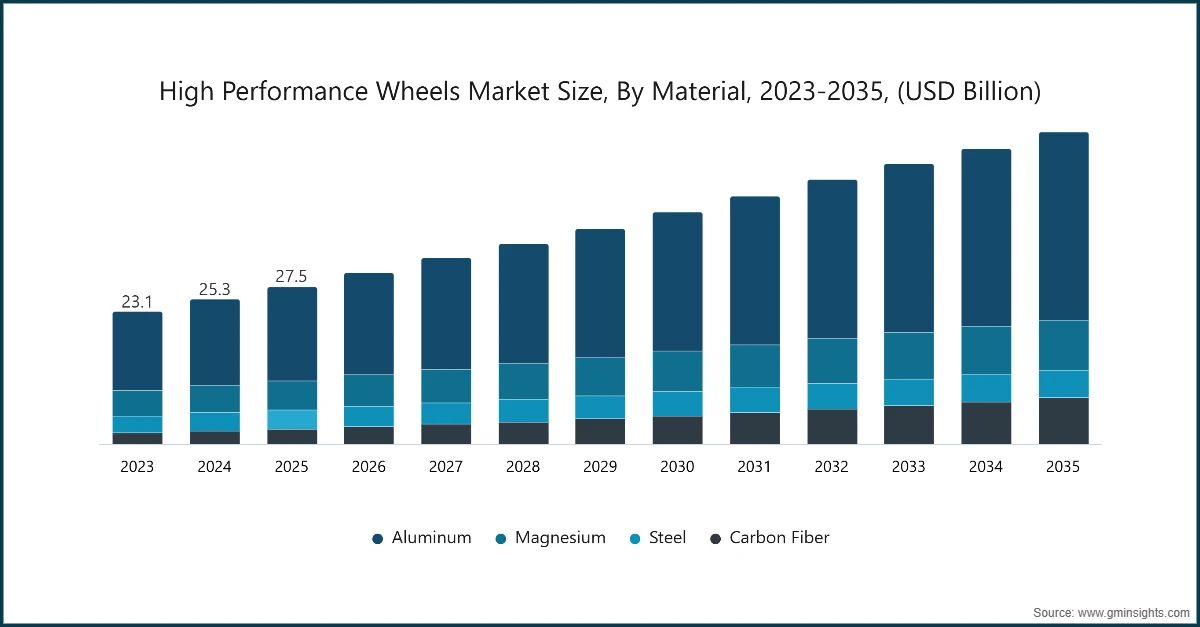
Based on material, the high-performance wheels market is divided into aluminum, magnesium, steel and carbon fiber. Aluminum dominated the market, accounting for 60% in 2025 and is expected to grow at a CAGR of 7% through 2026 to 2035.
- Aluminum alloy wheels continue dominating the market due to their lightweight properties, corrosion resistance, and cost-effectiveness. Increasing OEM integration in EVs and premium passenger vehicles is driving demand for flow-formed and forged aluminum wheels that improve vehicle handling, fuel efficiency, and driving dynamics.
- Magnesium wheels are witnessing growing adoption in motorsport and ultra-premium automotive segments due to superior strength-to-weight ratio. Their ability to reduce mass enhances acceleration and braking performance, encouraging niche OEM applications despite high production costs and complex corrosion protection requirements.
- Performance steel wheels are gaining traction in rally, off-road, and heavy-duty performance vehicles where impact resistance and durability are critical. Although heavier than alloy alternatives, advancements in high-strength steel compositions are improving load-bearing capacity and structural integrity in niche performance automotive applications.
- Carbon fiber wheels are emerging as a transformative trend in the high-performance automotive segment due to exceptional weight reduction and rigidity. Increasing adoption in luxury and electric vehicles supports improved energy efficiency, driving range, and vehicle dynamics despite limited scalability and high manufacturing costs.
Learn more about the key segments shaping this market
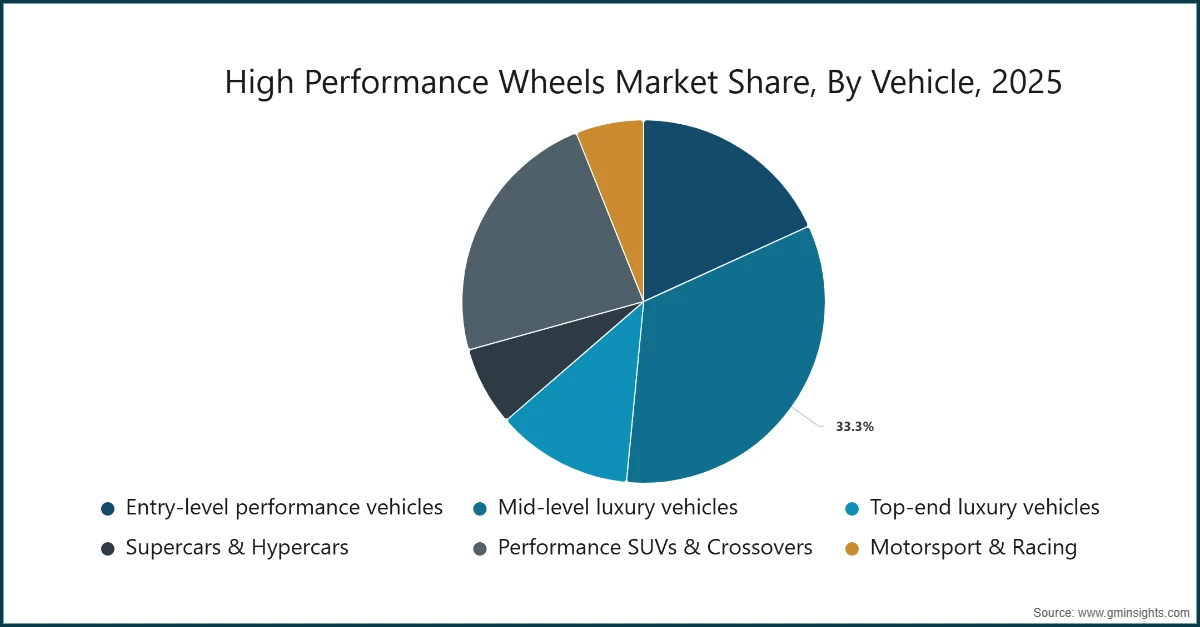
Based on vehicle, the high-performance wheels market is segmented into entry-level performance vehicles, mid-level luxury vehicles, top-end luxury vehicles, supercars & hypercars, performance SUVs & crossovers and motorsport & racing. Mid-level luxury vehicles segment dominates the market with 33.3% share in 2025, and the segment is expected to grow at a CAGR of 7.9% from 2026 to 2035.
- Mid-Tier luxury vehicles are utilizing both flow-formed aluminum wheels, which provide performance benefits while remaining cost-efficient, there is an evident growing trend within consumers for stylish and functional upgraded wheels. Automakers now provide optional packages for lightweight performance wheels for Executive Sedan class and Compact Luxury SUV market segments.
- Top-end luxury vehicles are increasingly integrating forged aluminum and carbon fiber wheels to enhance ride comfort, high-speed stability, and vehicle aesthetics. This option provides larger size and weight-efficient performance wheels as standard fitments to improve handling precision and complement premium vehicle design expectations.
- Sports and Performance-related vehicles are experiencing a large demand for lightweight forged and magnesium wheels to provide greater acceleration, cornering stability and improved braking performance. OEMs can provide more Motorsport-inspired wheel design for both OEM and aftermarket consumers for vehicle dynamics and high-end driving performance.
- With the growing number of SUVs, Crossovers and electric vehicles in the marketplace, the continued adoption of performance wheel designs that are both aerodynamic and reinforced will be critical to managing today’s heavier vehicles, along with achieving greater energy efficiency, improved vehicle dynamics and providing better load distribution, driving range, and improved stability.
Based on sales channel, the high-performance wheels market is segmented into OEM and aftermarket. The OEM segment dominates the market with 57% share in 2025, and the segment is expected to grow at a CAGR of 5.5% from 2026 to 2035.
- OEMs are seeing an increased demand for high-performance wheels. Vehicle manufacturers utilize lightweight forged and aerodynamic wheels for better vehicle performance, drive ability, and aesthetics. Examples of the use of these types of wheels include electric vehicles and luxury automobiles.
- Automakers are offering high-performance wheels as upgraded factory installations in their premium models. The advantages of these types of wheels include improved handling and stability, reduced weight, and the addition of styling and performance differences between competing models in premium sports and luxury automobile markets.
- The aftermarket is also benefiting from a strong demand for custom-designed forged and flow-formed wheels as consumers become increasingly interested in customizing their vehicles through personalization, performance enhancement, and aesthetics, particularly for sports cars, luxury vehicles, and performance SUVs.
- The popularity of motor sports and enthusiast culture continues to increase the demand for light-weight performance-oriented wheels. Vehicle owners are replacing their standard factory-installed wheels to improve acceleration times from a standstill, obtain better braking ability, and exhibit superior cornering ability in both street and track driving conditions.
Based on distribution channel, the high-performance wheels market is segmented into offline channel and online channel. The offline channel segment is expected to dominate the market with a share of 68% in 2025.
- High Performance Wheels are typically sold in offline channels such as specialized wheel retailers, car dealerships, and service shops, where customers receive personalized fitting and quality consultation, as well as premium quality custom wheels, whether they are for original equipment (OEM) upgrades or aftermarket high-performance driving enthusiasts.
- Physical showrooms provide an opportunity for customers to evaluate the style, material, and finish of wheels in person, so customers can have confidence investing in high-end wheels; therefore, OEMs and aftermarket brands are able to offer customers upgraded wheel options such as forged, magnesium wheels, and carbon fiber wheels.
- E-commerce and manufacturer websites are rapidly becoming very popular among consumers, as consumers desire convenience, competitive pricing, and a wider selection of high-performance wheels across all international markets.
- Digital platforms can give customers detailed images of their new wheels, virtual fitting assistance, and direct-to-consumer shipping. As a result, aftermarket and OEM wheels brands will benefit from an enlarged market presence, decreased supply chain costs, and will have the opportunity to connect with performance wheels enthusiasts, looking for the rarest wheels available on the planet.
Looking for region specific data?
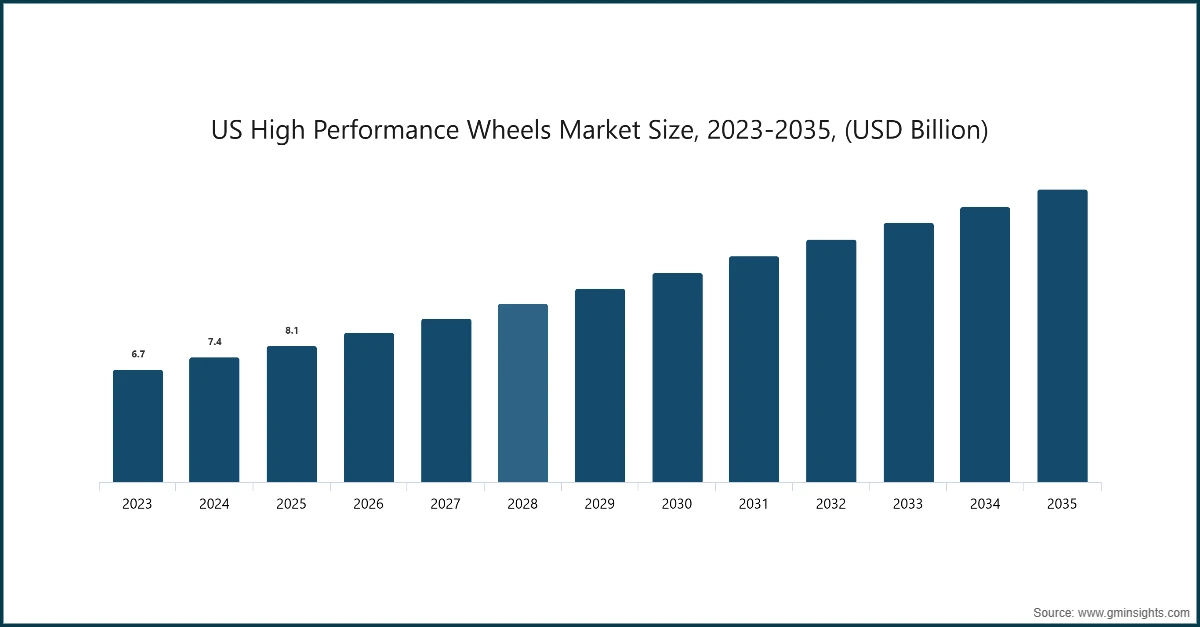
US high-performance wheels market reached USD 8.1 billion in 2025, growing from USD 7.4 billion in 2024.
- In US, the foundation for luxury and performance vehicles provides the framework for original equipment manufacturers (OEMs) to supply advanced wheel technology. Wheel designs such as forged and aerodynamic are prevalent across OEMs' product lines to meet consumer demands relating to aesthetics, ride quality and performance at high speed.
- With the emergence of premium wheels measuring 20 - 24 inches transforming pickup truck and off-road segments, this has created an environment conducive to strong sales growth for high value wheels, as well as an increase in overall market size for these niche vehicle segments.
- The movement towards EV automobile adoption in California, the Pacific Northwest and the Northeast has generated increased demand for lightweight and aerodynamic wheel solutions that improve both range and efficiency. OEMs and aftermarket brands can create opportunities to position new materials and technology as part of emerging marketplace-oriented strategies.
North America dominated the high-performance wheels market with a market size of USD 9.7 billion in 2025.
- In North America, the US is the leading market for luxury automobiles, with a well-established aftermarket infrastructure and an active performance vehicle culture that leads to the availability of high-end forged, aluminum and carbon fiber wheels from both OEMs and the aftermarket.
- Canada's increasing adoption of premium crossovers and SUVs has been beneficial to the premium wheel market, while larger-diameter wheels and lighter-weight wheel designs for OEMs have been designed with the intention of improving ride quality, handling capability, and fuel economy for performance-oriented consumers.
- OEMs and aftermarket parts suppliers are leveraging the trend toward electric vehicles in California, the Pacific Northwest and the Northeast by promoting lightweight, aerodynamic wheel designs that provide improved performance and range to customers through collaboration with performance wheel manufacturers to create innovative materials and designs.
Europe high-performance wheels market accounted for a share of 28.6% and generated revenue of USD 7.9 billion in 2025.
- Within Germany and other European countries, OEMs are well established, motorsports are ingrained in their history, and governments provide incentives for brands to create lightweight forged and carbon fiber wheels that meet requirements for efficiency, emissions and premium design.
- European manufacturers are taking advantage of the cascading effect of luxury vehicles to mass market vehicles by adopting racing style design principles and new technologies to influence consumer demand and aftermarket wheel styles.
- The increase in electric vehicle adoption driven by EU emissions regulations and fleet emission goals is pushing wheel manufacturers to develop new aerodynamic, lightweight, and sustainable designs and continues to strengthen Europe's role as a global center for performance.
Germany dominates the high-performance wheels market, showcasing strong growth potential, with a CAGR of 8.8% from 2026 to 2035.
- Germany is a home market for premium brands benefited from well-developed customer loyalty, tendencies to shop domestically and being an early adopter of advanced wheel technologies. This significantly benefits high-performance OEM and aftermarket brands.
- The cultural influence that originates from the Nürburgring and the history of motorsports has created a high demand for performance-tested technology, including forged aluminum wheels and carbon fibre wheels, as well as providing brands with marketing justification for their purchase.
- In Germany, the automotive industry is supporting continued lightweight wheel adoption based on both the automotive industry's requirement to adhere to regulatory compliance as well as continued emphasis on improved vehicle efficiency.
The Asia Pacific high-performance wheels market is anticipated to grow at the highest CAGR of 8.7% from 2026 to 2035 and generated revenue of USD 6.4 billion in 2025.
- The growth within the APAC region is being driven by China's high demand for lightweight aluminum, forged, and carbon fiber wheels as electric vehicle (EV) adoption increases, and domestic wheel producers scale production by developing advanced high-performance wheel technologies that target export purposes.
- With premium vehicle segments growing in Japan, South Korea, India, and Southeast Asia combined with an expanding aftermarket performance culture, the demand for regional specific high-performance wheel solutions is expanding for both international and local suppliers.
- Collaborative efforts among original equipment manufacturer (OEM) partners throughout the APAC market are working towards exploring efficiencies of OEM's EV offerings and OEMs differentiation by enabling existing international wheel manufacturers and emerging Chinese wheel manufacturers to gain greater market shares within the APAC performance segment and luxury segment.
China high-performance wheels market is estimated to grow with a CAGR of 9.1% from 2026 to 2035.
- In China, explosive EV adoption drives demand for lightweight, aerodynamic, and forged wheel solutions, with domestic and international manufacturers collaborating to differentiate products and enhance vehicle efficiency.
- Domestic luxury brands (NIO, XPeng, Li Auto) and international OEMs (BMW, Mercedes-Benz, Audi) specify premium wheel technologies to meet growing consumer expectations for performance and design.
- Chinese manufacturing ecosystem provides scale and cost advantages, supporting competitive positioning of high-performance wheels while improving quality perceptions of domestic producers for both domestic and export markets.
Latin America high-performance wheels market shows lucrative growth over the forecast period.
- Brazil is leading their respective regions in terms of their concentration of luxury vehicles and niche segments with aftermarket demand offering high-performance aftermarket product opportunities to premium wheel suppliers targeting affluent consumers.
- As a result of low EV adoption rates and limited premium segments, the primary focus is on durability, aesthetic value, and aftermarket customization for the performance-oriented SUV, crossover, and sports vehicle categories.
- Wheel manufacturers are strategically located in the Latin America by focusing on high-income urban areas targeting OEM partners with lightweight, stylish and racing inspired wheels for performance-oriented consumers and developing performance offerings specific to emerging performance markets.
Brazil high-performance wheels market is estimated to grow with a CAGR of 4.2% from 2026 to 2035 and reach USD 1.1 billion in 2035.
- In Brazil, domestic vehicle production and enthusiast aftermarket communities support selective high-performance wheel demand, focusing on cosmetic upgrades, off-road capabilities, and performance styling in urban centers.
- High import duties constrain premium foreign wheel access, creating opportunities for domestic or regional suppliers to offer cost-competitive alternatives in performance and lightweight designs.
- Premium vehicle penetration remains limited, but concentrated metropolitan demand enables niche aftermarket and OEM opportunities for high-performance wheels with distinctive styling or specialized functionality.
Middle East and Africa high-performance wheels market accounted for USD 1.5 billion in 2025 and is anticipated to show lucrative growth over the forecast period.
- Saudi Arabia and South Africa represent the largest MEA markets, with high-end consumer segments driving selective adoption of high-performance wheels for luxury and sports vehicles.
- Local manufacturing supports modest premium segment penetration, while economic development constraints in most African markets limit near-term high-volume growth opportunities.
- Niche aftermarket demand is driven by luxury vehicle owners seeking bespoke, racing-inspired, and durable wheel solutions for performance and style, emphasizing high-value positioning.
UAE market is expected to experience substantial growth in the Middle East and Africa high-performance wheels market, with a CAGR of 4.1% from 2026 to 2035.
- In UAE, high luxury vehicle concentration and ultra-high-net-worth population create a niche but lucrative market for premium wheels, including forged and carbon fiber options.
- Enthusiast culture and extensive highway infrastructure encourage performance wheel adoption for exotic supercars, emphasizing styling, handling, and customization.
- OEMs and aftermarket brands leverage disposable income and luxury-focused consumer behavior to offer bespoke wheel solutions and premium upgrade packages.
High Performance Wheels Market Share
- The top 7 companies in the high-performance wheels industry are Enkei, Ronal, Borbet, BBS, OZ Racing, Rays and Vossen contributing 31% of the market in 2025.
- Enkei makes lightweight forged and cast alloy wheels, supplying OEMs (original equipment manufacturers) and after-market segments. Enkei uses MAT flow forming technology, catering to all performance, motorsport and EV applications including McLaren and many other high-end OEM programs.
- Ronal is one of the largest wheel manufacturers in the world, supplying OEMs and after-market brands, producing forged, cast and flow formed wheels under their own Speedline Corse brand, supplying for passenger car, sport and motorsport applications throughout Europe and other regions.
- Borbet is in Germany and produces high quality aluminum alloy wheels for OEM and after-market applications. Borbet is a strong competitor in Europe, and has recently acquired Dymag; its main areas of focus are high performance designs that are lightweight and enhance the performance of passenger vehicles, luxury vehicles and sport vehicles.
- BBS Motorsport is an iconic performance wheel manufacturer providing forged and motorsport-grade wheels; it supplies to manufacturers such as Ferrari F1 and to after-market enthusiasts; its wheels are produced from high strength alloys and incorporate high performance lightweight technologies.
- OZ Racing is a premium manufacturer of racing wheels; they have excelled in providing wheels for motorsports, including producing wheels for Formula 1 and WRC championships. OZ Racing produces forged, cast and custom-designed wheels; as well as being supplied to OEMs, they also manufacture wheels for after-market performance vehicles, combining modern styling, lightweight construction and aerodynamic characteristics into their products.
- Rays Engineering, including Volk Racing, specializes in forged and lightweight alloy wheels for motorsport and aftermarket segments. Known for TE37 wheels and RM Forging, Rays serves high-performance street, racing, and OEM programs worldwide.
- Vossen Wheels is a leading premium aftermarket wheel manufacturer specializing in custom-designed, forged, and flow-formed alloy wheels. It focuses on aesthetic appeal, performance, and personalization for luxury vehicles, sports cars, and high-end SUVs globally.
High Performance Wheels Market Companies
Major players operating in the high-performance wheels industry are:
- BBS
- Borbet
- Carbon Rev
- Enkei
- HRE
- OZ Racing
- Rays
- Ronal
- Vossen
- Work
- The top players in the high-performance wheel segment are banking heavily on a number of strategic initiatives, such as making investments in manufacturing automation to cut down on labor costs and improve quality; adopting flow-forming processes as a means of positioning their products in the mid-premium range; increasing production capabilities in Asia; developing carbon fibre wheels through internal development projects and/or partnerships; taking advantage of the growth of e-commerce; and implementing sustainable measures including recycling of aluminum, energy efficiency, and reducing carbon footprints throughout their supply chains.
- Partnership and acquisition activity has been limited recently; however, rising capital requirements for advanced manufacturing technologies may drive consolidation. Strategic alliances between traditional wheel manufacturers and carbon fiber specialists are expected to accelerate commercialization of carbon fiber wheels, combining material expertise with automotive manufacturing, distribution capabilities, and aftermarket channel knowledge to penetrate the emerging premium performance wheel market.
- Research and development priorities focus on maximizing lightweighting through innovative materials, optimizing wheel designs, leveraging advanced additive manufacturing like 3D printing, and enhancing hydroforming techniques. Additionally, improving wear resistance, thermoplastic/thermoset composite processing, and manufacturing knowledge supports both OEM and aftermarket performance wheel applications, ensuring high durability, safety, and technological differentiation in competitive global markets.
High Performance Wheels Market Report Attributes
| Key Takeaway | Details |
|---|---|
| Market Size & Growth | |
| Base Year | 2025 |
| Market Size in 2025 | USD 27.5 Billion |
| Market Size in 2026 | USD 29.9 Billion |
| Forecast Period 2026-2035 CAGR | 6.9% |
| Market Size in 2035 | USD 54.5 Billion |
| Key Market Trends | |
| Drivers | Impact |
| Rising demand for lightweight vehicles | Drives adoption of forged aluminum and carbon fiber wheels to enhance fuel efficiency and performance. |
| Growth in premium & luxury vehicle sales | Increases OEM installation of high-performance wheels in sports and luxury segments. |
| Expansion of motorsports industry | Boosts demand durable and high-strength performance wheels. |
| Aftermarket customization trends | Drives higher recurring revenue through SaaS-based, always-on compliance platforms. |
| Pitfalls & Challenges | Impact |
| High manufacturing costs | Limits mass adoption due to expensive materials like carbon fiber and advanced forging processes. |
| Volatility in raw material prices | Impacts production costs and profit margins for wheel manufacturers. |
| Opportunities: | Impact |
| Increasing OEM partnerships | Opens new revenue streams through factory-fitted performance wheel programs. |
| Growing EV aftermarket segment | Expanded demand for lightweight wheels compatible with electric drivetrains. |
| Advancements in hybrid forging techniques | Enables scalable production of durable yet lightweight wheels. |
| Emerging automotive markets | Creates growth potential for performance wheel adoption in Asia-Pacific and Latin America. |
| Market Leaders (2025) | |
| Market Leader |
9% market share |
| Top Players |
Collective market share in 2025 is 26% |
| Competitive Edge |
|
| Regional Insights | |
| Largest Market | North America |
| Fastest growing market | Asia Pacific |
| Emerging countries | India, Mexico, Brazil, Thailand, Indonesia |
| Future outlook |
|
What are the growth opportunities in this market?
High Performance Wheels Industry News
- In January 2026, Carbon Revolution plans to double its Geelong facility capacity by Q3 2026, adding automated carbon fiber production lines to reduce costs, meet growing OEM EV demand, and target over 100,000 wheels annually by 2028.
- In December 2025, Enkei secured a multi-year agreement with a leading EV manufacturer, supplying lightweight, flow-formed aluminum wheels achieving 25% weight reduction, optimized for aerodynamics and energy efficiency, supporting global EV platform production from Q2 2026.
- In November 2025, BBS Kraftfahrzeugtechnik introduced FI-R forged wheels targeting mid-luxury segment, priced 30% lower than traditional lines, employing optimized forging processes for BMW, Mercedes, and Audi models without compromising structural performance or quality.
- In October 2025, Vossen Wheels opened a 45,000 sq. ft. technical center in Miami with FEA simulation, fatigue testing labs, and advanced design studios, enabling in-house engineering development and OEM-focused product optimization.
The high-performance wheels market research report includes in-depth coverage of the industry with estimates & forecasts in terms of revenue ($ Mn/Bn) and shipments (units) from 2022 to 2035, for the following segments:
Market, By Material
- Aluminum
- Magnesium
- Steel
- Carbon Fiber
Market, By Vehicle
- Entry-level performance vehicles
- Mid-level luxury vehicles
- Top-end luxury vehicles
- Supercars & hypercars
- Performance SUVs & crossovers
- Motorsport & racing
Market, By Sales channel
- OEM
- Aftermarket
Market, By Distribution channel
- Offline channel
- Online channel
The above information is provided for the following regions and countries:
- North America
- US
- Canada
- Europe
- Germany
- UK
- France
- Italy
- Spain
- Russia
- Nordics
- Poland
- Romania
- Asia Pacific
- China
- India
- Japan
- South Korea
- ANZ
- Vietnam
- Indonesia
- Philippines
- Latin America
- Brazil
- Mexico
- Argentina
- MEA
- South Africa
- Saudi Arabia
- UAE
Frequently Asked Question(FAQ) :
What was the market size of the high-performance wheels in 2025?
The market size was USD 27.5 billion in 2025, with a CAGR of 6.9% expected through 2035. The adoption of lightweight materials like forged aluminum and carbon fiber is driving market growth.
What is the projected value of the high-performance wheels market by 2035?
The market is poised to reach USD 54.5 billion by 2035, driven by advancements in wheel technology, increasing demand for electric vehicles, and customization trends.
What is the expected size of the high-performance wheels market in 2026?
The market size is projected to reach USD 29.9 billion in 2026.
What was the market share of aluminum wheels in 2025?
Aluminum wheels dominated the market with a 60% share in 2025 and is expected to grow at a CAGR of 7% through 2035.
What was the market share of the mid-level luxury vehicles segment in 2025?
The mid-level luxury vehicles segment held a 33.3% market share in 2025 and is set to expand at a CAGR of 7.9% till 2035.
What was the market share of the OEM segment in 2025?
The OEM segment accounted for 57% of the market in 2025 and is expected to witness over 5.5% up to 2035.
What was the valuation of the US high-performance wheels sector in 2025?
The US market was valued at USD 8.1 billion in 2025, led by the strong foundation of luxury and performance vehicles and the adoption of advanced wheel technologies.
What are the upcoming trends in the high-performance wheels market?
Trends include lightweight carbon fiber wheels, aerodynamic designs for EV efficiency, adoption of flow forming technology, and rising demand for customized wheel finishes.
Who are the key players in the high-performance wheels industry?
Key players include BBS, Borbet, Carbon Rev, Enkei, HRE, OZ Racing, Rays, Ronal, Vossen, and Work.
High Performance Wheels Market Scope
Related Reports